 ZapOracle Lightning Insight

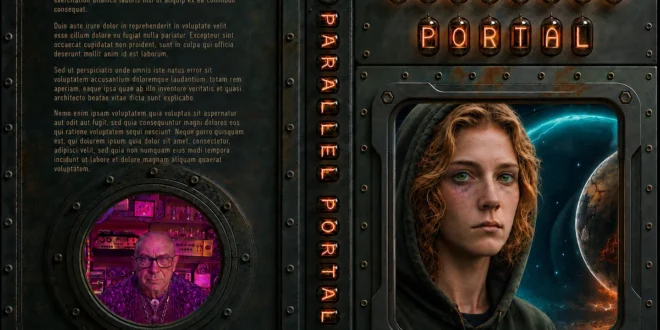
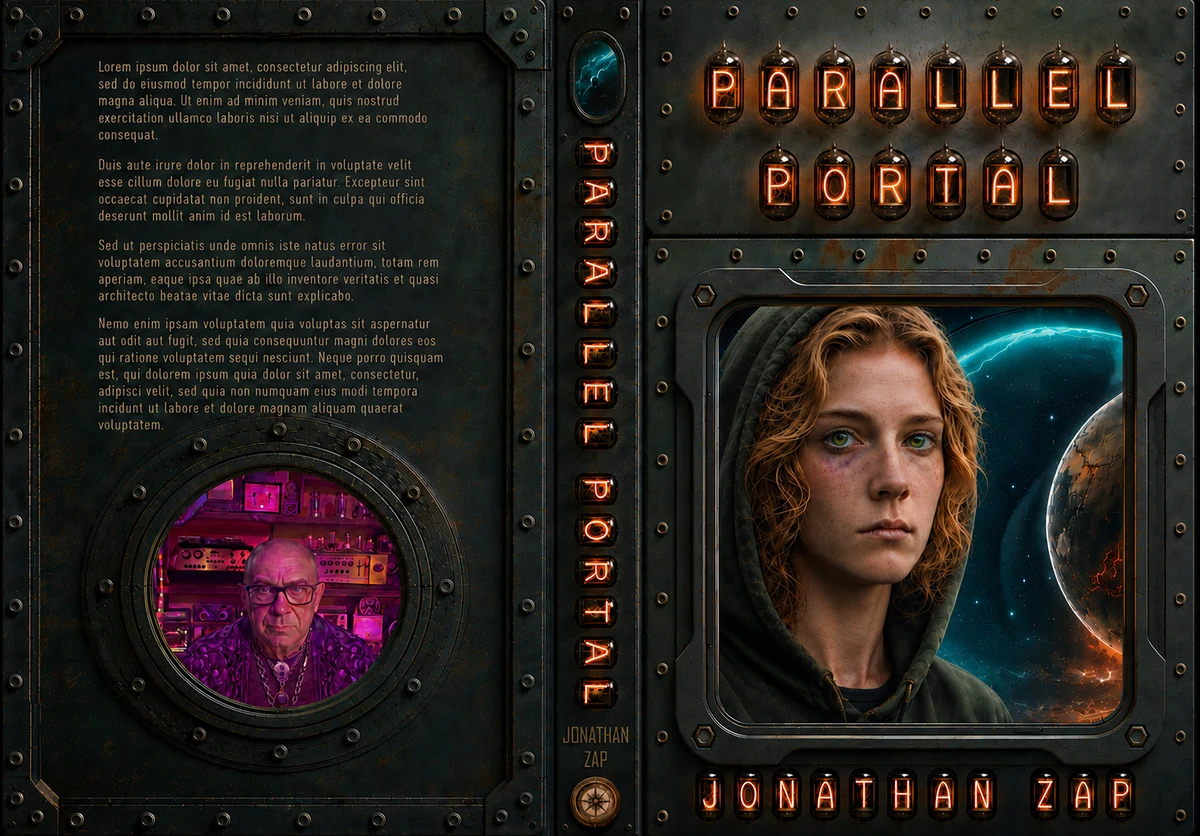
unfinished book cover
PARALLEL PORTAL
By Jonathan Zap
2026
One
Tommy’s Journal
I know this will sound crazy, probably all of this will, but from as far back as I can remember, I’ve sensed an older version of me. I feel his presence, almost like he’s whispering in my mind, but I can’t quite hear what he’s saying. It’s like he’s helping me write this, like my words are coming from both of us. He’s looking out from the shadows of my mind, watching over me, worried about my well-being and wanting to protect me from something dark that’s coming.
I’ve been having nightmares about it, the same nightmare again and again. In the dream, I’m waking up in my treehouse to the sound of gunfire, horrified as I realize that people in my community are being killed. The next moment, I’m standing beneath the treehouse. The gunfire has stopped, and everyone in my community, everyone I love, is dead.
The killer is out there in the woods coming toward me. He knows exactly where I am. I’m about to run, when I see a dark grey robot with a gun step out into the clearing where I’m standing. It’s shaped like a person, but its head is a black machine with camera lenses for eyes.
Somehow, I sense that the robot is not the killer. Its lenses focus down on me, and then a voice, oddly human, from somewhere inside this machine, speaks my name, “Tommy,” and I wake up in a panic.
Even though I’ve had this nightmare many times, it still takes me a while once I wake from it to realize that my community is still here. That no one has been killed. That I am still okay.
But am I?
The nightmare doesn’t make any sense. My home and community are peaceful, remote, tucked deep in the Green Mountains of Vermont. Why would anyone want to kill us? And I’ve seen pictures of military and police robots—they’re not shaped like people, and their weapons are built-in. But what is the dream trying to tell me? I sense something dark is coming, but I have no idea what it is.
I feel like that older version of me holds the answer. I’ve had visions of him since I was a child, writing in a journal, words being typed out on a computer screen. Something always kept me from reading what he wrote, but I knew it was a journal. In the visions, he looks about the age I am now, but he seems older, like he’s lived through much more than me. I think he’s lived through what’s coming, but it’s like he’s not supposed to interfere. It would be wrong in some way. He knows I need to guide myself through the darkness, and that’s why I need to write this journal. I need a place to try to figure things out.
I also have a strong intuition that I’m needed to write this journal. Like there’s someone else who will need to read this one day. I can’t see who that person is either, but I feel them wanting me to continue.
I have no idea who you might be—the person reading this—but I sense you out there, and I feel like I owe you this record. I don’t know why you’re the one who needs to read this, especially since I’ve kept my strange experiences secret from everyone I love—the people I live and work with in my small community called The Friends.
Now, I feel like there’s another person watching me. A strange image just flashed into my mind. I saw an older man in a dark room. Behind him were what looked like sophisticated but antique electronic devices with dials, knobs, meters, and red and green lights. It feels like he’s monitoring everything I’m writing and even my thoughts. I think he’s one of the people meant to read my journal, and I sense good intentions from him. The image disappeared pretty fast, but I feel like he’s still out there, with me as I journal alone in my treehouse, swaying in the howling wind.
I always come here to write or when I need to be alone. And lately I’ve needed that a lot. I feel guilty about hiding so much from the people I love, but I don’t want to burden others with my secret life. I know they’d listen and try to help, but there’s so much they wouldn’t understand. These secret experiences are more real for me, and closer to who I am than the stuff people see me doing every day.
They’d probably think I was having a breakdown of some sort and needed to see a therapist. I can’t be sure I don’t have psychological problems, but what’s going on with me is more than that. Someday, someone will need to know what I’ve experienced, and that’s why I’m writing it out.
People here and at the hospice where my mom works and I volunteer say I’m an empath, because I have a calming effect on the dying, like a cat or a dog. But there’s more going on than they know. Sometimes I see events before they happen and see other things that I can’t prove are real, but they seem so real to me. I’m driven by deep feelings and intuitions I can’t explain to others. And I’m getting one right now . . .
I feel it in the howling wind. My body is trembling, like I’m shivering with cold . . .
There’s someone out there I’m going to encounter soon. Someone who will alter my fate.
I don’t think I can write anything more tonight. The feeling is too overwhelming . . .
Two
Max’s Journal
My name is Max, I am 18, and I am a predator. Legally spoken, my name is Ulrich, but that does not go over so well here in the States, and it is far too tedious to continue having to spell it out for people. Max is one syllable, says much about me, but not too much, and the spelling is self-evident even for illiterate American persons.
I see I am doing what an American news reader would call “burying the lead.” As I was saying, I am a predator. Proudly so. If I said that to most people, they would think I was crazy or evil or both, but this is the extreme stupidity of most people, because homo Sapiens is categorized as a predator species—the apex predator of the whole planet on which it feeds. And yet, self-castrated members of this species use the word “predator” as a synonym for evil when they apply it to individuals who transgress their notions of social order.
Can you imagine a pride of lions calling a magnificent young lion a “predator” to suggest it should be despised and outcast? Yes, older lions have reason to fear an up-and-coming young lion. They may wish they had devoured him before he became dangerous, but to call him a predator would only be a sign of respect.
But no, I do not self-identify as a lion. Of the big cats, lions are too masculine for my tastes, too blunt force. I am more lean, agile, and stylish, more like. . . a leopard. I am not a savage predator, but an elegantly fastidious one. I revere control and abhor messiness. I maintain my person, possessions, and spaces in perfect order and cleanliness. Is this not how cats conduct themselves? This is why I do not care to talk or write in the sloppy, stupid, slangy way of my American “peers.” I operate with precision, effectiveness, and my own sense of style. I did not learn my polished demeanor from the random people around me, but from books and films that satisfy my standard of elegance.
I am a stealthy, slippery operator, not a brute who kills for sport. I prefer to acquire money and power rather than a body count. I have never been accused of an excess of kindness, but I have no interest in harming others as an end in itself. Nevertheless, I pursue my ends with ruthless determination, and I must admit to taking a certain enjoyment from employing deception and misdirection.
I am a predator, but in other ways than red in tooth and claw. Why would I not be predatory? I am a descendant of a predator species, so what could possibly be more natural?
I grew up with hypocrites who do not consider themselves predators merely because they buy their kilos of mammal flesh sanitarily sealed in plastic from the market. They celebrate bacon as an amusing family food, but if they saw someone consuming a puppy, they would call them a monster. And yet, it is an established scientific fact that pigs are more intelligent than dogs in a number of ways.
No, I do not eat puppies, and for that matter, neither do I eat bacon or any meat, not because of moral scruples but because I find such greasy items to be repulsive. I am simply made of finer stuff and therefore eat according to my nature. So those who might call me a predator are nothing but weaklings unable to see anything clearly, even what they put in their own mouths.
So, given that I do not eat animals, why do I call myself a predator? I am referring to my essential nature as one who ruthlessly stalks my quarry. That is to say, I efficiently pursue—I am German after all—my objectives.
Since my sexuality is part of my essential nature, it too has a predatory aspect. Indeed, I stalk, or more precisely, stealthily surveil those few who draw my interest, though I have yet to cross any bright red lines. But give me time—I am, as I have said, only eighteen. Perhaps I am joking, perhaps not—I cannot even be sure myself.
Maybe my grandiosity is an act I put on for my own amusement, maybe not. You may assume these egoistic things I say are merely adolescent bravado as befits my age—perhaps so, perhaps not. I have shown myself highly effective in the real world and have the most universally respected metric to prove it—money. However, other aspects of my agenda have yet to be fulfilled.
I am acknowledging my grandiosity here to examine it and to ensure it does not undermine my efficiency. As I have already said, I am German, and efficiency comes with that territory, as they say in English, but there are other German aspects I find lumpen and boring. I spent the first twelve years of my life in Berlin, but I have learned how to make the accent disappear. There are times, however, when I bring it back for effect. Even when I was a child living in Berlin, I put great emphasis on mastering English, as I recognized that it is the language with the greatest international currency. As you can see, my English is impeccable, which increases my scorn for how poorly it is used by most of its native speakers, who seem to have little knowledge of its vocabulary and how to express themselves with precision and style.
Yes, my Germanic aspects still inhabit me, but this does not mean I am some goose-stepping Nazi. In fact, I happen to admire some of those infernally intelligent Ashkenazi Jews with whom I share a strange karma. I am fascinated by their savants and admire certain of their highly proficient swindlers as well. Of human types, I despise all those who are inferior. And by those who are inferior, I mean almost everyone, but this is without regard to race.
My grandiosity and contempt need a place to be expressed because outwardly, I prefer to be underestimated and “fly beneath the radar,” as the expression goes. Sometimes, it is valuable to intimidate or impress with my upper-class demeanor, while at other times, it is far more effective to be a forgettable cipher.
So, you should not think that what I flaunt here is how I show up in public. It is certainly not. Nothing could make me light up more as a target than to present as a privileged white European male with high pretensions. In my earlier life, I did display haughty arrogance and disdain because there was no reason not to, and I was highly irritated by confinement and the pervasive imbecility I had to deal with both at home and at the supposedly “elite” (in other words, mediocrity plus money) prep school I was compelled to attend.
But now that I am out and about in the larger world, I have become a slippery and stealthy chameleon. For stalking and surveillance purposes, I sometimes forgo the elegant attire I prefer and wear baggy hoodies and similar clothing to present myself as a typical American teenager, unworthy of notice. I am an operator, and I have developed the tools and tricks of my personal tradecraft.
To sustain myself, I operate as a financial predator in the crypto and stock markets, where my ability to perceive deep patterns and short-term fluctuations has enabled me to accumulate significant wealth. I utilize my considerable abilities to identify signals that others miss and find windows of opportunity in global finance. Using a contrived identity, I bought and sold cryptocurrencies and stocks until I amassed a small fortune, which I have grown into an ever larger one. To keep my parents from questioning my activities, I applied to business schools and informed them that I was merely monitoring various market cycles to fulfill my ambition of becoming a hedge fund manager—a goal they could understand and approve. As a result, I need no help from parents or anyone to travel freely and “live off the land,” so to speak.
I am now a legal adult and can do as I please—and I am doing as I please—but not impulsively. That is the way of stupid predators, foolish petty criminals unthinkingly driven by animal drives. Besides constructing a false identity for financial transactions conducted before I was a legal adult, I have crossed few legal lines, though I may soon. If I do, it will be judicious, tactical, and strategic to minimize risk. It is not that I am risk-averse in any cowardly way. I simply seek to maximize reward and minimize any dangers to my own person.
In my former life, before I liberated myself, I was judged defective because I lack empathy for inferior persons. I have also been diagnosed as having on-the-spectrum autism, because I lack sociability and can focus intensely on a subject that interests me. The contemptible psychiatrist who made this diagnosis, which I had self-diagnosed years before, was entirely ignorant of the established fact that autistic mutants exhibit psychic abilities. All of this is extremely well documented as anyone capable of doing an internet search can affirm. Those who have researched this have concluded that the rise in autism is part of an evolutionary advance leading to superhuman abilities. When I informed this incompetent psychiatrist of the gaping hole in his knowledge of autism, he acted completely uninterested. But I could see him make a mental note of my comment as a pathological symptom—as if I had just spouted off a fanatical flat-earth theory or pre-psychotic grandiosity.
My autism is an asset, not a liability or pathology. Those who judge me—a perfect physical specimen with obviously superior intelligence—as defective only reveal their own stupidity.
Alas, I currently have no backups, not even a clone who might grow up to resemble me. Yet another reason not to take unwarranted risks.
So, while I am still confined to this one body, I will continue to take meticulous care of it as an irreplaceable resource and tool of my will. Consequently, I eat a highly refined diet and work out every day to maintain my slender but flawless physique.
Someone glancing at me sees a fit and immaculately dressed young man from a wealthy and privileged background, and there is nothing inaccurate about that impression, of course. I have often been mistaken for a model due to my elegant attire, finely wrought features, and nearly platinum-blond straight hair—very rare without color treatment. But this is a mixed compliment as far as I am concerned. Models are invariably stupid and vain creatures, highly inferior in every way save for looks. Based on my looks, people often assume I must be another such stupid and conceited type. It can be tactically advantageous for people to underestimate my intellect, but it is quite irritating as well.
From experience, I have learned that people find the stare of my blue-grey eyes disturbing, so I wear dark, vintage Mykita Leica ML18 sunglasses. This way, people see of me only what I care to show. If needed, however, I can eliminate the sunglasses and be charming and impressive, but that requires a significant expenditure of energy, so I use this mode only when necessary.
Otherwise, I give people as little energy or attention as possible. Why should I provide any more than that? What is the point of a social transaction that provides no reward? Because I refrain from such irrational energy expenditure, I have been judged a cold misanthrope. If it serves my purposes, I am certainly able to appear not only normal but charming and charismatic. But there was no motivation to do this with my parents or at school because I knew I would soon discard that inferior life just as a snake molts a constricting skin.
Instead, I focused my energy on improving my physique, finances, and escape plan. From the earliest age, I recognized the most obvious thing in the world—money is the universal resource and conduit to power. I also understood the obvious things about myself—I am a predator and vastly superior to others in all ways that matter.
And then, the day I turned eighteen, only a couple of months ago, I disappeared into my new life and identity. Employing contractors at a distance, I spent a considerable part of my fortune building a home base to my exacting specifications. Hidden in the dark deciduous woods of northern New England, from the outside it seems little more than an architecturally superb house, but hidden beneath is a highly secure and shielded sub-basement, part command center and part . . .
Well, now we come to the more controversial aspects of my identity and plans. And yes, these parts are questionable even to me because they represent most of my risk portfolio, and therefore, they must be red-flagged and subject to unflinching analysis. Until an hour ago, when I created this encrypted journal on an air-gapped computer, I never considered putting my predatory identity and intentions into words. I did so to analyze my—let’s call them potentially problematic aspects—because they tempt me toward considerable risks and are not as self-evidently rational as the rest of me certainly is.
Obviously, much of what I have written above is a self-indulgence expressive of grandiosity and narcissism, but I need to let some of the steam off my large ego before getting to the real work of this journal, which is planning and self-analysis.
I shall ruthlessly analyze my potential flaws, the parts of myself that are not rational, and other attributes, such as my sexuality, which are famously hard for most individuals to study objectively. I must be unsparing in examining possible liabilities in my nature, but first, it is appropriate to disclose certain aspects of my anomalous abilities, which are relevant to the riskier parts of my agenda.
The majority of my abilities are rare but not unprecedented, except in their highly effective combination. From that perspective, I could be seen as functioning merely at the outer edge of the human performance envelope. But I also have talents outside that envelope, which are, therefore, harder to evaluate. For example, I can anticipate the timing of certain events, not just market fluctuations, but life events that provide few precursory data points. Therefore, I cannot attribute my successful anticipations to logic or intuitive pattern recognition, but rather to something else, perhaps a form of what is popularly called “clairvoyance.” My working understanding is that it is a type of forecasting that may derive from a paranormal basis, as it is difficult to explain via even the most advanced information processing capacity.
Initially, I was dismissive of paranormal causations, but extensive research ultimately convinced me otherwise. Investigating scientific evidence of future sensing immediately led me to a paper published in a prestigious peer-reviewed journal by a renowned Cornell professor, Daryl Bem, an old, gay Jew with great credentials. When I investigated all the criticisms of his methodology, I discovered instead the irrational bias of his critics, establishment science, and Wikipedia against the paranormal.
I may not be an expert on scientific methodology, but I have the financial metrics to prove my ability to apply probability and statistical analysis in the real world. Ultimately, Bem’s work was vindicated. After analyzing a number of replicated experiments, I have concluded that many paranormal abilities, especially clairvoyance and telepathy, have been scientifically validated, at least as strong possibilities.
Beyond what is likely clairvoyance, I also have an exceptional ability to read people, to sense their weaknesses and strengths (if any), and often know what people are thinking or about to say. Sometimes, it is because inferior persons are so predictable, but other times it seems telepathic. And once, when I was thirteen, I was able to recognize another telepath at an airport and make contact. I will have more to discuss about that encounter soon.
I make these claims, and yet I must admit that some of my strange perceptions raise the red flag of logic error in my mind.
For example, I have a persistent sense that I am not the offspring of my parents. I see no way such high-functioning mediocrities could have produced someone like me. Of course, I realize it is a common grandiose delusion of children to believe they are descended from royalty, etc., so perhaps it is childish vanity causing me to doubt that I am merely the product of a sweaty parental transaction nineteen years ago. Perhaps a lucky cosmic ray hit this unexceptional combination of DNA to cause a massively favorable mutation. DNA from unexceptional parents can sometimes enter the mathematical lottery of genetic combination and produce an exceptional result.
Since childhood, I have recognized myself as a new human type, an advanced product of human evolution, anachronistically appearing in this primitive world of bustling primates. Perhaps evolution created me as a hedge against its main bet on AI, the new species overtaking the meat-bound one that gave rise to it. I am speculating, of course. I simply know my parents and environment are in no way sufficient to account for me.
There have been rare occasions when I encountered someone who seemed like they might also be a new evolutionary type. But these perceptions lack evidence and may be deceived by my most irrational drive—my sexuality. I thought I detected what I perceive as anomalous superiority in a few other young males who are, like me, nearly perfect physical specimens.
Since they are also the type I find attractive, I realize the high possibility of false positives and other perceptual errors. But I can assure you that looks alone are by no means sufficient to create anomalous radar returns. On many occasions, I have seen visually exquisite specimens that entirely lack the special quality I am looking for. What I seek is far rarer than mere physical beauty.
There was one boy at school who had what I considered at the time a paranormal level of charisma. He was certainly quite good-looking, even to my unrelenting standards, and his social and intellectual functioning were superior, if not anomalously so. I surveilled him without any of my attentions being detected.
Quite diplomatically and with considerable charm, I attempted to form a social alliance with him, but he politely rebuffed those efforts. Of course, he knew my reputation as a creature others found cold and disturbing, so there was no chance of making an unprejudiced first impression. It is most probable that he found the charm I turned on him, but not others, suspicious.
And then, as I continued my surveillance, he became less interesting. Indeed, he was an ideal physical specimen, popular and socially skilled, and he did gain admission to Princeton, but once I engineered access to his devices, he revealed himself to be a highly disappointing false positive. He was merely the best animal in the herd of subpar creatures swarming around me at this particular school.
My disappointment was not just with him but in my own failure of discernment. Hormones and animalistic drives had created a type of optical illusion out of someone who, in the end, proved to be only a superior mediocrity. He remained physically attractive enough to arouse sexual interest, but I refuse to degrade myself by having a physical transaction with an inferior person based on looks.
I am no mere meat puppet whose strings can be pulled by hormones. I consider my deluded inflation of this boy to be an embarrassing failure. It was due to the so-called “halo effect” —a well-documented blind spot in cognitive psychology, where one attributes undeserved virtues to an exceptionally good-looking individual. Nevertheless, it was a valuable lesson not to repeat such a humiliating error of perception.
Twice, while traveling with my parents—both occasions were in airports—my gaze was arrested by someone with a glow which made them stand out like demigods amongst the hustle and bustle of disappointing primates.
One of them was a young man who had a Norwegian decal on his luggage and possessed an ethereal beauty that was breathtaking. But now I suspect his beauty created another optical illusion on par with the boy at school. He also failed a test I now consider definitive. Though I stared at him for several seconds, he failed to notice me or my sharply focused attention. A true anomaly should be able to readily identify another.
The other person, however, I am certain was a true anomaly. Yes, he was beautiful and elegant with long, dark hair and exquisite bone structure. Anyone would have found him intriguing and mysterious. But he gave evidence of being far more than merely beautiful.
At first glance, I recognized him as a sophisticated and cosmopolitan Ashkenazi Jew. His appearance was not stereotypically Jewish, but as a German, I have inherited a certain “Jewdar,” an exquisite ethnic sensitivity, and felt the pull of racial exoticism and karma. He must have been eighteen or nineteen, but he seemed older and strangely timeless. He was unselfconsciously elegant and graceful, a prince of his ancient race. I noticed he was wearing an expensive diving watch, likely an Omega Seamaster, and despite his cosmopolitanism, he carried an air of being on a physical adventure.
I sensed he was not merely traveling but on a mission of some kind. I was able to detect that he was skilled at evading attention and could call upon subtle tradecraft, but he lit up more intensely than anyone I have ever encountered. I felt his intelligence as if it were a physical force and sensed a mind filled with secret knowledge.
It was obvious he was another neuro-atypical like me. I immediately felt the presence of another ultra-high-functioning on-the-spectrum mind. I could tell that he, too, was containing his stress at the sensory overload of rushing people in the airport.
The Jew sensed my scrutiny and turned toward me, his hyper-aware brown eyes locking onto my gaze with focused interest. Time stretched as I felt him reading me in a cool, analytical way.
I am so accustomed to being an unseen observer—what others perceive of me is merely a shadow of superficialities. This was the first and only time I have experienced actually being seen.
I must admit, if I am to be honest, that I could also feel him detecting things about me unknown to myself. I was, after all, only thirteen. And yet it did not feel intimidating or invasive. There was a delicacy of feeling and sympathetic sensitivity in the manner of it. For a moment, the boundary between subject and object dissolved, and our minds linked, but I felt him limiting the telepathic flow between us.
I sensed the nature of his caution as ethical and respectful. He was certainly not going to commit the impropriety of approaching a thirteen-year-old at an airport, but it was more than that. He held respect for my youth and refrained from interfering with my stage of development by revealing too much. So, he limited himself to an acknowledgment of me as another anomaly and telepath.
The form of his acknowledgment, occurring during an extended moment of telepathic eye contact rippling through time, had a formal and elegant quality, as though he were presenting me with an engraved calling card. I wish that he had. Nevertheless, it was a level of deeply respectful recognition I have never received before or since, a priceless gift.
When he was sure I received it, he bowed his head toward me in a beautiful gesture of formal respect. After bestowing this blessing, he turned and walked swiftly away.
He possessed qualities I have never encountered in another. I would never use a naïve adjective like “ethical” in regard to anyone else. In my experience, “ethics” is a clumsy pose people adopt to hide their true agenda. But with him—I scarcely know how to describe it—honor is such an archaic word—it was implicit in his deep character.
The encounter created a potent cognitive dissonance still reverberating within me. I was confronted with a quality so foreign to my predatory nature—and yet it was authentically part of his essential nature. It forces upon me a disturbing recognition that at least one person has an aspect unknown to me, a mystery.
I have tried in vain to imagine his Weltanschauung and perceptual qualia—so different from mine and yet so profound and keenly intelligent. I am forced into the admission that I met an equal, not an equality of similitude but of complementary difference. —Yes, that is it, he was so unlike, but a mutant on the same scale as I am. I could find nothing inferior in him—if anything, he had a strange depth I cannot find in myself. It is a continuing shock to acknowledge such a person exists.
I am certain I did not meet him by chance, though he seemed as surprised by the encounter as I was. While the Norwegian was oblivious to my presence, the Jew had been instantly aware, and that, I now realize, is the first test. There must be mutual recognition.
Regrettably, I was too dazzled by the encounter to slip away from my parents and follow him. If only I had trailed him to his departure gate, I could have found a way into the flight manifest.
I curse myself for lacking the presence of mind to take a good photo, I could have searched for him that way. Instead, I let him disappear into the masses. I was only thirteen and still quite stupid in many ways. I lacked the quickness to recognize and exploit this fleeting window of opportunity.
And yet, I have an enduring perception that our paths are destined to cross again. I keep an eye out for him on my travels to this day.
Though I have presented myself as a ruthless predator, his influence subtly shifted that aspect. It has taken the form of the one principle I follow, which is not to needlessly cause harm to others. I may not be kind to others unless the pretense of such is to my advantage, but I do restrain my misanthropic nature from being overtly cruel.
Living by this one principle is a form of respect or honor owed to the Jew for the respect and honor he gave me. If we meet again, I know he would sense if I indulged unwarranted violence or heedless malevolence, and he would lose respect for me. I would be diminished in his eyes and might lose the chance to learn from his secret knowledge.
At this phase, though, my main desire is to meet an anomalous, attractive male person close to my age. I want an equal, but also someone I can dazzle with my abilities and resources. Freed from parental captivity, I roam the country in my newly acquired luxurious and high-performance vehicle—German, of course, a ferociously fast, customized Porsche Panamera EV. Its curvilinear streamlined form is sleek and commanding, but in a subtle way, more leopard than leonine, unlike an American muscle car that has something to prove. And it is exquisitely finished in a deep, near-black forest green that appears almost black at night, cloaking it in the shadows. It is the perfect exoskeleton to sheath my essence. Its stealthy military-espionage bearing fits me like a second skin, like my black peccary Roeckl driving gloves.
The path of my hunt favors college and university towns, as those seem the likeliest to attract the type I am looking for. I can afford to stay in highly rated hotels with gyms, and my financial work is easily done from anywhere. Give me signal and a device—even a burner—and there is little I cannot orchestrate. Perhaps my hunting is merely driven by youthful hormones, but intuition tells me otherwise.
I am certain that somewhere out there, I will find my counterpart. I am not one to quote a primitive mystic like Rumi, but I do like his saying that what you seek is seeking you. In our suspicious age, however, there is a risk of encountering a counterpart who will refuse the time and persuasion needed to realize I am who they are seeking. Next time, I will not risk a rebuff or allow them to slip away without a trace. But before I take any risky step to extend the opportunity of mutual discovery, I will surveil a candidate to eliminate the chance of another false positive.
Once you gain access to someone’s devices and can study their communications, mediocrity becomes all too disappointingly apparent. If they pass my investigation, it may be necessary to make them an involuntary guest in the sub-basement of my home base, allowing them sufficient time to recognize my unique value.
Obviously, involuntarily hosting someone in my sub-basement would cross bright red legal lines and is the most questionable part of my plans. You may think such a step would violate my one ethical principle of avoiding unnecessary harm, but this is not how I see it. It would be a helpful intervention, a way to rescue someone with high potential from being subsumed by the cult of mediocrity. And yet, Americans of the present era are so easily “triggered” by such a great many things, and therefore there is a non-negligible risk that they will misinterpret the temporary loss of agency I must impose to hold their attention.
I would certainly prefer not to use such risky means, but I can foresee scenarios where I would need sufficient time and control over the setting to win them over. There would be no need for such measures if they were immediately willing to break with their former lives to ally themselves with me. But realistically, how likely is that?
Even when I am in charming mode, people find me a little too intense for comfort. If they are currently enrolled in college or university, it will take persuasion for them to realize the self-castration of remaining a captive of institutionalized education when they could immediately gain access to power and wealth by joining forces with me. If I find just the right person, I am confident that, given enough time, they will realize the superior value of what I offer, but such persuasion cannot be rushed.
I readily admit that my plan is a risky and perhaps even ill-advised first move to establish an alliance, but it will provide time to reveal my superiority, charm them, and demonstrate what a powerful ally I could be, financially and otherwise. Although I may have to extend my invitation in this involuntary way, I will not be taking advantage of them. I will be giving them a generous and undistracted opportunity to recognize my value. My facility is secure but luxurious, and they will lack nothing except connectivity and the ability to relocate. But how can I be sure they will not misinterpret my gesture?
This plan obviously entails felonies, and as meticulous as my planning and execution would undoubtedly be, risks cannot be entirely eliminated but remain a persistent variable impossible to fully calculate. I would certainly not sequester someone unless their anomalous nature met a high evidentiary standard. At a minimum, they must have keen self-awareness of being different, and I would have to see clear evidence of this on their devices. Only a fool would take such a step without compelling reasons to believe a successful outcome is the highest probability.
Still, of all my intentions, this is by far the most dangerous. Think of the messy fiasco if I were unable to persuade them, and they wanted to blackmail me with kidnapping charges! In such a worst-case scenario, I might have to resort to irreversible measures to ensure my safety.
My controversial plan begs a central question that someone reading this could legitimately pose. If I am such a flawless predator, why not just go solo? Why even look for a companion and accept so much risk?
All I can say is that I am a predator, not a machine, and, like my sexuality, the desire for a companion is an irreducible need. Although I agree with others’ perception of me as cold and lacking empathy, it does not mean I am without social interest, just that I have lacked the opportunity to relate to equals. Is it not a kind of empathy that allowed me to recognize anomalous superiority in the Jew at first glance and share a profound telepathic state?
There is no social deficiency in me. It is merely that I have been surrounded by horridly deficient mediocrities with whom I had no desire to socialize. The encounter with the Jew went far beyond mere socializing. I long for contact with another telepath where the exchange would be more than words or gross physical transactions.
To be objective about my motives, I must admit that my desire for control requires that such a relationship begin with an upper hand and a card or two up my sleeve. Otherwise, I might start such a relationship at a disadvantage. I have no experience in any sort of mutual relationship, or in physical intimacy, for that matter. Suppose they did? I would be at an enormous disadvantage.
Though I desire an equal, it is my reasonable expectation to be first amongst equals. I want someone who will admire and follow my way of seeking power in the world. But I am certainly not looking for a slave or someone I would be obliged to constantly dominate. It would be evidence of mediocrity if a prospective counterpart could be fully controlled. Anyone who would submit to domination would be highly disappointing. And with regard to sexuality, I would much prefer it if we could exchange such roles.
I want a true companion who can rise to my intellectual and aesthetic level. Obviously, this would be a rare person indeed, but not unprecedented in my experience. Given that he was several years older, I bear no shame in admitting that the Jew was at a higher level of self-realization than I was at thirteen.
Nevertheless, I must make sure that my need for a companion is not one of those classic tragic flaws that causes the downfall of a young hero in so many stories and mythologies. No, I will certainly not risk such an alliance unless I find exactly the right candidate.
Meanwhile, just knowing that I have a secure facility and a substance that would harmlessly render a guest unconscious while I relocate them is itself exciting, a fetish perhaps. It is the pursuit of such a person that gives my travels and financial work a sense of direction and purpose . . .
Three
Tommy’s Journal
It’s happened—the thing I sensed coming last night.
I’m out in the woods picking blackberries. My basket is nearly full when a wave of slowtime passes over me, and with it, an intense sense of déjà vu like I’ve been in this moment before.
I need to be alone when slowtime happens. Slowtime forces me to see into other people more than I want to—behind their thoughts and feelings. And that fills me with shame and anxiety, because I’m seeing private things they wouldn’t want me to know. So, I take my basket and disappear into the woods to hide out in my treehouse.
From its high cedar deck, I look out over the sea of leafy branches and rolling hills that form the valley I live in. Gusts of wind rustle the canopy of leaves around me. The wind calms as the sun breaks through the clouds, lighting up the forest with its golden rays.
The warmth on my skin melts my uneasiness. I lie back on the deck. The grain of the cedar planks against my skin and the smell of the newly sawn wood make me feel like I’m on an old ship sailing under the sun.
A fresh wind carries the evergreen scent of fir trees from deep in the valley, bringing me back to where I am. My sensations become intensely vivid, like I’m feeling everything for the first time. I reach into the basket, wanting to taste the blackberries.
They’re sweet and smooth, almost bubbly, sliding on my tongue. My senses cross, and their flavor becomes a deep purple light flowing into me.
Slowtime stretches every moment.
A great horned owl soars into view. I can see the brown and white stripes of its wind-ruffled feathers in perfect detail. The owl is like a banner rippling in the sky, bringing a message. It passes overhead and screeches, sending a current of fear through me.
As the owl flies off, a strong gust of wind pushes dark clouds across the sun. I hear a distant rumble of thunder coming from the western part of the valley, followed by more gusts of wind. The sudden chill forces me to sit up and hug my knees to my chest for warmth.
The howling wind is making me shiver. The shivering builds until it becomes violent. It’s almost like a seizure or being electrocuted.
And then I become the electricity.
I erupt from my body into the howling wind, swiftly ascending toward the dark clouds above.
I look down and see my body still sitting there on the deck of the treehouse, shrinking away as I rise higher and higher. The windblown tree branches continue swirling chaotically around me, but it’s too weird to view myself this way. Intense vertigo overtakes me, like I’m about to plummet. A dizzy panic, and I drop—
Suddenly, I’m in my treehouse in the dark, feeling intense fear. I hear gunfire in the distance. It’s where I’ve been in my nightmares, but this time I’m not asleep. I hear my mom speak with great urgency, but she’s not beside me—she’s speaking in my mind.
“Tommy, everyone else is gone, but you must live. You’re needed for something important. There is one who will help you survive, but you must leave. Now!”
The urgency of her last command propels me to take action. I feel the horrible truth of what she said.
Everyone is gone, but you must live.
I realize what the gunshots mean. The Friends have been murdered, and I’m the only one left. The killer knows where I am, and he’s coming toward me.
There’s no time to even dress or put on my shoes. I open the hatch, race halfway down the rope ladder, and jump onto the ground, ready to run, sensing death is almost upon me.
And then I look behind me and at the edge of the woods . . . it’s the robot I’ve seen in my nightmares—but now it has a more humanoid body. It’s holding a gun with a scope in a two-handed grip, aiming at something I can’t see.
Somehow, I know the robot is the one my mom said would help me survive. I hear a shot ring out, and I know it’s a kill shot, and it jolts me out of my body.
I find myself back on the treehouse deck, and it’s daylight again.
Was I killed by that shot? Killed in the vision? Is that my future?
My arms are wrapped around my knees, and I’m shivering. The sound of the shot still rings in my head.
The wind settles. The sky is overcast, but no longer darkened by thunderclouds. The warmth of the humid air stops my shivering.
I sense someone is with me, watching. I can’t see anyone, but I feel their gaze emanating from a point suspended in space about ten feet beyond my treehouse deck.
I stare in that direction until an outline of light begins to form. From its center, a boy about my age begins to appear.
He’s glowing and not quite solid in the way I am. As his body takes on definition, I discover something terrible has happened. His clothes are burnt, and much of his skin is charred. I try to hide my shock at the sight of his burns. The fire hasn’t touched his face, and I’m drawn to his eyes, their sorrowful intelligence looking deeply into me. I’m struck by how calm and aware he seems, even though he’s in such a terrible state.
I think of my volunteer work at the hospice. I’ve been with old people as they transitioned at the edge of death. Sometimes they communicated with me. Other times, they’d just look back at their body and depart.
But he’s my age. He needs to live.
As I gaze into his eyes, it’s like I’m being seen for the first time. Understood for the first time.
I want him to live. I need him to help me understand what just happened—what’s coming—it feels like we’re needed for something important.
Like knowing in a dream, I realize certain things about him.
We’re so different.
He’s grown up in a city world with books and complex ideas. His dark hair and eyes against his pale skin suggest an ethnicity I can’t name. We’re from different backgrounds and even different bloodlines. And yet, there’s a bond of brotherhood between us.
Whatever’s coming has brought us together. I sense he understands much of what I do about our encounter. His dark eyes hold secret knowledge, and I want to know the depths he’s seeing. It’s the moment to say something.
“Hey.” Despite the strangeness of the situation, I keep my voice calm and friendly. “I’m Tommy. What’s your name?”
“Andrew,” he replies.
“Andrew,” I repeat. The name lights up in my mind as though I knew it already. “Welcome to my treehouse, Andrew. Can you—would you like to sit with me?”
He looks at me uncertainly. I smile and pat the deck to invite him to sit. He flickers for a moment and suddenly is sitting across from me. Closeness makes him seem more solid, and I realize he’s not only my age but almost exactly my size. I want to hug him, my usual way of greeting people, but I don’t want to shock the fragile sort of body he’s in.
“Where are we?” he asks.
“Vermont. A valley in the Green Mountains.”
He turns to look out, but as soon as we break eye contact, his body begins to thin. He looks back in a panic, and our gazes lock as we realize something.
We need to stay focused on each other to keep him in my world.
I slow my breathing and surround him with my energy to help him stay solid.
“What happened to you, Andrew?”
“I was. . .” Andrew hesitates, and his vision turns inward. “I found myself looking down at the wreck below. There were two smashed-up metal hulks. Smoke was coming from the one that was once our—”
He stops talking, and his eyes fill with tears. They cast downward as if he’s still seeing the wreck. He’s trembling, and I sense him trying to hold back his feelings. He’s afraid they’ll disturb me.
I’m afraid he’ll lose solidity again, but he gathers himself, and when he looks up, his eyes are haunted, but his voice is calm and almost trancelike.
“There was broken glass everywhere. Flashes of red and blue lights from emergency vehicles lit up the fragments like rubies and sapphires. It all looked so strange, but eerily beautiful too. There was a feeling that everything was exactly the way it was supposed to be. The wreck was just something that unfolded in time—like a flower bud opening its petals.
“I let go of it and ascended into space. And . . .”
He seems confused, and he looks down again. It’s like he’s realizing he shouldn’t tell me certain things. I keep surrounding him with my energy so he doesn’t fade out. When he looks up, his gaze steadies.
“I blacked out. And when I woke up, I was floating near your treehouse.”
“Well, I’m really glad you found me.”
“I’m glad you found me, too,” he replies. “At first, you didn’t see me. I watched you. I saw you shivering, and it made me feel cold. Then, when you rose out of your body, I went with you, almost like we were the same person. I saw and felt with you.
“You’re in danger, Tommy, your whole world, and I want to help you—there’s something we’re needed to do.”
I let out a breath, grateful that Andrew experienced the vision with me. But then I feel a pang of fear. I sense our time is running out.
“Where are you, in this world? I mean—are you in this world? How do I find you?”
He could disappear at any moment.
“I don’t think you can, Tommy—we’re not in the same time. But one day, I will find you.”
I’m about to ask him more, but something in his gaze quiets me. We look deeper into each other’s eyes and then . . .
We merge.
It’s like we fell into each other. We were still ourselves, only swirling together without our bodies. Two sides of the same being. I saw with my soul instead of my eyes, like a revelation.
It was a moment, or an eternity. A space outside of time. And then, we separate. We’re still sitting across from each other on the treehouse deck. Andrew gives me an intense look.
“Tommy—” he begins to say when an electric shock arcs through his chest. His body seizes, and he vanishes in a flash.
It happens so quickly, I can’t even react.
The empty silence he leaves behind is crushing, and I’m afraid I’ve lost him forever.
He was ripped out of my world, and I’ll never know—
What, Andrew? What were you going to say?
And then, I hear him.
“Tommy . . .”
His voice seems like it’s stretching across space and time to reach me. An echo of an echo.
“I will find you, Tommy.”
And then he is gone, and only silence remains. I’m waiting for something more, sitting at the edge of the deck, listening like I’ve never listened before. But all I hear is the wind.
In my mind, the echo of his words trails off.
I will find you . . .
I stay on the deck for quite a while—an hour, maybe longer—searching for a trace of his presence, hoping for something more. But he’s gone.
Before I climb down, I take a last look around. There are only treetops as far as I can see while the sun drops toward the ridgeline in the distance.
I don’t know if my words will reach him, but I whisper a promise into the silence.
“Andrew. . . we’ll figure it out.”
I feel the moment rippling in time.
I walk through the woods for quite a while, needing time alone to think about what happened. Then I climb back into my treehouse, where I am now, writing in my journal, my words pooled in the light of my headlamp.
The encounter feels like something I always knew would happen—and writing about it, the words flowed out of me with a strange déjà vu feeling, like I’d written about it before.
Should I warn the others? But warn them about what?
I know visions can be more like dreams and shouldn’t be taken literally. It was all so absurd—a robot holding a gun like a person when police and military robots have built-in weapons.
If I tell anyone, they’re just going to say I had a bad dream or some kind of episode.
But it felt so real, and when I saw Andrew, I knew I wasn’t dreaming or just seeing a vision in my head. Andrew is real.
But if I tell them, it’ll just sound like crazy talk, and they might think volunteering at the hospice is making me unstable. And if I tell them anything, I’d really have to tell them everything—slowtime, quicktime, and my other visions.
I can’t stop thinking about Andrew. He said we aren’t in the same time, but that he’ll find me one day. I believe him, but that time feels far away.
The truth is, Andrew left me with a lot of really personal feelings about him, which is a little embarrassing to write about.
Andrew seems like the friend I’ve always been looking for, someone who understands me and all my strangeness. We have a deep bond, like we’ve known each other all our lives. At the same time, we’re so different.
Most of what I know is what I’ve learned here in my little community and from working at the hospice, but Andrew feels like he’s seen the wider world. I could tell he’s from a big city like New York. I’m just a farm boy compared to him, and yet he seemed as interested in me as I was in him.
I need Andrew to help me understand what’s happening to me, and it feels like, together, we could figure out what’s coming and what to do about it.
His eyes had so much inner knowing—it felt like he could see through anything and understood me perfectly, and when we merged. . . I don’t even know how to describe it—I wish I could experience it again. It’s like we became part of each other. It’s left me feeling he’s more than a friend—like some kind of soulmate. “
Four
Max’s Journal
Writing this journal seems to have had a most unheimlich effect. I’ve committed to writing in English, but the only word available in its weaker palette is “uncanny,” which pales by comparison. But as Americans would say to cover their lack of thoroughness: Whatever.
Ha, once again, I “bury the lead.” English seems to lead one into digressions, so that even a German slips from directness. For the second time in my life, I have discovered an exceptional person whom I am certain is a new evolutionary type!
I realize linking the journal to this event is not rationally justifiable, as correlation is not necessarily causation, and yet intuitively, I sense a relationship that is not, I think, merely coincidental between the journal and the event. The simplest explanation is that I had an unconscious premonition of the upcoming encounter, which spurred me to begin the journal. Now, as Shakespeare might say, the winter of my discontent turns to glorious summer.
Since liberating myself, I’ve been touring the Northeast, an area with a high concentration of elite colleges and universities. I had identified a practical advantage to conducting my search within a few hours’ drive of my home base to enable relocating someone. I was following a northward path when a problem with my new vehicle forced me to divert to Burlington, Vermont. Though the University of Vermont is probably not of sufficient caliber to attract the type I’m looking for, I decided to walk around Burlington while my vehicle was being checked.
In a neighborhood of local shops, I turned a corner, and there I saw him, a boy of maybe only fourteen or fifteen, working with a middle-aged man to unload beautifully made furniture from the back of a pickup truck and into a store showcasing local crafts. The boy defied my college-student demographic expectations, being inconveniently young and apparently not enrolled anywhere, as he was working in the middle of a school day.
At first, his physical beauty made me wary of another optical illusion effect. It had an uncanny aspect. It was not just the impossibly golden hair and green eyes—it was as if all parts of him, even the worn denim pants and flannel shirt he wore with sleeves rolled up, glowed with color and aliveness. I’ve never seen such radiance.
Simply looking at him made me feel as if I were included in his mythic life, as if he were Huckleberry Finn passing me on his log raft down the Mississippi. And I felt a poignant Fernweh—another German word that has no English equivalent but is sometimes idiotically glossed as “farsickness”—a longing for an unreachable elsewhere. I wanted to float down a slow river with him on such a rustic raft made of unfinished logs—no one else in sight.
I was outside his field of view and away from his line of travel to the front door of the store—nevertheless, he turned toward me—and this was no mere casual recognition—I could tell he was as startled and struck by my presence as I was by his. His dazzlingly green eyes searched mine, in a friendly, inquisitive way. And then, in my whole body, I felt him reading me. A flicker of alarm passed through my stealthy operator self, but his gaze had a melting warmth that actually made me want to be read, and as soon as I allowed this, we became immersed in telepathic mutuality.
His energy was so different from the Jew, who instantly impressed me as an intellectual equal with a mind full of secret knowledge. But the way this boy read me was not in the detached and analytical way that I do from behind my Leica ML18 sunglasses. What emanated from him was more like a musical waveform imbued with deep emotional resonance and a hard-to-define mythic quality.
Remarkably, though it was a sunny day and I am a notoriously light-sensitive creature, as soon as I spotted the boy, I instinctively removed my glasses.
Initially I accounted for this as a desire to hold the boy under naked-eye observation, but now it feels like premonitory intuition. I needed to make my eyes available to him because I sensed the possibility of telepathic encounter.
The boy had an awareness difficult to categorize. Time slowed around him, and his awareness seemed to take in all of me—what we Germans call a gestalt—in a moment. It wasn’t intellectual intelligence, but rather a profound emotional recognition.
He’s not an operator in the way I am, not someone who devises complex stratagems or employs deception. Everything about him was transparent and open for anyone to read, and yet that was not a weakness in his case, because others would be just as transparent to him. Whenever I hear someone call themselves an “empath,” they always turn out to be a self-pitying neurotic soliciting sympathy because they are “triggered” by all sorts of nonsense. But this boy was the real thing, and I got the unmistakable impression he could see right through to anyone’s intentions. If the eye contact lasted any longer, he might have read more than would be safe for him to know at this juncture.
I assumed the man I saw him with was his father, as there was an evident bond of strong affinity between them, something I’ve never experienced myself or even observed between my “peers” and their parents. But I suppose such affinity bonds must exist somewhere.
I retreated from the scene as soon as they entered the store, stopping only to capture a photo of the truck’s license plate. I proceeded down the block till I found a storefront shadowed by an awning where I could observe unnoticed. I pulled out the small Zeiss monocular I keep in my shoulder bag to surveil them.
Once the furniture had been unloaded and brought into the store, they raised the tailgate and drove away. That was my cue to enter the store, where the furniture was already on display along with a selection of exquisitely crafted kaleidoscopes, and—impossibly fortuitous—next to the kaleidoscopes, a stack of trifold brochures containing an intel treasure trove about the boy and the man who was with him.
The man’s name is Matthew, a master carpenter and furniture maker, and the boy, Tommy, is not his son but his apprentice. Tommy. The name suits him well—the name of a wholesome American country boy to my ear. That it might deceive others into seeing him as a simple country boy also pleases me. Tommy is my discovery.
The brochure included a photo of them working side by side in their workshop in a small, intentional community near the Green Mountains. The community is called “The Friends” and is devoted to permaculture principles and nonviolence—typical pious hippie nonsense, all the more reason to rescue Tommy. It also helpfully provided the URL of a primitive website for the Friends community and the crafts and produce they sell with contact information, address—everything I need to begin my surveillance.
Time slows again when I pick up one of the exquisitely made kaleidoscopes and—I realize this could be imagination—but it feels imbued with Tommy’s energy from all the meticulous hand labor he put into it. If necessary, I could probably lift his fingerprints, even his DNA, from it. I bring it to my eye and gaze into the stained-glass portal and see a fractalizing polychrome mandala lighting up like the birth of a new universe.
I hear someone approaching from the back of the store and look up to find an over-friendly older woman, apparently the store owner, walking toward me.
“Aren’t they just amazing!?” she says in an annoyingly loud and exclamatory voice. I notice she is without New England accent and sense she’s someone who came to Vermont in search of quaintness. A voluble sentimentalist no doubt, contemptible, but something I can use, so I restrain my extreme annoyance. I despise store folk greeting me or asking if I have any questions, as if the possibility of asking a question were something that would never have occurred to me without their prompting. Normally, I flash such intrusive retailers my Germanic death stare to stop their advance, but in this case, I hide my irritation since this woman might possess useful knowledge about Tommy.
“And those were delivered just five minutes ago!”
I take a deep breath to summon the immense energy necessary to animate my charming and ever-so-polite young man character, a laboriously contrived persona I loathe to put on and reserve only for situations where such a distasteful disguise is likely to yield a significant reward. Though I’ve learned to speak English with no hint of German, I decide to put on an egzzagerated Cherman accent and summon a flowery, faux nineteenth-century manner to portray an older American’s idea of an innocent, naïve, but well-bred European traveler amazed by everything in the New World. As I have said, I am a chameleon, and I sense this is the character that will elicit the volubility I require from this chatty woman.
“Oh, how lucky for me! Zese are quite vonderful! I vould love to purchase vone. Such exquisite craftsmanship. I assume zey vere made by someone local?”
“Oh yes, everything in the store is made by local artisans. These come from the Friends Community in the Green Mountains, and you just missed them.”
“Oh, vat a pity! I greatly admire ze true artisans.”
“Young man, I couldn’t agree with you more. So refreshing to hear from someone your age. We don’t get many young people in here these days. Most of them are just ordering factory-made things online and lack any appreciation or curiosity about finely made handicrafts.”
“Vhat a shame! I vas raised by my grandfazher, you know — part of a long line of cuckoo-clock makers in ze Schwarzwald, ze Black Forest region of Chermany. He always told me that if you want to truly understand a handmade object, you must know the hands that made it!”
“Well, I couldn’t agree more, young man! And the kaleidoscope you hold in your hand was made by a remarkable young artisan, even younger than you are!”
“Oh my! Even younger zan me! And to have achieved such superb skill already! Zis must be a most remarkable young person!”
“Yes, he is! Tommy is the sweetest and most polite fifteen-year-old boy I’ve ever met. When I asked Matthew if the other kids at the Friends Community are like Tommy, he gave me a serious look and said, ‘Nobody is like Tommy. He’s exceptional in every way, especially his kindness.’ And get this—at fifteen, Tommy’s already as good at carpentry as Matthew is, and Matthew’s a master! The whole new line of kaleidoscopes was Tommy’s own idea, can you imagine?”
“When I asked Tommy why he chose kaleidoscopes, he was just so humble. He said he couldn’t have dreamed of making anything if it weren’t for Matthew’s training. Then he smiled and thanked me for being interested in his work and told me how grateful he and his community were to me for showing their wares. His smile just lights up my whole day.”
“What kid talks so appreciatively to adults? And what fifteen-year-old that good at anything refuses personal credit?”
“And every time they drop stuff off, every single time, they bring me a gift, essential oils they’ve made, a freshly baked pie, or organic produce. Today, he brought me blackberry preserves he picked and canned himself.”
She points toward an old-fashioned green glass jar with a handwritten label. Tommy’s handwriting. I feel an insane urge to steal this Tommy artifact, but the risk is unwarranted.
“They shouldn’t be thanking me—I should be thanking them. Their crafts are my best seller!”
“Zis Tommy sounds like a remarkable young person indeed — so rare to find such modesty and kindness in zis day and age!”
“So true! But if other young people raised in the Black Forest are anything like you, they must also have wonderful Old-World manners.”
I won’t repeat every bit of this tiresome but info-rich conversation, but suffice to say I greedily devoured every morsel of information she divulged.
So, unlike that encounter with that stealthy Jew in the airport who left not a shred of identifying information, I’ve already been given everything but Tommy’s birth certificate.
As fanciful as this may sound, it seemed part of what I’d felt at first eye contact—of instantly becoming part of his mythic life, a life that seems not of this era but a distant past of farms and carpentry where instead of school, a boy might work as an apprentice living in a tiny community in the woods with his master. Does that not sound mythic in itself?
The oddest thing the shop owner told me was that Tommy volunteers at a hospice where his mother works as a nurse. Why would such an exemplary young person want such a distasteful job of working with old, dying people with their smells and whining? Perhaps it has something to do with his being an empath, but it still seems insanely altruistic. I’m no Nazi, but there is something to be said for eugenics, and offering to painlessly put such people out of their misery, rather than wasting Tommy’s precious time cleaning bed pans and other disgusting tasks. I would certainly put a bullet in my head before I let myself be checked into a hospice. I began to fear Tommy might be highly-Christian or something equally abhorrent, but the shop woman told me that though they follow a few Quaker principles, they’re not a religious community.
The few kids who are part of this twenty-person settlement are homeschooled, she added, and their education is mainly through sharing in the work needed to support the community, which lives off the grid.
Of course, I bought the beautiful kaleidoscope so imbued with Tommy’s essence. It stands on my hotel room desk as a Tommy talisman that makes him feel close. If only he were close enough to touch—meanwhile, I have to settle for a wooden cylinder as a surrogate, something to hold on to when I auto-eroticize about him.
The unfortunate news, from the surveillance point of view, is that the shop owner told me the community intentionally lives offline, and she can only communicate with them via email, which they check when they come into town. How I yearn to break into their devices, but there’s not much I can do to hack butter churns or whatever rustic contraptions they use instead of tech.
And yet, these rustic details add to a mythic sense of Tommy as a kind of Huckleberry Finn, a storybook character from an earlier time incongruously living in the present age. He lives in a forest, working with his hands, and only occasionally witnesses the life of a small city when he comes into town to drop off furniture.
Since I knew exactly where to find him, I retreated to my hotel room to see what I could learn online. I soon discovered that his settlement is surrounded by national forest land and is at the bottom of a valley, so it’ll be easy to surveil the community from a high vantage while camped in the nearby woods. I ordered a fabulously expensive Zeiss spotting scope—got to love those German optics—as well as high-end night vision equipment, a tent, and other things I’ll need to hide my vehicle and set up an observation post. Camping is permitted on national forest land, so all of this will be fully legal.
I have a strange feeling that everything’s been set up to facilitate my purposes. On the other hand, finding a way to encounter Tommy again without drawing attention from other members of his community will be tricky.
It’s strange how things work. I thought my search would lead me to another sophisticated operator like myself, and then the challenge would be to stay three or four steps ahead of them to earn their respect. But my strategies and tactics would not work on Tommy. He would simply feel what I was up to and see through to my underlying intentions.
And yet, these aspects of him, so inconvenient to my mode of operation, are at the heart of his unique magnetism. This boy is like a revelation of a principle of nature I hadn’t considered. I assumed attraction would be based on similarity, but the massive dissimilarity of this boy is key to his allure. I don’t want to call it an attraction of opposites as “opposite” is such an absolutism. We do have things in common, as we’re both anomalies and highly tuned in. Mutuality was evidenced by our ability to recognize and read each other immediately.
Instead of finding a slightly lesser anomaly, which would have given me the upper hand, I have found someone as anomalous as I am, but who embodies a different principle of nature. Such an alliance could be even more powerful, but I’m not sure how it would work. Or even if it would work. I’d face the immense challenge of adapting to someone whose nature is fundamentally different than mine.
I must confront red flags about my pursuit of this boy. On the practical level, I haven’t planned for the far greater legal hazards of someone underage. I assumed I’d find someone about my age, probably a college student.
There is nothing I value more than control. Control is implicit in being a predator and operator, and I make no apology for it. I’ve been derisively called a “control freak,” but I own that as a compliment. “Freak” is essentially a synonym mediocrities use for “anomaly.”
And yet, pursuing this boy runs dramatically against my need for control. If only he were eighteen like me, he’d be a free agent. If I persuaded him to join forces, there would be no legal lines crossed. However, as a fifteen-year-old, he’s not the controlling legal authority in his own life. Therefore, relocating him without the written consent of a parent or guardian would involve extreme risks that are hard to justify.
And then, even if I overcame that problem, this boy possesses an empathic awareness that would see through to my intentions, and I’d have no way to control that. Perhaps I could misdirect and deceive him within a short timeframe, but not in any ongoing alliance.
You likely assume from my many bold assertions of superiority that I have the fatal flaw of so many young males who overestimate themselves and what they can do. Actually, part of my superiority is an instinctive caution that leads me to be conservative in my strategies and tactics. I do not presume on luck, and I’m a shrewd realist about how things work.
Remember, I’m not American. I’m from the Old World, so I abhor the brash overconfidence of young American entrepreneurs. The media often glorifies the very few who succeed, while ignoring the far greater numbers who fail. Yes, my investments have an element of gambling, but I’ve always been careful not to put my principal at risk, and I’ve become wealthy by meticulously risk-profiling every significant action.
To ensure my safety, I must establish a bright red line in my pursuit. Any notion I had of making the right person a guest in my secure facility is a zero-percent option in this case. Besides the staggering legal risk, he is too dissimilar from me to predict his reaction to such a coercive scenario. The only action available that passes my risk profile analysis is surveillance.
Part of me doesn’t even want to make Tommy an involuntary guest. I can tell from his temperament that he would find that alarming and oppressive. Tommy should be handled with gracious and graceful means, as befits his nature, not brute force. My desire is to make him a welcome guest with me based on his own enthusiasm. I would make over my subbasement to his liking. I would program the floor-to-ceiling panels to draw the eye into an HD forest with wind blowing through the branches. I would order the finest tools and convert a room into an exquisitely well-equipped woodworking shop so he could pursue his craft. No expense would be spared to accommodate his every need. I note these specifications should circumstances later warrant. My goal is to rescue Tommy from his world of rustic mediocrity, not harm him in any way.
And yet, there is no safe way I can foresee to enable such a rescue without the permission of parents or guardians. The logical question is—given these factors, why am I pursuing him at all? One answer is that I’ve discovered a person who is even more of an anomaly than I was looking for, and I might learn interesting things just by observing him. But the real answer is one I must acknowledge is outside of logic.
A core intuition of significance tells me I am on the right track. The magnetism, attraction, and fascination I have for him are beyond logic, so I must proceed with extreme caution, and this journal is part of that caution. Let me define another red line. I will not consider any action beyond surveillance without returning to this journal for analysis and risk profiling.
My surveillance has already been highly successful, and I have learned a great deal about him with minimal effort and no risk whatsoever. From The Friends website, I learned that their community sells organic produce and handcrafted products at a farmer’s market. Assuming Tommy helps with that, it could be a chance for a brief, casual encounter, though obviously not a sufficient opportunity to convince him he should break free of a life he’s fully invested in. Also, Tommy will recognize me from our first encounter, and he might suspect I’m stalking him. Especially since he’s a tuned-in empath, and I am stalking him.
Worse, even if I convinced him to leave his community and come with me, I’d be transporting him across state lines and committing an intimidating list of felonies. As a minor, Tommy’s consent would count for nothing if his guardians wanted to prosecute me. It’d be far too dangerous unless they gave me written permission, and how would I ever manage that?
But wait. . . now that I’ve posed the question, I see a possible answer. I could propose hiring Tommy for live-in custom carpentry work on my new home. To create a more plausible and wholesome scenario, I’d say that the house was purchased by my parents, and they’d put me in charge of supervising the finish work during my summer vacation from college. I was so impressed with the furniture I saw in the store that I knew they were exactly the craftsmen I needed for the custom cabinet work on-site.
Of course, it would be too much to expect the master carpenter himself to relocate for such a project, but perhaps they’d be willing to hire out the apprentice? They could set the price for his services. The house has several unoccupied rooms where Tommy could stay in comfort. A generous salary, plus meals and expenses included. I could point out that the project would amount to a professional credential Tommy could later add to a CV.
I have to admit, it’s quite a clever solution. I wouldn’t be meeting him again suspiciously, but with a plausible reason, and I actually need custom cabinetry and furniture.
However, the giant flaw in this plan is that they would almost certainly require me to supply them with the house address, so my headquarters and the involuntary guest facility would be known upfront. And this is information I’ve worked hard to keep as unlisted as possible.
They’d probably ask to speak to my parents to confirm this arrangement. No, this is far too risky. I need to continue surveilling, and given how well things have worked so far, there will likely be other unexpected opportunities.
Perhaps someone reading this might think me diabolical for plotting to separate this underage kid from his community. I claim no purity of motivation, but, once again, I have no intention of causing him harm. On the contrary, I wish only to liberate him from a life in the woods of little significance.
Obviously, no one else would see the situation as I do, but Tommy is clearly meant for more than carpentry and farming. His present life is holding him back from a greater destiny. A greater destiny he could find with me. So, if you consider my plans objectively, I have only his best interests in mind.
Five
Tommy’s Journal
I know this will sound paranoid, but I think I’m being watched. It’s been a few days since my last entry, and there’ve been more strange episodes I need to write about.
I’m getting ready to leave the hospice in Bridgeton with my mom, and before we even leave the building, my heart is pounding. I’m shaking and scared, but I have no idea what it’s about.
As soon as we walk outside, I see a guy in a pickup truck parked at the corner staring at me and grinning. He has long, greasy hair and a scraggly beard, and his stare feels like a physical attack.
This is hard to even write about, but he has really bad sexual intentions toward me, and I can sense what he wants to do to me—it’s almost like he’s doing it to me, and it’s horrible, like someone stabbing me in an alley. But that’s more like a comparison, and what I saw . . . I don’t even want to put it into words.
Once we’re in my mom’s car, I feel a little safer, but my heart is still pounding like crazy, and I have cold sweat all over.
My mom looks at me and says, “Tommy, what’s wrong? You’re so pale. Are you ill?”
I have no idea what to say, but I have to say something.
“I think I might be having an allergic reaction.” She puts her hand to my forehead.
“You don’t feel hot,” she says. “Did you eat something at the hospice?”
“Yeah, a peanut butter and jelly sandwich.”
“Tommy, I told you not to eat there. It’s as bad as hospital food.”
As we pull out, she tells me everything that would be wrong with a peanut butter and jelly sandwich made by the hospice, but I’m only half listening. I see the truck pulling out just after we do. It has Maine plates.
“Tommy, from now on, I want you to make your own lunch and bring it with you, OK?”
“You’re right, Mom. I will. I promise.”
I look in the rearview mirror and see the truck following us for a while, but then it turns off right before we leave town. I have a feeling I’ve seen that truck somewhere before.
And then, two days later, I see it again.
I’m back in Bridgeton with Dorothy, picking up supplies. She needs me to load stuff into our community car because her knees are really bad.
The same truck with Maine plates pulls up. The sun glints off the windows, so I can’t see inside. But I feel that man staring at me, and my heart races. I feel like prey, like a mouse skittering beneath the watchful eye of a hawk.
I don’t want to show it, so I haul everything into our car without looking toward the truck.
And then, as we’re pulling out—a terrifying vision. I see the truck, the store, and the surroundings with my regular eyes, but with some other kind of vision, I see something else, an evil creature or entity.
It looks something like a giant translucent spider, but with a weird head like an upside-down pear with large black eyes watching me in a cold, scientific way. I can tell it’s not of this world because it isn’t reflecting the sun’s light, and it has no color, only a pale glow. It’s peering in at me from another dimension underneath or above this one.
Lines of energy, like nearly invisible electric guitar cords, run down from the spider into the man in the truck. The spider is operating him like a puppet set on my track.
I keep my face turned away from Dorothy so she won’t see the spasms of sickness overtaking me, contorting my body, almost doubling me up. Dorothy is a super careful driver, so I know she’ll keep her eyes on the road, and if I don’t squirm too much, she might not notice, but then she does.
“Tommy, are you—”
“Can you pull over, please? I might need to throw up.”
She pulls over, and I walk into the woods, crouch down, and do a couple of dry heaves. The nauseous spasms pass, but I still feel sick.
While I walk back to the car, I decide to tell Dorothy the story I told my mom about eating something at the hospice that disagreed with me. I hate lying to her, but I feel like I’ve got to, and I know it would fit with what the Friends believe—and I believe as much as anyone—that food from the outside world is suspect and to be avoided.
When we’re back home, Dorothy offers to make me her tea for nausea with ginger, chamomile, honey-lemon, fennel, peppermint, and licorice. She’s our master herbalist. I thank her and tell her it’s exactly what I need, and she lets it rest. Dorothy is really great that way—she can sense when it’s better not to talk and just lets me be in my own space when I need that.
The tea helps, not just the herbs, but I can feel the love Dorothy put into it, and it calms me. As I sit on the porch of her cabin drinking the tea, I force myself to think back to the vision.
It had a really odd twist. I know people throughout time believed in evil entities like the devil, but that’s just like a distant fact in my mind, like knowing that the Egyptians built pyramids a long time ago. To actually encounter such an entity was a horrifying shock. But the strangest part was the sense it was revealing itself purposefully and not to frighten me, but almost for my benefit, like it wanted me to know things.
If that wasn’t weird enough, yesterday, another strange thing happened—another watcher appeared. Matthew drove us to Burlington to drop off furniture at the store that sells our stuff, something we do about once every six weeks or so. There was a young guy who stopped to let us carry a heavy chest into the store, and I sensed him staring at me. I had a moment of slowtime, just a moment, which is not how slowtime usually works, and I turned to look at him, and . . . it was strange, not scary but not comfortable either . . . it was like we were reading each other’s minds.
It felt like he was a spy sent to find me or something like that. I’m not sure what I read from him, but he seemed highly intelligent and intensely interested in me, observing me, almost like his eyes were high-res camera lenses recording every detail.
He was another watcher, but I don’t think he had any connection to the scraggly guy in the pickup truck. He was almost the opposite of that guy in the way he looked. Not a hair was out of place, and he was almost weirdly perfect, like a European model you’d see in a glossy magazine ad. He didn’t seem like someone from Vermont, but like someone you’d see in Paris or New York, someone from a super-rich family. But he didn’t seem like a spoiled rich kid—it felt like he was on a serious mission. He was so alert, and his whole mind focused on me like we were in an espionage movie, and I was the person he had been sent to find.
When we came out of the store to get the next item, he was gone. I sensed him still thinking about me, like he was watching from a distance, but he didn’t seem like a threat. It felt like I was in a movie with him, and he was going to bring me a secret message or something.
I realize anyone reading this probably thinks I’m a kid with an overactive imagination, but I’ve learned to trust my strange perceptions, and I’m sure there’s something to the intense feeling I picked up from him.
There’s got to be a deeper pattern playing out—all these strange encounters in just a few days—Andrew, the man in the truck, the entity, and now this young spy or whatever he is. The weirdness just keeps piling on, and I’m struggling not to be so overwhelmed that others will sense something’s wrong. I’ve got to keep myself together because I’m needed for something, something related to all these strange events.
Part of me wishes I could just be a kid again. Normal, like the other Friends. But to be honest, when I look back on my life, I was never normal. There was always another level of things going on. Things I haven’t shared with anyone. But maybe now I have shared, by writing this journal. Having this place to talk about what’s really happening to me . . . it’s helping me not feel so crazy.
But I’m not sure how much more of this I can take, how much longer I can keep living two lives, the one I let The Friends see and this other life of strangeness that keeps pulling me further away from The Friends every day. It’s like my life doesn’t belong to me anymore, and I can’t control what’s happening or what’s coming. I’m caught up in something bigger than I am. It’s racing me along its path, and there’s no way off—I just have to let it take me.
I know that all of this is not just my imagination. I am being watched, but not everything watching me is evil.
Six
Max’s Journal
I am writing from inside my camouflaged tent on national forest land surrounding Tommy’s settlement. The tent is beneath a large oak tree I have rigged with climbing rope and a sling seat that gives me a line of sight to everything transpiring in the community that is visible from the outside.
I stripped away some leaves and installed a parabolic microphone I can aim remotely, allowing me to pick up fragments of conversation. I also have two cameras with zoom lenses—one with night vision—that I can operate and monitor from within the tent, but they do not see as much as I can with the Zeiss spotting scope when I clamp it to a branch.
This is the best I can do to surveil a radio-silent community. It is very much like being an anthropologist observing a tribe from a hidden distance, yet I do not learn as much as I want to. Nevertheless, it is summer, so people are outside frequently, and I can get eyes and ears on Tommy many times a day, which always gives me a thrill of excitement. Whenever he appears on the scene, he seems to light up everything around with significance.
I have also discovered that Tommy has a treehouse in the forest at the legal edge of the settlement property. The treehouse is beautifully constructed, and no doubt it is his own work and expressive of his essence. I set up a well-disguised camera and microphone on a tree in the nearby national forest to monitor his arboreal sanctuary. Even if he found my setup, it is an off-the-shelf trail cam identical to those the Forest Service uses to monitor wildlife, though it is set up higher than a trail cam would be unless it were there to observe avian life.
A few times, I have seen Tommy sitting on the treehouse’s small deck, gazing into the woods as though he is searching for something. Given how tuned in he is, I think it is quite possible that he senses a new presence in his life, a potential ally. As Rumi says, what you’re seeking is seeking you. Of course, I realize that many a stalker might delude themselves with the same thought. But it is unheard of for a stalker to have intentions as beneficent as mine. I have so much to offer Tommy, and given the chance, I am sure he will come to realize that.
All my devices can be recharged from my electric vehicle, which is parked under camouflaged netting on an unused, overgrown dirt road to nowhere. The vehicle is packed with freeze-dried food and other supplies sufficient for me to maintain my post for weeks if necessary.
I am thoroughly enjoying my setup as I have been meaning to learn how to operate in the wilderness for years. Of course, I am disgusted by the dirt and bugs that come with the territory. Fortunately, I have a portable shower gadget and take two showers a day but never feel quite as clean as I want to.
Thanks to a satellite phone, I have all the connectivity I need to continue my financial transactions. I can also keep an eye on my home base, some two hundred miles away, which, as you might expect, is equipped with motion-sensing cameras within and without.
What I do not have access to, unfortunately, is what is going on inside Tommy’s mind. I probably would if he were using devices, but these people emit no electronic signals whatsoever.
Despite these limitations, I have made some significant observations. Someone else is lurking about this national forest. I have observed him several times—an unkempt, suspicious-looking individual with disgustingly greasy hair. He has a battered pickup truck with Maine plates, wears camouflage, and carries a scoped rifle slung across his shoulder—a military-style semiautomatic, as best I can determine at this distance, likely an AR variant, which is more firepower than one needs to hunt deer. He may be a hunter, but he is not wearing the legally required orange, so he is probably a poacher illegally hunting off-season.
He appears to be a dangerous vagrant, perhaps ex-military, but he will not come upon me undetected, as I have motion sensors monitoring the perimeter of my campsite, and I am never without weapons. I have trained extensively at gun ranges. Not that I want the risk of neutralizing a vagrant, of course, but I am prepared for all contingencies. Of any anomalous physical capabilities I have, deadly aim is chief among them, as verified by the overlapping holes in the A-zone of my target sheets after a range session.
And, speaking of anomalous physical abilities—Tommy. This is, by far, the most interesting product of all my surveillance efforts. On three occasions, I have observed Tommy working on manual tasks with blurred motion speed. He is always alone during these episodes and in a place where no one in his community can observe him.
In one case, he slowed when someone began walking in his direction, though the approaching person was outside his line of sight. He must be able to detect their approach with some sense other than vision. This adds to my impression that he senses he has an ally watching over him.
My observations of him working with blurred motion speed were made with the Zeiss spotting scope, which unfortunately does not record video, but I know what I saw—unmistakable evidence that Tommy is a true anomaly. This boy is the most priceless asset I have ever been able to track, and I am determined to do whatever I can to form an alliance, but the right opportunity has yet to appear.
The move I could make, approaching Tommy and Matthew at the store in Burlington to inquire about live-in carpentry work, is too risky. There could be a quick rebuff, and I would be disclosing myself as an interested party. Tommy would recognize me from our earlier contact and might realize my intentions were about more than carpentry.
I also do not know what exactly Tommy read in me during our brief but intense eye contact on the street. He was undoubtedly aware of the significance of the moment, and there was no fear or revulsion, but could he have picked up desire? Even people who are not empaths can detect sexual interest. Contriving another contact could make me seem like a stalker. Obviously, I am stalking him, but my purposes transcend mere physical infatuation.
I have made a number of other general but highly significant observations about Tommy. He has an admirable work ethic and does everything with grace and efficiency, which is certainly a good recommendation to a German like myself. When not working in the carpentry shop, he is busy helping out with everything else. Numerous times I have seen people call on him for help, and he always cheerfully obliges.
Tommy greets everybody with a hug, which bothers me for a few reasons. First is that it shows how deeply he feels connected to the ordinary folk populating this rustic little world. It will take considerable persuasion to help him realize this community is trapping him in collective hippie mediocrity, and that he would be far better off with me.
Second, Tommy’s tendency to hug people is disturbingly dissimilar to how I interact. I abhor bodily contact with others, though I would make an exception for just the right sexual opportunity, something I have yet to experience. I am disgusted when people at stores or busy streets encroach on my physical space. I have learned to deal with space-invading American informality, but if people want to even fist bump with me, I find it highly distasteful. Tommy appears to hug everyone he encounters, and they all smile and seem to enjoy it, which arouses jealousy, a dangerous emotion. It is an aspect of him that makes me uncomfortable, and I do not like him giving himself away so freely.
I realize it is arguably irrational, but I do feel possessive about Tommy. He is, after all, my discovery—obviously, no one else recognizes how anomalous he is. These hippies are selfishly trapping him in a lesser destiny, while I seek to free him to achieve the greater destiny he deserves with me. Yes, my means may be unconventional, but so are Tommy and I, and objective evaluation indicates that my aim is necessary and ethical. Abandoning him to these people would be a failure of courage on my part, and I would be passively guilty of allowing him to be further harmed.
When I observe Tommy by himself, he seems quite different from when he is with others. His ever-friendly smile is replaced by a serious demeanor, and he seems truly alone and perhaps troubled. He is obviously acutely stressed by the need to keep his anomalous aspects hidden from the others.
Yesterday, I observed him loading heavy-looking sacks of fertilizer or feed or something onto the back of a pickup truck. It was oppressively hot and humid, so he took his shirt off. His face has the slight softness one expects of a fifteen-year-old, but the body revealed has perfect muscle definition, an eight-pack of abdominal muscles, and taut sinews across his chest as he worked.
His muscle definition surpasses what I have achieved through working out with free weights and machines during my intense gym workouts. I doubt there is any gym in this primitive settlement, so Tommy’s athleticism must be the result of genetics combined with all the manual labor he does. To be fair, if I were obliged to do farm work all day, I would no doubt equal Tommy in this, but I cannot spend the whole day working on my physique to the neglect of everything else. And now, out in the woods without access to even an inadequate hotel gym, I am certainly losing muscle tone.
I must admit my feelings about him changed instantly when I saw him shirtless and all muscley and glistening with sweat. I felt a sharp spike of desire. He is simply the most exquisite physical specimen I have ever seen. I had thought his beauty was mainly in his angelic face and graceful, slender form, but I did not anticipate the athletic perfection of his body. I know hyper-sensitive Americans might accuse me of “objectifying” him, but as I have pointed out, physical beauty is by no means sufficient to attract my attention.
Nevertheless, I must take into account the heightening of my desire because it strains against my patience to observe and wait for the right opportunity.
Tommy is my discovery, and I do not want his body to be seen by others who might desire him as I do. I have become understandably jealous of all the people in his community who can walk up to him, receive hugs, and command him to do anything they task him with.
Obviously, I want to be the one Tommy hugs and who commands him. I am the only one actually looking out for this boy’s welfare while these people take him for granted as their property without realizing what an incredibly valuable asset they are wasting on all these mundane labors. This tragic waste cannot stand. Tommy will inevitably remain trapped in this woodsy enclave unless I can find a way to liberate him.
***
The opportunity came, but in a form far more dangerous and dramatic than I could ever have imagined . . .
I am startled awake by the sound of distant gunfire. None of my proximity alarms have been triggered, so my site is not being invaded.
I turn on my screens to get a view from every camera. Muzzle flashes in the settlement. There appears to be only one shooter, and he’s moving quickly from cabin to cabin.
No time to assess risk—I must protect Tommy.
I race to don full-body night camo, strap on my weapons and night vision headgear.
I am out of the tent in two minutes, moving swiftly and stealthily toward Tommy’s treehouse, where he sleeps every night.
Primordial instincts in the form of flashes of telepathic intuition take over, tuning into the shooter’s mind and intentions. He is the vagrant with the rifle, and he is no professional, just an insane rampage shooter who takes pleasure in killing. Though he is hundreds of meters away, I am so tuned into him I can feel the heat of his acrid sweat and adrenaline-fueled pulse. He knows this ground, and having eliminated the whole community, he is advancing toward the treehouse driven by his main aim—a ferocious desire to rape Tommy. This fills me with murderous rage, but I suppress it. I need to be cold and efficient to eliminate the threat.
A screen strapped to my forearm allows me to continue monitoring the cameras. The infrared picks up the killer as a blotch of red and orange moving toward Tommy. I sprint to get there before him and hide in the woods behind the treehouse. I turn off my screens to make myself undetectable in the shadows.
My night vision is picking him out in the darkness, so I know exactly where he’ll emerge.
Now that I am in position and ready to fire, I rack the slide of my Sig Sauer P320 X-Five Legion, fitted with an IR-capable Steiner DBAL—a dual-beam aiming laser. I assume the classic Weaver shooting stance. The infrared beam, invisible to the naked eye, blazes bright in my night-vision headset, painting my aim across the darkness.
Just before he emerges from the path, there’s a dangerous complication.
The hatch beneath the treehouse creaks open, and Tommy comes down the rope ladder, putting himself between me and the killer.
Halfway down, Tommy jumps and lands like a cat, crouched low.
Time slows as I recognize that while Tommy is low to the ground is the moment to take the kill shot. My IR beam centers on the killer’s forehead, a bright point only I can see.
Every split second is a vivid frame in my mind.
I perceive the exact moment he senses me—the hunter’s certainty curdling into prey-terror—and his mouth drops open in shock the instant before I pull the trigger and take him down with one perfect shot.
I step out from my hidden spot, and Tommy, who is crouched like a cat ready to spring away, instantly swivels in my direction and looks at me as if I am something inhuman.
Then I realize what he sees—a faceless creature in night-vision goggles—so I remove my headgear. He blinks, recognizing me from our earlier encounter in Burlington.
We are both in a state of adrenaline-fueled primordial awareness. Tommy realizes I am his protector, and our alliance forms—the primal bond of combat soldiers in mortal danger.
I come toward him, and he stands up straight. His eyes are dilated by shock and darkness, but they are also hyper-alert and tuned in.
I need him to escape with me, but he is standing there almost naked in his underwear, an electrifying sight.
I decide to inject a bit of humor to calm things down, so I revive my German accent and say,
“Come vit me if you vant to live.”
I can tell he recognizes the line, but he is not in a state to find anything funny.
“We need to leave here as quickly as possible,” I add in unaccented English.
“But someone might still be alive down there,” he says.
“You know they aren’t,” I reply firmly.
A flicker of horror and then a look of intelligent acknowledgment from Tommy.
“We need to leave here, or we’ll both lose our freedom. If you stay, you’ll end up in some horrible foster home. I’m here to protect you and take you to safety,” I add in a commanding tone.
I see high-speed assessment in Tommy’s eyes. I gesture toward the treehouse, realizing he cannot travel in such a state of undress.
“Go back up there and get some clothes, shoes, and anything essential as quickly as possible. I will stand guard down here.”
Tommy nods and, with admirable speed and efficiency, carries out my instructions.
My mind is working at lightning speed, and it is mutual—we are linked in primal survival mode, working as a team, and Tommy’s gift for speed is enhancing my own.
In the two minutes it takes Tommy to dress and pack, my mind organizes an escape plan. I can abandon the cameras, proximity detectors, and parabolic microphone as I had the foresight to wear gloves when I installed those, and purchased everything via untraceable means. Investigators will assume they had been installed by the killer. But my tent and its contents are covered with my DNA and fingerprints and must be packed out. I organize the packing step-by-step in my mind, including delegating part of the labor to Tommy.
As soon as my plan is complete, Tommy comes down the rope ladder fully dressed and with a knapsack on his back.
“This way,” I say, and we run through the woods to my campsite.
I throw everything out of my camouflaged dome tent and command Tommy,
“Break down this tent for me.”
He nods and speedily sets to work.
I jam everything else into my large backpack, and Tommy, all his emotions shut off except survival urgency, works with dazzling speed, stowing the tent neatly in its stuff sack within a couple of minutes.
Packs back on, we race toward my Porsche. I lead the way, and Tommy follows.
I yank the camo netting off and use my remote to open the doors and trunk. In seconds, our packs are stowed, and we are inside the sleek, high-performance vehicle.
“Put your seatbelt on,” I tell Tommy, but he is already reaching for it.
I put on my night-vision headgear so we can travel without headlights for our immediate escape.
Tommy is startled by the silent acceleration of the powerful electric motors, which pleases me. He had grown up with old gas and diesel pickup trucks and is getting his first exposure to cutting-edge technology.
For the first time, I become conscious of sweat beneath my night camo, and my heartbeat is like a machine gun firing at an estimated 140 BPM. My finger stabs at the aircon button to cool down.
Once we make it to asphalt, I take off the night vision, and our adrenaline-fueled action mode ratchets down.
I flick on speed-limit-assist to ensure I never exceed posted limits, intending to meticulously obey every traffic rule during the two-hundred-mile drive to my home base. We are still in a risky zone because any police pull-over will be disastrous until I can create a new identity for Tommy as an eighteen-year-old with ID to match.
Tommy has the presence of mind to remain completely silent, allowing me to focus on driving until we merge with interstate traffic. Now that the need for him to take survival action is gone, I can feel the trauma of what he has just experienced beginning to catch up to him. So far, he is containing it, probably because he is evaluating whether I am a threat.
The quiet time gives me a chance to plan what I will say once Tommy asks the inevitable questions. Intuitively, I sense it will be better to let him speak first to ensure his mind is settled.
I sense his wariness as his dilated green eyes turn toward me, summoning his will to speak. So far, he has given mostly wordless acknowledgments. I recognize the nature of his hesitation. Once he speaks, the situation will become real in a different way. It will threaten his emotional dissociation, and that will be too overwhelming to deal with in the presence of an anomalous stranger.
Tommy takes a deep breath and speaks in a quiet but clear voice. It is the first time I have heard him speak close-up, his voice as mellifluous and lovely as his form.
“Thank you for saving my life. My name is Tommy . . . Who are you?” I sense what is beneath his words. What he is really asking is not my name, but what are you? And there is detectable fear behind the question. He was raised in a community devoted to nonviolence, and he has just seen me kill a man.
It occurs to me suddenly, a new part of my identity—I am now a killer.
I want to reassure Tommy and realize I must stay as close to the truth as possible without revealing everything. I have already planned my words.
“My name is Max,” I reply, “and like you, I am an unusual person. I recognized you as another highly exceptional person from the first moment I saw you outside that store in Burlington.”
I give him a couple of moments to absorb this. But then I make the mistake of stretching the truth.
“I sensed you were in some sort of danger, so I decided to camp out in the national forest land to keep an eye on your settlement in case you needed help.”
Tommy’s wariness intensifies. He senses a degree of falsehood.
“Of course, that is not the whole story, but there will be time to tell you more once we have reached safety.”
“Where are we going?”
“Somewhere safe, and off the grid. My home base, which is,” I glance at my GPS screen, “one hundred and seventy-seven miles away.”
He makes no response. As the silence stretches, a terrible strain in Tommy intensifies. He is losing his struggle to contain his emotions. I have never had such a struggle, but I sense Tommy’s whole body shifting, and it is both muscular and metabolic. It must be a mirror neuron or psychic attunement effect because I experience a surge of emotion . . . more emotion than I’ve ever felt in my life. I am not sure how else to describe it except as an intense sympathy for him. He seems so young and vulnerable and he’s . . . suffering.
In a gentle voice, I tell him to look in the back seat for a couple of water bottles. He does, and I try to think of an appropriately consoling remark. The best I can come up with is a line I heard multiple times at the funeral of my Uncle Hans. Tommy hands me a water bottle. His hands are shaking.
“I’m . . . sorry for your loss,” I hear myself say. The words trigger something in Tommy, permission for him to release the emotion he is straining to hold back. The floodgate opens, his head drops, and he begins sobbing convulsively. He bends over to hide his face behind his long, golden hair.
I have never been so physically close to someone feeling such a strong emotion. Never having grieved for anyone, I find this an alien perception. Of course, I have seen videos of people in war zones crying out in grief as a family member is discovered in the rubble, but those were recordings seen through a screen of faraway events. Tommy’s grief is happening in real time, right next to me.
As cold and annoying as they are, if my parents were killed, I think I would recognize it as a significant moment. I would probably take the day off to decompress or something, but then I’d be over it. If someone is dead, they’re dead, so what is the point in overreacting? It is not going to change anything.
Obviously, Tommy is not like me. I perceive the intensity of his grief as a bodily sensation, like a fever rising up all around him. I keep my eyes on the road to keep the force of his emotion from disorienting me. His whole body is convulsing with sorrow, and it is so raw, undisguised, and agonizing. I have never witnessed anything like it.
I do not want to intrude on his acutely vulnerable state, so there is no action to take except to continue driving silently. In films, I have seen people put a hand on the back of someone suffering such intense grief, but I am a stranger, and this is not the time to violate his physical space. I have no experience saying anything sympathetic to anyone, so any stock lines I know to such effect will ring false. And nothing I could say will change the horrific reality he is grieving over. I suppose a physician would offer him a sedative, but all I have is water and energy drinks.
The wheels in my mind stop spinning. This is not something I can analyze from a distance. Tommy is in a state of emotional agony, and there is no one to help him except me, but I have no idea what to do other than to be a silent witness.
And I must admit the truth—I am in a state of shock myself. We are linked in a primordial, telepathic bond, and the intensity of his emotion disorients me. I’m startled to find my eyes tearing up, as though I were grieving too.
It must be a mirror-neuron effect. I am not quite myself anymore because Tommy’s energy is spilling into mine. I had always viewed the world through a kind of scrolling data heads-up display, but these new sensations shatter my ability to analyze this phenomenon from a distance.
The convulsive sobbing slows, and Tommy raises himself back up.
“I’m sorry,” he says. “I’ll calm down in a minute.”
He leans back in his seat, and I glance at him. He tearfully gazes up toward the night sky and . . . it’s like his whole being is exposed in his eyes. I feel a surge of sympathy for him that is like a strange electricity running through me. The affect is so intense it almost triggers a circuit breaker in my mind, a reflexive dissociative mechanism to protect me from disorientation . . . and yet, part of me wants the intimacy of sharing Tommy’s feelings. I search for anything I can offer.
“Maybe you should drink some water,” I say.
Tommy nods and opens his water bottle.
It was the right thing to say. He doesn’t need a stranger who doesn’t understand what he’s feeling intruding on his private experience, so I’m being respectful and appropriate, and he needs me to direct him.
“If you open the glove box, you will find tissues.”
Tommy follows my suggestion, confirming my earlier observation. He does need me to tell him what to do, so I am actually helping him by taking charge.
“Thank you,” he says. “I’m sorry for my . . . for my outburst. I’m going to be calm now.”
“Tommy, there’s no need to apologize, your emotions are . . . appropriate to the terrible situation you’ve just lived through.”
“Thank you,” he says. “And thank you again for saving my life. I’m going to be calm now. I promise.”
“Take your time. Do you need something? Food, a restroom break, or anything?”
“No, I’m fine, but thank you for asking.”
We drive on in silence, letting things settle. My whole sense of myself is shifting and forming a new identity. I am now a proven warrior, a killer, but I am also Tommy’s protector, and I feel pride and warmth as I realize this.
There is a silent rapport between us. The sympathy presents as less of an electricity now and more of a steady glow emanating from my upper abdomen.
I have underestimated how I would be affected by an alliance with Tommy. I had rehearsed opening conversational ploys, imagining a complex and tense negotiation where I would need to have an answer for everything to persuade him to leave his life behind and join forces with me. But all my rehearsals of how that would work are now irrelevant.
Obviously, they are irrelevant since the life he once had is gone without any intervention on my part, but it is much more than that. In all my projections of how I would conduct myself, I was my usual, calculating self. I hadn’t prepared to have a telepathic bond with an empath.
I’m disoriented by the strange sensations his emotions evoke in me. And yet, by remaining outwardly calm and in control of the situation, I am helping him.
He is changing me, but not by any conscious effort—it is like his nature is adapting me to his needs, the way a cat’s purr can entrain your rhythm and force you to relax.
As I drive, I feel every alteration in Tommy’s state without even looking at him. I sense him composing himself to speak, and a moment later, he does.
“When I first saw you at the store, and our eyes met, I felt you were on a mission of some sort, like you’d been sent to find me.”
Tommy turns to look at me, but I keep my eyes on the road. It will be too distracting to meet his gaze now. I feel him gently but warily studying me.
“Are you on a mission? Were you—looking for me?”
“Yes. But I wasn’t specifically looking for you, not until I found you, that is. I was looking for another anomalous person like myself.”
“I’m sorry, I think I know what anomalous means, but I’m not sure what you mean by another anomalous person like yourself.”
“I mean someone highly unusual, exceptional. Someone aware of things others aren’t, a new human type. I’ve encountered one other such person, but it was at an airport, and there was no way to make contact. From the first moment I saw you, I sensed you were as anomalous as I am, but in highly dissimilar ways. And I knew it would be important to . . . reach out.”
“Did you actually sense I was in danger?” Tommy asks.
My pulse quickens as Tommy reads me in his acutely observant way, his truth sense cornering me. He detected falsehood when I made that claim.
I need to own up to that in some way, but truthfulness is just not the way I operate. As you see in this journal, I am certainly honest with myself, but to be forced into truthfulness with another feels wrong, a relinquishing of control. My mind races to find a workaround while Tommy studies me. I feel the acuteness of his perception in my whole body and realize that any degree of falsity will be detected and endanger our alliance. And every moment of further hesitation only lowers my credibility. My only option is selective truthfulness.
“No, not in the sense of what happened tonight. I sensed you were in a general danger of being isolated by your anomalous qualities, and thought reaching out would be . . . helpful.”
My reply is skillful, but Tommy senses the evasion and realizes I am not giving the whole truth.
“I see,” says Tommy, studying me. “So, your mission was to find someone . . . unusual?”
“Yes. I wanted to find another anomalous person like myself—” I hesitate, realizing I am repeating myself. Continued truthfulness in that direction will be risky, so I evade to prevent falsity. “When I turned eighteen, just a couple of months ago, I set off on my mission. I had already developed independent means—”
“Independent means? You mean like—money?”
“Yes, exactly, money, lots of money by working crypto and stock markets. Money is the way to freedom. With money I can obtain anything—like this vehicle. And I can show you how to obtain more money than you’ve ever dreamed of.”
I immediately regret my last statement as Tommy’s wariness intensifies. My words have landed poorly, and his feelings alter mine. I feel gross, like a pervert caught luring a child into a van with candy.
I scramble to think of something to say, but I am confused about what offended him, so all I can do is admit my perplexity.
“Don’t you want money?”
Tommy considers, but I am at a loss to understand why. It is like I have asked him if he wants to keep breathing, and he is not sure.
“I was brought up not to value money as an end in itself, just as something necessary to trade for needed supplies. I know it’s not the way most people live, but in our community, income was put into a shared fund used for community needs, and anything extra was divided up equally, so we’d all have some pocket money when we went into town.
“I’ve never lacked food, shelter, clothes, or anything I needed, so I guess I’m naïve. We were getting by, so I never gave money much thought. But I can see why you’d want a really cool car like this. And now . . .”
I sense Tommy straining to contain his emotion.
“I guess now I will have to start thinking about money.”
“Well, don’t worry about it, Tommy, I can provide everything you need, including money.”
“But that doesn’t seem right,” he replies. “Since I was a child, I’ve always worked to help my community. I made woodcrafts and essential oils, helped grow our food and tend animals, and did any kind of work that needed doing, so I didn’t feel bad about getting my share.
“If you’re going to help me out,” Tommy continues, “I want to work in exchange. We’re going to your house—I can do housework, cooking, cleaning, and carpentry. I can grow vegetables and other crops if you have land. I’m a good worker, and I wouldn’t want to be a . . .” Tommy searches for a word, “a freeloader. And besides . . .” Tommy takes a deep breath.
“I owe you my life. You deserve infinite work from me.”
His words of gratitude fill me with an unfamiliar warmth.
“OK, well, that’s great,” I reply. “I can always use help, and you obviously have many useful skills.”
Tommy seems satisfied with my answer.
“So, your mission was to find another anomalous person? But then what?” His question throws me off balance.
“Then . . . I would . . . try to form an alliance with them.”
“An alliance? You mean like being friends with them?”
“Right.”
“And . . . is that the whole mission, or is there more?”
“Well, finding another anomalous person and forming an alliance—becoming friends with them—would be a big step, and then we could figure out what to do next together.”
I stop, realizing this is as much as I can safely divulge.
“I see,” says Tommy, studying me. “I feel like I’m on a mission, too, but I don’t know what it is, just that it’s more important than I am. And I was told—”
Tommy is overwhelmed by emotion again and struggles to contain it. His voice is strained, almost strangled, when he continues,
“I was told I must survive because I’m needed for something important.”
Tommy slumps back in his seat, unable to continue. His head drops, and I know not to intrude. We drive silently while Tommy processes his feelings. Whoever told him he was needed for something important must be one of the people who were killed.
A few minutes go by before it feels right to break the silence. I do not want to trigger more grief, so I look for something pleasant or neutral to discuss.
“That treehouse was so beautifully constructed—did you build it?”
“Yes, thank you. It was a master project in my carpentry apprenticeship.”
I sense Tommy being pulled by memories that will stir up more grief, so I try to divert him.
“Well, I didn’t build my house, but I did design it. And it has a certain resemblance to a treehouse. Would you like to hear about it?”
“Yes, please, I would like that very much.”
Tommy senses what I am doing, filling the space with words so he won’t have to think back, and he is grateful for my effort. So, I tell him about my house, though it feels a bit silly since we will be there soon.
I feel, how can I say this—like I’m caring for him, like reading from a storybook to a child who’s just awakened from a nightmare. It is a warming sensation—it feels good to be comforting him.
I am Tommy’s protector.
“Have you ever seen a picture of the Space Needle in Seattle?”
Tommy shakes his head, but then he says,
“Wait, I think maybe I have. Does it look like a flying saucer on top of a huge tower?”
“Yes, exactly. My house resembles the Space Needle, but it’s much smaller, of course. The tower is a steel-reinforced concrete cylinder seven meters—twenty-three feet high. And the saucer on top is shaped much like the Space Needle, with windows all around. The diameter is only thirty-eight feet, so the living space is only eleven hundred square feet.”
“Well, that’s a lot bigger than my treehouse!” says Tommy.
He needs this diversion, but he is also making a conscious effort to be cheerful and enthusiastic to show appreciation.
“True, size is always relative, but actually, the house has twenty-two hundred square feet total because it has a sub-basement. The support column continues twenty-two feet below ground to another section identically shaped to the one above. Where there are windows in the elevated section, there are simulated ones in the space below—high-resolution screens that project images that appear 3D, creating the effect of windows looking out onto any setting such as forest, desert, or outer space. It can render anything you ask for.”
“The house is an eccentric design but highly symmetrical, like a set of barbells oriented vertically with one large circular weight at either end of the bar. It’s designed for structural integrity. The top part can withstand a hurricane, and the basement section features air filtration, making it a potential survival shelter in the event of a cataclysmic disaster. The door into the support column is solid steel, and even if someone were to get through it, they’d be unable to move the elevator, as it has a biometric lock. And there are no buttons indicating a basement level. So, you can think of it as an ultimate safe house.”
“Wow,” says Tommy, “your home sounds so advanced. I wish we had something like that. We never even had locks on our doors . . .”
Tommy falls silent, struggling not to think of what just happened. I give him space to compose himself.
“How long have you been living there?” he eventually asks.
“The truth is, I’ve only spent a few nights there. Construction finished a few weeks ago, and I’ve been traveling. I could certainly use your carpentry skills to make furniture and custom cabinets. Right now, it only has a few basic furnishings.”
Tommy’s face lights up.
“I’d love to do that for you. But all my tools . . .”
Tommy’s expression darkens as he thinks back, so I step in immediately.
“No problem, we’ll set up a wood shop for you, lots of room for that, and I’ll order all the tools tomorrow—anything you want—one of those table saws with the built-in vacuum system that catches all the sawdust, whatever else, the best power tools we can find, and every raw material you want. But there’s no rush. I’m looking for quality, not speed.”
“Don’t worry,” says Tommy, “I’m into quality and speed. And I can make anything to your exact specifications and style. With such a futuristic house, I’m thinking sleek designs, perhaps a Danish modern style. It’s a style I know well because I’m of Danish ancestry, but I can do anything you want. If there’s anything I’m good at—I’m only fifteen, but I’ve had seven years of training. My teacher, Matthew, is . . . was . . .”
Tommy turns away from me toward his window, his body trembling, but he forces himself to continue in a strained voice.
“I apprenticed with a real master, hours every day, and people say I’m a fast learner with things. I won’t let you down, I promise.”
“I’m sure you won’t, and I like your Danish modern idea, exactly what I had in mind—clean, smooth, curvilinear designs—I love streamlining. But if you need any time off to . . . process . . . totally fine . . . though my guess is work may be your best therapy, so I’ll get the tools and materials overnighted to us.”
“Thank you,” says Tommy, “I really appreciate that. Thank you for everything, Max. Work has always been my best therapy.”
Tommy’s last words—always been my best therapy—replay in my mind, and I perceive implications.
“I know we’re very different, but I’m guessing being anomalous—unusual—has also been a burden for you. You’ve probably had to keep your nature secret.”
“Yes, Max, you’re right,” he admits with obvious relief. “Work has always helped me deal with the stress of having to hide my . . . anomalous nature. I need to know I’m contributing. It helps me with the feeling, like you said, of being alone with my strangeness. I’m grateful to have a new friend who understands.
“Once I’m working again, I’ll be calmer, and it’d be great to talk about those things. If you want to,” he adds apologetically. “Totally fine if you don’t want to hear about my weird experiences.”
“No,” I reply, “I’d love to talk about it, anything you want to tell me, anything at all, I’ll be glad to hear.”
“By the way, there’s another structure on my property—a gazebo with the same saucer shape. The windows can be raised in warm weather, and at the center of the floor are panels that lift up, and beneath is a state-of-the-art jacuzzi, no chlorine—it uses UV and ozone to keep the water germ-free, so it could be a great place to talk in the evenings after work.
“The house is on top of a hill in the woods, so it’s quite private, like your settlement. Power is generated by wind and solar, with high-efficiency power banks. Very ecological,” I add, knowing this might accord with Tommy’s values. “Water comes from an underground spring, so it’s totally off-grid, but the house is well-equipped.
“In the lower section is a gym with high-end machines and free weights if you want to work out. Next to the gym is a home theater, also state-of-the-art, if we want to watch movies, series, or anything. The sub-basement is not a grim bomb shelter by any means. It has a kitchen, guest rooms, and a full bathroom. And there’s a guest room above too,” I add, making an effortless decision against an involuntary guest scenario, “so you can pick out a room above or below, and I’ll get you anything you need to make it your own.”
“Thanks, Max, I can never thank you enough for your kindness and generosity. Your home sounds so . . . futuristic. I’ve never lived anywhere so modern. We had a place to watch movies and such, but it was nothing fancy, and we didn’t have a gym or a hot tub, just cabins, workshops, and a meeting hall . . .”
Tommy withdraws into silence, reflecting on his lost world. I decide not to intrude—we have covered a lot, so I let the conversation rest. I want Tommy to save his energy for our arrival at his new home.
As we approach the turn-off to the winding road leading up to the house, I remotely turn on the lights so it will look more impressive when we arrive.
Tommy sits up when I tell him we’re close, and his eyes become alert like he’s memorizing every detail. We sweep up the winding road and approach the quartz gravel clearing at the top.
“Wow, this is even cooler than I imagined,” Tommy exclaims as the structures come into view.
Tommy is forcing himself to be cheerful to please me, which I appreciate, as well as his compliment. I stop the car and open the doors. Tommy unbuckles his seat belt and steps out to view the illuminated compound. He gazes around, awed by what I have created.
We hoist our packs and walk toward the support column. The biometric scanner identifies me, the steel door slides open, and we step onto the elevator, which takes us to the saucer section above. We step out into the illuminated living space. The windows are black. I had neglected to switch them to transparent mode. I make the adjustment, and the lights of the gazebo and clearing glow beneath us.
“Should I take my shoes off?” Tommy asks.
“Yes, please. And you can leave your pack by the door until you pick a room. Would you like anything to eat or drink?”
“No thanks,” says Tommy as he studies the futuristic space with a fascination that pleases me.
“Well, the kitchen isn’t well stocked, but please help yourself to anything you find, and tomorrow, we’ll order anything you want.”
I take Tommy on a house tour of the upper and lower sections, and after, ask him what room he’d like to claim. He picks the small guest room in the upper section, which has no furnishings except a high-quality memory foam mattress. I am pleased that he picked a room close to mine. Despite all my preparations to sequester someone below, I don’t want him locked away in the basement.
The bed hasn’t been made, so I bring him a set of new linens as he retrieves his pack. It is quite late, and Tommy, an early riser like the other members of his farming community, should be allowed to sleep, so I wish him goodnight and retreat to my office to bring this journal up to date. To be honest, I am too excited to sleep—things have worked out better than I could possibly have imagined . . .
Well, yes, I do realize the unfortunate nature of the circumstances—Tommy traumatized by everyone in his community getting killed. Much as I was annoyed by all the hippie mediocrity trapping Tommy in a tiny world, it’s not like I had any plan to cause them harm. And yet, I can’t help but feel something like . . . destiny (whatever that means), at work, as if larger forces saw my intention to liberate Tommy and set things in motion to enable that.
***
The next morning, when I come out of my room, I find Tommy already up and drinking tea. He is standing in front of the kitchen island in an alert stance as if he is a well-trained servant ready to work.
“Good morning, Max. I just looked through your kitchen, and there are a few things I could make for breakfast if you’re hungry.”
He is making an effort to sound cheerful, but I sense the pain beneath his pleasant demeanor. He has made an admirable choice to contain his grief and focus on being helpful.
Tommy clearly wants to be put to work, and I find no reason to interfere with his coping strategy. He lists the things he can make. I choose whole-grain pancakes, and he sets about his preparations. He said work is his best therapy, and since I am not trained in grief counseling, I let him go about his task while I head to my office to check the markets.
I turn on my devices, an array of monitors before me, feeling some premonitory anxiety. Due to the emergency situation, I have been out of the loop for an unprecedented number of hours.
As soon as the graphs are glowing before me, I see that my anxiety is fully warranted. Markets are never fully governed by rationality, but by what Maynard Keynes called “animal spirits.” Overvalued stocks are crashing, creating ripples of disturbance affecting multiple sectors, including several of my holdings, and I am well behind the curve.
I switch into damage-control mode, lining up a set of trades, but just before I am about to execute, a message window pops up on all my screens:
“Are you sure you want to do that?”
The shocking intrusion freezes me in place.
Despite all my firewalls and security measures, someone has hacked my system, a nightmare scenario.
“Who are you, and what do you want? I will not submit to your scam. I will report this activity to the FBI.” I type.
“Slow down, Max. Take a deep breath. We both know this is not the best time for you to contact the FBI, with an underaged runaway in the next room. I’m here to help you, not scam you. Here, I’ll show my good faith.”
A deposit notification from Lombard Odier, my Swiss account, flashes onto my screen, claiming one million Euros added to my account. It is obviously part of the scam, and I am horrified to see that the notification includes the last four digits of my account. The hacker has broken the encryption of my most vital information. I am nearly hyperventilating with panic. This is existential danger, but I need to remain in control.
“It’s real, Max. I can wait if you want to verify it before we proceed. And no need for thanks, a million Euros is just play money for me. If I wanted to cause you trouble, the police would already have you in custody, as I know what happened last night. But once again, I’m here to help you and Tommy. I sent in a team last night to clean up the scene and take down your cameras and microphones.”
A photo of the equipment flashes on the screen.
“It will all be returned to you.
“I get it, Max. If I were in your situation, a million paranoid scenarios would be going through my mind too. But none of those scenarios make any sense if you think them through. Law enforcement doesn’t set people up by depositing a million Euros in their Lombard Odier account, and certainly not when it’s obvious you acted in self-defense and to protect Tommy. They’d bring you in for questioning and would be obliged to read you your Miranda rights. Also, I won’t be asking you to admit to anything.
“Logically, you know the simplest explanation that accounts for all the facts is the one most likely to be true. That I’m here to help is the only consistent explanation. Yes, I broke into your system, but I did it to establish communication and to protect you from outside scrutiny. To assist, I’ve added additional layers of security to your network. If anyone else tries to break in, my security team will deal with it for you.”
“Who are you?”
“I’m sorry, Max, that’s one of a number of things I cannot disclose, and I won’t deceive you with a false identity. For the sake of convenience, you can call me Adrian.”
“Alright, ‘Adrian,’ what can you disclose?”
“That I know much about you and Tommy and am here to protect you both. You are rare and highly valuable people who may play a role in preventing our precarious species from extinction. I know that’s not your aim at present, but one day, when I can tell you more, you’ll understand. For now, let me say that I share your desire for wealth and power, but those goals require the furtherance of organic evolution, which is under threat from AI and other forces.
“You and I have more in common than either of us does with Tommy, so it’s better that I communicate with you. Think of me as an older brother, someone with whom you share many traits.
“I’m making this initial intervention, but otherwise, I won’t interfere unless you’re in danger. You’re understandably distracted right now, and you were about to make some moves that would have undermined your finances, which would distract you from what matters most.”
“Which is?”
“You and Tommy. I intervened to increase the probability of your meeting. The glitch in your vehicle’s operating system that forced you to stop at the nearest dealership, which happened to be in Burlington, was my doing. It was also a test. My hypothesis was that if I put you and Tommy into rough proximity, you’d sense the exact place and time to encounter him, and you did. You passed my test with flying colors, and then, if that weren’t enough, you managed to save Tommy’s life and deserve substantial reward for that. This was a gross failure of my surveillance, for which I take full responsibility. It won’t happen again. I have taken extensive measures to ensure that you and Tommy won’t be threatened again.
“You’re the real thing, Max, more exceptional than even you realize, just as Tommy is far more exceptional than he realizes. Something else you may come to realize is that crucial evolutionary developments can happen when two such dissimilar but exceptional people live and work in close proximity.”
“For now, I suggest that you focus on a healthy relationship with Tommy. You can count on his good intentions, but . . . Max, you and I have much in common, so please don’t take this as a criticism. The crucial task for you will be to restrain any intention you might have of exploiting Tommy. Treat him with the highest respect, as an equal, because he is. Let’s just say I have my own experience dealing with a psychic empath much like Tommy. We are both used to withholding as much information as possible and using deception and misdirection, but that won’t work with Tommy. I know this firsthand. You will need to change your whole modus operandi with him, and I realize how difficult that will be for you.
“In a few minutes, I will send you a proprietary analysis of the current state of market volatility and some projections. As you know, all financial advice is probabilistic, and my only advantage is that I have a team with access to more information working for me, while you are a highly talented solo operator.
“Overall, you have more talent for intuitive financial analysis than I do, and I must divide my intellectual capital into several other fields. But I have unique sources and top-notch pros doing market analysis for me, so I’ll continue to assist by sending you daily analysis and projection reports. I could supply you with all the finances you need, but I don’t want to undermine your independence, and I know you’ll want to keep a hand in, so I’ve given you some extra funds to play with.
“All I ask in return is that you don’t let finances distract you from the main event, which is working out a symbiotic relationship with Tommy. You and I were both designed to perform optimally at many things, but healthy relationships are not one of them. So this will be a real challenge for you. If I see you rising to that challenge, eventually there will be another communication when the time is right. Otherwise, it’s time for me to step back behind the curtain and leave you to your own devices. Best wishes to you both.”
The last message bubble disappears, and I sit there stunned, my heart pounding, unsure if I have been violated and manipulated or am the recipient of extraordinary good fortune.
I use my satellite phone to bypass my hacked network and check on my Lombard Odier account, verifying the deposit.
The whole encounter lasted less than ten minutes. And the stranger’s words appeared so quickly that I cannot rule out an AI agent staying within the limits of human typing speed. The only operational choice for now is to accept the information at face value. Logically, I can rule out an ordinary scam, as he or it obviously had the means to capture all my funds and have me arrested. Therefore, his purpose is not to cause immediate harm.
A file icon appears on my screen. I open it and find the promised market analysis, which is brilliantly well-informed and useful. I use it to adjust my transactions, and just as I finish, I hear Tommy outside my door telling me that breakfast is ready.
I join him in the kitchen and decide not to tell him about what just happened. He has enough to deal with, and I need more time to analyze the meaning of this strange intervention.
The breakfast Tommy has prepared, especially given the lack of fresh produce as my house has been unoccupied for a few weeks, is excellent even to my finicky standards.
Tommy is making every effort to be courteous and act normally, but I sense the underlying anguish and strain this is costing him. I should search for grief counseling online and learn the basic techniques. What would an empathic person do in a situation like this? For now, I will just have to extemporize.
“Tommy, you’ve just suffered an acute trauma, so you must need time to process it. Would talking about it help?”
Tommy looks toward the windows, his eyes mournful, as he considers my words.
“Thank you, Max. And thank you again for saving my life and inviting me to your home. I don’t think talking will help, at least not now. It won’t change anything or bring anybody back. I was told I must survive because I’m needed for something important.
“I can’t afford to look back too much. I need to look forward and work on whatever’s next. It would only be selfish for me to focus on my feelings. I only wish I knew what I’m needed for. Meanwhile, any kind of work will be my best therapy.”
Tommy trails off into a strained silence, and I want to lift him out of it as quickly as possible. His determination to focus on what is coming, and what he is needed for, causes me to reverse my decision not to tell him about the intervention, as Adrian addressed this exact point. He also told me to respect Tommy as an equal, and keeping such an important development secret would not be respecting him as an equal.
Thanks to my exceptional recall, I repeat the exchange verbatim, but I leave out the part where Adrian told me to restrain any intention to exploit Tommy, as that would only put me in a bad light and create more anxiety.
Tommy’s eyes light up with intense focus as I narrate the exchange. His face is a revelation of intelligence and empathic perception, and I sense his intuition reading between the lines of Adrian’s words and perceiving implications.
When I conclude my account, Tommy ponders silently for a few seconds before responding.
“Wow,” he says. “I’ve sensed watchers for a long time and that something really high stakes was going on, but . . . I always doubted it. Why would I be needed for something that important, like playing a role in preventing extinction? Hearing someone else put it into words makes it seem more real. On the other hand, Adrian says we may play a role, so it sounds like he doesn’t know what our role would be, but he did tell us what it is for now—that if we work on a healthy relationship, some kind of evolutionary shift can occur.
“I feel this Max, almost like I’ve been in a situation like this before. We’re together for a reason, an evolutionary experiment that’s meant to happen in this house.”
“I’m not so sure,” I reply. “You’re taking Adrian’s words at face value, but I think we should be cautious. We have no idea who or what these messages came from. All we have are words on a screen. For all we know, the words could’ve been generated by an AI or a group of people.
“What we do know is that Adrian—I suppose we will have to use the name he proposed for convenience—is powerful and holds leverage over us. He knows what happened last night, and he has penetrated my network. It is true that his version—that he is here to help us—is the simplest explanation accounting for the facts we know, but his story could have been contrived to appear that way. On the other hand, I have no alternate explanation. He also appears to know more about us than what he could have learned by hacking, and his knowledge includes not merely information but insight. Since we have no better explanation, and since it is possible that the face-value version is true, I suggest we work with it for now as if it is true pending further developments.”
“The proximity idea doesn’t just ring true,” I respond. “I have already experienced it. Last night, I witnessed your anomalous speed and discovered my thinking and movements synchronizing with your tempo. I also felt your state of emotion having unusual effects on me, influencing me to . . . experience more emotion than I normally would . . .”
I feel Tommy studying me as if he is expecting me to say something more.
“It was quite an interesting and . . . unprecedented phenomenon,” I add awkwardly, not sure how much to admit.
“However, we would need many more points on our map before we connect our isolated experiment with preventing the extinction of our species. I have high ambitions, but saving the world is something I associate with over-the-top Hollywood movies.”
“Well,” says Tommy, ready to counter my dismissal, “he said we may play a role. He didn’t say we’d play the role. Everyone who helped out during World War II played a role in preventing the Nazis from taking over the planet.
“My feeling is that I’m needed to contribute to something more important than I am, and preventing extinction is more important than any of us since extinction includes everyone. I was brought up in a community that chose to live sustainably to contribute to preventing extinction, but it’s not like we thought we were in a starring role, just playing our small part.
“Let me ask you this,” Tommy says, his bright green eyes focused intently on mine, “Do your high ambitions include making a contribution to the world at all?”
Tommy has caught me off guard with an unforeseen challenge. His expression is friendly, but he has intentionally cornered me with a high-stakes test. He wants to know if my values accord with his own. They don’t, of course, but admitting that could be a deal-breaker for our alliance, and he will know if I am lying, so I hastily invent a compromise.
“To be honest, no. But I haven’t formed a ten-year plan or anything like that. The world is too unstable. My short-term goals were to achieve independence from my parents and to find another anomalous person. I thought we could work on a larger plan together once I found an ally. And isn’t that what we’re doing right now? You said it feels like we’re in an evolutionary experiment together in this house. I agree, so we should set to work to make our experiment a success and see what else it leads to.
“Meanwhile, I would like to offer something as a sign of good faith toward respecting your values. Since I have been given additional wealth today, and it appears I will have the advantage of insider market analysis, I will establish a small charitable foundation and begin depositing funds into it. And I will do this work today. I will also let you pick the charities—environmental causes, whatever you like. This way, when you see me disappear into my office to work on finances, you will know those efforts are contributing to what you value as well. Would that be acceptable?”
“I wasn’t trying to pressure you into anything,” says Tommy, giving me a warm smile. “I just wanted to see what you care about. But, yeah, that would be amazing. Thank you.”
Of course, I didn’t mention the tax advantages of my scheme, but once again, I have found a way to give Tommy something he wants. A win-win on multiple levels. I feel a surge of confidence that I can win Tommy over. It is just a matter of recognizing his needs and making a few accommodations. I have underestimated my personal social skills, but now I see how well my business acumen assists—it’s all about deal-making. See what the other party needs and find a way to serve that and your needs with the same move.
“Meanwhile, since your financial work will contribute to the world, I’m glad to free up your time by doing any other tasks I know how to do or can be trained in. I meant it when I said I owe you infinite work for saving my life. I can take over all the housework and meal prep, and I’d love to get started on the custom cabinets. If you have a tape measure, a pencil, and paper—graph paper would be ideal—we can go over what you want, and I’ll draw up designs for your approval. We can start right now if you’re free.”
“As it happens, I do have graph paper, and I like your work ethic, Tommy. Come with me to my office.”
Tommy follows me on the semi-circular path from the kitchen to the living room to my office, which looks out at the gazebo surrounded by white-quartz gravel below.
“I think the first step should be ordering tools,” I say, “as well as lumber, and anything you want for cooking purposes, fresh produce, etc. I’ll get expedited drone deliveries where possible, and what we don’t get today, we’ll have by tomorrow. Once the orders are in, we can go around both levels and discuss cabinets and other furniture. When that’s done, I’ll leave you to work on designs while I create a new legal identity for you as an eighteen-year-old. I’ve done that before for myself, so I have a thorough protocol worked out.”
“Hopefully this goes without saying, but anything you might have ever done online—messaging apps, social media—must never be touched again. You can keep your first name since it’s a common one, but your last name must never be used again anywhere.”
“Oh, I’ve never used social media,” says Tommy. “I only get online at the public library. I have an email address I almost never use, so that’s easy to let go of.”
“Great,” I reply, “your online presence should be easy to scrub. I also want you to call the owner of the furniture shop, since she’ll recognize your voice. I have a phone set up to make untraceable calls. Tell her you’re okay, but you decided to leave the scene so as not to end up in a foster home. An undocumented immigrant who was hunting in the woods took care of the killer, but he told you he had to leave the scene because he’s not a legal citizen. You have travel money and are en route to someone safe who offered you work and a place to stay. Both statements are at least partly true. I have dual citizenship, but I am an immigrant, and you do have work and a safe place to stay. Ask her to call the police with this information, and then politely end the call. She’s talkative, so don’t let her keep you on the phone too long. This way, it won’t look like you were abducted, and hopefully, it will be enough to prevent a nationwide search for you as a missing person.
“We’ll work on other steps to cover your tracks later. You’ll have to stay here, in this compound, for a substantial period to avoid public cameras and any police encounter until the inevitable media circus has died down, and we’re sure you’re not the subject of an active search. In the immediate time frame, we need to establish your new legal identity and obtain legitimate government ID for you. Please let me know anything you need or want to make your stay comfortable and productive, and I will order it immediately.
“Wait, that would be absurdly inefficient. You know what you need, so you should make the orders.”
I wheel my chair across the room to where I have neatly stacked boxes of factory-sealed devices.
“I really do need cabinets!” I add, which elicits a brief smile from Tommy. Putting him to work is clearly the right move.
I pull out a slender box and pass it to Tommy. It’s a brand-new laptop.
“Set this up in your room. Do you know how?”
Tommy gives me a sheepish look and shrugs. “I can probably figure it out.” I write out the network credentials on a sticky note and pass it to Tommy.
“Once I see your new device on the network, I’ll send you links to my retail accounts with credentials. Order anything you need, paying no attention to price. Just get the best of everything. Expedited shipping is already set as the default on all those accounts. Besides tools, lumber, and groceries, order clothes, toiletries—anything you need or want. If in doubt, get it. Please let me know as soon as you’re done, and we’ll proceed to the next steps. Find me if you run into any glitches with the device or the accounts.”
“Thanks, Max. I’ll never be able to thank you enough.”
Tommy pauses and looks away, his eyes mournful.
“I’m sorry I’m not able to show you the appreciation you deserve, Max, but I’m not really myself right now. I’m not the person I was or hope to be again. Dorothy—” a spasm of pain contorts Tommy’s face, but he wills it away “—someone I knew—said, ‘Time heals all wounds.’ That doesn’t feel possible at the moment, but maybe it will be eventually. The best appreciation I can show for now is work. Maybe once I’m making a real contribution, I’ll be more . . . stable, at least. Give me time, Max, I won’t let you down. I promise.”
Seven
Tommy’s Journal
It’s going to be hard to put things into words, because it makes everything feel more real and permanent. I just can’t write about the terrible thing that happened, at least not yet. I need to let my past life go because it’s gone. Gone forever. And there’s nothing I can do to bring it back.
The most horrible thing is that I’m responsible for what happened. I could have warned them. I was shown exactly what was about to happen, but didn’t believe it was literal. I made a tragic mistake I can never undo. What threw me off is that the last thing I saw in my vision was what looked like a robot holding a gun, and that made it all seem like a dream image, not something that could actually happen.
And yet it was the way it happened, except there was no robot, just Max wearing night-vision gear and camo. But even if the vision didn’t make sense to me, I knew something terrible was coming, and I didn’t warn them.
I just can’t let guilt and grief break me, because that would be the most selfish thing of all. What I hold onto is my mom’s last words, the ones I heard in my head, that I must survive and am needed for something important. What I feel doesn’t matter—the only thing that matters is the strange mission I’ve been given. I must be faithful to it, no matter what sacrifices it requires of me.
There’s a part of me I must fight off constantly because it just wants to collapse in grief. Part of me wishes I was dead too and not the only Friend left. I know from things I witnessed at the hospice that death is not the end but a transition to something else. The Friends still exist, but in some other dimension that’s closed to me. I wish I could be with them wherever they’ve gone, but that longing is horribly selfish because I’d be abandoning the mission I’ve been given.
My sacred duty is to stay in this world, with all its madness and evil, but with some goodness, too. I can’t abandon what I’m needed for. And part of that is to keep making this record for someone else to read one day. I don’t know why that’s part of my mission, but I’m certain it is.
And I also need this journal to keep myself together and have a place to talk about things that wouldn’t be good to share with Max. He—well, he’s so different, not emotional like I am, so he wouldn’t understand, and I have no right to burden him with my stress. I know what the first part of the mission is—to form a good relationship with Max. But to pull that off, I need to become stable.
I don’t want to say anything negative about the person who saved my life, but Max doesn’t seem like . . . a well person. I need to be the one to make this a good relationship because I don’t think Max has ever had one. I must let go of The Friends and the life I’ve lost to become stable. The only way to be loyal to them and make amends for my tragic mistake is to do what my mom said, to survive for something important I’m needed for.
I need to keep my focus on Max and the work I’m doing. I can’t do anything for people and a life that’s gone. My contribution must be made here. Housework, cooking, and making cabinets and furniture may not seem like much of a mission, but for now, it is. It’s something Max appreciates, and it’s all I’ve been able to do so far.
I’ve got to do everything I can to understand Max. When I write things down like this, my thoughts become clearer.
Max is so different from me. Fundamentally different. I need to empathize and see things from his perspective, but that’s hard because he’s so unusual. Sometimes, it almost seems like he actually is a robot, though I know he isn’t. He doesn’t show his emotions the way most people do, but that doesn’t mean he doesn’t have any. His whole mission was to find a friend, what he calls an “alliance.” Deep inside, I feel he’s lonely and desperately needs one. He’s not sure how friendship works, but he’s trying his best.
The first part of my mission is to be his friend, but right now, I feel like I’m only part of myself. I shut off my emotions to focus on work, but that makes me into a kind of robot myself. To be the friend Max needs, I need to become Tommy again, and I must overcome the trauma to do that.
Maybe Max has been traumatized, and that’s why he’s the way he is. But he hasn’t mentioned any trauma. He doesn’t even seem fazed that he had to kill someone. He mentioned his family a couple of times, but in a purely factual way, and he showed no feelings about them except annoyance. Maybe they showed no feelings toward him. Maybe what damaged him isn’t a particular event, but that he’s never gotten love from anyone.
But I think that’s only part of the story. Lots of people don’t get the love they deserve, and they don’t end up like Max. He must’ve been born with his differences. So, I think it’s probably a combination of his nature and how he was raised. He didn’t have the advantage I did of a loving community.
Max grew up as an only child in a rich family, and I’ve heard that some rich people are cold and selfish and not even loving toward their own families. I’m sure not all rich people are that way, but Max is the only wealthy person I’ve ever met. He’s super capable and smart, but he doesn’t feel like a complete person.
A good relationship has to be a loving relationship, doesn’t it? You can’t relate well to a dog or a cat without love. Maybe a pet snake wouldn’t care if it was loved or not so long as you fed it, but warm-blooded social animals need it. I’m not sure if Max is capable of feeling love, but maybe it’s because no one has shown him any.
Until a couple of days ago, I was a loving person, but I was raised in a community of people who loved me. I didn’t need to shut off my emotions to keep functioning. Who would I be without the community that raised me? Now I feel lost and hollow because they’re all gone. But at least I know what love is and had a lifetime of experiencing it. So it’s my responsibility to bring love into our strange relationship.
Max probably never had anyone understand him. The more different you are, the harder it is to find someone who can understand you.
That’s why I long for Andrew to find me. When he looked at me, I felt like I was being understood for the first time. That wasn’t the fault of the Friends—they loved me—but they didn’t really get the things that made me different. I guess that was my fault because I didn’t give them a chance. I felt I had to figure out those things myself first before talking to anyone else about them, and now it’s too late.
To create a solid relationship with Max, I need to understand him. But right now, I’m having trouble figuring myself out. I was struggling to deal with my strangeness before, and now I’m not even the same person I was a few days ago. Trauma changes you. And things have only gotten stranger.
“Okay, calm down, Tommy. You will understand, just give it time.”
That sounded like Dorothy speaking in my head. Is it really her?
“That’s not the most helpful question, Tommy. The Friends are all still within you and always will be. Now you’re in a two-person community, and you can bring everything you learned with us into making this new community healthy and loving. You’re doing that already, Tommy. You’re doing better than you think. Maybe time can’t heal all wounds, but things will get better.”
She’s right. I need to stop panicking. I remember something she used to say. The first time I heard it was when I was six years old and had gotten stung multiple times on my hand and up my arm by a swarm of bees that made their nest in an old stump I found. I was crying and terrified.
“Moment-to-moment, Tommy. And every moment in its space,” said Dorothy.
I didn’t understand what those words meant at the time, but the way she said it calmed me. Later, she told me it was her mantra, something she’d read in a book. She told me she says it whenever she feels overwhelmed.
When she saw my perfectionism and self-criticism getting me upset with myself, she used to say,
“Tommy, just do the best you can between now and bedtime. That’s all you can ever do.”
I need to make those my mantras.
Thanks, Dorothy, your wise words will always be with me.
Right now, the best I can do is just be nice to Max and do work he values.
Dorothy once taught me some things about love that I need now more than ever.
“Love is a verb,” she said, “not a noun. It means doing kind things for people, and sometimes that means doing them even when you don’t feel love. Many years ago, I worked with a stressed-out single mom. She confided in me that she wasn’t sure how much love she had for her kid because he was born when she was still a teenager, and that caused all the fun to disappear from her life. She had to work three jobs, and paying the bills was a constant stress.
“I told her that she was a loving mother because she sacrificed and did all those things. No one can feel loving all the time, especially under high stress, but what counted was that she showed up for her child. Everything she did working those jobs away from her kid was a loving sacrifice.”
I think Dorothy was right. It wasn’t the mother’s fault because she was doing the best she could in a bad situation. But that still wouldn’t be an ideal relationship for a kid. A child needs a mother or someone to show and feel love for them sometimes, or it would be more like a survival relationship. It wouldn’t be the young single mom’s fault, she was doing her best, being as loving as she could, but it still wouldn’t be healthy.
The problem is that I can’t even love myself right now. I blame myself for not warning them when I was shown what was about to happen. I don’t feel like I deserve forgiveness, but I need to find a way to forgive myself, or I won’t be able to love again.
I wasn’t the one who put that killer in motion. I thought I’d only freak people out if I told them about a vision that seemed absurd. I didn’t know the vision was literal. Seeing what I thought was a robot made me feel sure it wasn’t.
I’m so sorry. I just wish I knew, but I didn’t. If I did, I would have done things so much differently.
How do I forgive myself?
“Tommy, there’s nothing to forgive. You did what you thought was best for everyone at the time. You can never do better than that. None of us really knows what’s coming. You are surrounded by unknowns, and you always will be. Just keep doing the best you can between now and bedtime.”
“Thanks, Dorothy. That helps a lot.”
But maybe I’m just putting words in her mouth. The thing is, I did know what was coming—I just second-guessed it, and if I hadn’t, maybe I could have saved everyone.
How can I ever forgive myself for that?
* * *
Sorry about all the frantic rambling in my last entry. I’m a lot calmer now. Work is really helping, and I use those mantras all the time. Sometimes, I say them aloud. Other times, I hear them in my head when the pain resurfaces, and I’ll hear Dorothy say,
“Moment-to-moment, Tommy. And every moment in its space.”
And she says other stuff like,
“You’re doing the best you can, Tommy, and you’re doing much better than you think. Give it time.”
And when she speaks, it’s like she’s speaking for all The Friends, so it feels like the whole community is supporting me. I haven’t been able to recall details, but I also feel like the Friends are with me when I dream, assuring me they’re alright and encouraging me to let go of grieving about them as much as possible so I can focus on my mission.
When I last wrote, I was still in shock, fighting off agonized panic, and it seemed like I’d always feel that way. But it feels like something larger than me is stabilizing me into something more like the Tommy I used to be.
As soon as the supplies arrived, I convinced Max that the best place for the woodshop would be the gazebo, which has windows that can be opened. At first, Max wanted me to work in the house, but I explained that wood dust would fill the air, and he’d be hearing power tools while he was in his office. He saw the sense of that, so now I’m working outdoors with forest all around, which brings me great comfort.
I come in to make our meals. I’ve always loved cooking, and people say I’m good at it. I’m learning all of Max’s very specific food and taste preferences. There are a lot of things Max can’t eat, including food textures that repulse him, but I’ve got all that dialed in now, and he praises the meals I come up with.
When I got here, there was almost no normal food. I found cupboards filled with supplements and expensive protein powders with the longest list of ingredients I’ve ever seen, most of them chemicals—synthetic vitamins and weird protein isolates and stuff like that. Max told me that he mostly lives on shakes. He claimed they have every nutrient and said he couldn’t waste time cooking.
He has plenty of money, but the poor guy wasn’t even eating actual meals. Besides not cooking for himself, he also said he doesn’t trust restaurant food. That’s something we have in common. We didn’t have much money, but I grew up eating farm-to-table, organic stuff we grew ourselves, whole foods cooked by people who put love into everything they made. “I was constantly schooled in nutrition and plant-based cooking, but I’ve never worked from recipes. I just improvise with whatever ingredients are available.” It’s a way I’m following Dorothy’s advice—bringing what I learned with The Friends into our two-person community.
Now that I’ve figured out Max’s preferences and distastes, he praises every meal and hasn’t made a single shake since I’ve gotten here. He’s eighteen, but it feels like he’s discovering real food and eating meals with someone for the first time.
Max told me that he refused to eat with his parents and never ate lunch at school. He said it’s impossible for him to be with other people when they’re eating. The way they eat and the noises they make disgust him. But I must be an exception because he seems to enjoy eating his meals with me.
Yesterday, I found he’d cleared his protein powders out of the kitchen cupboards and tossed them in the trash. At first, I was horrified because I was brought up to never waste food, but it was just powders neither of us was going to use, and it was a sign that he appreciates my cooking. Maybe even a sign that he’s willing to change a little in a healthy direction.
I’ve already built a composting station outside, and once the cabinetry and furniture are done, I can work on establishing a small permaculture farm on the property, so we won’t need drones to deliver all our produce. Max likes the idea because he’s an extreme survivalist and says we should always be prepared for major disasters.
Max told me about the “Carrington Event” and says a solar storm could wipe out all our devices and end technological civilization, and we should be ready for that and other disasters he calls “black swan events.” He told me that essential elements of what he called the “homebase infrastructure” were hardened to withstand solar storms and EMPs. Max loved my idea of using space in the basement to set up hydro and aeroponic gardens to grow stuff in the winter.
A few times every day, Max comes out of his office just to watch me do carpentry. I explain everything I’m doing, and he listens with great interest, but he never touches any of the tools, so I don’t think he wants to learn how to do carpentry himself. He always praises the quality of what I produce and says he likes my work ethic and perfectionism. He says he admires high proficiency in anything and takes pleasure from watching me do my craft.
He studies me with fascinated curiosity, and I’m doing my version of that, trying to learn everything I can about him.
There’s one thing I’ve figured out about Max that’s going to be awkward to write about, but I need to. This journal is becoming like a friend I can confide in, and I’ve got to talk to someone about this.
I’m pretty sure Max is attracted to me. Attracted, as in sexually attracted to me. And by “pretty sure,” I mean sure. You can’t be an empath and miss something intense like that.
Max doesn’t say anything about sex and never tries to touch me, but when I come out in a bathing suit to join him in the hot tub, I can feel his eyes on me. It’s not horrible, like what I felt from the killer in the truck or anything like that. But it makes me uncomfortable. It’s like a sudden surge of excited desire that feels a bit greedy but also really nervous and even fearful at the same time, like he doesn’t know what to do with his feelings.
And I don’t know what to do with his feelings either. I’m hoping writing about it will help me figure it out, because I have no one to guide me, and no experience.
But it’s not like I don’t know anything. I’ve been aware of different sexualities since I was a child. For example, Dorothy often talked about her partner Jane who died before she came to live with the Friends. It’s part of what drove her to find a community. But she wasn’t with anybody during the time I knew her. She used to say the whole community was her partner.
Maybe, in a way, I was like that too. It seems like it would be selfish to put all your focus on one person just because you’re attracted to them. I’ve seen that, and I didn’t like it.
Dorothy once told me something that’s really stayed with me. She said that when she was young, she was desperately trying to be loved, but now she’s found it’s easier and more fulfilling just to be love. Maybe that’s how I need to be with Max. When I think of Andrew I kind of desperately want to be loved and understood by him. But that’s not how I feel about Max, all I can do is try to be love around him. Though it’s more like Dorothy’s idea of love as a verb and not necessarily a feeling. A lot of my feelings are still numbed out, so I don’t collapse into grief. The best I can do most of the time is keep doing work that benefits Max.
I don’t know if that’s really being love the way Dorothy meant—it’s just the one thing I can do. But I’ve also learned that being love is quite different from being in love with someone, which can be quite selfish and annoying to others.
The Friends got outside visitors because Jordie taught workshops on permaculture, and the students who came were put up in guest cabins and ate with us in what we called “The Pavilion,” our circular dining and meeting hall with a ring of windows at the top. Most of the people were pretty cool, and I talked to many of them.
The permaculture students were always given a tour of our community on the first day, including the carpentry workshop where I worked. When they weren’t getting trained in permaculture, they were free to wander around and see how we lived and functioned, and if any of them asked me questions, I was always happy to talk to them.
A group came through last Spring, and I first saw them when the tour brought them to our workshop. Matthew gave them his usual talk on how we approach carpentry, what we do to ensure the wood we use is sustainably sourced, and so on. Everybody was listening with interest except this one young couple who weren’t listening at all.
I found their behavior shockingly rude and inconsiderate. They kept whispering to each other and laughing, and their laughter took the form of an irritating co-cackling that rose and fell in the same pattern every time. And then, every so often, one of them would kiss the other, and they were always staring into each other’s eyes and paying zero attention to Matthew’s talk.
The people standing near them were distracted and annoyed, but no one said anything, and it didn’t feel like my place to say anything either. If Jordie were there, he probably would’ve said something because he’s the workshop leader.
Later that day, I was staining furniture when I heard shouting outside, like a screaming match, and that’s not something you’d expect to hear in our community. It’s not like we don’t disagree on certain issues, but I’ve never seen a dispute turn into a public shouting match. The one Quaker ritual we follow is a monthly meeting where anyone, including the kids, gets to speak their mind. There are often disagreements, but it’s always a civil conversation, and we work through things in a reasonable way. If even just one person blocks a consensus on something, they’re always given space to fully express their dissent. Honoring a dissenter is actually written into the Friends’ constitution.
I went outside to see what was happening and found the same couple acting out this huge drama right in the center of our settlement. They seemed oblivious to the disturbance they were creating in our peaceful little world. They could’ve gone behind a cabin or out in the woods to perform their drama, but it was like they wanted to be on display, because their relationship was the center of the universe, and everything else was just a backdrop.
And what was there to get into such a big fight about while in a permaculture workshop? I heard the girl shout something in a rageful, accusatory tone, but couldn’t make out the words. I opened the door in time to hear the guy shout back,
“I didn’t know it was going to be this boring either!”
At that point, the girl turned and stormed off, and he went after her. A couple of minutes later, they took off in their SUV at an insane speed, throwing dust up everywhere.
I rarely get angry except at myself sometimes, but I was disgusted by their behavior. I felt the insult to our whole community. Nobody made them come to that workshop, and if they found it, and maybe all of us, boring, they could’ve kept it to themselves and politely left. What he said and their eat-my-dust screeching exit felt like a giant “Fuck you!” to everything I cared about.
I’m usually shy with strangers, but at that moment, I was hoping they forgot something and would have to come back. If they did, I would’ve walked right up to them and given them a piece of my mind. Even now, I feel pissed off thinking about them.
When I talked to Matthew about it, he just shrugged and said,
“That’s normal behavior for a young couple.”
If that’s what being a young couple is like, I’d rather just be in a relationship with the whole community like Dorothy.
Anyway, that was a big tangent, obviously. Maybe I got caught up in it because I’m nervous having to think about sex, which I’d rather not have to deal with, but I need to because I’ve got to work through anything going on between me and Max.
I’m a late bloomer, I only hit puberty a couple of months ago in the Spring, and it was the same time the disturbing visions and occurrences started coming at me. I already felt overwhelmed, so exploring my sexuality would have been one rabbit hole too many.
To be honest, I’m not even sure if I have a sexuality yet. I find certain people attractive, but I’m not sure what I’d want to do with them, if anything. Maybe just closeness and cuddling or something.
The only person I’ve ever felt a strong attraction to, like a soulmate, is Andrew. But it’s not like I was fantasizing about sex. I was more worried about Andrew’s survival because he had such terrible burns. The merger experience with him is the closest I’ve ever felt to anyone. I don’t see how sex could’ve brought us any closer.
I’m not even clear if I have a gender preference. I don’t quite get it. If I really like someone, why is it so crucial what sort of thing they have between their legs?
OK, I guess this is getting embarrassing. Obviously, I’m super naive, but I suppose I’m not the first fifteen-year-old to be confused about their sexuality. And it’s not like anybody is reading this right now. But I do have a weird feeling someone will someday.
Dorothy would say, “Just work with whatever is available in the moment.” What’s available is my confusion, and I need to work through it to figure out how this is going to affect my relationship with Max.
It won’t be healthy to just step around a secret tension between us like an elephant in the room no one talks about. Something as big as that needs to be brought out in the open and talked about at least, doesn’t it? But I can’t just bring it up when I have no clue what I’m going to say about it.
Intuition tells me what I need to hear, which is not always what I want to hear. Right now, it’s telling me I need to be open to something with Max for things to be healthy. It can’t just be this huge tension that never gets resolved. But I’m not ready for full-on sex with him or anyone. I mean, obviously, I can find videos online, so I’ll understand better what to do, but I’m just not clear if I want to do any of it. Does that mean I’m asexual?
I’ve always liked being physically close to people I care about, and I’ve always given people hugs. And for as long as I can remember, I’ve often gotten compliments about my looks, but I didn’t connect that with sex.
A couple of days ago, for the first time, I gave Max a hug, and it was quite awkward. I did it only after thinking about it and deciding it was necessary to make things healthier because Max has never even given me a fist bump. You can sense the protective space around him like a force field. Normally, he wouldn’t want anyone getting close, let alone touching him, but at the same time, I feel he does want some kind of closeness with me.
Max is not a very physical person. I guess he’s pretty fit, he works out every day, but he doesn’t seem like he’s actually in his body, more like he’s floating just above it. It’s almost like he’s walking around in a space suit and is cautious about touching even inanimate things as if he might get germs.
But as awkward as it was, breaking the ice with that first hug felt like the right thing to do, even though he didn’t know how to respond. He didn’t resist, but it was like he never got a hug before and didn’t know how to hug back. He didn’t pull away from it either, and after we broke apart, he said, “Thank you,” and then he was really quiet. People don’t usually say “thank you” after a hug, so it must’ve meant a lot to him, or he was just startled and didn’t know what to do or say.
Later, I realized my mistake. I surprised him with a hug, and that was too startling. I should make sure he knows it’s coming so he’ll be prepared for it. So, I’ve ritualized it. I give him one hug right after I say good morning and another after I say good night. Now he’s come to expect it and actually smiles, and it must be genuine because until I saw it, I wasn’t even sure Max could smile.
It’s obvious he likes me, and he lights up when he sees me, but he doesn’t know how to show it, or maybe he’s afraid it would make him seem weak or something. His normal expression is sort of cold and disdainful, which, along with his super-stylish clothes, is why I thought he looked like a European model when I first saw him.
I know this will probably seem like another big tangent, but it’s a memory that keeps coming up when I think of Max, and I’ve learned that when a memory pops up out of nowhere like that, there’s usually some kind of lesson in it related to what’s going on in the present.
When I wrote earlier that I never met a wealthy person before Max, I meant I never interacted with a rich person, but when I was twelve, I was once in a rich person’s house.
It was a custom cabinet job for this wealthy couple who lived in a house that looked like something you’d see in a glossy magazine. It didn’t look like a house anyone lived in because there were no personal items anywhere. It had no personality—it was like it had been designed by an architect and interior designer on the condition that the people who lived in it couldn’t change a thing. It made me afraid to touch anything like I was in a museum and would set off an alarm if I did.
I think the couple was in their forties, and they looked like they were dressed for a business meeting. The woman wore a pinstriped business suit with oversized shoulder pads and a man-sized watch. She was painfully thin and angular and seemed proud of it. You could tell she starves herself to look that way, and everything about her seemed designed to intimidate other well-dressed businesspeople who didn’t have the self-discipline to be as skinny as she was.
When Matthew introduced me, she inspected me from head to foot and said,
“Oh my, and isn’t he a cutie!”
But it didn’t feel like a compliment. It felt like I was some kind of merchandise, like a prize-winning poodle.
“Why don’t you go in there,” she instructed me, pointing toward a giant showcase living room, “and watch television while I talk to your boss.”
Her husband didn’t even glance in my direction. Feeling dismissed and insulted, I went where she pointed.
They didn’t offer Matthew or me anything to eat or drink, not even a glass of water, and that’s the opposite of how I was brought up. If anyone visited our community for any reason, we’d always take them to our dining hall and offer them a meal.
One time, Dorothy was teaching me baking in our communal kitchen. She gave me one of the cookies to sample, and I was about to bring it outside when she stopped me.
“Never go outside with food unless you bring enough to share with everyone!”
I instantly saw the rightness of that and never again ate food where other people were around if I didn’t have enough to share.
The living room was gigantic with a vaulted ceiling. But there was no evidence any living had ever occurred inside of it. There was a brand-new glossy grand piano that looked like no one had ever dared lay a fingerprint on it. I have to admit, the woodwork was super precise, every surface so perfectly shaped that I wondered if it had been made by people or robots. I’ll bet neither of them even plays piano.
Across from the piano was the biggest screen I’ve ever seen inset into the wall. The television was on showing a European fashion show, but the sound was muted.
There was a remote control with a million tiny buttons on the coffee table, but I didn’t want to touch it. I was afraid I’d mess something up and get in trouble. I was also afraid to sit on any of the fabric-covered furniture because it looked so expensive and like no one had ever sat on it. If there were any wood dust or anything on my pants, I would have ruined it. So, I carefully pulled over a hard chair, memorizing exactly where it was so I could return it to the same spot, and sat before the screen to watch the fashion show.
The screen was so huge that when the models came forward, they were much bigger than me. The show was fascinating and horrifying. Nobody, not the models, the designers, the people interviewing them, or the audience on either side of the runway, looked happy or healthy.
It seemed like everyone there was in an abusive relationship with everyone else there. The models looked like they hated life. The outfits they were made to wear were grotesque and ugly. I mean, I like weirdness, but this wasn’t cool weirdness—it seemed sadistically weird. I had the idea that the designers, who were not good-looking like the models, hated them for their looks and were forcing them to wear these super-embarrassing outfits to punish them for being young and good-looking. The audience appeared to be a bunch of rich people who were only there to take pleasure from watching the models get humiliated.
To keep their dignity, the models kept their faces locked into cold, disdainful, haughty expressions as they swaggered down the runway. Their eyes sometimes glinted with rageful resentment like big cats pacing their cage in a zoo, daring spectators to stick their fingers through the bars. They stared straight ahead, never looking at anyone.
It was like the models were saying fuck you to the audience and the designers with their eyes. I felt like I could read what was in their minds, and it was something like:
‘Go ahead, pay me enough, and I’ll wear your bizarre clown suit, but you’ll never look as good as I do.’
To me, it was more like a horror show than anything to do with fashion. The clothing, which I wouldn’t even consider clothing, seemed like a form of abuse. As the show went on, the costumes got more bizarre and hideous, as if it was a contest to invent the most unpleasant and uncomfortable outfit of all time.
Some of the outfits were made of clear plastic with weird things sticking out, and some of the models had to wear wire mesh over their faces.
Who would buy such clothing? If you wore it for any length of time, it looked like it could kill you. Your skin couldn’t breathe encased in plastic or clear vinyl or whatever it was, and some of the wire mesh and spikes and whatnot looked like they could cut the models to pieces if they stumbled in the bizarre platform shoes that came with the outfit.
One model had to wear a costume that was actually made of broken glass strung together with wire! It looked like it shouldn’t even be legal to make the models wear such dangerous and humiliating costumes, but the well-dressed people in the audience seemed to eat it up.
The sound was turned down, so nothing was explained. It must be something like what WrestleMania is for poorer folks, where people pay to see buff guys beating on each other. I guess this was like a kind of WrestleMania for rich people whose money couldn’t make them young and skinny and good-looking, so they wanted to see those who were humiliated in front of them.
Why would anyone take a job like that? I wouldn’t let someone do that to me for all the money in the world.
The outfits Max wears are not like that, of course. They are actually fashionable and quite tasteful and look good on him. They make him seem like a spy sent from the future or something like that. Everything Max wears has a sophisticated Euro-espionage look to it, his own personal style. But his clothes look too expensive and perfect to wear at home, and he wears a different outfit every day. I don’t know if he’s doing that to impress me, or if he’d be dressing that way if no one was around. I guess if I wore clothes like that, I’d be afraid to touch anything, too. One spill, and you might be out like a thousand dollars.
I wonder if Max was forced to be a fashion model earlier in his life, and that’s why he’s the way he is. He’s proportioned just like those European fashion models, though most of them looked quite a bit taller. Max is thin with chiseled features, and he has the same facial expression of haughty contempt, but it’s not directed toward me. I can tell it’s just his default expression even if no one was watching him.
And he is European, German, so maybe this is normal in Berlin where he grew up? He holds himself with perfect posture and walks with the arrogant swagger of one of those models coming down the runway in a bizarre outfit, trying to keep their dignity by walking perfectly. I can almost see another androgynous Euro model walking several feet behind Max down a runway every time he shows up in a new outfit.
Max is very good-looking but not handsome in a traditional, big, buff guy sense. His look is slightly feminine, delicate, and otherworldly, like David Bowie posing as an alien. He has very light blonde hair and large, emotionless blue-grey eyes. He looks weirdly perfect, like a living anime character.
Max doesn’t seem ill, but he also doesn’t seem entirely healthy, and I guess that’s not surprising because he lives in front of screens, and until I arrived, he wasn’t even eating food, only those powder-based shakes. I’d probably look like a space alien, too, if I tried to live off those science-project formulas instead of food.
He works out every day, but twenty-two feet underground in a gym filled with high-tech machines and a black rubber floor. I grew up in handmade wooden buildings and slept in a treehouse every night. But there’s not a splinter of wood or anything organic in his gym. To me, it looks more like a torture chamber on a 24th-century spaceship than any place I could comfortably exercise.
Meanwhile, it’s the height of summer outside, with mostly beautiful weather. A few days ago, Max reluctantly gave me permission to go for runs. I had to agree to stick to dirt roads through the woods. Max doesn’t want me visible to any cameras, including car dash cams.
Anyway, I asked him yesterday if he wanted to go running with me. He certainly has the right body type for running, and I thought fresh air might do him good. His reaction made me feel like a cat who had dragged in a dead mouse as a gift for its owner.
“Run outside in the dirt with flying insects swarming around me? No thank you.”
Max can certainly be cold like that ultrarich couple in their sterile mansion, but if there’s one thing he has any warmth toward, it’s me. It feels like an honor because I think I might be the first person he’s ever cared about. Overall, he treats me with perfect respect and manners and listens with great interest to everything I say. And even when we’re not talking, he watches me with fascinated curiosity.
I’ve also started to warm up to him and feel an affection for all his quirks and eccentricities. I can tell he’s been lonely for a long time and appreciates my company. I’m committed to learning how to relate to him, and sometimes it’s an enjoyable challenge, like figuring out how to socialize with a super-intelligent extraterrestrial who’s trying to learn how to pass as a human.
Max doesn’t seem to know how to be friends with someone, but he wants to be friends with me, so I just take baby steps toward getting him to act a little bit more human every day. It’s almost like a science project, figuring out exactly how far I can go without freaking him out.
Yeah, I think I’ll bring up the attraction soon, maybe tonight. I’ll just be very reassuring and tell him I’m not freaked out or anything, but that I’m inexperienced and don’t want to rush into anything, but I’m also not closing any doors and might be open to trying something small to start.
I’m not sure if I’m attracted to him, but I’m not repulsed by him either. He’s quite good-looking but not in a way that’s meant to attract anyone. He’s kinda like that skinny rich lady. His look is meant to intimidate people to keep their distance.
But he’s not trying to intimidate me. I feel a softening when I approach, almost like he’d prefer not to be inside his diamond-hard, stylish exterior, but doesn’t know how to take it off.
There are even moments when I pick up a vulnerable neediness and sense that he cares very much what I think and feel about him.
If you saw him from a distance, he might actually look sensitive, even feminine, with natural shading under his eyes, like an emo kid from back in the day.
Of course, any stranger who mistook him for a sensitive emo from a distance would be in for a big surprise if they came near him. Up close, they’d see the fierce alien intelligence in those blue-grey eyes coldly taking them apart in his mind. Then, they’d probably back away from him carefully like they would from a five-foot-eight-inch praying mantis.
He might look pretty from a distance, but no one with sense would trifle with him. Plus, he’s got a whole arsenal of weapons, including all these super-specialized concealable knives and guns and things. He proudly showed me his collection behind a locked wall panel. I told him I was raised to be nonviolent, and he said,
“Purely for self-defense. I’m not looking for trouble. I just want to be prepared in case it finds me.”
And I believe him. He wouldn’t want to get physical with anyone. He wants to keep people away from him. But anyone who tried to mess with him would probably end up like that killer, dead before they even hit the ground.
Anyway, sorry about all the tangents. I’m nervous thinking about bringing the attraction out into the open, but it’s just going to make me more anxious if I don’t. I’m going to bring it up tonight and hope for the best.
* * *
Holy shit, something super weird just went down.
It began with an unfortunate conflict with Max, which was partly my fault. I acted immaturely, but it’s not like Max was totally in the right either. Then in the middle of our fight, something paranormal happened that caused even more disagreement until we got caught up looking into the mystery of it together. But then, a second paranormal event happened that might’ve led to a breakthrough or possibly put everything at risk. I’m just overwhelmed, everything keeps getting stranger and more intense!
OK, I’m just going to stop and breathe for a minute, and then I’ll write about everything in the order in which things happened—that’s the only way that will make sense . . .
I think I’ve been guilty of trying to make myself look better in this journal than I really am, because what’s going on inside of me is way more chaotic than I’ve made it sound.
I ended my last entry, early this morning, with what looked like a firm decision to bring up the attraction tonight. I tend to do that, overcommitting myself to things I’m not able or ready to take on, and then I end up feeling disappointed or even angry with myself for not living up to them.
I spent the rest of the day second-guessing my decision and getting super nervous about the whole thing—the attraction and what to do about it. It had me feeling on the verge of a panic attack. The more I thought about it, the riskier it seemed because I really don’t know what I’m doing, or what I’d be willing to do, or how Max would react, or any of it. But it also doesn’t seem healthy to not even talk about it.
I just wish I had someone older and trustworthy still around, like Dorothy, to advise me.
Usually, work calms me. I can get into a zone with carpentry and take pride in being professional and efficient—Max’s favorite word. But today I was horribly distracted and made a couple of stupid mistakes that threw me off my game even more.
I got so mad and frustrated with myself that I had to stop and walk around the compound a couple of times. I decided to shift to simpler tasks, gave up on making cabinets for the day, and worked on house cleaning and food prep.
It’s not like the house needed cleaning, but no amount of cleaning is too much for Max. I realized this from the first time I saw his home. I guess it’s my home now, too. Max is an extreme clean freak. Everything he owns looks either brand new or kept in immaculate condition, and all his stuff, even supplements in a cabinet, is lined up perfectly with taller supplements in a back row, then medium-sized ones next, and smaller ones in front like a class photo. At first, it seemed a bit insane, or like maybe he’s addicted to compulsive rituals. But then I saw it was an efficient ordering scheme so all the labels would be visible. I’ve learned some psychiatric stuff, part of my hospice training, and if Max isn’t OCD and on the spectrum, then no one is.
I’m super careful not to mess with any of his ordering schemes. I try to keep everything almost inhumanly clean, which Max appreciates. I don’t mind adapting to Max’s standards because I’m something of a perfectionist myself, and I like doing almost any physical work because it’s calming and lets me feel useful. Also, Max has given me all kinds of gadgets he already had in unopened boxes—earbuds and so forth, so I can listen to audiobooks or music when I work.
Since I was too distracted for carpentry, I cleaned both levels and the gazebo, making sure every surface—and even the elevator—was immaculate.
After dinner, our ritual is to go out to the hot tub and talk. Max is always out there before me. This could easily be explained because I’m the one who cleans up after dinner, but tonight, I thought of a different reason that made me resentful. While changing into my bathing suit, it occurred to me that Max probably goes out there first so he can enjoy watching me walk from the elevator to the hot tub in the skimpy bathing suit he gave me.
The thought of this made me kind of mad. It’s like he’s making me walk a runway, like one of those Euro models, while he sits in the hot tub facing the house so he can watch me approach. I always feel his eyes on me, and sometimes, it feels greedy and unpleasant.
My heart is pounding during the elevator ride as I think about it. Usually, I carry a neatly folded towel in my hand, but this time, I decide to wrap it around me to hide as much of my body as possible. But just before the elevator door opens, I second-guess myself and pull the towel off. It might give away the game. Max might realize why I’m doing it, which could make him angry and would let him know I’m aware of the attraction in a bad way.
My nervous indecision leaves me feeling disgusted with myself and him. I’d more or less decided not to bring up the attraction tonight because I felt unprepared, and it seemed too risky, but now I’m second- or third-guessing that because if I don’t bring it up, it’s just going to keep eating away at me and making me more anxious, so I’d rather just get it over with, but now that I’m riled up about it, I’m likely to make a terrible mess of things.
I carry the unfolded towel in my hand and walk with determination toward the hot tub, looking straight ahead with no expression, like one of those models.
The view from my side of the hot tub is of the woods, which are filled with fireflies, so it looks like an enchanted forest. Max gives me a little time to settle into the hot, bubbly water before he starts speaking. I would’ve preferred more silence to calm myself.
“Major new developments in the Middle East today,” Max begins.
I guess it’s not his fault, but he really doesn’t know how to make friendly conversation. I mean, a normal person would probably begin by asking how my day was or something. Of course, on this day, I couldn’t have answered honestly without talking about the elephant in the room we’re not talking about.
The last couple days, to fill the silence, Max has been briefing me on world affairs as if that’s what’s expected when you’re with someone in a hot tub. I didn’t mind it that much before today. Max is a speed reader who consumes amazing quantities of information daily. He seems to know something about nearly everything. He can go into infinite detail on anything I ask about. He’s like a teenage college professor. I sometimes think of him as Dr. Max. But I’m not making fun of him. I feel like being around someone that brilliant is making me smarter too.
I never paid as much attention to politics and current events as I probably should have. Whenever I did, I became upset and anxious about all the terrible things going on. I also felt helpless to make any difference. I’m not old enough to vote, and most of my time was already committed to the work I did for our community and at the hospice, where I could actually do some good.
Max’s knowledge of the world is comprehensive, and I’m always willing to learn about anything. You can pick any country in the world, and Max can tell you everything going on there with the economy, political factions, mineral wealth, industries, demographics, and simmering tensions with other countries—you name it.
But this time, I’m anxious about whether or not to bring up the attraction. I’m trying to pay close attention to what he’s saying, but at the same time, I’m wishing we could talk about something else, especially anything related to us.
All I’ve really understood so far is that some Middle Eastern fanatics have been launching drone attacks on U.S. military bases over there. So, I try to pay better attention to follow what he’s saying.
“The problem,” Max says, “is prominent voices in the government and media are calling for a proportional response, and that is a mistake. Many Western governments are too predictable and measured in their responses, allowing adversaries to know exactly how much they can get away with.
“I agree with the Madman Theory of the Nixon administration. Nixon and his foreign policy team purposefully created an impression that Nixon was irrational and volatile, which made adversaries nervous about taking provocative actions. I think the Israelis have the right idea in dealing with Islamic factions that have a murder-suicide ideology, which welcomes martyrdom. You can not just react to a provocation—you have to massively overreact, or it will just keep happening.
“We should not be taking time out so we can carefully consider a proportional response, because that makes us look weak. They want to bring the world back to the eighth century when Islam conquered a land mass three times that of the Roman Empire and seven times that of the United States. If they want to live in the eighth century, we should bomb them back into it. Massive force is the only thing they will respect.
“As Machiavelli said, ‘A man must be caressed or crushed. Do him a small harm, and he plots his revenge. If you need to injure an enemy, do it in such a way that you cripple any possibility of vengeance.’ The way the Mafia applied this was by not just killing a man, but his sons as well.
“It is a perfectly logical strategy. Weak vengeance that allows the other party to respond in kind just perpetuates the cycle of violence. This is why a response can’t be proportional—it has to be massive and devastating when dealing with such a murder-suicide ideology. You can not just punish them a little. You must disable their ability to strike back.”
“Well, I was raised to be nonviolent,” I say, barely even stopping to think before I speak, “so I’m not down with bombing people back to the eighth century or whatever.”
I realize how dumb my comment sounds after I say it. I’m just impatient for him to stop talking for a minute so I can settle my nerves and let the hot, bubbly water relax my body. It wasn’t like I was trying to make a foreign policy statement. I’m just not in the mood to hear about the need for massive airstrikes in the Middle East with so much else on my mind related to what’s going on here.
“Yes, you have told me about your belief in nonviolence before,” says Max, impatiently, “but don’t you think that is a rather oversimplified and unrealistic ideology? Look at what just—” he stops himself, takes a deep breath, and says, “My point is, we live in a complex and dangerous world and nature rewards energy and aggression. Passive nonviolence is not a successful coping strategy.”
It’s obvious what Max was going to say, ‘Look at what just happened to your community,’ but he held back out of consideration for my trauma. I don’t stop to credit him for that because I’m a chaotic, nervous wreck, and now it feels like he’s just made my whole community look stupid for not having firearms to defend ourselves. Of course, he didn’t actually say that, but I’m flustered and riled up, so I lash out.
“Yeah, Max, you might be right in some ways, but it’s easy for you to sit up there in your office and decide we should have massive airstrikes, surrounded by screens, thousands of miles from where the bombs will fall. It might be logical or strategic or whatever, but I can’t help but think about a mother finding her kid buried under rubble and—”
I see something lighting up above the forest canopy to my left and turn to look.
“Holy shit, what is that?”
Max swivels around with lightning speed as if it were an incoming missile strike, and then we’re struck silent with awe as the blaze of light resolves itself into . . . a saucer-shaped craft hovering above the woods.
It’s pulsating with colored light, shifting from orange to lavender. Then, another saucer approaches it from behind, glowing a pale green.
Max is out of the water in a flash, retrieving his phone and crouching low to shoot video from within the open gazebo windows.
I also get out of the hot tub to get a better view.
Max must be working the outside cameras from his phone because they pan toward the glowing disks.
Beams of light emanate from the bottom of the saucers, projecting down into the forest. They were hovering when they emitted the beams, but now they’re moving in a semicircle around the compound. Perceptions about them flash into my mind—it doesn’t feel like they’re spacecraft but living creatures wanting to make contact. They pause, project more beams down into the forest, and then shoot away from us at amazing speed, vanishing beyond the horizon.
A voice in my head says something weird about them, but I don’t have time to think about it. I look at Max, who is still crouched low, his eyes deadly serious and alert, waiting to see if anything else is about to happen. When it doesn’t, he blinks and turns toward me and says,
“I’ve been researching such phenomena for years, but this is my first sighting.”
“They were beaming light down to something in the forest,” I say. “I want to go out there and investigate.”
Max looks at me with alarm.
“Tommy, no. Absolutely not. I forbid it,” Max says with a finality that pisses me off.
“You forbid it? What the hell, Max— you’re not my parent or guardian. If I want to investigate, I will,” I reply. I’m feeling a surge of rebelliousness, but it’s not like I’m going to run out there in my bathing suit.
“I apologize. I should not have put it that way,” Max says, and I can see he knows he messed up—his face is even a little flushed.
“I guess we are all in danger of reverting to our parents under stress. I respect you as an equal. But please, just listen to me for a minute. I know something about this.”
Max gestures toward the hot tub. I notice him dialing the temperature down a little, and I join him back in the bubbly water.
“The history of people encountering such objects is incredibly varied and often not benign at all,” he begins. “There are well-documented cases of radiation burns, brain damage, and even death.
“Reports about the so-called greys suggest they are biosynthetic clones with a hive consciousness. If threatened, they can secrete substances that can cause lethal allergic reactions capable of destroying the immune system of humans who make unwanted tactile contact. These secretions leave a powerful, lingering odor that is perceived as having elements of ammonia and sulfur. Even those who are not subject to direct contact may develop autoimmune disorders just from the presence of these visitors in the environment.
“Close encounters often result in serious psychological trauma and disorientation. Whatever these visitors are, they are able to manipulate our perception on every level, so what you experience is what they want you to experience, which may be highly deceptive. Also, people who have encounters seem to be marked in some way and will likely have more such contact, increasing the trauma.”
“I felt them wanting to make contact,” I reply. “I can’t define all my perceptions, but it seemed like the two saucers had different personalities or essences, like they were living entities. I think it’s part of the evolutionary experiment, and maybe they left something or someone out in the woods. I appreciate your cautioning me, Max, but I’m willing to put myself at risk. Everyone I loved is gone. The only reason I’m living is to fulfill some kind of important mission, and this feels related. That’s what my intuition tells me.”
“Tommy, all these intuitions and perceptions you are having about them are likely manipulated. You have no idea what you might be getting yourself into. Even if I went with you fully armed, I would have no way to protect you. Whatever they are, they take away all human control. They have done it to fighter jets and whole military facilities. They can paralyze your body, take over your will, and drastically manipulate your consciousness and memory. There are many reports of traumatic procedures, including taking genetic material, especially sperm and eggs, and sometimes leaving implants made of anomalous materials. To further their experiments on people or animals, they can warp space and time, triggering a disabling shock from which many never fully recover.
“Don’t be like that one kid in a horror movie who wants to rush into the house where chainsaws are whining. I am trying to protect you.”
Max’s last statement seems genuine, so I back off and offer a compromise.
“OK, Max, I won’t go out there tonight. But I’m not making any promises if they come back. What do you think they are, and why have you been researching them for years?”
“Your second question is easier to answer,” Max replies reflectively. “It might be what you would call an intuition. I became fascinated as a boy, and like many who know little of the subject, I assumed we were getting visited by an extraterrestrial civilization.
“Also, ever since I was a child, people have told me I seem like an alien, so maybe that influenced my interest as well. I didn’t like the people around me or the life they enforced on me, so I had a childish notion that if there were super-intelligent aliens out there, maybe they’d take me with them.
“And yes, my obsession with the subject no doubt influenced the architectural design of the home base with its three saucer-shaped structures. If we wanted to be silly, we could imagine that those shapes attracted them here.
“My hopeful, childish vision of benign extraterrestrials that might rescue me from my mundane life was soon crushed by research. Studying this phenomenon is not like investigating anything else.
“Normally, the more you research something, the more you know, but with ufology, the more you look into it, the more lost you become. Even if you keep to the best sources, you find yourself in a carnival mirror maze where every viewing angle distorts your vision in a different way. Some ufologists have speculated that the absurd and incomprehensible presentations are purposeful. They may be intentionally creating grotesque and inconsistent phenomena as a form of deception, or as a way of expanding our collective consciousness by creating paradoxes, like Zen Koans or quantum mechanics, to force us to think out of the box and embrace the unresolvable strangeness of the cosmos.”
As with other times when I’ve asked Max questions, he’s in his Dr. Max organized lecture mode, but this time, there’s a passionate edge to it. What he says is fascinating, so I don’t interrupt with questions.
“ETH, or the extraterrestrial hypothesis, is one of many possibilities I will not rule out, but it does not begin to account for the full range of the phenomena. If ETs wanted to colonize the Earth, they could have done it a long time ago. If they wanted to genetically sample our species, they could have accomplished that in a week. Much of what they do or how they appear is bizarre and seems more about psychological manipulation than a rational, scientific program with specific goals. The so-called post-modernist approach is not to resolve who they are, but to ask what effect they’re having on collective consciousness.
“I have investigated and catalogued all the theories, and it is hard to dismiss any of them because we do not know if the highly varied phenomena have a single source or many. None of the single-source theories can account for all the findings.
“Some claim that it is secret military tech, but that does not explain how the same sort of craft—able to make right-angle turns and do things impossible with classical physics—appeared in the fifties and likely much earlier.
“Another theory is that they are a future evolution of Homo sapiens time traveling into the past to make interventions.”
“Time travelers—that’s really interesting,” I say. “What sort of interventions?”
“The time traveler hypothesis suggests a number of motivations. One is that they have reached an evolutionary dead end and want to change that by changing us and thereby altering their own future. According to some testimony, they have become genetically nonviable and need to hybridize with us. Other reports suggest that they are the unfortunate result of disasters we are going to create, like nuclear war, and they are trying to alter their past to prevent those.
“Some of the best-documented cases here and in Russia report them shining beams down into nuclear weapons facilities, activating or disabling electronics. Multiple sources confirm a case in the Soviet Union, where they entered launch codes and activated a nuclear ICBM, apparently allowing frantic military personnel to cancel the launch only at the last minute.
“Close encounter communications often include harsh warnings about extinction based on nuclear war or environmental destruction. The motivation behind these warnings seems to be that losing us as a viable species threatens their interests.
“A theme emerging from close encounter testimony is that they are dependent on us in some way. They need our genetics to make themselves viable, or they have lost their ability to experience emotion and feel alive due to becoming increasingly biosynthetic.
“People are sometimes given what seem like prophetic visions, but these may include disconfirmed end dates and other absurdities. Some encounters induce a dangerous religious mania, which can lead to saucer cults, while others create disabling ontological shock.
“Often, they seem to have a hive mind and collective telepathic awareness, and act like drones that can be clumsy and unintelligent when dealing with spontaneous human individuals. Their bodies appear to be bioengineered and may function like space suits or containers housing a distributed hive consciousness.
“Another whole body of research involves cattle mutilations that sometimes leave hard-core anomalous evidence like calf fetuses intricately dissected inside an unbroken amniotic sac. Cuts are exact in a way we could only do with laser scalpels, and some procedures could not be reproduced by any known medical technology.
“In most cases, the mutilated bodies have had all blood drained, not a single drop spilled, and no tracks of any kind near the corpse. It appears that they were operated on remotely and then returned to the ground from above, as if the evidence is being left intentionally.
“There have been mutilations of other animals like cats and horses. There are also rare but horrifying cases of human mutilation where the entire spinal cord is removed.”
“Damn, Max, that’s pretty horrible. Does the government get involved in these mutilations?”
“The government is mixed up in all of this, discrediting witnesses and creating a smokescreen of misinformation. Mutilations have been investigated by local law enforcement and the FBI. They sometimes float rumors about Satanic rituals and so forth, but there has yet to be a single arrest. There are also notable cases, with varying levels of credibility, of those who claim to have worked in secret government programs reverse engineering alien spacecraft or to have seen live or frozen aliens.
“Other cases connect the supposed aliens with death and make a case that they are dead people come back as shape-shifting entities, perhaps appearing as a form of plasma. Carl Jung thought they might be exteriorizations of the collective unconscious, but also partly physical. He called them psychoid—a state between psyche and matter. You can find evidence for almost any theory you can think of.”
“Wow,” I reply. “I had no idea there were so many possibilities. But I do have experience related to one of those theories. At the hospice where I volunteered, I’ve experienced dying people appearing in shape-shifting forms. Sometimes, they appear as they must have looked when they were in their twenties and were perfectly healthy. It’s like now that they’re out of their old bodies, they naturally choose the best version of themselves. Other times, I’ve seen them turn into an amorphous light, like the aurora borealis, which I got to see a couple of winters ago.”
“The aurora borealis is plasma,” Max points out. “There are many connections between these phenomena and plasma. My speculation is that it is a form of matter that is closer to the psychoid.”
“Well, I don’t know if what we saw tonight was anything physical,” I reply, “but if my intuition is worth anything, I don’t think they were metal spacecraft because they felt alive and like they had different essences. I heard something in my mind, a kind of description of them, but it didn’t feel like it came from me, at least not from my usual consciousness. Maybe it was my subconscious speaking or something.”
“What did it say?”
“It said, ‘hungry souls glowing in the night of time.'”
We silently contemplate that for a while until an intuition seems to come bubbling up to me from the water.
This is the moment to talk about the elephant.
Why this is the moment, I don’t know. Maybe it’s better for shocks to come together.
“I feel what just happened is related to our evolutionary experiment,” I begin, “but there’s an element in our experiment we haven’t talked about. I’m not freaked out by it or anything—I think it’s totally natural—but I sense you’re attracted to me. And I just think it would be healthier to get it out in the open so we can talk about it.”
Max stares at me, his eyes alert and serious, but his expression is hard to read.
“What you say is true,” says Max carefully, but I can tell he’s really nervous. “I knew it was something that could not be hidden from an empath, but I wasn’t sure what would be the right time to bring it up. You had just been traumatized, and I didn’t want to create an impression that I was trying to . . . coerce you into anything. I respect you as an equal, and that means I respect your boundaries.”
Max pauses, collecting his thoughts. “It’s not just an attraction based on looks, though you certainly are beautiful, and that is certainly part of it, but by no means all of it. It is an attraction I have only experienced a couple of times before toward individuals who were both beautiful and anomalous. But I do not make the assumption that my attraction is . . . returned.”
When Max says ‘returned,’ I sense his fear of rejection and . . .
Something strange is going on with our eye contact.
I should be responding to what he’s said, but I can’t because . . . all the colors are changing, and Max’s face is morphing. His eyes are huge, and everything else becomes a color-shifting backdrop.
My mind no longer forms words as I’m overwhelmed by waves of energy flowing between us. It’s something like what happened with Andrew, but way more chaotic. With Andrew, it was like this mutual welcoming, but Max is desperately trying to escape.
Max radiates alarm, building toward panic like a silent scream.
He looks away, and the moment our eye contact breaks, the experience ends. Gentler waves of energy still flow between us, but all the visual weirdness disappears.
Max’s head is bowed, his eyes wide with shock. He’s trembling and seems unable to speak. His body is hunched over, and this makes him seem skinny, even frail.
A need to comfort him brings me to my feet, and I move to sit beside him. His eyes are cast down and his expression is haunted. He nods almost imperceptibly. I slide closer so our legs are touching, and slowly, so as not to startle him, wrap my arm and open hand around his hunched shoulders, holding him close to me. A tremor runs through his whole body, and he takes a deep breath.
“We’re okay,” I say, “everything is going to be okay, Max. We just had another strange experience, but I’ve felt that kind of energy flow before, with someone else, and nothing bad happened. Trust me, everything is going to be alright.”
I’m not even thinking about what I’m saying. I’m just following an instinct to comfort him because right now, Max seems like a traumatized child.
His intimidating personality has cracked off him like a shell, and what’s inside is frightened and unformed—a frail, even sickly child, like a hatchling bird fallen from its nest. The change is too startling for my mind to take in, so it steps aside, and my hospice worker self takes over to comfort this fragile kid.
“I’m not sure who I am now,” Max whispers. “I’m not myself anymore.”
“You’re still you, Max. This is just a different part of you. A part you’re not used to.” My words come without thinking.
“You’re . . .” Max begins haltingly. “You’re changing me. Your presence, your energy, it’s . . . changing me.”
Max’s body unhunches, and I sense fear, and it’s almost like he’s accusing me of breaking him. It’s time to give him space. I remove my arm and slide myself over to the other side of the hot tub.
Max splashes water onto his face and shakes his head like he’s trying to wake himself up. His eyes blink, and he takes a deep breath. I can feel his mind turning on and trying to gain distance to understand what’s happening. I take some deep breaths, trying to calm myself too. He needs me to be a reassuring presence.
Everything feels super unstable. Saying the wrong thing could have terrible consequences, so I remain silent to give him space to compose himself. Instinctively, I work on containing my energy because I sense Max needs separation now.
He looks at me warily. As much as I’ve withdrawn, my presence is still threatening to him. But at the same time, I sense he needs me to remain where I am to witness and support this shaky, in-between self coming into being as he gazes up at me.
“From that first night,” Max begins, in a nervous tone, “I sensed you changing me. In the car—I’d never been close to such intense emotion. I had strange sensations, like I was beginning to resonate with your nervous system and . . . what you were going through was so intense—it was like your story—your life was . . . more real than my own.
“I seemed hollow, like my whole personality was just a placeholder, a contrived identity, a flimsy image of who I thought I was. And you seemed so different. Who you were and are on the outside is who you are on the inside. You’re a congruent being, while I’m an incongruent creature, a chimera, an armored shell outside and some kind of . . .”
Max’s face contorts with disdain.
“. . . some kind of weakling within.”
The word weakling—the way he says it, the self-hate behind it, is frightening. It prompts me to intervene.
“No, Max. No! You’re the man who saved my life! Don’t call what’s inside you . . . I won’t even say it because it’s not true. Your inner self is not that—it’s more like a deprived and neglected child you need to protect and nurture. You can’t disown the inner part of you, if you do, you’ll . . . It won’t be good, Max. It will put you on a terrible path. Please, believe me.”
Max stares at me, startled by my intensity. Then he breaks eye contact, bows his head, and splashes water on his face again.
“I’m not even sure what I’m saying right now,” he says. “My judgment is addled.” He takes a deep breath. “You’re changing me, but I’m not saying it’s your fault. It’s not something you’re doing to me—it’s just how your being is affecting my being. Maybe that’s the evolutionary experiment.”
“Yes, Max. That probably is the evolutionary experiment. And an evolutionary experiment is not supposed to be stable or comfortable, it’s supposed to break apart stability to create change. It’s a metamorphosis, like . . .
“Jordie—someone I grew up with—showed me something a couple of summers ago. We were working by the edge of the woods, and he found a butterfly emerging from its chrysalis. While I watched it break free, Jordie told me about the stages of the metamorphosis.
“Within the chrysalis, the caterpillar starts to form a new kind of cell. They’re called imaginal cells, and they’re like the seeds of the butterfly. At first, the old cells of the caterpillar attack the scattered imaginal cells as if they’re cancer. But the imaginal cells persist and begin to join together, vibrating at the same frequency. They exchange information with each other and organize themselves into different parts to create something new, the butterfly.
“Your inner self—it’s in a fragile, unformed state, but it’s like the imaginal cells of your future self, Max. Don’t fight the metamorphosis—it’s not supposed to be comfortable, but now that it’s started, you’ve got to let it happen.”
The words pour out of me, almost breathlessly, and I realize I’m being too intense and not giving him enough space. I stop talking, lean back against the wall of the hot tub, and study him, trying to gauge where he’s at.
Max’s blue-grey eyes are in a trance-like state of higher thinking and analysis. He seems like a scientist studying the turbulence of the bubbly water on the verge of discovering something. I watch him fascinated, feeling the field of his intelligence boosting my mind.
Eventually, he looks up, his expression calm and collected.
“I must admit, Tommy, your metamorphosis hypothesis does appear to account for all the facts,” says Max in a tone of grand summation. “And now, I am ready to get out of this hot tub. I turned the temperature down before we got in, sensing a long conversation was imminent, but one more minute and I’m going to dissolve.”
I laugh, stand up, and reach for my towel. It’s a relief to get out of our bubbling, evolutionary cauldron.
When we return to the house, I sense we need our own spaces. I wish Max goodnight and give him a hug, which he accepts, but I feel fear of rejection in him, like an icy splinter in his heart. So, after we break apart, I put my hand on his shoulder and say, “We’ll figure it out, Max.” He nods and says, “Thank you.”
I go to my room to write up what just happened. When I’m done, I turn off my computer and the lights and go to sleep. As it turned out, still another paranormal encounter was to come later that night.
***
Sometime in the middle of my sleep I awaken into slow time, feeling a protective presence nearby watching over me. Opening my eyes, I find a boy about my age and size sitting patiently on the floor about three feet from my bed. He’s luminous in the dark and not solidly physical—something like the way Andrew seemed when I encountered him, but less solid and more glowy, and yet his form is more stable than Andrew’s was, like he’s used to showing up this way.
His presence is gentle and compassionate, and though he appears to be my age, his large blue eyes seem wise and knowledgeable, more timeless than young in the usual sense. He also seems familiar, as if I’d encountered him in my dreams, but can’t quite remember.
He’s waiting in a respectful, patient way, like he’s giving me time to study him and decide if I want to interact. I sense his good intentions and that he has messages for me, but he won’t speak unless I grant him permission to communicate, so I greet him in the way I did with Andrew at the treehouse.
“Hey, I’m Tommy. Welcome. What’s your name?”
“Thank you, Tommy. I’m Alex.”
He seems bound by some sort of honor code not to speak unless requested, so I ask another question.
“What brings you here, Alex?”
“A long journey. In another time, you saved me from falling into an abyss, but later, I foolishly chose to return to that darkness, a realm some call the Lower Astral. When I fell back into the hungry darkness, a member of a Guild came forward to protect me, and later I became part of that Guild. We are a group of souls who are trying to make amends for lives that ended or that we ended . . . poorly. Sucktacularly poorly in my case. But we have a serious mission, helping the living in a way that also helps us. We seek to be symbiotic with the living.”
Now I realize Alex is a spirit. But he seems so alive, and I see the quick and quirky teenager he must have been. Somebody who could have been a great friend.
“Yeah,” says Alex, picking up on my thoughts, “you miss a lot of great opportunities when you take your skin out of the game. But you live and learn—or die and learn in my case. Gotta go the distance. Like Churchill said, If you’re going through hell, keep going!“
“But wait, you said I saved you?”
“Yeah, but a different version of you. I think you’re aware of him.”
I nod. “I owe you protection, Tommy, for the great kindness you showed me. These visitors, if that’s what you want to call them, have your number, so I thought I should tell you something about them. But I should give you fair warning. This is some deep, creepy knowledge about strange parasitic life forms. Only you can know if it’s right for you to hear about such things. When I was fifteen, it would have freaked me the fuck out. You’re a lot stronger than I am, but I can’t share any of this without your consent.”
“I’m willing,” I reply. “It’s better to know than to be ignorant of what’s out there. I’ve already had a vision of an evil entity that wanted me to know about itself. It’s my responsibility to know, even if it’s scary.”
Alex nods, acknowledging my consent.
“I saw you and Max react to your sighting this evening. You told him you might go out and investigate if they returned. Even saying that is dangerous because it invites more contact.
“A lot of Max’s warnings were pretty right on from my experience. Some of what you and Max are calling visitors can intrude without permission, but what you said comes close to beckoning them to return, which increases the likelihood of more encounters. That’s not in your best interests, because some visitors are dangerous parasites.
“Of course, I’m a visitor too, so only you can decide if I should be trusted. A good friend of mine sometimes quotes Terence McKenna:
It is no great accomplishment to hear a voice in the head. The accomplishment is to make sure that it is telling you the truth, because the demons are of many kinds:
‘Some are made of ions, some of mind; the ones of ketamine, you’ll find, stutter often and are blind.’
“So, some visitors are fabrications of your mind, some are blind, some malign, some benign, and you have to trust your own intuition to tell the difference. But I digress—when you die you digress, I guess—not that I had a particularly organized mind when I was alive. What can you expect from a high school drop-out dead kid raised on video games, weed, and ultra-sour candy?” says Alex with a crooked grin.
He’s showing me his playful side and quicksilver mind, but I sense he’s doing this out of consideration of my age and the darkness of his news.
“I do trust you, Alex,” I say. “And I trust my intuition to know the difference.”
“Excellent. I can tell you have great intuition, Tommy—I wouldn’t be here if you didn’t. Anyway, back to the parasitic kind of visitors. Some are little more than automatons, but those who have individual consciousness suffer from a kind of . . . time curse.”
A haunted look comes over Alex, but he pulls himself out of it quickly.
“Lower astral time has no vitality or sense of movement toward anything—it just is. Lost souls crave the emotion and excitement of the living, whose existence unfolds like stories in linear time. When a living person gazes into the eyes of a lost soul, they sometimes perceive the time curse. They may feel the whole arc of their lives, including their death, reflected in the eyes of the lost, and this is deeply disturbing.”
“Some of the lost would like to attach themselves to you lifelong, as if they could hybridize with your essence to feel the emotion and excitement of living closer to the drama of linear time. To be honest, you could say that I am that type, but hopefully not in a parasitic way. I have a friend I knew when I was alive, and he invited me to share his life with him, and it lifts me out of the lower astral when I do.
“The time curse is more like a dark backdrop, but if I ceased striving toward something meaningful, the cursed deadness of lower-astral time would envelop me. The living have their own version of this. If they aren’t striving toward meaning, the dread ticking of the clock haunts them, and lower-astral time seeps in at the edges. When the clock strikes the living dead, they sink to the Lower Astral.
“On the other hand, with my skin out of the game, I have access to an additional dimension of time and can navigate it in ways that only the most intuitively gifted humans can.
“You and Max have a very bright time glow, the glow of the super-alive undergoing dramatic change. The two of you are an intense, energetic combo that draws the attention of energy-feeding creatures like moths to a flame. Tommy, you’ve got to be especially careful because you, far more than Max, glow so brightly with an essence that ravenous beings from my realm hunger for. We call it Laepur.
“People in your world can also sense your glow—I’m sure you’ve picked up on it—and some of them are highly dangerous. Max found you because he sensed your glow and hungers for it, but I don’t think he means you harm. Mutants sense and need other mutants. He’s really confused about his attraction to you. He needs your energy, but it’s triggering a metamorphosis that scares him. Just keep being gentle with him.
“Anyway, like I was saying, there are many types of parasitic visitors. Different cultures named them pretas, hungry ghosts, incubi, and succubae. Some are relatively chill—they content themselves with watching and cause little trouble. Most are just rogue solo operators, but they can do heavy damage to vulnerable people.
“And then there are parasitic automatons controlled by a hive queen called Viealetta. She is an archparasite—a complex entity that sits atop the planetary food chain. She directs these automatons like forager bees sent to gather the nectar of Laepur.
“I know, this is creepy, heady stuff, and most of this part, the Viealetta part, is not something I know firsthand, but I learned it from others I trust, mostly the Guild, and I take learning much more seriously now than I did when my skin was in the game.
“Viealetta is extremely powerful, like a demigod. She can operate through multiple beings simultaneously, so her form is, as they say, legion. I call her she, because we’ve mostly seen her in her hive queen aspect, but she’s a shapeshifter and her real gender is more complex and alien than male or female. She can reach across space and time and into multiple dimensions. The whole web of human psyches is visible to her, and she can penetrate and manipulate both individual and collective consciousness.”
“What is she trying to manipulate us to do?” I ask.
“I’ve been told that Viealetta has a complex agenda. She feeds on the darker range of emotion and sexual energy, and manipulates the living to create conflict, but only to a point. She needs humans to survive so she doesn’t lose her harvest. But she is not simply a feeder—she needs humans to complete their lifecycle so she can advance her own. She’s been known to intervene to prevent extinction-level events. Viealetta is cruel and voracious, but she also sometimes defends her human flock, in the way a cattle rancher will act to protect the herd.
“Though her corrupting influence has made people more destructive, she has also made interventions that have assisted evolutionary purposes to keep her flock viable.
“The Guild believes she will continue to do so to preserve her host and her place at the top of the food chain. But she is not all-powerful or all-knowing, so she can make mistakes that undermine her own interests. There is at least one timeline where her influence led to an extinction that left her in a famished and desperate state.
“Viealetta acts in ways that attempt to further her life cycle, but her means and ultimate ends are not fully understood by us. And it’s possible she doesn’t fully understand them herself. She too is a metamorphic creature.”
“I had an encounter with an evil, spider-like creature,” I say. “It revealed itself to me, almost like it was on purpose. I wonder if it was Viealetta.”
I tell Alex about the transparent spider creature I saw looming above me in town.
“I wasn’t there, I only know what I pick up from your memories, but I’m sure that was her,” says Alex. “Viealetta is very spider-like. She spins her web around humans, but sometimes she gets tangled in her own web, which is itself entangled in an infinitely larger web that no one, including her, understands.
“I think you and Max are an evolutionary experiment that may help prevent extinction. My hunch is that Viealetta recognizes this and used one of her puppets to destroy your community to bring the two of you closer while creating shock to further your metamorphosis.”
“Oh my God,” I reply, “you think she destroyed my community for that purpose?”
“Tommy. I’m sorry. But yes, I think she was the one who chose to destroy your community.”
Alex pauses, sensing my horror as I struggle to accept this terrible truth. He gives me space to absorb the shock.
“Likely, Viealetta wants your experiment to be a catalyst for human evolution. Her horrific means do not justify any end, but parasites play a key role in evolution.
“Although Viealetta acts to blind and deform humanity, she also needs the species to evolve to prevent extinction and to further her lifecycle. Like us, she seems caught in certain irresolvable paradoxes, and as powerful as she is, she’s not in control of the total process. Like all life forms, she is caught up in that infinitely complex web of life beyond her comprehension, and she may be intelligent enough to realize that. Nevertheless, she is aware of a great many things. She recognizes the momentum of her host species toward extinction, and though she created much of that momentum, she cannot afford to lose her host, and she sometimes acts to preserve certain metamorphic individuals who might disrupt this fatal trajectory.
“There is a color spectrum of human energies. Parasites cannot feed on higher states of human consciousness that are in a blue range toxic to them. Just like many biological parasites need red blood, etheric parasites need the red range of darker human emotions like suffering, fear, greed, and lust. That’s why most parasites can’t mess with you, even though you attract them, because you’re throwing out a crazy amount of high colors. And when you and Max are together—there’s a whole outer fringe of ultra-violet in your combined field they can’t get close to.
“Viealetta, like the lesser parasites, needs the red part of the spectrum to feed on. At the same time, she realizes that she cannot extinguish higher states of consciousness in humanity, as that would render her host species nonviable.
“Viealetta is caught in a feeding paradox because she cannot let the species as a whole evolve toward more advanced consciousness without losing her food supply, but she also can’t thwart it entirely without sabotaging her own life cycle. She seems to allow higher consciousness to develop in a small number of humans while provoking devolutionary trends in the majority.
“Devolutionary—like making people worse?” I ask.
“Yep. Fragmenting their attention and sabotaging their ability to have healthy relationships and communities. Addictions and poor diet also make people easier to feed on.
“That’s horrible. My community wasn’t like that, so maybe that’s why she wanted to destroy it,” I say. But once the words leave my mouth, they feel hollow and false. I don’t want it to be because of me.
“Anything’s possible, but I think we both sense it’s because she has plans for you and Max.”
“Well, I don’t want to be part of her plans, but I was told I’m needed for a mission of some sort. Do you know anything more about the role I’m supposed to play?” I ask.
“It would run against the Guild’s code of conduct to tell you what to do. You’ve got to be guided by your own truth, but you know more than you think you know. Listen, Tommy, I think you’re *already playing your role.* Your caring actions are what’s keeping your evolutionary experiment together. The only way you can give meaning to the death of those you loved is to keep doing what you’re doing, being the best friend you can be to Max.
“My only suggestion is to take back the statement you made that if more visitors come, you might go out to meet them. In saying that, you made, in effect, a dangerous magical proclamation. It’s too much of an opening for them. Does that feel true to you?”
“Yes, Alex. Max warned me about that, too. So, I take back what I said. I will not go out to them. If they come to me, I will deal with them as best I can, but I won’t seek them out.”
“Good. You put that very well, Tommy. And now, it feels like my permission to come forward has served its purpose, and I should step back. Be well. You live on the edge of a perilous time, but you have more friends than you know.”
Alex bows his head toward me in a humble gesture of blessing and departure before vanishing into the night.
Eight
Max’s Journal
I have been in too great a state of disequilibrium to keep up this journal. But now, my inner turmoil has me desperate enough to seek this form of contemplation as a shelter and a place to attempt to understand what is happening. Hopefully, written analysis will restore my clear-eyed and calculating self.
Evidently, my mind still works, but it feels like a glitching-out supercomputer in a bombed-out building. Every wall is riddled with cracks and gaping holes. The mind persists, but it rests on a structure that might collapse at any moment.
Tommy seems more intact, but also highly preoccupied when I first encountered him this morning. Nevertheless, he gave me his usual morning greeting and hug, and a breakfast made to the standard of excellence I have come to expect from his meals, though neither of us had much of an appetite.
Other mornings, even our first, Tommy contained his inner state and made efforts to seem upbeat, even cheerful, with varying degrees of strain. I appreciate the consideration behind these efforts. He does not want to burden me with his darker feelings.
But today, Tommy seemed either unable to maintain his upbeat façade or had purposefully dropped it. And then, when he saw that neither of us was interested in the food, he told me why. He had still another paranormal experience last night that awakened him from sleep and kept him up afterward, recording it in his journal.
It may surprise you to learn that I have not been surveilling Tommy’s devices. Part of my reluctance has been fear that eavesdropping would eventually be detected by an empath, and another part is . . . Well, I have not just been pretending to respect Tommy as an equal. I have been shocked and forced into that realization. After he divulged the existence of a journal, Tommy did something I could never have anticipated.
“Instead of telling you what happened,” Tommy said, “I realized I could send you the journal entry I just wrote about it. I think we have above-average memory in common, and I recorded every detail. But then, after I realized I could send you that entry, I had an intuition. I feel we need more transparency between us, Max, with as few secrets as possible. For my part, I’m going to extend that trust. You can read my whole journal if you want to.
“I’m not sure if that will be the right thing going forward. I may still need a private place to reflect, but you can read everything I’ve written so far. I’ve tried to second-guess my intuition because I wrote private things about you that I didn’t intend to share. I hope you don’t find those insulting, but if you do, I hope we can work through it.
“I know this is a risky choice, but the last twenty-four hours have made me more aware of what’s at stake in our evolutionary experiment. I want to be as open with you as possible. But I’m not saying you have to share everything with me.
“You saved my life, Max. I owe you a bond of trust. My feelings and desire for privacy are selfish concerns that don’t matter compared to what’s at stake.”
I am stunned by what Tommy has just offered. The journal and a degree of trust I would never consider giving to another. It does seem a risky move on his part. I do not need to tell you, the reader of this journal, that I do not exactly seem deserving of such trust.
All I am able to say is,
“Thank you, Tommy. I would be honored to read your journal.”
He sent it to me after breakfast.
I did not even admit to having a journal. How could I possibly share what I have revealed here? At the very least, Tommy would see how misplaced his trust is. It would likely destroy any chance of a heil or ganzheitlich or even heilsam relationship. I find myself reaching for German because I despise the English variants, “healthy” and “healing.” I particularly abhor healing, as it is often used by New Age types such as wealthy older women in expensive yoga outfits forever talking about their need for “healing.” We have all suffered some trauma, but a sound person focuses on effective action, not on trying to “heal” every little scratch life has offered. My mother had an American colleague of this neurotic type who spoke of “healing” herself after a divorce at a tiresome dinner party I had to endure. She seemed like an ungracefully aging princess complaining of a pea under her hand-tufted organic latex and cashmere Hästens mattress. As much as I have been insulted and demeaned by inferior persons during my upbringing, you do not hear me talk of “healing.”
To return to my point—I harbor no malign intentions toward Tommy. Self-serving perhaps, but not malign. Nudging him here and there to serve my needs, just as I serve his, is symbiotic but certainly not malevolent. And I am not just pretending to treat him as an equal, I truly regard him that way and treat him with as much respect as I am capable.
In this, I am faithful to Adrian’s advice that I treat Tommy as a full equal and make my relationship with him my highest priority to further the evolutionary experiment. I have come to believe that Adrian was intervening in our best interests and giving accurate information about our experiment and finances. As he promised, I have been getting daily market analysis reports which reflect a level of information and sophistication I did not even know was possible. They must have a proprietary, next-level AI system analyzing the world’s finances. Every day, I rely more on the recommendations I receive, and now, given how preoccupied I am and how reliable the projections have been, I am ready to simply defer to them.
But how can there be a “healthy” relationship between two if one is drastically unhealthy? (I surrender to English out of fatigue with correcting it.) My sense of identity has been shattered. Though I have always focused on effective action, I am forced to admit that I am not healthy, and perhaps I never was. I was high functioning, but that, I now realize, is not quite the same as healthy. Despite his grief and attendant stress, Tommy is healthy, and in ways I have never encountered in another.
I do not know what a healthy version of me would be like or if it is even possible. Perhaps the pre-Tommy version of me was the healthiest version—it was certainly more stable.
I have switched from financial research to psychology, trying to understand what is going on, but nothing in the literature anticipates my unique case. Perhaps I was designed to have “flattened affect”—a limited range of emotion. My psyche was a high-functioning closed system that operated efficiently within its low affect/low sociability equilibrium. And yet, it is I who chose to put my equilibrium at risk by seeking an anomalous companion.
Part of me must have known I was not complete in myself. But, as the saying goes, “Be careful what you wish for.” Tommy is not, as I had expected, a lesser version of myself but an altogether different anomaly. Now, I am in an episodically telepathic relationship with an empath who overflows with emotion and a different form of consciousness. The interfusion of our energies has shattered who I once was.
And that was the case before what just happened—the reading of Tommy’s journal—seeing how I appear to an empath, much of it not very flattering, is an eye-opener. Tommy’s sharing his most private thoughts and feelings is a revelation on many levels.
Like the Jew I encountered at the airport, Tommy is a shock to my profound egocentrism. Other people have never seemed fully real to me. I have viewed them more as pieces on a chessboard. Encountering two others who seem as real, or even more real and alive than I am, is an ontological challenge to my egocentric worldview.
The encounter with the Jew happened in less than a minute, but Tommy is an ongoing presence, constantly forcing me to recognize another complex and autonomous being. He sees me in many ways more clearly than I can see myself, and his journal confronts me with those perceptions.
That personal shock was followed by Tommy’s visitation from the purported spirit Alex, who made extraordinary claims about the visitor phenomena, especially the existence of an “archparasite” known as Viealetta, pulling strings from her position far above us on the food chain, and the probable cause of the mass casualty event in Tommy’s community. As bizarre as this visitation is—and its content—I have to admit it has an odd ring of truth. It resonates darkly with my deepest intuition.
Control, the quality I valued most and thought I had achieved, is exposed as a total sham. I was a rube, a foolish and over-confident child, who thought he was in control of everything, but I am not even in control of myself. I do not even know who I am now or what I am metamorphosing into.
All my valuations were based on me as the center of my cosmos. My every thought, plan, reaction, and action was oriented toward pursuing personal advantage. But now I am like a pre-Copernican astronomer discovering that the sun and stars do not orbit the Earth. I have lost my place as the star of my own solar system. Instead, I am in a binary orbit with another person I value as highly as myself, and the truth is, I esteem him above myself in many ways. He is a better person than I am. There, I have said it. It never even occurred to me that I would make such an admission.
Without a moment’s reflection, I instinctively put my life at risk to protect Tommy. And then came the car ride with the revelation of Tommy as more alive than I am. The shock of that continues to displace my center of gravity in myself.
The state that began with eye contact last night is the most shattering event of my life. I had to stop it because it felt like if it continued, I would no longer be me, but something else. It was as if we were a pair of liquid-metal terminators whose metallic fluids flowed together and intermingled. Individual structural integrity was breaking down as we swirled into each other. It felt catastrophic, like I might never regain my individuality. Tommy compared it to the metamorphosis of a caterpillar. That sounds like a good thing unless you are the caterpillar whose cells will be digested to turn it into a butterfly.
I think that is what I am—a caterpillar in a chrysalis whose body is being taken over by imaginal cells. My old self is dying and wants to resist, and yet, intellectually at least, I recognize the validity of the evolutionary metamorphic experiment. The one who calls himself Alex revealed to Tommy underlying patterns that have high internal consistency. They account for so many strange occurrences better than any model I have conceived to explain the perilous evolutionary state of Homo sapiens. I thought myself a dominant operator fully in control of my domain, moving effectively through the world like a knife through butter. But now I am confronted with vast forces above me that I had failed to take into account and can still barely comprehend.
Part of me is a centrifugal force vector that wants to pull away from this binary orbit, but there is an even stronger centripetal urge pulling me toward Tommy. He is mesmerizing to me—his otherness and vitality.
Until last night, this took the form of an increasingly uncomfortable and sometimes predatory-feeling sexual desire for him. But the paranormal state we shared last night was beyond sexual intimacy, a massive exchange of every kind of energy all at once. I became overwhelmed and panicked. It was a catastrophe of identity, an existential threat to the essence of who I thought I was. But Tommy is right—I cannot halt a metamorphosis in progress without regression and failing the evolutionary experiment.
And yet, as unstable as I now am, that I am able to analyze my predicament in this journal is evidence that even in a universe of new perceptions, my higher thinking still functions.
I need to reread Tommy’s journal. It holds secrets on so many levels, and I can feel in my whole body that there are crucial things I have missed.
***
-
Now I have. I read through it carefully and took notes. Tommy is preparing lunch, which seems the appropriate time to discuss it with him.