 ZapOracle.com home to the free 720-card Zap Oracle

© 2005, 2011, 2012 Jonathan Zap
“God is nearer to me than I am to myself; He is just as near to wood and stone, but they do not know it.” —Meister Eckart
“I am in some sense boundless, my being encompassing the farthest limits of the universe, touching and moving every atom of existence. The same is true of everything else…It is not just that ‘we are all in it’ together. We all are it, rising and falling as one living body.”
——-Francis Cook
The Gnostic Gospel According to Thomas:
When Jesus was asked, “When will the kingdom come?” He replied: “It will not come by waiting for it…Rather, the Kingdom of the Father is spread out upon the earth, and men do not see it.” Jesus also said, “…the Kingdom is inside of you, and it is outside of you.”
“..Jesus said to them: When you make the two one, and when you make the inner as the outer and the outer as the inner and the above as the below, and when you make the male and the female into as single one, so that the male will not be male and the female (not) be female…then shall you enter (the Kingdom).”
“He has no knowledge of his soul. How could he tell her apart from things and men? He could find his soul in desire itself, but not in the objects of desire. If he possessed his desire, and his desire did not possess him, he would lay a hand on his soul, since his desire is the image and expression of his soul.” —C.G. Jung, The Red Book
This essay will explore androgyny as the key to unlock many of the mysteries of: the 6,000 years of Feminine-hating dominator societies that continue to rule our world, key forms of religious extremism, the torturous enchantments of romantic relations, gender identity, and the core meaning of the ring symbolism and other aspects of the Tolkien mythology. That’s a fairly tall order and I am open to your feedback as to whether I seem to b e succeeding with such (grandiose?) ambitions. Given the density of the subject matter you can expect writing with a lot of density, but I’m hoping that it is readable for you, the perceptive reader.
Androgyny is at the core of many of the most difficult paradoxes and delusions of the interlocking realms of eros, religion, psychology, gender relations, spirituality and sexuality. We will begin with a discourse on what androgyny is and isn’t, its history and role in human development individually and historically. The second part will employ androgyny as a key to unlock the ring symbolism of the Tolkien mythology which will expand the meaning of androgyny and illustrate its extreme relevance to the present human predicament individually and collectively. (This section, and many other Tolkien allusions scattered throughout, may be a problem for people who are completely unfamiliar with the Tolkien mythology. I could give a synopsis of the story as an appendix, but that seems like a poor way for someone to be introduced to Tolkien). The third part will discuss the six thousand year era of patriarchal, dominator societies, theories about their origin, and the millennia-long campaign against women and the Feminine. It will consider evidence of a cycle shift underway, as well as dreams and mythologies that reflect a metamorphosis of gender. The fourth and last part will suggest ways to integrate androgyny into our psyches and lives.
My understanding of androgyny is greatly indebted to June Singer, a fellow Jungian, who has done by far the best formal study of androgyny. Our lives paralleled a little bit, we’re both Jewish and from New York City. I met June briefly at a Jungian conference in New York in the Eighties, and in the introduction to her book Androgyny she particularly thanks Werner Engle, a colleague of Jung whom I also knew as well as his nephew Jonathan Goldberg, also a Jungian analyst, who is a close friend of mine. I believe her book on Androgyny (Androgyny: The Opposites Within—an earlier edition had a different title: Androgyny Toward a New Theory of Sexuality) is one of the most important books of the 20th century. In 2004 I learned from Jonathan Goldberg of the death of June Singer and more about her relationship with his uncle, Werner Engle.
Note added 1/2012: Recording the Steamcast of this I realized that one of the reasons I considered this treatise”unfinished” is that, until now, I felt that my use of quotes from June Singer was excessive and that I should paraphrase her more. Once I started reading her quotes aloud and more fully realized how elegantly phrased, concise and penetrating they are, I realized that the muse would never give me any motivating energy to rewrite them because they are already fully realized gems. So I am including large numbers of them, but I also encourage everyone to get her books: June Singer on Amazon
Other sources I’ve found on androgyny have been no where near as illuminating as June Singer’s work. For example, another book on androgyny, which deserves some pioneering credit for possibly being the first published book to have the word “androgyny” in the title is Toward a Recognition of Androgyny by Carolyn G. Heilbrun. It was published just three years before Singer’s book. Unfortunately, it is nowhere near as insightful or useful. Ms. Heilbrun, who was an English professor at Columbia (an advocate for suicide as a conscious choice, she exercised her escape clause in 2003) seems to find the Western academic canon of literature to be the only part of the phenomenal world worthy of attention. For example, she makes the absurd statement that, “…America has not produced a novel whose androgynous implications match those of The Scarlet Letter…” Has Ms. Heilbrun, or anyone, read every novel produced in America since The Scarlet Letter debuted in 1850? I don’t think so. She just assumes that anything that hasn’t come to her attention as an English professor can’t possibly have merit, and typical of the parochial academic literary critic doesn’t even bother to consider the whole genre of fantasy literature, which is actually the mainstream of literature, and in which she would find much more about androgyny than she or Nathaniel Hawthorne ever dreamed of.
We’ll begin this exploration of androgyny by summarizing June Singer’s most important insights. Singer claims that androgyny may be the oldest archetype of which we still have any experience, and she finds it embedded in Hinduism, Taoism, Buddhism and the Platonic tradition. Androgyny is an intrapsychic orientation and not necessarily related to physical appearance, gender preference and other attributes with which it is often confused. An androgynous person could look distinctly male or female, while an androgynous-looking person may not be androgynous. Similarly, bisexuality, an interpersonal orientation, is not necessarily a sign of androgyny. Androgyny, however, is a key that may unlock the prison of sex and gender for those able to achieve it.
The androgyne represents a conscious fusion of archetypal masculine and feminine qualities, while the “hermaphrodite,” as Singer adapts the term, is a person where masculine and feminine are merely confused. Many people who are costumed in an androgynous way are actually hermaphrodites and have a connection to Dionysus who as Singer points out:
….is kept in the women’s quarters and disguised as a girl in order to keep him from being discovered by Hera. He is treated and educated like a girl and he grows up to be effeminate. Unable to differentiate Feminine from Masculine functioning in himself, he scarcely knows who he is. Like an eternal youth he wanders over the world, changing shape, going mad, drinking himself into insensibility, living the abandonment of total nature and, like nature, experiencing the cycles of death and rebirth.
Dionysus is not the true androgyne any more than Hippolyte was, for he has not come to peace with his Feminine side. His Masculine and Feminine aspects are not fused, they are merely confused…
Dionysus as god of madness, ecstasy, drunkenness and frenzy—was given to wild outbursts of excitement, performed preferably before an audience.
This description of Dionysus also tells us that many of the rock stars described as androgynous, like the young Mick Jagger, were channeling the Dionysus archetype, but not androgynous as Singer defines the term. Singer very incisively points out that our culture tends to provide representations of only the immature, confused and acting out face of androgyny.
Singer quotes James Hillman in The Myth of Analysis,
“….the peculiar tendency in our own culture to suppress these androgynous images. I noted that when such images do appear, they show themselves not so much as true androgynes, with their compensatory Masculine/Feminine aspects working in harmonious relationship to one another, but rather as the imperfect, incomplete, distorted image of the hermaphrodite. Such an image is the double-sexed Dionysus, whose borderline nature makes it impossible to tell whether he is “mad or sane, wild or somber, sexual or psychic, male or female, conscious or unconscious.”
In popular speech people continually confuse androgynes, hermaphrodites, transvestites, transexuals, intersexuals and bisexuals. For example, in Dan Brown’s runaway best seller The Da Vinci Code, the protagonist, Robert Langdon, is lecturing a group of prisoners on Leonardo Da Vinci:
“ ‘…Da Vinci was in tune with the balance between male and female. He believed a human soul could not be enlightened unless it had both male and female elements.’
‘You mean like chicks with dicks?’ someone called out.’”
Brown may be contributing to the confusion somewhat by using the terms “male” and “female” which imply anatomical differences. Jungians use the terms “Feminine” and “Masculine” to refer to the complimentary archetypal principles which the Chinese called “yin” and “yang.” Masculine and Feminine, yin and yang, exist in all human beings. It is not uncommon at all for a particular female to be far more Masculine than a particular male. A couple of years ago I gave a talk about Tolkien and androgyny and began by carefully explaining this distinction. Despite this, at the end of the talk I was amazed to get several comments (especially from women in the audience) who thought I was stereotyping men and women when I was referring to Masculine and Feminine. People are so used to being stereotyped by their gender that even these archetypal terms can generate automatic defenses. So let me state one more time: Masculine does not equate with men, Feminine does not equate with women, these are archetypal qualities all humans possess and from the point of view of androgyny need to be acknowledged and integrated parts of all self-actualizing people.
The first mention of the androgyne in Greek Philosophy is in Plato’s Symposium. Aristophanes is speaking:
“[The] original human nature was not like the present, but different. The sexes were not two, as they are now, but originally three in number; there was a man, woman and a union of the two, having a name corresponding to this double nature, which once had a real existence, but is now lost, and the word “Androgynous” is only preserved as a term of reproach.”
Aristophanes describes the original humans as spherical, and containing both genders, but Zeus, wanting to humble them, divided them in half,
“Each of us, when separated, having one side only, like a flat fish, is but the indenture of a man, and is always looking for his other half…the intense yearning which each of them has for the other does not appear to be the desire of lover’s intercourse, but of something else which the soul of either evidently desires and cannot tell, and of which she has only a dark and doubtful presentiment.”
The movie, Hedwig and the Angry Inch, a wonderfully creative and funny film about a transexual entertainer, includes an animated version of Aristophane’s mythology of the androgyne. In an interview, the movie’s creator and star, John Cameron Mitchell, compares Hedwig’s blonde wig to the One Ring of the Tolkien books. The relevance of this association will become much clearer in the Tolkien section. The non-androgynous person (Hedwig would have to be considered an hermaphrodite) will crave persons and objects to complete him or her in the obsessive way that Gollum seeks to be reconnected to his Precious. As Singer puts it,
“In the hope of achieving the feeling of love, this mystical joining of two beings into primordial oneness, people will do the most ill-advised things, beyond all reason. The loss of love can drive people to murder or suicide. …The archetype of the Androgyne is at the base of much of the anxiety that surrounds love, and especially it is connected with the emotions of jealousy, because it points to the fear of being torn asunder from that other.”
The nonandrogynous person is prone toward infatuation and obsessive dependence on another to feel whole and complete. Lacking awareness of inner wholeness, they desperately seek to import wholeness from outside, a painful and self-defeating aspiration.
Singer relates the loss of androgyny to the Perennial Philosophy and the densifying precession of four ages which have involved a fall from light, wholeness and androgyny (for parallels see The Mutant Vs. the Machine…, A Splinter in your Mind and Clock-Time Metastasizes toward 2012 ). Singer writes,
“…as we examine more mythological systems we will observe a consistent theme in which each succeeding world is of a lesser quality than that which preceded it. We saw this in the Greek system, with its progression from Golden to Silver to Bronze to Iron ages.”
“The four fold structure of mythology: ….Creation and the created world we know and live in belongs to the fourth stage. By this time the Primal Androgyne has either fallen from the spernal sphere to earth or the androgynous figure has split in two—and then perhaps into many parts—lost its immortality, and finally become human.”
From my point of view, the ultimate outer form of the androgyne would be that of a mercurial shape-shifter. Inwardly, the androgyne is a shape-shifter and inter-dimensional traveler connected to the axis mundi. As a changeling, the outer manifestation of the androgyne would alter to accord with the vicissitudes of psychic intentionality and circumstance. Singer points out that the Gnostics had a similar idea about Christ:
“Another Gnostic conceptualization of the Son of Man is that he is Aipolos, the pole (also a pun on the Greek word for goat herd, the one who must turn in all directions).This figure is symbolized by Mercurius, the ever-elusive trickster who is of essence but whom one cannot grasp; also Proteus, the shape shifter, in whom every quality exists in potentia.”
Although the New Testament tells us virtually nothing about Christ’s appearance, he has almost always been depicted as rather androgynous, though it is more likely that he was short, stocky, and swarthy with lots of body hair. In 2002, Popular Mechanics published an article entitled “The Real Face of Jesus.” British scientists, assisted by Israeli archeologists, came up with the best approximation that the new science of forensic anthropology can offer of what Jesus looked like. Their working assumption was that Jesus looked similar to what other Galilean Semites of that era looked like. The assumption is backed up by the passage in the Gospel of Mathew where Jesus is arrested in the garden of Gethsemane before the Crucifixion. Judas Isacriot had to point Jesus out to the soldiers because they could not tell him apart from the disciples. The image the scientists came up with would be much more likely to draw the attention of airport security than the approval of many Christians used to the androgynous, Nordic Jesus. (An anti-Tea Party protester I saw recently held a sign that said “Obama isn’t a dark-skinned socialist giving free health care to the poor–you are thinking of Jesus.”) How he is imagined to look, however, may be far more appropriate from the point of view of archetypal projection, since he has always been the bearer of an androgynous message. It is especially the Jesus who was edited out of the New Testament (mostly by the pagan Roman Emperor Constantine) who expresses an alchemical gnosis of androgyny. From The Gnostic Gospel According to Thomas:
“..Jesus said to them: When you make the two one, and when you make the inner as the outer and the outer as the inner and the above as the below, and when you make the male and the female into as single one, so that the male will not be male and the female (not) be female…then shall you enter (the Kingdom).”
As Singer points out,
“Androgyny is the act of becoming more conscious and therefore more whole…”
Singer follows Jung’s lead into alchemy, recognizing it as a science of human transformation, with much to say about androgyny. The Taoist I Ching, which employs an alchemical metaphor throughout, emphasizes the need for the conscious person to follow the path of “reverse alchemy” to regain their original essence. Acquired conditioning, beginning at birth, separates us from our original nature and wholeness, and the conditioning acquired from any culture is always full of intensive gender role programming. Aristophane’s myth goes further and suggests that human incarnation, incarnating into a gender specific body, is itself a departure from wholeness. Recent research demonstrates that a good part of gender differences which were believed to be culturally conditioned, turn out to have very strong biological underpinnings. Regaining androgyny, therefore, may be more difficult than even the heroic efforts necessary to break free of acquired conditioning. Some gender limitations may be over-determined, with part of their determinative influence locked down even into our DNA. To become androgynous may be analogous to trying to break the source code of the matrix, which is multi-layered, including both social and genetic coding.
The alchemists, and consciousness pioneers like Jung and Gurdjieff, understood that their work was “contra naturum,” it was against the enormous inertial mass of nature or matrix (“matrix” actually means mother). Gurdjieff even said that the work to not be mechanical was “against God.” At first glance it would seem that such an effort would be the supreme violation of the Taoist principle of working with, rather than against, cosmic forces. But as I’ve written elsewhere (see Dynamic Paradoxicalism…) it is our “True Will” (a phrase I am borrowing from Aleister Crowley) that is our deepest inner refraction of the Tao and the aspect of the Tao to be followed above all others. True Will is the inner core of our harmony with the cosmos, and this will is to be followed no matter what resistance is met with socially, politically, and even biologically.
The alchemists seemed to know what was at stake, and how deep into the rabbit hole they really had to go to regain their freedom and original wholeness. To break free of the matrix they first had to break down existing structures, to regain the “prima materia” out of which structures are created. Mixing alchemical and computer metaphors, this would be a cauldron of zeros and ones, undifferentiated potential for informational or psychic structure. Psychologically/spiritually this requires the dark night of the soul which some, in both tribal and modern contexts, seek to bring on with the use of ordeal poisons and/or hallucinogens.
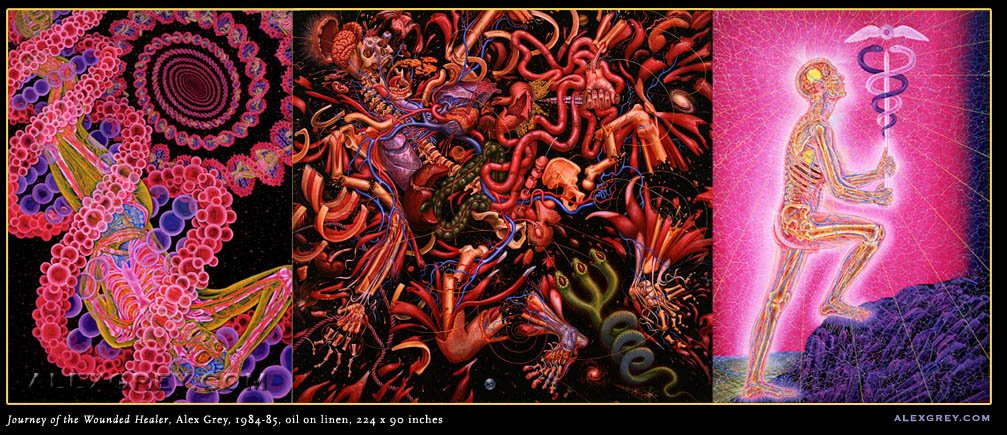
A series of paintings entitled The Journey of the Wounded Healer in Alex Grey’s visionary book, Sacred Mirrors, illustrates this process. We see a healer or potential shaman ascending a mountain. At one point he seems to be blown apart into a horrifically surreal explosion of body parts. This is a brilliant visual representation of the dark night of the soul (what the alchemists called the “nigredo”), the death of an ego identity, the necessary destruction of structure to create new form. Some initiates voluntarily chose to bring this on by self-created initiations—–fasting and wilderness isolation, hallucinogens, etc. There are advantages to the self-initiated metamorphosis in that it is consciously chosen, but there are also grave dangers.
A few years ago a very enthusiastic young woman told me how she was involved in a new education program for kids that would involve “tribal initiations in the wilderness.” Although not wishing to deflate her enthusiasm, I felt forced to tell her that actually she was talking about arts and crafts in the woods, that tribal initiations were impossible for any legally constituted school in our society because you would have to be willing to have some initiates die or go insane.
Self-initiations must be dangerous. If the self-initiate is fortunate, the danger proves lethal to ego structures but allows other healthy tissue to survive and reconfigure. But many self-initiations, just as those induced by the tribal collective, are shattering to the body and/or sanity of the initiate. There is always the danger that the self-initiate has presumed upon their inner strength, and like the naïve, young hero ends up devoured.
Another form of initiation is not self-initiated but is induced by the shocks that life supplies. (see the last part, “Dealing with Shock,” of A Guide to the Perplexed Interdimensional Traveler) Shamans often have histories of medical emergencies and/or other brushes with death in their youth. Another form of shock that could induce initiation is love shock. Someone with a great inner potential for consciousness may seek wholeness in the conventional way— through infatuation with another incomplete human—and in the shattering aftermath may sacrifice an identity and become more whole. An outcome of wholeness, however, is relatively rare. The more likely course is that one seeks another love object or becomes a depressed version of the former self.
Alchemists are self-induced initiates and well aware of the depth, scope and acute peril of what they undertake. Their endeavor could aptly be described by Galadriel’s words to the Ring Fellowship: “Your quest rests upon the edge of a knife. Stray but a little and you will fall to the ruin of all.”
What follows are a number of interesting quotes from Singer’s exposition on androgyny and alchemy:
“Gnosticism is Mater Alchimica, the Mother of Alchemy.”
“There was thought to have existed before Creation a chaotic prime substance. This was referred to in alchemy as the prima materia.”
“The intent of the alchemists, or so many believed, was to gain control of the prime matter and recombine it so that they could fashion substances of their own choosing and design. In other words, they would initiate their own process of creation. …they admitted that their work was an opus contra naturam. In this monumental task they were forever inveighing against hubris. …”
“…each metal had a Masculine or Feminine association that corresponded with the planetary power: gold-sun-Masculine, silver-moon-Feminine, copper-Venus-Feminine, iron-Mars-Masculine…”
“The alchemists worked in male/female pairs in a process referred to as the alchymical wedding”
“The crux of the process is the engagement with the prima materia, and this is symbolized in the problematic figure of “mercurious” in whom all things were supposedly combined. The opposites are present in him at the start of the process, but not yet differentiated.”
“Mercurius, also called Hermes, is not only the receptacle of the prima materia and the symbol for it, he is also the agent of transformation.”
“Mercurius is frequently depicted as an hermaphrodite, an image designed to reflect the nature of Divinity, which is ‘All in One.’ The mythical teacher Hermes Trimegistus, in revealing his secrets to Asclepius, says: ‘God has no name, or rather he has all names, since he is at once One and All. Infinitely rich with the fertility of both sexes, he is continuously bringing to birth all those things which he planned to create.’ The young healer god then asks: ‘What, you say that God has both sexes, Trismegistus?’ ‘Yes, Asclepius, and not God alone but all beings animate and vegetable.’”
“The elements with which the alchemists work are seen through the dark glass of symbol and metaphor as bipolar constructs: ‘Sun-moon,’ ‘sulfur-salt,’ ‘King-queen,’ ‘heaven-earth,’ ‘fire-water’ ‘living-dead,’ ‘open-occult’ and, of course, ‘Masculine-Feminine.’ The work on the soul is an integral, though not always stated or understood, part of the process. This means being able to commit oneself to the work, to put into a secondary space the purely personal and ego concerns (the psychological concomitant of the earth-centered world view) and to see oneself as part and parcel of the entire universe. The image to be held before one is that every act by every person has an effect on all, changing the delicate balance that keeps the universe in motion. Therefore, it was considered necessary by the alchemists to so conduct their work and their lives, which were really the same thing, as if the salvation of the world depended upon it.”
“The breaking down of substances into the prima materia would bring about the stage called the nigredo, which is characterized by the utter blackness of the original chaos. It is a period of destruction and despair, and it is absolutely essential to the process. It has its parallel in mystical literature as the ‘dark night of the soul’…akin to what is experienced by an individual as deep depression, either suffering a physical illness or beset by a dis-ease, a weariness of soul…The kind of healing they seek is what the word ‘healing’ essentially means; that is, ‘to be made whole’…The object of this stage was to bring about a condition where a new union could take place between opposites which have been broken down through the agency of operations personified in Mercurius.”
“From the Zohar (the classic Kabbalistic text) :…when they (the Masculine and the Feminine) unite, they look as if they were one body. From this we learn the Masculine by itself is like only one part of a body, and the Feminine also. But when they join together as a whole, then they appear as one real body.”
“….Therefore we know: what is only Masculine or only Feminine is called only part of the body. But no blessing rules over a faulty or incomplete thing, but only over a complete place, not one that is divided, for divided things cannot long endure or be blessed.”
The Gnostics and the Hindus, among others, saw the reality we experience as matrix or “Maya”—a deception or delusion. The awakened androgynous person is able to transcend this delusion:
“The Indians saw the world as a construct of the Great Goddess whom they call Maya, who measures out time and space, both in an important sense delusory.”
“…the embodied Self is freed from the enchantment of the flesh and passes into the sate of rapture known as samadhi.”
The paths of Kundalini Yoga, Tantra, T’ai Chi and Chi Gung are Eastern alchemical paths that open the possibility, for advanced initiates, to reconfigure themselves energetically and restore their lost androgyny:
“What is so strongly potent about Kundalini is the realization which it brings of the possibility for some individuals to come to a unity within themselves, a unity consisting of the interplay of energy and matter, the Feminine and the Masculine, the bodily experience and the spiritual experience. This path is difficult, arduous and demanding, but Kundalini Yoga offers one possibility for achieving one’s androgynous potential. It requires a rigidly ascetic discipline; it leads its adherents to the experience of our temporal world as illusory and of little value in comparison with the attainment of non-dual awareness of the ‘undivided Whole,’ the non-separability of the created and the Increate.”
“…the Buddhist Tantra stressed the androgynous being of the transformed, enlightened individual…”
The I Ching and Taoism are both centered on the principle of androgyny which is perfectly expressed in the T’ai chi symbol or yin-yang, where the Masculine (yang) and Feminine (yin) each contain their opposite and are dynamic parts of a unified whole. The sixty-four hexagrams of the I Ching are the sixty-four possible combinations of yin and yang lines into patterns of six. (for more on the I Ching see About I Ching)
Singer writes,
”If there were a ritual dance of the androgyne, T’ai chi as performed by this master could be that dance. It is neither a Masculine dance nor a Feminine dance. It has the strength and grace of both…The moving outward portion of the cycle belongs to the phase of the Masculine, Yang, the moving inward to the Feminine, Yin.”
“T’ai chi, the dance of life, can be done with the whole body, it can be turned into a work of calligraphy on a sheet of white paper, it can find its way into the art of painting, into music, into the cultivation of a garden, and into the act of love. Always it is the art of asymmetrical balancing, in which the flow between the opposites is so exquisitely smooth as to be almost indiscernible. The energy is never spent; it is always put forth and then drawn back. When the dancer stops he has more vitality than when he began.”
Singer discusses the two hemispheres of the brain, connected by a dense bundle of nerves, the corpus callosum, as parallel to the dual nature of human beings. In the following discussion, keep in mind as left and right are discussed that in right-handed people, the right hemisphere controls the left side of the body, the left hemisphere the right.
“In the early part of the present century, most brain research emphasized the superiority of the left hemisphere functions of the brain, primarily the intellectual, verbal, analytic capacities that tradition has associated with the Masculine mind.”
“In a study of the myth and symbolism of left and right, G. William Domhoff finds that the left is often the area of the taboo, the sacred, the unconscious, the Feminine, the intuitive and the dreamer.”
In Fritjof Capra’s book, The Web of Life, he emphasizes the dialectic of two great forces in nature—-the integrative and the self-assertive. Our society obviously idolizes the self-assertive tendency while more earth-based cultures emphasize the integrative. Singer discusses Arthur J. Deikman who seems to have had a similar conception,
“Arthur J. Deikman, in considering the infinite variety and rapid shifts of psychological and physiological states in an individual, concluded that there were two primary modes of organization: an ‘action’ mode and a ‘receptive’ mode. The action mode is the one that is organized to ‘manipulate the environment, while the receptive mode is organized around intake of the environment rather than manipulation.’ He points out the need for recognizing the relativity of the different modes, rather than assigning absolute primacy and validity to the one with which we are most familiar; namely, the ‘action’ mode.
Singer introduces Robert Ornstein’s research into the nature of consciousness,
“Ornstein expressed the view that it is the polarity and the integration of these two, the intellectual and the intuitive, that underlie some of the highest achievements of mankind.”
Singer and Ornstein would be the first to acknowledge that these two terms, intellectual and intuitive, are an oversimplification, but the need to efficiently language this distinction forces us into a certain degree of reduction. Recognizing this difficulty, Ornstein has prepared a chart to illustrate some of the ways the distinction between day-night, Masculine-Feminine consciousness has been understood by a variety of sources from the ancient to the modern:
THE TWO MODES OF CONSCIOUSNESS
A Tentative Dichotomy
| WHO PROPOSED IT? |
| Many Sources Day Night |
| Blackburn Intellectual Sensuous |
| Oppenheimer Time, History Eternity, Timelessness |
| Deikman Active Receptive |
| Polanyi Explicit Tacit |
| Levy, Sperry Analytic Gestalt |
| Domhoff Right (side of body) Left (side of body) |
| Many Sources Left hemisphere Right hemisphere |
| Bogen Propositional Appositonal |
| Lee Lineal Nonlineal |
| Luria Sequential Simultaneous |
| Semmes Focal Diffuse |
| I Ching The Creative: heaven The Receptive: earth
Masculine, Yang Feminine, Yin |
| I Ching Light Dark |
| I Ching Time Space |
| I Ching Verbal Spatial |
| Many Sources Verbal Spatial |
| Many Sources Intellectual Intuitive |
| Vedanta Buddhi Manas |
| Jung Causal Acausal |
| Bacon Argument Experience |
What Becoming Androgynous Means on the Personal Level
The emphasis on words may abstract the living reality of these forces. Understanding how these forces work in you and others is necessary to ground this distinction. Using myself as example: It took me a while to recognize the androgynous nature of my own mind as I was brought up in a family and culture that emphasizes the intellectual, analytical, and verbal modalities as the leading edge of perception and that which validates insights. When I was younger I identified with that side of mind and didn’t recognize what now seems obvious—–intuition was always the leading edge of my mind, the analytic and verbal followed behind processing the information streaming in from intuition. I have also noticed that others frequently misperceive me in the same way that I misunderstood myself: because I was brought up to favor a mode of detached analysis, people hearing me talk, or reading what I write, often have the false impression that what I am communicating is the result of a sequence of analytical thoughts. Actually the primary process is intuitive, and analytical thinking and verbalizing come in as a secondary process. Since the “finished product” is often a set of words presented in a tone of detached analysis, the secondary process is the more visible and manifest and seems to be the driving force. Now that I have recognized that my mind is a melding of intuition and analysis I have also shifted to discussing ideas (at least some of the time) in a more intuitive, surreal style (Stop the Hottie!, and Vision at Chichen Itza are examples). (Note: those titles and some others in this essay are links even though they are showing up in the same color)
One of the general implications of my particular case is that the process of becoming androgynous is largely a matter of inner recognition rather than transformation. I was always more intuitive than intellectual, but recognizing that allowed me to transform, to become more who I always was in my essence, and that process is not finished; as I age I notice that I am becoming more and more comfortable with allowing intuition to be the leading edge.
Often I find that the most intelligent people I meet have identified with their thinking process. Intuition often tells me that these people are powerfully intuitive, but some inner bias in them causes them to discard intuitions. My intuition senses their intuition as active and online, and it used to shock me when I would catch on that they were not reading or accessing their intuitions, because they have a prejudice that this source of information is not as valid as thinking. I find myself trying to communicate to these unrealized intuitives how much more empowered they would be if they learned how to meld intuition and intellect so that intuition was the leading edge (see discussion of the hierarchy of psychic functions in A Guide to the Perplexed Interdimensional Traveler).
A less perceptive sort of person I frequently run into in counter cultural circles has rebelled from the intellectual and analytical altogether, dismissing it as a patriarchal constraint. They believe themselves to be beyond the intellectual when they are actually not up to its mark, so they prefer to scorn that which they desperately need, but in which they are desperately incompetent. This rebellion does not, of course, empower their intuition but rather turns their psyches into a lunar landscape of complete confusion where discernment is entirely lacking. They falsely believe they are involved in occult or metaphysical study when actually their minds consist of a mushy hodgepodge of fragmented urban legends, “can you top this” bits of pseudo-esoteric lore, New Age clichés, etc. Their “study” mostly consists of narcissistically excited bull sessions in which they proffer bits of this inner refuse to anyone that will join them in kind or even pretend to listen to them. They personify what Singer identifies as “hermaphrodites” rather than androgynes. The androgyne, however, values and is skilled in intuitive and intellectual abilities.
Singer credits Ornstein with recognizing that the passing age is characterized by its tendency to polarize the left and right, the lunar and solar modalities of consciousness. You are either a “serious” scientist or thinker or you are an artist, mystic or freak. But the present dilemmas and Swords of Damacles hanging over our heads will not be understood or addressed by those who work out of only one hemisphere of consciousness. We need people, like Jung, who had both hemispheres firing, the androgynous mind, to comprehend what is happening to us.
A radical surgical treatment for grand mal epilepsy involves severing the corpus callosum (the dense bundle of nerves connecting the two hemispheres of the brain). It was discovered that these two hemispheres, each of them connected to a different eye, were forced to work independently so that when patients who had undergone this procedure closed one eye they could read words but not comprehend pictures, and if they closed the other eye they could recognize pictures but not name what they were seeing. Singer makes an excellent point that this surgical procedure can be viewed as the ultimate symbolic act of the age of Pisces, the Age of Polarities. The Internet, which in just a few years has come to be a global central nervous system, may be seen as a technology of the Aquarian Age since it wires everyone together. Also, since it involves word, sound and image it has the potential to engage both hemispheres and to wire many billions of brains or psyches into one interconnected system.
Singer suggests that Systems Theory may be a mythology of the Aquarian Age which she expects to be an age of androgyny. Although as a Jungian Singer recognizes mythology as a far more substantial thing than the way most people hear that word (many people hear it as: a bunch of nonsense and superstition), I think that Systems Theory might more aptly be called a paradigm of the Age of Androgyny. Singer writes,
“As we move into the Age of Aquarius (which may come to be designated as the Age of Androgyny), no one would be surprised to discover that a new myth is emerging. Naturally it manifests as have all the other myths, in the guise of a “sacred truth”; only this time the truth is designated as science: The Systems View of the Universe. Systems theory does not announce itself as a mythology; no mythology ever does.”
One Sidedness Versus the Integrated View
Indeed, Systems Theory does seem like an inevitable evolutionary correction of Western thought and science which has gone to such extremes in dividing, reducing, and compartmentalizing knowledge and investigation. Systems Theory recognizes what the I Ching long before recognized, that everything is a pattern of energy and change embedded in other patterns of energy and change interwoven with all patterns of energy and change and harmonizing with the principles of energy and change found everywhere.
As Singer puts it,
“….the universe is not lying in fragments at the feet of the philosopher. Nor are the polarities ‘worlds apart’ in reality. The world is characterized by a remarkable degree of consistency and coherence. If we do not see it that way, it is because of the limitations of our own capacities—the elephant is not divided into pieces because the blind men are only able to sense its parts.”
Inner and outer are not the irreconcilable opposites which they were for Descartes and are for many in science,
“Inwardness, called “psyche,” and outwardness, called “world” may appear to be in opposition to one another. From a more encompassing viewpoint they may be seen simply as two systems, one subsystem contained within another larger system.”
“….We need to recognize that we are members of an interrelated series of systems which all obey the same principles and have a common theme. “
Some people in the New Age, particularly those who have dabbled in Eastern practice, have swung with the pendulum of enatiadromia to a new extreme or one-sideness. They will monotonously insist on the oneness of everything no matter what is being discussed, and use this obvious reality as a way of leveling all difference, distinction and discernment. This point of view can be even more limiting than the tunnel vision of the reductive thinker, since at least the reductive thinker is still thinking about and investigating something, no matter how much they miss the infinite, interelated context of the something. This type of New Ager, however, takes oneness as a truism that relieves them of the need for thinking, discrimination and discernment and pulls oneness out of a hat, like the most tired of magician’s rabbits, whenever any issue requiring discernment appears. Recognizing that individuals or groups that are in conflict are part of the same oneness is crucial, but it is also crucial to recognize their individual differences and what sets them apart. The great American pioneer psychologist William James wrote more than a century ago that besides the oneness of things, anyone who glances at the phenomenal world should also be struck by the eachness of things. We see a world of unique individual trees and people, for example, and not an homogenous mass of treeness or undifferentiated pool of humanity. The androgynous mind recognizes that there is both oneness and eachness, these are the two poles of the paradox that must be held in mind to understand both interrelation and individuality. (See Dynamic Pardoxicalism and Lessons for an Entity Incarnating as a Mammal for more on the dynamic paradox of eachness and oneness)
Quite often the same person who is a proponent of the oneness of things will unconsciously switch to reductive dualism and the next minute be preaching to the choir of like minded friends about the badness (and implied otherness) of corporations, environmental destruction, etc What is really maddening is talking to the New Age person who, if they are not preaching about the oneness of things, are telling you about the badness and wrongness of everything they don’t like (always something human associated) which they will inevitably damn with their harshest of epithets, their version of the Mark of the Beast, the fiery brand of “unnaturalness.” Whenever you hear the words “natural” or “unnatural” being used you are almost certainly in the presence of sloppy thinking. The Fundamentalist tells you, for example, that homosexuality is unnatural though it is displayed by about 450 species. Often the same people who condemn the simple-mindedness of the Fundamentalist will tell you that everything modern technological man does is unnatural. From my point of view, nothing is outside of nature. Therefore nothing is unnatural or supernatural. Mother nature created, as Terence Mckenna put it: “a technology extruding primate.”
Of course, what I just said is still only one side of the paradox, there is a meaningful discrimination to be made between, for example, eating a toxic diet of processed foods and eating a diet of live, organic whole food. But furless primates who choose to eat poison are still part of nature, part of the Tao, and what doesn’t make sense to someone’s preferences, may make perfect sense if understood out of the judgment box and seen as part of an unexpected web of connections. (For more on the false use of “natural” see A Guide to the Perplexed Interdimensional Traveler ).
Singer quotes one of the original systems theorists, Buckminster Fuller:
“What seems to be important at the moment is never what is really going on. For the bee, it is the honey that is important; for Nature, what matters is the cross-pollination the bee effects in going after the nectar. So also, 99 per cent chromosomically programmed humans have been doing the right things for the wrong reasons. What we think of as side events are really Evolution’s main events. How events and discoveries will cohere is unforeseeable. The one sure thing is that cohere they will. The “Planner” incarnates the human mistake of supposing that Universe is waiting for human beings to make the major evolutionary decisions.”
Of course, Buckminster’s statement is flawed since bees are obviously not separate from nature, but the principle is sound. As Singer points out,
“Fuller is the generalist par excellence…One of his favorite principles is synergy, a word that means the unexpected interaction of parts in combination”.
An Androgynous Mind is a Generalist Mind
Jung, himself a master generalist, decried the growing prevalence of soulless experts which increasingly characterizes our society (see “Crossing the Great Stream…” an article I wrote for Holistic Education Review). The “expert” is almost the opposite of the androgyne. The focus on expertise in academics and science tends toward that well known syndrome of knowing more and more about less and less until you know everything about nothing. The androgynous mind is a generalist mind, it may have expertise in certain areas, but will not become so married to its expertise that it will be unable to see the gestalt of things, it will instead be able to thrive on the serendipitous synergy of different fields of knowledge. This is what characterizes a great Renaissance thinker, and androgyne, like Leonardo Da Vinci who was creative in arts and sciences. Another of the great Renaissance androgynes is William Shakespeare. His androgyny is not reducible to his bisexuality (the classic love sonnets were written for a male youth), it is his ability to project himself empathically and with great penetration into such a wide spectrum of human types of every age and gender. Shakespeare pioneered the rediscovery of androgynous “Green Worlds” (see A Splinter in Your Mind ). When the characters in As You Like It find themselves in the Green World of the Forest of Arden, gender bending ( a boy plays a girl who plays a boy who pretends to be a girl) becomes the key to unlock their various neurotic dilemmas. Although androgyny may seem to be worked out interpersonally, remembering that Shakespeare created all the characters from within you can see As You Like It as manifestation and realization of his own intrapsychic androgyny.
Androgyny and Auto-Eroticism

There is a strange way in which my interest in androgyny, the Tolkien Mythology and Singer’s book intersect, and oddly enough it has to do with masturbation (hereafter I will omit the word masturbation and instead use auto-eroticism which is not a euphemism, but a more accurate term, as masturbation defines only a physical act of manipulating genitals while auto-eroticism encompasses a type of eros with much larger implications.)
For most of the time I’ve had a connection with The Lord of the Rings trilogy, since I was twenty or so, I was extremely uneasy about the ring symbolism of the trilogy. Since the ring is a circle, and the circle is the classic symbol of wholeness and the Self (the Sankrit definition of God is: “A circle whose center is everywhere, and circumference is nowhere”) I was rather suspicious of the need for it to be destroyed. I was aware of Tolkien’s orthodox Catholicism and felt that it might be the source of Tolkien’s antagonism toward any human, or human-like individual possessing a symbol of divine wholeness. I felt that Tolkien’s hostility toward the ring came from a problem with what I call “mislocation of the Godhead.”
I am minimizing here the use of the word “God” because it is contaminated by anthropomorphisms and emotionally charged projections of such variety that using the term only invites confusion and tends to widen the gap of miscommunication between the person employing the term and their audience. Instead I am using the term “Godhead,” which has various dictionary definitions, but I am using it to mean: that which is divine and the source of divine emanation. Like all definitions this is imprecise and circular, but hopefully the meaning will emerge.
Locating the Godhead and the Monad
From my point of view, the location of the Godhead should be oriented like some of the more recent interpretations of the Sanskrit salutation “Namaste.” A popular (if nontraditional) version is sometimes translated as: “I honor the Spirit in you which is also in me.” You recognize the Godhead in the other, but also recognize that is within you and everything else. This location of the Godhead is like the Sanskrit definition of God as a circle whose center is everywhere and whose circumference is nowhere. If your location of the Godhead, however, is asymmetrical, if it is unevenly distributed, you get major schizoid splits and often violent outcomes. If I locate the Godhead exclusively in me than I will tend to become an Anti-Christ, a psychopath, a Wall Street executive looking out for “number one.” For this type, their ego is the only subject, and everything else in the universe is real estate, livestock or the hired help. On the other hand, if I externalize the Godhead onto a savior, a sky god, or something like that, I tend to feel that everybody is a wretched sinner compared to this Godhead shining in the sky. Since God is said to be the summum bonum —the source and principle of all good and utterly without taint, then I need to find the dark side of reality carried by someone else. I need scapegoats to carry the dark side of reality which I don’t want to attribute to my savior or sky god who is supposed to be entirely outside of the dark principle. Ultimately this can fill me with feelings of conviction that some sort of blood bath is necessary to please God, and so forth. (see Jung’s book Aion for more on this schizoid split that is especially apparent in Christians (except Gnostic Chrisitians).
Viewing everything as the Godhead may be the position most in accord with the findings of physics. Once the “monad,” or indivisible constituent of reality, was believed to be a small particle. This was first postulated by the Greek atomists. The word “atom” comes from the Greek “atomos” which means uncut. An atom, as the early Greek philosophers saw it. was the uncuttable, indivisible constituent of physical reality. The belief in atoms as the monad fell apart by the time of Einstein, when matter was shown to be not a particle but a special case of energy. Matter turned out to be mostly empty space and a more congealed form of energy. The universe came to be recognized as a flow of patterned energy. Now many physicists are saying that the universe is more accurately considered a flow of information. Physicists Fred Alan Wolf and Amit Goswami go a step further and say that if you posit the monad as consisting not of matter, energy or information, but of mind, of consciousness, then all the paradoxes of quantum mechanics vanish. This is what I believe—-everything is the Godhead and everything is composed of consciousness.
Many Christians (and orthodox Catholics would especially tend toward this) do not view the Godhead everywhere but see a very uneven distribution of it; mostly they locate it in God the Father and his son, Jesus. This relocation of the Godhead into two male identified figures is part of a strange evolution of mythologies:
Joseph Campbell’s five-volume study of mythology, published under the general title of The Masks of God, contains in each of its volumes an extraordinary record of the ancient shift from matriarchy to patriarchy. The shift is schematized by Campbell in four steps as follows:
1. The world born of a goddess without consort,
2. The world born of a goddess fecundated by a consort,
3. The world fashioned from the body of a goddess by a male warrior-god,
4. The world created by the unaided power of a male god alone.
(Heilbrun/ Toward a Recognition of Androgyny)
The Schizoid Split of Christianity
Many forms of Christianity (but not Gnostic Christianity) moved toward a massive schizoid split which fractured every layer of reality—–cosmological, spiritual, psychological, sexual—-it split men from women, Masculine from Feminine, light from dark, mind from body, Christian from nonChristian. This split was caused by the drastically uneven distribution of the Godhead. God the Father and Jesus became ever more divine and perfect, the “summum bonnum” and all darkness, through ever more tortured reasoning, became the fault of Satan, humans through “original sin,” female witches, the Jews… As white light came to glow around father and son, man and human nature (though created by God and in his image) came to be seen as blacker and blacker. Divinity was almost exclusively in the two male Gods, and humans were dust and corruption. One apotheosis of this insane split was American Puritanism. Among the most classic expressions of this madness are the hellfire and brimstone sermons of the Puritan minister Jonathan Edwards (1703-1758). The schizoid split in Puritans became so extreme that it resulted in the most pathological projections. Women were burned as witches (nothing new there, Europe had burned several million) and human beings were so dark and repellent that God could scarcely hold himself back from damning them to eternal punishment in hell for even one more moment. Here are some excerpts from Edward’s most well known sermon, “Sinners in the Hands of an Angry God”:
“The God that holds you over the pit of hell, much as one holds a spider, or some loathsome insect over the fire, abhors you, and is dreadfully provoked: his wrath towards you burns like fire; he looks upon you as worthy of nothing else, but to be cast into the fire; he is of purer eyes than to bear to have you in his sight; you are ten thousand times more abominable in his eyes than the most hateful venomous serpent is in ours. You have offended him infinitely more than ever a stubborn rebel did his prince; and yet it is nothing but his hand that holds you from falling into the fire every moment. …There is no other reason to be given why you have not gone to hell, since you have sat here in the house of God, provoking his pure eyes by your sinful wicked manner of attending his solemn worship. Yea, there is nothing else that is to be given as a reason why you do not this very moment drop down into hell. …Your wickedness makes you as it were heavy as lead, and to tend downwards with great weight and pressure towards hell; …He will not only hate you, but he will have you, in the utmost contempt: no place shall be thought fit for you, but under his feet to be trodden down as the mire of the streets. …It is everlasting wrath. It would be dreadful to suffer this fierceness and wrath of Almighty God one moment; but you must suffer it to all eternity. There will be no end to this exquisite horrible misery. When you look forward, you shall see a long forever, a boundless duration before you, which will swallow up your thoughts…and you will absolutely despair…You will know certainly that you must wear out long ages, millions of millions of ages, in wrestling and conflicting with this almighty merciless vengeance; and then when you have so done, when so many ages have actually been spent by you in this manner, you will know that all is but a point to what remains. So that your punishment will indeed be infinite….this is the dismal case of every soul in this congregation that has not been born again, however moral and strict, sober and religious, they may otherwise be. …The wrath of God burns against them, their damnation does not slumber, the pit is prepared, the fire is made ready, the furnace is now hot, ready to receive them; the flames do now rage and glow. The glittering sword is whet, and held over them, and the pit hath opened its mouth under them. The devil stands ready to fall upon them, and seize them as his own…”
A Question Few Christians Ask
Jung, a Christian and the son of a Protestant minister, had the courage to ask himself a question that few Christians have ever had the courage to ask themselves: Why has more blood been spilled in the name of Christianity than anything else in human history? Jung considered this question in his book Aion, and basically concluded that by removing all darkness from creator and messiah a schizoid split was created which required a feverish need for shadow projection, a need to locate darkness in some human group that would serve as scapegoat. Once you created an all white light Jesus, then unconsciously you needed to create as his twin— antichrist— to counterbalance this one-sidedness.
Why Destroy the One Ring?
For more than twenty years I suspected that the need to destroy the ring came from the schizoid disempowerment of locating the Godhead outside the Self. As an orthodox Catholic Tolkien would tend to think that recognizing divinity in the Self would swing the pendulum of enantiodromia to the other one-sided extreme of antichrist. Even today I believe that this is a factor in his ring symbolism.
When I was twenty I recognized a parallelism between the need to destroy the One Ring, and its corruption of any ring bearer, with the harsh Catholic taboo against auto-eroticism. Freud pointed out a crucial difference between what he called “primitive” man and modern man in their perception of sexual energy. The primitive worshipped the mysterious fire within, while the modern man worshipped the beloved, the object on whom the fire was projected. In other words, our eros had become configured or conditioned so that we project power outwards. Just as with Christianity (except Gnostic Christianity), where divinity was projected outside the Self onto an all perfect God or messiah, sexual fire was projected onto an idealized, external love object. From the age of Chivalry to Victorian times, and even in some rare cases to this day, a classic form of this projection was for a male to feel his desires “unworthy” of some idealized woman whom he thought “too pure for this world,” certainly too pure to have any sexuality of her own, etc. ( See No Tristans Allowed Beyond this Point—Debunking the Modern Myth of Romantic Love for much more on this) This form of schizoid eros parallels the schizoid projection of the Godhead as outside the Self and residing in an all white light divine figure. To the extent that the Feminine was recognized as divine at all it was in the inflation of Mary, mother of Jesus (who in the Bible Jesus treats rather contemptuously) into a demigod, a distant fourth in the otherwise male field of three (father, son, holy ghost) that comprise the Catholic Trinity. Also the earthy and dark side of the Feminine were edited out and she became the “white Madonna,” a virgin mother too pure for sex, etc.
Breaking the Prime Commandment of the Matrix
What makes auto-eroticism so horrifying to this schizoid mind set is that the human personification of Godhead, the beloved, is not necessarily projected into the external world or into an assigned mythology, but is instead generated internally by the individual. A person engaging autoeroticism is generating both subject and object, and is partaking in the potential sacrament of orgasm without the mitigation of individual power by an external person, institution of marriage, Church delivered sacrament, etc. No control system wants the individual to be so empowered and able to close the circle within themselves. In the Catholic Church, to this day, birth, marriage and even death require priestly sacraments— i.e. authorization by external authority. A control system wants you to always be seeking fulfillment, love, security, salvation outside, out in the society and institutions that it controls, so that you become an object of control within the system. This is the prime commandment of the matrix: Thou shalt not exercise the ability to generate your own reality, but shall abjectly submit to the reality created for you. George Bernard Shaw seemed to understand this when he said, “”The reasonable man adapts himself to the world. The unreasonable one persists in trying to adapt the world to himself. Therefore, all progress depends on the unreasonable man.” The “reasonable” person is the one who submits to the matrix, the control system, the “unreasonable” person is the androgyne, the person who is aware of themselves as cocreator.
I believe it is appropriate to redefine masturbation and autoeroticism to parallel the way Singer has redefined hermaphrodism and androgyny. The conventional form of masturbation common in our culture involves the same kind of projection of power outside the Self as it practices with interpersonal sexuality. An idealized beloved (or in promiscuous, materialist contemporary society—-a “hottie”(see Stop the Hottie!) becomes the subject of externalized focus as if he or she were the energy source of the autoerotic experience. As in the hermaphrodite, this type of masturbation is characterized by the confusion of Masculine and Feminine rather than the integrated fusion of them in the androgyne. Autoeroticism, as I am redefining it, means androgynous autoeroticism, and that means that the individual is conscious of both the content of the fantasy and of themselves as the creator of all parts of the fantasy. This means that the autoerotic person would be conscious of themselves as both subject and object, lover and beloved, Masculine and Feminine, and whether they generate a lover of the opposite or same sex, no one at all, or any other possibility, they are consciously closing the circle (wielding their own ring of power). The androgyne in an autoerotic experience realizes that they have the power of the shape-shifter to be in any body they deem appropriate as well as to generate a lover in whatever form is desired. They also realize that their point of view is not bound to the subject, but may travel back and forth between the created lovers if they feel so drawn.
Orgasms that are not merely the result of genital stimulation may in some cases be experienced as a sacrament, as a participation mystique with the universe where one emerges into an energy body that is interpenetrated with the universe. That such a sacrament could be experienced by an individual without permission or reference to outside power and authority is horrifying to a control system which demands that power in all circumstances be projected outside.
I am not trying to disproportionately glorify the autoerotic experience as compared to the interpersonal sexual experience or the person who abstains from any form of sex. All experiences may be sacred or profane depending on the experiencer and the context. Indeed, for some an excessive indulgence in the autoerotic could be a version of the dark side of the uroboros archetype, the snake swallowing its own tail. A given individual, at a given time, might need the interpersonal to be more powerful to pull them out of themselves, etc. What I try to emphasize whenever I talk or write about eros is that ONE SIZE DOES NOT FIT ALL! If there is one obvious fact about human nature and human eros that is most neglected, it is respect for its fantastic variability. Human situations need to be examined from a much more case specific point of view.
I also find it interesting that masturbation taboo is to a partial extent multicultural. Singer points out the prohibitions against masturbation in numerous cultures and spiritual disciplines including Taoism, kundalini Yoga and Tantra and states that it has no basis in human anatomy, suggesting that is based on archetypal material. From the point of view of the Eastern energetic alchemies of Tantra and Chi Gung, ejaculation by males is in most cases viewed as extremely detrimental. While these systems have, in other ways, a very sophisticated understanding of human energy, when it comes to male orgasm they seem to view the energy system not as an open flow of energy, but as a closed system with limited resources which each ejaculation permanently diminishes. But the body creates seminal fluid to be ejaculated and not to be indefinitely retained where it can putrefy and cause infection. Dr. Andrew Weil (go to drweil.com and type “masturbation” into the search engine) reports on an Australian study which finds that men who masturbate are 30% less likely to develop prostate cancer than those who don’t! Anybody who knows how hard it is to find detectable statistically significant correlations with many health factors will tell you what a gigantic differential this 30% is.
I am not suggesting that there is no truth to the position of Tantra and Chi Gung on ejaculation, but I am asserting that it is a one-size-fits-all formulation. Indeed, excessive ejaculation can be draining, particularly when conditions are more yin and less yang. Aging makes one more yin, and therefore older males need to ejaculate less than younger males. Also, during winter, which is much more yin, ejaculation may be more depleting than during the height of summer which is far more yang. Again, the case specific points of view, as well as general formulations, need to be considered. When ejaculation is interpersonal, rather than autoerotic, there are all sorts of other factors to be considered. There are significant numbers of people of either gender who are able to drain another person’s energy (see Mind Parasites, Energy Parasites, Vampires). Excess ejaculation, like an excess of anything, can be detrimental, but the phobic, horrified, over-the-top warnings and prohibitions against masturbation indicate schizoid projections.
One of the aspects of June Singer’s book that most resonated with me were her very parallel findings on autoeroticism. Singer implies a parallelism between androgyny and autoeroticism as both are subject to taboo and secrecy:
“If androgyny has remained submerged over the centuries, then masturbation has been similarly ubiquitous and nearly as secret.”
Especially fascinating is that Singer connects autoeroticism to the Tree of Knowledge in almost exactly the same way as Terrance McKenna connected it to hallucinogens. Terrance would sometimes refer to the expulsion from Eden as, “history’s first drug bust.” As Singer puts it:
“From earliest childhood on into youth and maturity, masturbation is an act of self-assertion, the object of which is a movement in the direction of independence… Masturbation and the prohibitions against it can be viewed in connection with the legends that are told about the Tree of Knowledge. Here, also, the issue is the potential independence of the individual from the more powerful Other. There is the prohibition against eating the fruit of that tree because if Adam and Eve do eat of it, they will learn the secrets of carnal life, which are allied with the secrets of creativity. This knowledge would make them like the gods; that is, powerful and independent….The God who prohibits eating the fruit of the tree which enables humans to know good and evil may be afraid they will begin to believe that they can become self-sufficient if they can meet their own sexual needs through self-manipulation.”
Singer connects autoeroticism with the individual partaking of a forbidden independence and power. She quotes a patient:
“That was the first time I remember that I ever masturbated to orgasm. It was a great feeling. For the first time I was feeling in control of my sexuality”.
Those seeking to shame and discourage people from masturbation portrayed it as having the most dire consequences for physical and mental health. As recently as the Fifties, young men were commonly told that they would go blind or insane. The parallels between these absurdly over-the-top and blatantly false warnings, and the Refer Madness type propaganda used to scare young people away from marijuana and other hallucinogens, are quite striking. Engaging in autoeroticism or hallucinogen use can in some cases be an appropriate assertion of power to be your own alchemist, to engage in highly mood-altered energetic practices outside of social sanction or control.
Singer points out that autoeroticism can actually be a practice that, engaged in the right way, can produce healing and lead toward wholeness and creativity:
“Masturbation can provide a person with the intensely felt experience of being the lover and the beloved at the same time. The experience can be a total one if accompanied by fantasies that are healing; that is, ‘making whole.’ It provides also a stimulus for creativity, reminding us of the Egyptian creation mythology in which creation proceeds from a masturbatory act. Here giving and receiving, activity and receptivity are combined. There is great freedom in knowing that one can be whole in one’s inner life, and that this wholeness need not depend absolutely upon a relationship with another person.”
“The difference is that the masturbation that belongs to the androgyne’s experience is performed consciously; the reason for it is understood and accepted; and it is entered into with the fantasy which allows the soul to participate in the experience of the body without guilt or shame.”
Subcreation
An aspect of autoeroticism that associates it with the Tree of Knowledge, and that would particularly anger the gods of patriarchal control systems, is that the individual is exercising his or her power to “subcreate.” “Subcreation” is a term introduced by Tolkien in his essay on fairy stories as his way of acknowledging that the fantasy writer is generating a creation, a subordinate reality within the larger creation of God. Tolkien’s creation of this term, and the way he employs it, reflects a certain ambivalence toward creativity, and may partly explain his dark view of the One Ring. Tolkien acknowledges that fantasy writing at its highest level is a profound act of creation, a birthing of a parallel reality. But as an orthodox Catholic who locates the Godhead more outside than inside, he is careful to put “sub” before it and emphasizes that the fantasy creation is a derivative subset within God’s creation. Tolkien tells us that subcreation is a natural human right and divine, but also warns about hubris and the tendency for power to corrupt and to be used wickedly:
“Fantasy is a natural human activity.”
“Fantasy remains a human right: we make in our measure in our derivative mode, because we are made: and not only made, but made in the image and likeness of a Maker.”
“Are there any ‘bounds to a writer’s job’ except those imposed by his own finiteness? ….humility and an awareness of peril is required…
The right to ‘freedom’ of the sub-creator is no guarantee among fallen men that it will not be used as wickedly as is Free Will.”
Tolkien also seems to suggest that subcreation can never be an entirely original creation because it must be derivative of “Reality” which he capitalizes. Tolkien may have thought that his own creation of Middle Earth was more a matter of unearthing something or channeling a lost reality:
“Probably every writer making a secondary world, a fantasy, every sub-creator, wishes in some measure to be a real maker, or hopes that he is drawing on reality; hopes that the peculiar quality of this secondary world (if not all the details) are derived from Reality, or are flowing into it. If he indeed achieves a quality that can fairly be described by the dictionary definition: ‘inner consistency of reality,’ it is difficult to conceive how this can be, if the world does not in some way partake of reality. The peculiar quality of the ‘joy’ in successful Fantasy can thus be explained as a sudden glimpse of the underlying reality or truth.”
Tolkien wrote to W. H. Auden” ‘I am a West-midlander by blood, and took to early West-midland Middle English as to a known tongue as soon as I set eyes on it.’ Tolkien felt he had an ancestral knowledge of this language that was just waiting to be activated. He gave voice to these feelings in his experimental story “The Lost Road:”
Alboin was trying to explain his feeling about ‘language atmosphere’. ‘You get echoes coming through, you know,’he said, ‘in odd words here and there —often very common words in their own language, but quite unexplained by the etymologists; and in the general shape and sound of all the words, somehow; as if something was peeping through from deep under the surface.” (p. 40, The Lost Road and Other Writings, edited by Christopher Tolkien, Boston Houghton Mifflin Company 1987)
But Tolkien also discusses another realm of reality where subcreation is more powerful and divine. He calls this realm “Faërie,”
An essential power of Faërie is thus the power of making immediately effective by the will the visions of ‘fantasy.’
In Faërie, imagination and manifestation are melded and this seems to locate the Godhead, the source of manifestation, closer to the individual, because in Faërie the individual’s imagination is like the mind of God; it has the power of instantaneous manifestation. Even more than the hallucinogen experience where the experiencer typically feels that they are the recipient of vision rather than the conscious creator of it, the auto-erotic experience may be seen as existing closer to Faërie than the ordinary realm. The person able to generate a vivid auto-erotic fantasy, which produces measurable physiological effects in the fantasizer, is asserting the essential power Tolkien attributes to Faërie: “…the power of making immediately effective by the will the vision of ‘fantasy.’”
To be “effective,” the manifestation does not have to have weight or occupy three dimensional space. Few effects are as powerful as orgasm. This imaginal effectiveness is a forbidden power that may cause the gods that rule society and the collective baseline of human consciousness to become jealous, competitive, angry and fearfully vindictive.
For more than twenty years I saw the need to destroy the One Ring as analogous and parallel to the Catholic taboo on autoeroticism. Being able to access the imaginal plane to generate your own orgasms was unconsciously recognized as too much power for the individual and a forbidden internalization of the Godhead. In the Lord of the Rings movies, which I think were brilliant visual and dramatic amplifications of the Tolkien mythology, we see Frodo (personified in a more youthful and androgynous form than in the books ) secretly and guiltily stroking the One Ring as he lies in bed at night in a way that is obviously intended to evoke guilty masturbation. Tolkien’s mythology reflects his ambivalence about subcreation, which he affirms as a human right but also thinks might be too much power for fallen man to wield.
On Christmas Eve. of 2002 I watched the first Lord of the Rings movie, magnificently realized by Peter Jackson and an army of gifted people. But this was not the first time I had seen the movie, far from it, it was more like the eighth or ninth time, and it was my second viewing of the extended DVD version. Early on in the movie, there was a fifteen minute period where, unexpectedly, a flood of intuitions and realizations about Tolkien’s mythology and the meaning of the ring cascaded through my mind. The view I had of the need to destroy the ring seemed to fold in on itself and reverse.
First, I had an intuition that seemed to reinforce my earlier point of view. I saw that the ring was an androgyny symbol, a multi-layered T’ai Chi symbol, or yin-yang. The ring’s yin or archetypal Feminine aspect is its coital roundness meant to be penetrated by a finger. Its archetypal Masculine aspect is its solar goldness. This I had already realized, but now I saw that like the black yin dot in the white yang, and the white yang dot in the black yin, its Feminine aspect was carried in its geometric shape, and geometric shapes are part of the dimension of pure form associated with the Masculine. Its Masculine aspect was its goldness and that was carried by its materiality, and materiality is associated with the Feminine. The next layer of the One Ring as Tai’Chi symbol is that it is composed of both matter, the most dense, heavy and impervious of metals, grounding it into the Feminine realm of corporeal, gravity-bound bodies, but it is also composed of language, and when exposed to the yang element of fire, words of power glow as fiery runes, and both language and fire are etherialized elements and aspects of the Masculine.
Next in the chain of intuitions was a realization about Sauron’s relationship to alchemical gender. His form, brilliantly realized in the movie, is a red eye of fire atop a tower. This form is the perfect realization of Masculinity completely untempered by the Feminine, the furthest position possible from androgyny.
Chthonic Phallic versus Solar Phallic
Jung identified two poles or types of Masculine power. The first type is the “lower” or “chthonic phallic” Masculine energy. This type of Masculine power is identified with male genitals, machismo, the linebacker, the stud…but it can also be identified with an animal like a bull. This type of Masculine energy is closer to earth and the animal realm and therefore is the far more Feminine type of Masculine energy. The higher, or solar phallic, Masculine energy is associated with the power of the mind, the will, the penetrating gaze, the sword of discernment, Apollo, the larger head rather than the smaller head in male anatomy, etc. The best animal representation of this power I can think of is the bald-headed eagle (whose coloring emphasizes its head) which soars above the earth and has the sharpest, highest resolution eyesight of any animal. (For more on these two poles of phallic power see The Psyche as an Oscillating Entity in Thomas Hardy’s Jude the Obscure)
In the books, a human personification of the virtues and weaknesses of lower phallic power is Boromir who is described as, “…taking no wife and delighting chiefly in arms; fearless and strong, but caring little for lore, save the tales of old battles.” He has plenty of phallic courage, but his mind and will are weak, and he is easily corrupted by proximity to the ring. Lower phallic power is perfectly embodied in the movie version by the great Uruk-Hai Orc that Saruman manifests out of a pit of slime in the earth. This Orc embodies physical aggression, looks like a linebacker crossed with various animal essences, and doesn’t know anything more than it needs to. It has no will of its own, no solar phallic power, and it is completely ruled by Saruman, who, after Sauron, is the character most completely ruled by the solar phallic. Saruman also lives in a great phallic tower (hence the title of the second book, The Two Towers), and has a “mind of metal and wheels” and “…does not care for growing things, except as far as they serve him for the moment,” and, like Sauron, is ruled by an electrified will to power.
When Jung was a child he had a disturbing vision. He entered a tree that was like a cave and found himself in a great chamber. On a throne sat a huge column. The column was a gigantic anatomically correct penis except that at its top was an eye and the head of the penis was surrounded by a glowing aura. Consider how close Jung’s archetypal vision of the solar phallic is to Sauron, an eye of fire atop a great tower. Sauron’s glyph is a red eye. Sauron is the embodiment of the Luciferian will to power. He is so divorced from the Feminine and the earth that his physical form, a red eye of fire, is almost non-physical. Corporeal, flesh-based bodies are mostly water, all fetuses begin as female, but Sauron has no water, no Feminine. Sauron’s Ringwraiths cannot abide water. His Great Captain has a head made of fire and cannot be slain by any man, but is slain by a woman. Notice how much the power of phallic penetration is evoked in this description of Sauron:
“One moment only it stared out, but as from some great window immeasurably high there stabbed northward a flame of red, the flicker of a piercing Eye; and then the shadows were furled again and the terrible vision was removed.”
The eye, as the most ethereal of outer physical organs, and most closely linked to the mind, is closest to the solar phallic. The next closest outer physical organ is the hand, the cutting edge of the mind, with its phallus-like fingers. Saruman’s glyph is a white hand and castration of power is represented in the Tolkien mythology by finger amputation. Sauron has his ring finger amputated by Isildur, a deed which effectively castrates him at the height of his power, and Gollum bites off Frodo’s third finger (his phallic middle finger, not the usual ring finger) which leads to Sauron’s second castration.
The phallic aspect of the One Ring is apparent in a number of ways. During the twenty minute or so cascade of insights on Christmas Eve, 2002, I saw an image of the One Ring—glowing, with fiery letters revealed—-on an excited, erect penis. This image was, as you might imagine, rather shockingly unexpected at the time, but makes perfect sense to me now. On the literal level the One Ring behaves much like a penis. Far more than ordinary metal, it expands when hot, shrinks when cool. Isildur, writing in his journal, tells us of his first moments of contact with the ring:
“It was hot when I first took it, hot as glede, and my hand was scorched, so that I doubt if ever again I shall be free of the pain of it. Yet even as I write it is cooled, and it seemeth to shrink, though it loseth neither its beauty nor its shape. Already the writing upon it, which at first was clear as red flame, fadeth and is now only barely to be read.”
In a later journal entry, Islidur no longer describes the ring as an uncanny object, it has now become for him his beloved, his precious, what he covets above all other things. His coveting is fearful, obsessively addictive, jealous and painful. Islidur especially fears that his beloved will be unfaithful, that the ring may be lusting for the heat of Sauron’s hand:
“The ring misseth, maybe, the heat of Sauron’s hand, which was black and yet burned like fire, and so Gil-galad was destroyed; and maybe were the gold made hot again, the writing would be refreshed. But for my part I will risk no hurt to this thing: of all the works of Sauron the only fair. It is precious to me, though I buy it with great pain.”
What helps to make the One Ring perfect as an object of almost universal attraction and obsession is its androgyny. As a plain circular ring it has the shape of a zero, but it is also the “One” Ring. Its shape is coital and, if we believe Islidur, it misses the yangness, the heat of Sauron’s hand. The two magics the Ring always provides have a T’ai Chi orientation. Optical magic is about light, the Masculine principle, but the black yin dot in the white yang of optical magic is the ability to erase light, the negative optical magic of invisibility. Healing magic is about the body which is an aspect of the Feminine, materiality, corporeal vulnerability. Our bodies are mostly water, all fetuses begin as females and all bodies are subject to aging which makes them progressively more yin until they encounter death and decay which are entirely yin states (for the body, not necessarily for the spirit). The white yang dot in the black yin of healing magic, is that the bodily effect of contact with the Ring is an increase in “unnatural” yang, Masculine, obsessive vitality, a demoniac energy to gain or keep possession of The Precious, and a desiccating longevity that eventually turns the ring bearer into a wraith.
Geometric shapes are an aspect of the Masculine or yang principle, but the Ring’s shape is a circle, and circularity is Feminine or yin. That is the black yin dot in the yang aspect of form. Materiality is Feminine, and in its materiality it is gold—the most solar and yang of materials, and that is like the white yang dot in the yin of materiality.
The Ring seeks the alpha male, which is Sauron, so it can be said to be a manifestation of the power principle (“One ring to rule them all.”), but it can also be a manifestation of the Feminine and the unconscious because it seeks union and has an uncanny fate that the power principle can’t account for. The Ring has the fate of a seductive lover who has the negative power of betrayal, but can’t ultimately choose its relationships or destiny. Like most lovers sent by the unconscious, it brings pleasure and pain, feelings of power and inflated pride, but also feelings of humiliation, degradation, and powerlessness. It is associated with jealous lovers who are infatuated, and are ruled by possessiveness. The Ring gives and takes—-it promotes the longevity of its bearer, giving him an uncanny vitality that persists even if the ring leaves him. Gollum, though separated from the Ring for decades, still possesses an intense wiry strength, agility and speed. But the Ring is an unfaithful lover, Gollum does not misplace the Ring, “….the Ring betrayed Gollum.”
The Ring as seductive lover is not merely its strategy to gain power, it is also a process of mysterious eros that involves synchronistic encounters and relationships that neither the Ring nor its maker ever intended. Consider some of the major turning points in its history: The Ring and Sauron become separated when Islidur slays Sauron via ring finger amputation, an obvious castration equivalent, that unmans Sauron—- disembodying him and breaking his power. The Ring becomes the possession of Islidiur the man who slayed its creator. But the possession quickly becomes that which possesses; Islidur comes to worship the ring and it seduces, entraps and betrays him to his death. After this particular vengeance is spent, the Ring and its maker seem to sink into a long depression. The Ring, once the companion of a powerful magical entity, and then the captive of a King, becomes the beloved of an obscure Halfling, a Hobbit named Smeagol. Smeagol has a lustful, corruptible nature, and within moments of encountering the Ring on his birthday, he becomes possessively infatuated with it, and seeks to legitimize his claim by defining the Ring as his “birthday present.” Moments later Smeagol murders his best friend, the finder of the Ring, so he can secure his possession. Tormented by guilt and shame, ostracized by other Hobbits, his dark path leads to a long, long lifetime in an underground world where he lives near a pool of slimy water which is surrounded by a maze of Orc tunnels. He now becomes “Gollum” and he and the Ring stagnate underground for centuries chewing on cold fish and Orc meat, a meager, cold life of sneaking and murdering and no companionship except the ring which Gollum calls “My Precious.” The Ring and Gollum, essentially, enter into the long depression of a stagnant, dysfunctional relationship. They are literally sunk into a depression in the earth, encompassed by the yin aspects—-dark, cold, wet and furtive. Eventually, the Ring and Sauron come out of the depression and awaken together. Their lust for power reanimates, and the Ring betrays Gollum falling from his finger onto the floor of an Orc tunnel where it would most likely be picked up by an Orc, of course, which would be a quick shortcut back to Sauron. But, as Gandalf points out, the power of light may play a role in the Ring’s fate as well, and it was found by “the most unlikely of persons” Bilbo Baggins. Like Helen of Troy or Cleopatra, the Ring is like a lover with great powers of seduction, but who cannot ultimately control his/her fate.
The vision I saw of a glowing Ring on an excited penis has many levels of meaning. There is a fever of sexualized power feelings in the image, but it is also an image of enslavement, the Ring can be seen as a phallic manacle which has absolute power over the genital impulse. The Ring as glowing manacle on an excited penis is the perfect emblem of infatuation. The enslaved, excited penis is like an arrow showing the direction of power draining out of the Self and toward the external object of infatuation. This version of enslavement was very concisely stated by the seductive sorcerer in the movie Labyrinth, played by David Bowie: “I ask so little. Just let me rule you, and you can have everything that you want.” This is the aspect of the Ring which means that the power of darkness is ascending unless the Ring can be dissolved in the Cracks of Doom. The more that one has lost the original wholeness of androgyny, the more likely one is to become enslaved by a Precious, and darkness ascends unless this identification can be broken. Our world, the global culture which has created history and which mostly rules the human realm at the time of this writing, can also be emblemized by an excited penis pleasurably/painfully manacled to a Ruling Ring of Power. What characterizes the dominant human culture is the seeking of external objects—-consumer goods, Hotties, territory, worldly power. Extremely few humans have achieved an androgynous inner independence where they locate wholeness and fulfillment within rather than without.
What manacles the excited penis is not merely a ring of metal, it is the One Ring, a ring that is also a spell of power wrought of language, an artifact of the technology of alphabets and writing. In the vision, as in the books and movies, when the Ring is hot it is revealed to have fiery letters, “words of fell power.” An alphabet-manacled penis may be an emblem of the fall from androgyny, an emblem of six thousand years of patriarchal, dominator culture, also known as history or his-story. According to Riane Eisler in her seminal book, The Chalice and the Blade, there was an age of androgyny during Paleolithic times, before the fall into history. Relations between the sexes were egalitarian, there was goddess worship, and life-affirming values, emblemized by the chalice, were celebrated. But this age was wiped out by dominator cultures that worshipped the One Male God to rule them all, and the sword became the worshipped emblem, skill in violence and conquest were celebrated, and this trend continues right up to a monotheistic president landing on an aircraft carrier in a flight suit with an enormous codpiece. (Though he was replaced by the surprisingly androgynous Obama.) How did such a dramatic change occur?
One intriguing theory is put forth by Leonard Shlain in his book, The Alphabet versus the Goddess. According to Shlain, the switch over to dominator culture was always preceded by the adoption of a written alphabet. Written alphabets, as objects of perception, cause a shift in hemispheric dominance emphasizing the left hemisphere. This is the hemisphere that can deal with abstracted language, and it is also the hemisphere associated with linearity and hierarchy. It is the Masculine hemisphere, the one which would be inclined to build a dominator society. As Shlain points out, quickly following the adoption of a written alphabet goddesses are eliminated, women are forbidden to preside over religious rituals, or even to participate at all, and in general become second class citizens or disposable property. A text of some sort becomes the ruling principle (“In the beginning was the word…”), and that text could be religious—the Bible, the Koran—-or secular—-the Communist Manifesto, the “rule of law.” Clerics would even come to prefer garments of black and white, the colors of ink and paper. (see the four hour audio “Logos Beheld” or the Logos Beheld section of my book Crossing the Event Horizon—Human Metamorphosis and the Singularity Archetype)
The excited penis manacled by words of fell power could be seen as the emblem of the patriarchal era. Language-abstracted war-like primates continue to dominate a planet which they see as made up of real estate and livestock there to be conquered and exploited. The manacle of abstracted language, taking the forms of propaganda and ends justify the means rationalizations, allows this destruction to occur. The words of fell power include many abstracted phrases of the Twentieth Century like “inferior races,” “justified use of force,” “collateral damage,” “pacification,” “neutralize,” “Department of Defense,” “non-operative personnel,” “body count,” “final solution” and “ethnic cleansing.” The Ring in the vision also acts as a “cock ring,” it keeps the phallic patriarchal intention engorged with blood—a manacle of metal and language keeping the Tower of Babel erect, and excited, acting out masculinity inflated, its six thousand year erection continuing into our present era of Viagra and violence.
The quest of the Ring Fellowship is the quest of a few individuals who seek to throw this Ring into the Cracks of Doom and bring down the phallic towers of power and oppression. The tower, phallic in shape, which leaves the ground at an abstracted distance below, is the unsurpassed emblem of the dominator culture. This is the reason that phallic possessed Islamic terrorists would want to bring down the Twin Towers of a competing dominator culture. 9/11 was an act of castration. Dan Brown’s Davinci Code, a book that for all its many flaws is essentially about the rediscovery of androgyny, begins with jokes about the phallic Eiffel Tower.
One of the most emblematic scenes in contemporary mythology occurred at the top of a giant Ferris wheel, which was probably used as the tallest object around. It was a key scene in the classic film noir, The Third Man, which was written by Graham Greene and starred Joseph Cotton and Orson Welles. The setting is Vienna right after World War II. Joseph Cotton plays Holly Martin, a writer down on his luck who has arrived at the invitation of his lifelong friend Harry Lime (played by Orson Welles) who offered him a job. Harry Lime is a personality of immense charisma who has great powers of charm and persuasion. When Martins arrives he finds that Lime has supposedly just been murdered, but there are so many conflicting details that he knows that something very fishy is going on. Martins meets Lime’s lover, a beautiful, intelligent woman who remains under Lime’s spell no matter what terrible things she learns about him, and his many betrayals. Martins soon discovers that Lime has faked his own murder to avoid arrest. Lime has become a black market racketeer, and one of his scams involved stealing penicillin from military hospitals and then diluting and selling it on the black market for 20,000 pounds a vial. The diluted penicillin resulted in numerous deaths, especially of children, and there is a hospital ward of children dying horrible deaths as a direct result of the diluted penicillin. Martins refuses to believe his friend capable of such appalling evil until he is shown all sorts of incontrovertible evidence. As they stand at the top of the Ferris wheel, Martins confronts Lime with his terrible deeds. Essentially, Martins, with World War as the appropriate back drop, is asking the question of the age, how such a talented, charismatic Masculine force could do such appalling things. Martins asks,
“Have you ever seen any of your victims?” Lime replies with the view from the tower,
“….victims? Don’t be melodramatic. (Lime gestures at the people walking far bellow them.) Look down there, would you really feel any pity if one of those dots stopped moving forever? If I offered you 20,000 pounds for every dot that stopped would you really, old man, tell me to keep my money or would you calculate how many dots you could afford to spare, free of income tax, old man, free of income tax, the only way you can save money nowadays…”
A minute later Lime points out that he is only emulating the morality of governments,
“Nobody talks about human beings anymore. Why should we? They talk about the proletariat and the people, I talk about the suckers and the mugs, it’s the same thing. They have their five year plans and so have I.”
Lime has merely adopted the patriarchal morality of the day, the point of view of the one-eyed penis tower manacled by abstract language—-people become statistics, the living world becomes a chess board, the ends justify the means.
This “tower” consciousness is exemplified in the Tolkien mythology by The Two Towers, and their associated dictators Sauron and Saruman. Two Towers represent two solar phallic powers emblemized by the Red Eye of Sauron and the White Hand of Saruman. Each has their own army of genetically engineered Orcs which bear one of these two glyphs. Saruman’s orcs may be superior to Sauron’s in that they can better stand to be in the sun. They wonder which master is the more powerful,
“Is Saruman the master or the Great Eye? We are the servants of Saruman the Wise, the White Hand: the Hand that gives us man’s flesh to eat.”
Towers are emblems of both solar phallic and chthonic phallic power. Neither solar phallic nor chthonic phallic power is good or bad in itself, like all forms of power either may be used for good or evil. The most complete embodiment of solar phallic power in the Tolkien mythology is neither Sauron nor Saruman, but Gandalf the White. Consider this description of him,
“A gleam of sun through fleeting clouds fell on his hands, which lay now upturned on his lap: they seemed to be filled with light as a cup is with water. At last he looked up and gazed straight at the sun.”
While the Orcs and Ring Wraiths can scarcely abide the sun, Gandalf the White can look straight at it, and his hands are filled with light. Sauron’s solar phallic power is not associated with the sun but with the inferior version of it—fire, even his thoughts are described as “fiery.” Fire is usually inferior to and derivative of solar energy. On the earthly plane fire is most commonly caused by the release of solar energy stored in a plant-based fuel such as wood, coal and oil and is far less intense that the nuclear fire of the sun.
When we first hear of Saruman, Gandalf the Grey acknowledges him as his superior, Saruman the White, highest of the Ishtari, the race of wizards:
“Saruman the White is the greatest of my order…Saruman has long studied the arts of the Enemy himself, and thus we have often been able to forestall him.”
A danger for the one-sided solar phallic personality is that it all too easily becomes obsessed and possessed by what it studies and this has already happened to Saruman. When Gandalf discovers that Saruman is a traitor, it is also learned that he is no longer white. Gandalf narrates,
“ ‘I have come for your aid, Saruman the White.’ And that title seemed to anger him….”
Saruman makes a proclamation of power,
“ ‘For I am Saruman, the Wise, Saruman Ring-maker, Saruman of many Colours!
White!’ He sneered ‘It serves as a beginning. White cloth may be dyed. The white page can be overwritten; and the white light can be broken.’”
Gandalf replies,
“In which case it is no longer white, and he that breaks a thing to find out what it is has left the path of wisdom.”
To understand why whiteness is superior to many coloredness we need to reverse our associations of political correctness which would identify white as Caucasian and many colors as diversity. Tolkien is referring to white as an optical property, not a racial one. White light is a fusion of all colors, and corresponds to Singer’s definition of androgyny where Masculine and Feminine are fused. From the point of view of this optical metaphor, many coloredness is a fragmentation of the diverse elements analogous to Singer’s definition of the hermaphrodite. Gandalf’s response to Saruman shows his recognition that Saruman has left the path of individuation, of wholeness, and has descended into psychological fragmentation. Access to the source of consciousness, white light in this metaphor, has been shattered into identification with the ten thousand things.
The solar phallic personality who has undergone such a fragmentation typically seeks to compensate with a Luciferian will to power, a compensatory single-minded focus, which presents as a deluded will to bring order and control to everything in the external world. Similarly, Darth Vader, in the Star Wars mythology, hides his shattered, fragmented self in a cybernetic exoskelteon and seeks to seduce his son with a reasonable sounding entreaty, “Join me and together we can end this destructive conflict and bring order to the Galaxy.” This is the same psychological force which motivates so many of the political power figures of our day who disguise, even to themselves, their unbridled lust for power, their hysterical attempts to compensate for inner chaos, by attempts to control the external— as patriotism, international order, etc. Rationalizations (in the form of inner and outer propaganda) parading as “righteous” and “reasonable” are used to justify the darkest means. As Saruman puts it to Gandalf,
“The time of the Elves is over, but our time is at hand: the world of Men, which we must rule. But we must have power, power to order all things as we will, for that good which only the Wise can see… There is no hope left in Elves or dying Numenor. This then is one choice before you, before us. We may join with that Power….the Wise, such as you and I, may with patience come at last to direct its courses, to control it. We can bide our time, we can keep our thoughts in our hearts, deploring maybe evils done by the way, but approving the high and ultimate purpose: Knowledge, Rule, Order; all the things that we have so far striven in vain to accomplish, hindered rather than helped by our weak or idle friends. There need not be, there would not be, any real change in our designs, only in our means.”
This line is extremely close to the logic of so many modern power figures. Saruman becomes even more transparent to Gandalf when he refers to the ring:
“Why not? The Ruling Ring? If we could command that, then Power would pass to us.”
Gandalf incisively responds,
“Saruman…only one hand at a time can wield the One, and you know that well, so do not trouble to say we!”
Gandalf recognizes the limitations of the monodimensional power- obsessed personality. It has no access to the Feminine, to eros, and therefore there can only be a ME! and never a we. This is the antichrist configuration where the Godhead resides only in that particular ego which gazes out at a universe of livestock and real estate there for it to exploit. But this monodimensionality is also its greatest weakness and leads to its defeat and destruction. Gandalf, who has solar phallic power, but is also an androgyne, is able to project his awareness into the mind of Sauron, but Sauron cannot project his monodimensional mind into the androgynous mind of Gandalf. Gandalf uses the superiority of his awareness to recognize Sauron’s blind spot and creates a strategy that ultimately defeats Sauron. Gandalf recognizes that Sauron weighs everything according to the one scale available to his mind—- self-serving power:
“For he is very wise, and weighs all things to a nicety in the scales of his malice. But the only measure that he knows is desire, desire for power, and so he judges all hearts. Into his heart the thought will not enter that any will refuse it, that having the Ring we may seek to destroy it….This quest may be attempted by the weak with as much hope as the strong.”
The scale of power allows Sauron to very accurately judge all other power-oriented personalities, but he is blind-sided by the androgynous psyche which is able to play out a Taoist strategy of conquering by relinquishing power. This is the purported strategy of Christ (but not of so many who purport to be his followers) who stated that “The meek shall inherit the earth.” It never occurs to Sauron that anyone who came into possession of his precious One Ring would relinquish it and destroy it. He is blind-sided by a principle that he cannot anticipate because it has no place in his one-sided psyche.
Another of Sauron’s vulnerabilities is that his power is altogether given over to an external object. Only the androgyne, who has followed the path of wholeness has restored any of the inner power which both the self-appointed slave and master give over to the outer world. The person who chooses the path of slavery projects power onto the master, the control system, the dogma, the outside Godhead, while the master projects his power onto the outside objects he desires to subjugate. Both are altogether given over to the outer world, the matrix, and just as sadism and masochism are two sides of the same coin, masters and slaves are merely the active and passive faces of bondage to the external. (Again, I refer to those who choose the slave’s path, not those involuntarily bound into slavery by force.)
This one-sided extraversion is apparent in many modern persons. For example, both Bush presidents have stated proudly and repeatedly that they never “psychoanalyze themselves.” W has stated proudly that, “I never look in the mirror except to shave.”
“I’m not really the type to wander off and sit down and go through deep wrestling with my soul.”
—-George W. Bush, as quoted in Vanity Fair, October 2000
“I’m also not very analytical. You know I don’t spend a lot of time thinking about myself, about why I do things.” —George W. Bush, aboard Air Force One, June 4, 2003
For those who refuse Socrates’ wise commandment, “First, know thyself” the whole world is a distorted mirror of the psyche they do not know and everything is seen as through a glass darkly. They may seem to have power, but it is of a delusory, mechanical sort that uses them, that easily possesses them and wisely has chosen them as voluntary hollow men, empty vessels, psyches proud to surrender inner vision, the only kind of vision which allows the possibility of having any individual will or choice. Without inner vision one is absolutely ruled by a constellation of the inner and outer forces continuously pressing on us.
Sauron, though he is such a powerful sorcerer and stands right at the threshold between the spirit realm and the external world, is still absolutely given over to the external. He has one eye only which looks outward only. It takes two eyes for stereoscopic vision which allows you to see the depth of things. To see the psychological and spiritual depth of things the eyes must be connected to two active hemispheres. A mind needs access to both Masculine and Feminine for there to be depth vision. The eye of fire stabs outward, but it cannot endure to penetrate itself with inner vision. Its power is bonded to the outer also, and Sauron has given over a great part of his power to an external object, his Precious, and all his will is given over to recapturing it.
When a psyche is one-sided, particularly when its one-sidedness is Masculine, then it will seek to hurry or push itself through time in a vain struggle to obtain some external object, person, goal that it falsely believes will bring it wholeness (see Clock-time Metastasizing toward 2012 ) This configuration of pushing through time with eyes of fire and white hands of greed, is not limited to evil wizards, but is actually endemic in our culture in countless mundane versions. A man who is typically one-sided and deficient in the Feminine watches the clock till it is quitting time and he get with his girlfriend. Or he counts down the days to the next vacation when he can have a brief interlude in a tropical environment by the ocean. People of both genders in our culture are hurrying toward an imaginary future where they will reach their ideal weight, find their perfect mate, and obtain the fundamentalist materialist version of salvation, “success”—a blessed state where one can buy many things. But as Jesus put it, “What if a man should gain the whole world, but lose his own soul?”
As I watched Lord of the Rings on Christmas Eve of 2002, my perception of the ring as a symbol of wholeness folded in on itself and reversed, and I saw that the key aspect of the ring was the ring as “The Precious,” the coveted external object which glows with the false promise of wholeness. I saw that Sauron needed to give power to the ring, because it was like his umbilicus, his point of connection to externality, a psychoid object that was made of both matter and language hovering between the realms of spirit and matter. As a being with no Feminine part whatsoever, his will to seek an external object was absolute and of fiery intensity.
Sauron’s predicament may seem inhumanly extreme, but it is actually a purified version of the typical predicament of the modern person. Anyone who is not in touch with their inner wholeness will become obsessed with a ring of power and may be devastated by its loss. That ring of power may be money, house, car, celebrity or other position of worldly power. The ring of power that most closely approximates the power of the One Ring, however, is the object of romantic or sexual infatuation, the beloved or “hottie.” (See Stop the Hottie! ) More than any material object or external goal, another person hovers like the One Ring at the threshold of the realms of inner and outer, spiritual and material. A person, like the ring, is made of both matter and language, and is the occurrence in the outer, phenomenal world best suited to arrest our gaze, mesmerize us, turn us into an obsessed ring wraith. A person of great physical beauty can particularly become a potent projection screen for our lost wholeness. Their Feminine, Masculine or androgynous beauty can cause them to emblemize the principle we are lacking, so that they light up in our imagination as the magical key to restore our lost wholeness. When this obsession takes hold,then we become like ring wraiths, and are consumed by an unloving monomania where the ends justify the means—-“all’s fair in love and war.” While we seek in the outside world for wholeness with fiery eyes and the white hands of greed, we become, like the ring wraiths, or Gollum, ever more withered and desiccated. What animates us is no longer real vitality but obsessive passions—greed, hate, jealousy and fear.
Am I speaking against romantic and/or sexual relationships? Of course not. What I am saying is that fulfilling relationships and eros are only possible if there is some degree of androgyny, which is the only way one can actually know another person rather than a flat projection of him. If you approach another person from the deluded belief that they will complete you and make you whole then you erect an enormous barrier between you and authentic relationship with that person which will have to be worked through before a fulfilling relationship can be established. Usually people don’t have the will to work through this barrier and after their projected idealization collapses, disenchantment and betrayal sets in and they are off to a new fantasy, a new ring of power with which they hope to find wholeness. It is crucial to realize that if you approach another person with the intention of that person completing you, then the very first step on that path is betrayal, a betrayal by you of your own soul, and you should therefore not be surprised if the theme of betrayal will continue to characterize this delusory quest.
As Aristophanes suggests in Plato’s Symposium, since we are incarnated in this realm bound anatomically (usually) to one gender only, we tend to look outward to regain our lost wholeness. As social, gendered mammals this has a certain validity. But since we are also androgynous psyches or spirits, this validity is only one side of the paradox. Loving and bonding to others is a key part of our destiny, but we are not fully capable of this without a return to our inner wholeness. In the unFeminine squareness of the 1950s a man would stereotypically introduce his wife: “And here’s the little woman, my better half.” I never cease to be amazed at how revealing are the most seemingly simple of unconscious statements. The above introduction manages to be patronizingly undervaluing and sentimentally idealizing at the same time, as well as revealing the essential flaw in the relationship. Multiply two half-persons and you get a quarter not a whole.
Imagine the following thought experiment: You enter a crypt filled with pirate treasure. The crypt is absolutely dark. You have a flashlight with you and switch it on. You gasp as the flashlight beam illuminates red rubies, glittering gold, green emeralds and cobalt blue sapphires. What beautiful colors these precious objects have!
Actually, this is the illusion of projection, these objects have no color, no light energy, the light, color and energy are mere reflections and refractions of the white light of the flashlight which contains all colors. Freud noticed something similar about the sexuality of the modern person as compared to the “primitive.” The primitive worshipped the mysterious inner fire, and the object on whom this might be bestowed was of secondary significance. The modern person conversely sees all the magic and fire in the outside object (what modern slang calls the “hottie”) and fails to recognize the mystery and power of their inner fire. For example, a man sees Britney Spears on television and says, “She’s so hot!” Actually, she’s an odorless, touchless, two inch pixellated phantom moving beneath a glass screen. What’s hot is his inner fire, the power that he forever gives away to the image, fantasy or person of the hottie.
When we are infatuated with another person, we see them as our energy source and our way to gain wholeness. The best thing that can happen to us on a path of illusion is disillusionment, which is often extremely painful. The problem is that we attribute the pain to the disillusionment, but not to the original illusion. We don’t usually see that we have betrayed our own soul by seeking wholeness in the outer world. Typically we think that if the other person had behaved more to our liking that we would have found what we were looking for. If our disillusionment with the other person becomes complete, then we will look to another person to find our salvation, and put another face on the same illusion.
Singer contrasts the typical romantic experience with that of the androgyne:
“Unfortunately, all too often the expectations that the other person would fill the void in one’s own personality were frequently not met, because people rarely behave as we imagine they will or as we need them to behave.”
“Often, when the inner psychic process is unconscious, its expression becomes sexual in nature on a purely personal level. This means that the experience of loving is felt almost as something autonomous: people “fall in love,” something “happens” to them, and suddenly they are caught in a web of emotions that envelop the self and the other person. The attention is on the individuals and the magical interaction between them. This is “romantic love,” about which the novels, plays, operas and movies are written. It is engaging, enchanting, ennobling, inspiring and exhausting. Although it has also the capacity to bring about a sense of peace and well-being, romantic love also tends inevitably toward entropy because the energy in it is discharged little by little until the passion dissipates itself. This is because romantic love becomes a closed system when the two involved in it merge their psychological reality into one, bound closely in a relationship that revolves about its own center.”
See: No Tistans Allowed Beyond this Point—Debunking the Western Myth of Romantic Love (a crucial follow up to this document)
Androgynous love includes the inward reflectivity that helps to gain self-knowledge, it goes beyond the self-enclosed. It also extends beyond the interpersonal relationship we call “romantic love,” although it may very well include the most tender and deep feelings toward a particular person. Androgynous love is essentially transpersonal in nature. This is its distinguishing feature, whatever else it may include. The transpersonal dimension of the so completely human experience to which we refer as “love” is the intimate knowledge, made conscious in every cell of our bodies and beings, that we are nourished into life by the “stream of androgyny.”
The One Ring of the Tolkien mythology is emblematic of the human tendency to covet wholeness and power from an outside object. It is especially the one-sidedly Masculine characters who become most vulnerable to becoming possessed by the ring. We have already discussed the one-sided masculinity of Boromir who is described as “…taking no wife and delighting chiefly in arms; fearless and strong, but caring little for lore, save the tales of old battles.” Not surprisingly, he is the member of the ring fellowship who most easily falls under the spell of ring lust. In violation of everything he has agreed to at the ring council, he presses Frodo to give him the ring. Frodo responds,
“ Were you not at the Council? … Because we cannot use it, and what is done with it turns to evil.”
But Boromir is not to be deflected by reason and with increasing mania he continues to press his case,
“For themselves they may be right. These elves and half-elves and wizards, they would come to grief perhaps. Yet often I doubt if they are wise and not merely timid. But each to his own kind. True-hearted Men, they will not be corrupted. …We do not desire the power of wizard-lords, only strength to defend ourselves, strength in a just cause. And behold! In our need chance brings to light the Ring of Power. It is a gift, I say; a gift to the foes of Mordor. It is mad not to use it, to use the power of the Enemy against him. The fearless, the ruthless, these alone will achieve victory. What could not a warrior do in this hour, a great leader? What could not Aragorn do? Of if he refuses, why not Boromir? The Ring would give me power of Command. How I would drive the hosts of Mordor, and all men would flock to my banner!”
Tolkien switches to description, rather than verbatim dialogue to describe Boromir’s continued monologue. He makes it clear that Boromir is in a yang, excited state—-he paces, and speaks in an ever louder voice, and like other characters possessed by the ring he becomes more egocentric, his talk a monologue that becomes ever more unaware of Frodo. His manner is stereotypical of a romantically obsessed man prior to committing some crime of passion.
“Boromir strode up and down, speaking ever more loudly. Almost he seemed to have forgotten Frodo while his talk dwelt on walls and weapons, and the mustering of men; and he drew plans for great alliances and glorious victories to be; and he cast down Mordor, and became himself a mighty king, benevolent and wise.”
And then Boromir, whose hands are trembling in what sounds very like sexual excitement, commits a crime of passion which breaks the ring fellowship,
“He laid his hand on the hobbit’s shoulder in friendly fashion; but Frodo felt the hand trembling with suppressed excitement.
‘I am a true man, neither thief nor traitor. I need your ring…but I give you my word that I do not desire to keep it… Fool! Obstinate fool! Running willfully to death and ruining our cause. If any mortals have claim to the Ring, it is the men of Numenor and not Haflings. It is not yours save by unhappy change. It might have been mine. It should be mine. Give it to me!’ His fair and pleasant face was hideously changed; a raging fire was in his eyes. “
Frodo escapes, and then, like many abusive lovers, Boromir is filled with remorse and tries to get the object of his infatuation to come back,
“….What have I said? …What have I Done? Frodo, Frodo! Come back! A madness took me, but it has passed. Come back!”
In sharp contrast to Boromir is his brother Faramir, a character that Tolkien identified as like himself. Faramir is competent in arms, but does not delight in them. Faramir has androgynous qualities and is able to resist the power of the ring when he has it within his grasp. His father Denethor, however, worships only the Masculine principle. He is another solar phallic- possessed tower dweller, his wife dies of despair in this anti-Feminine atmosphere, and he identifies with his chthonic phallic son Boromir and treats his more evolved son, Faramir, with contempt. Significantly, he tries to sacrifice both himself and his son Faramir to the yang element of fire.
Tolkien describes Denethor as follows:
“Denethor marries late a woman of great beauty and gentleness but within 12 years she is dead. But it seemed to men that she withered in the guarded city, as a flower of the seaward vales set upon a barren rock. The shadow in the east filled her with horror, and she turned her eyes ever south to the sea that she missed. …In this way (palantir) Denethor gained his great knowledge…but he bought the knowledge dearly, being aged before his time by this contest with the will of Sauron. Thus pride increased in Denethor together with despair, until he saw in all the deeds of that time only a single combat between the Lord of the White Tower and the Lord of Barad-dur, and mistrusted all others who resisted Sauron, unless they served himself alone.”
Hobbits are able to resist the ring more than most because they have a kind of earthy androgyny. Gandalf says about them, “Soft as butter they can be, and yet sometimes as tough as old tree roots. I think it likely that some would resist the Rings far longer than most of the Wise would believe.” Unlike men, the hobbits have no tendency toward one-sided masculinity. To some extent this is also associated with a rural mediocrity as they do not go in for adventures or advanced learning. But this also gives them a sustainable way of life and they avoid the obsession with warfare, machines and towers. Consider the following descriptions of hobbit nature:
“At no time had the Hobbits of any kind been warlike, and they had never fought among themselves. Nonetheless, ease and peace had left this people still curiously tough.”
“They do not and did not understand or like machines… (except of the simplest sort such as a hand loom)”
“The craft of building may have come from Elves or Men, but the Hobbits used it in their own fashion. They did not go in for towers.”
“But Hobbits have never, in fact, studied magic of any kind, and their elusiveness is due solely to a professional skill that heredity and practice, and a close friendship with the earth, have rendered inimitable by bigger and clumsier races.”
A gender swapping quirk that the hobbits share with the elves is that they call the sun “she.” Like the elves, the hobbits live in their own “green world” and have separated themselves from historical time:
“Shire-reckoning and Year One of the Shire begins with crossing a river. At once the western Hobbits fell in love with their new land, and they remained there, and soon passed once more out of the history of Men and of Elves. While there was still a king they were in name his subjects, but they were, in fact, ruled by their own chieftains and meddled not at all with events in the world outside.”
In addition to their aversion to towers, the hobbits opt out of history/ his-story.
Amongst hobbits, Bilbo and Frodo come from the most androgynous ancestry:
“The harfoots had much to do with Dwarves…
The Stoors…were less shy of Men…”
“The Fallohides(the least numerous, were a northerly branch. They were more friendly with Elves than the other hobbits were, and had more skill in language and in song)…the Fallohidish strain still noted among the greater families, such as the Tooks and the Masters of Buckland, were fairer of skin and also of hair, and they were taller and slimmer than the others’ they were lovers of trees and woodlands.”
In the Hobbit, Tolkien tells us,
“It was often said…that long ago one of the Took ancestors must have taken a fairy wife…still something not entirely hobbitlike about them.”
Goldberry (Mrs. Bombadil) says: “I had not heard that folk of the Shire were so sweet-tongued. But I see you are an elf-friend; the light in your eyes and the ring in your voice tells it.”
Tolkien tells us that: “Bilbo and Frodo Baggins were as bachelors very exceptional, as they were also in many other ways, such as their friendship with Elves.”
And as their fellow hobbits describe Bilbo and Frodo: “…Bag End’s a queer place, and its folk are queerer.”
One of the most effective changes made by Peter Jackson in adapting the books for film was the casting of a young, androgynous Elijah Wood as Frodo. In the books, Frodo is turning thirty-three when we first meet him. He doesn’t leave on the quest for another eighteen years after Bilbo’s departure and is fifty-one when he begins the quest, which is well into middle age even by hobbit standards. He is described as having a middle-aged paunch and Merry and Pippin joke about how the walking may help him to work that off. Our archetypal expectations are somehow better fulfilled by a younger-looking, more androgynous character in this role. In the film Frodo resolves the conflict in the council by volunteering to take the ring, and then adds humbly, “But I do not know the way.” This combination of decisiveness and humility has a Taoist androgyny, he knows what he knows (what fate requires of his essence) and knows that he does not know as well. The casting of large-eyed, androgynous Elijah Wood makes Frodo seem by far the most elvish hobbit, which reinforces the rightness of his being chosen as ring bearer.
The elves are the race whom we most expect to be androgynous. Tolkien, in his notes and in references in his letters, seems to come close to recognizing the androgynous nature of the elves, but then seems to withdraw from that recognition. At one point, in a letter, he states:
“It is the view of the Myth that in (say) Elves and Men ‘sex’ is only an expression in physical or biological terms of a difference of nature in the ‘spirit,’ not the ultimate cause of the difference between femininity and masculinity.”
Tolkien is saying that anatomy is not destiny, genitals do not cause sexuality, it is rather a function of the spirit and the body is a secondary expression of this difference. This is a quarter step toward recognition of androgyny. Tolkien takes another quarter step toward recognition of androgyny in the following note on elves which recognizes an androgynous inner independence:
“They are not easily deceived by their own kind; and their spirits being masters of their bodies, they are seldom swayed by the desires of the body only, but are by nature continent and steadfast.”
As if these partial recognitions made him uncomfortable (and Tolkien was extremely conservative, even a bit priggish in his personal life) Tolkien then takes a full step back from the brink of androgyny. Talking about the Eldar he splits them definitively into the “neri” (males) and “nissi” (females) and states that this is an absolute distinction that transcends even the life of a particular body:
“There are, however, no matters which among the Eldar only a ner can think or do, or others which only a nis is concerned.”
“According to the Eldar, the only ‘character’ of any person that was not subject to change was the difference of sex. For this they held to belong not only to the body…but also to the mind…equally that is, to the person as a whole. (even if their body dies, they will come back as same gender)”
Since the 1970s I have been studying an unfolding contemporary mythology, and associated emergent archetypal images, which reflect an approaching event horizon in human evolution (see Crossing the Event Horizon—The Singularity Archetype and Human Metamorphosis ). In the various permutations of this new mythology, the ones who make a break with the old human form are usually large-eyed, androgynous-looking adolescents. The Japanese anime classic Akira is an example. Akira is a large-eyed, androgynous looking male youth whose body parts must be kept stored underground in a massive vault at absolute zero, because if any of his cells reanimate, his mutant power is sufficient to overthrow the entire military-industrial complex of “Neo-Tokyo”(the patriarchal world order). Anime has settled on this form —large eyed, androgynous—- in general, and its characters look less and less like actual Japanese. The ubiquitous representations of the “Grays”— a stereotyped extraterrestrial with large eyes and willowy androgynous body is another presentation of this form. In the Sixties the counter cultural celebrities who became visual icons were mostly all androgynous like the skinny, large- eyed London model Twiggy who launched the anorexic version of female beauty. The male icons were mostly androgynous rock stars like David Bowie and Mick Jagger. In Frank Herbert’s science fiction masterpiece, Dune, the Kwitsaz Haderach, the first example of a new human form, is a fourteen year old boy, Paul Atreides, who brings down the Emperor and a galactic patriarchal power structure. There are countless other examples. The casting of large-eyed, androgynous Elijah Wood as Frodo is, therefore, an archetypal updating of Tolkien’s mythology. This is the visual form we expect of the one who will throw the ring of power, the alphabet manacle, into the Cracks of Doom, bringing down a patriarchal power structure and ushering in a new age. (Of course, Frodo doesn’t actually do that without the help of his shadow, Gollum.)
It would of course be a literalizing of an archetypal projection to think that we must look toward a large-eyed androgynous adolescent form for our salvation. If we interpret this representation, however, we see a number of evolutionary themes. Larger eyes may be seen as a visual representation of a massive evolutionary change that is well underway—-a movement from an alphabet or text based culture toward a more visual one. Terrance McKenna has written much about this shift (see Logos Beheld and the “Logos Beheld” section of Crossing the Event Horizon when it is published) extreme relevance. Etherealized bodies are a representation of movement away from assigned corporeality in an age of plastic surgery and genetic manipulation. They emblemize our desire to transcend our gravity-bound mortal bodies (see The Glorified Body). And as we move from an iron and coal industrial age to a digitized, pixilated information age, our technologies become ever more etherealized. While adolescents are more likely to be hermaphrodites than androgynes (as June Singer defines the terms) they are usually the best visual representations of androgyny as a human type. Also adolescence is a difficult, acting out, rebellious phase of human biological metamorphosis which has a parallel resonance to the present state of our species.
The path of androgyny, however, suggests that we do not look toward any external figures, mythologies or evolutionary developments for our salvation, but to our return to the inner union of Masculine and Feminine within.


Worth it! I could feel how my mind was breaking and how the pieces were placed back carefully one by one, forming an image slightly more profound than before 🙂
A seemingly inexhaustible wellspring of awareness within awareness. Bravo and well done…all of it, not just this piece.
In German the Sun is considered a feminine noun… "Die Sonne." So it's not that surprising that the Elves in Tolkien consider it feminine since… the Elves were based on the germanic… or Nordic myths. Most likely the real elves are the Nordic Blonde aliens reported by ufologists. Elf means "White" as in Albino. Of course the term elf in old norse could also refer to angels or spirits of the dead that might appear "white" or glowing.
I reckon Elves would be the most likely to be considered androgynous since… as stated… the term could be used (at least back then) to refer to what some call ANGELS.