 ZapOracle.com home to the free 720-card Zap Oracle

THE CAPSULE OF INTENTIONALITY
A Warrior’s Tool and Field Guide for Journeying
into the Strange Wilderness of a New Millennium
text and photos © 1996, 2004, 2011 by Jonathan Zap
Note: Due to formatting loss when transferring over parts of this document over, many book and movie titles that should be italicized are not.
1. Introduction: Application for Human Incarnation
Application for Human Incarnation. A Special Message from the Author. Who the Capsule of Intentionality is for. The Secret of Life.
Chapter 2. “Get Real”—Facing the Darkness and Challenge of the Human Condition
Dazed and Confused. The Industrial Crucifixion. Take the Pain. Don’t let go of the Rope. An Authentic and Viable Way to Face Human Suffering.
Chapter 3. The Capsule of Intentionality—A Core Ritual System with Two Levels
The Capsule of Intentionality as a Physical Object. Level One—The Mission Statement. Living With The Capsule of Intentionality. Level Two—Daily Mission Parameters
Chapter 4. The Way of the Warrior—An Authentic Life Stance with Heart
What is a Warrior? Don Juan’s Philosophy of Being a Warrior. The Shambala Warrior Teachings. The Cocoon. Fear. Emotions —The Mindfulness Approach. Other Techniques for Dealing with Pain. The Value of “Broken Heartedness.” Basic Goodness. Living in the Moment. Vigilance, Skillful Intelligence, and Discriminating Awareness.Warrior Aphorisms. The Modern Warrior: A Manifesto.
Chapter 5. Through a Glass Darkly
White Crows Rising—Evolution, Jung, UFOs, Near Death Experiences, Virtual Reality, and the Approaching Singularity at the End of Human History
6. Conclusion: Facing the Singularity
Turning a Message into Action. Designing your Quest. Helping the Planet. Helping Fellow Human. Re-envisioning Reality. Taking Responsibility for a Precarious Experiment.
I Introduction
Application for Human Incarnation. A Special Message from the Author.Who the Capsule of Intentionality is for and the Secret of Life
© 1996, 2004 by Jonathan Zap
I
APPLICATION FOR HUMAN INCARNATION
Wanted! A few strong souls willing to incarnate and successfully pursue a quest on a world of extreme peril and hardship. Go for human incarnation now and be all that you can be! Remember, it’s not just a life time, it’s an adventure!
Sounds great! What do I have to do?
The first step is to accept the three conditions.
No problem. What are they?
1. You must accept a fragile, organic body vulnerable to projectile weapons, sharp objects, radiation, numerous microorganisms, toxins, diseases, and innumerable other hazards. This body will, under even the best of circumstances, deteriorate inevitably with age.
2. You must accept complete amnesia of everything that you’ve learned before this incarnation and be born in a completely helpless, dependent condition under the control of a society of irrational primates who will saturate you with every sort of pernicious illusion possible.
3. You must accept devastating emotional pain, loss, abandonment, betrayal, depression, madness, evil, nuclear and biological warfare, genocide, taxation, frustration,poverty, rejection,torture, crucifixions of various sorts, and other sorrows and trials which can’t be anticipated at this time.
Please initial here that you have read and understood these conditions:
X________________________
Sounds OK, but suppose I find I don’t like human incarnation, will it just go on forever?
Absolutely not! If you do run into any difficulties they will be temporary only. In fact, we offer the following ironclad lifetime guarantee:
Guarantee:
Human incarnation is for a limited time only! Better than 99% of incarnates are completely released from the human condition in one hundred years or less, and you are absolutely guaranteed that everything is temporary only!
Sounds easy, but how do I know my soul will survive the experience intact?
You don’t for sure, but lots of human incarnates say that it will, and not knowing for sure will definitely add to the drama of an exciting incarnation!
I can hardly wait, but when in human history will I incarnate? I don’t want to get stuck in some Stone Age.
Don’t worry, if you apply right now we have a limited number of incarnations available during a high tech era with air conditioning, artificial lighting and processed food available almost everywhere. In fact, if you act right now we can incarnate you during the most chaotic, rapidly mutating terminal period in the history of the human species!
That settles it, I’m going! What do I have to do?
Just send legally notarized release forms and proof of full medical coverage in triplicate. An application fee that includes the complete surrender of your soul will be negotiated later.
SPECIAL BONUS IF YOU ACT BEFORE MIDNIGHT TONIGHT:
Accept human incarnation before midnight tonight and we will provide you free of charge (please include $24.95 plus tax to cover profit and handling) with the Capsule of Intentionality and a helpful field guide that will greatly assist you in your human incarnation!
Thanks Gents for the limited time opportunity to experience human incarnation! I fully accept all the conditions and would like to incarnate ASAP!
Your Signature: X__________________________
——————————————————————————–
A Special Message to Fellow Human Incarnates from the Author
If you are reading these words right now then you must have already signed the application for human incarnation. Don’t be surprised if you can’t remember, because amnesia is one of the first conditions. It’s also possible that you are suffering from repressed memory syndrome as many people find human incarnation traumatic.
A number of fellow human incarnates who have contacted me recently are finding that this incarnation is causing them inconvenience and difficulties that they feel they weren’t sufficiently prepared for, and as a result they are forming a support group. A smaller group of incarnates I’ve run into recently have decided to accept responsibility for agreeing to human incarnation, even if they don’t remember it, and have decided to take all the difficulties they are discovering as a challenge. It is for this second group that I have created the Capsule of Intentionality and Field Guide. If you’re a member of this second group you probably already know that you have incarnated during a time of evolutionary transformation and that there is a quest of incredible difficulty which you must fulfill. Please take the Capsule of Intentionality and Field Guide with you on your journey. I hope and believe that they will serve you well.
—Jonathan Zap
——————————————————————————–
WHO THE CAPSULE OF INTENTIONALTY
IS FOR AND THE SECRET OF LIFE
The Capsule of Intentionality and the field guide are designed for someone striving to live a worthy life during a rapidly evolving period in human history. They will provide you with: the secret of life on the next page, a questworthy tool for your life journey, and a field guide for human incarnation, facing life as a warrior and journeying into a very strange future. One premise of this field guide is that human incarnation is usually a very difficult enterprise, often requiring the humble and alert stance of the warrior. Another premise is that this particular time in human history especially needs the warrior spirit because it is a critical time, an accelerating vortex of transformation heading toward what Pierre Teilhard de Chardin called “the Omega Point,” a singularity in human evolution involving unimaginably radical shifts in human consciousness and the nature of reality.
But before we address the particular needs and problems of this unusual time let’s consider that which is essential to human life in any era including the present. The secret of human life is that for this incredibly difficult incarnation to be worth it you need two key elements. These two elements are the secret to just about all the happiness and meaning possible in a human life. The two elements may be expressed in different words but they are recognized cross culturally and across history by the most varied traditions, religions and sources of wisdom. You can find them in the words of the ancient prophet of your choice, in the spiritual awakening of someone who has had a near death experience, and you can also find them deep in your own heart.
The first element is learning. You are here to learn and become more aware. Instead of saying learning you could call it growing, evolving, becoming more conscious, achieving wholeness or individuation. Choose whatever words you find most suitable. This element is such a deep human longing that people can be persuaded to join the army to “Be all that you can be.” Learning is such a basic drive that it takes years and years of sadistic compulsory education to bring down your desire to learn enough for society to get some use out of you.
The second element is love. Giving love and helping others is crucial, more crucial than receiving love or help. You’ll notice that I referred to helping “others” and not “people.” Others is a larger set that includes people as well as any of a number of other sorts of beings from animals to the sentient entity of your choice.
Loving and learning are the two sides of the secret of life coin. Often they will overlap as showing someone love and helping them be more aware are often the same thing. Beyond a certain point you can’t have one without the other.
Obviously, the secret of life isn’t much of a secret. You’ve probably always known what the secret was. Pretending we don’t know what the secret is can sometimes be easier than manifesting the will to take actions to fulfill these two great and ever present purposes. Focusing will and using awareness, wisdom, intuition and compassion to fulfill the secret of our incarnation, which we already know, is what it’s all about. If this is what you are trying to do, then The Capsule of Intentionality and the information in the Field Guide can be of some help.
II “Get Real”—–Facing the Darkness and Challenge of the Human Condition Dazed and Confused. The Industrial Crucifixion. Take the Pain.Don’t let go of the Rope. An Authentic and Viable way to Face Human Suffering
“Get Real”—–Facing the Darkness and Challenge of the Human Condition
“Get Real” is a popular expression amongst the young in our culture. (Or it was when I first wrote this in 1995.) How could anything not be “real” so that youth would have to form a popular expression against that which is not real? This phrase comes from the same place of suffering in the human soul that Holden Caufield in The Catcher in the Rye expressed in his anguish at the “phoniness” of the world. Deep in the human soul a cry of “Get Real” is going forth today, resonating ubiquitously in the atmosphere of our world like an all channel SOS. I have found that this is a cry that erupts with a special vehemence among the young.
Perhaps I should also explain that I have been a place to hear this cry because for fourteen years I have worked with troubled adolescents as an English teacher and counselor in a South Bronx high school and at an alternative school on Long Island. The struggling young persons I have worked with over the years have taught me many valuable lessons about how a civilization in transition lives out its crisis in individual lives. They have also provided me with an intense crucible for testing what sorts of spiritual equipment can actually help an individual struggling to evolve during the present era. Above all they have grounded my perceptions of a transforming species and forced any advice I could offer to “Get Real” and recognize the darkness and complexity of actual lives.
“Get Real” is a cry with many levels of meaning. It is a cry of protest and spiritual nausea at the masks people wear, the commercially designed false personalities that parade before us while we starve for contact with authentic people. “Get Real” has a close brother in the youth expression, “Get a Life.” Both articulate the rage felt at experiencing plastic, hollow, unfelt, meaningless lives. The deep fear in a young person of the shallowness of their own reality and life will cause them to cry out against the unreal other, often a close contemporary, who is the mirror of their own empty darkness. When someone uses one of these phrases as a put down they are unconsciously crying out, “Please God let me be more real, more alive. I am dying in the wasteland. I starve for an authentic life.” The nausea and irritation we feel in the presence of phony people living fake lives is the powerful resonance of this fear for ourselves. And this fear is utterly realistic and grounded in the actuality of our culture. Ours is a culture that penetrates us unceasingly with great industrial engines of mind control in the form of mass media, especially advertising, bombarding us night and day with seductive, insistent demands that we be inauthentic, that we live in a manic, compulsive world of surfaces, appearances, mind-warping illusions and consumer goods. We’re programmed to expect happiness by fulfilling industrial aims of product consumption. And when we feel the dying agony of our soul in this toxic environment, we are told to kill the pain by spending more on pills, possessions, diets and sexual objects.
Above all we hear the cry “Get Real” coming forth from a deep core of suffering, the suffering of our collective hysterical denial of the darkness and pain of the human condition. Paradoxically, the denial of suffering and darkness causes suffering and darkness to become virulent and over powering. The denial of darkness has an analogy, which I do not make lightly, with the AIDS retrovirus. AIDS attacks the immune system leaving one unable to resist the dark power of other microorganisms and ailments. The denial of darkness destroys the spiritual immune system, leaving a person utterly vulnerable and helpless before the suffering inherent to human existence.
Where can we see this denial of the darkness? We see it in the smiling, unblemished faces of euphoric actors in television commercials whose lives have been transformed by a new purchase. We see it in the beatific smile of the New Age guru who wants to share the secrets of eternal bliss with anyone who has a major credit card. We see it in the glowing smiles of factory made people who tell us that our lives can be transformed by lotteries, diets, self help books and other industrial versions of miracles and blessings. We see it in the shattered despair of the discarded homeless, elderly, and dying members of the human family who have fallen off the industrial road to happiness. And we see it beneath the plastic smiles of those who strive for “success”, the well adapted workers who have been successfully molded by advertising to keep the wheels and tread mills spinning stimulated by caffeine, sugar, nicotine and the will to obtain the overlapping promised realms of fantasy sexual objects and consumer goods.
We alienate and torture the young, not to mention the rest of us, with the hysterical denial of the darker aspects of life. Who can be surprised at the destructive rebelliousness formed in response?
To be authentic, to heal any wounds, we must accept the reality of suffering and darkness. It mocks the reality of peoples’ actual felt experience of life to deny the suffering involved in being a human being. To a person struggling with an authentic life advertising images and the unreal expectations pushed in weight loss, self help and New Age programs of self transformation are as artificial and toxic as being sprayed in the face with Rose Bouquet room deodorizer. This book will not turn your life into the perpetual volley ball game on the California beach with the golden boys and girls we see in the magazine ad for mentholated cigarettes. It cannot rid your life of all suffering or promise that you will lose ten pounds the first week. hope that it can, however, reveal some unseen forces at work in our world and suggest ways to adapt and grow with them. I hope that it can show a strong and authentic way to live with the problem of human suffering and be more alive and effective. But before any of these positives can be attempted I feel that we have to look deeper into the darkness.
DAZED AND CONFUSED
“Dazed and Confused ” is the name of a Led Zeppelin song and recent movie that captured the zeitgeist of teenagers in a Texas high school in the Seventies. Sometimes there are new words or phrases that capture something of the deepest essence of a particular zeitgeist or spirit of the times. I’ve already mentioned “Get real.” “Get a life.” Let’s add “Dazed and Confused”, and credit Led Zeppelin and film director, Richard Linklater for their insight. “Dazed and Confused” describes a state that nearly everyone in the unstable, rapidly shifting, complexity of our world bound to feel. Change and complexity accelerate so rapidly that even the source of the change and complexity, the most intelligent and adaptable of primates, cannot help but to feel disoriented. If we look about us we see that many people live in a permanent state of being Dazed and Confused, passively adrift in lives that are muddled, cut off from deeper meaning, and that require compulsive sexual experiences, substance abuse and consumer goods to remain in the words of the Pink Floyd song, “Comfortably Numb.”
If you are self reflective enough to read these words than you have seen the confused emptiness in countless faces. But seeing darkness in the eyes of others is a poor substitute for seeing our own darkness. Many painful lessons have taught me that the detachment of the observer does not make one exempt from the dark undertow of the collective. Still, observation is the first step.
THE INDUSTRIAL CRUCIFIXION
Our society is extremely effective at manufacturing personal suffering This suffering often takes the form of a hungry, restless discontent with our possessions, bodies, relationships and life situations. Suffering in the form of acute envy is manufactured by a bombardment of and misinformation about people—-models, actors, and a diverse pantheon of celebrities who actually have, or are made to seem to have, lives more glowing and favored than ours. This manufactured suffering and envy creates a hunger to see that celebrities—-as objects of envy and fascination——also suffer. And since any hunger can be used to make a profit, we have products devoted to servicing this appetite. For the price of a bottle of beer you can have a copy of People magazine and enjoy the suffering of all sorts of celebrities including athletes, rock stars, models and movie stars. This is the pleasure offered to us in such magazines, tabloids and various television shows —– generous, heaping portions of steaming sadism. Whenever we feel jealous and dissatisfied with our lives we can pull out the glossy photos of Nicole Simpson and remember that the home coming queen who got the famous foot ball star also died in a pool of blood. Or we can gawk at Superman become a quadriplegic. These fallen celebrities are the Christs of our age, dying for our sins, suffering publicly that we can both love and gloat over them.
We’ve been conditioned to think of celebrity as an ultimate state to strive for, an industrial Nirvana that combines buying power, sexual fantasy and the narcissistic orgasm of global attention. But the striving for celebrity seems to be based on an amazing denial of its darker aspects. Every newspaper and television broadcast tells us incessantly that celebrity means exposure to soul destroying temptations, pressures, addictions and public scandals. Like Jim Morrison, we all want to play Dionysus, even though all the legends inform us that we can play that role for only a season and then we are devoured. Do you really want to be a celebrity? Like Christ, you must be prepared for suffering as well as glory. If you want fame, be forewarned. If you covet public attention and want the collective to celebrate you as a “Star” (the industrial version of being a Messiah), don’t forget that it has a voracious appetite for crucifixions. The more they love you the more fascination they will have with your destruction. So if you want to be famous, make sure you get some shots done first and be sure that you’ll look good wearing a crown of thorns.
The stars and us share a common crucifixion trying to keep our bodies in the industrialized version of the divine image. The star knows better than any of us that those who rise with their looks tend to fade with them just as quickly. This is the narcissistic crucifixion. Even objects in our society must suffer this fate. The automobile is certainly the Messiah of consumer goods, the thing , after sex objects, that is sought above all others. The automobile begins life glossy and with all the magazines and television channels trumpeting its glory. We see it posed with a beautiful boy or girl against the sunrise in Monument Valley beckoning us to paradise. But the very next year the sun rises behind a new model, a new divine image, and the gleaming Messiah we purchased becomes the fallen object, the “used” product which has lost the divine spark of corporate profit and has the status of a prostitute who has outlived her charms. It’s no wonder that we love our cars because we suffer their fates. In one of the darker passages of The Bible, Ecclesisastes:3:19, we are told,
“For that which befalleth the sons of men befalleth beasts; even one thing befalleth them: as the one dieth, so dieth the other; yea, they have all one breath; so that a man hath no preeminence above a beast: for all [is] vanity. “
Obviously this is not the stuff of New Age or Madison Ave. optimism. And yet this humbling reminder might actually represent an improvement over our culture where, “What befalls the appliance, befalls the man.” We also tend to outlive the glossy brand newness of youth. If a woman lives to be ninety how many of those years will she be the desired “New Model” and how many will she be considered “Used Goods?” It’s a rather discouraging ratio even for those particularly blessed with the best looks. This is an industrial crucifixion. A mind warping culture feeds narcissistic obsession with physical beauty and forever torments us with how our possessions, our cars and our bodies fail to compare with the new models in the ads.
Do you see that advertising is the most brilliant , potent and ruthless technology of suffering ever created? Advertisers are the great black magicians of our time, controlling us through our sexuality, fear and hunger for transformation. How many young women have starved themselves to death on the cross of trying to achieve the industrial divine image, the streamlined, high definition, android-like, androgynous youth? We have been brainwashed into believing that only by perfecting our looks can we enter the Kingdom of Heaven. Choose this well worn, blood-stained path if you want the impossible quest that leads you ever deeper into despair, suffering and madness. And if you do ever succeed in perfecting your body, keep the cyanide pills close at hand because commercially correct physical beauty is a rare and unstable phenomenon that no one can sustain for long. Many people clutching dollars in nervous hands crowd into the beauty factory where powerful industrial engines extract their money and extrude them as hamburger meat.
Mind warping machinery works day and night to focus our sexuality, hearts and minds on industrial aims. Industrial strength illusions have been created to keep us on the quest of seeking possessions and looks. Illusory images must bombard us constantly so that we “Go for it.” We must keep going for “it” even though “it” always seems further and further away and we suffer pain, humiliation and inner poverty. “Do it.” “Go for it.” Keep moving, keep up the pace and above all don’t look at the souring tissue inside, keep your eyes on the video screen and swallow some pills, this car, this diet may really be the one. Just keep moving. Quicken the pace, take caffeine and sugar to keep your spirits up, buy a lottery ticket and a dream, work long hours, keep smiling for the customers and the cameras, above all keep spending, buy now and pay later, keep it moving , and one day you’ll be a “success.” A “success” is the industrial version of the Saint or blessed person—the one who can buy many things. And what shining grail actually awaits us in the horizon of this quest? New brands of adult diapers and air conditioned buses to Atlantic City.
The path of the Warrior is based on inner truth and not surface appearance. It transcends looks. That’s why we would be very surprised to find Gandhi or Mother Theresa selling us hair care products on an infomercial. Industrial reproductions of Christ show us a movie star handsome guy with excellent muscle definition and no body hair. But where are the original photos? If the crucifixion happened today Christ certainly would have to be slim, androgynous and well toned to get any media attention. Journalists would crowd around and want to know, “Who was your personal trainer? Did you really know Madonna? Who does your loin cloths? Do you ever have to struggle with your weight? “
Yes, we can buy whole magazines that celebrate, even sponsorthe suffering and humiliation of celebrities. But to make sure that this sadistic fulfillment does not make us too complacent, the very same magazines will tempt us toward the cross. Every other page will be a glossy ad that promises you eternal youth, beauty and sexual popularity if only you are wise enough to buy certain toiletries or other such objects of great transformational power. Those are the pages that fulfill our masochistic hunger and make us feel the bitter agony of not being as beautiful and happy as the boys and girls from Advertising Land. These are the ads that drive us to look for the Philosopher’s Stone in the form of consumer goods, some of them quite seductive, like sleek new sports cars that seem ready to accelerate us beyond suffering into a world of high performance luxury. The ads all tell us that our looks and our lives suck royally compared to the folks in Advertising Land with their blonde hair flowing beside the glossy 32 valve convertible as the sun sets over the ocean while we are waiting under the florescent lights in the dentist’s office reading a magazine.
And ours is the culture that tells us that we don’t have to suffer! Feverishly, the commercial designers work to manufacture, market and export suffering while telling us that we should expect to be happy all the time, an expectation that is in itself a potent infection of suffering.
Take the Pain
Suffering is a universal human problem. We may have bodily problems, others who treat us poorly, or any of a number of other causes of human misery. We are often the major source of our own suffering through neurotic complexes, addictions, compulsions and so on. Unlike the blissful smiling faces in New Age catalogues or TV commercials, we cannot always be as eternally happy as the bikini girl playing volley ball on the beach in the magazine ad. Sure, there may be Taoist masters living in the mountains somewhere who are beyond all sorrow, but meanwhile, back on Ranch Earth, most of us pay our dues to the gods of depression, anxiety and so on.
The time we live in has vast underground reservoirs of despair and anxiety. Even with constant doses of escapism and self medication it’s hard not to feel this darkness when it permeates the global atmosphere. And then there is always our personal share of darkness.
Don’t deny your personal share of darkness and pain. Try to remember pain is one of the essential feelings of being alive. Birth is a painful process and life and dying involve their share of pain too. The self hypnosis tape from the New Age book store won’t cure you of that. An authentic quest always involves suffering. Don’t be surprised or feel picked on when you discover that there are long, dark threads of suffering woven into your life that can’t be pulled out without destroying the whole design. Character is formed by consciously dealing with the darkness in loving and life affirming ways.
We must have respect for other people’s suffering and not trivialize it with aphorisms and justifications designed to make us feel better. Particularly offensive are statements like, “God only gives you the burdens you need to bear.” That one is often repeated in twelve step groups and has a nice ring to it. I accept for myself that all burdens are valueable learning experiences. I also recommend that stance to anyone with sufficent inner resources. But I wouldn’t want to have to be the one to explain it to a child with AIDS. I’ll accept for myself that whatever pain I experience is part of my development. But if a whole continent is undergoing famine I don’t want to glibly explain that away by asserting it is their karma, or that God is giving them the burden they need to bear. Similarly, Nietzche said, “What doesn’t kill us makes us stronger.” Some truth to that but it can be pushed too far and long before he died Nietzche went insane from the effects of syphillis.
“Suicide is painless, and it brings on many changes.” the MASH theme song tells us. But if you don’t want the path of suicide you must learn to take the pain. If you can’t, then you are already on the path of different forms of suicide. I need to belabor this point because we’ve been brainwashed in our culture to think that TV commercial happiness is our birthright. Your actual birthright is both darker and more brilliant. Your actual birthright is to be authentically alive feeling the joy, hope and wonder of being a human being, but also the darkness, suffering and despair. You are a being of far more dimensions than the flat smiling stick figures in Advertising Land. The authentically struggling person is a more magnificent being with a more interesting life than the woman on TV who is beaming with happiness at the new improvements in Lemon Pledge.
Compromising with the notion that we must accept suffering is a major cultural aim of American society. We are sold endless means to putting ourselves into anesthetized trances. We are already assumed to be in such a trance that advertisers can amuse themselves with Satanic jokes on us. We see beautiful bodies in sexual posses selling a perfume called “Obsession.” This is the truth spoken when the devil knows we are completely under control. What’s next, a brand of clothes for teenaged girls called “Anorexia.”? We have little doubt or perception of irony when we’re sold that pills will “kill” the pain. Recurrent headaches? Don’t try to understand the cause or ease the stress, “Bang it back!” with Excedrin.
Despite all human technological progress human pain seems to be a very elusive pest to wipe out. East or West we find people experience pain, and I’m hardly the first to suggest that is often an ally. Pain can be the great awakener, the great teacher. Lose your pain and you may be very disappointed with the results.
DON’T LET GO OF THE ROPE—- AN AUTHENTIC AND VIABLE WAY TO FACE SUFFERING
In the Sixties a zeitgeist phrase and activity was to go out and “Look for the meaning of life.” A wiser and more thoughtful person pointed out, however, that people out “Looking for the meaning of life.” had the question reversed. Meaning in life is not a question that we can ask of life, it is an answer that we have to supply to fill the existential void. We might almost say that life asks, “What is the meaning of your life?” I believe this question is asked to us heart beat by heart beat. Our being and actions define the answer. If our answers are worthy enough, life may conspire with us to set us on a worthy quest. If we don’t have answers, but only the conditioned reflexes programmed into us by commercial designers, then life steers us toward the dark, downward flow of the “Dazed and Confused, Comfortably Numb, Get a Life” folks. It’s as if a black hole has entered our collective psychic space and weaker souls are being pulled into an immensely powerful gravity which is continually increased as more selves are absorbed into the mass. Don’t let go of the rope. The only way to resist the powerful, dark gravity is to hold tight to our life line—-the worthy core of meaning in our life. Level one of the Capsule of Intentionality is designed to recognize and strengthen this life line.
It may be true that the gravity of conformity, passivity and mediocrity has been a power in all human epochs. But it has never been as dangerous or avoidable as it is today. It is more dangerous than ever before because human history has never before been such a boiling chaos ready to bifurcate in unimaginable ways. (We will try to imagine some ways later in the Guide.) But the lack of meaning has also never been more avoidable. With the challenges the world faces today, and the information and possibilities open to us, discovering a Sacred Quest may only require that we look out the window or open a newspaper. If we consider the two great purposes of life discussed earlier, we should realize that this is the richest time in human history. The information readily available to us if we want to learn and evolve grows geometrically. And the availability of opportunities to help others is more than present, it surrounds us, beckoning desperately from every corner of our minds, from a billion video images and from our real time, flesh and blood experience of the world. The problem that haunts us is not where can I find a worthy cause, but Which one? How many can I handle? Any one with the capacity to help others, and that includes all functioning persons who have any empathy at all and the will to act on it, can’t help but to be overwhelmed by the profusion of needy souls and worthy causes. This is a golden age for anyone serious about the second purpose of life, helping others. And for anyone interested in the first purpose—– learning, evolving, becoming more aware—- this is a diamond and platinum age, the age of the bewildering overabundance of treasure, an embarrassment of riches.
I walk across the street to the bookstore and can buy what were once the most guarded esoteric secrets like the Tibetan Book of the Dead, and it won’t cost me more than a couple of boxes of breakfast cereal. Esoteric traditions that once guarded their secrets, revealing them only to tested initiates, have spilled them out into the information market, and many have done so because they realize that the spiral of human history is so desperate that it’s best to put their knowledge out there with the hope that someone, somewhere can make some use of it. “Western” knowledge is even more available. Any internet enabled computer is a portal into more information than I could tap in thousands of lifetimes. You know this familiar song and dance, and it’s easy to mock it as a nerd’s paradise, but how many of us are sufficiently grateful for these opportunities that no other humans have ever had? Who among us can say that they can’t find the information, experiences or creative endeavors that allow pursuit of the first purpose? You would have to be in a 1984 style Orwellian Dungeon that combined solitary confinement with a technology, pharmaceutical or otherwise, that cut you off from your mind, to be truly without the opportunity to learn.
Of course there is another side to this case which, as a former school teacher, I know only too well. Most people don’t nourish themselves with the available knowledge and culture and instead accept confinement to an Orwellian Dungeon and a life lived in front of the telescreen. Have you ever seen someone walk into a supermarket stocked with an amazing variety of fresh fruits and vegetables and walk out with a cart load of poison as if they were determined to be the first person on their block to develop both heart disease and cancer? Having so much esoteric knowledge and information available means nothing if someone is not inwardly ready to receive it. There is a lot more information out there than knowlege or knowing perceivers. Outward opportunity presumes a self that has the intentionality to take advantage of it. Those lacking the ability or will to be their own teachers are like trees growing in plastic pots. The soil around the pot might be the most fertile, nutrient rich soil possible, but if the roots do not grow into that soil it might as well not be there.
But those who do have a will to learn can find nourishment in the most toxic environments. There are all sorts of real life examples of people in the worst kind of prisoner of war or concentration camps that were still able to learn. Consider Victor Frankl, a Jewish psychologist who developed a psychology called “Logotherapy” out of the suffering of his internment in a concentration camp. Logotherapy recognizes man’s search for meaning as one of his core needs. It is certainly true that many people are not strong enough to learn in environments as stressful and toxic as prisons and concentration camps. The experience overwhelms their capacity to adapt and they become passive and regress. But our world, the world of someone with enough discretionary income and free time to be reading this, is a world, however stressful and toxic, that does not overwhelm our bodily needs or crush the spirit as aggressively as the concentration camp or war trauma. Certainly some are crushed by our world, but many others build their own Orwellian dungeons, numbing their minds through various means and living in an underground space of shadowy illusions.
Sure, there are a lot of Orwellian dungeon potatoes flicking through channels of mind-warping drivel while the ecosystem burns up around them. But there are also those who, in this richly chaotic period of history, thrive upon the challenge to their adaptability that this time offers. Such people find that no time has presented more opportunities for resourcefulness, creativity, awareness and noble purpose. To enter the field of chaos with worthy purpose and the willingness to take action means being a Warrior. Being a Warrior does not mean being giddily happy all the time like the folks on TV. As a Warrior you might well look about you at this moment with some realistic fear and alarm. A skilled mountain climber would feel these things approaching a steep summit with a storm moving in. But the Warrior welcomes the challenge and strives to adapt and thrive in the chaotic flux of accelerating life. The Warrior chooses to let go of paralyzed fear or numbed out denial of vast forces of nature beyond ego control. The Warrior learns to act despite the fear. This guide is not a survival manual because we are interested in more that just surviving. Survival detached from meaning in not one of the two great reasons to be alive. And as Don Juan says, “There are no survivors on this earth.” Life on this plane of incarnation has always been a temporary opportunity to fulfill the two great purposes.
Your Capsule of Intentionality cannot magically brighten every mood, but what it can do is remind you to act on a stable core of meaning as you watch your feelings coming and going in their usual cycles. Learn to act to carry out your missions despite the feelings. I’ve learned mountain climbing despite a fairly intense fear of heights. What I discovered was that I could act despite my fear. Feel your moods, your happiness, grief, fear or whatever, but focus your will on doing the actions you need to do. Level Two of the Capsule of Intentionality works on that focus, and the chapter on the way of the Warrior develops an authentic, effective stance in relation to the darkness and rich chaos of the world.
The way of the Warrior is , among other things, an authentic response to the inescapable human problem of suffering. I have field tested this approach in the darkest moments of my own life and found it viable. Let’s openly discredit the pain killers that the suffering makers sell us and take our pain. The world desperately needs Warriors who can take the pain and stay true to their quests. Let’s acknowledge our pain and grief and get on with life.
(For more on dealing with, thriving with the pain of human incarnation see
A Guide to the Perplexed Interdimensional Traveler)
III. The Capsule of Intentionality—A Core Ritual System with Two Levels

The Capsule of Intentionality as a Physical Object.
Level One–The Mission Statement.
Living With The Capsule of Intentionality.
Level Two—-Daily Mission Parameters
The Capsule of Intentionality as a Physical Object
The Capsule of Intentionality is an object both functional and symbolic. On the functional level it is a water proof cylindrical capsule or container of some sort. You can find these in various places. A small version can be found in many pet stores in the name tag section—-little screw together barrels or cylinders. Some hardware stores have slightly larger key chain versions. A larger one can often be made by taking the batteries and other loose parts out of a disfunctional waterproof flashlight. The capsule gives you a few cubic centimeters of portable, secure sacred space. This sacred space is to be filled by you with your most sacred essence—-your quest, or the meaning you are living for. The meaning or quest is completely up to you, and therefore this is a nondenominational ritual system. The Capsule of Intentionality will work for you if you are Christian, Buddhist, Jew, Taoist, or unaffiliated.
There are two levels of participation in the system. Level one will take zero seconds per day to perform. Level two builds on level one and will take five minutes or less per day.
Level One—-The Mission Statement
Level One participation in the Capsule of Intentionality ritual system requires that you compose a Mission Statement. Mission Statement is capitalized because it will consist of the most important words in your life. The Mission Statement is a twenty-five word or less statement of your deepest intentions—-the purposes, goals, meanings you are living for.
Writing twenty-five words or less does not take long, but composing these words is worth all the time and soul-searching that it takes to come up with them. If you can’t formulate a Mission Statement, then your life is adrift. I can’t imagine waking up in the morning, and certainly can’t see walking out the front door to do anything without an implicit Mission Statement. The fact that you may never have written down a Mission Statement, of course, doesn’t mean you lack one. Your Mission Statement may well be implicit in your thoughts and actions. But it is a major step toward clarity, focus and effective action to clarify your Mission Statement, writing it on paper so that it becomes a concrete object that you carry with you always. (If you prefer not to deal with a metal capsule, another option is to take yor mission document and have it laminated at a copy shop. You could them carry it in a wallet, a back pack or other bag that is usually with you, hang it up somewhere in your living space where you can see it all the time, or all of the above.)
In the beginning was the word…
Our world is composed of language. If you are sitting in any sort of a room and look about you you will see that most of what you are seeing is congealed language. The furniture, clothing, appliances and other human artifacts almost all began as language symbols—words, numbers, perhaps two dimensional schematics or design drawings. Someone used language to fulfill their intention to make these objects real. Your body is composed of language. The DNA molecule you are based on is a complex structure of molecular coded information that uses protein syntax to fulfill an intention to bring the complex organic forms we consist of into being. Your mind is a language processor. Its word/thought making continues almost non stop. Breathing is an important function under both voluntary and involuntary control. Most of us, however, can go twelve seconds without breathing if we choose to. At the end of this sentence I’d like to challenge you to go twelve seconds without thinking in words….
START
12 SECONDS
STOP
Were you able to? Thinking in words is as much a reflex as breathing. In most traditions of magic words or language are considered the key to changing reality. To know the name of a person or thing is to have power over them or it.
When you have created your Mission Statement you will have an object of power. In writing down your Mission Statement you create an object which is both symbolic and concrete that expresses your deepest intentionality. Your Mission Statement is like the DNA molecule of your soul, a living, informational structure that creates form and life. It is a truly sacred thing and it belongs close to you in sacred space. The Capsule of Intentionality is your portable sacred space. It is waterproof and impervious to the elements. If your body can survive it, your capsule certainly will. It is your lifeline of purpose and meaning in the chaos and uncertainties of the world. Of course you could simply memorize your Mission Statement and carry it around with you that way. Memorizing your Mission Statement would be a helpful exercise. But I also think it is important that it become an external, tangible, concrete object. Your Mission is not just internal. Your Mission must involve bringing some internal intention out into the world. The ritual of taking your internal Mission Statement, writing it out and turning it into a concrete object is a true ritual of power. It is a step both symbolic and concrete toward realizing your dreams. And it is a major step, a step that logically comes before other steps. If you want to create a chair or a computer or a house you will probably start with a piece of paper on which this goal will be expressed in language or symbolic elements of some sort. If this is the logical step in building something as simple and easy to manifest as a chair, what is required to build something as complex and difficult as a meaningful life? A life formed without a Mission Statement is likely to work as well as a computer assembled intuitively, with no prior design.
Creating Your Mission Statement
A wise man once advised me to consider everything I did in the light of whether or not I would remember it well on my death bed. Being aware of our mortality is certainly one way to cut through the trivial and superficial noise of life and discover what is most important. What will make you feel fulfilled when the day inevitably comes to let go of everything on this plane?
Will you feel you’re a winner because you died with more toys than someone else? Consider the two great purposes discussed earlier. My feeling is that a worthy Mission Statement should be congruent with these two great purposes. The design of your Mission Statement is completely up to you and what I say are merely suggestions. Use them if they are helpful, discard them if they aren’t.
A way of structuring your Mission Statement you might consider is the inverted pyramid. Reporters phoning in a breaking story use the inverted pyramid to get the most important information out first—–the who, what, where, why and when—-in case they are cut off. Newspapers articles are usually written with an inverted pyramid structure so that you can learn the basic facts, often in the first sentence, and can read further if you want more details. To incorporate this inverted pyramid structure in your Mission Statement you would start with the deep, universal principles in your life and work toward the more specific and particular. I believe that the two great purposes of life are worth considering for the top of your inverted pyramid. You can incorporate the two great purposes in just two words. For example, All you could choose a word like Grow, Learn or Evolve and combine it with the word Love. Grow /Love, Learn/ Love, and Evolve/ Love work both as pairs of separate words and also connected as positive commandments: Grow Love. Learn Love. Evolve Love. Again, you may find a more poetic way of expressing this. I’m just trying to provide an example. If you are religious you could draw a Cross, Star of David or other appropriate symbol at the top of your Mission Statement. Perhaps there is some other symbol that represents something essential to your quest.
Once the top (base) of the inverted pyramid has been created you can now move toward the more particular. For example, love can become Nurture my Family or Love __________ filling in the name of your most significant other(s). Notice that if you begin with the unmodified word love, and then go on to specify particular persons, you are not disavowing the universal intention of love. You are not saying, “Only nurture my family and not anyone else’s.” You are rather making the universal principle of love specific and personal. As we will discuss further when we consider level two, moving from universal principles to specifics is the path of action and fulfillment.
Examples of more specific derivatives from the Learn/Grow/Evolve principle would be such things as reading books, practicing meditation, remembering and studying your dreams, working on your body through an exercise program or a mind/body discipline such as dance, yoga or martial arts. Any of these could be expressed in one word. For example:
EVOLVE LOVE
Love my Family and Friends.
Tai Chi
Dreams
Reading
Notice that the four items listed under “Evolve Love” are worthy enough aims that they fulfill aspects of both Evolve and Love. Learning balance and wholeness through Tai Chi or by understanding your dreams creates personal evolution and also allows someone to be better able to love. “Love my Family and Friends” must necessarily be an experience of continuous learning and evolution. Reading may promote personal evolution obviously, but could also be connected to love. Knowledge increases our capacity to understand the world and others, and that may allow our loving actions to be more appropriate and effective. Reading particular books or documents may help one to have a worthy career that helps the world and provides financial sustenance for yourself and/or family. As we move down toward the apex of the pyramid we write goals that tend to be more specific and/or temporally limited. For example, someone who has a life aim of writing, and a specific aim of finishing their present novel would write,
Writing
Finish Novel
As we move further down the pyramid we may also want to include aims that are not necessarily ends in themselves but essential means to something above them in the pyramid. For example, if you have a job that is not fulfilling in itself, but that is essential for you to pay your way through college, or to feed your family, you might put this down at the bottom since it is an essential means. Means such as keeping your house and finances in order might be listed in this area. If you are a recovering addict of some sort you could put down something like, “No Alcohol.” But don’t put down “No Cigarettes” if you are still smoking and only have a future intention of doing something about it.
Keep in mind that this category of means is more specific, but not necessarily less important, than any other. If you are a recovering alcoholic, not drinking may be the most essential part of your Mission Statement to allow growth and love of yourself and others. The job that is a means to an end may provide money which is sometimes useful for personal growth and/or caring for others. Such a job may not be very fulfilling, but it probably provides some useful service or product. If it doesn’t, find one that does. Being a stocker at the supermarket may not be very fulfilling, but people do need to buy food and there must be stockers. Performing this humble task can be considered an act of love, as much a contribution to the community as anything. If you strive to do such a job with the most perfect efficiency you may find that it promotes personal growth by developing your discipline, concentration, mindfulness and humility. But you would also do well to strive to find the most creative and fulfilling livelihood you possibly can.
Spend as much time as necessary to create the most incisive, concise and inclusive Mission Statement you can. When you are satisfied that you have come up with a Mission Statement that clearly states your deepest intentions in life then commit it to writing on a small piece of paper sized to fit your capsule. Roll the paper into a cylindrical scroll and put it in your Capsule of Intentionality. Now your Capsule of Intentionality is a functional, individual symbol of your quest. Keep it close. As Gandalf told Frodo in the Fellowship of the Ring movie, “Keep it secret, keep it safe.”
Living With The Capsule of Intentionality
Your Capsule of Intentionality should be with you all the time. It is designed to be what I call a “quest object.” It is both symbolically and functionally essential to your quest. A religious symbol worn on a chain is a symbolic object that may also have an ornamental jewelry aspect. The Capsule of Intentionality is different. It includes the symbolic and (if you wish) ornamental aspects, but it is more. Your Mission Statement could include a Cross or Star of David or other symbol essential to your life. But your Mission Statement itself is more than symbolic. It is representative of your intentionality, but it is also the literal, functional, language coded core of your life. And since that Mission Statement is a sacred, vulnerable physical object, your Capsule of Intentionality has an essential physical functionality in maintaining protected sacred space for this sacred object.
The Capsule of Intentionality should be made to be “questworthy.” A questworthy object should be rugged and durable enough that you could take it into the wilderness or into any environment in which a human being could survive. A questworthy object should be constructed so that it will not wear out in a life time. If you wear your Capsule of Intentionality on a chain it will keep your deepest intentions close to your heart. In stressful situations, or if you feel yourself wavering from your intentions, you can feel the capsule and the chain. They are your life line.
If you decide to wear your Capsule of Intentionality on a key chain consider that your keys are also objects that are both functional and symbolic. They give access to some of your most valuable resources as your car, your home and the people within. Even without the Capsule of Intentionality attached to your keys it is always a practical mindfulness discipline, and necessary security measure, to know where your keys are. Keys are sometimes essential survival equipment. In this world we need to create secure boundaries and should only give our keys to people we love or at least trust. Losing your keys, or not being mindful of them, may mean that someone can invade the sacred space of your home. The practical and security aspect of being mindful of your keys takes on an added symbolic dimension when you attach your Capsule of Intentionality. Now your keys not only give access to sacred space but also contain a few cubic centimeters worth of portable sacred space. We all know that there is always a man near the President of the United States that carries the “foot ball”—– a briefcase that contains the secret codes for launching thermonuclear weapons that could likely end the world as we know it. Think of your Capsule of Intentionality as containing the Secret Code for keeping your world alive. Be vigilant in protecting the capsule and the principles contained within it. On the practical level I recommend that you have the sort of key chain where you can easily detach car keys or any other key that you might have to give to someone else so that you never have to surrender your Capsule of Intentionality. Also, I recommend that you apply a little adhesive—-glue sticks are great for this—- to the threads of your capsule (assuming it is the type that screws together) so it won’t unscrew inadvertently.
Your Capsule of Intentionality represents your striving to stay true to certain principles and aims, and to maintain continuity of will through time as the chaotic storms rage inside of you and in the world about you. This does not mean that your Mission Statement needs to be unchanging. In level two of this ritual system you will be taking out and copying over your Mission Statement every day. At any time you can modify or radically change your Mission Statement. But you should never do this for superficial reasons or without careful thought and reflection. Before you change your Mission Statement you need to go into your deepest self to be sure about what you are doing. Take your Mission Statement out and copy it over once a day before sleep or upon awakening if you wish. As an absolute minimum, I would take out the Mission Statement and reexamine it, and how well you are living by it, every birthday.
LEVEL TWO ——Lifeline Mission Parameters
Level two involves a daily ritual that builds on level one. Every evening or every morning take out your Mission Statement and write it out on another piece of paper. Then on the back of this paper write down specific goals, tasks, actions that are congruent with the goals of your Mission Statement. You can call this side of the page Lifeline Misson Parameters. For example, visit with a friend, go to work, write in your journal, exercise, buy groceries, are all examples of specific activities. You’ll know at the end of the day whether you wrote in your journal or bought groceries or not. I would avoid generalities like “work harder” or “try to relax.” This is a place to write down specific goals rather than self admonitions. This list is different than a to do list. First, you must make sure that every important part of your Mission Statement has a corresponding action on the Lifeline Mission Parameters side. If you have long-term goals then make sure you have a corresponding activity listed on the Lifeline Mission Parameters side of the paper. If you have long-term goals it is important to take some action on them every day, even if it is only ten minutes worth. (Though two hours would be preferable.) If it seems silly to write down something as inevitable as “go to work,” do it anyway, because the immense energy involved deserves recognition on the paper and you deserve the recognition of a major item to check at the end of the day. If there are items on the paper that you might forget, record them elsewhere so you can keep them in mind. Each one of these activities should be a “Lifeline Mission Objective” meaning something that helps to further or sustain your life. Buying groceries or picking up an application may not be very glamorous, but they are absolutely authentic parts of your quest. In fact, whether or not you carry out these actions will be the real test of your intentionality. Remember, intentionality is revealed by actions, not wishes.
What is a Warrior? Don Juan’s Philosophy of Being a Warrior. The Shambala Warrior Teachings. The Cocoon. Fear. Emotions —-The Mindfulness Approach. Other Techniques for Dealing with Pain. The Value of “Broken Heartedness.”Basic Goodness. Living in the Moment. Vigilance, Skillful Intelligence and Discriminating Awareness.Warrior Aphorisms. The Modern Warrior: A Manifesto.
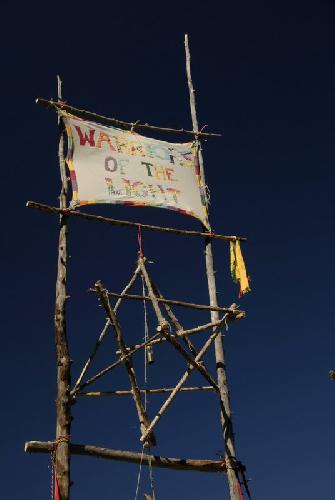
The Way of the Warrior: An Authentic Life Stance with Heart
© 1996, 2009 by Jonathan Zap Edited by Austin Iredale
WHAT IS A WARRIOR?
Why is being a Warrior important, and what is meant by being a Warrior anyway?
Language is so often a barrier to understanding. The word, ” Warrior ,” for example, presents many problems. Sometimes the best available word has a shadow, a dark area of connotations that may be alien or even contradictory to what we are trying to convey. If we want to convey the possibility of a more effective focus in our lives, the word “discipline” comes to mind. But “discipline” can also mean to punish, and our Puritan heritage gives the word an unwanted sadistic resonance. In Sanskrit the nearest word to discipline is “tapas,” which has a range of meanings such as the use of austerities to generate and conserve transformational inner heat. There’s no sadistic or punitive connotation to “tapas,” but it is not a word readily available to most people. “Warrior” is a word that is readily available, but, like the word “discipline,” it carries much unwanted baggage. The word “war” is in “Warrior,” and the connotations of aggression and violence are obvious. But “Warrior” is also a word that in certain circles has been undergoing major redefinition and rediscovery. Essentially, the archetype of the Warrior is being salvaged from millennia of patriarchal associations. The best definition I have been able to come up with for “Warrior” that reflects its archetypal meaning is as follows: A Warrior is someone who strives to live alertly, intelligently, attuned to the moment in order to serve life affirming transpersonal values.
Warrior with a capital “W” is one who efficiently serves life affirming transpersonal aims. A warrior with a lower case “w” could be a mercenary, one who serves selfish aims, or one who serves transpersonal but anti-life aims — a Nazi SS officer, for example. Someone could have rippling muscles, be a potent martial artist, highly efficient, focused and determined and yet only be a warrior. Someone else could be confined to a wheel chair and yet be an exemplary Warrior.
DON JUAN’S PHILOSOPHY OF BEING A WARRIOR
My first contact with the unexpected positive significance of “Warrior” was in the writings of hoaxer and trickster-genius Carlos Casteneda. Casteneda writes in The Teachings of Don Juan: A Yaqui Way of Knowledge about his supposed apprenticeship with a Yaqi Indian sorcerer. During this apprenticeship Don Juan tells and shows Carlos what being a Warrior means through powerfully evocative words and deeds. Being a Warrior is a total life stance, a way of facing the unspeakable difficulty of a human incarnation with grace and skill.
Don Juan uses the word “impeccable” to describe the behavior of the Warrior. The Warrior makes decisions, and he acts strategically and efficiently to carry them out. Many of the statements Don Juan makes about the Warrior are aphoristic and beautiful. Here are a few examples, some of them slightly paraphrased:
No one is born a Warrior; one must elect to become one.
The ordinary man views everything as either a blessing or a curse. The Warrior takes everything as a challenge.
Life for a Warrior is an exercise in strategy.
There are always cubic centimeters of chance that power makes available to the Warrior. The Warrior’s art is to be perennially fluid in order to pluck them.
A Warrior does not allow himself to become obsessed and does not abandon himself to anything.
To be a Warrior means to be humble and alert.
A Warrior must be fluid and shift harmoniously with the world around him.
One needs the mood of a Warrior for every single act. Otherwise one becomes distorted and ugly. There is no power in a life that lacks this mood.
The Warrior performs even the most trivial of his tasks impeccably to store power.
A Warrior should strive to meet any conceivable situation, the expected and the unexpected, with equal efficiency. To be perfect under perfect circumstances is to be a paper Warrior.
The Warrior starts off with the certainty that his spirit is off balance. Then by living in full control and awareness, but without hurry or compulsion, he does his ultimate best to gain his balance .
A Warrior is never under siege. To be under siege implies that one has personal possessions that could be blockaded. A Warrior has nothing in the world except his impeccability, and impeccability cannot be threatened.
Impeccability can exist only in the present.
Impeccability is always available
Being a Warrior is not a simple matter of wishing to be one. It is rather an endless struggle that will go on to the last moments of our lives.
Don Juan’s spin on being a Warrior is powerfully existential. Don Juan continually emphasizes the value of being aware of your own death. He encourages Carlos to experience death physically and directly as a shadowy presence standing on his left. Death is described as a powerful ally that has the particular virtue of absolute honesty. In an interview with Sam Keen, Castaneda remarks,
“Don Juan’s approach has a strange twist because it comes from the tradition in sorcery that death is a physical presence that can be felt and seen. One of the glosses in sorcery is: death stands to your left. Death is an impartial judge who will speak truth to you and give you accurate advice. After all, death is in no hurry. He will get you tomorrow or next week or in fifty years. It makes no difference to him. The moment you remember you must eventually die, you are cut right down to size.”
Awareness of our mortality makes us more alive in the moment. It is also cuts through the trivial and superficial. As I have mentioned in previous writings, a wise man once advised me, “Only do things that you will remember well on your death bed.” Absolute honesty is a core characteristic of the Warrior, and the denial of death, the illusory belief that we can put things off, is the cardinal self-deception that keeps us from becoming Warriors. As Don Juan says, “Our greatest enemy is that we never believe what is happening to us,” and, “There are no survivors on this planet.”
There is a strong relationship between being a Warrior and practicing mindfulness meditation, through which one becomes alertly attuned to the present moment. Only by being in the Now can you effectively engage the world. The path of the Warrior makes you a more alive, aware and engaged presence in the world. In the same interview with Sam Keen, Castaneda comments,
“It has been this element of engagement in the world that has kept me following the path which Don Juan showed me. There is no need to transcend the world. Everything we need to know is right in front of us, if we pay attention. If you enter a state of nonordinary reality, as you do when you use psychotropic plants, it is only to draw from it what you need in order to see the miraculous character of ordinary reality. For me the way to live—the path with heart—is not introspection or mystical transcendence but presence in the world. This world is the Warrior’s hunting ground.”
THE SHAMBALA WARRIOR TEACHINGS
Some of the best commentaries on the way of the Warrior are to be found in the Shambala Warrior teachings of Rinpoche Chogyam Trungpa. Trungpa was born in Eastern Tibet, the son of peasants. At a very early age he was recognized as a tulku , or incarnate lama. Trungpa began work on the Shambala teachings during his years in Tibet, where he was the supreme abbot of the Surmang monasteries where he received, at the age of eighteen, the degree of Khyenpo (comparable to a doctorate in theology, philosophy, and psychology). As he was fleeing from the Communist Chinese over the Himalayas in 1959, Rinpoche wrote a spiritual account of the history of Shambhala, which unfortunately was lost on the journey. Rinpoche fled to India where he was appointed by the Dalai Lama to serve as spiritual advisor to the Young Lamas’ Home School. In 1963 he traveled to England, where he attended Oxford University as a Spaulding Fellow, studying Western philosophy, religion, art and language. Rinpoche began teaching the Sacred Path of the Warrior in 1976 in the American South West. In Boulder, Colorado, Rinpoche founded the Naropa Institute and a Shambala Warriorship training program.
The Shambala teachings are founded on the premise that there is basic human wisdom that can help to solve the world’s problems. This wisdom does not belong to any one culture or religion, nor does it come only from the West or the East. Rather, it is a tradition of human Warriorship that has existed in many cultures at many times throughout history.
What follows is my way of understanding the Shambala teachings. I would encourage you to read the Shambala material first hand. I would also encourage you to read Jeremy Hayward’s book, Sacred World—A Guide to Shambala Warriorship in Daily Life . Hayward studied with Trungpa for years and was asked by him to write a book from a student’s point of view. My summary of the Shambala teachings is not so much an objective summary but more like variations on a theme inspired by Shambala. The Shambala teachings should not be held responsible for any of my excesses of language or tangential anecdotes as I attempt to relate them. I will quote many passages from the books directly so that you can experience their message and lucidity first hand.
THE COCOON
Trungpa refers to the little world of self-limiting habits into which we retreat from the world as “the cocoon.” One of the first steps to becoming a Warrior is recognizing this all too familiar cocoon in which we seal ourselves off from the world. We build a cocoon of self-deception because we ultimately don’t accept ourselves or the world in which we live. We shroud our radiance in a membrane of forgetfulness to buffer ourselves from the vivid, sometimes harsh intensity of the world. The cocoon has a strong relationship to what Jung called “the shadow,” a dark area of the personality thought to be inferior that we would much rather not look at. The cocoon is the claustrophobic, neurotic place we go to retreat from the intensity of life.
The cocoon is as real and familiar as yesterday’s dirty dishes sitting in the sink. We have to be wary about abstractions in talking about the cocoon because abstracting this shadowy place can be another form of hiding in the cocoon. What does a cocoon look like? Every cocoon is as unique as the psyche it encapsulates. To get a more concrete feeling of this concept, let’s take a caricatured look at “Bob’s cocoon.” Bob is a stereotypical cocooned American male. Although a cocoon is an inner psychic space we’ll represent it metaphorically as a physical place.
Bob’s cocoon is a cramped, stuffy room. The room is cluttered, sloppy and lit with electric lights. The windows haven’t been opened in years and are covered with heavy, opaque, dusty curtains. All sorts of mirrors of different sizes and shapes are screwed into the walls. Bob paces around in his underwear nervously examining himself first in one mirror and then in another. The glass in each of these mirrors is subtly warped. One mirror makes Bob look big and fat, another makes him look like a little nothing, in another he looks dangerous and powerful, in another he looks like a square-jawed movie star, in another he looks puffy and out of shape. Looking at all these varying reflections makes Bob anxious and restless. On the television in the background a seductive woman is extolling the delights of a Carnival Cruise to nowhere, and we see flickering images of tables weighted down with rich food and people dancing in a disco. She begins to croon, “If your friends could see you now!”
Bob sits down on the couch, lights up a Marlboro and flips through the pages of the Sharper Image catalogue. His eyes settle on a piece of expensive, high-tech exercise equipment that seems for a moment like it might be just what he needs to turn his life around, but then he thinks about the cost and his overdue credit card bills. This reminds Bob of his ex girlfriend who still owes him money. Bob calls her on the phone and gets her voicemail. He leaves a somewhat nasty, sarcastic message. He hangs up the phone, opens a can of Budweiser and inserts a well-worn porno disc into the DVD player and . . . well, you can fill in the rest.
Certainly there are people who don’t live in a cocoon. But most of us sometimes regress into a personal, little ghetto of narcissistic self-reflections, egoistic wants and self-pity. Sometimes the world seems too much for us, and self-acceptance too difficult. At other times, perhaps during certain moments of peak or optimal experience, we feel what it is like to be more fully alive. At those times it may be wise to pause for a moment and look back with compassion at the cocoon behind us.
What causes us to retreat into that cocoon sometimes? Fear is the answer that comes most readily to mind. But fear, in itself, is not able to make us do anything. Rather it is a timid way of relating to fear that is the real problem. We can work with fear. It is the attitude that wants to deny fear, that wants to be comfortably numb, that causes us to pull away, to disengage from life and hang out in our cocoon.
FEAR
The Warrior’s way is to acknowledge fear, accept it, even make friends with it. Fearlessness is the willingness to face fear. When fear arises, try greeting it with acceptance, like an old friend, and then go about your business. Someone came up with a clever redefinition of fear as “the energy to do your best.” Another well-known, valid principle is, “Feel the fear, and do it anyway.” When I got involved in mountain climbing I found that my intense fear of heights did not go away. But what I did find is that I could reach for the next handhold, I could continue to climb, to take actions, while I felt intense fear. Fear became one more natural element like the wind, the cold, or the density of the rock. The change I experienced in relationship to fear is fairly typical, and it may be worthwhile to further develop this personal example to see how fear can become an ally.
My first experience with mountain climbing was during an Outward Bound course in the Cascade Mountains of Northern Washington. I was placed near the front of a line of a dozen or so people as we climbed a particular mountain. While we climbed, I was so busy looking for the next handhold or foothold that I didn’t have time to fully experience my fear of heights. But then we got to the summit, which was unusually small and sloped on both sides like the roof of a large dog house. Sitting on top of it was completely safe, but when you looked on either side there was a drop of thousands of feet. My fear of heights seems to work visually, it doesn’t matter how much real danger there is, but rather how much distance I can see between where I am and what lies below me. There came then a very long waiting period caused by some technical problems, and the rest of the group made it to the summit one by one with agonizing slowness. While I waited, there was nothing for me to do but sit, that huge drop off all around me, feeling the most intense fear and vertigo. Adrenaline raced through my blood and I felt my heart pounding. The energy of the fear was intensely physical and felt like electricity running through my inner thighs and into the center of my stomach. I felt the sun beating down, the gusts of cold wind and the rough surface of the rock on my exposed skin. It was a remote area of the Cascades and there was no sign of anything manmade, not even a trail, in the green valley below. The sky was clear and empty, undisturbed by aircraft or vapor trails. I looked at the rust colored lichen growing on the slope I sat on and suddenly felt the rock that was supporting me, that was keeping me from falling, was the living tissue of an organism, the earth, that was sustaining my life, heartbeat by heartbeat.
The intensity of my fear had awakened my senses, physical and spiritual, and I felt the tenuous living connection I had with the earth. Fear helped to pull back the veil, helped me to experience death as an ally sitting close by. It stripped away my comfortable cocoon and allowed me to be more alive and aware. It allowed me to feel the world, the earth, in a more immediate and powerful way than I had ever experienced.
So fear is not the problem. Fear can be a powerful ally, a great and wise teacher, if it is accepted and embraced. Fear is an intense energy that can help us to awaken to the full brilliance of reality.
SUMMONING WARRIOR ENERGY
“Being on line with Warrior energy creates a point of concentration and focus beyond physical fatigue and emotional mood swings. Correctly accessing the Warrior brings energy and clarity.” —Shambala Warrior Teachngs
In the Shambhala tradition, invoking this heightened state of energy, or “Chi,” is referred to as “raising windhorse.” By using your will to take actions when laziness, fatigue or temptation tries to slow you down, you create this type of energy. In the classic Yoga Aphorisms of Pantajali , it is written that, “Energy is like a muscle, it grows stronger through being used.”
THE VALUE OF “BROKEN HEARTEDNESS”
One aspect of the Shambala teachings that I especially admire is the acknowledgment of the pain and suffering of the human condition. It will profoundly change how you deal with reality, but it will not pretend to eliminate inherent suffering. With long-sustained work, your relationship to suffering can change significantly. For myself, I have found that the mindfulness approach to emotions and thoughts as well as accepting and flowing with life based on the principles of the I Ching have greatly reduced my experience of depression and anxiety. That’s been a great reprieve, but new challenges could bring those forces back into my life at any time. If and when that happens, I expect to be learning new lessons and a new level of wakefulness. Trungpa goes even further than that acknowledgement and states that there is a particular type of emotional pain, a soulful broken heartedness, that is characteristic, even prerequisite, to being a Warrior. This is a refreshing change from the New Age catalogue where every sort of practitioner, whether they are doing hypnotherapy, reflexology or past life regression, has been photographed with the identical beatific, blissed-out smile.
The denial of the shadow, the dark aspect of human existence, greatly promotes suffering. Also, a willingness to engage the pain and darkness within is an essential ability on the path of self-development and truth seeking. Consider the poem “The Wayfarer,” by Stephen Crane.
The Wayfarer
The Wayfarer,
Perceiving the pathway to truth,
Was struck with astonishment.
It was thickly grown with weeds.
“Ha”, he said,
“I see that none has passed here
In a long time.”
Later he saw that each weed
was a singular knife.
“Well,” he mumbled at last,
“Doubtless there are other roads.”
—Stephen Crane
The way of the Warrior has never been a way to escape suffering or become comfortably numb. Rather, it is a way to actively engage suffering, to accept it from a strong and centered stance that allows you to continue to take appropriate actions while feeling pain. As Don Juan says, “A Warrior cannot avoid pain and grief, but only the indulging in it. A Warrior acknowledges his pain, but does not indulge it.”
Sadness is not a sign of being screwed up or in need of medication. If you look at the world and the human condition, it should be obvious that sadness is one of the most appropriate emotions. The Buddhists say, “All being is sorrow.” Jeremy Hayward, in Sacred World: The Shambala Way to Gentleness, Bravery and Power, writes,
“Pointing to the place of sadness in the Warrior’s path or any spiritual path was one of the most profound teachings of the Dorje Dradul (Chogyam Trungpa). So much spiritual teaching and systems of therapy nowadays are oriented toward finding contentment, joy, love, wisdom, and all the other wonderful things. Sometimes they seem like another version of the inalienable right to the pursuit of happiness. People who feel genuine sadness are told that they are sick. Psychologists list sadness as one of the symptoms of clinical depression, and the latest wave of self-help books label depression—and by implication sadness—as one of the most common diseases of our time. Perhaps people feel genuinely sad that their lives feel so empty, that the society they were born into is such a mess, and that they and others are suffering so much. People feel this kind of sadness for others, often without being aware of it . . .”
Trungpa and Hayward make a case that sadness is not merely inevitable, but it is actually a desirable state for a Warrior. Sadness can be an authentic state in which a Warrior is in touch with his or her own feelings and feels empathy for others. Sadness can be a strangely fulfilling awareness of the depth of the human heart and the poignant mystery of human existence. Hayward writes,
“An open heart realizes that the human heart is sad when it is genuine. Early American blues and Spanish flamenco—songs of love and separation of any time and place—reveal a sadness that is less an expression of depression or misery than of the depth of the human heart. In the best of these songs there is always something timeless and beyond the personal drama. It rings true to us, and we feel glad. The root of the word sad is the Latin satis, which is also the root of the word satisfied. So sadness is related to being completely full, completely satisfied
Trungpa, in Shambala: Sacred Path of the Warrior, describes sadness as a state of heightened awareness characteristic of someone who is fully alive:
“You feel sore and soft, and if you open your eyes to the rest of the world you feel tremendous sadness. This kind of sadness doesn’t come from being mistreated. You don’t feel sad because someone has insulted you or because you feel impoverished. Rather, this experience of sadness is unconditioned. It occurs because your heart is completely exposed. Your experience is raw and tender and so personal.”
“In order to be a good Warrior, one has to feel this sad and tender heart. If a person does not feel alone and sad, he cannot be a Warrior at all.”
“Arrogant Warriorship does not work. It does nothing to benefit others. So the discipline of renunciation also involves cultivating further gentleness, so that you remain very soft and open and allow tenderness to come into your heart. The Warrior who has accomplished true renunciation is completely naked and raw, without even skin or tissue. He has renounced putting on a new suit of armor or growing a thick skin, so his bone and marrow are exposed to the world. He had no room and no desire to manipulate situations. He is able to be, quite fearlessly, what he is.”
“Although the Warrior’s life is dedicated to helping others, he realizes that he will never be able to completely share his experience with others. The fullness of his experience is his own, and he must live with his own truth. Yet he is more and more in love with the world. That combination of love affair and loneliness is what enables the Warrior to constantly reach out to help others. By renouncing his private world, the Warrior discovers a greater universe and a fuller and fuller broken heart. This is not something to feel bad about: it is a cause for rejoicing. It is entering the Warrior’s world.”
“Experiencing the upliftedness of the world is a joyous situation, but it also brings sadness. It is like falling in love. When you are in love, being with your lover is both delightful and very painful. You feel both joy and sorrow. That is not a problem; in fact, it is wonderful. It is the ideal human emotion. The Warrior who experiences windhorse feels the joy and sorrow of love in everything he does. He feels hot and cold, sweet and sour, simultaneously. Whether things go well or things go badly, whether there is success or failure, he feels sad and delighted at once.”
BASIC GOODNESS
The preceding discussion of the need to accept fear, painful emotions and being brokenhearted should not give a false impression that being a Warrior means increasing the pain and unhappiness we already feel. The way of the Warrior is far more likely to eventually create a more positive feeling about self and life. An aspect of the Shambala teachings that seems unique to me in writings on the way of the Warrior, and related to a more positive feeling about life, is an emphasis on what Trungpa calls “basic goodness.” Trungpa writes,
“If we are willing to take an unbiased look, we will find that, in spite of all our problems and confusion, all our emotional and psychological ups and downs, there is something basically good about our existence as human beings.”
( Shambala: Sacred Path of the Warrior )
Recognition of basic goodness in ourselves and the world is a wonderful antidote to the entrenched pessimism, cynicism and low self-esteem that plague so many today. Denial of the shadow in our culture creates a paradoxical focus on everything that is wrong with us, everything in ourselves and our lives that falls short of a commercial ideal. Images of perfect bodies bombard us from magazine ads, movies and television. When we look in the mirror, therefore, we tend to view our bodily reality with negative judgments about how imperfect it seems compared to the airbrushed magazine images. We may perceive our bodies as basically bad and impose punishing diets or regimens to try to make them more like the idealized images. Similarly, we look at our lives and see all the ways they seem empty or lacking. We may also look into a harshly psychoanalytical mirror and see all the dark aspects of our personality and relationships.
Recognition of basic goodness reverses this morbid focus. To recognize basic goodness in your body, for example, consider the fact that you have a beating heart keeping you alive moment by moment. Even while you sleep your heart works to keep you alive. If you have eyes, consider what a gift they are, and what fantastic variety of forms and colors they allow you to perceive. Recognize that your psyche has sufficient intelligence to read these words and comprehend their meaning and that you are capable of understanding and creating complex language structures that allow you to communicate with others. Appreciate that you came into this world in a helpless, dependent condition, and that other human beings fed you, sheltered you and gave you a chance at life.
We may see how much speed and aggression there is among human beings, but consider the abundance of cooperation. People may crowd a sidewalk or cars may crowd a freeway, and most of the time people are working vigilantly to avoid injuring anyone else. Go through a day and notice all the moments in which people work cooperatively with you, acknowledge you, and show some form of simple manners. When you eat food consider how much work has gone into the creation of it so that you could be nourished. Consider the basic goodness of the fact that you probably have sufficient food and water to sustain your life. Feel the warmth of the sun, the fresh feeling of your skin after a shower, the wonderful reprieve of sleep, the solace of talking to a friend and having other human beings to relate to. Trungpa writes,
“The goal of Warriorship is to express basic goodness in its most complete, fresh, and brilliant form. This is possible when you realize that you do not possess basic goodness but that you are the basic goodness itself. Therefore, training yourself to be a Warrior is learning to rest in basic goodness, to rest in a complete state of simplicity.” ( Shambala: Sacred Path of the Warrior )
In other words, basic goodness does not derive from continually doing good deeds, but just from our being itself. We are a part of the universe, as everything else is, and our very existence itself is a function of the creativity of the cosmos.
Basic goodness can also be expressed as “basic trust.” Hayward writes,
“Feeling and opening your genuine heart of sadness is the key to letting go of your preconceptions and your interpretations of the world. By letting go, you leave your familiar and snug world behind, at least for a moment, and relax into the sacred and strange space of the real world. To do this, you need to have basic trust. Basic trust is not trusting in something but simply trusting. It is very much like breathing. You do not consciously hold on to your breath or trust in your breath, yet breathing is your very nature. When you breathe out, you trust that the next breath will come in—you don’t think about it, or wonder about it, you trust. When you take a step, you trust that the earth will support you. When you eat, you trust that your stomach will digest the food. This is basic trust.
“…trust not only the basic functions of breathing, eating, and walking, but the sacredness of your whole world. Such trust grows as you step over the threshold of fear again and again and discover that the world beyond your fear is supporting you.
“Your basic trust relaxes you and lets you be. It is simple, unremarkable, ordinary experience, but at the same time it is very powerful; it has a quality of fulfillment. Like the vast, profound, blue sky that is free from clouds yet accommodates everything, from the small white fluffy clouds of a summer’s afternoon to the violent cumulus of a thunderstorm, you let yourself be with whatever you are feeling.
“But trust can be even more basic. Even when your body is not working according to your idea of health, you can still trust your fundamental wellbeing. Usually we don’t experience this level of trust except in life-threatening situations, but it is a basic state of mind that is always there for us.
“The strange but real world is trustworthy because it is always present and, so long as we are genuine, it always responds to us. As long as we do not interpret that response in terms of success or failure, it always gives us a way to go forward. Instead of working so hard to get everything in your life just right, you can profoundly trust and let go. When you learn to let go further, you can let the intelligence of basic goodness determine the course of your life, as it does in any case. It brings great joy and relief to be able to let go in this way.” ( Sacred World: The Shambala Way to Gentleness, Bravery and Power )
Here is how Trungpa describes basic trust:
“The sense of trust is that, when you apply your inquisitiveness, when you look into a situation, you know that you will get a definite response. If you take steps to accomplish something, that action will have a result. When you shoot your arrow, either it will hit the target or it will miss. Trust is knowing that there will be a message . . .
“When you trust in those messages, the reflections of the phenomenal world, the world begins to seem like a bank, or reservoir, of richness. You feel that you are living in a rich world, one that never runs out of messages. A problem arises only if you try to manipulate a situation to your advantage or ignore it. Then you are violating your relationship of trust with the phenomenal world, so then the reservoir might dry up. But usually you will get a message first. If you are being too arrogant, you will find yourself being pushed down by heaven, and if you are being too timid, you will find yourself raised up by earth.
“Ordinarily, trusting in your world means that you expect to be taken care of or to be saved. You think that the world will give you what you want—or at least what you expect. But as a Warrior, you are willing to take a chance; you are willing to expose yourself to the phenomenal world, and you trust that it will give you a message, either of success or failure.”
( Shambala: Sacred Path of the Warrior )
LIVING IN THE MOMENT
An essential application of the principles of basic goodness and basic trust is being in the now and accepting and working with your situation as it is. Generally, this means respect for, and complete presence in, the everyday, mundane world. As Ram Dass said, “Be here now.” Trungpa advises that we apply the principles of Warriorship by being fully present and mindful in our ordinary domestic life. By bringing order and healthfulness to our own household we create a healthy foundation from which we can bring healthfulness to the world. Trungpa writes,
“The way to experience nowness is to realize that this very moment, this very point in your life, is always the occasion. So the consideration of where you are and what you are, on the spot, is very important. That is one reason that your domestic everyday life is so important. You should regard your home as sacred, as a golden opportunity to experience nowness. Appreciating sacredness begins very simply by taking an interest in all the details of life. Interest is simply applying awareness to what goes on in your everyday life—awareness while you’re cooking, awareness while you’re driving, even awareness while you’re arguing. Such awareness can help to free you from speed, chaos, neurosis, and resentment of all kinds.
“It may seem that washing dishes and cooking dinner are completely mundane activities, but if you apply awareness in any situation, then you are training your whole being so that you will be able to open yourself further, rather than narrowing your existence.
“You may feel that you have a good vision for society but that your life is filled with hassles—money problems, problems relating to your spouse or caring for your children—and that those two things, visions and ordinary life, are opposing one another. But vision and practicality can be joined together in newness.
“The most practical and immediate way to begin sharing with others and working for their benefit is to work with your own domestic situation and to expand from there.”
( Shambala: Sacred Path of the Warrior )
(Note: In some of the following quotes, Trungpa uses the term drala . Hayward defines dralas as “patterns of living energy and wisdom in the world that you can connect with when you open your mind and heart.”)
“Your physical environment . . . may be as small and limited as a one-room apartment or as large as a mansion or a hotel. How you organize and care for that space is very important. If it is chaotic and messy, then no drala will enter into that environment . . For the Warrior, invoking external drala is creating harmony in your environment in order to encourage awareness and attention to detail. In that way, your physical environment promotes your discipline of Warriorship.
“The attitude of sacredness towards your environment will bring drala. You may live in a dirt hut with no floor and only one window, but if you regard that space as sacred, if you care for it with your heart and mind, then it will be a palace.
“If you want to solve the world’s problems, you have to put your own household, your own individual life, in order first. That is somewhat of a paradox. People have a genuine desire to go beyond their individual, cramped lives to benefit the world, but if you do not start at home, then you have no hope of helping the world. So the first step in learning how to rule is learning to rule your household, your immediate world. There is no doubt that, if you do so, then the next step will come naturally. If you fail to do so, then your contribution to this world will be further chaos.”
( Shambala: Sacred Path of the Warrior )
VIGILANCE, SKILLFUL INTELLIGENCE AND DISCRIMINATING AWARENESS
Whether in the most ordinary, mundane circumstances or a catastrophic emergency the Warrior strives to maintain vigilance, skillful intelligence and discriminating awareness. It is the Warrior’s duty to remain, as Don Juan put it, “humble and alert.” In a world so filled with suffering and in need of help, anyone capable of conscious, effective actions has continual responsibility. Although it is worthwhile to be relaxed in the sense of “letting go”—a state in which one is fluid and adaptable without unnecessary bodily tension or psychic rigidity and clinging—it is not good to be relaxed in the sense of a slouchy, careless attitude. There is a need to maintain conscious disciplines and to be prepared for anything.
One thing to be prepared for is that certain people may experience this type of vigilance as a subtle threat, or as a disturbing contrast to the slackness that they find comfortable. Such people prefer the path of the partygoer and believe that life is meant to be a mellow, pleasurable experience you can passively float through. Such people are likely to suggest that you “take it easy” and “go with the flow.” The Warrior’s focus on impeccability and presence in the moment may cause them to be unpopular company for those who want only to hang out and kill time.
A Warrior is always vigilant and in a way is never “off duty.” Don Juan and Trungpa both describe being a Warrior as a continual journey in which one must earn Warriorship moment by moment.
(Note: In some of the following quotes Trungpa refers to “the setting sun world.” This term describes the modern “wasteland” world—the toxic environment in which so many modern lives occur.)
Here’s how Trungpa describes Warrior vigilance:
“The important point to realize is that you are never off duty. You can never just relax, because the whole world needs help.
“The Warrior never neglects his discipline or forgets it. His awareness and sensitivity are constantly extended. Even if a situation is very demanding or difficult, the Warrior never gives up. He always conducts himself well, with gentleness and warmth, to begin with, and he always maintains his loyalty to sentient beings who are trapped in the setting-sun world. The Warrior’s duty is to generate warmth and compassion for others. He does this with complete absence of laziness. His discipline and dedication are unwavering.
“The Warrior is constantly reminded that he has to be on the spot, on the dot, because he is choosing to live in a world that does not give him the setting sun’s concept of rest.
“Warriorship is a continual journey. To be a Warrior is to learn to be genuine in every moment of your life.”
( Shambala: Sacred Path of the Warrior )
WARRIOR APHORISMS
Finally, I’d like to conclude our discussion of the way of the Warrior with a small collection of what I consider Warrior aphorisms. They are in no particular order, some are written by me and some are written by others, but they all express aspects of being a Warrior. Some of the “aphorisms” are actually paragraphs, but have an aphoristic ability to stand on their own. Following the collection of aphorisms, I’ve included “A Modern Warrior’s Manifesto,” a set of principles created by writer, professor and fifth degree Akido black belt George Leonard.
“If not now, when? If not me, who?” —Jewish saying
“Grace under pressure.” —Hemingway’s definition of heroism
“To serve, to strive and not to yield.”
—Outward Bound Motto from the poem “Ulysses” by Tennyson
“The Chinese language contains much wisdom in its symbols. The two-part character “wel-ji” is equivalent to our word for crisis. One character means danger and the other opportunity. We in the western world focus only upon the danger. Yet the Chinese know the word means opportunity as well. We can open many doors and enrich our lives simply by ceasing to focus only on our fears and by looking more at the creative possibilities for action and change that can arise from a state of fear, anxiety. Outward Bound proposes that we recondition our reflexes to find energy and enthusiasm in the stirrings of fear and stress.”
—From the Outward Bound Philosophy
“But I will say this: the rule of no realm is mine, neither Gondor nor any other, great or small. But all worthy things that are in peril as the world now stands, those are my care. And for my part, I shall not wholly fail of my task, though Gondor should perish, if anything passes through this night that can still grow fair or bear fruit and flower again in the days to come. For I also am a steward.” —Gandalf, from The Ring Trilogy by J.R.R. Tolkien
“Man’s great passion isn’t sex, power or money—it’s laziness.” —C.G. Jung
The Litany Against Fear
I must not fear.
Fear is the mind-killer.
Fear is the little death that brings total obliteration.
I will face my fear.
I will permit it to pass over me and through me.
And when it has gone past I will turn the inner eye to see its path.
Where the fear has gone there will be nothing.
Only I will remain.
—from the Dune books by Frank Herbert
“Yesterday is ashes. Tomorrow is wood. Only today, the fire burns brightly.” —Native American saying
“An advance always begins with individuation, that is to say with the individual, conscious of his isolation, cutting a new path through hitherto untrodden territory.” —C. G. Jung
“There is no harm in falling down. The only harm is in not picking yourself up again.” —Chinese saying
“Act on what the world is presenting to you in the moment rather than what you think of the world.”—Jordan Scott
The following is a collection of aphorisms and paragraphs I’ve created for myself. Some were written in journals or at odd moments when an insight occurred to me.
“When the Warrior finds that a certain pattern of behavior or thinking never seems to produce the desired results, he will try something else.”
The following defines the stance I call “existential impeccability:”
“The immature attitude toward transformation is to see impeccability as a sacrifice to gain a reward. It degrades the present into a sacrifice for an imaginary “transformed” magical future. The immature approach turns all efforts into their opposite, light into dark. True impeccability is existential; it is done for its own sake, not in the expectation of anything. Only such a stance has the detachment from result to achieve the fluidity and adaptability to mean a lasting value. This type of impeccability is not ‘for’ transformation. It is in itself the revolutionary transformation you seek. Transformation occurs when you strive to give up the expectant attitude and replace it with a lasting effort to seek impeccability as an end in itself.”
—from a journal entry I wrote in the Eighties
“The Warrior must be aware that the psyche is conservative in nature, preferring old, self-destructive, neurotic patterns to the unknown. The Warrior must have the insight and determination to break those patterns, particularly those created by early childhood situations.”
“Don’t crack under pressure.”—Ad slogan for Tag Heuer Sport watches. I would rephrase it: “Don’t crack under pressure, but if possible, release the pressure.”
“Impeccability, like being in touch with the body, brings a feeling of connection with the world: being in the moment, being connected to the world, connected to the body that’s in the world.”
“Professionalism is the modern way of saying Warrior-like. Usually it is applied to skillful work in a particular profession, but its meaning can be extended to indicate a general impeccability.
“The professional acts impeccably under great stress.”
“Focus on your physical actions in your physical realm. Physically, do the work.”
“Make a decision for the moment and act on it.”
“Leaving the moment is self-deception. Being in the moment is self-love.”
“Insight may be irrelevant and recursive when will is the issue.”
“Pain is part of the beauty of the now. Pain, when experienced in long moments of time, is like a fire burning in the soul. It burns and consumes the oxygen of self-love with terrifying speed threatening to turn us into cold ashes. But then the cycle turns and the pain becomes sadness and one is capable of deeper reflection. By accepting the pain and sadness that you feel in the moment, you enter the moment with your heart and become fully authentic and alive. Accepting this pain is an act of moral courage. Our darker thoughts and feelings, and the realities they may correspond to, are not easy to accept as what’s so. But when we do accept what’s so and continue to act mindfully we become a Warrior. This is the true test and making of a Warrior, how you chose to handle the problem of being when the setting sun of the West burns you with its radioactive rays and your spirit is nauseous and oppressed by flickering shadows. How well do you act toward others while you may happen to be mutating and decomposing at the same time? The Warrior must act impeccably under all circumstances, inner or outer. The Warrior must maintain balance while dark inner chaos whirls about like winds howling in radioactive ruins after the end of the world.”
(end of warrior quotes I authored)
Deng Ming-Dao is a contemporary Taoist sage who has keen insights into Taoism and the Warrior stance. The following quotes are excerpted from two of his highly recommended books — 365 Tao and Everyday Tao :
“The action must be complete. It must burn clean; it cannot leave any bad ramifications or lingering traces. An act that leaves destruction, resentment, or untidiness in its wake is a poor one.”
“When unpredictable things happen, those who follow Tao are skilled at improvisation. If circumstances deny them, they change immediately.”
“In the midst of great difficulty, a tiny opportunity will open, if only by chance. You must be sharp enough to discern it, quick enough to catch it, and determined enough to do something with it.”
“Make every move count.
Pick your target and hit it.
Perfect concentration means
Effortless flowing.”
“Each day your life grows a day shorter. Make every move count. All that matters is accomplishing what you envision with the greatest dispatch.”
“Make your stand today. On this spot. On this day. Make your actions count; do not falter in your determination to fulfill your destiny. Don’t follow the destiny outlined in some mystical book: Create your own.”
“When one senses that one has come to the limits of the time and situation, one should conserve one’s energy. Often, this will be in preparation for a challenge to the limits, or a changing over to a new set of constraints.”
“If one is a hermit, one can be quiescent. If one is in the world, one must be aggressive.”
“To be aggressive . . . is to have the prowess and cunning of the wolf. A wolf is shrewd. It does not blindly go into a situation. It scouts things out. It has a sense of itself and its surroundings that is nearly supernatural. Trackers have a hard time trapping it. Prey have a difficult time eluding it.”
“When things go badly, those who follow Tao seek the causes and correct them. If the problem cannot be corrected, they shift the entire frame of reference so that the relative importance of the problem is diminished or eliminated . . .”
“When you act, act completely. Follow through. Do everything that has to be done. Be like the fire that burns completely clean: only from that pure stage can you then take the next step.”
“Not to have feeling is inhuman.
To be carried away by feeling is foolish.
Not to have desire is death.
To be a slave to desire is to be lost.”
“Whether our lives are magnificent or wretched depends upon our ordering daily details. We must organize the details into a composition that pleases us. Only then will we have meaning in our lives.”
“You could tell the secret of life ten times over, and it would still be safe. After all, the secret is only known when people make it real in their own lives, not when they simply hear it.”
“Indecision and procrastination are corrosive habits. Those who wait for every little thing to be perfect before they embark on a project or who dislike the compromise of a partial solution are among the least happy. Ideal circumstances are seldom given to anyone for an undertaking. Instead there is uncertainty in every situation. The wise are those who can wrest great advantage from circumstances opaque to everyone else.”
“Every day passes whether you participate or not. If you are not careful, years will go by and you will only have regrets. If you cannot solve a problem all at once, at least make a stab at it. Reduce your problems into smaller, more manageable packages, and you can make measurable progress toward achievement. If you wait for everything to be perfect according to your preconceived plans, then you may well wait forever. If you go out and work with the current of life, you may find that success comes from building upon small things.”
The following three quotes come from Back to Beginnings, Reflections on the Tao by Huanchu Daoren, translated by Thomas Cleary. They were written around 1600 by a retired Chinese Scholar, Hong Yingming, whose Taoist name, Huanchu Daoren, means “A Wayfarer Back to Beginnings.”
“When you are constantly hearing offensive words and always have some irritating matter in mind, only then do you have a whetstone for character development. If you hear only what pleases you, and deal only with what thrills you, then you are burying your life in deadly poison.”
“If the mind is illumined, there is clear blue sky in a dark
room. If the thoughts are muddled, there are malevolent ghosts in broad daylight.”
“When thoughts arise, as soon as you sense them heading on the road of desire, bring them right back onto the road of reason. Once they arise, notice them, once you notice them, you can change them. This is the key to turning calamity into fortune, rising from death and returning to life.”
And a few miscellaneous quotes:
“Forget the flight plan, from this moment on we are improvising the mission.” From the movie Apollo 13
“Nobody made a greater mistake than he who did nothing
because he could only do a little.” —Edmund Burke
“Do not be too timid and squeamish about your actions.
All life is an experiment.” —Emerson (1842)
Modern Warrior: A Manifesto
by George Leonard
- The Modern Warrior is not one who goes to war or kills people, but rather one who is dedicated to the creation of a more vivid peace.
- The Modern Warrior honors the traditional Warrior virtues: loyalty, integrity, dignity, courtesy, courage, prudence and benevolence.
- The Modern Warrior pursues self-mastery through will, patience, and diligent practice.
- 4. The Modern Warrior works to perfect himself or herself not so much as a means to achieving some external goal as for its own sake.
- The Modern Warrior is willing to take calculated risks to realize his or her potential and further the general good.
- The Modern Warrior is fully accountable for his or her actions.
- The Modern Warrior seeks the inner freedom that comes from the study of esthetics, culture, and the wisdom of the ages.
- The Modern Warrior respects and values the human individual and the entire web of life on this planet. To serve others is of the highest good. To freely give and accept nourishment from life is the Warrior’s challenge.
- The Modern Warrior reveres the spiritual realm that lies beyond appetites and appearances.
- The Modern Warrior cherishes life and thus conducts his or her affairs in such a manner as to be prepared at every moment for death. In this light, he or she is able to view all complaints, regrets, and moods of melancholy as indulgences.
- The Modern Warrior aims to achieve control and act with abandon.
- The Modern Warrior realizes that being a Warrior doesn’t mean winning or even succeeding. It does mean putting your life on the line. It means risking and failing and risking again, as long as you live.
For more on the path of the warrior, go the warrior category on this site.
Chapter V
White Crows Rising—-
The Singularity Archetype and the Event Horizon of Human Evolution
© 1996, 2009 by Jonathan Zap
Edited by Austin Iredale
Through a Glass Darkly
When we talk about the future we attempt to look, through a glass darkly, at a landscape that is unknown and unformed. Prophecy is a notoriously tricky and unreliable enterprise. Many people who have sought to look through that dark glass have seen images that were distorted reflections of themselves—of their hopes, fears and expectations. If there is a universal theme in the visions of prophets it is the prediction that extremely dramatic events will occur within their own lifetimes. The authors of the book of Revelations, for example, described events that they believed were going to happen in their time, the First Century AD, a fact rarely mentioned by born-again doomsayers. It is quite possible for someone to have a genuine revelation and then be completely mistaken about the time frame, or fall into the trap of being literal and concrete about the typically metaphorical vision they have seen.
Certain predictions about the future require little vision beyond the ordinary sort. A concise summary of what ordinary vision should tell us about the future is: “We’re in trouble, and we’re due for radical changes.” The fact that we’re in trouble seems almost too obvious to mention. Overpopulation rises exponentially while ecosystems spiral downward. More and more children are trying to suck greedily at the breasts of a mother who has cancer and grows weaker daily. And to this likely terminal situation you can add any of your own favorite force vectors of potential disaster: plague, nuclear or biological terrorism, global economic collapse, pandemics, toxification of the environment, climate change, natural or unnatural disasters, insane mass movements and despotic governments.
The metabolism of the species, and therefore the metabolism of events on this planet, has heated up to feverish intensity. An evolutionary process is rapidly approaching critical mass. Just consider how much change has occurred since 1908. A safe prediction is that we are not heading into a quiescent plateau.
So what is on the horizon if not a plateau? How can we contemplate the future development of our own species in a planetary situation that boils over with an infinite array of variables? And how can we possibly transcend the inherent subjectivity of being fully vested members of the species we’re trying to predict?
Analogical Analysis
When the human mind is confronted with the task of analyzing an almost impossibly complex phenomenon, like the fate of the species, one way it can assist itself is by creating an analog, an analogy to some simpler phenomenon that is of a size more workable for our type of intelligence. This type of analogical analysis can often work surprisingly well because there seems to be an aspect of the universe that is very much like a hologram or a fractal—a small part, the microcosm, seems to recapitulate the essential pattern of the larger part, the macrocosm. To apply analogical analysis to the human species let’s consider the analog of a single human individual.
A single human individual is still a phenomenon at the very boundary of human comprehension. Since we are social primates, our brains have adapted and struggled heroically to understand individuals of our own species more than any other phenomenon. We are marvelously equipped to understand each other and yet each individual personifies all the deepest mysteries that defy understanding. Also, the variables affecting the future of an individual are a magnitude of infinity perhaps greater than those affecting the future of the species because the future of the species is itself an included variable in the life of an individual. So although an individual of our species is certainly a sufficiently complex microcosm, and a phenomenon that obviously parallels the larger phenomenon of the species, he is, unfortunately, an almost equally intimidating phenomenon to attempt to analyze or predict. But pursuing this analogy as a thought experiment may lead us along a convoluted path to some place interesting.
John, a Thought Experiment in Prophecy
To make our thought experiment more concrete let’s give our human individual a specific identity.
I propose that our human sample be named John Doe, and that he be a seventeen-year-old male living right now in a suburb of Los Angeles, California. Of course you may be wondering why I didn’t pick Olga Pietrowski, age fifty-six, mother of three grown children, and a clerical worker at the People’s Agricultural College in Northern Ukraine, or Lee Chung, age thirty two, an unmarried Taiwanese poultry butcher suffering from a rare kidney ailment, or any of a number of other possible human samples.
I picked an adolescent, first of all, because I feel that adolescence is the time of life in Western culture that most closely resembles the present developmental stage of the species. It is a time of intense energy and change when identity is unsure, life is unstable, and it feels like almost anything might happen. I picked a male adolescent because our species is in an immature masculine phase of acting out, often destructively, testing the limits, enamored of speed, aggression and power. Like perpetual adolescents we are obsessed with looks and sex. And like John’s life in a suburb of Los Angeles, we are aware of so many critical problems all around us, while below there are tremors in the San Andreas fault.
To continue our thought experiment let’s fill in some of the gaps in John’s case history. John’s parents are wealthy, but his father, a high-powered advertising executive, a workaholic John rarely sees, is also a big spender and heavily in debt. John’s mother has malignant breast cancer and is currently undergoing aggressive chemotherapy and radiation treatment, which has left her in a state of exhaustion and despair. And although John goes about his life at a frenetic pace, driving along at high speeds in his red V-8 Firebird, using his charismatic looks and charm to pick up a series of girls for sexual encounters that he later boasts about to his friends, he is not without feeling and is deeply disturbed by his mother’s condition. But what can he do? His mother is under the care of the most highly paid experts and they say her condition is “under control.” As much as possible, John tries not to think of his withering mother hooked up to all those machines and tubes at the hospital.
His feelings tend to alternate between acute undifferentiated rage and a crushingly dark despair. When in the rage state he is capable of violent outbursts. John has studied martial arts, and when another teenage male calls him an insulting name in the parking lot outside of Dark Frenzy, an LA dance club, John beats him senseless. While still in the adrenaline rush of this conquest John feels exultant about his victory, but later that night the other boy’s bloodied face appears in a nightmare and John’s victorious feelings turn to anxiety and regret. When in the despair state John can barely get out of bed. He misses school, steals Valium from the medicine cabinet and watches television, utterly bored and lethargic.
But John’s life is not wholly filled with darkness. He has a great facility with computers and a fascination with virtual reality. And although it might not be readily apparent, John is still capable of love. When John hangs out with his friends they typically insult each other in joking putdown contests, but there are also hidden moments of compassion and empathy between John and a couple of his closest friends. John also shares a bond of absolutely unconditional love with his dog, Clyde, a three-year-old pit bull.
Recently, however, John’s mother has taken a turn for the worse and John, in dark sympathetic response, has begun to act out more self-destructively. His drug use is getting more compulsive and sometimes, after doing a couple lines of crystal meth to heighten his reflexes, he tours the express way at night, driving the Firebird with thrilling speed. Hidden under the driver seat is the nine millimeter automatic he bought on the street with most of his birthday money.
Our thought experiment is to predict where John is heading. The conventional prediction would be that John is headed toward relative or absolute self-destruction. But some people survive self-destructive phases of their lives and are even positively transformed by them. The case history simply doesn’t provide enough information to make a prediction that is anything other than broad conjecture. John, like his species, is obviously in a crisis stage and some sort of disaster seems very likely. But even if we knew for certain that John was going to have a serious car wreck we still have a prediction problem. John might be killed in the car wreck; death cannot be excluded as a possibility for John anymore than extinction can be excluded as a possibility for the species. But human lives often take strange, unexpected twists and turns. There are quite a number of possibilities for John that may seem a bit farfetched, but for which there is plenty of human precedent.
Suppose, for example, that John only nearly dies in the car wreck and that while he lies trapped in the wrecked Firebird he has a classic near-death experience. From a disembodied distance he views his mangled body and the wreck of his car. (If this description of an NDE seems like New Age confabulation then you need to do your homework on NDEs. NDEs, including comprehensive life reviews and verifiable remote viewings, have happened when people had no measurable electrical activity in their brains.) He travels through darkness toward a light. A being approaches John from whom he feels unconditional love. John is guided through a complete life review and as he re-experiences encounters with others he is aware of what they are feeling and how they are being impacted by his actions and energy. Much of what he learns is devastating and he sees how arrogant and often cruel he has been in his life, but he also sees how he was influenced to be that way and has a new compassion and understanding for his own flawed nature. He is given a choice of going toward the light or returning to life on earth. EMS technicians resuscitate his body and John emerges from his NDE with the recognition that life is more meaningful and valuable than he ever imagined.
Such a scenario, however unlikely, cannot be excluded as a possibility. There are countless real-life case histories of NDEs creating lasting spiritual transformations in people who had hitherto led dissolute lives. The point is that knowing John is self-destructive and that he is heading toward a very serious car wreck is not enough information to predict his future. We can say with certainty that, like his species, John is in serious trouble and due for radical changes. John and his species are speeding toward a critical nexus, but what will emerge on the other side of this event horizon remains to be seen.
Of course, what is lacking in this analogy is the whole range of middle possibilities, that gradient of gray tones. Suppose John survives the wreck only to become more bitter and negative. Or perhaps he survives the wreck and it moves him toward the functional maturity of an adult, but without much of a spiritual transformation. This may seem counterintuitive, but I think the middle range possibilities are less likely than the extremes. I believe that some individuals, and some species, are so highly charged that when they hit the bifurcation point they are most likely to emerge greatly transformed (higher or lower).
To continue our thought experiment, let’s consider what type of additional information would improve our chances of predicting where John is going. For example, if we could extend the theoretical limits of medical technology so that we could continuously monitor every aspect of John’s physiological condition that could be turned into a number—not just pulse and blood pressure, but also the most minute fluctuations of blood sugar, liver enzymes, neurotransmitters, etc. We would now have megabytes of hard, objective information about John pouring in every second.
Access to objective, physical information of this sort would probably be a delight to a neurological materialist, one of those folks currently crowding our universities and citadels of science who believes that human consciousness is an illusion and that we are essentially a byproduct of neurochemistry suffering from delusions of grandeur. With this new source of information about John, the neurological materialists would be able to show endless correlations between fluctuations of John’s neural peptides and his affective states. But would they be able to tell us where this carbon-based automaton, John, is headed? When Einstein was asked whether we would eventually be able to understand the universe exclusively in terms of numbers, his reply was yes, but it would be like trying to understand a Beethoven symphony in terms of variations in air pressure. Now imagine trying to use variations in air pressure to predict a symphony that has never been heard before, one that composes itself moment by moment and is altered by being observed.
To extend the analogy once more to the species let’s suppose we had instantaneous access to every number in every database on the planet. Suppose we sat in the basement of the Pentagon surrounded by a thousand Cray mainframes with quadrillions of gigabits of statistics on global population, meteorological data, economic trends, market research data, etc. pouring in by the nanosecond. At a moment’s notice we could determine copper sulfate consumption in Eastern Romania in 1959 accurate to six decimal places, or the number of males between the ages of 33 and 38 with peptic ulcers who purchased a major brand of dandruff shampoo with a Visa card last Wednesday. How much would this help us predict where the species was going?
Let’s return to John for a minute. If detailed, objective information about John’s body doesn’t tell us where he’s going, what information could we add to John’s case history that would focus our intuition and allow us to speculate intelligently about his future? Is there a source of subjective but global information that would reflect what is happening on the deepest level of John’s soul? The source I’d like to recommend for consideration is John’s dreams. For three or so hours a day John’s psyche generates its own universe, a parallel dimension where the deepest aspects of his being are given form.
So let’s consider one of John’s dreams. John finds himself standing in the clearing of a forest. The sky is turning very dark. Underground tremors occur and escalate to where the earth seems to be shaking itself to pieces. There is fire and lightening and it seems to be the end of the world. Then everything calms down. The sky clears and now a large white eagle comes spiraling down from above. In its talons it holds a golden egg with a glowing aura. Carefully, it deposits this egg in a nest at the top of a great tree.
This dream suggests that John’s current self-destructive crisis, as represented by the darkening sky and earthquake, might be a rite of passage from which John may emerge spiritually transformed—the eagle bearing a glowing, golden egg. John’s self-destructiveness now seems a necessary part of an evolutionary process, and we can speculate that he will bring his life to the brink of destruction but will emerge spiritually transformed. Of course, this is still only a speculation, but it has a certain intuitive confidence.
Dreams of the Collective
The dream attributed to John was an actual dream reported to me by a young man about John’s age. In his case, the dream may have had a meaning more collective than personal. And this brings us back full circle to our species for which John’s case was intended as analog. If a dream was the most useful source of information for speculating about John’s future, what source of information would have the analogous function for a species? The answer Carl Jung provided was that myths are to the collective what dreams are to the individual. A myth, therefore, is a kind of collective dream.
The work of Jung and his followers demonstrates convincingly the existence of a collective unconscious. From this collective layer of the unconscious emerge the great, primordial images Jung referred to as the “archetypes.”Across cultures and periods we find endless variations of these archetypes. The archetypes may appear as dreams or visions, especially in the fertile psyches of artists, poets, mystics, writers, shamans and prophets. Through such individuals the archetypes become myths and diffuse throughout a culture.
The dreams of an individual in crisis will tend to be dynamic, highly charged, and revealing of the deepest essence of the inner process. Similarly, the mythology of a culture in crisis will be intense and revealing of forces shaping collective destiny beneath the world of surfaces and appearances. Furthermore, the realms of dream and mythology will typically parallel or overlap. For example, while Jung worked as an analyst during the era of the Weimar Republic he found that Wotan, in Germanic mythology a god of war and mayhem, was occurring frequently in the dreams of his educated, highly civilized German patients. Jung was very disturbed by this phenomenon, which he called “Wotanism.” Based on the emergence of this archetype Jung was able to correctly predict the future shape of irrational forces brewing in the German psyche. Meanwhile, many people in various governments who had access to all sorts of statistics, experts and specialists, were found napping, their sleepy heads buried in the sand at the shore of the collective unconscious when the Nazi tidal wave seemed to swell out of nowhere. And surfing at the very top of this tidal wave was a pale, homely looking fellow who began his career as an unemployed artist making daily trips to the occult bookstore. Steeping himself in black magic, young Adolph gained malevolent access to the collective unconscious, adapted an astrological symbol, the Swastika, as the symbol of his world domination cult, and the rest, as they say, is history…
Down the Rabbit Hole
Before we descend, however briefly, through the rabbit hole to encounter the Singularity Archetype, I would like to suggest an invaluable piece of equipment to bring along. Besides all the critical faculties that you bring to bear on this or any other document you read, an encounter with an archetype also requires a deeply intuitive truth sense. As you approach an archetype you will feel a resonance within, a sense of uncanny familiarity and recognition. The Hero with a Thousand Facesis the memorable title of Joseph Campbell’s classic book on the hero archetype. Campbell was being numerically modest because every archetype has billions or trillions of faces. These myriad faces are the individual permutations or manifestations of the archetype, like facets allowing you to look into the prismatic depths of a jewel that can dazzle and overwhelm.
During our brief journey we will have time to look through only a few faces/facets of the Singularity Archetype. Hopefully these few vantages will allow the reader to triangulate the essence of an ever-shifting vision. At most, a fundamentalist looks through a single facet of an archetype and concretizes a single face he has been conditioned to see there. The Jungian approach, however, is to realize that each facet involves its own prismatic distortions of the archetype, like a series of cubist paintings of a single subject. Unlike the fundamentalist, the Jungian doesn’t attach to the idiosyncratic reflections of particular versions, but attempts to see the essence that unites the myriad manifestations of the archetype.
As I mentioned before, “John’s dream” was an actual dream reported to me by an intelligent young man a few years ago. I believe that this dream is an example of what I call the “Singularity Archetype.” This archetype is a resonance, flowing backward through time, of an approaching Singularity in or at the end of human history. This Singularity will be a critical point where transformation, in ways impossible to fully anticipate, will greatly shift human consciousness and therefore the nature of “reality.” From an ordinary, grounded human perspective this Singularity may be perceived as apocalyptic extinction.
As with all archetypes, visions of this approaching Singularity occur in a variety of permutations. When an archetype emerges from the collective unconscious it is colored by the cultural conditioning, personal unconscious and unique individuality of the psyche perceiving it. Attached to what I will hereafter refer to as the”Singularity Archetype” is a constellation of archetypal elements, a developing mythology of a new step in human evolution. These elements reflect changes occurring as we approach the Singularity. The Singularity Archetype is found in the prophecies of great religions and tribal cultures, and many who feel it approaching see it through the particular lens of their religious or cultural tradition. An evangelical Christian, for example, may speak of Armageddon and the Rapture.
While most perceive the Singularity through religious prophecy, it is also possible to view it from a nondenominational vantage. We can do this by looking at a variety of traditions and observing their parallelisms. A recapitulation of the prophecies of various religions and traditions, however, is a tricky business, and well outside the scope of this book. Capsulated summaries would do injustice to the rich complexity of these traditions and would necessarily have to gloss over interpretive controversies and varying points of view. You may already have some familiarity with some of these traditions, and if not, there are countless sources you can investigate.
It may be more helpful to view this Singularity through the eyes of modern individuals. We have already considered “John’s dream” In this dream, apocalyptic events—earthquake and the darkening of the sky—transform into the descent of a divine form—an eagle bearing a glowing, golden egg. There is an obvious suggestion here that destruction will become cosmic rebirth. Alongside this example, let’s consider a couple of dreams recorded by one of Jung’s most brilliant colleagues, Marie Louise Von Franz, in Jung’s classic introductory work: Man and his Symbols.
Two Dreams
Von Franz describes two dreams reported to her by someone she describes as “…a simple woman who was brought up in Protestant surroundings…” In both dreams a supernatural event of great significance is viewed. But in one dream the dreamer views the event from below, standing on the earth, in the other dream she views the same event from above.(The dreamer’s paintings, from Man and His Symbols by C.G. Jung.)
In the earthbound dream, the dreamer stands with a guide, looking down at Jerusalem. The wing of Satan descends and darkens the city. The occurrence in the Middle East of this uncanny wing of the devil immediately brings to mind Antichrist and Armageddon.


But in her other dream, the dreamer witnesses the same event from the heavens. From this vantage the dark wing of Satan appears as the white, wafting cloak of God. This white spiral appears as a symbol of evolution. Von Franz describes,
“…the spectator is high up, somewhere in heaven, and sees in front of her a terrific split between the rocks. The movement in the cloak of God is an attempt to reach Christ, the figure on the right, but it does not quite succeed. In the second painting, the same thing is seen from below—from a human angle. Looking at it from a higher angle, what is moving and spreading is a part of God; above that rises the spiral as a symbol of possible further development. But seen from the basis of our human reality, this same thing in the air is the dark, uncanny wing of the devil.
In the dreamer’s life these two pictures became real in a way that does not concern us here, but it is obvious that they may also contain a collective meaning that reaches beyond the personal. They may prophesy the descent of a divine darkness upon the Christian hemisphere, a darkness that points, however, toward the possibility of further evolution. Since the axis of the spiral does not move upward but into the background of the picture, the further evolution will lead neither to greater spiritual height nor down into the realm of matter, but to another dimension…”
Childhood’s End
We will now switch facets and view a third manifestation of the Singularity Archetype through a very different psyche and medium. The very different psyche belongs to Arthur C. Clarke, who was originally an astrophysicist and later became famous as a science-fiction writer. Perhaps Clarke is best known for the novel and Stanley Kubrik film, 2001: A Space Odyssey. 2001 is one of the most brilliant versions of this archetype, but we are going to consider an earlier example of Clarke’s work, the classic science-fiction novel, Childhood’s End. A science-fiction novel is a consciously created fantasy, and a very different medium than a dream, but it is also an especially fertile and open imaginal realm where the collective unconscious can communicate with modern persons, and a new mythology, however unrecognized, can collectively express itself.
Childhood’s End begins with the appearance of UFOs in the heavens all over the earth. Beings from within these craft break through all communications and announce that they are “the Overlords” and have come to establish peace on earth. This sounds like ominous news, but the Overlords do establish peace on earth and, excepting military aggression, do not curtail any human freedoms. Another curious aspect of the Overlords is that they announce that they will not reveal their physical form to humanity for two generations—fifty years. People speculate that they must be hideous and look like giant insects or slime mold or some other grotesque and horrifying form.
The fifty years pass peacefully for the human species. The Overlords come to be accepted and everyone eagerly awaits the day when the Overlords will descend to earth and reveal themselves. When the long anticipated day arrives the great spacecraft descend. With some ceremony, the Overlords emerge and to the uneasy surprise of the human species they look exactly like gigantic devils with horns, tails and great ebony wings.
This decidedly mythological element is fascinatingly incongruous with the setting of technological materialism stereotypical of the science-fiction genre. What is the meaning of a specter from the Christian and pagan past reemerging in the world of the future? Clarke gradually reveals that the Overlords’ alarming physiognomy is simply the result of their physical adaptation to the environmental conditions of their planet. The Overlords are actually perfectly benevolent and are far more rational and intelligent than humans.
The Overlords are servants of the”Overmind,” a cosmic intelligence permeating the universe that is Clarke’s naturalistic God concept. The Overmind employs the Overlords as midwives. When the Overmind senses that an intelligent species is about to make the evolutionary jump into higher consciousness it sends the Overlords to their planet to supervise the process. This evolutionary process is apparently volatile and unstable, and if not properly supervised could result in disastrous consequences whose effects would reach far beyond the particular world on which the process occurs. The fact that the Overlords have the appearance of a deep ancestral archetype of evil is described by Clarke as, “…a race memory of a future event.” The human race has a premonitory fear of the Overlords because it senses that their arrival signifies the end of the genome, the obsolescence of the species in its old form. From the earthbound perspective of the conservative old form, this evolutionary birth is apocalyptic and evil.
The Overlords, though infinitely superior to humans in every perceivable attribute, are themselves barren and unable to manifest the evolutionary birth process that it is their perpetual task to oversee. On earth, in addition to keeping human beings from destroying each other, the Overlords have a secret task, to search for an extraordinary individual who will be the first human being to exhibit these evolutionary changes. This individual is referred to as “Subject Zero” and the concept seems close to a naturalistic version of searching for the Messiah.
As part of this search, an Overlord named Rasheverak pays a visit to an American man who has one of the largest privately owned collections of books on parapsychology and the occult. Rasheverak is interested in this library because he is looking for any examples of extraordinary functioning that might indicate the emergence of Subject Zero. Like any intelligent, skeptical reader of such material, Rasheverak finds that it is often difficult to sift the truth from the abundant nonsense.
During Rasheverak’s visit, the library owner has several houseguests who are apparently drawn by the celebrity name-dropping opportunity of meeting an Overlord. The guests, like the owner, seem to be narcissistic individuals with a gullible appetite for occult and parapsychological entertainments. In many ways they seem a prophetic anticipation of stereotyped New Agers.
Rasheverak, who has the forbearance of a visiting anthropologist, maintains an observer’s stance as he witnesses many examples of human foolishness and gullibility. At one point he observes these New-Age types conducting a séance with a Ouija board. Unexpectedly, something of great interest occurs. When they ask the Ouija board the traditional question, “Who are you?” its response is highly suggestive of the collective unconscious: “IAMALL.” The Ouija participants next ask, “What are the coordinates of the Overlord’s sun?” This information had always been denied the human species and Rasheverak takes sudden interest when the Ouija planchette spells out the correct coordinates. Rasheverak is forced to conclude that one of these thoroughly mediocre-seeming individuals must be Subject Zero.
Rasheverak investigates and discovers that one member of the Ouija séance, a young woman, is pregnant. Subject Zero turns out to be her unborn child. When Subject Zero is born he exhibits numerous special powers. His Messiah-like status is short-lived, however, because all the children born after him also have similar powers. The children quickly evolve and become more powerful, and their psyches merge to form a collective consciousness. The children materialize themselves on one continent and join hands forming a giant moving spiral. Older, pre-Subject Zero human beings are not destroyed, but having given birth to their successors they become literally sterile and are utterly demoralized by their irrelevance and inevitable extinction.
When the children manifest their ultimate evolution and are able to merge energetically with the Overmind, they appear to the last human being left alive as an aurora borealis, a white spiral of light in the sky.
Childhood’s End uncannily parallels the three dreams we have considered. In the young man’s dream, darkness and earthquake transform into a spiraling white eagle bearing a golden egg. Similarly, the dark wing of Satan descends in the dream of a simple Christian woman, only to be later revealed as the cloak of God. And all three manifestations envision a white spiral of light in the sky as the interdimensional, evolutionary portal of the species. A central, emergent theme is that what seems apocalyptic from the earthbound ego point of view is revealed from a cosmic point of view to be a transcendent evolutionary metamorphosis.
I have recorded and studied numerous other examples of this Singularity Archetype and found the essential pattern repeated with all sorts of interesting variations. To avoid doubling the length of this chapter I’m going to have to omit most of them, but I’m confident that if you keep your eyes open you’ll find many examples for yourself. The world of contemporary culture is intensely mythological; it is only a question of recognizing it. Tune into the right frequencies and you will notice that archetypal information about this approaching Singularity permeates our environment as ubiquitously as radio and television waves. If you remember that the same tools of symbolic analysis employed in dream interpretation may be employed in understanding all sorts of cultural manifestations, you will find yourself provided with endless messages about the approaching event horizon.
UFOs—Harbingers of the Singularity?
Jung on “Flying Saucers”
Like Childhood’s End, many of the messages of an approaching Singularity involve UFOs. Jung, shortly before his death, wrote a book about UFOs entitled, Flying Saucers, a Modern Myth of Things Seen in the Sky. Jung believed that the relative spiritual vacuum and lack of a ruling myth characteristic of the twentieth century created a great tension in the collective unconscious, an uneasy tabula rasa on which almost anything might appear. Human beings have always looked toward the heavens for signs of God or other transcendent beings monitoring and altering human affairs. Jung was struck by the typically circular appearance of whatever was seen in the sky. To Jung this suggested the mandala, an archetypal circular pattern that represented God, self and wholeness. Jung pointed out that the Sanskrit definition of God is a circle whose center is everywhere and whose circumference is nowhere. Jung gave to the UFO field a much-needed examination from the point of view of depth psychology. He did not presume that UFOs were immaterial, and noted that they often seemed to reflect radar waves, but he wondered if they might not be physical exteriorizations of the collective unconscious. Like other archetypal manifestations, UFOs have the ability to appear in dreams and to haunt or inspire the imagination.
Holes in the Extraterrestrial Hypothesis?
Since I wrote this section I have seen substantial evidence favoring the extraterrestrial hypothesis, but I include it anyway because there are so many people who assume that UFOs must mean extraterrestrials in metal spacecraft. In dealing with anomalous phenomenon and other areas of investigation that are at or beyond the boundaries of human comprehension I recommend an avoidance of premature closure. Many people readily adopt some pet theory and then corral evidence and thinking to support it. I feel that it is wiser to learn to endure ambiguity, keep the mind open to multiple possibilities and delay the reaching of ultimate conclusions.
When we investigate anomalous phenomena we need to always be wary about the human tendency to project expectations and needs onto the unknown that are generated by our own psyches. In a technological, materialistic era where the human ego seems to rule, fewer and fewer people have faith that there is a God watching over the human species who is ready to intervene miraculously. Speculations about UFOs, such as that they are the spacecraft of superior beings here to prevent us from destroying each other through nuclear war, etc. create a secular equivalent of an absent Godhead. UFOs, as mysterious signs in the heavens, serve as extraordinary projection screens for people’s needs, fears and archetypal visions. Since they are themselves singularities of a sort, they very naturally become associated with the Singularity Archetype.
This is not to imply, however, that they are purely psychological phantoms or that they do not have a relation to the approaching Singularity that is more than imaginal. Those who have taken an intelligent look at this phenomenon have recognized that underneath the hoaxes and manipulated stories, something of significance is occurring, but its ultimate nature may be beyond the present boundaries of human comprehension. Be forewarned, however, if you want to do research in this field. A great deal of the material available is highly unreliable. Many UFO buffs are gullible true believers, people utterly possessed by their need to believe a particular UFO mythology. Many others consciously perpetuate fraud and illusion.
One of the most insightful people to investigate this subject is the French astronomer, Jacque Valle. Valle, in his book Messengers of Deception, and elsewhere, has shown that exploring UFO lore means entering a trickster world, a carnival of warped mirrors where mental illness, fraud and government manipulation have layered illusion on top of illusion. Much of the warped thinking and conscious manipulation, including government manipulation, has the apparent aim of enforcing the extraterrestrial hypothesis as the ruling UFO creed. Most of the general public who take any interest at all in UFOs is convinced that they must be extraterrestrials.
Although no one can disprove the extraterrestrial hypothesis, the conventional version of it, that they are aliens in nuts and bolts metal space craft here to do scientific research or genetic manipulation, is filled with obvious holes. As Valle points out there have been hundreds of thousands of sightings. If you assume that the supposed aliens are making efforts not to be detected, then presumably there must be millions of actual visitations. What program of scientific research or genetic manipulation could possibly require this much work? They must be dreadfully incompetent scientists to still be at it so often after all this time. Also, the idea that they are here in spacecraft, at least in a conventional sense, is inconsistent with the fact that UFOs are frequently reported to change shape or merge with one another. And wouldn’t such an advanced technology that wanted to avoid detection have some sort of stealth capability? Would they really streak across the sky lit up like Christmas ornaments? The idea that they are technology wielding imperialists, or well-meaning missionaries, may be a case of our recreating the unknown in our image.
Reality Transformers
The truth about UFOs is likely far more interesting and significant than some of the threadbare, conventional alien scenarios. Valle quotes a scientist who describes UFOs as “reality transformers.” Reality transformers may well be the best and most accurate descriptive phrase that can be applied to UFOs at our present level of understanding. UFOs are apparently able to appear in a great variety of different forms to different people and, like an archetype, the variations seem to have much to do with the belief system and cultural conditioning of the perceiving psyche. Valle compares observing the UFO phenomenon to looking at a screen in a movie theater. You look at the screen and all sorts of fantastical images pass before your eyes. But to really understand what’s going on you need to look over your shoulder back at the projector, the source of all the endlessly varying images.
UFOs seem more akin to projectors, capable of projecting all sorts of thoughts and images into the human psyche. The human mind, especially in our materialistic culture, is prone to take what it sees very literally. In the UFO world you can see an obvious inverse relationship between intelligence and how literal and specific a person’s alleged knowledge of UFOs is. On one side of the spectrum, the most conscious observers acknowledge that UFOs are unknowns about which we can make some general speculations. And on the other side are those who know the names of everyone on the Pleiadian high council and who are channeling the most detailed information about superior beings who apparently live on worlds remarkably similar to those of grade B science-fiction movies from the 1950s.
Valle and others make a convincing case that the source of the UFO phenomenon is not new, that it has been involved with human culture throughout human history. Many of the miraculous experiences and visitations recorded from the past may well have been the same phenomenon viewed through psyches conditioned by differing sets of cultural values. We live in an age where magic takes the form of technology and where we launch crude metal spacecraft into the heavens. Unimaginative psyches will tend to view UFOs as an advanced extrapolation of present technology and human motivation. The manifestations of the phenomenon are probably not, however, reducible to the psychological expectations of the witnesses. The phenomenon seems to have an ability to actively, consciously form its own manifestations. Rather than merely reflecting cultural values it may actually be adapting and manipulating them. Think again of the analogy of the movie projector. Movies both reflect and manipulate cultural values.
There is evidence that UFO phenomena, like dreams, are intelligently formed, and are both profoundly aware of the psyches to whom they communicate and capable of exerting powerful influence on them. Like dreams, the phenomenon is real and capable of leaving physical traces and effects. Dreaming is associated with profound energetic changes in the brain easily observed on an EEG. The supposedly solid world of the waking life, as we now know from physics, is actually composed of patterned energy and is comparable to a holographic projection. Dreams are also patterned energy, and in many ways it is merely cultural prejudice to view them as “less real” than the waking reality.
UFOs seem to obey the physics of dreams far more than the old fashioned Newtonian physics, which we expect solid, metal spacecraft to obey. The physics of dreams, where consciousness and reality are inextricable and the universe is infinitely plastic and mutable, is far closer to the universe revealed by quantum mechanics, although both defy our conventional understanding of reality. As J.B.S. Haldane put it, “Reality is not only stranger than you think, it’s stranger than you can think.”
UFOs are powerful reminders of that inconceivable strangeness. It might be very comforting to our innate conservatism and limited imagination to view them as high-speed metal containers bearing “aliens” who stand upright and have two arms, legs and eyes, and familiar human motivations such as curiosity and conquest. But reality is not necessarily as limited as the imaginations of UFO buffs. The evidence seems more supportive of UFOs traveling interdimensionally rather than through long distances of space. They may be just as able to travel through inner psychic space as outer space. Far more likely than their being metal spacecraft, they may be organisms in a more energetic state than we are, or the projections of a consciousness of some sort.
(I am no longer as dismissive of the extraterrestrial hypothesis as I was in 1996 when I wrote the section above. There seems to be substantial evidence for both the reality transformer aspect and more tangible, physical aspects)
Strange Parallels—UFOs, Near Death Experiences, and Psychotropics
Dr. Kenneth Ring, a scientist who has devoted most of his career to formal research on Near Death Experiences, has shown that there are striking similarities between NDEs and UFO experiences. Many of the stages, and lasting effects of NDEs and abduction experiences have strong correspondences. For example, in both types of experience people often report seeing a vision of the earth being destroyed and emerge from the episode with a new and lasting commitment to environmental work. William Buhlman, who has studied thousands of Out of Body Experiences (OBEs), has pointed out how much they resemble, and might be confused with, abductions. Terence McKenna, a visionary genius with much to say about many of the topics discussed in this chapter, has shown connections between UFO experience and the experience of psychotropic hallucinogens. Terence refers to the effects of certain hallucinogens as “UFO experiences on demand.” Although McKenna does have a tendency to overgeneralize from his particular experience, he does demonstrate convincingly that chemically altered mind states are valid access channels to the source of UFO phenomenon. People in deep states of meditation, or in traumatic situations of various sorts, often report nonordinary perceptions of reality that are radical departures from the prevailing societal view and yet are often highly consistent with each other. Therefore, rather than viewing the UFO as a peculiar anomaly occurring in an otherwise stable and homogenous reality, perhaps we should view them as yet another exception that shows us that our perception of reality is woefully lacking in general.
The so-called postmodern approach to UFOs is to study what effect they are having on us rather than what they are. There is a certain validity to this approach because the nature of UFOs may be beyond human comprehension at this point. Nevertheless, I think there is value in our continued speculations about what they might be, keeping in mind that speculation may be an imaginative exercise while we struggle to understand something that is “…stranger than we can think.” In that spirit, I’d like to offer my own wild speculation about a possible “what” in relation to UFOs. Before I do, I want to be absolutely clear that this is pure speculation without a shred of evidence. I would consider it more a catalyst for further imaginative speculation than a finished hypothesis.
Vision of a Multiply Incarnate Organism
My speculation arose from a vision I had of a roughly circular organism. The organism was composed of a series of highly differentiated connected organs. Each of these organs was actually a separate incarnation or lifetime of this organism viewed outside of linear time. An analogy would be to viewing a human being outside of linear time. Rather than seeing a snapshot of a person at a particular age in a particular frozen moment of time we might see the full lifecycle—a fertilized egg connected to a fetus connected to an infant, a child, an adolescent, a middle aged person, an aged person, a corpse. Yet this picture of the human lifecycle would still only represent that portion known to us, the interval between birth and death. We don’t know that the human lifecycle is completely contained between a single birth and death and there is much reason to think that it isn’t.
The circular, manifold incarnate organism I saw presented itself to my mind as the full lifecycle of a being for whom human incarnation was one phase or organ. Outside of linear time all the incarnations or organs were perceived as connected and in a state of simultaneous interdependence and influence with all the other organs and incarnations. Human incarnation was an organ far closer to the “head” rather than the “tail” of this Ouroboros–like organism. In other words, human incarnation was a more conscious, differentiated organ of the body in much the same way that the brain is a more conscious, differentiated organ than the liver. Another analogy would be to the brain itself where we see a living manifestation of the principle, “ontogeny recapitulates phylogeny.” More evolved structures, like the neocortex, are built on top of more primitive structures such as the hypothalamus. But in this manifold incarnate organism human beings were not the most advanced organ or incarnation. Ahead of us were the beings behind the UFOs. And this “alien” incarnation or organ is the most conscious and most aware of all the organs or incarnations.
Evolutionary Design Limitations
Since we’re indulging the bizarre, let’s go off on a tangent for a paragraph or so. Michael Murphy, in his seminal book on human evolution,The Future of the Body, discusses the work of certain theorists in evolutionary biology. These theorists claim that some species have fundamental design limitations or flaws that will not allow them to ever evolve the degree of intelligence human beings have. Marsupial brains, for example, lack the corpus callosum, the dense bundle of nerve cells that connect the left and right hemispheres of the human brain. This neurological limitation means that the marsupial brain can never have the relatively excellent communication between hemispheres that the human brain usually enjoys. But, these theorists continue, the human brain may also have a fundamental design flaw limiting our further evolution or even survival. The structure of our brain is a kind of retrofit where a mammalian brain is superimposed on a reptile brain and the neocortex is retrofitted onto the mammalian brain. The neocortex, said to be the center of our self-reflective consciousness and ego, believes itself to be the head honcho, but unfortunately it has very poor communication with some of the earlier structures that control appetites and aggression and so forth. Anyone who goes on a diet discovers that the neocortex and its creation—the cognitive ego with all its powers—are not necessarily a match for the reptilian brain and its relentless will to defend body weight. Similarly, our sexuality seems largely beyond ego control, and for all our civilization and wisdom our ability to restrain territorial aggression has not prevented world wars and the possibility of our making ourselves extinct through technologically amplified territorial aggression. Poor communication between higher and lower brain structures may be a fundamental design flaw in the human species that may result in our eventual extinction.
One White Crow
On the other hand, I take the theories of many evolutionary theorists, especially if they are neurological materialists, with many grains of salt. In fact, there’s an obvious flaw in the aforementioned theory. As William James once said, “One white crow is all that is needed to disprove the notion that all crows are black.” If we have even a single human being—Jesus, Buddha, whomever—who has overcome the problem of poor communication between brain structures, or whose consciousness transcends appetites and aggression, then there is the possibility that the species can also transcend this limitation. But, if the fatalistic conclusion of the theory is flawed, the problem it describes bears an interesting analogy to my speculation about manifold incarnate being.
In the way that I perceived the manifold incarnate organism, all the organs/incarnations are interdependent. Therefore, the health and fate of the “alien” incarnation is also dependent on the status of the human incarnation. I’ll further speculate that the human incarnation is the adolescent phase of development, a crucial juncture on which the fate of the entire organism depends. The alien part of the organism recognizes that although there is interdependence, there is poor communication between organs or incarnations. It is capable of communication and is seeking to contact us through inner and outer space to make us aware of things crucial to our fate and that of the larger organism.
The “aliens” in this model may actually be dead people. A part of the lifecycle of the human being about which we have much uncertainty is the post-death phase. As Terence McKenna has pointed out, if we wanted to look for an ecology of souls, an intelligent species that seems to be very interested in our evolution, by the principle of logic known as Ockham’s Razor we seek the simplest hypothesis that accounts for all the facts. Our species is a source of intelligent souls that we know for certain exists and is interested in its own evolution. Perhaps the “aliens” are merely us in an after-death phase of incarnation. When Terence showed pictures of grey aliens to tribal shamans in the Amazon they replied, “Oh, the ancestors.” People who have abduction experiences frequently report seeing deceased relatives in the company of the grey aliens.
UFOs—Evolutionary Messages
UFOs seem to bear many messages related to our further evolution. In recent decades, the UFO beings that contactees experience frequently have a stereotyped appearance that UFO buffs used to call “the Delta type humanoid” and that is now more commonly known as “the Greys.” What is perceived is an androgynous being with huge almond-shaped eyes, a somewhat ethereal, willowy body and a small, almost vestigial mouth. The beings typically communicate without spoken words. This characteristic appearance may be a message anticipating an evolutionary future where we have transcended ordinary language and gender limits, and our body is moving from matter toward a more ethereal, energetic state. As mentioned before, people who have UFO abduction experiences are frequently shown images of the earth’s destruction by manmade causes and are influenced by these visions toward a much greater awareness of our interdependence with the planet. Many will devote themselves to environmental causes after these deeply affecting experiences. Another typical theme of abduction experiences involves genetic manipulation, and particularly the cross-fertilization and hybridization of human and alien species. This is often presented as a symbiotic evolutionary step or of actually having greater benefit for the supposedly superior alien species. These experiments could be interpreted as metaphorical communication of our need to evolve and to merge with this other consciousness. Whatever the source of UFOs, they do seem to be bearing a message that we are at a critical nexus and need to evolve. But once again, they remain, perhaps appropriately, in a realm of imaginative speculation. Their nature may not be understood until we have evolved further.
(Twelve years since writing that, I am now more impressed with the physical evidence of the Greys, and would not emphasize them as evolutionary metaphors so much as I did above. Some of the physical evidence seems more impressive now than it did then when I was more influenced by Valle, McKenna, and Jung on the subject. For example, abduction researchers have found that areas where abductees claim to have been touched by Greys will fluoresce under UV light, and Dr. Roger Lier has removed implants from people that laboratory tests have found to be composed of anomalous materials. Dr. David Jacobs, a Temple University professor of history, also seems a very credible researcher who has investigated thousands of abduction cases. Stanton Friedman, a nuclear physicist, also strikes me as highly credible with vast knowledge of the field. While I haven’t personally vetted any of this research, I have been impressed in recent years by how well grounded some of the best researchers seem to be.
Further Speculations on Human Evolution
Our need to evolve may express itself in ways that seem paradoxical and disturbing. For example, there is much reason to believe that this evolutionary rebirth may become possible only as we push the species toward the brink of extinction. If you’ll continue to indulge me, I’d like to offer some further speculations about human evolution.
The Last Great Evolutionary Jump
The last great quantum jump in evolution on this planet was the development of the human capacity to think in words. Some linguists believe that human language originated at one time and one place. Noam Chomsky and others have pointed out that all human languages are essentially the same on the level of deep syntax.
One way of imagining an evolutionary jump is to consider the possibility of an individual mutation that is capable of superior functioning. Most mutations, of course, are disadvantageous and bred out, but occasionally, even random mutagenic forces can generate something superior. This model wouldn’t work very well for the evolution of language, however, which is a collective phenomenon. A single mutation capable of language wouldn’t have anyone to develop language with. Therefore, one can speculate that the structures in the brain that allowed the capacity for language developed gradually, and that for a long period of time some latent capacity for language existed in a great many individuals without it being manifest. One possibility is that some tribe or grouping of early humans was experiencing acute stress. There are numerous possible scenarios in which the tenuous survival of the tribe could be threatened enough to make extinction and complete loss of the genome possible. With this ultimate pressure acting as a catalyst, the long latent capacity for language becomes manifest as a new survival adaptation. The superior consciousness and communication allowed by this adaptation allows the tribe to survive. Perhaps the advantages incurred by this adaptation allow these humans to overtake competing hominid species or other human tribes that lack this development. This scenario may have an analogous relationship to the present situation of our species.
Organisms and Change
Putting aside our species in particular for a moment, let’s consider in general the nature of organisms and change. Organisms are extremely complex patterns or structures, living processes rather than fixed objects. The coherence of these extremely complex processes is constantly being threatened by various insults—attacks by other species, weather and climate change, cosmic rays, environmental toxins, etc.—that can degrade the coherence of the entire pattern/organism. Enough degradation of this coherence and the process may completely destabilize as in disease and especially in death, where there is the most radical apparent loss of coherence and complexity. Organisms, therefore, are conservative in nature, striving to maintain their inner coherence. Biologists refer to this drive toward maintaining inner coherence as”homeostasis.” Similarly, a species seeks to ensure the survival and reproduction of its genome—a coherent genetic pattern changing relatively little between generations.
Human individuals are obviously also organisms. If we change our frame and look at the human species, or at the human psyche, we are still viewing an organismic phenomenon, an extremely complex living process. Both Freud and Jung agreed that the human psyche is essentially conservative. The psyche has its own homeostasis, a powerful drive to maintain its coherence and particular identity. Generally, it strives mightily to maintain that coherence and resist change. An organism will defend homeostasis even if that homeostasis is unsuccessful in some ways. A neurotic psyche, for example, will maintain its coherence, including pathological aspects that produce much suffering and that could be changed. Better the devil I know than the devil I don’t know. Addicts remain in their addictions. People stay in their comfort zones even if they are suffocating in them. The human psyche is a complex and vulnerable structure living in an acutely stressful environment. Most people maintain their feelings of sanity and manufacture a socially acceptable identity by strained, tenuous repression of the irrational. All sorts of powerful, unconscious forces that don’t fit into the model of themselves society has trained them to create must be repressed. They may feel about change what a sentient house of cards might feel about gusts of wind.
The collective psyche of a society or culture can be even more resistant to change. And when such conservative psyches, individually or collectively, sense the approach of a singularity that will thoroughly punctuate their equilibrium, they perceive it as apocalyptic. And their perception may not be far off, as powerful change may require apocalyptic shocks. An analogy to such a threatening level of change can be drawn to tribal rites of initiation. Many tribal cultures take an adolescent and put him or her through life-threatening experiences. They blow down the whole house of cards so that a new structure can be formed. For example, one tribal practice is to give someone what’s called an ordeal poison. Initiates are given a poison that will make them feel horribly ill. At first they will be certain they are dying, then they will suffer so intensely they will beg to die, and then they will completely recover. A physiological apocalypse is created and then it disappears and a transformed psyche emerges. Perhaps the human species, sensing its adolescent crisis and need of initiation, is creating its own global ordeal poison by toxification of the environment.
Terence McKenna and the Attractor Point
Terence McKenna (1946-2000) has written a number of fascinating books that make similar speculations about evolution. The parallels to the conclusions I’ve reached through different means are so numerous that I can only conclude that we are either experiencing exactly the same form of mental illness or are perceiving the same truths. McKenna, for example, refers to what I call the Singularity as either “the end of history” or as”the strange attractor.” McKenna adopted the term”strange attractor” from chaos mathematics. Astrange attractor is apparently an event in the future that is able to bend and warp causality toward it. Although from the point of view of linear time it is an event that has not yet occurred, its influence is pervasive.
I can’t pretend to have much understanding of chaos mathematics, but an analogy occurs to me that what the strange attractor is for the life of the species, death is for the individual. Death is a strange attractor in the life of every individual. While we live, death is obviously a future event that has not occurred but which is inevitable. Our mortality, the fact that we move inexorably toward that attractor, shapes and influences every aspect of our lives. Also, although it is definite that we must pass into that attractor, the moment it will occur and the manner of our passing are not necessarily determined. The inevitability of the attractor is beyond our free will and individuality, but the time and manner of it are often influenced by our choices and personality. I can’t choose whether or not I will die, but the way I care for my body, the life choices I make, the risks I choose, the option of suicide, all demonstrate that the attractor may not be fully determined outside of my will. Like entering a singularity in space, we also don’t know for sure what will happen when we pass the event horizon of death. Spiritual teachings from many cultures and periods, NDEs, etc. suggest that death is a doorway. Where we go when we pass through that doorway may be influenced by choices we make in life. Neurological materialists and other pessimistic types view death as a dead end, as one put it to me, “It’s just lights out and that’s it.” From the untranscendent vantage of the ego, the strange attractor of death is viewed as an apocalyptic extinction. Similarly, our species is heading toward a strange attractor. Many view it as extinction—unredeemed apocalypse. But others view it as a doorway. Where we go when we pass through that doorway may be greatly influenced by the choices that we make now.
One of the reasons that prophecy has been so unreliable relates to the perpetual confusion in the human psyche between the inner world and the outer world. The confusion is only to be expected given that there is often a blurred boundary between inner and outer. Inner and outer converge through synchronicity and through many causative mechanisms such as self-fulfilling prophecies. The most classic confusion of inner and outer is interpersonal projection. We project some disowned part of ourselves on to another or others. For example, a man may project the disowned feminine aspect of his soul onto a beautiful woman he sees walking down the street. He looks at her and feels this sense of eternal recurrence—she was meant for me, I’ve known her from other lifetimes. In a sense, the perception is correct, this aspect of his soul is meant for him, and it has been with him from time immemorial. The incorrect part, and it can be disastrously incorrect, is the confusion of the inner and outer, the acting out interpersonally of what is intrapsychic. Most interpersonal violence, as well as genocide and other forms of collective violence, occur in a state of shadow projection, where disowned and dreaded parts of oneself, or of the collective, are projected onto a despised other or another race, etc.
Anything with a strong emotional charge in the psyche, and especially if the charge is strong and uncomfortable, will be projected outside. One of the strongest charges in most psyches is anxiety about death. A classic projection is for a person to feel their own mortal vulnerability, the imminence of their own death that may come at any time, and to attribute that feeling to the world. I can feel it, this is all temporary, this world is going to end; I am living in the end times! Again, the perception is correct except for the confusion of inner and outer. Every mortal is always living in end times, death is always imminent and even if any of the many possible causes of premature death are avoided, the years left are still only a one or two digit figure. The uncomfortable feeling of perilous temporal fragility must go somewhere and an end of world prophecy is like a lightning rod for this intensely uncomfortable inner charge.
Like a fractal or a hologram, the life cycle of the individual to some extent recapitulates the life cycle of the species. An individual has a certain limited life span before they cross the event horizon of death, and a species also has a limited life span before it becomes extinct. I’ve heard that the average life span of a species is 100,000 years. Because of the parallelism, it is easy for someone to confuse the imminence of personal death with collective eschaton. This confusion is also well motivated as it seems to displace much of the individual anxiety about death, which is usually faced alone, onto a “we’re all in it together”general event that has strong elements of high drama and excitement associated with it. Instead of a feeling of powerlessness about the inevitability of one’s own death, the prophet feels empowered by his sense that he has been privileged with secret knowledge withheld from the common person. Also, the ego is very concerned about its place in the social hierarchy and is appalled by the idea that it could cease to exist while others continue to live. If everyone checks out at once, however, then death involves no such social humiliation. Even better, if there is some sort of Rapture, where the ego is part of an elect that becomes immortal while others of the sort the ego doesn’t like are annihilated or left behind to deal with the Antichrist and Armageddon, then personal anxiety about death gets channeled into an all-satisfying scenario. For these powerful psychological reasons, prophecies of the end of the world usually seem to be conveniently scheduled to occur before the end of the prophet’s expected lifespan, allowing the eschaton to upstage anxiety about personal death.
Many years after I formed this hypothesis I heard of an episode that gave it anecdotal support. In the 1960s there was a well-known woman psychic (but not Jean Dixon) who had a nationally syndicated newspaper column. She had a vision that a gigantic earthquake would destroy most of California on a particular date and reported this in her column. In copycat fashion, other psychics began to predict a quake on the same day. This woman was sincere in her prediction, and at great expense she relocated her family from the Bay Area to Nevada. On the predicted date there was no earthquake, but the woman died of some rare disease.
Approaching the Singularity
To engage another speculative area, let’s consider what may happen as our species approaches the evolutionary event horizon. Our present world may be viewed as being in a rather tense position between realms of matter and of spirit. Much in our world can be explained by Newtonian physics and a very mundane, mechanical model of reality. But those of us not actively trying to repress the atypical notice that there are many white crows in our world. Anomalous events occur that can’t quite be explained by coincidence or cause and effect. Yes, the fields of parapsychology and esoteric studies may contain a certain amount of nonsense and unproven assertions, but if we have even a single authentic instance of one individual exhibiting telekinesis, communicating telepathically, reaching another person through their dreams, etc.—just one example in all of human history—then the door to extraordinary functioning and consciousness is thrown wide open for the whole species. And many of us can point toward a number of such events in our lives. A miraculous evolutionary capacity in human beings, that is mostly latent now, has been manifesting episodically for a long, long time.
As we approach the Singularity, the completely inextricable, interdependent phenomenon of human consciousness and our experience of reality will mutate. Much of the change will be impossible to anticipate, but some broad areas are available for speculation. We can be pretty confident, for example, that the human ego will be considerably altered. Certainly, there are spiritually advanced persons in history or among us right now who have transcended the limits of ego identification. What is possible for them is possible for the species. But before we consider the alteration of the ego, let’s consider its evolutionary significance. (This will, once again, be unannotated speculation, so view as skeptically as you like.)
Although most evolutionary theorists will resist what I’m about to say vehemently, many people have noticed that there is some force in nature that seems to generate greater levels of complexity and consciousness. The creation of the ego has obviously had some unpleasant consequences, but it was also an evolutionary development that allowed for a tremendous increase in complexity and consciousness.
The Future of the Ego—an Evolutionary Perspective
In tribal cultures the ego seems less developed than in modern individuals living in industrialized societies. Tribal societies seem to have less individual boundaries and more group consciousness. Earlier human beings may have had less ego, but also less individuality and differentiation. A fundamental aspect or function of the ego is the creation of isolation. An individual perceives him or herself as a separate identity apart from others and the world. This perception creates a degree of isolation and within this insulating bubble an explosion of novelty occurs. A highly complex, unique, differentiated, often pathologized personality develops. Egocentric isolation, like the irritating grain of sand in an oyster, causes the development of a fantastic structure as complex buffering layers are accreted around the irritant and the beautiful pearl of individuality is created.
The ego is a complex structure and difficult or impossible to define. There is an inevitable imprecision when we use the term, as different people understand very different things by the term “ego.” From some vantage points the ego serves crucial functions in the human psyche. The ego has been called “the self-organizing principle of the organism” and necessary self-reference may not be possible without it. From other angles we see that the ego is often the carrier of will to power and destructive intentions. For all the novelty the human ego helped to create, and the invaluable role it plays in the human psyche, it has also become a very heavy albatross hanging around the neck of the species. It may now, in its present form at least, have exceeded its evolutionary purpose and be a species of psychic structure due for extinction. But the ego, like all organs, clings to life, and can act with a will of its own. Certainly the ego has a virulent will to power, and it is no more willing to quietly withdraw than Napoleon at his prime would be willing to accept life in a retirement home. The dark aspect of the ego, which is what I will sometimes be referring to when I use the loose term “ego,” sees itself as God, as apart from the rest of the universe. It is driven by a will to power, a will to bring external objects, animate and inanimate, under its control. This pathologized version of the ego doesn’t see itself as part of a living matrix, but rather looks out at an abstracted chessboard consisting of real estate, technology and livestock waiting to be owned and exploited.
The power-oriented view of the ego is based on the illusion of separateness. Love may be considered the awareness that everything is connected. Let’s consider two sentences that will illustrate this difference:
“We made love.”
“I fucked Jane.”
In the first example, subject and object are merged; there is an awareness of Eros, connection and mutuality. In the second example we have an unerotic world of separated subject and object. The ego is the royal “I” enjoying conquests over beings that are merely objects to be dominated and controlled. Currently, we are suffering a highly contagious plague of this noxious type of ego that uses sex as a metaphor for power and views mother earth as real estate.
For quite some time the ego has strutted triumphantly across our world consuming and poisoning its mother, the earth. Like many psychic forces, the ego is able to completely possess certain individuals. Of some of these, as it’s done in the past, it will create Antichrists who will seek to prevent this evolutionary birth and will do whatever possible to destroy consciousness, love and life. If they sterilize the mother, then she cannot give birth to creatures that might take their place. The ego wants to be the only one sucking on the breast and would much rather see the mother dead than have her give birth to a more favored, usurping child. Very likely Antichrists—human puppets of the ego—and the herds of unconscious, fearful people eager to follow them, will create a good part of the dark events that will bring us to the edge of extinction. Like Napoleon or Hitler, the ego can be expected to win many costly battles before it gives up the ghost.
The Village of the Damned—the Singularity Seen through the Eyes of the Ego

Still image from the movie, Village of the Damned
I have some personal history with the film,Village of the Damned, and the novel Childhood’s End that may be worth noting here. When I readChildhood’s End at the age of thirteen or fourteen I was shocked. It seemed as if someone had taken what I thought were my most creative and unusual ideas, which I had planned to turn into science-fiction stories myself, and stolen them right out of my head! I might have suspected Arthur C. Clarke of telepathic theft but for the fact that the novel was published four years before I was born. Knowing nothing at the time of Jung or the concept of a collective unconscious, I didn’t know what to make of this overlapping of inner and outer worlds.
There are certain events or occurrences that have what Jung referred to as “numinosity.” Numinmeans spirit, and that which a particular psyche perceives as numinous glows with a mysterious, uncanny significance. Reading Childhood’s End was a numinous event for me, and another powerfully numinous event was watching Village of the Damned on television. I was somewhere between twelve and fourteen years old and saw the 1960 black-and-white British version, which was an adaptation of the novel The Midwich Cuckoos by John Wyndham. I had seen many, many science fiction and horror films by that age, but none affected me the way that this one did. It seemed to stir my deepest and most private obsessions and felt almost like a religious revelation.
By the time I was nineteen, and a senior in college, I set out to understand these numinous visions and was quickly led to a very personal encounter with Jung. A few years ago I described that encounter as follows:
“My first encounter with Jung was intense and had the uncanny stamp of what Jung called ‘synchronicity’ all over it. I was nineteen years old and attempting to investigate certain anomalies. I had had experiences of a parapsychological nature, and found myself fascinated by disturbing fantasies and strange visions, which lit up in my imagination with recurrent intensity, but also appeared, inexplicably, outside of my psyche in sci-fi books and movies. This appearance of artifacts of the inside world materializing outwardly, another example of synchronicity, was especially strange as some of the material pre-dated my incarnation. Arthur C. Clarke’s Childhood’s End, for example, had been written two years before I was born. Even more disturbing was the British 1960 sci-fi movie, Village of the Damned, which was based on the novel, The Midwich Cuckoos by John Wyndham, published the year I was born. How could fantasies and visions that I thought weirdly peculiar to my imagination turn up in stories that were older than I was?
Unlikely help offered itself to me during the course of my studies. I was in my last year of college and the Chairman of the Philosophy Department, though I was an English major, had become my benefactor and opened doors for me in a highly conservative academic environment, allowing me to pursue interdisciplinary research projects into obscure, shadowy areas. But it was actually my mom who suggested that I read what a Carl Jung had to say about the ‘archetypes and the collective unconscious.’
And so I came to stand before the many elegant black volumes of the Princeton Bollingen edition of Jung’s collected works. But what could this Swiss psychologist, the son of a minister, who reached manhood in the nineteenth century, say of any use to a nineteen-year-old Jewish kid from the Bronx who found himself obsessed with sci-fi fantasies like The Midwich Cuckoos, in which a UFO-related incident somehow resulted in large-eyed, androgynous children with psychic powers and a group mind? I scanned the index volume for a minute or so and came across a late work, Flying Saucers, A Modern Myth of things Seen in the Sky. That was a bit of a shock, as UFOs were a major part of the fantasies and my esoteric research. I went right to volume ten, Civilization in Transition, where flying saucers were considered. This subject seemed to haunt Jung near the end of his life, and he couldn’t let go of it. At the end of the book there was an afterward, followed by an epilogue, followed by a supplement.
As I glanced through the supplement my jaw dropped open in amazement. Jung had devoted this lengthy supplement to analyzing mythological layers of meaning in John Wyndham’sThe Midwich Cuckoos! It seemed as if this dead Swiss guy had stepped out of the bookcase and holographically manifested himself to look over my shoulder at the same sci-fi story that obsessed me. Even more amazing, I saw that we had some parallel ideas about what it might mean.”
From the moment of that first encounter, Jung, like a wizard bearing a torch, became my guide as I followed numinous visions of evolutionary metamorphosis down the rabbit hole and discovered what I now call “the Singularity Archetype.”
The Midwich Cuckoos repeats many of the bizarre particular elements that occur inChildhood’s End. They both open with the appearance of disc-shaped UFOs over the planet. In Childhood’s End the Overlords immediately open communication, but in The Midwich Cuckoos the UFOs shut down human consciousness. In a circular area with a very precise perimeter beneath each UFO, all higher animals, including humans, suddenly lapse into sleep. After twenty-four hours, everyone who wasn’t at the wheel of a car, holding a hot iron or otherwise in an unfortunate situation for nodding off, wakes up as if nothing happened. Everyone who didn’t have an accident seems unchanged until some days pass and the village doctor, Zellaby, discovers that every woman of child bearing age, including young virgins and old maids, has become pregnant. Again, we are seeing an evolutionary change from the point of view of the ego. It sees itself in the helpless, unconscious”little death” of dreamless sleep. And while it is in this helpless, mortal state it is raped and inseminated by a hostile alien life form.
In the novel, the character who personifies the ego is the physician Zellaby. He is the man of science and reason trying to control this irrational, miraculous event. He sets out, like the Overlords, to be midwife to this evolutionary birth. Interestingly, the name “Midwich” sounds much like “midwife” but with the emphasis of “witch” modifying the second syllable. In this mutation of the word midwife we see the ego’s xenophobic, witch-hunting view of the evolutionary birth. Rather than being a selfless midwife, it would rather burn the witches, the new children who possess the dangerous magic and represent change.
Besides his role as midwife, Zellaby has some other commonalties with the Overlords. He is obviously more intelligent and technologically sophisticated than the average human, and he is, like the Overlords, barren. Zellaby and his wife have never been able to conceive a child. So, at first, the Zellabys greet their pregnancy with the enthusiasm of Abraham and Sarah receiving a miraculous blessing from God.
With inhuman speed the pregnancies come to term and all the women give birth to exceptionally large and healthy babies. But the prodigal infants seem to be racially different and unique; they have large golden eyes and platinum blonde hair. The infants grow and develop, physically and mentally, with unnatural speed. It becomes apparent that they have extraordinary powers. For example, after one mother accidentally pricks her daughter with a safety pin she is found compulsively stabbing herself with the pin. Apparently, the superior alien will of the child mind pressured her into this self-violence.
Homogestalt
Zellaby also discovers that the children, like the new children in Childhood’s End, have a collective consciousness. Collective consciousness turns up frequently in expressions of the Singularity Archetype and merits some examination. In Theodore Sturgeon’s science-fiction novel, More than Human, a group of mutants, who each have distinctly different strengths and weaknesses, form a collective consciousness while retaining some individuality and become, in many ways, a single entity where each mutant serves in a specialized role, as if they were organs of a single body. Sturgeon coined the term “homogestalt” to describe this new entity. Similarly, more recent abduction testimony has emphasized the “greys” as having a hive-like collectivity, and this is experienced as another threatening aspect of their alien otherness.
There are a number of possible reasons for this collective consciousness motif appearing in so many permutations of this archetype. One is that it may be a fairly literal indicator of evolutionary change. If the ego ceases to dominate the human psyche, then perhaps the boundaries that it creates around the individual will dissipate and we will become more collectively aware. The shells of the oysters dissolve and the pearls lie together. From the ego’s point of view this would be a catastrophic loss of personal identity. This is also a typical ego view of that other attractor, death. From this pessimistic ego view, humans travel from dust to dust, and are simply returned to the undifferentiated source from which they are thought to emerge.
Enantiodromia
But if this were all that the evolutionary step amounted to it would be regressive and not evolutionary. Instead of expanding the immense novelty of individual identity, it would be contracting it a homogenous mass with a great decrease in complexity. Certainly there are many cycles in nature that reverse themselves, that oscillate between extremes. Jung called this process of returning to the opposite, “enantiodromia,” a term he borrowed from Heraclitus, the ancient Greek philosopher. The ego fears, somewhat reasonably, that the evolutionary process will be enantiodromia, nature just pressing the reset button and erasing all the individual differentiation it sacrificed so much to create. But the Singularity Archetype tells us that the pendulum of enantiodromia, viewed from the right perspective, is an evolutionary spiral.
%