THE GLORIFIED BODY
Metamorphosis of the Body and the Crisis Phase of Human Evolution
— a book proposal– © 1996 Jonathan Zap revised 11/29/05
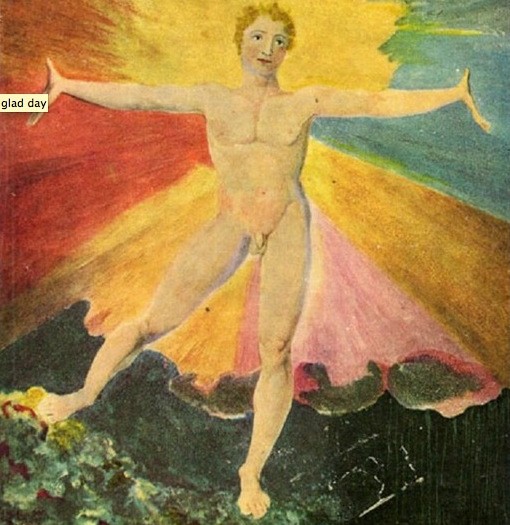
>Glad Day
“Glad Day” by William Blake
(To find out what inspired the following, and why it remains in this form, see The Path of the Numinous, but essentially I found that when I had written the proposal I had recorded what I had to say on the subject, and had no desire to turn it into a book. I have also rewritten this book proposal as a briefer article, you will miss some important sections but there is more flow, and you won’t have the annoyance of frequently hearing about a nonexistant future book. To read the article click here)
I. OVERVIEW
Suffering associated with body image has reached such epidemic proportions in our culture that it must be counted as one of the greatest spiritual plagues ever to be visited upon mankind. Media bombards us unceasingly with images of ever more idealized youth and beauty while vast portions of our population undergo voluntary starvation, grueling exercise regimens and surgery in an effort to control their body image. Attempts to control body image often result in collapsing self esteem, intense suffering and premature death through self imposed famine.
The temptation is to view body image problems as an isolated illness, rather than a phenomenon that points right to the core of our evolutionary predicament. What from one vantage seems an illness in need of eradication, from another is an evolutionary process in need of understanding and continued transformation. The purpose of this book is to explore body image problems in their actual context—- the spiritual/biological evolution of the species. Viewed from this depth, body image disorders come to seem part of a difficult birthing process. This process involves risk and suffering, but may also result in the creation of new life. For readers actually suffering from body image problems this book will provide both the understanding and the means to transform illness into growth.
From the illness point of view, body image is a problem neither hidden nor unstudied, and especially in the last decade there has been an explosion of studies, articles and books which have attempted to understand and ameliorate this collective illness. Much of the most profound and valuable work on body image disorders has been done by feminist historians and psychologists who have done incisive studies of how the oppressive force vectors of a patriarchal society, particularly the media, have distorted womens’ expectations of their bodies. This work is entirely valid as far as it goes which, unfortunately, is not to the core of the problem. The body image epidemic is greatly exacerbated by media and patriarchal forces, but is not entirely reducible to those forces. What is perceived as the cause of the illness is actually a set of pernicious symptoms created by a deeper, more primary cause. Hiding the primary cause of the collective illness are symptoms and secondary forces that are powerful, highly visible, and capable of acting as seemingly independent prime movers. But at the true center of the epidemic and its vortex of symptoms is an absolutely primary human urge, which I have termed the will toward the Glorified Body. This primary cause, unlike the secondary forces mistaken as primary, is a force capable of creating growth and transformation. When we look to the actual core of this problem we see both the reasons and the means for creating an unexpectedly positive outcome.
To understand the will toward the Glorified Body we first need to define what I am referring to as ” the Glorified Body.” In the chapter entitled “Anatomy of a Glorified Body” this question will be explored in depth. Meanwhile, we need a working understanding of what a Glorified Body is. Many Christian writings describe the body of the resurrected Christ as being a “Glorified Body” —-a radiant body free of mortal limitations. Although I am not working from a Christian point of view, I believe that this phrase captures a powerful archetype. We see images and hear stories of the Glorified Body in most or all cultures and periods. There are all sorts of variations and numerous gradations on the Glorified Body spectrum, but the defining characteristics are fairly apparent.
Although the Glorified Body occurs in endless variations there are two very broad categories in which the term “Glorified Body” will be employed in this book. One use of Glorified Body refers to the inherent “energy body” that all human beings possess. Sometimes I will substitute “energy body” to make clear this first meaning of Glorified Body. The second, and somewhat overlapping, category of use for the term “Glorified Body” is to refer to human or nonhuman entities whose manifest bodies are closer to energy than conventional flesh and blood bodies. This type of Glorified Body hovers in the collective psyche of the human species as a highly charged image and expectation of our further evolution.
The opening chapters of the book will provide substantial evidence of the inherent, human energy body. No mystical leap of faith or willing suspension of disbelief will be required to accept the existence of this type of Glorified Body recognized by secular and religious traditions throughout human history. Empirical findings from quantum mechanics, Eastern models of the energy body from Chinese and Aruvedic medicine, scientific studies of human energy fields by psychologist and physiologist Valerie Hunt, and numerous other perspectives will illustrate the existence and nature of our energetic self. Demonstrations of the Glorified Body will take many forms ranging from interpreted scientific data to specific exercises designed to heighten the reader’s awareness of their energy body.
Although the intense materialism of our culture has caused us to lose touch with our real nature, in many other cultures and periods the existence of an energy body existing in parallel to the flesh and blood body was accepted as medical, everyday fact. Chinese medicine has for thousands of years recognized that we have a body made of “Chi”, or life energy, and that it is composed of an intricate structure of energy meridians. Acupuncture works with “virtual points” located along these energy meridians which are not in any way discernible in the dense, physical body. Western medicine has gradually come to recognize the validity of acupuncture, though it is as yet unable to explain how it works. In other Eastern traditions the Glorified Body is referred to as “Shakti” or “Kundalini.” In Western occultism it is referred to variously as the “astral body,” “subtle body,” “light body,” “dream body,” “fine matter body,” and “etheric body.” Soul, psyche, self, mind, ego and consciousness can all be considered energy bodies or aspects of the Glorified Body which materialist science has failed miserably to locate or explain in terms of the physical body.
Parapsychological phenomena are also difficult or impossible to explain in terms of a physical body. Materialist science tends to react to such phenomena with agitation and denial. But these supposedly anomalous phenomena become obvious and expected when we recognize that we have an energy body. William James once said that, “All that is necessary to disprove the notion that all crows are black is one white crow.” A single occurrence in all of human history of a person, for example, being aware of another person remote from sensory information, just one mother in all of human history being able to accurately visualize her child in trouble at a distant location, would probably be sufficient to disprove the notion that we are only physical bodies. And we’ve had whole flocks of such white crows pass over our heads. For example, very large numbers of people in different cultures and periods report out-of-body and near death experiences. OBEs and NDEs involve the experience of consciousness remote from the physical body. Increasingly, these phenomena have been subjected to serious and systematic study. NDE researchers have found that people who are revived from states of arrested bodily function describe strikingly similar, life changing experiences of departing their physical bodies and discovering their awareness existing as an energy body—-a Glorified Body which many describe as possessed with extraordinary vitality, capable of seeing and hearing with dazzling acuity and sometimes able to travel anywhere in space or time at will. Frequently, near death experiencers are able to view and remember specific details of the scene in which their body died and was revived though ordinary, anatomical eyesight was not possible at the time.
Although the Glorified Body may exist in all of us, some people are able to manifest it in different ways and degrees than others. A charismatic person, a person who seems radiant or has a powerful presence may be a person better able to manifest their Glorified Body. Later, in a chapter entitled “Reflection and Radiance” there will an extensive discussion of the shifting ratios of physical body and Glorified Body in our perception of, and projection toward, other human beings. There are apparently rare cases of human beings who have shifted their energy body into the foreground of manifestation to such an extent that, for a period of time, they appear to be closer to light than flesh and blood. Much well substantiated evidence has accumulated that certain yoga masters, saints, religious ascetics, etc. achieve incorporation of the Glorified Body in ways that conventional, materialist science fails to explain. For example, there are numerous accounts of such persons being able to live for years on little or no physical nourishment.
In mythologies, the Glorified Body appears free of some or all of the many limitations of mortality. The Glorified Body may be completely free of cosmetic blemishes, limited vitality, aging, pain, disease, and death. A Glorified Body may be able to transcend conventional limitations of space and time. For example, it may not need technology or an intermediary force of any sort to appear in any location it chooses. It may have transcendent clarity of vision and thought. Often it will transcend ordinary language and communicate through radiance or from the inside of another psyche. A being with a Glorified Body may live in a state of enlightenment and love. Or it could be evil and possess an incredibly potent array of diabolical powers. Visually, a Glorified Body may appear radiant and beautiful—–awe inspiring, numinous—–the body of an angel. But it could also choose to appear cloaked as a mundane, physical body or as a hideous apparition or demon. The most evolved Glorified Bodies are infinitely plastic—-able to take on whatever form is desired. This is the quality of the shape shifter, the changeling——like the devil that “hath the power to assume a pleasing shape” or the liquid metal terminator in the popular movie Terminator 2.
In contemporary mythology the Glorified Body appears in a spectrum of permutations ranging from an idealized human material body to a state of omnipotent, omniscient godhood. In our materialistic culture we have Superman, “the Man of Steel”, who has a more industrialized version of the Glorified Body. (the “the man of steel” seems the perfect Iron Age emblem of the Glorified Body—to put this in the perspective of the cycle of ages see The Mutant versus the Machine—the End of the Iron Age and the Galactic Alignment of 2012) Superman doesn’t have special radiance, telepathy or most other divine attributes, but leaps tall buildings in a single bound, outruns locomotives, and most helpful in our culture, is bullet proof. At the other end of our cultural spectrum the Glorified Body turns up as the shape-shifting UFO phenomenon perceived by human observers in endlessly varying forms.
An interesting mythological place to observe an evolving spectrum of Glorified Bodies in contemporary culture is in the rich fantasy world of Ann Rice’s Vampire Chronicles. These novels also have much to say about the intensity of the modern will toward the Glorified Body. As Rice develops her vision, particular vampires grow more powerful and their bodies become more glorified. Fledgling vampires don’t age, are stronger than mortals, more energetic, have superior mental clarity and memory, are superb mimics and have a number of telepathic abilities. But they are also dependent on living blood and can be destroyed by fire, sunlight and older, more powerful vampires. Vampire bodies go through a kind of reverse aging—-they become stronger, more impervious, and they develop an array of powers that seems to be evolving toward omnipotence. Significantly, the most advanced vampires are no longer fully dependent on drinking blood and become less and less constrained by the organic world. In Rice’s mythology the first vampire was created when a spirit, driven by jealous discontent at not having a body, is able to enter a human being and merge as a kind of symbiont with body and psyche. In the fourth book of the Chronicles, The Body Thief , the Vampire Lestat is tempted to trade his glorified vampire body for a mortal one by the “Body Thief”—-a man of dark psychic gifts who has learned how to transfer his psyche into the body of a vulnerable human being. Lestat agrees to a three day exchange of his vampire body for the body of an exceptionally handsome, vital young man. As soon as the exchange is made Lestat is horrified by the clumsiness of the mortal body, its vulnerability, slowness, tendency toward fatigue, poor vision and lack of telepathic abilities. He feels the most extreme revulsion when he has to suffer through eating, indigestion, bowel movements and illness. It takes a desperate struggle for him to regain his Glorified Body from the duplicitous Body Thief and he is never again tempted by mortality. In the Chronicles you can feel the deep urge in Rice to have a Glorified Body herself, a body not limited by predetermined gender, unwanted body fat, limited beauty and power. Through her characters Rice displays the gifts of a talented body thief in the imaginal realm as she projects her awareness into one Glorified Body after another. And of course there is her cult following—-those folks who write her all the time begging to be made vampires so they can escape their mortal bodies.
The human will toward the Glorified Body is not a subtle urge. It is an iron fist pounding on both sides of the doors of perception. It is an urging of such terrible power that it will prompt some to go under the surgeon’s knife, to starve themselves to death, to sell their souls in the hope of having a mortal body that will merely better resemble a Glorified Body for a brief time. The Glorified Body is not a casual, imaginative musing or an episodic blip on the radar screens of various cultures. It is a powerful, emergent archetype. It is one of our most ancient obsessions and one of the most explosively contemporary. It is related to the deepest sources of human suffering, an inextricable aspect of a thousand types of neurotic torment, a companion in some way to almost every form of personal hell. It is also a divine muse, one of the greatest sources of hope and inspiration we’ve ever known.
Messages about the will toward a Glorified Body are as ubiquitous in our culture as radio and television waves. Expression of this will can also be found deeply embedded in every religion and mythology, and yet it is rarely named, rarely seen as a highly defined, differentiated and absolutely integral aspect of human psychology. The will toward the Glorified Body is at the center of some of our most destructive and also some of our most creative impulses. This will is a primary urge which can inspire incredible athletic achievement, great art, and technology that blurs with magic.
The will toward the Glorified Body is what inspired Michelangelo to carve David. This same will has also inspired the technological magicians of the computer industry to provide us with “Avatars”, animated characters that will represent us in the once visually anonymous world of the Internet. Soon we will be able to boot up our virtual Glorified Bodies and revel in a digital garden of earthly delights. Our bodies will be infinitely plastic and with a mouse click we can be leaner than Kate Moss or have cybernetically enhanced muscle definition that will make Mr. Universe look like the Pilsbury Dough Boy. It’s interesting to note the term the computer industry has adopted for these new digital bodies—-Avatars. The first definition of Avatar in the abridged Oxford dictionary is: “(in Hindu mythology) the descent of a deity or released soul to earth in bodily form.”
But somewhere behind the ever more glowing computer monitor or virtual reality goggles will be a human being—– a digitally unenhanced mortal/organic version 1.0, who will very likely have bags under their eyes and a pot belly. The Wizard of Oz tells us not to look at the man behind the curtain. But we will look, and will be ever more horrified with the contrast between what we see behind the curtain and what’s up there on the screen. The primary urge will remain agonizingly unfulfilled.
However unfulfilling it may be in some ways, technology is one of the central expressions of the will toward a Glorified Body. Technology actually does allow us to extend our physical bodies through time and space. The urge to become a celebrity, for example, is an urge toward a Glorified Body that modern technology can, to some degree, create. In her films, Marilyn Monroe still lives as a youthful beauty. Since she died young there is no aging, mortal body to provide an embarrassing contrast to her Glorified Body projected on the silver screen. She remains a goddess. People in our culture perceive that someone like Marilyn Monroe has achieved a kind of technological Glorified Body and seek material, technological means to achieve immortality themselves. For example, Walt Disney was a man who devoted a life time to creating virtual Glorified Bodies in the form of cartoon characters and the “auto-amniotronic” robots of the Disney theme parks. It is well known that Disney had himself cryogenically frozen at death. But Disney didn’t stop there in his will to achieve a Glorified Body through technology. Less well known is that exactly a year after his death Disney executives were called to a very unusual meeting. They were each asked to sit in a particular spot. Suddenly the lights dimmed, a projector turned on and Disney’s face, larger than life, appeared on a screen. Disney turned to look at each executive individually and asked them about particular projects they were responsible for that were still pending at the time of his death. At the end of the session he announced that he would be back to check on them again.
Projecting the image of a Glorified Body is much more difficult, however, for human beings who don’t live on the silver screen and instead are subject to the embarrassment of having an organic mortal body visible to others in real time without airbrushing or digital enhancements. Most people don’t possess unusual physical beauty or, if they do presently, may have problems if they plan to live a normal life span. Many in our culture try to glorify their mortal bodies through dieting, cosmetic surgery and exercise regimens. But attempts to whip the mortal body into Glorified Body status can never result in a lasting feeling of success. There is always that person in the glossy magazine picture who looks better and seems to really have a Glorified Body. Projection of the Glorified Body onto the idealized other makes them light up like a god, a being impervious to the blemishes of mortality. Many people are secretly fascinated and delighted when a beautiful celebrity is revealed in a tabloid photo to have gained weight, aged or otherwise fallen from the projected glory of Mount Olympus to the mortal gutter. When many people see a glowingly beautiful person they don’t realize they are seeing a changing mortal body in a temporary condition of beauty. The glossy, airbrushed photo is relatively unchanging, but the super model is aging and hurtling toward death with the rest of us. For many, beautiful people, particularly celebrity beauties, are members of a fundamentally different caste than mortal appearing humans. These are the “hot” (see Stop the Hottie!) people that light up in our minds with the sacred fire of deep sexual longing. Perceiving them we feel the stirrings of immortal, archetypal forces. It may seem as if there were a race of gods and a race of mortals inhabiting the same planet. Nietzche’s Zarathustra said, “If there are gods, how can I stand it to be no god!” In our culture we say, “If there are beautiful people, how can I stand it to be no beautiful person!”
One of the great causes of despair and suffering in modern society is our tendency to identify exclusively with the mortal body. The intense materialistic bias of our culture has caused many of us to forget that we also have a Glorified Body —-an energy or spirit body which religious and secular traditions from all cultures and periods have recognized. Modern science has also begun to recognize that it is a fallacy to view a human being as an object. The mortal body is not a fixed object, but a process. Several trillion cellular animals, each of them changing nanosecond by nanosecond, work cooperatively to create body. The mortal body has been called “spiritualized tissue” and conventional materialist science has failed utterly to explain the connection between mind and brain. Quantum mechanics, meanwhile, has exploded the materialist bias of conventional science as an irrational prejudice definitively contradicted by experimental evidence. A number of open minded physicists have confronted the replicable, empirical data which has exposed the materialist fallacy contaminating not only science, but every level of our culture. The so called paradoxes of quantum mechanics—-objects being in two places at the same time, nonlocality—the instantaneous parallelism of objects separated by any distance, the decisive need of consciousness to collapse the wave function and determine outside reality, etc—-immediately cease to be paradoxes when we give up the obsolescent notion that the universe is composed of “matter” and that mind, body, and cosmos are separated. As soon as we accept what mystics and religious visionaries from all cultures and periods have recognized—- that reality is one field composed of consciousness and that what we call matter is epiphenomenonal—–a secondary creation of consciousness—-all the paradoxes vanish.
But does the materialist bias of science really affect, for example, a teenager with a body image problem? As a teacher in an Alternative School for troubled adolescents I worked with a fifteen year old boy we’ll call Adam who was depressed, even suicidal. Adam was unhappy with his body and saw human existence as painful and futile. In talking about the source of his despair he mentioned a television program he had seen a couple of years earlier. The program was a documentary of some sort that showed brain surgery being performed on someone suffering from epilepsy. During this operation, neurosurgeons would stimulate part of the patient’s exposed brain, see what response they got, and label that portion. Adam was horrified by the television documentary. It seemed that being human was reducible to a brain that was nothing more than a circuit board. He felt that this show proved that he was nothing more than a “meat puppet”, a term he borrowed from the name of a popular rock band. Adam’s feelings about his own body, and human existence, were influenced by the briefest glimpse of the pseudoscientific position referred to as “neurological materialism”—-the belief that human consciousness is nonexistent or is reducible to an epiphenomenal by product of chemical process in the brain.
A central purpose of this book is to demonstrate that we are not “meat puppets,” that we are much more than our mortal bodies and that we already possess a Glorified Body. For several hundred years the priests of science have influenced the rest of society toward the materialist fallacy. We became much more focused on objects and away from the realm of the spirit. Our present magic is technology which we can buy at the store. The gods and goddesses we once saw in the heavens have become technology wielding extraterrestrials who, like evil scientists, do medical tests on us inside of metal saucers. And, most significantly, we became focused on the body, our body and the body of the other, as an object. We identified with the denser, mortal aspect of our being—–our physical body. That identification became more and more exclusive, and our Glorified Body—-the energy body that exists in parallel to the physical body——-was forgotten.
Our Glorified Body became the “ghost in the machine” an elusive, suspect dimension that couldn’t be measured in grams, centimeters or amperes. Materialist science found that it was completely unable to explain mind, which is more a function of the Glorified Body than the physical body. Therefore, it literally and pervasively dismissed human consciousness as either nonexistent or, at best, as a by product of an automated neurological process. Once the patriarchy declared man made in the image of God, but more recently the patriarchal dogma went all the way to the other extreme and declared man made in the image of the machine. Consciousness and free will were disparaged as illusions, accidental subprograms of our “real” center—-the brain misinterpreted as a tangled, wet, digital computer. But to the great credit of science, there are now many scientists who have left the rather clueless paradigm of materialism behind. These scientists have begun to integrate the findings of quantum mechanics, and have stopped denying the existence of phenomena that materialist science finds impossible to explain.
One of the findings of quantum mechanics is that point of view changes the physical reality of what is out there. A simple, replicable experiment illustrates this principle. A photon emitter is set up to project one photon at a time at a metal plate. If the plate has one slit in it, the photon is a particle, and goes straight through the slit like a bullet. If the plate has two slits in it, however, the photon is a wave and a wave interference pattern results. The photon somehow “knows” what it is supposed to be before it even leaves the emitter. This result was startling and agitating to the naive mind of the materialist. But almost anyone who pays open minded attention to ordinary life sees all sorts of examples of inner psychic states having acausal parallelisms to outside reality. These are the strange, meaningful coincidences that Jung termed “synchronicities.” Later we will have much more to say about the principle of synchronicity and its relationship to the Glorified Body.
The photon has been called a “wavicle” because it is either a particle or wave depending on what you expect it to be. Some physicists have suggested that human beings are like the wavicle—–if you view a human being as an object, a particle, then you experience the mortal, physical body as all there is and will tend toward the “meat puppet” view of neurological materialism. If you view a human being as a soul, then you experience the wave-like spirit body and will tend toward a mystical, religious point of view. To see the full human being you must flip back and forth between these points of view until you are able to experience that human beings are both particle-like physical bodies and wave-like energy bodies.
The dualistic point of view formalized by Descartes at the dawn of science caused mind and body to be sundered into entirely separate realms. But that naive separation is failing both in science and society. Increasingly, a regained awareness is dawning in the West that body and mind are two sides of the same coin, that spirit and body have an inherent integration captured by the famous alchemical motto, “As above, so bellow.” The Glorified Body is an energy body that is still physical, but more difficult for our present instrumentation to measure. Classical Newtonian physics and the materialist paradigm fail to explain consciousness and other aspects of the Glorified Body. But contemporary physicists like Danah Zohar, Amit Goswami, Fred Alan Wolf and others are beginning to hypothesize quantum mechanical models of the human organism that account for both body and spirit. One problem is that a generation gap of sorts has opened up between those people doing science who are aware, and have struggled to integrate, new paradigms of reality that jive with the findings of quantum mechanics and those who profess to do science but refuse to give up the obsolescent paradigm of materialism that fails to account for quantum mechanics, consciousness, parapsychological phenomena, etc. This generation gap is even wider in society were many ordinary persons, like my fifteen year old student Adam, believe that science has proven that we are “meat puppets” and that there is no spirit or energy body, and others who know the “facts of life” recognized by almost every other culture in history that we have both physical and energetic bodies.
The Sixties rebellion from the dense, naive materialism of the Fifties was in many ways a reassertion of the Glorified Body. Consciousness altering psychedelic experiences were sought as out-of-body experiences on demand. The fascination with Eastern religion, transcendental meditation, parapsychology and the occult was largely a rebellion from the patriarchal dogma of the material body as all there was. For all the narcissistic goofiness, crass commercialism and gullibility often associated with the New Age, this movement grew out of the Sixties and furthered and articulated collective dissatisfaction with the reigning creed of materialism. Body image and eating disorders are largely pernicious symptoms of this reigning materialism and its tendency to create an exclusive identification with the physical body that is both painful and highly disorienting. A major purpose of this book is to heal that disorientation and expand our identification with the physical body to include recognition of our inherent Glorified Body. This help will partly take the form of conceptual shifts, but will also be grounded by specific exercises, practices and traditional resources to help those suffering from exclusive identification with the physical body.
The intensifying will toward the Glorified Body is happening at a time of evolutionary crisis when the metabolism of the whole species is heating up. The twentieth century has seen an incredible acceleration of the historical process and now we approach a new millennium. Technological changes and scientific discoveries are fundamentally altering our experiences of self and outer reality. The biosphere that allows the existence of our physical bodies has undergone a global toxification threatening the continuance of our species. To understand the body image plague we must view it in the context in which it occurs—–a crisis phase of human evolution. Many attributes of the human psyche, from sexuality and body image to spirituality and our sense of relation to the universe, are rapidly mutating. We cannot comprehend symptoms without understanding the general condition of a species that is hurtling toward an evolutionary nexus charged with images of extinction and rebirth. Our intensifying will toward the Glorified Body is more than an urge to reconnect with the inherent, human energy body recognized by all human cultures. It is also a species wide urge to make a quantum, evolutionary jump toward the Glorified Body as our embodied manifestation. We are experiencing an urge to massively redefine body, self and our relationship to physical reality.
This book is a journey toward understanding our body image problems as a spiritual plague occurring in a volatile evolutionary context. It will provide healing practices, specific exercises and resources for those suffering from body image problems during the era of intense and precarious transitions we are currently experiencing. This book will provide the understanding and means to transform illness into growth. Finally, it will provide an in depth look at what the body image plague reveals about the transformative evolutionary context in which it occurs.
(Chapter one will be an expanded version of the preceding overview. The essential ideas of other chapters—–presented in a very tentative order—-will be indicated by a combination of summaries, outlines and sample passages. In order to keep this book proposal to a manageable size a high density of ideas must be presented in a short space. The finished text, however, will be far more readable and accessible, vividly illustrated with examples from popular culture and personal experience.)
II. REFLECTION AND RADIANCE
Sample Passage:
A large part of our suffering is caused by our tendency to mistake reflection for radiance. Our materialistic bias causes us to equate ourselves and others with reflections. Mirrors, photographs, film, video obviously present us with mere reflections of other human beings. But directly gazing at a real time human body passing us on the sidewalk can also be a case of seeing a mere reflection. What we actually see is the reflection of ambient light off the surface topography of skin, hair, clothing. This reflection enters the simple convex lens of the cornea and emerges turned upside down. This imperfectly transmitted light must be turned right side up and otherwise interpreted by neurological processing. This doesn’t happen instantaneously, so there exists a time buffer between environmental phenomena and our perception.
What we actually see is a neurological construct of a past event. Fortunately, we don’t perceive with just the conventional five bodily senses. Other persons have radiance—the direct transmission of self that allows us to feel their presence at a distance which precludes ordinary sense perception. What we actually perceive may be more like an overlay of reflection—-a neurological construct—and radiance—-direct perception of the self of the other. A person with the looks to create a beautiful topographical reflection might have a radiance that is sickening to behold. You see reflections, you behold radiance. We would ease a great deal of suffering if we could shift the ratio between seeing and beholding when we perceive ourselves and others. If we learn to behold others as radiance, to look beyond the blemishes of their reflections, to perceive the Glorified Body already present, then we will have gone a long way toward healing transformation. To accomplish that transformation we need to name and recognize the perception of radiance we already have. We also need to shift the ratio of reflection and radiance in our perception to favor radiance.
III. WE ALREADY HAVE A GLORIFIED BODY
Sample Passage:
We are in the situation of a sleeper struggling to awaken from a long, and in many ways unpleasant dream—–what some would call the realm of Maya, a place of mistaking material appearence for underlying reality. One wake up call was quantum mechanics which completely disrupted the bachelor party of science and its intoxicated reveling in the supposed certainties of Newtonian physics. At the end of the nineteenth century British physicist A.A. Michelson remarked at a scientific conference that physics was now a finished project and mostly a question of “adding a few decimal places to results already obtained.” But quantum mechanics, like the trickster aspect of the UFO phenomenon, exposed the formidable patriarchs of science as entranced suckers for Maya—–the tendency to view projection as fundamental reality. To the great credit of science, however, some physicists have been able to get off of the embarrassing whoopee cushion of materialism and realize that one can posit consciousness as the essential nature of the universe and still do science.
When we recognize the universe as a field of consciousness, we realize that mortality is a projection—- albeit a very convincing projection. We are eternally the “individual” occurrences of unified consciousness. The Glorified Body—-and its spectrum of gradations from an improved material body to unlimited potential —-is a path of developing recognition of what we really are. Out-of-body and near death experiences are revelations of the Glorified Body, episodic interruptions of the delusion that we are occurrences of solid matter in space. My personal, spontaneous out-of-body experiences, for example, caused my fear of death to vanish. The direct experience of awareness not only being able to continue apart from the “material”, but actually being energized and vitalized in a joyous way by the break in identification, was like brilliant sunlight falling on the image of a bogey man projected on a movie screen. People who have NDEs frequently report a complete loss of the fear of death.
IV. THE NATURE OF A PRIMARY URGE
Sample Passage:
The will toward a Glorified Body is a primary urge, the urge of our entire species and not just single individuals living in a particular culture.. But a species is a meta-phenomenon that can be an unwieldy object of contemplation to say the least. Before we further contemplate evolutionary urges in the human species let’s consider urges on a more accessible scale.
Organisms of all sorts seem to have the primary urge to reproduce, to genetically propagate. Among gendered organisms there is an insistent urge to couple with other individuals of the same species. That urging may be intense enough to be described as “going into heat.” Heat is a state of excitement and increased dynamism whether it is the material heat of fire or the metabolic heat of a living organism. The organism in heat may appear agitated, even tormented while in the grip of this urge. In the adolescent stage of development—–the stage of recently acquired reproductive potential—-there may be the particularly urgent will to achieve that first coupling. The unfulfilled urge is antecedent to the coupling event—-an event that in chaos math would be a called an attractor. (An attractor is an event in the future that is so powerful that it warps causality and phenomenon in the present.) Very likely the organism will get to fulfill this urge. But it’s not a sure thing. Some organisms may die before they fulfill the urge—but certainly some individuals of that species must get to fulfill that urge or the species will face extinction. As far as I can tell, urges in nature are always fulfilled by a species, though not necessarily by every individual of that species. Only in human beings could we even imagine the existence of an urge that seems to never be fulfilled. My contention is that the human species has “gone into heat”—-a state of heightened expectation, agitation and chaos. We are nearing the attractor, nearing the place where we can couple with the Glorified Body and fulfill a primary urge.
V. ANATOMY OF A GLORIFIED BODY
Although the outline may sound technical, this chapter will provide an accessible, vividly illustrated discourse on what a Glorified Body is.
Outline:
a. Anatomy of the Glorified Body in various traditions——
The Glorified Body has been called Shakti, Kundalini, Mercury and Chi. In Western occultism it is variously referred to as the “etheric body”, the “subtle body”, the “fine-matter body” and the “light body.”
b. Anatomical similarities and differences between these different models of the Glorified Body
c. The “Dreambody” in Castendea and Mindell
d. The Glorified Body and time, space, dimension
e. A Quantum Mechanical View of the Glorified Body
f. Danah Zohar and The Quantum Self —-a physicist’s model of the Glorified Body
g. The Glorified Body as a “field” experience——-
(The idea of the dreambody as high intensity in space and time corresponds to one of Jung’s intuitions about the nature of the soul. In his words,
“It might be that psyche should be understood as unextended intensity and not as a body moving with time. One might assume the psyche gradually rising from minute extensity to infinite intensity, transcending for instance the velocity of light and thus irrealizing the body.”)
We will also consider the work of physiologist researcher Valerie Hunt to measure and understand the human energy field.
h. The Glorified Body, the archetypes and the collective unconscious
i. The Glorified Body and Ruppert Sheldrake’s theory of morphogenetic fields.
j. Corona Anatomy—-The Glorified Body, radiance and aura
k. Comparative Anatomy—-the Glorified Body and the mortal body—- How they relate, the flow of causation and synchronicity, how they perceive each other
l. Technologies for integrated anatomy ——How various esoteric traditions employ practices to achieve integration of Glorified Body and mortal body.
m. Anatomical case studies—-Analysis of the sorts of bodies achieved by yoga masters, saints, religious ascetics, etc.
n. The mercurial anatomical spectrum of the Glorified Body
VI. EXPERIENCING AND INTEGRATING THE GLORIFIED BODY
Summary:
This chapter will provide specific techniques allowing the reader to recognize and experience the Glorified Body. There will also be an overview of the different technologies of mortal/Glorified Body integration provided by different esoteric traditions.
VII. PROJECTION OF THE GLORIFIED BODY
Summary:
We tend to project the Glorified Body onto those we perceive as especially graced with physical beauty. Some will project their fear and horror of mortality onto the over weight, disabled or cosmetically blemished. These projective mechanisms can cause great suffering in both the projecting psyche and the human objects of these projections. This chapter will examine the personality dynamics of the projector, and the personality warping effects of being the object of such projections. There will be a discussion of projection, envy (one of the most extreme characteristics of our age) , and antisocial behavior such as stalking. We will discuss the synergy and antagonism of Glorified Body projection merged with anima/animus projection.
VIII. BEAUTY AND THE EXTENDED SELF
Summary:
The physical beauty of reflection, and the spiritual beauty of radiance are both examples of what I have termed the extended self. Various talents—-musical, social, skill with words, etc. allow us to extend the self, to be better able to enter the perceptual field of the other as a welcome presence. Physical beauty is a profound example of the extended self and by no means a trivial gift. A beautiful person is welcomed into the perceptual field of the other often with deep sexual and emotional stirrings. There will be a discussion of the paradoxical relationship between projection and extension.
IX. PHYSICAL BEAUTY AND THE SOUL
Summary:
One of the great unexamined presumptions in our culture is the notion that physical beauty is an accident of nature, “the luck of the draw”, an attribute with a completely random distribution. In Vedic texts there are four essential variables that karma determines at birth: the place one is born in the social hierarchy, intelligence, physical strength and beauty.
Sample Passage:
Our culture lives in a painful paradox of infatuation, obsession and worship of physical beauty, and a set of devaluing presumptions that it is in some way a trivial attribute, an accident of genetics unrelated to character, karma, or psyche. Beauty, like intelligence, appears to have an amoral distribution curve—– possessing beauty, intelligence and many other talents does not have a consistent association with a person’s worthiness or morality. But it is a terribly unexamined presumption to assume that this is never the case. Physical beauty is an incredibly potent attribute of someone’s incarnate givens—-the hand they seem to have been dealt. How can we possibly presume that a particular psyche’s level of physical beauty has no connection to their incarnated spiritual essence? To suggest that beauty or its lack may be karmically intended does not presume that beauty is the outward sign of a “superior” soul. Having beauty can mean deeper entrapment in Maya, and exposure to corrupting temptations. But physical beauty may sometimes be the appropriate radiance of a soul that is beautiful. Once in a while a hero may really have a “noble brow” or imposing stature and that correspondence might be karmic intention. The relative lack of beauty may also be an essential karmic challenge to a beautiful soul. My intuition is that the beauty variable is karmic but fantastically varied, paradoxical, subtle ways. The beauty card in the context of a particular psyche may have a meaning fantastically different than the beauty card in the context of another psyche. Despite our worship and infatuation with physical beauty—- sanctioned and encouraged by our society in a billion ways—-it is politically incorrect to suggest that physical beauty might sometimes have a meaningful association with a beautiful soul. But for some reason it is less incorrect to suggest that a precociously intelligent person might be an “old soul” that has somehow earned cognitive abilities in previous lifetimes. It seems intuitively likely to me that if any of the cards in the incarnation hand we are dealt—–intellectual capacity, our parents, the wealth or poverty we are born into, etc. are subject to karmic influence than all of them are—-including looks.
We should also take careful note that the radiant beauty of a good looking loving person, and the topographical beauty of a hateful good looking person are quite different. To those unhypnotized by reflection and projection these are readily apparent as very different types. Similarly, the intelligence of a loving personality is a very different intelligence in kind than the intelligence of a hateful personality. A liquid metal Terminator would never fool a psyche that was gifted at perceiving radiance. It could only fool those who see only reflection.
X. NARCISSISM AND THE GLORIFIED BODY
Summary:
This chapter will discuss the many layered relationship of the will toward a Glorified Body and narcissism. Narcissism can be viewed as the tension of a Glorified Body perceiving itself in a mortal envelope. The narcissist’s desperate longing for attention is largely the urge to explode the delusion of isolation caused by over identification with the mortal body. The narcissist wants physical beauty and other attributes to extend the self into the perceptual field of the other. We will take another look at the myth of Narcissus and consider the work on narcissism by Nathan Schwartz and others.
XI. THE GLORIFIED BODY IN RELIGION AND MYTHOLOGY
Summary:
This chapter will provide a brief survey of some of the ways the Glorified Body appears in religion and mythology. It will examine certain differences between Western and Eastern religion in their views of the mortal body and the Glorified Body. For example, in Buddhism, Hinduism, and Jainism the mortal body is seen as a tool to attain salvation. The goal is to transform the body in order to transcend its limitations and to achieve liberation. For example, Buddha, according to legend, was brought up in a palace where he was purposelfully kept away from the sight of mortality—-aging, disease and death. At his first glimpse of the outside world he recoils in horror at all the signs of mortal body corruption. He begins his spiritual quest to find an answer to the body problem and tries, masters, and ultimately rejects fasting and extreme bodily privation. When he reaches enlightenment, the nature of his physical body changes and becomes more glorified. In Christianity, however, the emphasis seems to be on separating from the mortal body at death and attaining a Glorified Body in the afterlife. There is also an expected future event, the Rapture, where there will be a collective deliverance into Glorified Bodies.
There will also be an analysis of the many forms of Glorified Body revealed in religious and mythological art. The varying forms of Krishna in Vedic text and art will be considered. Krishna means “the all attractive” and he appears in a multiplicity of forms. To attract baser souls he appears in his “opulent” form, depicted in Vedic art as a bejeweled, youth with a coquettish, seductive look. In his highest form he is supposed to be a humble cow shepherd boy. Krishna chose to stop growing at the age of sixteen so he remains an androgynous youth. There will be a parallel analysis of how the physical form of Jesus is portrayed in Christian art.
XII. THE GLORIFIED BODY IN POPULAR CULTURE
Summary:
This chapter will analyze the appearance of the Glorified Body in forms as diverse as rock star worship and the visionary Sacred Mirrors paintings of Alex Gray. We will examine the technological Glorified Body as it appears in characters out of contemporary mythology such as Darth Vader, RoboCop, The Terminator, Edward Scissorhands and the Lawnmower Man. We will consider the fascination with Christopher Reeve—-a man who was the subject of Glorified Body projection and chosen to personify Superman, revealed suddenly to have a quadriplegic mortal body. We will examine a spectrum of Glorified Bodies in three great fantasy works—-Ann Rice’s Vampire Chronicles, Frank Herbert’s Dune books and J.R.R. Tolkien’s Ring Trilogy.
These examples will elucidate the complex, contemporary mythology we have developed around the Glorified Body archetype. This interpreted mythology will reveal much about our current attitudes toward the mortal body and our expectations of human evolution.
XIII. THE BIOLOGY OF BEAUTY
Summary:
This chapter will provide a very brief overview of recent research that has tried to identify a genetic basis for standards of beauty. There will also be a brief discussion of how possible biological determinants of the human urge toward beauty increase the will to achieve a Glorified Body.
Sample Passage:
We have all been brought up to believe that “beauty is in the eye of the beholder,” that it is an entirely subjective perception and influenced by all sorts of shifting cultual influences and contexts. There is some truth to this, especially when we compare what is considered an ideal body type for women today as compared to earlier times. Even as recently as the Fifties—- if Marilyn Monroe were trying to get work today as a model or actress she would be considered to have a “weight problem”. Sun tans and “pale” being a pejorative for caucasians is fairly recent, not very long ago caucasian women were desired to be as pale as possible “Who’s the fairest of them all?” Scientific studies, however, have shown that beauty is not so subjective or culturally dependent, that it is actually based on easy to define universal criteria such as facial symmetry and simple mathematical ratios. When people from various cultures were shown photographs of people (also from various cultures) and asked to rank them according to looks, the agreement in rankings was almost astounding.
XIV. WILHELM REICH, BIOENERGETICS, THE ORGASM AND THE GLORIFIED BODY
Summary:
This chapter will consider the relationship of the Glorified Body and the field of Bio-Energetics including the work of Wilhelm Reich and the neo-Reichians Alexander Lowen, Stanley Keleman and John Pierrakos. Particularly, I will make a case that the orgasm is an eruption of the Glorified Body into mortal perception and is a point of contact between the bodies. I will compare the views of orgasm in Bio-Energetics and Tantra.
XV. SEXUALITY AND THE GLORIFIED BODY
Summary:
Sexuality and the urge toward the Glorified Body are deeply entwined. Many sexual goals have more to do with an urge to couple with the Glorified Body than with reproduction or having a relationship with an actual human being. Among the many topics considered in this chapter will be the tendency in a materialistic, visual culture to unhappily identify with the mortal body and project the numinous Glorified Body archetype onto the other. When the Glorified Body is projected onto the other there are typically power struggles and strongly sado-masochistic obsessions and behaviors. If a person does not perceive their own Glorified Body and has only a dis-eased identification with the mortal body they will tend toward flipping back and forth between the urge to dominate, control, possess, demean and punish the beautiful other or the converse tendency to worship, submit, be enslaved, possessed, demeaned and punished by the object of Glorified Body projection. (like the lyrics of the Eurthymic’s best known song: “Some of them went to abuse you. Some of them want to be abused.”)In other cases, materialistic, dis-eased identification with the mortal body results in interpersonal sexuality being overwhelmed by the will to obtain a Glorified Body through doomed attempts to perfect the mortal body via dieting, surgery, etc. The Glorified Body is a key player in many of the sexual paradoxes, problems and phenomena of our time. As Jung once said, “Everyone who has ever come to me with a religious problem actually had a sexual problem. And everyone who has ever come to me with a sexual problem actually had a religious problem.” The body image problem strongly overlaps religion (or spirituality) and sexuality.
XVI. THE GLORIFIED BODY AND THE WILL TO POWER
Summary:
In the psychology of Alfred Adler the will to power is the most primary human urge. But the will to power, the will to achieve the Glorified Body and the will to obtain many sexual goals are inextricably entwined. Shakespeare’s Richard the III, for example, fuses all three. He hates the body he’s been incarnated in, “…sent into this breathing world scarce half made up, and that so lamely and unfashionably that dogs bark at me as I halt by them.” His absolute hatred of his mortal incarnation electrifies a will to power that is strongly sexual and sadistic. Richard makes a sexual conquest of the beautiful widow of a man he has assassinated, for example. He admits to killing her husband but tells her, “Twas your beauty that provoked me.” She falls for Richard’s seduction and soon after he has her killed.
In our society we see sex increasingly appearing as a metaphor for power. An alienated man living in the margins of society becomes obsessed with a beautiful young actress he sees on television. She glows with an unreal beauty that seems utterly removed from the squalor of his own mortal incarnation. He stalks her and eventually murders her. In fictional fantasies that amplify our fascination with serial killers we see a fusion of these three drives. Tom Harris’s novels Red Dragon and Silence of the Lambs provide very accessible illustrations. The Red Dragon killer worships Blake’s vision of a red dragon and feels that by taking life he internalizes his victim’s spirit energy and will transform into a glowing, transcendent, immortal being. Buffalo Bill, the serial killer being hunted in Silence of the Lambs, is loosely based on an actual serial killer, Ed Gein, who wore body suits made out of the skins of his female victims in an effort to transform his body into another gender. And then there is our cultural fascination with vampires, who in a highly sexual way take the life blood of mortal bodies to maintain an immortal Glorified Body.
XVII. THE GLORIFIED BODY AND ADOLESCENCE
Sample Passage:
The biological condition of adolescence has many parallels to the feverishly excited and unstable state of the species as it experiences an inflamed, frustrated desire to couple with the Glorified Body. Adult culture increasingly resembles the worst excesses of adolescents. People Magazine, for example, with its sexual gossip, and rankings of “who’s hot, and who’s not!” is essentially a nightmare amplification of high school popularity games on an international, adult stage.
Actual adolescents suffer both as objects of Glorified Body projection, and also as subjects who feel the most intense dissatisfaction with the mortal body at a time when it glows the most brightly. (a BBC documentary called, I think, Faces, a plastic surgeon who was involved in some of the cross cultural studies of beauty —see biology of beauty section—makes the statement that, based on objective criteria, human beauty is usually at it its peak between 14 and 24)
The androgynous adolescent is often used to personify the Glorified Body. Krishna, for example, is said to have chosen to stop growing at age sixteen. Peter Pan seems to be an androgynous early adolescent who has a Glorified Body and invites children, not weighed down with heavy adult corporeality, and aided by a little angel dust, to fly away to Never Never Land. Some middle aged rock stars, especially Michael Jackson, seem desperately determined to hold on to the form of the androgynous adolescent. Jackson admits to a life long obsession with Peter Pan, his estate is named after Never Never Land and he is apparently willing to use surgery and (apparently) inappropriate relationships to hold on to the youthful Glorified Body.
XVIII. ANDROGYNY AND THE GLORIFIED BODY
Sample Passage:
The Sixties were, in many ways, an explosion of mutating adolescent culture fascinated with experiencing the Glorified Body. There was a rebellion from repressive patriarchal injunctions about physical beauty, sexuality, and gender roles. Psychedelic art and music combined with powerful hallucinogens to provide out-of-body experiences on demand. There was a fascination with parapsychology, flying saucers, science fiction and weirdness generally, the occult, and Eastern religions which seemed to promise states of bodily transformation and transcendence. There was an urge to break down the isolation of the separated mortal body through communal orgiastic experience that involved boundary dissolving ingredients like sexual freedom, hallucinogens, psychedelic lights, colors and music. There was a surreal aesthetic in dress, music, art, language and thinking. Androgynous rock stars like Mick Jagger seemed liked prophets or gods. Gender roles blurred and men and women came to resemble each other more.
For many there was also a revulsion for unliberated adults, not just for their values, but also for the heavy corporeality of their very gender defined bodies which seemed liked personifications of enslaved mortality and mediocrity. “Don’t trust anyone over thirty.” (was it Jerry Rubin who coined this commandment that became famous in the Sixties?) is a statement that presumes an eternally youthful Glorified Body as birthright. Much in our popular culture is devoted to the rage and disbelief many Sixties baby boomers feel about discovering themselves to be middle aged.
Twiggy (the most famous model of the Sixties), with her ethereal body and huge eyes was almost prophetic of the stereotyped form of the androgynous, big-eyed alien. She seemed halfway between corporeal and cartoon, far closer to the large eyed, androgynous characters in Japanese animation than to the form of a mature woman’s body.
As the transcendent (but also narcissistic) surrealism of the Sixties congealed and descended into the dense materialism of the ensuing decades, the fascination with androgyny became more concrete, literal and corporeal. The Twiggy fad became a reigning, patriarchal standard co-opted by industry. Young women had to starve themselves into submission to it. But the origin of this androgynous ideal had far more to do with the will to achieve a Glorified Body than any patriarchal motive.
XIX. WOMEN, THE PATRIARCHAL CULTURE AND THE GLORIFIED BODY
XX. DIETING, EXERCISE REGIMENS AND THE MYTHS OF SISYPHUS AND TANTALUS
XXI. DIETING AND EXERCISE REGIMENS AS A NEW RELIGION
XXII. ANOTHER LOOK AT ANOREXIA AND BULIMIA
Summary:
These chapters will largely incorporate an eighty page document entitled, The New Religion—Body Image and Eating Disorders. This was a small, not-for-publication book that I wrote in the late Eighties to sum up years of research into body image and eating disorder psychology. It was intended for my teaching colleagues and some of the troubled adolescents I was working with at a Long Island alternative school. During this period of research I was pleased to discover that most of my independent insights and realizations had already been anticipated by feminist historians and psychologists. Supported by their work, I created a theory that the world view of a person afflicted by a body image/ eating disorder could best be understood as a secular and highly materialistic religion involving guilt, sin, ritual, fasting, asceticism, trials, images of salvation in the form of a glorified, slim, androgynous mortal body, and a descent into the corrupted flesh and despair of the damned. Feminist historians pioneered the connection between patriarchal, puritanical Christianity and its abhorrence of the body as a “temple of corruption” and the fanatical, secular abhorrence of body fat. In the feminist paradigm, when women in the Sixties tried to “get bigger” by liberating themselves from patriarchal domination, there was a compensatory effort to make them smaller by wasting their life energy on Sisyphus-like efforts to retain a down-sized pubescent body. The pioneering feminist work continues to have great value, but needs to include a missing dimension—-the innate human will to achieve a Glorified Body.
In these chapters anorexia, bulimia, low bodily self esteem, body image and eating disorders of all sorts will be reevaluated as symptoms of a will to achieve a Glorified Body. This will is both internal and innate, but also externally created and exacerbated by patriarchal forces and media. The fatality rate in these disorders reveals that this urge can be stronger than the urge to obtain needed nourishment, the urge to survive. Many of the control issues involved in eating disorders, the will to control other people, and especially the will to control the mortal body, also need to be reevaluated as refractions of the will to achieve a Glorified Body.
XXIII. THE SUFFERING OF OUR WILL TO A GLORIFIED BODY AND THE CREATION OF SELF-REFLECTIVE CONSCIOUSNESS
Sample Passage:
The painful dichotomy of identification with the mortal body and tantalizing, fleeting perceptions of a Glorified Body may be the essential irritant that awakens self reflective consciousness. Arnold Mindell in his book, Dreambody, writes: “We can say with the ancient Chinese shamans and physicians that ‘life itself is the beginning of illness,’ that consciousness develops from pain, discomfort, joy and extreme sensations. The ego awakens when the body is disturbed, since the disturbance means consciousness of a foreign element.”
When Adam and Eve follow the serpent’s advice and eat from the tree of the knowledge of good and evil they depart the unconscious paradise of Eden where they have immortal Glorified Bodies free of blemish to incarnate as flawed mortals. Human incarnation begins with shame at their naked bodies. Bodily self consciousness is the end of animal consciousness and the beginning of self reference. In our culture we use the phrase “self conscious” pejoratively to mean that someone is caught in feedback loops of a neurotic/narcissistic painful self awareness that is probably making them socially and bodily awkward. But consider the phrase self conscious apart from the cultural bias. Being conscious of the self is a paragon virtue. Socrates said, ” Know thyself.” When Adam and Eve ate of the tree of knowledge they became self conscious in both senses. A body image problem, understood in its full depth, can become a path to self knowledge.
XXIV. TRANSFORMING HATRED OF THE MORTAL BODY
Summary:
This chapter will review the evidence of our profound hatred of the mortal body. A magazine ad for Porcelana, an anti-aging cream, reads, “They call them aging spots. I call them ugly.” (Ram Dass, who pointed out this ad slogan in a talk on aging as an example of manufactured suffering, reveresed the statement and said, “They call them ugly, I call them aging spots.” The depth of self hatred and hatred of the other for having a mortal body will be confronted. The desire to escape hated corporeality by the urge to mate with a glorified looking other will be compared to the myth of Tantalus who was punished by the gods for feeding them corporeal flesh. Tantalus was doomed to be forever hungry and thirsty. There was always beautiful fruit just above his head, but when he would reach for it, it was always pulled away. Finally, there will be discussion and exercises that will encourage acceptance of the temporary mortal body and recognition of the Glorified Body that exists now and that awaits us in the future.
Sample Passage:
For many people, corporeality is a crucifixion. They are nailed on the horizontal axis of the mortal body which intersects the vertical axis of the Glorified Body. Jung felt that the crucifixion was the central metaphor of the human condition. Before Christ could be resurrected and incarnated in a Glorified Body he had to accept the crucifixion fate.
Accepting the suffering, the crucifixion of mortality, with its bleeding stigmata of cosmetic blemish, disease, aging and death may be a crucial phase of our spiritual development. We may despise, even feel wrathful, homicidal rage when we see that our bodies don’t appear in the bathroom mirror as Glorified Bodies. “That body needs to be starved to death!” is the unconscious cry of the anorexic. Perhaps it is sensed unconsciously that death is, in fact, the only cure for mortality. Perhaps death really does hold the potential for transition from corporeality to the Glorified Body, so that a death wish is a true unconscious intention of a psyche seeking transformation.
When we view the body of the other we may be equally hateful. If the other does not appear to have a beautiful body then they receive no projection of the Glorified Body archetype. Instead we may project our own shadow on to them. They become projection screens for our own anxiety about corporeality, our fears of becoming fat, old, diseased or disabled. One sees the sad, anxious mirror of ones own mortality. The sacred fire of sexuality grows cold in their presence. The unglorified other carries the odor of death, and mating with them compared to the beautiful other may seem a choice between coupling with a corpse or a god.
But if one couples with a glorified, beautiful other to escape the imperfections of corporeality then one spins about in a vortex of Maya and arrives back at the same point. The idol starts to age and develop feet of clay. It turns out to be a trick and the god or goddess is revealed to be a flawed mortal. One reaches for the fruit of paradise, but like Tantalus, punished for feeding the gods the mortal flesh of his own son, it is always pulled away.
XXV. HEALING/TRANSFORMING THE MORTAL BODY
Summary:
This chapter will discuss flaws in the Western medicine paradigm. It will suggest paradigm shifts necessary to understand and work with the ailing body. It will examine the presumption that illness is always a bad thing that needs to be cured and suggest other possibilities. We will understand possibilities and cases of shifting the physical body into a more energetic, glorified state. Finally this extensive chapter will provide alternative attitudes, practices and resources for bodily healing and transformation.
Sample Passage:
Indian, Chinese and Tibetan medicine all employ out-of-body states to promote healing. They attempt to create a state of health which approaches the Glorified Body. Certain very rare individuals—yoga masters, saints, religious ascetics —–have reportedly achieved states where they required little or no physical nourishment to live for long periods of time.
Our attitude toward healing tends to be very bipolar. Death and disease are not aspects of a process, but enemies to be fought at all costs. We take our doctors and other “experts” very seriously. Almost every other commercial on TV is a remedy for the headaches, stomach aches, indigestion, heart burn, constipation, etc. that are typically caused by eating a toxic diet (also sold on TV) and living in a toxic culture (also brought to you on TV). A typical commercial of this time involves a worried older man who describes symptoms that sound like they might very well be stomach cancer. But then he goes to his television doctor and a few seconds later in the final deliverance scene his face is beaming and he proclaims, “My doctor says just take Mylanta!” As health insurance becomes too expensive, these helpful companies offer people free medical diagnoses and prescriptions. Buy their product and everything will be just fine. And why pay so much to see a real doctor when the television doctor already knows the answer? If you’re masochistic enough to sit through a couple of hours of American commercial television you’ll be amazed at the chorus of voices repeating the mantra, “My doctor says.. My doctor says… My doctor says….” followed by injunctions to take various over the counter potions. The television doctor never says anything about changing your diet or exercising. There’s always a delightfully simpler and easier solution that involves a helpful purchase and in no time you’ll be up and about keeping the treadmills of industry spinning merrily along.
Very recently,11/16/05, I wrote a very brief blog that has some relevance here:
Feeling Unhappy?
That’s just your body’s way of saying you have a Prozac deficency.
I keep hearing a really offensively stupid ad on the radio where an announcer asks menopausal women, “Are you getting hot flashes, mood swings, etc.?” A list of symptoms are recited that probably apply to almost any menopausal/premenopausal woman—“Well that’s just your bodies way of saying it’s time for _________”(insert name of pharmaceutical which I can’t recall).
So this is a pretty interesting concept that never occurred to me before. Specific bodily sensations we might have are actually our bodies way of notifying us that it is time to buy specific pharmaceuticals or other products. This principle can help us to redefine many of the physical sensations that sometimes puzzle us. In the ignorant past you might wonder why you were having a headache, but now you know that headaches are just your body’s way of saying that you have a defficency of Extra-Strength Excedrin. Bodily sensations now start to make a lot more sense. For example, let’s say someone punches me as hard as they can in the face and it hurts. Well, this is probably just my body’s way of saying I need Comcast High Speed Digital Cable, because if I were home alone watching cable I wouldn’t be having dangerous human interactions that could result in punches. Sore feet are just my body’s way of saying that I need to purchase Nikes. If I feel tired, that’s just my body’s way of saying I have a latte deficiency and need to report to the nearest Starbucks.
This is the helpful role that society has always played for us, it takes our internal perceptions and explains them to us eliminating our confusion. Feel an excitement in your lower charka? Well that’s just your body’s way of saying you need a hottie. Feel unhappy? That’s just your soul’s way of saying you need a Fundamentalist Religion. Got Fundamentalist Religion and still unhappy? Well that’s just your souls way of saying it needs the 72 virgins waiting for it in paradise and its time to put on the exploding overcoat. Uncertain about where the world is going? That’s just your mind’s way of saying it’s time to vote for a helpful cowboy as President. You are President but still don’t feel important enough? That’s just God’s way of saying that you need to be a War Time President and it’s time to preemptively invade another country. Got a splinter in your mind you can’t get out? That’s just the matrix’s way of saying that the world hasn’t been pulled over your eyes tightly enough and you need to buy something, some imaginary steak perhaps, so that you’ll stop worrying your pretty little head and let parasitic entities keep sucking you dry while you sleep away your incarnation. (end of blog entry)
But my real doctor says don’t listen to the television doctors, listen to him. And what does my real doctor say? Quite often he’ll say that everything will be better if I purchase some prescription pills that a helpful multinational pharmaceutical company has brewed up for my healing. Perhaps some nice antibiotics that will kill the bad disease. That good looking, dynamic man on television doesn’t sit around trying to figure out why he has so many headaches like some introspective sissy, no he’s going to “Bang it back with Excedrin!” And we all know that real doctor pills have an even stronger bang. My doctor says…
But here’s something the doctor doesn’t say very much about. For approximately eighteen hundred years Western medicine was under the spell of a Greek medical philosopher by the name of Galen. Galen believed that the body was governed by certain fluids, called humors, such as “phlegm”, “cholera”, etc. When Shakespeare’s characters are sometimes described as “phlegmatic” or “choleric” we must remember that these were not merely personality adjectives but were also actual medical diagnoses in Elizabethan time. Galen’s philosophy had an authoritative and impressive sound to it, but it also had the disadvantage of being utterly and completely wrong, and the treatments derived from Galen, particularly blood-letting were harmful, sometimes fatal. But for eighteen hundred years or so, the impressive patriarchs of medicine, the graduates of the most distinguished medical schools in Europe, treated most illness by letting blood—applying hot glasses or leeches to people’s skin. This was such a common and universal practice that doctors were called in the vernacular “leeches.” For eighteen hundred years, “My doctor said just apply blood sucking leeches!” Many of the most famous historical figures, and lots more regular folks died because they listened to “My doctor says…” during this eighteen hundred year interlude of insanity. For example, a man whose face appears on our dollar bill above the motto “In God We Trust”, by the name of George Washington believed in “My doctor says…” A hail and hearty man of sixty-eight, he went out for a winter horse back ride and came back with a common cold. Over the next two days his doctor proceeded to relieve him of six pints of blood. George Washington’s last words were spoken to his doctor, “Pray, take no more trouble about me, just let me go.” Finally, in the 1860s a young, not especially distinguished young British doctor working in a public hospital decided to do an experiment. It may have been the first double blind study. He took a randomized list of patients and divided it into two groups. The first group was treated with the techniques he learned in medical school—mostly blood letting. The second group was treated with just soup and bed rest. The second group did significantly better and gradually the medical establishment came to realize that they had been killing people for a mere eighteen hundred years.
Please don’t mistake the meaning here. I’ll go to a doctor and even take antibiotics, which have saved countless lives, if I’m absolutely convinced its necessary. Western medicine has uncovered an amazing wealth of valuable information and effective treatments. But I consider myself to be the person responsible for my body, not my doctor or the friendly pharmaceutical company. I’ve also learned, many of us have, that dis-eases are not to be looked at with the naive, literal materialism of Western medicine. Often they are the metaphors or physicalized expressions of spiritual process.
Arnold Mindell speculates presciently about what collective compensatory mechanisms might do in response to false healing, “Will Death create diseases that cannot be healed?” This was written about three years before the discovery of AIDS. Mindell, a Jungian analyst, describes medical dreams observed in various patients that point toward the urgent need to free our understanding of bodily process from the constricting illusions of materialism. Mindell writes,
“Frequently the dream physician is unable to cope with the nature of the disease. In a dream of a cancer patient, a surgeon-physician—who in reality is a manly, powerful person—-appeared as an insane man asking the dreamer for help. A leukemia patient dreamed that her physician said jokingly that he was a holistic doctor; but beings from another world associated to the leukemia said that they too were holistic. Still another cancer patient dreamed that the last healer who could help her was called a mandala doctor. Another person, after receiving a diagnosis of cancer, dreamed that the healing medicine consisted of a spiraling rocket. In many dreams of ill persons the physician himself is responsible for propagation of the disease.”
XXVI. HEALING THE SUFFERING OF OUR WILL TO A GLORIFIED BODY
Summary:
This chapter will provide an array of practices and techniques for healing some of the suffering associated with our will to a Glorified Body. Already existent healing methodologies and resources such as Feldenkrais method, Bioenergetics and Eastern disciplines of transforming human energy like Chi Kung and Tai Chi will be discussed. Some of the major goals of these practices and resources will be:
a. Shifting exclusive materialist identification with the mortal body by gaining awareness of the Glorified Body.
b. Shifting the perceptual ratio of reflection and radiance in favor of radiance.
c. Recognizing the illusory projection of the Glorified Body archetype onto good looking mortals and reclaiming some of this projection.
d. Recognizing that over weight, aging and average looking folks also have Glorified Bodies.
e. Learning to recognize, interrupt and still the thousand tongued demon of bodily self hate when it speaks in the mind.
f. Providing help for those who are particularly good looking to resist the pressures and distortions of being Glorified Body projection screens.
g. Exploring techniques that encourage movement toward open hearted acceptance of suffering that may be unavoidable in a mortal body incarnation
h. Providing new approaches to compulsive eating disorder thinking and behavior
i. Suggesting life affirming approaches to healthful eating and body weight
XXVII. DREAMS, LUCID DREAMING AND THE GLORIFIED BODY
Summary:
This chapter will discuss the reality of dreams as the other side of incarnation. It will demonstrate that dreams, particularly lucid dreams, are opportunities for us to experience the shape-shifting Glorified Body free from the constraints of conventional space-time perception. Quantum mechanical models of dreaming created by Fred Alan Wolf and other physicists will be discussed. Dreams will also be considered as voices and visual, emotional expressions of processes of disease, healing and transformation in the mortal body and Glorified Body.
XXVIII. OUT-OF-BODY EXPERIENCE, NEAR DEATH EXPERIENCE, DEATH AND THE GLORIFIED BODY
Summary:
This chapter will provide a brief over view of the wealth of valuable research done on OBEs and NDEs. Particular attention will be paid to the work of Dr. Kenneth Ring, a remarkably open-minded university scientist who has been studying NDEs for decades. There will be a discussion of what these phenomena indicate about the Glorified Body and quantum mechanical models of consciousness.
Paradigm shifts in our perception of death will be offered. The relationship of death to the mortal and Glorified bodies will be discussed and once again we will consider the point of view of quantum mechanics. Use of death as an ally, teacher and rejuvenator in the Casteneda books, Mindell’s somatic therapy and Eastern traditions will be discussed. Alternatives to our society’s dis-ease with death will be offered. A paradigm of mortality and death as developmental catalyst will be presented.
XXIX. TECHNOLOGY, VIRTUAL REALITY AND THE WILL TOWARD A GLORIFIED BODY
Summary:
This chapter will begin a widening of focus and shift in emphasis as we move toward the conclusion of the book. The plague of body problems was introduced in the context of a larger evolutionary struggle which will be given more thorough consideration in the final chapters.
Topics covered in this particular chapter will include the development of technology as an extension and augmentation of the human body. The film Edward Scissorhands and other examples of popular culture will be used to illustrate the prodigious benefits and problems involved in our emergence as a technological animal.
A major section of this chapter will be a consideration of the technology of virtual reality and its relationship to the Glorified Body and the further evolution of man.
XXX. THE GLORIFIED BODY IN UFO AND ABDUCTION PHENOMENA
Summary:
This chapter will discuss possible relationships between UFO and abduction phenomena, the Glorified Body, and human evolution. An overview will be presented of the work of Carl Jung, Jacque Valle, Kieth Thompson and others who have studied these phenomena with open minds and psychological depth. The inadequacy of both denial and conventionalized extraterrestrial explanations will be discussed.
Sample Passage:
People who have abduction or encouter experiences, like people who have OBEs or NDEs often articulate a changed sense of bodily reality. A woman describing her own encounter to Whitley Streiber relates, “My realization was that I was a spiritual being solidified into physical form. I really got, emotionally, that physical and spiritual are not separated whatsoever.”
XXXI. HUMAN EVOLUTION AT THE BRINK OF QUANTUM CHANGE
Summary:
This final chapter will incorporate material from two earlier works: Archetypes of a New Evolution and The Capsule of Intentionality. Archetypes of a New Evolution, written when I was an undergraduate in the late Seventies uses the analytical tools of Jungian psychology to reveal an evolving mythology just beneath the surface of popular culture. The Capsule of Intentionality provides an expanded view of these emergent archetypes which provides us with information about the evolutionary nexus we are approaching.
Archetypes of a New Evolution I don’t have scanned in and reformatted yet, but will soon. Chapter V of the Capusle of Intentionality—–
White Crows Rising—Evolution, Jung, UFOs, Near Death Experiences, Virtual Reality,and the Approaching Singularity at the End of Human History puts the Glorified Body into a a larger evolutionary context as does Casting Precious Into the Cracks of Doom—–Androgyny, Alchemy, Evolution and the One Ring.
There is a brief discussion of the Glorified Body and a very thorough discussion of the evolutionary context in the two DVDs I did with John Jenkins and Lost Arts Media: Dialogs about Prophecy and the End of Time and Looking toward the Event Horizon (see products and services section of the site).


Leave a reply