 ZapOracle.com Zap Oracle

Instructions:
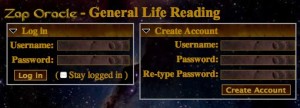
Create an account for yourself with a user name and password. Your information is kept private, but we do have a rarely used function called “Collective Theme Tracker” that anonymously does a statistical analysis of all cards chosen by the entire oracle to look for deviations from chance. This information will not be associated with your name or account. If you fill in your name (first name or a nickname is fine) then when you do a General Life Reading your name will appear in each card position in stead of “querent.”
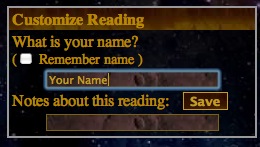
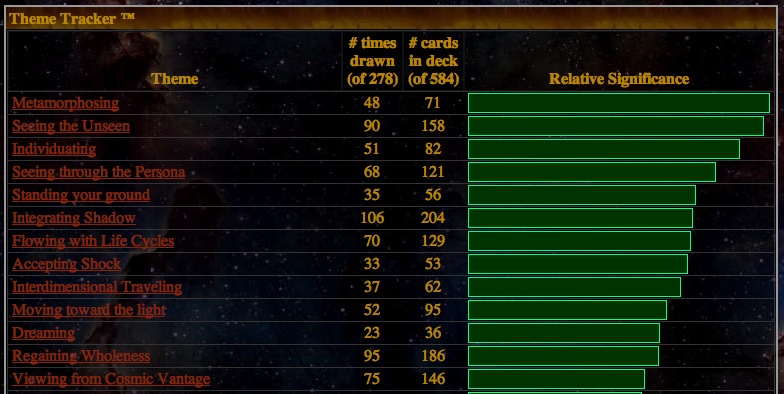
At the reading screen there is a notes field where you can add anything that may help you identify the reading or its context after you save it. For example, “Reading on the first day of my trip to Australia.” Clicking “List Readings” (on the left side of the oracle screen under user account) will take you to a screen where you can review all your saved readings. After you draw the last card of a reading click “View Themes for this Reading” and Theme Tracker™ which will show you a bar graph chart of the themes and which are the most prominent for your reading. As far as I know, no oracle has ever had such a capability. Besides tracking themes for an individual reading, you can hit the Theme Tracker button (on the left side of the oracle screen under your account) and see themes for the last 29 days (the default) or another time interval you set. Click on a theme to learn more about it and to see related cards.
There are different options for each of the four spreads. At the General Life Reading screen you are asked, “What is your name?” Filling in this field substitutes your name for “querent” in the ten card positions of the General Life Reading. If you already entered your name in account settings you won’t need to do this step. The relationship reading asks “Who is the other?” And there are similar questions for the other types of readings
Currently you have a choice of four spreads. You can choose one of the spreads and ignore what it says about the card position substituting your own question. If you want to review your reading, don’t use the back arrow on your browser, instead click on “view all.”
I generally don’t ask oracles to predict future outcomes as that implies I don’t have free will which would affect the outcome. Something I have noticed in my interaction with all oracles is that there are zones of time when I will get more oblique, sometimes even irrelevant or random responses, and there are other zones of time where I seem to be inwardly more ready for messages and everything I get is absolutely dead-on accurate.
These instructions will be updated based on user feedback and modifications so check back with them every so often.
Any questions, suggestions, anomalies about this version please email: jonathanzap@hotmail.com
I would be glad to get any kind of feedback on your experience with the oracle as this is very much a work in progress.
If you should want to consult with me about your Zap Oracle readings see Zap Oracle Consultation Service
Unusual Terms —“Babylon Matrix,” “Mutant,” etc.
I use some unusual phrases in the oracle text and also familiar words and phrases that I have reinterpreted. See A Glossary of Zap Terms for definitions.
Credits/Copyrights/Watermarks
Photographs in the Zap Oracle are by me unless otherwise noted. These are all copyrighted and have secret digital watermarks hidden in them so please don’t copy without permission or the zaporacle.com security force (which works closely with the FBI and Interpol) will hunt you down. I have tried to credit other images as well as I can, but some of the originals were scraps of paper, attachments people sent, etc. I certainly don’t want to infringe on anyone else’s copyright or in any way disrespect the talented artists who created these images, so if anyone notices an image that shouldn’t be posted, or that is improperly or insufficiently credited, please let me know (jonathanzap@hotmail.com) so we can immediately edit or remove it.
In 2009 I revised and expanded many of the cards. Since some of the cards are fairly long, it is up to your discretion how much of the card you read. The first paragraph is usually a capsule of the larger card, so if you just want the gist of it you could read just that. In 2010-11 I worked with my superb editor, Austin Iredale, to polish all the cards.
You may notice that there are two style sheets for the oracle. The most common one is called “Arrakis” which has a starfield background. The alternate style sheet called “Lothlorien” has a leafy background. Whenever you sign on you have a two thirds chance of getting Arrakis and a one third chance of getting Lothlorien. If you wanted to interpret your style sheet as having oracular significance, Arrakis means cosmic vision and the path of the Warrior. Lothlorien means the path of heart and the way of magick.
A Brief History of the Zap Oracle:
Although I have attached my last name to the oracle I consider myself the co-creator of the oracle as a variety of other forces (human and otherwise) have collaborated in its inception and continuing growth and development. The Zap Oracle had a very humble origin about thirty years ago. I grew up in New York City where I frequently visited art museums. At some point I began to accumulate art post cards which I found at museums and various stores. Eventually I put all these cards in an unused camera bag and started a weekly ritual—-picking four cards from the bag and putting them on the fridge with refrigerator magnets. I probably didn’t have any oracular expectations; I just wanted a way to vary the display on the fridge. I had already read Jung at this point, so I already knew about synchronicity, but I don’t think I was expecting the card choice to be synchronistic. At some point, I began to notice synchronicities between the card choices and what was going on in my life during the week the cards were chosen. The card collection more or less revealed its own identity as an oracle.
Crucial to the card collection beginning to function as an oracle was that the images I collected were ones that were “numinous” to me. (“Numin” means spirit, so something is numinous when it is imbued with the spirit and lights up in the mind of a perceiver as having an uncanny significance.) Intuitively, I had chosen images that were numinou,s and therefore mostly archetypal and dense with layers of meaning. Some images were uplifting and filled with light, others were dark and twisted. This was also crucial in the collection becoming an oracle, because life is dark and light, yin and yang, and an oracle needs to be a symbolic microcosm of the macrocosm. If both principles are not represented then you get a pseudo oracle that is one-sided and inadequate. For this reason I find a New Age product like Angel Cards to be light weight and superficial because only “nice,” flattering things are represented.
If you put together a collection of archetypal signifiers of some sort, and those signifiers represent light and dark and a wide variety of states, you are creating a symbolic microcosm, and that microcosm becomes a kind of brain or neural network that is “activated” by the presence of an open percipient. I put “activated” in quotes because I have to be careful of my verbs here as the principle of synchronicity implies an acausal relationship and most verbs imply a causal relationship.
(click here to read a page I wrote on synchronicity and the I Ching)
So I discovered, rather than intended, that this collection of postcards was acting like a kind of brain. Each card was like a neuron in this brain, and the power of those neurons came from the visionary artists who created the original images. The more cards/ neurons added to the oracle, the more varied the states that it could represent in its interaction with me, and therefore the more intelligently interactive it seemed to be.
Eventually the oracle outgrew the camera bag and moved into a small back pack. By this time I was calling it the “image oracle,” a name that it retained during most of its life. In addition to consulting the oracle myself, I also made it available to other people and sometimes did readings for them, often done in combination with I Ching readings. The cards had no captions, so I was typically the one to narrate the meaning of the cards and together we would explore relationships of meaning between the cards in the reading and what was going on in the life of the person getting the reading.
The image oracle had been in use for more than twenty years before my friend Daniel made a suggestion in 2004 that seems simple, obvious and amazing in that it had never occurred to me. He suggested I caption the images. Almost immediately I began to carry out that suggestion.
Two other changes in the oracle happened around the same time. Increasingly, I was using my own photographs (I tend to photograph what I find numinous) as the new cards in the oracle. I was living in rural British Columbia at the time, so I wasn’t running into so many new art cards, but I had lots of photographs. I also became anxious about the physical vulnerability of the oracle as it was made out of paper and existed in one back pack. Many cards had been in use for twenty years or more and were getting scuffed and dog-eared. I decided to begin the laborious process of laminating the cards with self-adhesive lamination sheets. This choice was a very mixed blessing—-it prevented further scuffing of cards, but it was a poor solution compared to scanning the cards and preserving them in a digital format. When I later did start to scan them, the lamination would adversely affect the image quality. (Some of this will be improved in the future when I find negatives and better sources of the images I can rescan.) While I was captioning and laminating, I was also going through piles of my own photographs and adding them to the oracle which had now out grown the back pack and molted into a large gym duffle bag.
In May of 2005, I was brain storming with my friend Drew Stricker about the design of a new website he was going to build for me. Drew is a young digital artist and computer wizard who at the time lived in Arkansas. Thinking about what functions I wanted on this website, it occurred to me that it would be great to have the image oracle available on line. The more I thought about it, the more it seemed that this would be a central part of the site, and when it came to choose a domain name I decided on “zaporacle.com.” During the summer, Drew built the infrastructure of the site and many of the graphical elements. Also during the summer, I discussed the structure of the oracle function with another friend, David Thomas, who is a talented software engineer known for his ability to create quick and effective solutions to complex problems. At the time David was too busy with his job at IBM to do more than make a few suggestions. In mid-October of 2005, I called David and found that he had a block of free time available and he immediately set to work on writing the code for the oracle.
David found a random number generator algorithm called the “Mersenne Twister” designed by Makoto Matsumoto and Takuji Nishimura to have “a far higher order of equidistribution than any other implemented generators” and so that “623-dimensional equidistribution property is assured.” As far as I can figure out, this has something to do with math and sounds really cool. My initial readings were extremely synchronistic and relevant so it seemed to be working.
Over the next few days, David made amazing progress in coding a working prototype. Halloween of 2005, was a day of synchronicities with a lot of thematic coherence. It was an emotionally charged day because my mom was entering Mt. Sinai hospital for procedures preliminary to open heart surgery on November 1st. A long I Ching consultation that morning pointed to work on the website as my main focus. Synchronicities immediately seemed to support that with emails (the first of this sort in weeks) coming in from people who found the website and wanted DVDs and readings. Later in the day, I found myself doing other livelihood work which I experienced as extremely counter-enthusiastic. Almost the moment that work ended, I got a call from David and he set up a three-way call with Drew. Most of this conversation was rapid-fire dialogue between D&D in computerese that I could only follow in broad outline, but I was delighted to be a bystander. I felt like a kid looking in at the elves workshop as these two computer wizards talked about future designs and at the same time, working online together, modified a prototype David had built for the Zap Oracle. To my amazement and delight, while we were on the phone, they uploaded it onto the website and made a number of modifications and enhancements. I was out on my bicycle when the phone call started, by the time I got home and turned on my laptop the Zap Oracle had been born, coming on line at the time of the year most associated with magic and the crossing over of living and dead, conscious and unconscious—-All Hallow’s Eve—also known as Halloween.
Some astrologers do charts not just on people, but on projects, political movements etc. and they base their charts on the time and place of inception. Without anyone having the conscious intention, the conference call and birth of the Zap Oracle happened to occur on Halloween Evening which was also the eve of a huge medical transition for my immediate family, and the eve of a day in which there had been so many indications to focus on the website. The place of inception would have to be cyberspace, otherwise we would have to triangulate some intermediary point in the USA as all three of us on the design team were at least a thousand miles from the next nearest person. Come to think of it, both time and space were somewhat indeterminate as we were are all in a different time zone. That also seems propitious, as an oracle (like the unconscious, like the dreamtime) needs to exist somewhat outside of space/time. Also propitious was that every phase of my mom’s recovery from heart valve replacement surgery (which occurred the following morning) happened ahead of schedule. Eight years later in 2013, she’s still doing fine at age 89.
Some other notes on the oracle:
Quite a few of the Zap Oracle cards are self-portraits and there are three reasons for this I can think of. The most obvious is that I’m a very slowly recovering narcissistic personality type. The second reason is that I have a lot of self-portraits, not because I am photogenic, but because I am the one person always around when I take pictures. Third is that it feels easier to assign a meaning to a self-portrait and doing that for pictures of friends and strangers can sometimes seem more like an imposition.
Version 3 of the Zap Oracle was coded by computer wizard Mathael (the name he was born with). It launched in the summer of 2007, and brought many improvements in layout, new user features such as an ability to magnify cards, and many, and many new administrative functions for building and editing cards.
Version 3.2 launched on November 9, 2007. This version allows users to save their readings, plus any notes they add, and also individualizes each card position based on information entered by the user. This version also includes the first prototype of Theme Tracker™ a program that analyzes all the user’s saved readings to show which of 46 archetypal themes are most (or least) prominent. As far as I know, no oracle has ever had such a capability.
Version 3.2, which included the first occurrence of Theme Tracker™, unintentionally launched on an astrologically significant day—a Scorpio New Moon. The day of the launch, a friend showed me an article in The Mountain Astrologer about the Scorpio New Moon occurring on the same day. The New Moon is the ideal time in the lunar cycle to begin something, and Scorpio is all about delving into mysteries, the unconscious, etc. Neither I nor Mathael had any awareness of this when the new version launched. All of this reinforces the sense I have, which others have had about the I Ching or the Tarot, that the oracle is its own entity.
When you choose cards from the oracle, you also become part of its history or morphic field. This field is continuing to develop, and has now become part of that global brain called the internet which will likely mutate it into even more unexpected directions. The Zap Oracle presently (August, 2013) has 662 cards, but I expect to add many, many more and I hope to be continuing to add, edit and modify it for many years to come
Only you can decide if the results you get from an oracle are random or oracular synchronicities (parallelisms between your psyche/life situation and the signifiers, cards, hexagrams, etc., of the oracle). What many people find is that there are certain times, especially when they are sincere in approaching the oracle (and truly in need) when every response is dead on accurate. At other times, the responses seem random, irrelevant, even misleading, and this seems to especially happen when one is redundantly or indulgently consulting the oracle. In ancient times, and continuing into the present, people often approach oracles looking to have their ego preferences confirmed, to be flattered, or to get answers to questions when their own intuition or a previous oracle has already supplied an answer. Mechanically, (we all do this, certainly I have) we approach the oracle as if we were pulling the handle of a slot machine until we get a prize. The I Ching recognizes this tendency and has many relevant lines in Hexagram # 4, Youthful Folly. For example, “It is not I who seeks the young fool; the young fool seeks me. At the first oracle I inform him, if he asks two or three times, it is importunity. If he importunes, I give him no information. It does not further to persevere.” If you do persevere, you may get random or irrelevant results, or, far more dangerously, the oracle may mirror your own trickster energy and give you the results your ego craves, allowing you to play the fool.
Essentially, a moment of consulting an oracle is a networked constellation of elements. The oracle, your psyche, the particular moment in time, the method of choosing one of the oracle’s signifiers, and the principle of synchronicity seem to be the chief elements. All of these elements need to align for an ideal moment of oracle consultation.
Feedback of any kind about the oracle—including typos, errors of grammar or word choice, factual errors, philisophical disagreements—are gratefully appreciated. Please send to jonathanzap@hotmail.com
Best wishes for your relationship with the Zap Oracle!