 ZapOracle.com Zap Oracle

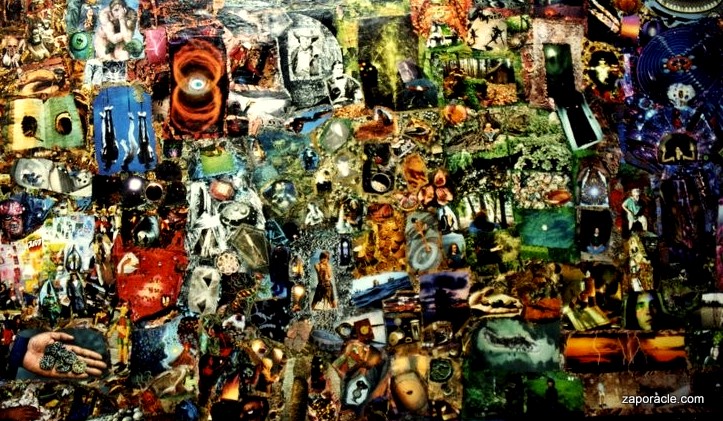
© 2000 Jonathan Zap
Dreams and “Reality”
The heart has two phases, contraction and expansion, systole and diastole. Mammal incarnation has two phases it cycles through on a daily basis — waking and dreaming. We are interdimensional travelers, arriving from another dimension at birth, departing to other dimensions at death. The cycle of the day recapitulates the cycle of a life. At night/old age we run out of energy, grow sleepy, and eventually surrender to the temporary oblivion of sleep/death. Sleep/death is not an eternity of velvet darkness; the velvet darkness is polka-dotted with shimmering portals — incarnations/dreams. The dreamtime is our other daily dimension, and it is ruled by a different physics than the physics of our waking dimension. The relentless and ubiquitous tyrant gravity does not bind us, and if we realize that we are able to fly and translocate at will. Linear time does not bind us, and past, present and future fold together in wavy patterns like Damascus steel;. In the dreamtime, synchronicity is the rule rather than the seeming exception. The Tao of the dream usually unfolds in parallel to inner psychic content. An unproven assumption is that we generate our own dreams. But the dreams of people who are dull and unimaginative in the waking life, often have the surreal double and triple entendre complexity of the dreams of the most imaginative, as if they were all directed by David Lynch. And who is the dream generator in the many documented cases of mutual dreaming?
Our culture of fundamentalist materialism has the naïve prejudice that waking is “more real” than dreaming. Waking and dreaming are just two cases of our having a perception that something seems to be going on. Physics tells us that the seemingly solid objects of our waking life are actually patterned energy, that matter (as Einstein pointed out) is actually just a special case of energy. Also, we never sense anything but internal perceptions. For example, when you look at an object with your waking eyes you see ambient light reflected off the topography of its surface. That light passes through the simple convex lens of your cornea and appears upside down on the back of your retina. The image is then turned right side up and otherwise interpreted by neurological processing. There is obviously a time gap between the object and this artifact of its existence (reflected light) reaching your eye and then being interpreted into perception. So what I see with my waking eyes is a neurological reconstruction of a past event. Spiritual teachings, philosophy, neurology and psychology are unanimous in telling us that we are never sure of what we’re looking at, that human perception means to look through a glass darkly at a thin slice of an edge of a multidimensional multiverse. So it is merely cultural prejudice to assume that the patterned energy we perceive in our waking life is “more real” than the patterned energy we perceive in the dreamtime.
Consider the case of a sleeping boy having a dream on a subway train. In the waking life this boy has the stereotypical bad stepfather — a sadistic, controlling personality who sees this boy’s whole existence as an irritation. Superficially, especially when others are present, he pretends to have the boy’s best interests at heart. The boy’s mother tells her son that he should love his stepfather and the boy is confused; he’s not sure what to think of him. In the boy’s dream his stepfather appears as a monster who turns into a human only when other adults are in the room. Meanwhile, back in the waking life, random strangers step on or off the subway, stations are announced, etc. Which is more “real,” what’s going on in the subway or what’s going on in the dream? If your point of view is meaningfulness or relevance to the boy, then the dream seems more “real.”
There’s a Jewish tradition that says, “An uninterpreted dream is like an unopened letter.” That overstates the case for dream interpretation. Dreams are not puzzles awaiting solution, but life experiences. Dream interpretation is at least as subjective and limiting as “life interpretation.” It would probably be meaningless, for example, to attempt an interpretation of what you did last Tuesday. But on some Tuesday there could be a dramatic episode of the sort that would later become a frequently repeated story or anecdote. These dramatic episodes could be subject to interpretations such as, “That certainly taught me never to believe that people are who they say they are.” Similarly, most of the dreams that people bring for dream interpretation are dramatic episodes where insistent meanings are breaking through from dreamtime to waking time. Interpretation is still subjective, but the dream may be tasking us to interpret it into the waking life.
Another naïve assumption about dreams is that we are alone in a world of our own imagining. Sleeping and dreaming are boundary-dissolving states, and our dreaming psyche may be impinged on by other dreaming psyches or by autonomous entities able to travel into the dreamtime dimension.
Nightmares
In classical antiquity it was believed that all dreams passed through two gates. Dreams that passed through the gate of ivory were pleasing but always false. Dreams that passed through the gate of horn were terrifying, but always true.
Dream theories are at least as unreliable as life theories. Sometimes, however, they may identify one of many possible functions that a dream can serve. Nightmares often seem to have a healing function that has much in common with the way homeopathic medicine works. If you have a lung infection, for example, the homeopath will give you a very dilute poison that attacks the lungs. There is a paradoxical mechanism at work here—-the poison hopefully stimulates an immunological response that will overtake both poison and infection. Similarly, nightmares often seem to contain a homeopathic poison designed to stimulate a psychic immunological response that can ultimately create psychological/spiritual healing. For example, several times I have had people bring me almost the identical nightmare. They are hanging out a bar or a party and suddenly all the people around them turn into vampires. When questioned about their feelings surrounding the dream, the dreamer volunteers that they have a tendency to be self-destructively promiscuous. The nightmare reconditions this toxic habit so that when they are next in such a social setting they are much more appropriately wary and feel a nauseous gut response when some random stranger tries to pick them up.






I agree that nightmares can be cathartic if they allow the dreamer to face or release fears and anxieties that they otherwise repress in daily life. However, what they do about them in waking life is another matter entirely, which can lead either to positive or to negative results.
I often dream in a city. I would like to know more about, and to learn Who among Us All is the dream generator in the many documented cases of mutual dreaming. Some years ago a long-time friend and I learned that we often dream of the same city-we were able to draw a map and point out many areas mutually recognized. I want to know-are there other people that dream in our City? Can we connect in this reality?