Looking Toward the Event Horizon—-the Singulairty Archetype and the Evolutionary Metamorphosis of the Human Species::
<!--
/* Font Definitions */
@font-face
{font-family:"Cambria Math";
panose-1:2 4 5 3 5 4 6 3 2 4;
mso-font-charset:0;
mso-generic-font-family:roman;
mso-font-pitch:variable;
mso-font-signature:-1610611985 1107304683 0 0 159 0;}
@font-face
{font-family:Calibri;
panose-1:2 15 5 2 2 2 4 3 2 4;
mso-font-charset:0;
mso-generic-font-family:swiss;
mso-font-pitch:variable;
mso-font-signature:-1610611985 1073750139 0 0 159 0;}
/* Style Definitions */
p.MsoNormal, li.MsoNormal, div.MsoNormal
{mso-style-unhide:no;
mso-style-qformat:yes;
mso-style-parent:"";
margin-top:0in;
margin-right:0in;
margin-bottom:10.0pt;
margin-left:0in;
line-height:115%;
mso-pagination:widow-orphan;
font-size:11.0pt;
font-family:"Calibri","sans-serif";
mso-ascii-font-family:Calibri;
mso-ascii-theme-font:minor-latin;
mso-fareast-font-family:Calibri;
mso-fareast-theme-font:minor-latin;
mso-hansi-font-family:Calibri;
mso-hansi-theme-font:minor-latin;
mso-bidi-font-family:"Times New Roman";
mso-bidi-theme-font:minor-bidi;}
h3
{mso-style-priority:9;
mso-style-unhide:no;
mso-style-qformat:yes;
mso-style-link:"Heading 3 Char";
mso-margin-top-alt:auto;
margin-right:0in;
mso-margin-bottom-alt:auto;
margin-left:0in;
mso-pagination:widow-orphan;
mso-outline-level:3;
font-size:13.5pt;
font-family:"Times New Roman","serif";
mso-fareast-font-family:"Times New Roman";}
a:link, span.MsoHyperlink
{mso-style-priority:99;
color:blue;
text-decoration:underline;
text-underline:single;}
a:visited, span.MsoHyperlinkFollowed
{mso-style-noshow:yes;
mso-style-priority:99;
color:purple;
mso-themecolor:followedhyperlink;
text-decoration:underline;
text-underline:single;}
span.Heading3Char
{mso-style-name:"Heading 3 Char";
mso-style-priority:9;
mso-style-unhide:no;
mso-style-locked:yes;
mso-style-link:"Heading 3";
mso-ansi-font-size:13.5pt;
mso-bidi-font-size:13.5pt;
font-family:"Times New Roman","serif";
mso-ascii-font-family:"Times New Roman";
mso-fareast-font-family:"Times New Roman";
mso-hansi-font-family:"Times New Roman";
mso-bidi-font-family:"Times New Roman";
font-weight:bold;}
.MsoChpDefault
{mso-style-type:export-only;
mso-default-props:yes;
mso-ascii-font-family:Calibri;
mso-ascii-theme-font:minor-latin;
mso-fareast-font-family:Calibri;
mso-fareast-theme-font:minor-latin;
mso-hansi-font-family:Calibri;
mso-hansi-theme-font:minor-latin;
mso-bidi-font-family:"Times New Roman";
mso-bidi-theme-font:minor-bidi;}
.MsoPapDefault
{mso-style-type:export-only;
margin-bottom:10.0pt;
line-height:115%;}
@page Section1
{size:8.5in 11.0in;
margin:1.0in 1.0in 1.0in 1.0in;
mso-header-margin:.5in;
mso-footer-margin:.5in;
mso-paper-source:0;}
div.Section1
{page:Section1;}
-->
White Crows Rising---- The Singularity Archetype and
the Event Horizon of Human Evolution
(Chapter V of The
Capsule of Intentionality)
©
2008 by Jonathan Zap NOTE: THIS IS A REVISION IN PROGRESS AND MAY
CONTAIN NUMEROUS FORMATTING ANOMALIES (in addition to the formatting
gobledy-gook above).
Through a Glass Darkly
When we talk about
the future we attempt to look, through a glass darkly, at a landscape that is
unknown and unformed. Prophecy is a notoriously tricky and unreliable
enterprise. Many people who have sought to look through that dark glass have
seen images that were distorted reflections of themselves---of their hopes,
fears and expectations. If there is a universal theme in the visions of
prophets it is the prediction that extremely dramatic events will occur within
their own lifetimes. The authors of the book of Revelations, for example,
described events that they believed were going to happen in their time, the
First Century AD, a fact rarely mentioned by born-again doomsayers. It is quite
possible for someone to have a genuine revelation and then be completely
mistaken about the time frame, or fall into the trap of being literal and
concrete about the typically metaphorical vision they have seen.
Certain predictions about the future require little
vision beyond the ordinary sort. A concise summary of what ordinary vision
should tell us about the future is: "We're in trouble, and we're due for
radical changes." The fact that we're in trouble seems almost too obvious
to mention. Overpopulation rises exponentially while ecosystems spiral
downward. More and more children are trying to suck greedily at the breasts of
a mother who has cancer and grows weaker daily. And to this likely terminal
situation you can add any of your own favorite force vectors of potential
disaster: plague, nuclear or biological terrorism, global economic collapse,
pandemics, toxification of the environment, climate change, natural or
unnatural disasters, insane mass movements and despotic governments.
The
metabolism of the species, and therefore the metabolism of events on this
planet, have heated up to feverish intensity. An evolutionary process is
rapidly approaching critical mass. Just consider how much change has occurred
since 1908. A safe prediction is that we are not heading into a quiescent
plateau.
So what is on the horizon if not a plateau? How
can we contemplate the future development of our own species in a planetary
situation that boils over with an infinite array of variables? And how can we
possibly transcend the inherent subjectivity of being fully vested members of
the species we're trying to predict?
Analogical Analysis
When the human mind is confronted with the task of
analyzing an almost impossibly complex phenomenon, like the fate of the
species, one way it can assist itself is by creating an analog, an analogy to
some simpler phenomenon that is of a size more workable for our type of
intelligence. This type of analogical analysis can often work surprisingly well
because there seems to be an aspect of the universe that is very much like a
hologram or a fractal----a small part, the microcosm, seems to recapitulate the
essential pattern of the larger part, the macrocosm. To apply analogical
analysis to the human species let's consider the analog of a single human
individual.
A single human individual is still a phenomenon at the
very boundary of human comprehension. Since we are social primates, our brains
have adapted and struggled heroically to understand individuals of our own
species more than any other phenomenon. We are marvelously equipped to
understand each other and yet each individual personifies all the deepest
mysteries that defy understanding. Also, the variables affecting the future of
an individual are a magnitude of infinity perhaps greater than those affecting
the future of the species because the future of the species is itself an
included variable in the life of an individual. So although an individual of
our species is certainly a sufficiently complex microcosm, and a phenomenon
that obviously parallels the larger phenomenon of the species, it is,
unfortunately, an almost equally intimidating phenomenon to attempt to analyze
or predict. But pursuing this analogy as a thought experiment may lead us along
a convoluted path to some place interesting.
John, a Thought Experiment in Prophecy
To make our thought experiment more concrete
let's give our human individual a specific identity.
I propose that our human sample be named John Doe, and
that he be a seventeen year old male living right now in a suburb of Los
Angles, California. Of course you may be wondering why I didn't pick Olga
Pietrowski, age fifty-six, mother of three grown children and a clerical worker
at the People's Agricultural College in Northern Ukraine or Lee Chung, age thirty
two, an unmarried Taiwanese poultry butcher suffering from a rare kidney
ailment, or any of a number of other possible human samples.
I picked an adolescent, first of all, because I feel
that adolescence is the time of life, at least in this culture, that most
closely resembles the present developmental stage of the species. It is a time
of intense energy and change when identity is unsure, life is unstable and it
feels like almost anything might happen. I picked a male adolescent because our
species is in an immature masculine phase of acting out, often destructively,
testing the limits, enamored of speed, aggression, and power. Like perpetual
adolescents we are obsessed with looks and sex. And like John's life in a
suburb of Los Angles, we are aware of so many critical problems all around us,
while below there are tremors in the San Andreas fault.
To continue our thought experiment, let's fill in some
of the gaps in John's case history. John's parents are wealthy, but his father,
a high powered advertising executive, a workaholic John rarely sees, is also a
big spender and heavily in debt. John's mother has malignant breast cancer and
is currently undergoing aggressive chemotherapy and radiation treatment which
has left her in a state of exhaustion and despair. And although John goes about
his life at a frenetic pace, driving along at high speeds in his red, V 8
Firebird, using his charismatic looks and charm to pick up a series of girls
for sexual encounters which he later boasts about to his friends, he is
actually not without feeling, and is deeply disturbed by his mother's
condition. But what can he do? His mother is under the care of the most highly
paid experts and they say her condition is "under control." As much
as possible, John tries not to think of his withering mother hooked up to all
those machines and tubes at the hospital.
His feelings tend to alternate between acute
undifferentiated rage and a crushingly dark despair. When in the rage state he
is capable of violent outbursts. John has studied martial arts, and when
another teenage male called him an insulting name in the parking lot outside of
Dark Frenzy, an LA dance club, John beat him senseless. While still in the
adrenaline rush of this conquest John felt exultant about his victory, but
later that night the other boy's bloodied face appeared in a nightmare and
John's victorious feelings turned to anxiety and regret. When in the despair
state John can barely get out of bed. He misses school, steals Valium from the
medicine cabinet and watches television, utterly bored and lethargic.
But John's life is not wholly filled with
darkness. He has a great facility with computers and a fascination with virtual
reality. And, although it might not be readily apparent, John is still capable
of love. When John hangs out with his friends they typically insult each other
in joking put down contests, but there are also hidden moments of compassion
and empathy between John and a couple of his closest friends. John also shares
a bond of absolutely unconditional love with his dog, Clyde, a three year old
pit bull.
Recently, however, John's mother has taken a turn for
the worse and John, in dark sympathetic response has begun to act out more self
destructively. His drug use is getting more compulsive and sometimes, after
doing a couple lines of crystal meth. to heighten his reflexes, he'll tour the
express way at night, driving the Firebird with thrilling speed. Hidden under
the driver seat is the nine millimeter automatic he bought on the street with
most of his birthday money.
Our thought experiment is to predict where John is
heading. The conventional prediction would be that John is headed toward
relative or absolute self destruction. But some people survive self destructive
phases of their lives and are even positively transformed by them. The case
history simply doesn't provide enough information to make a prediction that is
anything other than broad conjecture. John, like his species, is obviously in a
crisis stage and some sort of disaster seems very likely. But even if we knew
for certain that John was going to have a serious car wreck we still have a
prediction problem. John might be killed in the car wreck; death cannot be
excluded as a possibility for John anymore than extinction can be excluded as a
possibility for the species. But human lives often take strange, unexpected
twists and turns. There are quite a number of possibilities for John that may
seem a bit farfetched, but for which there is plenty of human precedent.
Suppose, for example, that John only nearly dies in
the car wreck and that while he lies trapped in the wrecked Firebird he has a
classic near death experience. From a disembodied distance he views his mangled
body and the wreck of his car. (if this description of an NDE seems like New
Age confabulation then you need to do your homework on NDEs. NDEs
including comprehensive life reviews and verifiable remote viewings have
happened when people had no measurable electrical activity in their brains.) He
travels through darkness toward a light. A being approaches John from whom he
feels unconditional love. John is guided through a complete life review and as
he re-experiences encounters with others he is aware of what they are feeling
and how they are being impacted by his actions and energy. Much of what he
learns is devastating and he sees how arrogant and often cruel he has been in
his life, but he also sees how he was influenced to be that way and has a new
compassion and understanding for his own flawed nature. He is given a choice of
going toward the light or returning to life on earth. His body is resuscitated
by EMS technicians and John emerges from his NDE with a recognition that life
is more meaningful and valuable than he ever imagined.
Such a scenario, however unlikely, cannot be
excluded as a possibility. There are countless real life case histories of NDEs
creating lasting spiritual transformations in people who had hitherto led
dissolute lives. The point is that knowing that John is self destructive and
that he is heading toward a very serious car wreck is not enough information to
predict his future. We can say with certainty that, like his species, John is
in serious trouble and due for radical changes. John and his species are
speeding toward a critical nexus, but what will emerge on the other side of
this event horizon remains to be seen.
Of course, what is lacking in this analogy is the
whole range of middle possibilities, that gradient of gray tones. Suppose John
survives the wreck only to become more bitter and negative. Or perhaps he
survives the wreck and it moves him toward the functional maturity of an adult,
but without much of a spiritual transformation. This may seem counter intuitive,
but I think the middle range possibilities are less likely than the extremes. I
think that some individuals, and some species, are so highly charged that when
they hit the bifurcation point they are more likely to emerge greatly
transformed (higher or lower).
To continue our thought experiment, let's consider
what type of additional information would improve our chances of predicting
where John is going. For example, if we could extend the theoretical limits of
medical technology so that we could continuously monitor every aspect of John's
physiological condition that could be turned into a number-----not just pulse
and blood pressure, but also the most minute fluctuations of blood sugar, liver
enzymes, neurotransmitters, etc. We would now have megabytes of hard, objective
information about John pouring in every second.
Access to objective, physical information of this sort
would probably be a delight to a neurological materialist, one of those folks
currently crowding our universities and citadels of science who believe that
human consciousness is an illusion and that we are essentially a byproduct of
neurochemistry suffering from delusions of grandeur. With this new source of
information about John, the neurological materialists would be able to show
endless correlations between fluctuations of John's neural peptides and his
affective states. But would they be able to tell us where this carbon-based
automaton, John, is headed? When Einstein was asked whether we would eventually
be able to understand the universe exclusively in terms of numbers, his reply
was yes, but it would be like trying to understand a Beethoven symphony in
terms of variations in air pressure. Now imagine trying to use variations in
air pressure to predict a symphony that has never been heard before, is
composing itself moment by moment and that is altered by being observed.
To extend the analogy once more to the species, let's
suppose we had instantaneous access to every number in every database on the
planet. Suppose we sat in the basement of the Pentagon surrounded by a thousand
Cray mainframes with quadrillions of gigabits of statistics on global
population, meteorological data, economic trends, market research data, etc.
pouring in by the nanosecond. At a moment's notice we could determine copper
sulfate consumption in Eastern Romania in 1959 accurate to six decimal places
or the number of males between the ages of 33 and 38 with peptic ulcers who
purchased a major brand of dandruff shampoo with a Visa card last Wednesday. How
much would this help us predict where the species was going?
Let's return to John for a minute. If detailed,
objective information about John's body doesn't tell us where he's going, what
information could we add to John's case history that would focus our intuition
and allow us to speculate intelligently about his future? Is there a source of
subjective, but global information that would reflect what was happening on the
deepest level of John's soul? The source I'd like to recommend for
consideration is John's dreams. For three hours or so a day John's psyche
generates its own universe, a parallel dimension where the deepest aspects of
his being are given form.
So let's consider one of John's dreams.
John finds himself standing in the clearing of a forest. The sky is turning
very dark. Underground tremors occur and escalate to where the earth seems to be
shaking itself to pieces. There is fire and lightening and it seems to be the
end of the world. Then everything calms down. The sky clears and now a large
white eagle comes spiraling down from above. In its talons it holds a golden
egg with a glowing aura. Carefully, it deposits this egg in a nest at the top
of a great tree.
This dream suggests that John's current self
destructive crisis, as represented by the darkening sky and earthquake, might
be a rite of passage from which John may emerge spiritually transformed----the
eagle bearing a glowing, golden egg. John's self destructiveness now seems a
necessary part of an evolutionary process, and we can speculate that he will
bring his life to the brink of destruction but will emerge spiritually transformed.
Of course, this is still only a speculation, but it has a certain intuitive
confidence.
Dreams of the Collective
The dream attributed to John was an actual dream
reported to me by a young man about John's age. In his case, the dream may have
had a meaning more collective than personal.
And this brings us back full
circle to our species for which John's case was intended as analog. If a dream
was the most useful source of information for speculating about John's future,
what source of information would have the analogous function for a species? The
answer Jung provided was that myths are to the collective what dreams are to
the individual. A myth, therefore, is a kind of collective dream.
The work of Jung and his followers demonstrates
convincingly the existence of a collective unconscious. ( see Thoughts
on Jung ) From this collective layer of the unconscious emerge the great,
primordial images Jung referred to as the "archetypes." Across
cultures and periods we find endless variations of these archetypes. The
archetypes may appear as dreams or visions, especially in the fertile psyches
of artists, poets, mystics, writers, shamans and prophets. Through such
individuals the archetypes become myths and diffuse throughout a culture.
The dreams of an individual in crisis will tend to be
dynamic, highly charged, and revealing of the deepest essence of the inner
process. Similarly, the mythology of a culture in crisis will be intense and
revealing of forces shaping collective destiny beneath the world of surfaces
and appearances. Furthermore, the realms of dream and mythology will typically
parallel or overlap. For example, Jung, working as an analyst during the era of
the Weimar Republic found that Wotan, in Germanic mythology a god of war and
mayhem, was occurring frequently in the dreams of his educated, highly
civilized German patients. Jung was very disturbed by this phenomenon which he
called "Wotanism." Based on the emergence of this archetype
Jung was able to correctly predict the future shape of irrational forces
brewing in the German psyche. Meanwhile, many people in various governments who
had access to all sorts of statistics, experts and specialists were found
napping, their sleepy heads buried in the sand at the shore of the collective
unconscious when the Nazi tidal wave seemed to come out of nowhere. And surfing
at the very top of this tidal wave was a pale, homely looking fellow who began
his career as an unemployed artist making daily trips to the occult bookstore.
Steeping himself in black magic young Adolph gained malevolent access to the
collective unconscious, adapted an astrological symbol, the Swastika, as symbol
of his world domination cult and the rest, as they say, is history...
Down the Rabbit Hole
Before we descend, however briefly, through the rabbit hole to encounter the Singularity Archetype, I would like to suggest an invaluable piece of equipment to bring along. Besides all the critical faculties that you bring to bear on this or any other document you read, an encounter with an archetype also requires a deeply intuitive truth sense. As you approach an archetype you will feel a resonance within, a sense of uncanny familiarity and recognition. The Hero with a Thousand Faces is the memorable title of Joseph Campbell’s classic book on the hero archetype. Campbell was being numerically modest because every archetype has billions or trillions of faces. These myriad faces are the individual permutations or manifestations of the archetype, like facets allowing you to look into the prismatic depths of a jewel that can dazzle and overwhelm.
During our brief journey we will have time to look through only a few faces/facets of the Singularity Archetype. Hopefully these few vantages will allow the reader to triangulate the essence of an ever-shifting vision. At most, a fundamentalist looks through a single facet of an archetype and concretizes a single face he has been conditioned to see there. The Jungian approach, however, is to realize that each facet involves its own prismatic distortions of the archetype, like a series of cubist paintings of a single subject. Unlike the fundamentalist, the Jungian doesn’t attach to the idiosyncratic reflections of particular versions, but attempts to see the essence that unites the myriad manifestations of the archetype.
“John's
dream” was an actual dream reported to me by an
intelligent young man a few years ago. I believe that this dream is an example of what I
call the “Singularity Archetype.” This archetype is a resonance, flowing
backward through time, of an approaching Singularity in, or some would say at
the end of, human history. This Singularity will be a critical point where
transformation, in ways impossible to fully anticipate, will greatly shift
human consciousness and therefore the nature of "reality." From an
ordinary, grounded human perspective this Singularity may be perceived as
apocalyptic extinction.
As with all archetypes, visions of this approaching
Singularity occur in a variety of permutations. When an archetype emerges from
the collective unconscious it is colored by the cultural conditioning, personal
unconscious and unique individuality of the psyche perceiving it. Attached to
what I will hereafter refer to as the "Singularity Archetype,"
is a constellation of archetypal elements, a developing mythology of a new step
in human evolution. These elements reflect changes occurring as we approach the
Singularity. The Singularity Archetype is found in the prophecies of great religions
and tribal cultures, and many who feel it approaching see it through the
particular lens of their religious or cultural tradition. An evangelical
Christian, for example, may speak of Armageddon and the Rapture.
While most perceive the Singularity through religious
prophecy, it is also possible to view it
from a nondenominational vantage. We can do this by looking at a variety of
traditions and observing the parallelisms. A recapitulation of the prophecies
of various religions and traditions, however, is a tricky business, and well
outside the scope of this book. Capsulated summaries would do injustice to the
rich complexity of these traditions and would necessarily have to gloss over
interpretive controversies and varying points of view. You may already have
some familiarity with some of these traditions, and if not, there are countless
sources you can investigate.
It may be more helpful to view this Singularity
through the eyes of modern individuals. We have already considered "John's
dream" which was reported to me by a young American male. In this dream,
apocalyptic events-----earthquake and the darkening of the sky----- transform
into the descent of a divine form----an eagle bearing a glowing, golden egg.
There is an obvious suggestion here that destruction will become cosmic rebirth.
Alongside this example, let's consider a couple of dreams recorded by one of
Jung's most brilliant colleauges, Marie Louise Von Franz in Jung’s
classic introductory work: Man and his
Symbols.
Two Dreams
Von
Franz describes two dreams reported to her by someone she describes as
"...a simple woman who was brought up in Protestant surroundings..."
In both dreams a supernatural event of great significance is being viewed. But
in one dream the dreamer is viewing the event from below, standing on the
earth, in the other dream she views the same event from above.
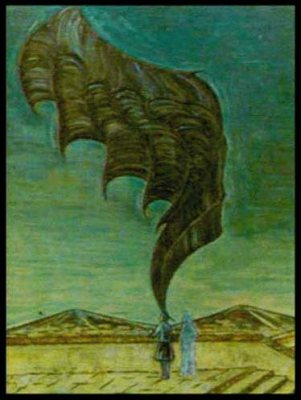
(The dreamer’s painting, from Man and His Symbols by C.G. Jung.)
In the earthbound dream, the dreamer is standing with a guide looking down at Jerusalem. The wing of Satan descends and darkens the city. The uncanny wing of the devil occurring in the Middle East immediately brings to mind Antichrist and Armageddon.
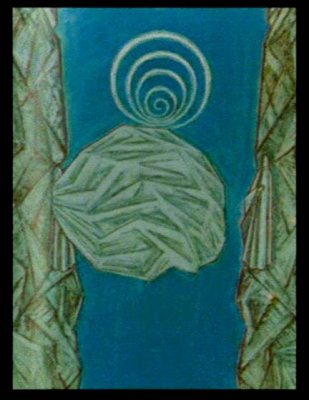
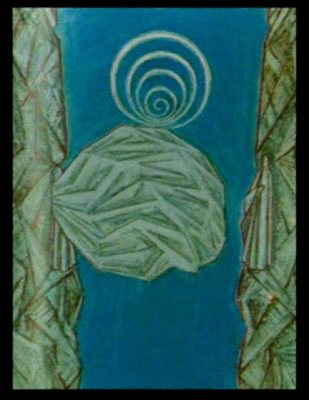
But in her other dream, the dreamer is
witnessing the same event from the heavens. From this vantage the dark wing of
Satan appears as the white, wafting cloak of God. A white spiral appears as a
symbol of evolution. Von Franz describes,
"...the spectator is high up,
somewhere in heaven, and sees in front of her a terrific split between the
rocks. The movement in the cloak of God is an attempt to reach Christ, the
figure on the right, but it does not quite succeed. In the second painting, the
same thing is seen from below---from a human angle. Looking at it from a higher
angle, what is moving and spreading is a part of God; above that rises the
spiral as a symbol of possible further development. But seen from the basis of
our human reality, this same thing in the air is the dark, uncanny wing of the
devil.
In the dreamer's life these two
pictures became real in a way that does not concern us here, but it is obvious
that they may also contain a collective meaning that reaches beyond the
personal. They may prophesy the descent of a divine darkness upon the Christian
hemisphere, a darkness that points, however, toward the possibility of further
evolution. Since the axis of the spiral does not move upward but into the
background of the picture, the further evolution will lead neither to greater
spiritual height nor down into the realm of matter, but to another
dimension..."
Childhood's
End
Now we
shall switch facets and view the third manifestation of the Singularity Archetype
through a very different psyche and medium. The very different psyche belongs
to Arthur C. Clarke, who was originally an astrophysicist and later became
famous as a science-fiction writer. Perhaps Clarke is best known for the novel
and Stanley Kubrik film, 2001. 2001 is one of the most brilliant
versions of this archetype, but we are going to consider an earlier example of
Clarke's work, the classic science-fiction novel, Childhood's End. A
science-fiction novel is a consciously created fantasy, and a very different
medium than a dream, but it is also an especially fertile and open imaginal
realm where the collective unconscious can communicate with modern persons and
a new mythology, however unrecognized, can collectively express itself.
Childhood's End begins with the appearance of
UFOs in the heavens all over the earth. Beings from within these craft break
through all communications and announce that they are "the Overlords"
and have come to establish peace on earth. This sounds like ominous news, but
the Overlords do establish peace on earth and, excepting military aggression, do
not curtail any human freedoms. Another curious aspect of the Overlords is that
they announce that they will not reveal their physical form to us for two generations---fifty
years. People speculate that they must be hideous and look like giant insects
or slime mold or some other grotesque and horrifying form.
The fifty
years pass peacefully for the human species, and the Overlords come to be
accepted and everyone eagerly awaits the day when the Overlords will descend to
earth and reveal themselves. When the long anticipated day arrives the great spacecraft
descend. With some ceremony, the Overlords emerge and to the uneasy surprise of
the human species they look exactly like gigantic devils with horns, tails and
great ebony wings.
This decidedly
mythological element is fascinatingly incongruous with the setting of
technological materialism stereotypical of the science-fiction genre. What is
the meaning of a specter from the Christian and pagan past reemerging in the
world of the future? Clarke gradually reveals that the Overlords’ alarming
physiognomy is simply the result of their physical adaptation to the
environmental conditions of their planet. The Overlords are actually perfectly
benevolent and are far more rational and intelligent than humans.
The Overlords
are servants of the "Overmind," a cosmic intelligence
permeating the universe that is Clarke's naturalistic God concept. The Overmind
employs the Overlords as midwives. When the Overmind senses that an intelligent
species is about to make the evolutionary jump into higher consciousness it
sends the Overlords to their planet to supervise the process. This evolutionary
process is apparently volatile and unstable, and if not properly supervised
could result in disastrous consequences whose effects would reach far beyond
the particular world on which the process occurs. The fact that the Overlords
have the appearance of a deep ancestral archetype of evil is described by
Clarke as, "...a race memory of a future event." The human
race has a premonitory fear of the Overlords because it senses that their
arrival signifies the end of the genome, the obsolescence of the species in its
old form. From the earthbound perspective of the conservative old form, this
evolutionary birth is apocalyptic and evil.
The Overlords,
though infinitely superior to humans in every perceivable attribute, are
themselves barren and unable to manifest the evolutionary birth process that it
is their perpetual task to oversee. On earth, in addition to keeping human
beings from destroying each other, the Overlords have a secret task, to search
for an extraordinary individual who will be the first human being to exhibit
these evolutionary changes. This individual is referred to as "Subject
Zero" and the concept seems close to a naturalistic version of
searching for the Messiah.
As part of
this search, an Overlord named Rasheverak pays a visit to an American man who
has one of the largest privately owned collections of books on parapsychology
and the occult. Rasheverak is interested in this library because he is looking
for any examples of extraordinary functioning that might indicate the emergence
of Subject Zero. Like any intelligent, skeptical reader of such material,
Rasheverak finds that it is often difficult to sift the truth from the abundant
nonsense.
During
Rasheverak's visit, the library owner has several houseguests who are
apparently drawn by the celebrity name-dropping opportunity of meeting an
Overlord. The guests, like the owner, seem to be narcissistic individuals with
a gullible appetite for occult and parapsychological entertainments. In many
ways they seem a prophetic anticipation of stereotyped New Agers.
Rasheverak, who has the forbearance of a visiting
anthropologist, maintains an observer’s stance as he witnesses many examples of
human foolishness and gullibility. At
one point he observes these New-Age types conducting a séance with a Ouija
board. Unexpectedly, something of great interest occurs. When they ask the
Ouija board the traditional question, "Who are you?" its
response is highly suggestive of the collective unconscious: "IAMALL."
The Ouija participants next ask, "What are the coordinates of the
Overlord's sun?" This information had always been denied the human species
and Rasheverak takes sudden interest when the Ouija planchette spells out the
correct coordinates. Rasheverak is forced to conclude that one of these
thoroughly mediocre-seeming individuals must be Subject Zero.
Rasheverak
investigates and discovers that one member of the Ouija séance, a young woman,
is pregnant. Subject Zero turns out to be her unborn child. When Subject Zero
is born he exhibits numerous special powers. His Messiah-like status is short
lived, however, because all the children born after him also have similar
powers. The children quickly evolve and become more powerful, and their psyches
merge to form a collective consciousness. The children materialize themselves
on one continent and join hands forming a giant moving spiral. Older, pre-Subject
Zero human beings are not destroyed, but having given birth to their successors
they become literally sterile and are utterly demoralized by their irrelevance
and inevitable extinction.
When the
children manifest their ultimate evolution and are able to merge energetically
with the Overmind, they appear to the last human being left alive as an aurora
borealis, a white spiral of light in the sky.
Childhood's
End uncannily parallels the three dreams we have considered. In the young
man's dream, darkness and earthquake transform into a spiraling white eagle
bearing a golden egg. Similarly, the dark wing of Satan descends in the dream
of a simple Christian woman, only to be later revealed as the cloak of God. And
all three manifestations envision a white spiral of light in the sky as the
interdimensional, evolutionary portal of the species. A central, emergent theme
is that what seems apocalyptic from the earthbound, ego point of view is
revealed from a cosmic point of view to be a transcendent evolutionary
metamorphosis.
I have recorded and studied
numerous other examples of this Singularity archetype and found the essential
pattern repeated with all sorts of interesting variations. To avoid doubling
the length of this chapter I'm going to have to omit most of them, but I'm
confident that if you keep your eyes open you'll find many examples for
yourself. The world of contemporary culture is intensely mythological; it is
only a question of recognizing it. Tune into the right frequencies and you will
notice that archetypal information about this approaching Singularity permeates
our environment as ubiquitously as radio and television waves. If you remember
that the same tools of symbolic analysis employed in dream interpretation may
be employed in understanding all sorts of cultural manifestations, you will
find yourself provided with endless messages about the approaching event
horizon.
UFOs—Harbingers of the Singularity?
Jung on "Flying Saucers"
Like Childhood's End, many of the messages of
an approaching Singularity involve UFOs. Jung, shortly before his death, wrote
a book about UFOs entitled, Flying
Saucers, a Modern Myth of Things Seen in the Sky. Jung believed that
the relative spiritual vacuum and lack of a ruling myth characteristic of the
twentieth century created a great tension in the collective unconscious, an
uneasy tabula rasa on which almost anything might appear. Human beings have
always looked toward the heavens for signs of God or other transcendent beings
monitoring and altering human affairs. Jung was struck by the typically
circular appearance of whatever was seen in the sky. To Jung this suggested the
mandala, an archetypal circular pattern that represented God, self and
wholeness. Jung pointed out that the Sanskrit definition of God is a circle
whose center is everywhere and whose circumference is nowhere. Jung gave to the
UFO field a much needed examination from the point of view of depth psychology.
He did not presume that UFOs were immaterial, and noted that they often seemed
to reflect radar waves, but he wondered if they might not be physical
exteriorizations of the collective unconscious. Like other archetypal
manifestations, UFOs have the ability to appear in dreams, and to haunt or
inspire the imagination.
Holes in the ExtraTerrestrial Hypothesis?
Since I wrote this section I have seen substantial
evidence favoring the extraterrestrial hypothesis, but I include it anway
because there are so many people who assume that UFOs must mean
extraterrestrials in metal space craft. In dealing with anomalous phenomenon
and other areas of investigation that are at or beyond the boundaries of human
comprehension I recommend an avoidance of premature closure. Many people
readily adopt some pet theory and then corral evidence and thinking to support
it. I feel that it is wiser to learn to endure ambiguity, keep the mind open to
multiple possibilities and delay the reaching of ultimate conclusions.
When we investigate anomalous phenomena we need to
always be wary about the human tendency to project onto the unknown expectations
and needs generated by our own psyches. In a technological, materialistic era
where the human ego seems to rule, fewer and fewer people have faith that there
is a God watching over the human species who is ready to intervene
miraculously. Speculations about UFOs, such as that they are the spacecraft of
superior beings here to prevent us from destroying each other through nuclear
war, etc. create a secular equivalent of
an absent Godhead. UFOs, as mysterious signs in the heavens, serve as
extraordinary projection screens for people's needs, fears and archetypal
visions. Since they are themselves singularities of a sort, they very naturally
become associated with the Singularity archetype.
This is not to imply, however, that they are purely
psychological phantoms or that they do not have a relation to the approaching
Singularity that is more than imaginal. Those who have taken an intelligent
look at this phenomenon have recognized that underneath the hoaxes and
manipulated stories, something of significance is occurring, but its ultimate
nature may be beyond the present boundaries of human comprehension. Be
forewarned, however, if you want to do research in this field. A great deal of
the material available is highly unreliable. Many UFO buffs are gullible true
believers, people utterly possessed by their need to believe a particular UFO
mythology. Many others consciously perpetuate fraud and illusion.
One of the most insightful people to investigate
this subject is the French astronomer, Jacque Valle. Valle in his book Messengers
of Deception, and elsewhere, has shown that exploring UFO lore means
entering a trickster world, a carnival of warped mirrors where mental illness,
fraud and government manipulation have layered illusion on top of illusion.
Much of the warped thinking and conscious manipulation, including government
manipulation, has the apparent aim of enforcing the extraterrestrial hypothesis
as the ruling UFO creed. Most of the general public who take any interest at
all in UFOs are convinced that they must be extraterrestrials.
Although no one can disprove the extraterrestrial
hypothesis, the conventional version of it, that they are aliens in nuts and
bolts metal space craft here to do scientific research or genetic manipulation
is filled with obvious holes. As Valle points out there have been hundreds of
thousands of sightings. If you assume that the supposed aliens are making efforts
not to be detected, then presumably there must be millions of actual
visitations. What program of scientific research or genetic manipulation could
possibly require this much work? They must be dreadfully incompetent scientists
to still be at it so often after all this time. Also, the idea that they are
here in space craft, at least in a conventional sense, is inconsistent with the
fact that UFOs are frequently reported to change shape or merge with one
another. And wouldn't such an advanced technology that wanted to avoid
detection have some sort of stealth capability? Would they really streak across
the sky lit up like Christmas ornaments? The idea that they are technology
wielding imperialists, or well meaning missionaries, may be a case of our recreating
the unknown in our image.
Reality Transformers
The truth about UFOs is likely far more interesting
and significant than some of the threadbare, conventional alien scenarios.
Valle quotes a scientist who describes UFOs as "reality transformers."
Reality transformers may well be the best and most accurate descriptive phrase
that can be applied to UFOs at our present level of understanding. UFOs are
apparently able to appear in a great variety of different forms to different
people and, like an archetype, the variations seem to have much to do with the
belief system and cultural conditioning of the perceiving psyche. Valle
compares observing the UFO phenomenon to looking at a screen in a movie
theater. You look at the screen and all sorts of fantastical images pass before
your eyes. But to really understand what's going on you need to look over your
shoulder back at the projector, the source of all the endlessly varying images.
UFOs seem more akin to projectors, capable of
projecting all sorts of thoughts and images into the human psyche. The human
mind, especially in our materialistic culture, is prone to take what it sees
very literally. In the UFO world you can see an obvious inverse relationship
between intelligence and how literal and specific a person's alleged knowledge
of UFOs is. On one side of the spectrum, the most conscious observers
acknowledge that UFOs are an unknown about which we can make some general
speculations. And on the other side are those who know the names of everyone on
the Pleiadian high council and who are channeling the most detailed information
about superior beings who apparently live on worlds remarkably similar to those
of grade B science fiction movies from the nineteen fifties.
Valle and others make a convincing case that the
source of the UFO phenomenon is not new, that it has been involved with human
culture since before human history. Many of the miraculous experiences and
visitations recorded from the past may well have been the same phenomenon viewed
through psyches conditioned by differing sets of cultural values. We live in an
age where magic takes the form of technology and where we launch crude metal
spacecraft into the heavens. Unimaginative psyches will tend to view UFOs as an
advanced extrapolation of present technology and human motivation. The
manifestations of the phenomenon are probably not, however, reducible to the
psychological expectations of the witnesses. The phenomenon seems to have an
ability to actively, consciously form its own manifestations. Rather than
merely reflecting cultural values it may actually be adapting and manipulating
them. Think again of the analogy of the movie projector. Movies both reflect
and manipulate cultural values.
There is evidence that UFO phenomena, like dreams, are
intelligently formed, and are both profoundly aware of the psyches to whom they
communicate and capable of exerting powerful influence on them. Like dreams,
the phenomenon is real and capable of leaving physical traces and effects. Dreaming
is associated with profound energetic changes in the brain easily observed on
an EEG. The supposedly solid world of the waking life, as we now know from
physics, is actually composed of patterned energy and is comparable to a
holographic projection. Dreams are also patterned energy, and in many ways it
is merely cultural prejudice to view them as "less real" than the
waking reality.
UFOs seem to obey the physics of dreams far more than
the old fashioned Newtonian physics which we expect solid, metal spacecraft to
obey. The physics of dreams, where consciousness and reality are inextricable
and the universe is infinitely plastic and mutable, is far closer to the
universe revealed by quantum mechanics, although both defy our conventional
understanding of reality. As J.B.S. Haldane put it, "Reality is not
only stranger than you think, it's stranger than you can think."
UFOs are powerful reminders of that inconceivable
strangeness. It might be very comforting to our innate conservatism and limited
imagination to view them as high speed metal containers bearing
"aliens" who stand upright and have two arms, legs and eyes and
familiar human motivations such as curiosity and conquest. But reality is not
necessarily as limited as the imaginations of UFO buffs. The evidence seems
more supportive of UFOs traveling inter dimensionally rather than through long
distances of space. They may be just as able to travel through inner psychic
space as outer space. Far more likely than their being metal spacecraft, they
may be organisms in a more energetic state than we are, or the projections of a
consciousness of some sort.
(I am no longer as dismissive of the
extraterrestrial hypothesis as I was in 1996 when I wrote the section
above. There seems to be substantial
evidence for both the reality transformer aspect and more tangible, physical
aspects)
Strange Parallels—UFOs, Near Death Experiences, and Psychotropics
Dr. Kenneth Ring, a scientist who has devoted most of
his career to formal research on Near Death Experiences, has shown that there
are striking similarities between NDEs and UFO experiences. Many of the stages,
and lasting effects of NDEs and abduction experiences have strong
correspondences. For example, in both types of experience people often report
seeing a vision of the earth being destroyed and emerge from the episode with a
new and lasting commitment to environmental work. William Buhlman (astralinfo.org), who has studied thousands of Out of Body
Experiences (OBEs) has pointed out how much they resemble, and might be
confused with, abductions. Terence McKenna, a visionary genius with much to say
about many of the topics discussed in this chapter, has shown connections
between UFO experience and the experience of psychotropic hallucinogens.
Terence refers to the effects of certain hallucinogens as "UFO
experiences on demand." Although McKenna does have a tendency to over
generalize from his particular experience, he does demonstrate convincingly
that chemically altered mind states are valid access channels to the source of
UFO phenomenon. People in deep states of meditation, or in traumatic situations
of various sorts, often report nonordinary perceptions of reality that are
radical departures from the prevailing societal view and yet are often highly
consistent with each other. Therefore, rather than viewing the UFO as a
peculiar anomaly occurring in an otherwise stable and homogenous reality,
perhaps we should view them as yet another exception that shows us that our
perception of reality is woefully lacking in general.
The so called post modern approach to UFOs is to study
what effect they are having on us rather than what they are. There is a certain
validity to this approach because the nature of UFOs may be beyond human
comprehension at this point. Nevertheless, I think there is value in our
continued speculations about what they might be, keeping in mind that
speculation may be an imaginative exercise while we struggle to understand
something that is "...stranger than we can think." In that spirit,
I'd like to offer my own wild speculation about a possible "what" in
relation to UFOs. Before I do, I want to be absolutely clear that this is pure
speculation without a shred of evidence. I would consider it more a catalyst
for further imaginative speculation than a finished hypothesis.
Vision of a Multiply Incarnate Organism
My speculation arose from a vision I had of a roughly
circular organism. The organism was composed of a series of highly
differentiated connected organs. Each of these organs was actually a separate
incarnation or life time of this organism viewed outside of linear time. An
analogy would be to viewing a human being outside of linear time. Rather than
seeing a snapshot of a person at a particular age in a particular frozen moment
of time we might see the full life cycle----a fertilized egg connected to a
fetus connected to an infant, a child, an adolescent, a middle aged person, an
aged person, a corpse. Yet this picture of the human life cycle would still
only represent that portion known to us, the interval between birth and death.
We don't know that the human life cycle is completely contained between a
single birth and death and there is much reason to think that it isn’t.
The circular, multiply incarnate organism I saw
presented itself to my mind as the full life cycle of a being for whom human
incarnation was one phase or organ. Outside of linear time all the incarnations
or organs were perceived as connected and in a state of simultaneous
interdependence and influence with all the other organs and incarnations. Human
incarnation was an organ far closer to the "head" rather than the
"tail" of this uroborically structured organism. In other words,
human incarnation was a more conscious, differentiated organ of the body in
much the same way that the brain is a more conscious, differentiated organ than
the liver. Another analogy would be to the brain itself where we see a living
manifestation of the principle, "ontogeny recapitulates phylogeny."
More evolved structures, like the neocortex, are built on top of more primitive
structures such as the hypothalamus. But in this multiply incarnate organism
human beings were not the most advanced organ or incarnation. Ahead of us were
the beings behind the UFOs. And this “alien” incarnation or organ is the most
conscious and most aware of all the organs or incarnations.
Evolutionary Design Limitations
Since we're indulging the bizarre, let's go off on a
tangent for a paragraph or so. Michael Murphy in his seminal book on human
evolution, The Future of the Body, discusses the work of certain
theorists in evolutionary biology. These theorists claim that some species have
fundamental design limitations or flaws that will not allow them to ever evolve
the degree of intelligence human beings have. Marsupial brains, for example,
lack the corpus collosium, the dense bundle of nerve cells that in the human
brain connect left and right hemispheres. This neurological limitation means
that the marsupial brain can never have the relatively excellent communication
between hemispheres that the human brain usually enjoys. But, these theorists
continue, the human brain may also have a fundamental design flaw limiting our
further evolution or even survival. The structure of our brain is a kind of
retrofit where a mammalian brain is superimposed on a reptile brain and the neo
cortex is retrofitted onto the mammalian brain. The neo cortex, said to be the center
of our self reflective consciousness and ego, believes itself to be the head
honcho, but unfortunately it has very poor communication with some of the
earlier structures that control appetites and aggression and so forth. Anyone
who goes on a diet discovers that the neo cortex and its creation---the
cognitive ego with all its powers---- are not necessarily a match for the
reptilian brain and its relentless will to defend body weight. Similarly, our
sexuality seems largely beyond ego control, and for all our civilization and
wisdom our ability to restrain territorial aggression has not prevented world
wars and the possibility of our making ourselves extinct through
technologically amplified territorial aggression. Poor communication between
higher and lower brain structures, these evolutionary theorists suggest, may be
a fundamental design flaw in the human species which may result in our eventual
extinction.
One White Crow
On the other hand, I take the theories
of many evolutionary theorists, especially if they are neurological
materialists, with many grains of salt. In fact, there's an obvious flaw in the
aforementioned theory. As William James once said, "One white crow is
all that is needed to disprove the notion that all crows are black." If
we have even a single human being----Jesus, Buddha, whomever, who has overcome
the problem of poor communication between brain structures, or whose
consciousness transcends appetites and aggression, then there is the
possibility that the species can also transcend this limitation. But, if the
fatalistic conclusion of the theory is flawed, the problem it describes bears
an interesting analogy to my speculation about a multiply incarnate being.
In the way that I perceived the multiply incarnate organism, all the organs/incarnations are interdependent. Therefore, the health and fate of the “alien” incarnation is also dependent on the status of the human incarnation. I'll further speculate that the human incarnation is the adolescent phase of development, a crucial juncture on which the fate of the entire organism depends. The alien part of the organism recognizes that although there is interdependence, there is poor communication between organs or incarnations. It is capable of communication and is seeking to contact us through inner and outer space to make us aware of things crucial to our fate and that of the larger organism.
The “aliens”
in this model may actually be dead people.
A part of the life cycle of the human being about which we have much uncertainty
is the post death phase. As Terence
McKenna has pointed out, if we wanted to look for an ecology of souls, an
intelligent species that seems to be very interested in our evolution, by the
principle of logic known as Ockham’s Razor we seek the simplest hypothesis that
accounts for all the facts. Our species
is a source of intelligent souls which we know for sure exists and is
interested in its own evolution. Perhaps
the “aliens” are merely us in an after death phase of incarnation. When Terence
showed pictures of grey aliens to tribal shamans in the Amazon they replied, “Oh,
the ancestors.” People who have
abduction experiences frequently report seeing deceased relatives in the
company of the grey aliens.
UFOs—Evolutionary Messages
UFOs seem to bear many messages related to our further
evolution. In recent decades, the UFO beings that contactees experience frequently
have a stereotyped appearance that UFO buffs used to call "the Delta
type humanoid" and that is now more commonly known as "the
Greys." What is perceived is an androgynous being with huge almond
shaped eyes, a somewhat ethereal, willowy body and a small, almost vestigial
mouth. The beings typically communicate without spoken words. This
characteristic appearance may be a message anticipating an evolutionary future
where we have transcended ordinary language, gender limits and our body is
moving from matter toward a more ethereal, energetic state. As mentioned
before, people who have UFO abduction experiences are frequently shown images
of the earth's destruction by manmade causes and are influenced by these
visions toward a much greater awareness of our interdependence with the planet.
Many will devote themselves to environmental causes after these deeply
affecting experiences. Another typical theme of abduction experiences involves
genetic manipulation, and particularly the cross fertilization and hybridization
of human and alien species. This is often presented as a symbiotic evolutionary
step or of actually having greater benefit for the supposedly superior alien
species than our own. These experiments could be interpreted as metaphorical
communication of our need to evolve and to merge with this other consciousness.
Whatever the source of UFOs, they do seem to be bearing a message that we are
at a critical nexus and need to evolve. But once again, they remain, perhaps
appropriately, in a realm of imaginative speculation. Their nature may not be
understood until we have evolved further.
Further Speculations on Human Evolution
Our need to evolve may express itself in ways that
seem paradoxical and disturbing. For example, there is much reason to believe
that this evolutionary rebirth may become possible only as we push the species
toward the brink of extinction. If you'll continue to indulge me, I'd like to
offer some further speculations about human evolution.
The Last Great Evolutionary Jump
The last great quantum jump in evolution on this
planet was the development of the human capacity to think in words. The crucial
importance and centrality of language has already been discussed in chapter two
in our discussion of the Mission Statement. Many linguists believe that human
language originated at one time and one place. They are able to trace all
languages to a single, root language known as Primo Indo European. Noam Chomsky
and others have pointed out that all human languages are essentially the same
on the level of deep syntax.
One way of imagining an evolutionary jump is to
consider the possibility of an individual mutation that is capable of superior
functioning. Most mutations, of course, are disadvantageous and bred out, but occasionally,
even random mutagenic forces can generate something superior. This model
wouldn't work very well for the evolution of language, however, which is a
collective phenomenon. A single mutation capable of language wouldn't have
anyone to develop language with. Therefore, one can speculate that the
structures in the brain that allowed the capacity for language developed
gradually, and that for a long period of time some latent capacity for language
existed in a great many individuals without it being manifest. One possibility
is that some tribe or grouping of early humans was experiencing acute stress.
There are numerous possible scenarios in which the tenuous survival of the
tribe could be threatened enough to make extinction and complete loss of the
genome possible. \ With this ultimate pressure acting as a catalyst, the long
latent capacity for language becomes manifest as a new survival adaptation. The
superior consciousness and communication allowed by this adaptation allows the
tribe to survive. Perhaps the advantages incurred by this adaptation allow
these humans to overtake competing hominid species or other human tribes that
lack this development. This scenario may have an analogous relationship to the
present situation of our species.
Organisms and Change
Before we consider our species, let's consider the
nature of organisms and change in general. Organisms are extremely complex
patterns or structures, living processes rather than fixed objects. The
coherence of these extremely complex processes is constantly being threatened
by "insults to form"-----chaotic environmental forces, such a
radiation, that can degrade the coherence of the entire pattern/organism.
Enough degradation of this coherence and the process may completely destabilize
as in disease and especially in death where there is the most radical apparent
loss of coherence and complexity. Organisms, therefore, are conservative in
nature, striving to maintain their inner coherence. Biologists refer to this
drive toward maintaining inner coherence as "homeostasis."
Similarly, a species seeks to ensure the survival and reproduction of its
genome----a coherent, genetic pattern changing relatively little between
generations.
Human individuals are obviously also organisms. If we
change our frame and look at the human species, or at the human psyche, we are
still viewing an organismic phenomenon, an extremely complex living process.
Both Freud and Jung agreed that the human psyche is essentially conservative.
The psyche has its own homeostasis, a powerful drive to maintain its coherence
and particular identity. Generally, it strives mightily to maintain that
coherence and resists change. An organism will defend homeostasis even if that
homeostasis is unsuccessful in some ways. A neurotic psyche, for example, will
maintain its coherence, including pathological aspects that produce much
suffering and that could be changed. Better the devil I know than the devil I
don't know. Addicts remain in their addictions. People stay in their comfort
zones or cocoons even if they are suffocating in them. The human psyche is a
complex and vulnerable structure living in an acutely stressful environment.
Most people maintain their feelings of sanity and manufacture a socially
acceptable identity by strained, tenuous repression of the irrational. All
sorts of powerful, unconscious forces that don't fit into the model of
themselves society has trained them to create must be kept down. They may feel
about change what a sentient house of cards might feel about gusts of wind.
The collective psyche of a society or culture can be
even more resistant to change. And when such conservative psyches, individually
or collectively, sense the approach of a Singularity, of quantum change, they
perceive it as apocalyptic. And their perception may not be far off, as
powerful change may require apocalyptic pressure. An analogy to such a
threatening level of change can be drawn to tribal rites of initiation. Tribal
cultures take an immature human being and put him or her through life
threatening experiences. They blow down the whole house of cards so that a new
structure can be formed. For example, one tribal practice is to give someone
what's called an ordeal poison. Initiates are given a poison that will make them
feel horribly ill. At first they will be certain they are dying, then they will
suffer so intensely they will beg to die, and then they will completely
recover. A physiological apocalypse is created and then it disappears and a
transformed psyche emerges. Perhaps the human species, sensing its adolescent
crisis and need of initiation, is creating its own global ordeal poison by
toxification of the environment.
Terence McKenna and the Attractor Point
Terence McKenna has written a number of fascinating
books that make similar speculations about evolution. The parallels to the
conclusions I've reached through different means, are so numerous that I can
only conclude that we are either experiencing exactly the same form of mental
illness or are perceiving the same truths. McKenna, for example, refers to what
I call the Singularity as either "the end of history" or as "the
strange attractor." The term "strange attractor" was
adopted by McKenna from chaos mathematics. A strange attractor is
apparently an event in the future that is able to bend and warp causality
toward it. Although from the point of view of linear time it is an event that
has not yet occurred, its influence is pervasive.
I can't pretend to have much understanding of chaos
mathematics, but an analogy occurs to me that what the strange attractor is for
the life of the species, death is for the individual. Death is a
strange attractor in the life of every individual. While we live, death is
obviously a future event that has not occurred but which is inevitable. Our
mortality, the fact that we move inexorably toward that attractor, shapes and
influences every aspect of our lives. Also, although it is definite that we
must pass into that attractor, the moment it will occur and the manner of our
passing are not necessarily determined. The inevitability of the attractor is
beyond our free will and individuality, but the time and manner of it are often
influenced by our choices and personality. I can't choose whether or not I will
die, but the way I care for my body, the life choices I make, the risks I
choose, the option of suicide, all demonstrate that the attractor may not be
fully determined outside of my will. Like entering a singularity in space, we
also don't know for sure what will happen when we pass into the attractor of
death. Spiritual teachings from many cultures and periods, NDEs, etc. suggest
that death is a doorway. Where we go when we pass through the doorway may be
influenced by choices we make in life. Neurological materialists and other
pessimistic types view death as a dead end, as one put it to me, "It's
just lights out and that's it." The attractor of death is viewed as an
apocalypse in the life of the individual with no evolutionary rebirth.
Similarly, our species is heading toward an attractor. Many view it as
extinction---unredeemed apocalypse. But others view it as a doorway. Where we
go when we pass through that doorway may be greatly influenced by the choices
that we make now.
One of the reasons that prophecy has been so
unreliable is that the human psyche tends to confuse its individual event
horizon (death) with collective eschaton. Since these two events have many
parallels, it is very easy for someone to project the feeling of the imminence
of their own end (never far away) onto an eschaton for the collective. This
seems to displace some of the individual anxiety about death onto a “we’re
all in it together” general event which has strong elements of high drama
and excitment associated with it. Instead of a feeling of powerlessness about
the inevitablity of ones own death, the prophet feels empowered by his sense
that he has been privileged with secret knowledge witheld from the common
person. For these powerful psychological reasons, prophecies of the end of the
world usually seem to be scheduled to occur before the end of the prophet’s
expected lifespan, allowing the eschaton to upstage anxiety about personal
death. Many years after I formed this theory I heard of an episode that gave it
anectdotal support. In the 1960s there was a well know woman psychic (not Jean
Dixon) who had a nationally syndicated newspaper column. She had a vision that
a gigantic earthquake would destroy most of California on a particular date and
reported this in her column. In copy cat fashion, other psychics began predict
a quake on the same day. This woman was sincere in her prediction, and at great
expense she reolcated her family from the Bay Area to Nevada. On the predicted
date there was no earthquake, but the woman died of some rare disease.
Approaching the Singularity
To engage another speculative area, let's consider
what may happen as our species approaches the evolutionary event horizon. Our
present world may be viewed as being in a rather tense position between realms
of matter and of spirit. Much in our world can be explained by Newtonian
physics and a very mundane, mechanical model of reality. But those of us not
actively trying to repress the atypical notice that there are many white crows
in our world. Anomalous events occur that can't quite be explained by
coincidence and cause and effect. Yes, the fields of parapsychology and
esoteric studies may contain a certain amount of nonsense, and unproven
assertions, but if we have even a single instance of one individual exhibiting
telekinesis, communicating telepathically, reaching another person through
their dreams, etc.------just one example in all of human history-----then the
door of extraordinary functioning and consciousness is thrown wide open for the
whole species. And I believe that many people can point toward a number of such
events in their lives. A miraculous evolutionary capacity in human beings, that
is mostly latent now, has been manifesting episodically for a long, long time.
As we approach the Singularity, the completely
inextricable, interdependent phenomenon of human consciousness and our
experience of reality will mutate. Much of the change will be impossible to
anticipate, but some broad areas are available for speculation. We can be
pretty confident, for example, that the human ego will be considerably altered.
Certainly, there are spiritually advanced persons in history or among us right
now who have transcended the limits of ego identification. What is possible for
them, is possible for the species. But before we consider the alteration of the
ego, let's consider its evolutionary significance.
Although most evolutionary theorists will resist what
I'm about to say vehemently, many people have noticed that there is something
in nature that seems to generate greater levels of complexity and
consciousness. Mckenna calls this desirable variable novelty. Novelty refers to
the creation of new forms and also means density of interconnectedness. The
evolution of human beings, for example, opened the doorway to enormous novelty
on this planet. The human brain is also the most densely interconnected object
we know of. In the twentieth century there has been an exponentiation of
novelty and electronic communications have infinitely increased the density of
interconnectedness of the human species. The creation of the ego has obviously
had some unpleasant consequences, but it was also an evolutionary development
that allowed for a tremendous increase in novelty.
The Future of the Ego—an Evolutionary Perspective
In tribal cultures, ego seems less developed than in
modern individuals living in industrialized societies. There are less
individual boundaries and more group consciousness. Earlier human beings may
have had less ego, but also less individuality and differentiation. A
fundamental aspect or function of the ego is the creation of isolation. An
individual perceives him or herself as a separate identity apart from others
and the world. This perception creates a degree of isolation and within this
insulating bubble an explosion of novelty occurs, a highly complex, unique,
differentiated, often complexly pathologized personality develops. Egocentric
isolation, like the irritating grain of sand in an oyster, causes the
development of a fantastic structure as complex buffering layers are accreted
around the irritant and the beautiful pearl of individuality is created.
The ego is a complex structure and difficult or
impossible to define. There is an inevitable imprecision when we use the term,
as different people understand very different things by the term "ego."
From some vantage points the ego serves crucial functions in the human psyche.
The ego has been called “the self organizing principle of the organism” and
necessary self refrence may not be possible without it. (see Part Two of A Guide to
the Perplexed Interdimensional Traveler for more on the hierarchy of psychic functions).
From other angles we see that the ego is often the carrier of will to power and
destructive intentions. For all the novelty the human ego helped to create, and
the invaluable role it plays in the human psyche, it has also become a very heavy
albatross hanging around the neck of the species. It may now have exceeded its
evolutionary purpose and be a species of psychic structure due for extinction.
But the ego, like all organs, clings to life, and can act with a will of its
own. Certainly, the ego has a virulent will to power, and it is no more willing
to quietly withdraw than Napoleon at his prime would be willing to accept life
in a retirement home.The dark aspect of the ego, which is what I will hereafter
refer to when I use the term “ego,” sees itself as God, as apart from
the rest of the universe. It is driven by a will to power, a will to bring
external objects, animate and inanimate, under its control.
The power oriented view of the ego is based on the
illusion of separateness. Love may be considered the awareness that everything
is connected. Let's consider two sentences that will illustrate this
difference:
"We made love."
"I fucked Jane."
In the first example, subject and object are
merged, there is an awareness of Eros, connection and mutuality. In the second
example we have an unerotic world of separated subject and object. The ego is
the royal "I" enjoying conquests over beings who are merely
objects to be dominated and controlled. Currently, we are suffering a highly contagious
plague of this noxious type of ego that uses sex as a metaphor for power and
views mother earth as real estate.
For quite some time the ego has strutted triumphantly
across our world consuming and poisoning its mother, the earth. Like many
psychic forces, the ego is able to completely possess certain individuals. Of
some of these, as it's done in the past, it will create Antichrists who will
seek to prevent this evolutionary birth and will do whatever possible to
destroy consciousness, love and life. If they sterilize the mother, then she
cannot give birth to creatures that might take their place. The ego wants to be
the only one sucking on the breast and would much rather see the mother dead
than have her give birth to a more favored, usurping child. Very likely
Antichrists-----human puppets of the ego----and the herds of unconscious,
fearful people eagar to follow them, will create a good part of the dark events
that will bring us to the edge of extinction. Like Napoleon or Hitler, the ego
can be expected to win many costly battles before it gives up the ghost.
The Village of the Damned—the Singularity Seen through the Eyes of the
Ego
Often, when human beings perceive the Singularity
archetype, they perceive it from the point of view of the ego. A fascinating
example of this occurs in a science fiction novel entitled The Midwhich
Cuckoos. The Midwhich Cuckoos was written by John Wyndhamn in 1957
shortly after Arthur C. Clarke wrote Childhood's End. The Midwhich
Cuckoos is probably best known as its two movie adaptations (1960, 1995)
which were both entitled Village of the Damned.
Midwhich Cuckoos repeats may of the bizarre particular
elements that occur in Childhood's End. They both open with the
appearance of disc shaped UFOs over the planet. In Childhood's End the
Overlords immediately open communication, but in Midwhich Cuckoos they shut
down human consciousness. In a circular area with a very precise perimeter
beneath each UFO, all animals, including humans, suddenly lapse into sleep.
After twenty-four hours, everyone who wasn't at the wheel of a car, holding a
hot iron or otherwise in an unfortunate situation for nodding off, wakes up as
if nothing happened. Everyone who didn't have an accident seems unchanged until
some days pass and the village doctor, Zellaby, discovers that every woman of
child bearing age, including young virgins and old maids, has become pregnant.
Again, we are seeing an evolutionary change from the point of view of the ego.
It sees itself in the helpless, unconscious, "little death" of
dreamless sleep. And while it is in this helpless, mortal state it is raped and
inseminated by a hostile alien life form.
In the novel, the character who personifies the ego is
a physician named Zellaby. He is the man of science and reason trying to
control this irrational, miraculous event. He sets out, like the Overlords, to
be midwife to this evolutionary birth. Interestingly, the name "Midwhich"
sounds much like "midwife" but with the emphasis of "witch"
modifying the second syllable. In this mutation of the word midwife we see the
ego's xenophobic, witch hunting view of the evolutionary birth. Rather than
being a selfless midwife, it would rather burn the witches, the new children
who possess the dangerous magic and represent change.
Besides his role as midwife, Zellaby has some other
commonalties with the Overlords. He is obviously more intelligent and technologically
sophisticated than the average human, and he is, like the Overlords, barren.
Zellaby and his wife have never been able to conceive a child. So, at first,
the Zellabys greet their pregnancy with the enthusiasm of Abraham and Sarah
receiving a miraculous blessing from God.
Still from Village of the Damned, 1960
With inhuman speed the pregnancies come
to term and all the women give birth to exceptionally large and healthy babies.
These prodigal infants also seem to be racially different and unique, they have
large golden eyes and platinum blonde hair. The infants grow and develop,
physically and mentally, with unnatural speed. It becomes apparent that they
have extraordinary powers. For example, after one mother accidentally pricks
her daughter with a safety pin she is found compulsively stabbing herself with
the pin. Apparently, the superior alien will of the child mind pressured her
into this self violence.
Homogestalt
Zellaby also discovers that the children, like the new
children in Childhood's End, have a collective consciousness. Collective
consciousness turns up frequently in expressions of the Singularity archetype
and merits some examination. In Theodore Sturgeon's science fiction novel, More
than Human, a group of mutants who each have distinctly different strengths
and weaknesses, form a collective consciousness, while retaining some
individuality, and become in many ways a single entity where each mutant serves
in a specialized role as if they were organs of a single body. Sturgeon coined
the term "homogestalt" to describe this new entity. Similarly,
more recent abduction testimony has emphasized the “greys” as having a hive
like collectivity, and this is experienced as another threatening aspect of
their alien otherness.
There are a number of possible reasons for this
collective consciousness motif appearing in so many permutations of this
archetype. One is that it may be a fairly literal indicator of evolutionary
change. If the ego ceases to dominate the human psyche, then perhaps the
boundaries that it creates around the individual will dissipate and we will
become more collectively aware. The shells of the oysters dissolve and the
pearls lie together. From the ego's point of view this would be a catastrophic
loss of personal identity. This is also a typical ego view of that other
attractor, death. From this pessimistic ego view, humans travel from dust to
dust, and are simply returned to the undifferentiated source from which they
are thought to emerge
Enantiodromia
But if this were all the evolutionary step amounted to
it would be regressive and not evolutionary. Instead of expanding the immense
novelty of individual identity, it would be contracting it into a homogenous
mass with a great decrease in complexity. Certainly there are many cycles in
nature that reverse themselves, that oscillate between extremes. This process
of return to the opposite was called by Jung, "enantiodromia,"
a term he borrowed from Heraclitus, the ancient Greek philosopher. The ego
fears, somewhat reasonably, that the evolutionary process will be
enantiodromia, nature just pressing the reset button and erasing all the
individual differentiation it sacrificed so much to create. But the Singularity
archetype tells us that the pendulum of enantiodromia, viewed from the right
perspective, is an evolutionary spiral.
The evolutionary step may not be a loss of
individuality, but rather an expansion of individual consciousness into
collective awareness. This was true of the homogestalt being in More than
Human. Another example occurs in Frank Herbert's Dune books where we see one of
the most sophisticated developments of the Singularity archetype and a number
of forms of homogestalt consciousness. In the world of Dune, the Bene Gesserit
are a highly conscious sisterhood that have been trying to assist human
evolution for thousands of years. To reach the inner circle of the Bene
Gesserit, and achieve the most exalted rank within the sisterhood, Reverend
Mother, an initiate must take an ultra powerful psychotropic known as "the
water of life." If the intiate survives ingestion of this substance
she becomes a Reverend Mother. A Reverend mother retains individual
consciousness but also has access to the psyches of all Reverend Mothers who have
come before. Individual consciousness evolves to become both individual and
collective.
Another possible causation of the collective
consciousness motif in these stories is that it is an expression of the fact
that the writer's imagination has contacted the collective unconsciousness.
This possibility is not mutually exclusive of the aforementioned one, and it is
quite likely that both may be present and working in parallel with each other.
A recurring motif in these visions, inextricably related to the collective
consciousness, involves a new means of communication transcending speech.
Conventionally, we think of telepathy as projecting a voice into someone's
head. This would hardly be much of an improvement over speaking aloud, or
calling someone on the telephone. More sophisticated visions of this new means
of communication allow for a direct transmission of the self, and this becomes
the medium through which individual and collective consciousness can merge. In
fact, there could be no collective consciousness without such a medium of
communication.
In Midwhich Cuckoos, unlike Chidlhood's End,
there is an interesting limitation of communication and collective
consciousness among the new children. Zellaby notices that what one child
learns or knows is instantly available to all the other children who are of the
same gender, but the communication does not cross gender lines. Here we see
what is probably another manifestation of an ego fear about the evolutionary
change. That the children have a collective awareness is threatening enough,
but for collective awareness to transcend gender boundaries is intolerable to
contemplate even in an alien species.
Androgyny
Androgyny, at least a significant lessening of
gender differentiation, if not its disappearance, surfaces again and again as
an element of the evolutionary change. A good example are the "grays.” In
addition to over sized eyes, telepathic ability and collective consciousness,
they are also notably androgynous in appearance. Gender differentiation has not
necessarily disappeared, however, as many who report contact with these
creatures will say that they were able to sense gender in them even if they
couldn't visually discern gender characteristics. There are also numerous cases
of contactees who claim to have had sex with these creatures. In the Dune
Books, the collective consciousness of a Reverend Mother is limited to other
female Reverend Mothers. But the whole point of the Bene Geserit Sisterhood's
thousands year long plan of genetic manipulation is to create a messianic being
they call the Kwitzaz Haderach, a male Reverend Mother whose consciousness will
transcend the gender limits that constrain them. Themes and images of androgyny
are deeply entwined in many manifestations of the Singularity archetype.
Androgyny is feared by the ego both for its connection to evolutionary change
and because it is a state of dissolved boundaries.
Pseudospeciation
From the ego's point of view, these new children are a
hostile, alien competing life form. Nature has played a trick, like the cuckoo
bird leaving its young in another bird's nest. It is acknowledged that the
children are superior, however, and since they are racially distinct, they must
be racially superior. In the black and white classic 1960 film version the
children look distinctly Aryan, as if they were cloned by Nazi scientists. Here
we may have a case of shadow projection. The Nazis projected their shadow on to
the Jews and claimed there was a Jewish conspiracy to take over the world while
the Nazis actively pursued world domination themselves. Here we have a British
psyche creating imperialistic aliens out to dominate a lesser race.
The fear that a new intelligent species will be bent
on our destruction goes beyond the ego. Michael Murphy in The Future of the
Body discusses a speculation about racism postulated by evolutionary
biologists. These biologists use the term pseudospeciation to refer to
the human tendency to view other racial groups as though they were competing
species. This pseudospeciation may have biological roots, as it's possible that
Homo sapiens achieved evolutionary dominance by killing off other competing
hominid species. In Midwhich Cuckoos, the children, although perfectly
human in appearance and gestated in human mothers, are supposed to be a
completely different species. In Childhood's End, the new children are
an evolutionary development of the human species. The new children of Childhood's
End would also have to be considered a new species, since a species is
defined as a grouping of organisms that can mate and bear live young. Once the
new children are born, the old humans become sterile so, technically, they
wouldn't even qualify as a species among themselves. But at least in Childhood's
End the new children are acknowledged as related and not as completely
other and alien. Older humans accept evolution and allow themselves to be
supplanted.
In the world of the Midwhich Cuckoos, however,
this evolutionary change is fought tooth and claw. Besides Midwhich, there are
other circular areas on the planet that have spawned alien children. But these
other places are not as civilized as Britain and they treat their children more
harshly. In the Irkutsk region near the borders of Outer Mongolia, for example,
both the children and their mothers, who are presumed to have slept with
devils, are killed. Another colony occurs in a Russian town. At first the
Russians decide to cultivate what seem like a flock of potential geniuses, but
when the children's uncanny powers start to manifest they use a nuclear
projectile and wipe out the whole town where the children are growing.
Zellaby personifies an idealized face of the ego with
all its civilized veneer. He's interested in the children for the sake of
science and so forth, but ultimately he decides that his group of children must
die too. His method of genocide is extremely interesting. He enters their
classroom with a briefcase full of dynamite and then he visualizes a brick wall
in his mind when the children try to probe his psyche. He shuts out
communication by conjuring a wall in his mind. It's hard to imagine a more
perfect symbol of repression! The ego feels it can only protect itself by
putting up a psychic wall between itself and the collective awareness of the
children.
Village of the Damned, Childhood's End and Jung
I have some personal history with the film, Village
of the Damned, and the novel Childhood's End that may be worth
noting here. When I read Childhood's End at the age of thirteen or fourteen I
was shocked. It seemed as if someone had taken what I thought were my most
creative and unusual ideas, that I had planned to turn into science fiction
stories myself, and stolen them right out of my head! I might have suspected
Arthur C. Clarke of telepathic theft but for the fact that the novel was
published four years before I was born. Knowing nothing at the time of Jung or
the concept of a collective unconscious, I didn't know what to make of this
overlapping of inner and outer worlds.
There are certain events or occurrences that have what Jung referred to as
"numinosity." Numin means spirit, and that which a
particular psyche perceives as numinous glows with a mysterious, uncanny
significance. Reading Childhood's End was a numinous event for me, and
another powerfully numinous event was watching Village of the Damned on
television.
By my senior year in college I had accumulated quite a
number of related numinous fantasies, much of them involving UFOs and or psychic
powers, and was determined to find out what was going on, what did it all mean?
Someone suggested that I read Jung's work on the archetypes and the collective
unconscious. I began to read Volume nine, Archetypes of a Collective
Unconscious and was amazed to find that within this volume was a book
called "Flying Saucers, a Modern Myth of Things Seen in the Sky." This
book was one of the last Jung would publish and UFO question clearly
haunted him at the end of his life. After the end of the book,
Jung added on more sections, an epilouge, then an afterword and finally
a supplement. As I glanced through the supplement I had one of those
life changing moments of synchronistic connection-----the supplement consisted
of a detailed analysis of a recently published science fiction novel----The
Midwhich Cuckoos! (for a better description of
this synchronistic encounter see Thoughts
on Jung)
Jung died in 1961 when the UFO myth was just
getting started, and it would be interesting to know what he would have thought
of the development of this mythology to include abduction experiences and all
sorts of other elaborations. (Again, by referring to UFO lore as a mythology, I
do not mean to imply that its source is purely imagination and that there isn't
real phenomena at its center.) In 1995 Midwhich Cuckoos/ Village of the
Damned UFO story continued its evolution.
Village of the Damned—a New Variation
In the Spring of 1995, horror director John Carpenter
released a remake of Village of the Damned. The new version was
reasonably faithful to the original, but with some interesting variations.
Since the new version occurs in the Nineties instead of the Fifties, the pregnant
mothers face a decision of whether or not to bring their pregnancies to term.
Simultaneously, they all have an archetypal dream, and apparently as a result
of it, they decide to keep the babies. When the new children are born, they all
look human except for one. There is one female infant that looks completely
alien and it is immediately removed from the mother. It is either still born or
destroyed. As the infants become children it is observed that they always walk
in male/female pairs, and that the pairs are constant as if the children were
divided into a series of married couples. There is one boy, however, who walks
at the end of the line alone, and appears to be the only one without a mate.
This boy, whose name is David, is also unique in being empathic while the other
children are impersonal and ruthless.
At one point in the story Zellaby finds David
wandering alone in a cemetery. Asked what he is doing, the boy replies, "Looking
for the baby. The one who was born with us. The one who died." Zellaby
is astonished, because the children were never told about the baby. David
reveals that the dead infant was meant to be his mate. Here we have an
interesting variation on the human/alien hybrid theme. This pairing is more
polarized than the others, as this boy's intended mate was much closer to being
an alien. Also this boy is much more human than the other new children as he
exhibits an acute empathy for others. This empathy is heightened by the pain
and suffering he feels as the one left behind without a mate. Ultimately, when
the other children are destroyed, his life is spared and he is rescued by his
mother. His survival makes him seem a kind of messianic Subject Zero, gifted in
both psychic powers and empathy, and we are left with the hopeful feeling that
evolution may somehow continue through him. This new variation is an
improvement over the original ending where the ego destroys the children and
himself with them.
Synchronicity
But the new film version adds a strange unintentional
piece to the story. To understand this additional piece will require a working
understanding of a principle that Jung referred to as "synchronicity."
Many of you are no doubt already familiar with the term, if you aren't, a brief
explanation follows, but I would also recommend reading Jung's Synchronicity:
The Acausal Connecting Principle. Synchronicities also have an evolutionary
significance which will be discussed later in the chapter.
Jung defined synchronicity as an “acausal
connecting principle.” In other words, synchronicity describes
relationships that are not mediated by cause and effect, but instead a
parallel, acausal relationship. Jung was searching for a way to account for
those uncanny, completely improbable “coincidences” (assumption of randomness)
whe