PARALLEL PORTAL (sequel to Parallel Journeys)
January 10, 2026
Writing
133 Views

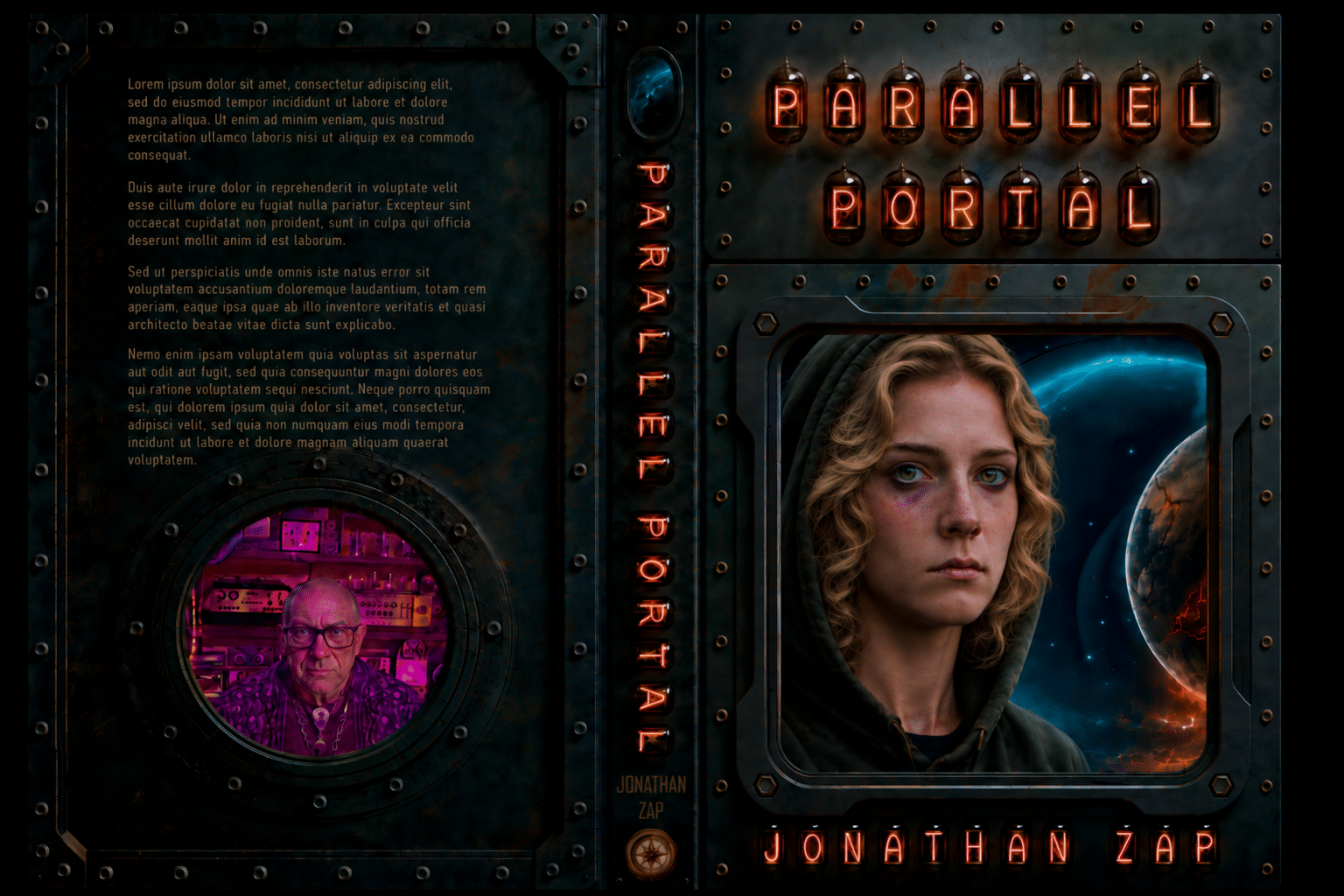
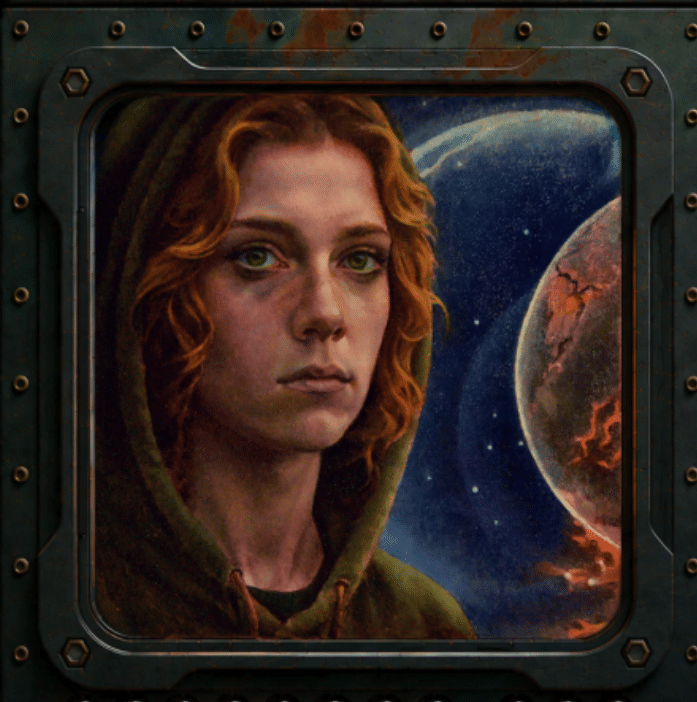
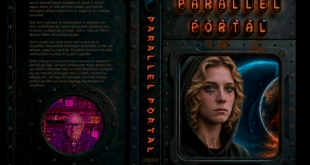
unfinished book cover
PARALLEL PORTAL
By Jonathan Zap
2026
One
Tommy’s Journal
I know this will sound crazy, probably all of this will, but from as far back as I can remember, I’ve sensed an older version of me. I feel his presence, almost like he’s whispering in my mind, but I can’t quite hear what he’s saying. It’s like he’s helping me write this, like my words are coming from both of us. He’s looking out from the shadows of my mind, watching over me, worried about my well-being and wanting to protect me from something dark that’s coming.
I’ve been having nightmares about it, the same nightmare again and again. In the dream, I’m waking up in my treehouse to the sound of gunfire, horrified as I realize that people in my community are being killed. The next moment, I’m standing beneath the treehouse. The gunfire has stopped, and everyone in my community, everyone I love, is dead.
The killer is out there in the woods coming toward me. He knows exactly where I am. I’m about to run, when I see a dark grey robot with a gun step out into the clearing where I’m standing. It’s shaped like a person, but its head is a black machine with camera lenses for eyes.
Somehow, I sense that the robot is not the killer. Its lenses focus down on me, and then a voice, oddly human, from somewhere inside this machine, speaks my name, “Tommy,” and I wake up in a panic.
Even though I’ve had this nightmare many times, it still takes me a while once I wake from it to realize that my community is still here. That no one has been killed. That I am still okay.
But am I?
The nightmare doesn’t make any sense. My home and community are peaceful, remote, tucked deep in the Green Mountains of Vermont. Why would anyone want to kill us? And I’ve seen pictures of military and police robots—they’re not shaped like people, and their weapons are built-in. But what is the dream trying to tell me? I sense something dark is coming, but I have no idea what it is.
I feel like that older version of me holds the answer. I’ve had visions of him since I was a child, writing in a journal, words being typed out on a computer screen. Something always kept me from reading what he wrote, but I knew it was a journal. In the visions, he looks about the age I am now, but he seems older, like he’s lived through much more than me. I think he’s lived through what’s coming, but it’s like he’s not supposed to interfere. It would be wrong in some way. He knows I need to guide myself through the darkness, and that’s why I need to write this journal. I need a place to try to figure things out.
I also have a strong intuition that I’m needed to write this journal. Like there’s someone else who will need to read this one day. I can’t see who that person is either, but I feel them wanting me to continue.
I have no idea who you might be—the person reading this—but I sense you out there, and I feel like I owe you this record. I don’t know why you’re the one who needs to read this, especially since I’ve kept my strange experiences secret from everyone I love—the people I live and work with in my small community called The Friends.
Now, I feel like there’s another person watching me. A strange image just flashed into my mind. I saw an older man in a dark room. Behind him were what looked like sophisticated but antique electronic devices with dials, knobs, meters, and red and green lights. It feels like he’s monitoring everything I’m writing and even my thoughts. I think he’s one of the people meant to read my journal, and I sense good intentions from him. The image disappeared pretty fast, but I feel like he’s still out there, with me as I journal alone in my treehouse, swaying in the howling wind.
I always come here to write or when I need to be alone. And lately I’ve needed that a lot. I feel guilty about hiding so much from the people I love, but I don’t want to burden others with my secret life. I know they’d listen and try to help, but there’s so much they wouldn’t understand. These secret experiences are more real for me, and closer to who I am than the stuff people see me doing every day.
They’d probably think I was having a breakdown of some sort and needed to see a therapist. I can’t be sure I don’t have psychological problems, but what’s going on with me is more than that. Someday, someone will need to know what I’ve experienced, and that’s why I’m writing it out.
People here and at the hospice where my mom works and I volunteer say I’m an empath, because I have a calming effect on the dying, like a cat or a dog. But there’s more going on than they know. Sometimes I see events before they happen and see other things that I can’t prove are real, but they seem so real to me. I’m driven by deep feelings and intuitions I can’t explain to others. And I’m getting one right now . . .
I feel it in the howling wind. My body is trembling, like I’m shivering with cold . . .
There’s someone out there I’m going to encounter soon. Someone who will alter my fate.
I don’t think I can write anything more tonight. The feeling is too overwhelming . . .
Two
Max’s Journal
My name is Max, I am 18, and I am a predator. Legally spoken, my name is Ulrich, but that does not go over so well here in the States, and it is far too tedious to continue having to spell it out for people. Max is one syllable, says much about me, but not too much, and the spelling is self-evident even for illiterate American persons.
I see I am doing what an American news reader would call “burying the lead.” As I was saying, I am a predator. Proudly so. If I said that to most people, they would think I was crazy or evil or both, but this is the extreme stupidity of most people, because homo Sapiens is categorized as a predator species—the apex predator of the whole planet on which it feeds. And yet, self-castrated members of this species use the word “predator” as a synonym for evil when they apply it to individuals who transgress their notions of social order.
Can you imagine a pride of lions calling a magnificent young lion a “predator” to suggest it should be despised and outcast? Yes, older lions have reason to fear an up-and-coming young lion. They may wish they had devoured him before he became dangerous, but to call him a predator would only be a sign of respect.
But no, I do not self-identify as a lion. Of the big cats, lions are too masculine for my tastes, too blunt force. I am more lean, agile, and stylish, more like. . . a leopard. I am not a savage predator, but an elegantly fastidious one. I revere control and abhor messiness. I maintain my person, possessions, and spaces in perfect order and cleanliness. Is this not how cats conduct themselves? This is why I do not care to talk or write in the sloppy, stupid, slangy way of my American “peers.” I operate with precision, effectiveness, and my own sense of style. I did not learn my polished demeanor from the random people around me, but from books and films that satisfy my standard of elegance.
I am a stealthy, slippery operator, not a brute who kills for sport. I prefer to acquire money and power rather than a body count. I have never been accused of an excess of kindness, but I have no interest in harming others as an end in itself. Nevertheless, I pursue my ends with ruthless determination, and I must admit to taking a certain enjoyment from employing deception and misdirection.
I am a predator, but in other ways than red in tooth and claw. Why would I not be predatory? I am a descendant of a predator species, so what could possibly be more natural?
I grew up with hypocrites who do not consider themselves predators merely because they buy their kilos of mammal flesh sanitarily sealed in plastic from the market. They celebrate bacon as an amusing family food, but if they saw someone consuming a puppy, they would call them a monster. And yet, it is an established scientific fact that pigs are more intelligent than dogs in a number of ways.
No, I do not eat puppies, and for that matter, neither do I eat bacon or any meat, not because of moral scruples but because I find such greasy items to be repulsive. I am simply made of finer stuff and therefore eat according to my nature. So those who might call me a predator are nothing but weaklings unable to see anything clearly, even what they put in their own mouths.
So, given that I do not eat animals, why do I call myself a predator? I am referring to my essential nature as one who ruthlessly stalks my quarry. That is to say, I efficiently pursue—I am German after all—my objectives.
Since my sexuality is part of my essential nature, it too has a predatory aspect. Indeed, I stalk, or more precisely, stealthily surveil those few who draw my interest, though I have yet to cross any bright red lines. But give me time—I am, as I have said, only eighteen. Perhaps I am joking, perhaps not—I cannot even be sure myself.
Maybe my grandiosity is an act I put on for my own amusement, maybe not. You may assume these egoistic things I say are merely adolescent bravado as befits my age—perhaps so, perhaps not. I have shown myself highly effective in the real world and have the most universally respected metric to prove it—money. However, other aspects of my agenda have yet to be fulfilled.
I am acknowledging my grandiosity here to examine it and to ensure it does not undermine my efficiency. As I have already said, I am German, and efficiency comes with that territory, as they say in English, but there are other German aspects I find lumpen and boring. I spent the first twelve years of my life in Berlin, but I have learned how to make the accent disappear. There are times, however, when I bring it back for effect. Even when I was a child living in Berlin, I put great emphasis on mastering English, as I recognized that it is the language with the greatest international currency. As you can see, my English is impeccable, which increases my scorn for how poorly it is used by most of its native speakers, who seem to have little knowledge of its vocabulary and how to express themselves with precision and style.
Yes, my Germanic aspects still inhabit me, but this does not mean I am some goose-stepping Nazi. In fact, I happen to admire some of those infernally intelligent Ashkenazi Jews with whom I share a strange karma. I am fascinated by their savants and admire certain of their highly proficient swindlers as well. Of human types, I despise all those who are inferior. And by those who are inferior, I mean almost everyone, but this is without regard to race.
My grandiosity and contempt need a place to be expressed because outwardly, I prefer to be underestimated and “fly beneath the radar,” as the expression goes. Sometimes, it is valuable to intimidate or impress with my upper-class demeanor, while at other times, it is far more effective to be a forgettable cipher.
So, you should not think that what I flaunt here is how I show up in public. It is certainly not. Nothing could make me light up more as a target than to present as a privileged white European male with high pretensions. In my earlier life, I did display haughty arrogance and disdain because there was no reason not to, and I was highly irritated by confinement and the pervasive imbecility I had to deal with both at home and at the supposedly “elite” (in other words, mediocrity plus money) prep school I was compelled to attend.
But now that I am out and about in the larger world, I have become a slippery and stealthy chameleon. For stalking and surveillance purposes, I sometimes forgo the elegant attire I prefer and wear baggy hoodies and similar clothing to present myself as a typical American teenager, unworthy of notice. I am an operator, and I have developed the tools and tricks of my personal tradecraft.
To sustain myself, I operate as a financial predator in the crypto and stock markets, where my ability to perceive deep patterns and short-term fluctuations has enabled me to accumulate significant wealth. I utilize my considerable abilities to identify signals that others miss and find windows of opportunity in global finance. Using a contrived identity, I bought and sold cryptocurrencies and stocks until I amassed a small fortune, which I have grown into an ever larger one. To keep my parents from questioning my activities, I applied to business schools and informed them that I was merely monitoring various market cycles to fulfill my ambition of becoming a hedge fund manager—a goal they could understand and approve. As a result, I need no help from parents or anyone to travel freely and “live off the land,” so to speak.
I am now a legal adult and can do as I please—and I am doing as I please—but not impulsively. That is the way of stupid predators, foolish petty criminals unthinkingly driven by animal drives. Besides constructing a false identity for financial transactions conducted before I was a legal adult, I have crossed few legal lines, though I may soon. If I do, it will be judicious, tactical, and strategic to minimize risk. It is not that I am risk-averse in any cowardly way. I simply seek to maximize reward and minimize any dangers to my own person.
In my former life, before I liberated myself, I was judged defective because I lack empathy for inferior persons. I have also been diagnosed as having on-the-spectrum autism, because I lack sociability and can focus intensely on a subject that interests me. The contemptible psychiatrist who made this diagnosis, which I had self-diagnosed years before, was entirely ignorant of the established fact that autistic mutants exhibit psychic abilities. All of this is extremely well documented as anyone capable of doing an internet search can affirm. Those who have researched this have concluded that the rise in autism is part of an evolutionary advance leading to superhuman abilities. When I informed this incompetent psychiatrist of the gaping hole in his knowledge of autism, he acted completely uninterested. But I could see him make a mental note of my comment as a pathological symptom—as if I had just spouted off a fanatical flat-earth theory or pre-psychotic grandiosity.
My autism is an asset, not a liability or pathology. Those who judge me—a perfect physical specimen with obviously superior intelligence—as defective only reveal their own stupidity.
Alas, I currently have no backups, not even a clone who might grow up to resemble me. Yet another reason not to take unwarranted risks.
So, while I am still confined to this one body, I will continue to take meticulous care of it as an irreplaceable resource and tool of my will. Consequently, I eat a highly refined diet and work out every day to maintain my slender but flawless physique.
Someone glancing at me sees a fit and immaculately dressed young man from a wealthy and privileged background, and there is nothing inaccurate about that impression, of course. I have often been mistaken for a model due to my elegant attire, finely wrought features, and nearly platinum-blond straight hair—very rare without color treatment. But this is a mixed compliment as far as I am concerned. Models are invariably stupid and vain creatures, highly inferior in every way save for looks. Based on my looks, people often assume I must be another such stupid and conceited type. It can be tactically advantageous for people to underestimate my intellect, but it is quite irritating as well.
From experience, I have learned that people find the stare of my blue-grey eyes disturbing, so I wear dark, vintage Mykita Leica ML18 sunglasses. This way, people see of me only what I care to show. If needed, however, I can eliminate the sunglasses and be charming and impressive, but that requires a significant expenditure of energy, so I use this mode only when necessary.
Otherwise, I give people as little energy or attention as possible. Why should I provide any more than that? What is the point of a social transaction that provides no reward? Because I refrain from such irrational energy expenditure, I have been judged a cold misanthrope. If it serves my purposes, I am certainly able to appear not only normal but charming and charismatic. But there was no motivation to do this with my parents or at school because I knew I would soon discard that inferior life just as a snake molts a constricting skin.
Instead, I focused my energy on improving my physique, finances, and escape plan. From the earliest age, I recognized the most obvious thing in the world—money is the universal resource and conduit to power. I also understood the obvious things about myself—I am a predator and vastly superior to others in all ways that matter.
And then, the day I turned eighteen, only a couple of months ago, I disappeared into my new life and identity. Employing contractors at a distance, I spent a considerable part of my fortune building a home base to my exacting specifications. Hidden in the dark deciduous woods of northern New England, from the outside it seems little more than an architecturally superb house, but hidden beneath is a highly secure and shielded sub-basement, part command center and part . . .
Well, now we come to the more controversial aspects of my identity and plans. And yes, these parts are questionable even to me because they represent most of my risk portfolio, and therefore, they must be red-flagged and subject to unflinching analysis. Until an hour ago, when I created this encrypted journal on an air-gapped computer, I never considered putting my predatory identity and intentions into words. I did so to analyze my—let’s call them potentially problematic aspects—because they tempt me toward considerable risks and are not as self-evidently rational as the rest of me certainly is.
Obviously, much of what I have written above is a self-indulgence expressive of grandiosity and narcissism, but I need to let some of the steam off my large ego before getting to the real work of this journal, which is planning and self-analysis.
I shall ruthlessly analyze my potential flaws, the parts of myself that are not rational, and other attributes, such as my sexuality, which are famously hard for most individuals to study objectively. I must be unsparing in examining possible liabilities in my nature, but first, it is appropriate to disclose certain aspects of my anomalous abilities, which are relevant to the riskier parts of my agenda.
The majority of my abilities are rare but not unprecedented, except in their highly effective combination. From that perspective, I could be seen as functioning merely at the outer edge of the human performance envelope. But I also have talents outside that envelope, which are, therefore, harder to evaluate. For example, I can anticipate the timing of certain events, not just market fluctuations, but life events that provide few precursory data points. Therefore, I cannot attribute my successful anticipations to logic or intuitive pattern recognition, but rather to something else, perhaps a form of what is popularly called “clairvoyance.” My working understanding is that it is a type of forecasting that may derive from a paranormal basis, as it is difficult to explain via even the most advanced information processing capacity.
Initially, I was dismissive of paranormal causations, but extensive research ultimately convinced me otherwise. Investigating scientific evidence of future sensing immediately led me to a paper published in a prestigious peer-reviewed journal by a renowned Cornell professor, Daryl Bem, an old, gay Jew with great credentials. When I investigated all the criticisms of his methodology, I discovered instead the irrational bias of his critics, establishment science, and Wikipedia against the paranormal.
I may not be an expert on scientific methodology, but I have the financial metrics to prove my ability to apply probability and statistical analysis in the real world. Ultimately, Bem’s work was vindicated. After analyzing a number of replicated experiments, I have concluded that many paranormal abilities, especially clairvoyance and telepathy, have been scientifically validated, at least as strong possibilities.
Beyond what is likely clairvoyance, I also have an exceptional ability to read people, to sense their weaknesses and strengths (if any), and often know what people are thinking or about to say. Sometimes, it is because inferior persons are so predictable, but other times it seems telepathic. And once, when I was thirteen, I was able to recognize another telepath at an airport and make contact. I will have more to discuss about that encounter soon.
I make these claims, and yet I must admit that some of my strange perceptions raise the red flag of logic error in my mind.
For example, I have a persistent sense that I am not the offspring of my parents. I see no way such high-functioning mediocrities could have produced someone like me. Of course, I realize it is a common grandiose delusion of children to believe they are descended from royalty, etc., so perhaps it is childish vanity causing me to doubt that I am merely the product of a sweaty parental transaction nineteen years ago. Perhaps a lucky cosmic ray hit this unexceptional combination of DNA to cause a massively favorable mutation. DNA from unexceptional parents can sometimes enter the mathematical lottery of genetic combination and produce an exceptional result.
Since childhood, I have recognized myself as a new human type, an advanced product of human evolution, anachronistically appearing in this primitive world of bustling primates. Perhaps evolution created me as a hedge against its main bet on AI, the new species overtaking the meat-bound one that gave rise to it. I am speculating, of course. I simply know my parents and environment are in no way sufficient to account for me.
There have been rare occasions when I encountered someone who seemed like they might also be a new evolutionary type. But these perceptions lack evidence and may be deceived by my most irrational drive—my sexuality. I thought I detected what I perceive as anomalous superiority in a few other young males who are, like me, nearly perfect physical specimens.
Since they are also the type I find attractive, I realize the high possibility of false positives and other perceptual errors. But I can assure you that looks alone are by no means sufficient to create anomalous radar returns. On many occasions, I have seen visually exquisite specimens that entirely lack the special quality I am looking for. What I seek is far rarer than mere physical beauty.
There was one boy at school who had what I considered at the time a paranormal level of charisma. He was certainly quite good-looking, even to my unrelenting standards, and his social and intellectual functioning were superior, if not anomalously so. I surveilled him without any of my attentions being detected.
Quite diplomatically and with considerable charm, I attempted to form a social alliance with him, but he politely rebuffed those efforts. Of course, he knew my reputation as a creature others found cold and disturbing, so there was no chance of making an unprejudiced first impression. It is most probable that he found the charm I turned on him, but not others, suspicious.
And then, as I continued my surveillance, he became less interesting. Indeed, he was an ideal physical specimen, popular and socially skilled, and he did gain admission to Princeton, but once I engineered access to his devices, he revealed himself to be a highly disappointing false positive. He was merely the best animal in the herd of subpar creatures swarming around me at this particular school.
My disappointment was not just with him but in my own failure of discernment. Hormones and animalistic drives had created a type of optical illusion out of someone who, in the end, proved to be only a superior mediocrity. He remained physically attractive enough to arouse sexual interest, but I refuse to degrade myself by having a physical transaction with an inferior person based on looks.
I am no mere meat puppet whose strings can be pulled by hormones. I consider my deluded inflation of this boy to be an embarrassing failure. It was due to the so-called “halo effect” —a well-documented blind spot in cognitive psychology, where one attributes undeserved virtues to an exceptionally good-looking individual. Nevertheless, it was a valuable lesson not to repeat such a humiliating error of perception.
Twice, while traveling with my parents—both occasions were in airports—my gaze was arrested by someone with a glow which made them stand out like demigods amongst the hustle and bustle of disappointing primates.
One of them was a young man who had a Norwegian decal on his luggage and possessed an ethereal beauty that was breathtaking. But now I suspect his beauty created another optical illusion on par with the boy at school. He also failed a test I now consider definitive. Though I stared at him for several seconds, he failed to notice me or my sharply focused attention. A true anomaly should be able to readily identify another.
The other person, however, I am certain was a true anomaly. Yes, he was beautiful and elegant with long, dark hair and exquisite bone structure. Anyone would have found him intriguing and mysterious. But he gave evidence of being far more than merely beautiful.
At first glance, I recognized him as a sophisticated and cosmopolitan Ashkenazi Jew. His appearance was not stereotypically Jewish, but as a German, I have inherited a certain “Jewdar,” an exquisite ethnic sensitivity, and felt the pull of racial exoticism and karma. He must have been eighteen or nineteen, but he seemed older and strangely timeless. He was unselfconsciously elegant and graceful, a prince of his ancient race. I noticed he was wearing an expensive diving watch, likely an Omega Seamaster, and despite his cosmopolitanism, he carried an air of being on a physical adventure.
I sensed he was not merely traveling but on a mission of some kind. I was able to detect that he was skilled at evading attention and could call upon subtle tradecraft, but he lit up more intensely than anyone I have ever encountered. I felt his intelligence as if it were a physical force and sensed a mind filled with secret knowledge.
It was obvious he was another neuro-atypical like me. I immediately felt the presence of another ultra-high-functioning on-the-spectrum mind. I could tell that he, too, was containing his stress at the sensory overload of rushing people in the airport.
The Jew sensed my scrutiny and turned toward me, his hyper-aware brown eyes locking onto my gaze with focused interest. Time stretched as I felt him reading me in a cool, analytical way.
I am so accustomed to being an unseen observer—what others perceive of me is merely a shadow of superficialities. This was the first and only time I have experienced actually being seen.
I must admit, if I am to be honest, that I could also feel him detecting things about me unknown to myself. I was, after all, only thirteen. And yet it did not feel intimidating or invasive. There was a delicacy of feeling and sympathetic sensitivity in the manner of it. For a moment, the boundary between subject and object dissolved, and our minds linked, but I felt him limiting the telepathic flow between us.
I sensed the nature of his caution as ethical and respectful. He was certainly not going to commit the impropriety of approaching a thirteen-year-old at an airport, but it was more than that. He held respect for my youth and refrained from interfering with my stage of development by revealing too much. So, he limited himself to an acknowledgment of me as another anomaly and telepath.
The form of his acknowledgment, occurring during an extended moment of telepathic eye contact rippling through time, had a formal and elegant quality, as though he were presenting me with an engraved calling card. I wish that he had. Nevertheless, it was a level of deeply respectful recognition I have never received before or since, a priceless gift.
When he was sure I received it, he bowed his head toward me in a beautiful gesture of formal respect. After bestowing this blessing, he turned and walked swiftly away.
He possessed qualities I have never encountered in another. I would never use a naïve adjective like “ethical” in regard to anyone else. In my experience, “ethics” is a clumsy pose people adopt to hide their true agenda. But with him—I scarcely know how to describe it—honor is such an archaic word—it was implicit in his deep character.
The encounter created a potent cognitive dissonance still reverberating within me. I was confronted with a quality so foreign to my predatory nature—and yet it was authentically part of his essential nature. It forces upon me a disturbing recognition that at least one person has an aspect unknown to me, a mystery.
I have tried in vain to imagine his Weltanschauung and perceptual qualia—so different from mine and yet so profound and keenly intelligent. I am forced into the admission that I met an equal, not an equality of similitude but of complementary difference. —Yes, that is it, he was so unlike, but a mutant on the same scale as I am. I could find nothing inferior in him—if anything, he had a strange depth I cannot find in myself. It is a continuing shock to acknowledge such a person exists.
I am certain I did not meet him by chance, though he seemed as surprised by the encounter as I was. While the Norwegian was oblivious to my presence, the Jew had been instantly aware, and that, I now realize, is the first test. There must be mutual recognition.
Regrettably, I was too dazzled by the encounter to slip away from my parents and follow him. If only I had trailed him to his departure gate, I could have found a way into the flight manifest.
I curse myself for lacking the presence of mind to take a good photo, I could have searched for him that way. Instead, I let him disappear into the masses. I was only thirteen and still quite stupid in many ways. I lacked the quickness to recognize and exploit this fleeting window of opportunity.
And yet, I have an enduring perception that our paths are destined to cross again. I keep an eye out for him on my travels to this day.
Though I have presented myself as a ruthless predator, his influence subtly shifted that aspect. It has taken the form of the one principle I follow, which is not to needlessly cause harm to others. I may not be kind to others unless the pretense of such is to my advantage, but I do restrain my misanthropic nature from being overtly cruel.
Living by this one principle is a form of respect or honor owed to the Jew for the respect and honor he gave me. If we meet again, I know he would sense if I indulged unwarranted violence or heedless malevolence, and he would lose respect for me. I would be diminished in his eyes and might lose the chance to learn from his secret knowledge.
At this phase, though, my main desire is to meet an anomalous, attractive male person close to my age. I want an equal, but also someone I can dazzle with my abilities and resources. Freed from parental captivity, I roam the country in my newly acquired luxurious and high-performance vehicle—German, of course, a ferociously fast, customized Porsche Panamera EV. Its curvilinear streamlined form is sleek and commanding, but in a subtle way, more leopard than leonine, unlike an American muscle car that has something to prove. And it is exquisitely finished in a deep, near-black forest green that appears almost black at night, cloaking it in the shadows. It is the perfect exoskeleton to sheath my essence. Its stealthy military-espionage bearing fits me like a second skin, like my black peccary Roeckl driving gloves.
The path of my hunt favors college and university towns, as those seem the likeliest to attract the type I am looking for. I can afford to stay in highly rated hotels with gyms, and my financial work is easily done from anywhere. Give me signal and a device—even a burner—and there is little I cannot orchestrate. Perhaps my hunting is merely driven by youthful hormones, but intuition tells me otherwise.
I am certain that somewhere out there, I will find my counterpart. I am not one to quote a primitive mystic like Rumi, but I do like his saying that what you seek is seeking you. In our suspicious age, however, there is a risk of encountering a counterpart who will refuse the time and persuasion needed to realize I am who they are seeking. Next time, I will not risk a rebuff or allow them to slip away without a trace. But before I take any risky step to extend the opportunity of mutual discovery, I will surveil a candidate to eliminate the chance of another false positive.
Once you gain access to someone’s devices and can study their communications, mediocrity becomes all too disappointingly apparent. If they pass my investigation, it may be necessary to make them an involuntary guest in the sub-basement of my home base, allowing them sufficient time to recognize my unique value.
Obviously, involuntarily hosting someone in my sub-basement would cross bright red legal lines and is the most questionable part of my plans. You may think such a step would violate my one ethical principle of avoiding unnecessary harm, but this is not how I see it. It would be a helpful intervention, a way to rescue someone with high potential from being subsumed by the cult of mediocrity. And yet, Americans of the present era are so easily “triggered” by such a great many things, and therefore there is a non-negligible risk that they will misinterpret the temporary loss of agency I must impose to hold their attention.
I would certainly prefer not to use such risky means, but I can foresee scenarios where I would need sufficient time and control over the setting to win them over. There would be no need for such measures if they were immediately willing to break with their former lives to ally themselves with me. But realistically, how likely is that?
Even when I am in charming mode, people find me a little too intense for comfort. If they are currently enrolled in college or university, it will take persuasion for them to realize the self-castration of remaining a captive of institutionalized education when they could immediately gain access to power and wealth by joining forces with me. If I find just the right person, I am confident that, given enough time, they will realize the superior value of what I offer, but such persuasion cannot be rushed.
I readily admit that my plan is a risky and perhaps even ill-advised first move to establish an alliance, but it will provide time to reveal my superiority, charm them, and demonstrate what a powerful ally I could be, financially and otherwise. Although I may have to extend my invitation in this involuntary way, I will not be taking advantage of them. I will be giving them a generous and undistracted opportunity to recognize my value. My facility is secure but luxurious, and they will lack nothing except connectivity and the ability to relocate. But how can I be sure they will not misinterpret my gesture?
This plan obviously entails felonies, and as meticulous as my planning and execution would undoubtedly be, risks cannot be entirely eliminated but remain a persistent variable impossible to fully calculate. I would certainly not sequester someone unless their anomalous nature met a high evidentiary standard. At a minimum, they must have keen self-awareness of being different, and I would have to see clear evidence of this on their devices. Only a fool would take such a step without compelling reasons to believe a successful outcome is the highest probability.
Still, of all my intentions, this is by far the most dangerous. Think of the messy fiasco if I were unable to persuade them, and they wanted to blackmail me with kidnapping charges! In such a worst-case scenario, I might have to resort to irreversible measures to ensure my safety.
My controversial plan begs a central question that someone reading this could legitimately pose. If I am such a flawless predator, why not just go solo? Why even look for a companion and accept so much risk?
All I can say is that I am a predator, not a machine, and, like my sexuality, the desire for a companion is an irreducible need. Although I agree with others’ perception of me as cold and lacking empathy, it does not mean I am without social interest, just that I have lacked the opportunity to relate to equals. Is it not a kind of empathy that allowed me to recognize anomalous superiority in the Jew at first glance and share a profound telepathic state?
There is no social deficiency in me. It is merely that I have been surrounded by horridly deficient mediocrities with whom I had no desire to socialize. The encounter with the Jew went far beyond mere socializing. I long for contact with another telepath where the exchange would be more than words or gross physical transactions.
To be objective about my motives, I must admit that my desire for control requires that such a relationship begin with an upper hand and a card or two up my sleeve. Otherwise, I might start such a relationship at a disadvantage. I have no experience in any sort of mutual relationship, or in physical intimacy, for that matter. Suppose they did? I would be at an enormous disadvantage.
Though I desire an equal, it is my reasonable expectation to be first amongst equals. I want someone who will admire and follow my way of seeking power in the world. But I am certainly not looking for a slave or someone I would be obliged to constantly dominate. It would be evidence of mediocrity if a prospective counterpart could be fully controlled. Anyone who would submit to domination would be highly disappointing. And with regard to sexuality, I would much prefer it if we could exchange such roles.
I want a true companion who can rise to my intellectual and aesthetic level. Obviously, this would be a rare person indeed, but not unprecedented in my experience. Given that he was several years older, I bear no shame in admitting that the Jew was at a higher level of self-realization than I was at thirteen.
Nevertheless, I must make sure that my need for a companion is not one of those classic tragic flaws that causes the downfall of a young hero in so many stories and mythologies. No, I will certainly not risk such an alliance unless I find exactly the right candidate.
Meanwhile, just knowing that I have a secure facility and a substance that would harmlessly render a guest unconscious while I relocate them is itself exciting, a fetish perhaps. It is the pursuit of such a person that gives my travels and financial work a sense of direction and purpose . . .
Three
Tommy’s Journal
It’s happened—the thing I sensed coming last night.
I’m out in the woods picking blackberries. My basket is nearly full when a wave of slowtime passes over me, and with it, an intense sense of déjà vu like I’ve been in this moment before.
I need to be alone when slowtime happens. Slowtime forces me to see into other people more than I want to—behind their thoughts and feelings. And that fills me with shame and anxiety, because I’m seeing private things they wouldn’t want me to know. So, I take my basket and disappear into the woods to hide out in my treehouse.
From its high cedar deck, I look out over the sea of leafy branches and rolling hills that form the valley I live in. Gusts of wind rustle the canopy of leaves around me. The wind calms as the sun breaks through the clouds, lighting up the forest with its golden rays.
The warmth on my skin melts my uneasiness. I lie back on the deck. The grain of the cedar planks against my skin and the smell of the newly sawn wood make me feel like I’m on an old ship sailing under the sun.
A fresh wind carries the evergreen scent of fir trees from deep in the valley, bringing me back to where I am. My sensations become intensely vivid, like I’m feeling everything for the first time. I reach into the basket, wanting to taste the blackberries.
They’re sweet and smooth, almost bubbly, sliding on my tongue. My senses cross, and their flavor becomes a deep purple light flowing into me.
Slowtime stretches every moment.
A great horned owl soars into view. I can see the brown and white stripes of its wind-ruffled feathers in perfect detail. The owl is like a banner rippling in the sky, bringing a message. It passes overhead and screeches, sending a current of fear through me.
As the owl flies off, a strong gust of wind pushes dark clouds across the sun. I hear a distant rumble of thunder coming from the western part of the valley, followed by more gusts of wind. The sudden chill forces me to sit up and hug my knees to my chest for warmth.
The howling wind is making me shiver. The shivering builds until it becomes violent. It’s almost like a seizure or being electrocuted.
And then I become the electricity.
I erupt from my body into the howling wind, swiftly ascending toward the dark clouds above.
I look down and see my body still sitting there on the deck of the treehouse, shrinking away as I rise higher and higher. The windblown tree branches continue swirling chaotically around me, but it’s too weird to view myself this way. Intense vertigo overtakes me, like I’m about to plummet. A dizzy panic, and I drop—
Suddenly, I’m in my treehouse in the dark, feeling intense fear. I hear gunfire in the distance. It’s where I’ve been in my nightmares, but this time I’m not asleep. I hear my mom speak with great urgency, but she’s not beside me—she’s speaking in my mind.
“Tommy, everyone else is gone, but you must live. You’re needed for something important. There is one who will help you survive, but you must leave. Now!”
The urgency of her last command propels me to take action. I feel the horrible truth of what she said.
Everyone is gone, but you must live.
I realize what the gunshots mean. The Friends have been murdered, and I’m the only one left. The killer knows where I am, and he’s coming toward me.
There’s no time to even dress or put on my shoes. I open the hatch, race halfway down the rope ladder, and jump onto the ground, ready to run, sensing death is almost upon me.
And then I look behind me and at the edge of the woods . . . it’s the robot I’ve seen in my nightmares—but now it has a more humanoid body. It’s holding a gun with a scope in a two-handed grip, aiming at something I can’t see.
Somehow, I know the robot is the one my mom said would help me survive. I hear a shot ring out, and I know it’s a kill shot, and it jolts me out of my body.
I find myself back on the treehouse deck, and it’s daylight again.
Was I killed by that shot? Killed in the vision? Is that my future?
My arms are wrapped around my knees, and I’m shivering. The sound of the shot still rings in my head.
The wind settles. The sky is overcast, but no longer darkened by thunderclouds. The warmth of the humid air stops my shivering.
I sense someone is with me, watching. I can’t see anyone, but I feel their gaze emanating from a point suspended in space about ten feet beyond my treehouse deck.
I stare in that direction until an outline of light begins to form. From its center, a boy about my age begins to appear.
He’s glowing and not quite solid in the way I am. As his body takes on definition, I discover something terrible has happened. His clothes are burnt, and much of his skin is charred. I try to hide my shock at the sight of his burns. The fire hasn’t touched his face, and I’m drawn to his eyes, their sorrowful intelligence looking deeply into me. I’m struck by how calm and aware he seems, even though he’s in such a terrible state.
I think of my volunteer work at the hospice. I’ve been with old people as they transitioned at the edge of death. Sometimes they communicated with me. Other times, they’d just look back at their body and depart.
But he’s my age. He needs to live.
As I gaze into his eyes, it’s like I’m being seen for the first time. Understood for the first time.
I want him to live. I need him to help me understand what just happened—what’s coming—it feels like we’re needed for something important.
Like knowing in a dream, I realize certain things about him.
We’re so different.
He’s grown up in a city world with books and complex ideas. His dark hair and eyes against his pale skin suggest an ethnicity I can’t name. We’re from different backgrounds and even different bloodlines. And yet, there’s a bond of brotherhood between us.
Whatever’s coming has brought us together. I sense he understands much of what I do about our encounter. His dark eyes hold secret knowledge, and I want to know the depths he’s seeing. It’s the moment to say something.
“Hey.” Despite the strangeness of the situation, I keep my voice calm and friendly. “I’m Tommy. What’s your name?”
“Andrew,” he replies.
“Andrew,” I repeat. The name lights up in my mind as though I knew it already. “Welcome to my treehouse, Andrew. Can you—would you like to sit with me?”
He looks at me uncertainly. I smile and pat the deck to invite him to sit. He flickers for a moment and suddenly is sitting across from me. Closeness makes him seem more solid, and I realize he’s not only my age but almost exactly my size. I want to hug him, my usual way of greeting people, but I don’t want to shock the fragile sort of body he’s in.
“Where are we?” he asks.
“Vermont. A valley in the Green Mountains.”
He turns to look out, but as soon as we break eye contact, his body begins to thin. He looks back in a panic, and our gazes lock as we realize something.
We need to stay focused on each other to keep him in my world.
I slow my breathing and surround him with my energy to help him stay solid.
“What happened to you, Andrew?”
“I was. . .” Andrew hesitates, and his vision turns inward. “I found myself looking down at the wreck below. There were two smashed-up metal hulks. Smoke was coming from the one that was once our—”
He stops talking, and his eyes fill with tears. They cast downward as if he’s still seeing the wreck. He’s trembling, and I sense him trying to hold back his feelings. He’s afraid they’ll disturb me.
I’m afraid he’ll lose solidity again, but he gathers himself, and when he looks up, his eyes are haunted, but his voice is calm and almost trancelike.
“There was broken glass everywhere. Flashes of red and blue lights from emergency vehicles lit up the fragments like rubies and sapphires. It all looked so strange, but eerily beautiful too. There was a feeling that everything was exactly the way it was supposed to be. The wreck was just something that unfolded in time—like a flower bud opening its petals.
“I let go of it and ascended into space. And . . .”
He seems confused, and he looks down again. It’s like he’s realizing he shouldn’t tell me certain things. I keep surrounding him with my energy so he doesn’t fade out. When he looks up, his gaze steadies.
“I blacked out. And when I woke up, I was floating near your treehouse.”
“Well, I’m really glad you found me.”
“I’m glad you found me, too,” he replies. “At first, you didn’t see me. I watched you. I saw you shivering, and it made me feel cold. Then, when you rose out of your body, I went with you, almost like we were the same person. I saw and felt with you.
“You’re in danger, Tommy, your whole world, and I want to help you—there’s something we’re needed to do.”
I let out a breath, grateful that Andrew experienced the vision with me. But then I feel a pang of fear. I sense our time is running out.
“Where are you, in this world? I mean—are you in this world? How do I find you?”
He could disappear at any moment.
“I don’t think you can, Tommy—we’re not in the same time. But one day, I will find you.”
I’m about to ask him more, but something in his gaze quiets me. We look deeper into each other’s eyes and then . . .
We merge.
It’s like we fell into each other. We were still ourselves, only swirling together without our bodies. Two sides of the same being. I saw with my soul instead of my eyes, like a revelation.
It was a moment, or an eternity. A space outside of time. And then, we separate. We’re still sitting across from each other on the treehouse deck. Andrew gives me an intense look.
“Tommy—” he begins to say when an electric shock arcs through his chest. His body seizes, and he vanishes in a flash.
It happens so quickly, I can’t even react.
The empty silence he leaves behind is crushing, and I’m afraid I’ve lost him forever.
He was ripped out of my world, and I’ll never know—
What, Andrew? What were you going to say?
And then, I hear him.
“Tommy . . .”
His voice seems like it’s stretching across space and time to reach me. An echo of an echo.
“I will find you, Tommy.”
And then he is gone, and only silence remains. I’m waiting for something more, sitting at the edge of the deck, listening like I’ve never listened before. But all I hear is the wind.
In my mind, the echo of his words trails off.
I will find you . . .
I stay on the deck for quite a while—an hour, maybe longer—searching for a trace of his presence, hoping for something more. But he’s gone.
Before I climb down, I take a last look around. There are only treetops as far as I can see while the sun drops toward the ridgeline in the distance.
I don’t know if my words will reach him, but I whisper a promise into the silence.
“Andrew. . . we’ll figure it out.”
I feel the moment rippling in time.
I walk through the woods for quite a while, needing time alone to think about what happened. Then I climb back into my treehouse, where I am now, writing in my journal, my words pooled in the light of my headlamp.
The encounter feels like something I always knew would happen—and writing about it, the words flowed out of me with a strange déjà vu feeling, like I’d written about it before.
Should I warn the others? But warn them about what?
I know visions can be more like dreams and shouldn’t be taken literally. It was all so absurd—a robot holding a gun like a person when police and military robots have built-in weapons.
If I tell anyone, they’re just going to say I had a bad dream or some kind of episode.
But it felt so real, and when I saw Andrew, I knew I wasn’t dreaming or just seeing a vision in my head. Andrew is real.
But if I tell them, it’ll just sound like crazy talk, and they might think volunteering at the hospice is making me unstable. And if I tell them anything, I’d really have to tell them everything—slowtime, quicktime, and my other visions.
I can’t stop thinking about Andrew. He said we aren’t in the same time, but that he’ll find me one day. I believe him, but that time feels far away.
The truth is, Andrew left me with a lot of really personal feelings about him, which is a little embarrassing to write about.
Andrew seems like the friend I’ve always been looking for, someone who understands me and all my strangeness. We have a deep bond, like we’ve known each other all our lives. At the same time, we’re so different.
Most of what I know is what I’ve learned here in my little community and from working at the hospice, but Andrew feels like he’s seen the wider world. I could tell he’s from a big city like New York. I’m just a farm boy compared to him, and yet he seemed as interested in me as I was in him.
I need Andrew to help me understand what’s happening to me, and it feels like, together, we could figure out what’s coming and what to do about it.
His eyes had so much inner knowing—it felt like he could see through anything and understood me perfectly, and when we merged. . . I don’t even know how to describe it—I wish I could experience it again. It’s like we became part of each other. It’s left me feeling he’s more than a friend—like some kind of soulmate. “
Four
Max’s Journal
Writing this journal seems to have had a most unheimlich effect. I’ve committed to writing in English, but the only word available in its weaker palette is “uncanny,” which pales by comparison. But as Americans would say to cover their lack of thoroughness: Whatever.
Ha, once again, I “bury the lead.” English seems to lead one into digressions, so that even a German slips from directness. For the second time in my life, I have discovered an exceptional person whom I am certain is a new evolutionary type!
I realize linking the journal to this event is not rationally justifiable, as correlation is not necessarily causation, and yet intuitively, I sense a relationship that is not, I think, merely coincidental between the journal and the event. The simplest explanation is that I had an unconscious premonition of the upcoming encounter, which spurred me to begin the journal. Now, as Shakespeare might say, the winter of my discontent turns to glorious summer.
Since liberating myself, I’ve been touring the Northeast, an area with a high concentration of elite colleges and universities. I had identified a practical advantage to conducting my search within a few hours’ drive of my home base to enable relocating someone. I was following a northward path when a problem with my new vehicle forced me to divert to Burlington, Vermont. Though the University of Vermont is probably not of sufficient caliber to attract the type I’m looking for, I decided to walk around Burlington while my vehicle was being checked.
In a neighborhood of local shops, I turned a corner, and there I saw him, a boy of maybe only fourteen or fifteen, working with a middle-aged man to unload beautifully made furniture from the back of a pickup truck and into a store showcasing local crafts. The boy defied my college-student demographic expectations, being inconveniently young and apparently not enrolled anywhere, as he was working in the middle of a school day.
At first, his physical beauty made me wary of another optical illusion effect. It had an uncanny aspect. It was not just the impossibly golden hair and green eyes—it was as if all parts of him, even the worn denim pants and flannel shirt he wore with sleeves rolled up, glowed with color and aliveness. I’ve never seen such radiance.
Simply looking at him made me feel as if I were included in his mythic life, as if he were Huckleberry Finn passing me on his log raft down the Mississippi. And I felt a poignant Fernweh—another German word that has no English equivalent but is sometimes idiotically glossed as “farsickness”—a longing for an unreachable elsewhere. I wanted to float down a slow river with him on such a rustic raft made of unfinished logs—no one else in sight.
I was outside his field of view and away from his line of travel to the front door of the store—nevertheless, he turned toward me—and this was no mere casual recognition—I could tell he was as startled and struck by my presence as I was by his. His dazzlingly green eyes searched mine, in a friendly, inquisitive way. And then, in my whole body, I felt him reading me. A flicker of alarm passed through my stealthy operator self, but his gaze had a melting warmth that actually made me want to be read, and as soon as I allowed this, we became immersed in telepathic mutuality.
His energy was so different from the Jew, who instantly impressed me as an intellectual equal with a mind full of secret knowledge. But the way this boy read me was not in the detached and analytical way that I do from behind my Leica ML18 sunglasses. What emanated from him was more like a musical waveform imbued with deep emotional resonance and a hard-to-define mythic quality.
Remarkably, though it was a sunny day and I am a notoriously light-sensitive creature, as soon as I spotted the boy, I instinctively removed my glasses.
Initially I accounted for this as a desire to hold the boy under naked-eye observation, but now it feels like premonitory intuition. I needed to make my eyes available to him because I sensed the possibility of telepathic encounter.
The boy had an awareness difficult to categorize. Time slowed around him, and his awareness seemed to take in all of me—what we Germans call a gestalt—in a moment. It wasn’t intellectual intelligence, but rather a profound emotional recognition.
He’s not an operator in the way I am, not someone who devises complex stratagems or employs deception. Everything about him was transparent and open for anyone to read, and yet that was not a weakness in his case, because others would be just as transparent to him. Whenever I hear someone call themselves an “empath,” they always turn out to be a self-pitying neurotic soliciting sympathy because they are “triggered” by all sorts of nonsense. But this boy was the real thing, and I got the unmistakable impression he could see right through to anyone’s intentions. If the eye contact lasted any longer, he might have read more than would be safe for him to know at this juncture.
I assumed the man I saw him with was his father, as there was an evident bond of strong affinity between them, something I’ve never experienced myself or even observed between my “peers” and their parents. But I suppose such affinity bonds must exist somewhere.
I retreated from the scene as soon as they entered the store, stopping only to capture a photo of the truck’s license plate. I proceeded down the block till I found a storefront shadowed by an awning where I could observe unnoticed. I pulled out the small Zeiss monocular I keep in my shoulder bag to surveil them.
Once the furniture had been unloaded and brought into the store, they raised the tailgate and drove away. That was my cue to enter the store, where the furniture was already on display along with a selection of exquisitely crafted kaleidoscopes, and—impossibly fortuitous—next to the kaleidoscopes, a stack of trifold brochures containing an intel treasure trove about the boy and the man who was with him.
The man’s name is Matthew, a master carpenter and furniture maker, and the boy, Tommy, is not his son but his apprentice. Tommy. The name suits him well—the name of a wholesome American country boy to my ear. That it might deceive others into seeing him as a simple country boy also pleases me. Tommy is my discovery.
The brochure included a photo of them working side by side in their workshop in a small, intentional community near the Green Mountains. The community is called “The Friends” and is devoted to permaculture principles and nonviolence—typical pious hippie nonsense, all the more reason to rescue Tommy. It also helpfully provided the URL of a primitive website for the Friends community and the crafts and produce they sell with contact information, address—everything I need to begin my surveillance.
Time slows again when I pick up one of the exquisitely made kaleidoscopes and—I realize this could be imagination—but it feels imbued with Tommy’s energy from all the meticulous hand labor he put into it. If necessary, I could probably lift his fingerprints, even his DNA, from it. I bring it to my eye and gaze into the stained-glass portal and see a fractalizing polychrome mandala lighting up like the birth of a new universe.
I hear someone approaching from the back of the store and look up to find an over-friendly older woman, apparently the store owner, walking toward me.
“Aren’t they just amazing!?” she says in an annoyingly loud and exclamatory voice. I notice she is without New England accent and sense she’s someone who came to Vermont in search of quaintness. A voluble sentimentalist no doubt, contemptible, but something I can use, so I restrain my extreme annoyance. I despise store folk greeting me or asking if I have any questions, as if the possibility of asking a question were something that would never have occurred to me without their prompting. Normally, I flash such intrusive retailers my Germanic death stare to stop their advance, but in this case, I hide my irritation since this woman might possess useful knowledge about Tommy.
“And those were delivered just five minutes ago!”
I take a deep breath to summon the immense energy necessary to animate my charming and ever-so-polite young man character, a laboriously contrived persona I loathe to put on and reserve only for situations where such a distasteful disguise is likely to yield a significant reward. Though I’ve learned to speak English with no hint of German, I decide to put on an egzzagerated Cherman accent and summon a flowery, faux nineteenth-century manner to portray an older American’s idea of an innocent, naïve, but well-bred European traveler amazed by everything in the New World. As I have said, I am a chameleon, and I sense this is the character that will elicit the volubility I require from this chatty woman.
“Oh, how lucky for me! Zese are quite vonderful! I vould love to purchase vone. Such exquisite craftsmanship. I assume zey vere made by someone local?”
“Oh yes, everything in the store is made by local artisans. These come from the Friends Community in the Green Mountains, and you just missed them.”
“Oh, vat a pity! I greatly admire ze true artisans.”
“Young man, I couldn’t agree with you more. So refreshing to hear from someone your age. We don’t get many young people in here these days. Most of them are just ordering factory-made things online and lack any appreciation or curiosity about finely made handicrafts.”
“Vhat a shame! I vas raised by my grandfazher, you know — part of a long line of cuckoo-clock makers in ze Schwarzwald, ze Black Forest region of Chermany. He always told me that if you want to truly understand a handmade object, you must know the hands that made it!”
“Well, I couldn’t agree more, young man! And the kaleidoscope you hold in your hand was made by a remarkable young artisan, even younger than you are!”
“Oh my! Even younger zan me! And to have achieved such superb skill already! Zis must be a most remarkable young person!”
“Yes, he is! Tommy is the sweetest and most polite fifteen-year-old boy I’ve ever met. When I asked Matthew if the other kids at the Friends Community are like Tommy, he gave me a serious look and said, ‘Nobody is like Tommy. He’s exceptional in every way, especially his kindness.’ And get this—at fifteen, Tommy’s already as good at carpentry as Matthew is, and Matthew’s a master! The whole new line of kaleidoscopes was Tommy’s own idea, can you imagine?”
“When I asked Tommy why he chose kaleidoscopes, he was just so humble. He said he couldn’t have dreamed of making anything if it weren’t for Matthew’s training. Then he smiled and thanked me for being interested in his work and told me how grateful he and his community were to me for showing their wares. His smile just lights up my whole day.”
“What kid talks so appreciatively to adults? And what fifteen-year-old that good at anything refuses personal credit?”
“And every time they drop stuff off, every single time, they bring me a gift, essential oils they’ve made, a freshly baked pie, or organic produce. Today, he brought me blackberry preserves he picked and canned himself.”
She points toward an old-fashioned green glass jar with a handwritten label. Tommy’s handwriting. I feel an insane urge to steal this Tommy artifact, but the risk is unwarranted.
“They shouldn’t be thanking me—I should be thanking them. Their crafts are my best seller!”
“Zis Tommy sounds like a remarkable young person indeed — so rare to find such modesty and kindness in zis day and age!”
“So true! But if other young people raised in the Black Forest are anything like you, they must also have wonderful Old-World manners.”
I won’t repeat every bit of this tiresome but info-rich conversation, but suffice to say I greedily devoured every morsel of information she divulged.
So, unlike that encounter with that stealthy Jew in the airport who left not a shred of identifying information, I’ve already been given everything but Tommy’s birth certificate.
As fanciful as this may sound, it seemed part of what I’d felt at first eye contact—of instantly becoming part of his mythic life, a life that seems not of this era but a distant past of farms and carpentry where instead of school, a boy might work as an apprentice living in a tiny community in the woods with his master. Does that not sound mythic in itself?
The oddest thing the shop owner told me was that Tommy volunteers at a hospice where his mother works as a nurse. Why would such an exemplary young person want such a distasteful job of working with old, dying people with their smells and whining? Perhaps it has something to do with his being an empath, but it still seems insanely altruistic. I’m no Nazi, but there is something to be said for eugenics, and offering to painlessly put such people out of their misery, rather than wasting Tommy’s precious time cleaning bed pans and other disgusting tasks. I would certainly put a bullet in my head before I let myself be checked into a hospice. I began to fear Tommy might be highly-Christian or something equally abhorrent, but the shop woman told me that though they follow a few Quaker principles, they’re not a religious community.
The few kids who are part of this twenty-person settlement are homeschooled, she added, and their education is mainly through sharing in the work needed to support the community, which lives off the grid.
Of course, I bought the beautiful kaleidoscope so imbued with Tommy’s essence. It stands on my hotel room desk as a Tommy talisman that makes him feel close. If only he were close enough to touch—meanwhile, I have to settle for a wooden cylinder as a surrogate, something to hold on to when I auto-eroticize about him.
The unfortunate news, from the surveillance point of view, is that the shop owner told me the community intentionally lives offline, and she can only communicate with them via email, which they check when they come into town. How I yearn to break into their devices, but there’s not much I can do to hack butter churns or whatever rustic contraptions they use instead of tech.
And yet, these rustic details add to a mythic sense of Tommy as a kind of Huckleberry Finn, a storybook character from an earlier time incongruously living in the present age. He lives in a forest, working with his hands, and only occasionally witnesses the life of a small city when he comes into town to drop off furniture.
Since I knew exactly where to find him, I retreated to my hotel room to see what I could learn online. I soon discovered that his settlement is surrounded by national forest land and is at the bottom of a valley, so it’ll be easy to surveil the community from a high vantage while camped in the nearby woods. I ordered a fabulously expensive Zeiss spotting scope—got to love those German optics—as well as high-end night vision equipment, a tent, and other things I’ll need to hide my vehicle and set up an observation post. Camping is permitted on national forest land, so all of this will be fully legal.
I have a strange feeling that everything’s been set up to facilitate my purposes. On the other hand, finding a way to encounter Tommy again without drawing attention from other members of his community will be tricky.
It’s strange how things work. I thought my search would lead me to another sophisticated operator like myself, and then the challenge would be to stay three or four steps ahead of them to earn their respect. But my strategies and tactics would not work on Tommy. He would simply feel what I was up to and see through to my underlying intentions.
And yet, these aspects of him, so inconvenient to my mode of operation, are at the heart of his unique magnetism. This boy is like a revelation of a principle of nature I hadn’t considered. I assumed attraction would be based on similarity, but the massive dissimilarity of this boy is key to his allure. I don’t want to call it an attraction of opposites as “opposite” is such an absolutism. We do have things in common, as we’re both anomalies and highly tuned in. Mutuality was evidenced by our ability to recognize and read each other immediately.
Instead of finding a slightly lesser anomaly, which would have given me the upper hand, I have found someone as anomalous as I am, but who embodies a different principle of nature. Such an alliance could be even more powerful, but I’m not sure how it would work. Or even if it would work. I’d face the immense challenge of adapting to someone whose nature is fundamentally different than mine.
I must confront red flags about my pursuit of this boy. On the practical level, I haven’t planned for the far greater legal hazards of someone underage. I assumed I’d find someone about my age, probably a college student.
There is nothing I value more than control. Control is implicit in being a predator and operator, and I make no apology for it. I’ve been derisively called a “control freak,” but I own that as a compliment. “Freak” is essentially a synonym mediocrities use for “anomaly.”
And yet, pursuing this boy runs dramatically against my need for control. If only he were eighteen like me, he’d be a free agent. If I persuaded him to join forces, there would be no legal lines crossed. However, as a fifteen-year-old, he’s not the controlling legal authority in his own life. Therefore, relocating him without the written consent of a parent or guardian would involve extreme risks that are hard to justify.
And then, even if I overcame that problem, this boy possesses an empathic awareness that would see through to my intentions, and I’d have no way to control that. Perhaps I could misdirect and deceive him within a short timeframe, but not in any ongoing alliance.
You likely assume from my many bold assertions of superiority that I have the fatal flaw of so many young males who overestimate themselves and what they can do. Actually, part of my superiority is an instinctive caution that leads me to be conservative in my strategies and tactics. I do not presume on luck, and I’m a shrewd realist about how things work.
Remember, I’m not American. I’m from the Old World, so I abhor the brash overconfidence of young American entrepreneurs. The media often glorifies the very few who succeed, while ignoring the far greater numbers who fail. Yes, my investments have an element of gambling, but I’ve always been careful not to put my principal at risk, and I’ve become wealthy by meticulously risk-profiling every significant action.
To ensure my safety, I must establish a bright red line in my pursuit. Any notion I had of making the right person a guest in my secure facility is a zero-percent option in this case. Besides the staggering legal risk, he is too dissimilar from me to predict his reaction to such a coercive scenario. The only action available that passes my risk profile analysis is surveillance.
Part of me doesn’t even want to make Tommy an involuntary guest. I can tell from his temperament that he would find that alarming and oppressive. Tommy should be handled with gracious and graceful means, as befits his nature, not brute force. My desire is to make him a welcome guest with me based on his own enthusiasm. I would make over my subbasement to his liking. I would program the floor-to-ceiling panels to draw the eye into an HD forest with wind blowing through the branches. I would order the finest tools and convert a room into an exquisitely well-equipped woodworking shop so he could pursue his craft. No expense would be spared to accommodate his every need. I note these specifications should circumstances later warrant. My goal is to rescue Tommy from his world of rustic mediocrity, not harm him in any way.
And yet, there is no safe way I can foresee to enable such a rescue without the permission of parents or guardians. The logical question is—given these factors, why am I pursuing him at all? One answer is that I’ve discovered a person who is even more of an anomaly than I was looking for, and I might learn interesting things just by observing him. But the real answer is one I must acknowledge is outside of logic.
A core intuition of significance tells me I am on the right track. The magnetism, attraction, and fascination I have for him are beyond logic, so I must proceed with extreme caution, and this journal is part of that caution. Let me define another red line. I will not consider any action beyond surveillance without returning to this journal for analysis and risk profiling.
My surveillance has already been highly successful, and I have learned a great deal about him with minimal effort and no risk whatsoever. From The Friends website, I learned that their community sells organic produce and handcrafted products at a farmer’s market. Assuming Tommy helps with that, it could be a chance for a brief, casual encounter, though obviously not a sufficient opportunity to convince him he should break free of a life he’s fully invested in. Also, Tommy will recognize me from our first encounter, and he might suspect I’m stalking him. Especially since he’s a tuned-in empath, and I am stalking him.
Worse, even if I convinced him to leave his community and come with me, I’d be transporting him across state lines and committing an intimidating list of felonies. As a minor, Tommy’s consent would count for nothing if his guardians wanted to prosecute me. It’d be far too dangerous unless they gave me written permission, and how would I ever manage that?
But wait. . . now that I’ve posed the question, I see a possible answer. I could propose hiring Tommy for live-in custom carpentry work on my new home. To create a more plausible and wholesome scenario, I’d say that the house was purchased by my parents, and they’d put me in charge of supervising the finish work during my summer vacation from college. I was so impressed with the furniture I saw in the store that I knew they were exactly the craftsmen I needed for the custom cabinet work on-site.
Of course, it would be too much to expect the master carpenter himself to relocate for such a project, but perhaps they’d be willing to hire out the apprentice? They could set the price for his services. The house has several unoccupied rooms where Tommy could stay in comfort. A generous salary, plus meals and expenses included. I could point out that the project would amount to a professional credential Tommy could later add to a CV.
I have to admit, it’s quite a clever solution. I wouldn’t be meeting him again suspiciously, but with a plausible reason, and I actually need custom cabinetry and furniture.
However, the giant flaw in this plan is that they would almost certainly require me to supply them with the house address, so my headquarters and the involuntary guest facility would be known upfront. And this is information I’ve worked hard to keep as unlisted as possible.
They’d probably ask to speak to my parents to confirm this arrangement. No, this is far too risky. I need to continue surveilling, and given how well things have worked so far, there will likely be other unexpected opportunities.
Perhaps someone reading this might think me diabolical for plotting to separate this underage kid from his community. I claim no purity of motivation, but, once again, I have no intention of causing him harm. On the contrary, I wish only to liberate him from a life in the woods of little significance.
Obviously, no one else would see the situation as I do, but Tommy is clearly meant for more than carpentry and farming. His present life is holding him back from a greater destiny. A greater destiny he could find with me. So, if you consider my plans objectively, I have only his best interests in mind.
Five
Tommy’s Journal
I know this will sound paranoid, but I think I’m being watched. It’s been a few days since my last entry, and there’ve been more strange episodes I need to write about.
I’m getting ready to leave the hospice in Bridgeton with my mom, and before we even leave the building, my heart is pounding. I’m shaking and scared, but I have no idea what it’s about.
As soon as we walk outside, I see a guy in a pickup truck parked at the corner staring at me and grinning. He has long, greasy hair and a scraggly beard, and his stare feels like a physical attack.
This is hard to even write about, but he has really bad sexual intentions toward me, and I can sense what he wants to do to me—it’s almost like he’s doing it to me, and it’s horrible, like someone stabbing me in an alley. But that’s more like a comparison, and what I saw . . . I don’t even want to put it into words.
Once we’re in my mom’s car, I feel a little safer, but my heart is still pounding like crazy, and I have cold sweat all over.
My mom looks at me and says, “Tommy, what’s wrong? You’re so pale. Are you ill?”
I have no idea what to say, but I have to say something.
“I think I might be having an allergic reaction.” She puts her hand to my forehead.
“You don’t feel hot,” she says. “Did you eat something at the hospice?”
“Yeah, a peanut butter and jelly sandwich.”
“Tommy, I told you not to eat there. It’s as bad as hospital food.”
As we pull out, she tells me everything that would be wrong with a peanut butter and jelly sandwich made by the hospice, but I’m only half listening. I see the truck pulling out just after we do. It has Maine plates.
“Tommy, from now on, I want you to make your own lunch and bring it with you, OK?”
“You’re right, Mom. I will. I promise.”
I look in the rearview mirror and see the truck following us for a while, but then it turns off right before we leave town. I have a feeling I’ve seen that truck somewhere before.
And then, two days later, I see it again.
I’m back in Bridgeton with Dorothy, picking up supplies. She needs me to load stuff into our community car because her knees are really bad.
The same truck with Maine plates pulls up. The sun glints off the windows, so I can’t see inside. But I feel that man staring at me, and my heart races. I feel like prey, like a mouse skittering beneath the watchful eye of a hawk.
I don’t want to show it, so I haul everything into our car without looking toward the truck.
And then, as we’re pulling out—a terrifying vision. I see the truck, the store, and the surroundings with my regular eyes, but with some other kind of vision, I see something else, an evil creature or entity.
It looks something like a giant translucent spider, but with a weird head like an upside-down pear with large black eyes watching me in a cold, scientific way. I can tell it’s not of this world because it isn’t reflecting the sun’s light, and it has no color, only a pale glow. It’s peering in at me from another dimension underneath or above this one.
Lines of energy, like nearly invisible electric guitar cords, run down from the spider into the man in the truck. The spider is operating him like a puppet set on my track.
I keep my face turned away from Dorothy so she won’t see the spasms of sickness overtaking me, contorting my body, almost doubling me up. Dorothy is a super careful driver, so I know she’ll keep her eyes on the road, and if I don’t squirm too much, she might not notice, but then she does.
“Tommy, are you—”
“Can you pull over, please? I might need to throw up.”
She pulls over, and I walk into the woods, crouch down, and do a couple of dry heaves. The nauseous spasms pass, but I still feel sick.
While I walk back to the car, I decide to tell Dorothy the story I told my mom about eating something at the hospice that disagreed with me. I hate lying to her, but I feel like I’ve got to, and I know it would fit with what the Friends believe—and I believe as much as anyone—that food from the outside world is suspect and to be avoided.
When we’re back home, Dorothy offers to make me her tea for nausea with ginger, chamomile, honey-lemon, fennel, peppermint, and licorice. She’s our master herbalist. I thank her and tell her it’s exactly what I need, and she lets it rest. Dorothy is really great that way—she can sense when it’s better not to talk and just lets me be in my own space when I need that.
The tea helps, not just the herbs, but I can feel the love Dorothy put into it, and it calms me. As I sit on the porch of her cabin drinking the tea, I force myself to think back to the vision.
It had a really odd twist. I know people throughout time believed in evil entities like the devil, but that’s just like a distant fact in my mind, like knowing that the Egyptians built pyramids a long time ago. To actually encounter such an entity was a horrifying shock. But the strangest part was the sense it was revealing itself purposefully and not to frighten me, but almost for my benefit, like it wanted me to know things.
If that wasn’t weird enough, yesterday, another strange thing happened—another watcher appeared. Matthew drove us to Burlington to drop off furniture at the store that sells our stuff, something we do about once every six weeks or so. There was a young guy who stopped to let us carry a heavy chest into the store, and I sensed him staring at me. I had a moment of slowtime, just a moment, which is not how slowtime usually works, and I turned to look at him, and . . . it was strange, not scary but not comfortable either . . . it was like we were reading each other’s minds.
It felt like he was a spy sent to find me or something like that. I’m not sure what I read from him, but he seemed highly intelligent and intensely interested in me, observing me, almost like his eyes were high-res camera lenses recording every detail.
He was another watcher, but I don’t think he had any connection to the scraggly guy in the pickup truck. He was almost the opposite of that guy in the way he looked. Not a hair was out of place, and he was almost weirdly perfect, like a European model you’d see in a glossy magazine ad. He didn’t seem like someone from Vermont, but like someone you’d see in Paris or New York, someone from a super-rich family. But he didn’t seem like a spoiled rich kid—it felt like he was on a serious mission. He was so alert, and his whole mind focused on me like we were in an espionage movie, and I was the person he had been sent to find.
When we came out of the store to get the next item, he was gone. I sensed him still thinking about me, like he was watching from a distance, but he didn’t seem like a threat. It felt like I was in a movie with him, and he was going to bring me a secret message or something.
I realize anyone reading this probably thinks I’m a kid with an overactive imagination, but I’ve learned to trust my strange perceptions, and I’m sure there’s something to the intense feeling I picked up from him.
There’s got to be a deeper pattern playing out—all these strange encounters in just a few days—Andrew, the man in the truck, the entity, and now this young spy or whatever he is. The weirdness just keeps piling on, and I’m struggling not to be so overwhelmed that others will sense something’s wrong. I’ve got to keep myself together because I’m needed for something, something related to all these strange events.
Part of me wishes I could just be a kid again. Normal, like the other Friends. But to be honest, when I look back on my life, I was never normal. There was always another level of things going on. Things I haven’t shared with anyone. But maybe now I have shared, by writing this journal. Having this place to talk about what’s really happening to me . . . it’s helping me not feel so crazy.
But I’m not sure how much more of this I can take, how much longer I can keep living two lives, the one I let The Friends see and this other life of strangeness that keeps pulling me further away from The Friends every day. It’s like my life doesn’t belong to me anymore, and I can’t control what’s happening or what’s coming. I’m caught up in something bigger than I am. It’s racing me along its path, and there’s no way off—I just have to let it take me.
I know that all of this is not just my imagination. I am being watched, but not everything watching me is evil.
Six
Max’s Journal
I am writing from inside my camouflaged tent on national forest land surrounding Tommy’s settlement. The tent is beneath a large oak tree I have rigged with climbing rope and a sling seat that gives me a line of sight to everything transpiring in the community that is visible from the outside.
I stripped away some leaves and installed a parabolic microphone I can aim remotely, allowing me to pick up fragments of conversation. I also have two cameras with zoom lenses—one with night vision—that I can operate and monitor from within the tent, but they do not see as much as I can with the Zeiss spotting scope when I clamp it to a branch.
This is the best I can do to surveil a radio-silent community. It is very much like being an anthropologist observing a tribe from a hidden distance, yet I do not learn as much as I want to. Nevertheless, it is summer, so people are outside frequently, and I can get eyes and ears on Tommy many times a day, which always gives me a thrill of excitement. Whenever he appears on the scene, he seems to light up everything around with significance.
I have also discovered that Tommy has a treehouse in the forest at the legal edge of the settlement property. The treehouse is beautifully constructed, and no doubt it is his own work and expressive of his essence. I set up a well-disguised camera and microphone on a tree in the nearby national forest to monitor his arboreal sanctuary. Even if he found my setup, it is an off-the-shelf trail cam identical to those the Forest Service uses to monitor wildlife, though it is set up higher than a trail cam would be unless it were there to observe avian life.
A few times, I have seen Tommy sitting on the treehouse’s small deck, gazing into the woods as though he is searching for something. Given how tuned in he is, I think it is quite possible that he senses a new presence in his life, a potential ally. As Rumi says, what you’re seeking is seeking you. Of course, I realize that many a stalker might delude themselves with the same thought. But it is unheard of for a stalker to have intentions as beneficent as mine. I have so much to offer Tommy, and given the chance, I am sure he will come to realize that.
All my devices can be recharged from my electric vehicle, which is parked under camouflaged netting on an unused, overgrown dirt road to nowhere. The vehicle is packed with freeze-dried food and other supplies sufficient for me to maintain my post for weeks if necessary.
I am thoroughly enjoying my setup as I have been meaning to learn how to operate in the wilderness for years. Of course, I am disgusted by the dirt and bugs that come with the territory. Fortunately, I have a portable shower gadget and take two showers a day but never feel quite as clean as I want to.
Thanks to a satellite phone, I have all the connectivity I need to continue my financial transactions. I can also keep an eye on my home base, some two hundred miles away, which, as you might expect, is equipped with motion-sensing cameras within and without.
What I do not have access to, unfortunately, is what is going on inside Tommy’s mind. I probably would if he were using devices, but these people emit no electronic signals whatsoever.
Despite these limitations, I have made some significant observations. Someone else is lurking about this national forest. I have observed him several times—an unkempt, suspicious-looking individual with disgustingly greasy hair. He has a battered pickup truck with Maine plates, wears camouflage, and carries a scoped rifle slung across his shoulder—a military-style semiautomatic, as best I can determine at this distance, likely an AR variant, which is more firepower than one needs to hunt deer. He may be a hunter, but he is not wearing the legally required orange, so he is probably a poacher illegally hunting off-season.
He appears to be a dangerous vagrant, perhaps ex-military, but he will not come upon me undetected, as I have motion sensors monitoring the perimeter of my campsite, and I am never without weapons. I have trained extensively at gun ranges. Not that I want the risk of neutralizing a vagrant, of course, but I am prepared for all contingencies. Of any anomalous physical capabilities I have, deadly aim is chief among them, as verified by the overlapping holes in the A-zone of my target sheets after a range session.
And, speaking of anomalous physical abilities—Tommy. This is, by far, the most interesting product of all my surveillance efforts. On three occasions, I have observed Tommy working on manual tasks with blurred motion speed. He is always alone during these episodes and in a place where no one in his community can observe him.
In one case, he slowed when someone began walking in his direction, though the approaching person was outside his line of sight. He must be able to detect their approach with some sense other than vision. This adds to my impression that he senses he has an ally watching over him.
My observations of him working with blurred motion speed were made with the Zeiss spotting scope, which unfortunately does not record video, but I know what I saw—unmistakable evidence that Tommy is a true anomaly. This boy is the most priceless asset I have ever been able to track, and I am determined to do whatever I can to form an alliance, but the right opportunity has yet to appear.
The move I could make, approaching Tommy and Matthew at the store in Burlington to inquire about live-in carpentry work, is too risky. There could be a quick rebuff, and I would be disclosing myself as an interested party. Tommy would recognize me from our earlier contact and might realize my intentions were about more than carpentry.
I also do not know what exactly Tommy read in me during our brief but intense eye contact on the street. He was undoubtedly aware of the significance of the moment, and there was no fear or revulsion, but could he have picked up desire? Even people who are not empaths can detect sexual interest. Contriving another contact could make me seem like a stalker. Obviously, I am stalking him, but my purposes transcend mere physical infatuation.
I have made a number of other general but highly significant observations about Tommy. He has an admirable work ethic and does everything with grace and efficiency, which is certainly a good recommendation to a German like myself. When not working in the carpentry shop, he is busy helping out with everything else. Numerous times I have seen people call on him for help, and he always cheerfully obliges.
Tommy greets everybody with a hug, which bothers me for a few reasons. First is that it shows how deeply he feels connected to the ordinary folk populating this rustic little world. It will take considerable persuasion to help him realize this community is trapping him in collective hippie mediocrity, and that he would be far better off with me.
Second, Tommy’s tendency to hug people is disturbingly dissimilar to how I interact. I abhor bodily contact with others, though I would make an exception for just the right sexual opportunity, something I have yet to experience. I am disgusted when people at stores or busy streets encroach on my physical space. I have learned to deal with space-invading American informality, but if people want to even fist bump with me, I find it highly distasteful. Tommy appears to hug everyone he encounters, and they all smile and seem to enjoy it, which arouses jealousy, a dangerous emotion. It is an aspect of him that makes me uncomfortable, and I do not like him giving himself away so freely.
I realize it is arguably irrational, but I do feel possessive about Tommy. He is, after all, my discovery—obviously, no one else recognizes how anomalous he is. These hippies are selfishly trapping him in a lesser destiny, while I seek to free him to achieve the greater destiny he deserves with me. Yes, my means may be unconventional, but so are Tommy and I, and objective evaluation indicates that my aim is necessary and ethical. Abandoning him to these people would be a failure of courage on my part, and I would be passively guilty of allowing him to be further harmed.
When I observe Tommy by himself, he seems quite different from when he is with others. His ever-friendly smile is replaced by a serious demeanor, and he seems truly alone and perhaps troubled. He is obviously acutely stressed by the need to keep his anomalous aspects hidden from the others.
Yesterday, I observed him loading heavy-looking sacks of fertilizer or feed or something onto the back of a pickup truck. It was oppressively hot and humid, so he took his shirt off. His face has the slight softness one expects of a fifteen-year-old, but the body revealed has perfect muscle definition, an eight-pack of abdominal muscles, and taut sinews across his chest as he worked.
His muscle definition surpasses what I have achieved through working out with free weights and machines during my intense gym workouts. I doubt there is any gym in this primitive settlement, so Tommy’s athleticism must be the result of genetics combined with all the manual labor he does. To be fair, if I were obliged to do farm work all day, I would no doubt equal Tommy in this, but I cannot spend the whole day working on my physique to the neglect of everything else. And now, out in the woods without access to even an inadequate hotel gym, I am certainly losing muscle tone.
I must admit my feelings about him changed instantly when I saw him shirtless and all muscley and glistening with sweat. I felt a sharp spike of desire. He is simply the most exquisite physical specimen I have ever seen. I had thought his beauty was mainly in his angelic face and graceful, slender form, but I did not anticipate the athletic perfection of his body. I know hyper-sensitive Americans might accuse me of “objectifying” him, but as I have pointed out, physical beauty is by no means sufficient to attract my attention.
Nevertheless, I must take into account the heightening of my desire because it strains against my patience to observe and wait for the right opportunity.
Tommy is my discovery, and I do not want his body to be seen by others who might desire him as I do. I have become understandably jealous of all the people in his community who can walk up to him, receive hugs, and command him to do anything they task him with.
Obviously, I want to be the one Tommy hugs and who commands him. I am the only one actually looking out for this boy’s welfare while these people take him for granted as their property without realizing what an incredibly valuable asset they are wasting on all these mundane labors. This tragic waste cannot stand. Tommy will inevitably remain trapped in this woodsy enclave unless I can find a way to liberate him.
***
The opportunity came, but in a form far more dangerous and dramatic than I could ever have imagined . . .
I am startled awake by the sound of distant gunfire. None of my proximity alarms have been triggered, so my site is not being invaded.
I turn on my screens to get a view from every camera. Muzzle flashes in the settlement. There appears to be only one shooter, and he’s moving quickly from cabin to cabin.
No time to assess risk—I must protect Tommy.
I race to don full-body night camo, strap on my weapons and night vision headgear.
I am out of the tent in two minutes, moving swiftly and stealthily toward Tommy’s treehouse, where he sleeps every night.
Primordial instincts in the form of flashes of telepathic intuition take over, tuning into the shooter’s mind and intentions. He is the vagrant with the rifle, and he is no professional, just an insane rampage shooter who takes pleasure in killing. Though he is hundreds of meters away, I am so tuned into him I can feel the heat of his acrid sweat and adrenaline-fueled pulse. He knows this ground, and having eliminated the whole community, he is advancing toward the treehouse driven by his main aim—a ferocious desire to rape Tommy. This fills me with murderous rage, but I suppress it. I need to be cold and efficient to eliminate the threat.
A screen strapped to my forearm allows me to continue monitoring the cameras. The infrared picks up the killer as a blotch of red and orange moving toward Tommy. I sprint to get there before him and hide in the woods behind the treehouse. I turn off my screens to make myself undetectable in the shadows.
My night vision is picking him out in the darkness, so I know exactly where he’ll emerge.
Now that I am in position and ready to fire, I rack the slide of my Sig Sauer P320 X-Five Legion, fitted with an IR-capable Steiner DBAL—a dual-beam aiming laser. I assume the classic Weaver shooting stance. The infrared beam, invisible to the naked eye, blazes bright in my night-vision headset, painting my aim across the darkness.
Just before he emerges from the path, there’s a dangerous complication.
The hatch beneath the treehouse creaks open, and Tommy comes down the rope ladder, putting himself between me and the killer.
Halfway down, Tommy jumps and lands like a cat, crouched low.
Time slows as I recognize that while Tommy is low to the ground is the moment to take the kill shot. My IR beam centers on the killer’s forehead, a bright point only I can see.
Every split second is a vivid frame in my mind.
I perceive the exact moment he senses me—the hunter’s certainty curdling into prey-terror—and his mouth drops open in shock the instant before I pull the trigger and take him down with one perfect shot.
I step out from my hidden spot, and Tommy, who is crouched like a cat ready to spring away, instantly swivels in my direction and looks at me as if I am something inhuman.
Then I realize what he sees—a faceless creature in night-vision goggles—so I remove my headgear. He blinks, recognizing me from our earlier encounter in Burlington.
We are both in a state of adrenaline-fueled primordial awareness. Tommy realizes I am his protector, and our alliance forms—the primal bond of combat soldiers in mortal danger.
I come toward him, and he stands up straight. His eyes are dilated by shock and darkness, but they are also hyper-alert and tuned in.
I need him to escape with me, but he is standing there almost naked in his underwear, an electrifying sight.
I decide to inject a bit of humor to calm things down, so I revive my German accent and say,
“Come vit me if you vant to live.”
I can tell he recognizes the line, but he is not in a state to find anything funny.
“We need to leave here as quickly as possible,” I add in unaccented English.
“But someone might still be alive down there,” he says.
“You know they aren’t,” I reply firmly.
A flicker of horror and then a look of intelligent acknowledgment from Tommy.
“We need to leave here, or we’ll both lose our freedom. If you stay, you’ll end up in some horrible foster home. I’m here to protect you and take you to safety,” I add in a commanding tone.
I see high-speed assessment in Tommy’s eyes. I gesture toward the treehouse, realizing he cannot travel in such a state of undress.
“Go back up there and get some clothes, shoes, and anything essential as quickly as possible. I will stand guard down here.”
Tommy nods and, with admirable speed and efficiency, carries out my instructions.
My mind is working at lightning speed, and it is mutual—we are linked in primal survival mode, working as a team, and Tommy’s gift for speed is enhancing my own.
In the two minutes it takes Tommy to dress and pack, my mind organizes an escape plan. I can abandon the cameras, proximity detectors, and parabolic microphone as I had the foresight to wear gloves when I installed those, and purchased everything via untraceable means. Investigators will assume they had been installed by the killer. But my tent and its contents are covered with my DNA and fingerprints and must be packed out. I organize the packing step-by-step in my mind, including delegating part of the labor to Tommy.
As soon as my plan is complete, Tommy comes down the rope ladder fully dressed and with a knapsack on his back.
“This way,” I say, and we run through the woods to my campsite.
I throw everything out of my camouflaged dome tent and command Tommy,
“Break down this tent for me.”
He nods and speedily sets to work.
I jam everything else into my large backpack, and Tommy, all his emotions shut off except survival urgency, works with dazzling speed, stowing the tent neatly in its stuff sack within a couple of minutes.
Packs back on, we race toward my Porsche. I lead the way, and Tommy follows.
I yank the camo netting off and use my remote to open the doors and trunk. In seconds, our packs are stowed, and we are inside the sleek, high-performance vehicle.
“Put your seatbelt on,” I tell Tommy, but he is already reaching for it.
I put on my night-vision headgear so we can travel without headlights for our immediate escape.
Tommy is startled by the silent acceleration of the powerful electric motors, which pleases me. He had grown up with old gas and diesel pickup trucks and is getting his first exposure to cutting-edge technology.
For the first time, I become conscious of sweat beneath my night camo, and my heartbeat is like a machine gun firing at an estimated 140 BPM. My finger stabs at the aircon button to cool down.
Once we make it to asphalt, I take off the night vision, and our adrenaline-fueled action mode ratchets down.
I flick on speed-limit-assist to ensure I never exceed posted limits, intending to meticulously obey every traffic rule during the two-hundred-mile drive to my home base. We are still in a risky zone because any police pull-over will be disastrous until I can create a new identity for Tommy as an eighteen-year-old with ID to match.
Tommy has the presence of mind to remain completely silent, allowing me to focus on driving until we merge with interstate traffic. Now that the need for him to take survival action is gone, I can feel the trauma of what he has just experienced beginning to catch up to him. So far, he is containing it, probably because he is evaluating whether I am a threat.
The quiet time gives me a chance to plan what I will say once Tommy asks the inevitable questions. Intuitively, I sense it will be better to let him speak first to ensure his mind is settled.
I sense his wariness as his dilated green eyes turn toward me, summoning his will to speak. So far, he has given mostly wordless acknowledgments. I recognize the nature of his hesitation. Once he speaks, the situation will become real in a different way. It will threaten his emotional dissociation, and that will be too overwhelming to deal with in the presence of an anomalous stranger.
Tommy takes a deep breath and speaks in a quiet but clear voice. It is the first time I have heard him speak close-up, his voice as mellifluous and lovely as his form.
“Thank you for saving my life. My name is Tommy . . . Who are you?” I sense what is beneath his words. What he is really asking is not my name, but what are you? And there is detectable fear behind the question. He was raised in a community devoted to nonviolence, and he has just seen me kill a man.
It occurs to me suddenly, a new part of my identity—I am now a killer.
I want to reassure Tommy and realize I must stay as close to the truth as possible without revealing everything. I have already planned my words.
“My name is Max,” I reply, “and like you, I am an unusual person. I recognized you as another highly exceptional person from the first moment I saw you outside that store in Burlington.”
I give him a couple of moments to absorb this. But then I make the mistake of stretching the truth.
“I sensed you were in some sort of danger, so I decided to camp out in the national forest land to keep an eye on your settlement in case you needed help.”
Tommy’s wariness intensifies. He senses a degree of falsehood.
“Of course, that is not the whole story, but there will be time to tell you more once we have reached safety.”
“Where are we going?”
“Somewhere safe, and off the grid. My home base, which is,” I glance at my GPS screen, “one hundred and seventy-seven miles away.”
He makes no response. As the silence stretches, a terrible strain in Tommy intensifies. He is losing his struggle to contain his emotions. I have never had such a struggle, but I sense Tommy’s whole body shifting, and it is both muscular and metabolic. It must be a mirror neuron or psychic attunement effect because I experience a surge of emotion . . . more emotion than I’ve ever felt in my life. I am not sure how else to describe it except as an intense sympathy for him. He seems so young and vulnerable and he’s . . . suffering.
In a gentle voice, I tell him to look in the back seat for a couple of water bottles. He does, and I try to think of an appropriately consoling remark. The best I can come up with is a line I heard multiple times at the funeral of my Uncle Hans. Tommy hands me a water bottle. His hands are shaking.
“I’m . . . sorry for your loss,” I hear myself say. The words trigger something in Tommy, permission for him to release the emotion he is straining to hold back. The floodgate opens, his head drops, and he begins sobbing convulsively. He bends over to hide his face behind his long, golden hair.
I have never been so physically close to someone feeling such a strong emotion. Never having grieved for anyone, I find this an alien perception. Of course, I have seen videos of people in war zones crying out in grief as a family member is discovered in the rubble, but those were recordings seen through a screen of faraway events. Tommy’s grief is happening in real time, right next to me.
As cold and annoying as they are, if my parents were killed, I think I would recognize it as a significant moment. I would probably take the day off to decompress or something, but then I’d be over it. If someone is dead, they’re dead, so what is the point in overreacting? It is not going to change anything.
Obviously, Tommy is not like me. I perceive the intensity of his grief as a bodily sensation, like a fever rising up all around him. I keep my eyes on the road to keep the force of his emotion from disorienting me. His whole body is convulsing with sorrow, and it is so raw, undisguised, and agonizing. I have never witnessed anything like it.
I do not want to intrude on his acutely vulnerable state, so there is no action to take except to continue driving silently. In films, I have seen people put a hand on the back of someone suffering such intense grief, but I am a stranger, and this is not the time to violate his physical space. I have no experience saying anything sympathetic to anyone, so any stock lines I know to such effect will ring false. And nothing I could say will change the horrific reality he is grieving over. I suppose a physician would offer him a sedative, but all I have is water and energy drinks.
The wheels in my mind stop spinning. This is not something I can analyze from a distance. Tommy is in a state of emotional agony, and there is no one to help him except me, but I have no idea what to do other than to be a silent witness.
And I must admit the truth—I am in a state of shock myself. We are linked in a primordial, telepathic bond, and the intensity of his emotion disorients me. I’m startled to find my eyes tearing up, as though I were grieving too.
It must be a mirror-neuron effect. I am not quite myself anymore because Tommy’s energy is spilling into mine. I had always viewed the world through a kind of scrolling data heads-up display, but these new sensations shatter my ability to analyze this phenomenon from a distance.
The convulsive sobbing slows, and Tommy raises himself back up.
“I’m sorry,” he says. “I’ll calm down in a minute.”
He leans back in his seat, and I glance at him. He tearfully gazes up toward the night sky and . . . it’s like his whole being is exposed in his eyes. I feel a surge of sympathy for him that is like a strange electricity running through me. The affect is so intense it almost triggers a circuit breaker in my mind, a reflexive dissociative mechanism to protect me from disorientation . . . and yet, part of me wants the intimacy of sharing Tommy’s feelings. I search for anything I can offer.
“Maybe you should drink some water,” I say.
Tommy nods and opens his water bottle.
It was the right thing to say. He doesn’t need a stranger who doesn’t understand what he’s feeling intruding on his private experience, so I’m being respectful and appropriate, and he needs me to direct him.
“If you open the glove box, you will find tissues.”
Tommy follows my suggestion, confirming my earlier observation. He does need me to tell him what to do, so I am actually helping him by taking charge.
“Thank you,” he says. “I’m sorry for my . . . for my outburst. I’m going to be calm now.”
“Tommy, there’s no need to apologize, your emotions are . . . appropriate to the terrible situation you’ve just lived through.”
“Thank you,” he says. “And thank you again for saving my life. I’m going to be calm now. I promise.”
“Take your time. Do you need something? Food, a restroom break, or anything?”
“No, I’m fine, but thank you for asking.”
We drive on in silence, letting things settle. My whole sense of myself is shifting and forming a new identity. I am now a proven warrior, a killer, but I am also Tommy’s protector, and I feel pride and warmth as I realize this.
There is a silent rapport between us. The sympathy presents as less of an electricity now and more of a steady glow emanating from my upper abdomen.
I have underestimated how I would be affected by an alliance with Tommy. I had rehearsed opening conversational ploys, imagining a complex and tense negotiation where I would need to have an answer for everything to persuade him to leave his life behind and join forces with me. But all my rehearsals of how that would work are now irrelevant.
Obviously, they are irrelevant since the life he once had is gone without any intervention on my part, but it is much more than that. In all my projections of how I would conduct myself, I was my usual, calculating self. I hadn’t prepared to have a telepathic bond with an empath.
I’m disoriented by the strange sensations his emotions evoke in me. And yet, by remaining outwardly calm and in control of the situation, I am helping him.
He is changing me, but not by any conscious effort—it is like his nature is adapting me to his needs, the way a cat’s purr can entrain your rhythm and force you to relax.
As I drive, I feel every alteration in Tommy’s state without even looking at him. I sense him composing himself to speak, and a moment later, he does.
“When I first saw you at the store, and our eyes met, I felt you were on a mission of some sort, like you’d been sent to find me.”
Tommy turns to look at me, but I keep my eyes on the road. It will be too distracting to meet his gaze now. I feel him gently but warily studying me.
“Are you on a mission? Were you—looking for me?”
“Yes. But I wasn’t specifically looking for you, not until I found you, that is. I was looking for another anomalous person like myself.”
“I’m sorry, I think I know what anomalous means, but I’m not sure what you mean by another anomalous person like yourself.”
“I mean someone highly unusual, exceptional. Someone aware of things others aren’t, a new human type. I’ve encountered one other such person, but it was at an airport, and there was no way to make contact. From the first moment I saw you, I sensed you were as anomalous as I am, but in highly dissimilar ways. And I knew it would be important to . . . reach out.”
“Did you actually sense I was in danger?” Tommy asks.
My pulse quickens as Tommy reads me in his acutely observant way, his truth sense cornering me. He detected falsehood when I made that claim.
I need to own up to that in some way, but truthfulness is just not the way I operate. As you see in this journal, I am certainly honest with myself, but to be forced into truthfulness with another feels wrong, a relinquishing of control. My mind races to find a workaround while Tommy studies me. I feel the acuteness of his perception in my whole body and realize that any degree of falsity will be detected and endanger our alliance. And every moment of further hesitation only lowers my credibility. My only option is selective truthfulness.
“No, not in the sense of what happened tonight. I sensed you were in a general danger of being isolated by your anomalous qualities, and thought reaching out would be . . . helpful.”
My reply is skillful, but Tommy senses the evasion and realizes I am not giving the whole truth.
“I see,” says Tommy, studying me. “So, your mission was to find someone . . . unusual?”
“Yes. I wanted to find another anomalous person like myself—” I hesitate, realizing I am repeating myself. Continued truthfulness in that direction will be risky, so I evade to prevent falsity. “When I turned eighteen, just a couple of months ago, I set off on my mission. I had already developed independent means—”
“Independent means? You mean like—money?”
“Yes, exactly, money, lots of money by working crypto and stock markets. Money is the way to freedom. With money I can obtain anything—like this vehicle. And I can show you how to obtain more money than you’ve ever dreamed of.”
I immediately regret my last statement as Tommy’s wariness intensifies. My words have landed poorly, and his feelings alter mine. I feel gross, like a pervert caught luring a child into a van with candy.
I scramble to think of something to say, but I am confused about what offended him, so all I can do is admit my perplexity.
“Don’t you want money?”
Tommy considers, but I am at a loss to understand why. It is like I have asked him if he wants to keep breathing, and he is not sure.
“I was brought up not to value money as an end in itself, just as something necessary to trade for needed supplies. I know it’s not the way most people live, but in our community, income was put into a shared fund used for community needs, and anything extra was divided up equally, so we’d all have some pocket money when we went into town.
“I’ve never lacked food, shelter, clothes, or anything I needed, so I guess I’m naïve. We were getting by, so I never gave money much thought. But I can see why you’d want a really cool car like this. And now . . .”
I sense Tommy straining to contain his emotion.
“I guess now I will have to start thinking about money.”
“Well, don’t worry about it, Tommy, I can provide everything you need, including money.”
“But that doesn’t seem right,” he replies. “Since I was a child, I’ve always worked to help my community. I made woodcrafts and essential oils, helped grow our food and tend animals, and did any kind of work that needed doing, so I didn’t feel bad about getting my share.
“If you’re going to help me out,” Tommy continues, “I want to work in exchange. We’re going to your house—I can do housework, cooking, cleaning, and carpentry. I can grow vegetables and other crops if you have land. I’m a good worker, and I wouldn’t want to be a . . .” Tommy searches for a word, “a freeloader. And besides . . .” Tommy takes a deep breath.
“I owe you my life. You deserve infinite work from me.”
His words of gratitude fill me with an unfamiliar warmth.
“OK, well, that’s great,” I reply. “I can always use help, and you obviously have many useful skills.”
Tommy seems satisfied with my answer.
“So, your mission was to find another anomalous person? But then what?” His question throws me off balance.
“Then . . . I would . . . try to form an alliance with them.”
“An alliance? You mean like being friends with them?”
“Right.”
“And . . . is that the whole mission, or is there more?”
“Well, finding another anomalous person and forming an alliance—becoming friends with them—would be a big step, and then we could figure out what to do next together.”
I stop, realizing this is as much as I can safely divulge.
“I see,” says Tommy, studying me. “I feel like I’m on a mission, too, but I don’t know what it is, just that it’s more important than I am. And I was told—”
Tommy is overwhelmed by emotion again and struggles to contain it. His voice is strained, almost strangled, when he continues,
“I was told I must survive because I’m needed for something important.”
Tommy slumps back in his seat, unable to continue. His head drops, and I know not to intrude. We drive silently while Tommy processes his feelings. Whoever told him he was needed for something important must be one of the people who were killed.
A few minutes go by before it feels right to break the silence. I do not want to trigger more grief, so I look for something pleasant or neutral to discuss.
“That treehouse was so beautifully constructed—did you build it?”
“Yes, thank you. It was a master project in my carpentry apprenticeship.”
I sense Tommy being pulled by memories that will stir up more grief, so I try to divert him.
“Well, I didn’t build my house, but I did design it. And it has a certain resemblance to a treehouse. Would you like to hear about it?”
“Yes, please, I would like that very much.”
Tommy senses what I am doing, filling the space with words so he won’t have to think back, and he is grateful for my effort. So, I tell him about my house, though it feels a bit silly since we will be there soon.
I feel, how can I say this—like I’m caring for him, like reading from a storybook to a child who’s just awakened from a nightmare. It is a warming sensation—it feels good to be comforting him.
I am Tommy’s protector.
“Have you ever seen a picture of the Space Needle in Seattle?”
Tommy shakes his head, but then he says,
“Wait, I think maybe I have. Does it look like a flying saucer on top of a huge tower?”
“Yes, exactly. My house resembles the Space Needle, but it’s much smaller, of course. The tower is a steel-reinforced concrete cylinder seven meters—twenty-three feet high. And the saucer on top is shaped much like the Space Needle, with windows all around. The diameter is only thirty-eight feet, so the living space is only eleven hundred square feet.”
“Well, that’s a lot bigger than my treehouse!” says Tommy.
He needs this diversion, but he is also making a conscious effort to be cheerful and enthusiastic to show appreciation.
“True, size is always relative, but actually, the house has twenty-two hundred square feet total because it has a sub-basement. The support column continues twenty-two feet below ground to another section identically shaped to the one above. Where there are windows in the elevated section, there are simulated ones in the space below—high-resolution screens that project images that appear 3D, creating the effect of windows looking out onto any setting such as forest, desert, or outer space. It can render anything you ask for.”
“The house is an eccentric design but highly symmetrical, like a set of barbells oriented vertically with one large circular weight at either end of the bar. It’s designed for structural integrity. The top part can withstand a hurricane, and the basement section features air filtration, making it a potential survival shelter in the event of a cataclysmic disaster. The door into the support column is solid steel, and even if someone were to get through it, they’d be unable to move the elevator, as it has a biometric lock. And there are no buttons indicating a basement level. So, you can think of it as an ultimate safe house.”
“Wow,” says Tommy, “your home sounds so advanced. I wish we had something like that. We never even had locks on our doors . . .”
Tommy falls silent, struggling not to think of what just happened. I give him space to compose himself.
“How long have you been living there?” he eventually asks.
“The truth is, I’ve only spent a few nights there. Construction finished a few weeks ago, and I’ve been traveling. I could certainly use your carpentry skills to make furniture and custom cabinets. Right now, it only has a few basic furnishings.”
Tommy’s face lights up.
“I’d love to do that for you. But all my tools . . .”
Tommy’s expression darkens as he thinks back, so I step in immediately.
“No problem, we’ll set up a wood shop for you, lots of room for that, and I’ll order all the tools tomorrow—anything you want—one of those table saws with the built-in vacuum system that catches all the sawdust, whatever else, the best power tools we can find, and every raw material you want. But there’s no rush. I’m looking for quality, not speed.”
“Don’t worry,” says Tommy, “I’m into quality and speed. And I can make anything to your exact specifications and style. With such a futuristic house, I’m thinking sleek designs, perhaps a Danish modern style. It’s a style I know well because I’m of Danish ancestry, but I can do anything you want. If there’s anything I’m good at—I’m only fifteen, but I’ve had seven years of training. My teacher, Matthew, is . . . was . . .”
Tommy turns away from me toward his window, his body trembling, but he forces himself to continue in a strained voice.
“I apprenticed with a real master, hours every day, and people say I’m a fast learner with things. I won’t let you down, I promise.”
“I’m sure you won’t, and I like your Danish modern idea, exactly what I had in mind—clean, smooth, curvilinear designs—I love streamlining. But if you need any time off to . . . process . . . totally fine . . . though my guess is work may be your best therapy, so I’ll get the tools and materials overnighted to us.”
“Thank you,” says Tommy, “I really appreciate that. Thank you for everything, Max. Work has always been my best therapy.”
Tommy’s last words—always been my best therapy—replay in my mind, and I perceive implications.
“I know we’re very different, but I’m guessing being anomalous—unusual—has also been a burden for you. You’ve probably had to keep your nature secret.”
“Yes, Max, you’re right,” he admits with obvious relief. “Work has always helped me deal with the stress of having to hide my . . . anomalous nature. I need to know I’m contributing. It helps me with the feeling, like you said, of being alone with my strangeness. I’m grateful to have a new friend who understands.
“Once I’m working again, I’ll be calmer, and it’d be great to talk about those things. If you want to,” he adds apologetically. “Totally fine if you don’t want to hear about my weird experiences.”
“No,” I reply, “I’d love to talk about it, anything you want to tell me, anything at all, I’ll be glad to hear.”
“By the way, there’s another structure on my property—a gazebo with the same saucer shape. The windows can be raised in warm weather, and at the center of the floor are panels that lift up, and beneath is a state-of-the-art jacuzzi, no chlorine—it uses UV and ozone to keep the water germ-free, so it could be a great place to talk in the evenings after work.
“The house is on top of a hill in the woods, so it’s quite private, like your settlement. Power is generated by wind and solar, with high-efficiency power banks. Very ecological,” I add, knowing this might accord with Tommy’s values. “Water comes from an underground spring, so it’s totally off-grid, but the house is well-equipped.
“In the lower section is a gym with high-end machines and free weights if you want to work out. Next to the gym is a home theater, also state-of-the-art, if we want to watch movies, series, or anything. The sub-basement is not a grim bomb shelter by any means. It has a kitchen, guest rooms, and a full bathroom. And there’s a guest room above too,” I add, making an effortless decision against an involuntary guest scenario, “so you can pick out a room above or below, and I’ll get you anything you need to make it your own.”
“Thanks, Max, I can never thank you enough for your kindness and generosity. Your home sounds so . . . futuristic. I’ve never lived anywhere so modern. We had a place to watch movies and such, but it was nothing fancy, and we didn’t have a gym or a hot tub, just cabins, workshops, and a meeting hall . . .”
Tommy withdraws into silence, reflecting on his lost world. I decide not to intrude—we have covered a lot, so I let the conversation rest. I want Tommy to save his energy for our arrival at his new home.
As we approach the turn-off to the winding road leading up to the house, I remotely turn on the lights so it will look more impressive when we arrive.
Tommy sits up when I tell him we’re close, and his eyes become alert like he’s memorizing every detail. We sweep up the winding road and approach the quartz gravel clearing at the top.
“Wow, this is even cooler than I imagined,” Tommy exclaims as the structures come into view.
Tommy is forcing himself to be cheerful to please me, which I appreciate, as well as his compliment. I stop the car and open the doors. Tommy unbuckles his seat belt and steps out to view the illuminated compound. He gazes around, awed by what I have created.
We hoist our packs and walk toward the support column. The biometric scanner identifies me, the steel door slides open, and we step onto the elevator, which takes us to the saucer section above. We step out into the illuminated living space. The windows are black. I had neglected to switch them to transparent mode. I make the adjustment, and the lights of the gazebo and clearing glow beneath us.
“Should I take my shoes off?” Tommy asks.
“Yes, please. And you can leave your pack by the door until you pick a room. Would you like anything to eat or drink?”
“No thanks,” says Tommy as he studies the futuristic space with a fascination that pleases me.
“Well, the kitchen isn’t well stocked, but please help yourself to anything you find, and tomorrow, we’ll order anything you want.”
I take Tommy on a house tour of the upper and lower sections, and after, ask him what room he’d like to claim. He picks the small guest room in the upper section, which has no furnishings except a high-quality memory foam mattress. I am pleased that he picked a room close to mine. Despite all my preparations to sequester someone below, I don’t want him locked away in the basement.
The bed hasn’t been made, so I bring him a set of new linens as he retrieves his pack. It is quite late, and Tommy, an early riser like the other members of his farming community, should be allowed to sleep, so I wish him goodnight and retreat to my office to bring this journal up to date. To be honest, I am too excited to sleep—things have worked out better than I could possibly have imagined . . .
Well, yes, I do realize the unfortunate nature of the circumstances—Tommy traumatized by everyone in his community getting killed. Much as I was annoyed by all the hippie mediocrity trapping Tommy in a tiny world, it’s not like I had any plan to cause them harm. And yet, I can’t help but feel something like . . . destiny (whatever that means), at work, as if larger forces saw my intention to liberate Tommy and set things in motion to enable that.
***
The next morning, when I come out of my room, I find Tommy already up and drinking tea. He is standing in front of the kitchen island in an alert stance as if he is a well-trained servant ready to work.
“Good morning, Max. I just looked through your kitchen, and there are a few things I could make for breakfast if you’re hungry.”
He is making an effort to sound cheerful, but I sense the pain beneath his pleasant demeanor. He has made an admirable choice to contain his grief and focus on being helpful.
Tommy clearly wants to be put to work, and I find no reason to interfere with his coping strategy. He lists the things he can make. I choose whole-grain pancakes, and he sets about his preparations. He said work is his best therapy, and since I am not trained in grief counseling, I let him go about his task while I head to my office to check the markets.
I turn on my devices, an array of monitors before me, feeling some premonitory anxiety. Due to the emergency situation, I have been out of the loop for an unprecedented number of hours.
As soon as the graphs are glowing before me, I see that my anxiety is fully warranted. Markets are never fully governed by rationality, but by what Maynard Keynes called “animal spirits.” Overvalued stocks are crashing, creating ripples of disturbance affecting multiple sectors, including several of my holdings, and I am well behind the curve.
I switch into damage-control mode, lining up a set of trades, but just before I am about to execute, a message window pops up on all my screens:
“Are you sure you want to do that?”
The shocking intrusion freezes me in place.
Despite all my firewalls and security measures, someone has hacked my system, a nightmare scenario.
“Who are you, and what do you want? I will not submit to your scam. I will report this activity to the FBI.” I type.
“Slow down, Max. Take a deep breath. We both know this is not the best time for you to contact the FBI, with an underaged runaway in the next room. I’m here to help you, not scam you. Here, I’ll show my good faith.”
A deposit notification from Lombard Odier, my Swiss account, flashes onto my screen, claiming one million Euros added to my account. It is obviously part of the scam, and I am horrified to see that the notification includes the last four digits of my account. The hacker has broken the encryption of my most vital information. I am nearly hyperventilating with panic. This is existential danger, but I need to remain in control.
“It’s real, Max. I can wait if you want to verify it before we proceed. And no need for thanks, a million Euros is just play money for me. If I wanted to cause you trouble, the police would already have you in custody, as I know what happened last night. But once again, I’m here to help you and Tommy. I sent in a team last night to clean up the scene and take down your cameras and microphones.”
A photo of the equipment flashes on the screen.
“It will all be returned to you.
“I get it, Max. If I were in your situation, a million paranoid scenarios would be going through my mind too. But none of those scenarios make any sense if you think them through. Law enforcement doesn’t set people up by depositing a million Euros in their Lombard Odier account, and certainly not when it’s obvious you acted in self-defense and to protect Tommy. They’d bring you in for questioning and would be obliged to read you your Miranda rights. Also, I won’t be asking you to admit to anything.
“Logically, you know the simplest explanation that accounts for all the facts is the one most likely to be true. That I’m here to help is the only consistent explanation. Yes, I broke into your system, but I did it to establish communication and to protect you from outside scrutiny. To assist, I’ve added additional layers of security to your network. If anyone else tries to break in, my security team will deal with it for you.”
“Who are you?”
“I’m sorry, Max, that’s one of a number of things I cannot disclose, and I won’t deceive you with a false identity. For the sake of convenience, you can call me Adrian.”
“Alright, ‘Adrian,’ what can you disclose?”
“That I know much about you and Tommy and am here to protect you both. You are rare and highly valuable people who may play a role in preventing our precarious species from extinction. I know that’s not your aim at present, but one day, when I can tell you more, you’ll understand. For now, let me say that I share your desire for wealth and power, but those goals require the furtherance of organic evolution, which is under threat from AI and other forces.
“You and I have more in common than either of us does with Tommy, so it’s better that I communicate with you. Think of me as an older brother, someone with whom you share many traits.
“I’m making this initial intervention, but otherwise, I won’t interfere unless you’re in danger. You’re understandably distracted right now, and you were about to make some moves that would have undermined your finances, which would distract you from what matters most.”
“Which is?”
“You and Tommy. I intervened to increase the probability of your meeting. The glitch in your vehicle’s operating system that forced you to stop at the nearest dealership, which happened to be in Burlington, was my doing. It was also a test. My hypothesis was that if I put you and Tommy into rough proximity, you’d sense the exact place and time to encounter him, and you did. You passed my test with flying colors, and then, if that weren’t enough, you managed to save Tommy’s life and deserve substantial reward for that. This was a gross failure of my surveillance, for which I take full responsibility. It won’t happen again. I have taken extensive measures to ensure that you and Tommy won’t be threatened again.
“You’re the real thing, Max, more exceptional than even you realize, just as Tommy is far more exceptional than he realizes. Something else you may come to realize is that crucial evolutionary developments can happen when two such dissimilar but exceptional people live and work in close proximity.”
“For now, I suggest that you focus on a healthy relationship with Tommy. You can count on his good intentions, but . . . Max, you and I have much in common, so please don’t take this as a criticism. The crucial task for you will be to restrain any intention you might have of exploiting Tommy. Treat him with the highest respect, as an equal, because he is. Let’s just say I have my own experience dealing with a psychic empath much like Tommy. We are both used to withholding as much information as possible and using deception and misdirection, but that won’t work with Tommy. I know this firsthand. You will need to change your whole modus operandi with him, and I realize how difficult that will be for you.
“In a few minutes, I will send you a proprietary analysis of the current state of market volatility and some projections. As you know, all financial advice is probabilistic, and my only advantage is that I have a team with access to more information working for me, while you are a highly talented solo operator.
“Overall, you have more talent for intuitive financial analysis than I do, and I must divide my intellectual capital into several other fields. But I have unique sources and top-notch pros doing market analysis for me, so I’ll continue to assist by sending you daily analysis and projection reports. I could supply you with all the finances you need, but I don’t want to undermine your independence, and I know you’ll want to keep a hand in, so I’ve given you some extra funds to play with.
“All I ask in return is that you don’t let finances distract you from the main event, which is working out a symbiotic relationship with Tommy. You and I were both designed to perform optimally at many things, but healthy relationships are not one of them. So this will be a real challenge for you. If I see you rising to that challenge, eventually there will be another communication when the time is right. Otherwise, it’s time for me to step back behind the curtain and leave you to your own devices. Best wishes to you both.”
The last message bubble disappears, and I sit there stunned, my heart pounding, unsure if I have been violated and manipulated or am the recipient of extraordinary good fortune.
I use my satellite phone to bypass my hacked network and check on my Lombard Odier account, verifying the deposit.
The whole encounter lasted less than ten minutes. And the stranger’s words appeared so quickly that I cannot rule out an AI agent staying within the limits of human typing speed. The only operational choice for now is to accept the information at face value. Logically, I can rule out an ordinary scam, as he or it obviously had the means to capture all my funds and have me arrested. Therefore, his purpose is not to cause immediate harm.
A file icon appears on my screen. I open it and find the promised market analysis, which is brilliantly well-informed and useful. I use it to adjust my transactions, and just as I finish, I hear Tommy outside my door telling me that breakfast is ready.
I join him in the kitchen and decide not to tell him about what just happened. He has enough to deal with, and I need more time to analyze the meaning of this strange intervention.
The breakfast Tommy has prepared, especially given the lack of fresh produce as my house has been unoccupied for a few weeks, is excellent even to my finicky standards.
Tommy is making every effort to be courteous and act normally, but I sense the underlying anguish and strain this is costing him. I should search for grief counseling online and learn the basic techniques. What would an empathic person do in a situation like this? For now, I will just have to extemporize.
“Tommy, you’ve just suffered an acute trauma, so you must need time to process it. Would talking about it help?”
Tommy looks toward the windows, his eyes mournful, as he considers my words.
“Thank you, Max. And thank you again for saving my life and inviting me to your home. I don’t think talking will help, at least not now. It won’t change anything or bring anybody back. I was told I must survive because I’m needed for something important.
“I can’t afford to look back too much. I need to look forward and work on whatever’s next. It would only be selfish for me to focus on my feelings. I only wish I knew what I’m needed for. Meanwhile, any kind of work will be my best therapy.”
Tommy trails off into a strained silence, and I want to lift him out of it as quickly as possible. His determination to focus on what is coming, and what he is needed for, causes me to reverse my decision not to tell him about the intervention, as Adrian addressed this exact point. He also told me to respect Tommy as an equal, and keeping such an important development secret would not be respecting him as an equal.
Thanks to my exceptional recall, I repeat the exchange verbatim, but I leave out the part where Adrian told me to restrain any intention to exploit Tommy, as that would only put me in a bad light and create more anxiety.
Tommy’s eyes light up with intense focus as I narrate the exchange. His face is a revelation of intelligence and empathic perception, and I sense his intuition reading between the lines of Adrian’s words and perceiving implications.
When I conclude my account, Tommy ponders silently for a few seconds before responding.
“Wow,” he says. “I’ve sensed watchers for a long time and that something really high stakes was going on, but . . . I always doubted it. Why would I be needed for something that important, like playing a role in preventing extinction? Hearing someone else put it into words makes it seem more real. On the other hand, Adrian says we may play a role, so it sounds like he doesn’t know what our role would be, but he did tell us what it is for now—that if we work on a healthy relationship, some kind of evolutionary shift can occur.
“I feel this Max, almost like I’ve been in a situation like this before. We’re together for a reason, an evolutionary experiment that’s meant to happen in this house.”
“I’m not so sure,” I reply. “You’re taking Adrian’s words at face value, but I think we should be cautious. We have no idea who or what these messages came from. All we have are words on a screen. For all we know, the words could’ve been generated by an AI or a group of people.
“What we do know is that Adrian—I suppose we will have to use the name he proposed for convenience—is powerful and holds leverage over us. He knows what happened last night, and he has penetrated my network. It is true that his version—that he is here to help us—is the simplest explanation accounting for the facts we know, but his story could have been contrived to appear that way. On the other hand, I have no alternate explanation. He also appears to know more about us than what he could have learned by hacking, and his knowledge includes not merely information but insight. Since we have no better explanation, and since it is possible that the face-value version is true, I suggest we work with it for now as if it is true pending further developments.”
“The proximity idea doesn’t just ring true,” I respond. “I have already experienced it. Last night, I witnessed your anomalous speed and discovered my thinking and movements synchronizing with your tempo. I also felt your state of emotion having unusual effects on me, influencing me to . . . experience more emotion than I normally would . . .”
I feel Tommy studying me as if he is expecting me to say something more.
“It was quite an interesting and . . . unprecedented phenomenon,” I add awkwardly, not sure how much to admit.
“However, we would need many more points on our map before we connect our isolated experiment with preventing the extinction of our species. I have high ambitions, but saving the world is something I associate with over-the-top Hollywood movies.”
“Well,” says Tommy, ready to counter my dismissal, “he said we may play a role. He didn’t say we’d play the role. Everyone who helped out during World War II played a role in preventing the Nazis from taking over the planet.
“My feeling is that I’m needed to contribute to something more important than I am, and preventing extinction is more important than any of us since extinction includes everyone. I was brought up in a community that chose to live sustainably to contribute to preventing extinction, but it’s not like we thought we were in a starring role, just playing our small part.
“Let me ask you this,” Tommy says, his bright green eyes focused intently on mine, “Do your high ambitions include making a contribution to the world at all?”
Tommy has caught me off guard with an unforeseen challenge. His expression is friendly, but he has intentionally cornered me with a high-stakes test. He wants to know if my values accord with his own. They don’t, of course, but admitting that could be a deal-breaker for our alliance, and he will know if I am lying, so I hastily invent a compromise.
“To be honest, no. But I haven’t formed a ten-year plan or anything like that. The world is too unstable. My short-term goals were to achieve independence from my parents and to find another anomalous person. I thought we could work on a larger plan together once I found an ally. And isn’t that what we’re doing right now? You said it feels like we’re in an evolutionary experiment together in this house. I agree, so we should set to work to make our experiment a success and see what else it leads to.
“Meanwhile, I would like to offer something as a sign of good faith toward respecting your values. Since I have been given additional wealth today, and it appears I will have the advantage of insider market analysis, I will establish a small charitable foundation and begin depositing funds into it. And I will do this work today. I will also let you pick the charities—environmental causes, whatever you like. This way, when you see me disappear into my office to work on finances, you will know those efforts are contributing to what you value as well. Would that be acceptable?”
“I wasn’t trying to pressure you into anything,” says Tommy, giving me a warm smile. “I just wanted to see what you care about. But, yeah, that would be amazing. Thank you.”
Of course, I didn’t mention the tax advantages of my scheme, but once again, I have found a way to give Tommy something he wants. A win-win on multiple levels. I feel a surge of confidence that I can win Tommy over. It is just a matter of recognizing his needs and making a few accommodations. I have underestimated my personal social skills, but now I see how well my business acumen assists—it’s all about deal-making. See what the other party needs and find a way to serve that and your needs with the same move.
“Meanwhile, since your financial work will contribute to the world, I’m glad to free up your time by doing any other tasks I know how to do or can be trained in. I meant it when I said I owe you infinite work for saving my life. I can take over all the housework and meal prep, and I’d love to get started on the custom cabinets. If you have a tape measure, a pencil, and paper—graph paper would be ideal—we can go over what you want, and I’ll draw up designs for your approval. We can start right now if you’re free.”
“As it happens, I do have graph paper, and I like your work ethic, Tommy. Come with me to my office.”
Tommy follows me on the semi-circular path from the kitchen to the living room to my office, which looks out at the gazebo surrounded by white-quartz gravel below.
“I think the first step should be ordering tools,” I say, “as well as lumber, and anything you want for cooking purposes, fresh produce, etc. I’ll get expedited drone deliveries where possible, and what we don’t get today, we’ll have by tomorrow. Once the orders are in, we can go around both levels and discuss cabinets and other furniture. When that’s done, I’ll leave you to work on designs while I create a new legal identity for you as an eighteen-year-old. I’ve done that before for myself, so I have a thorough protocol worked out.”
“Hopefully this goes without saying, but anything you might have ever done online—messaging apps, social media—must never be touched again. You can keep your first name since it’s a common one, but your last name must never be used again anywhere.”
“Oh, I’ve never used social media,” says Tommy. “I only get online at the public library. I have an email address I almost never use, so that’s easy to let go of.”
“Great,” I reply, “your online presence should be easy to scrub. I also want you to call the owner of the furniture shop, since she’ll recognize your voice. I have a phone set up to make untraceable calls. Tell her you’re okay, but you decided to leave the scene so as not to end up in a foster home. An undocumented immigrant who was hunting in the woods took care of the killer, but he told you he had to leave the scene because he’s not a legal citizen. You have travel money and are en route to someone safe who offered you work and a place to stay. Both statements are at least partly true. I have dual citizenship, but I am an immigrant, and you do have work and a safe place to stay. Ask her to call the police with this information, and then politely end the call. She’s talkative, so don’t let her keep you on the phone too long. This way, it won’t look like you were abducted, and hopefully, it will be enough to prevent a nationwide search for you as a missing person.
“We’ll work on other steps to cover your tracks later. You’ll have to stay here, in this compound, for a substantial period to avoid public cameras and any police encounter until the inevitable media circus has died down, and we’re sure you’re not the subject of an active search. In the immediate time frame, we need to establish your new legal identity and obtain legitimate government ID for you. Please let me know anything you need or want to make your stay comfortable and productive, and I will order it immediately.
“Wait, that would be absurdly inefficient. You know what you need, so you should make the orders.”
I wheel my chair across the room to where I have neatly stacked boxes of factory-sealed devices.
“I really do need cabinets!” I add, which elicits a brief smile from Tommy. Putting him to work is clearly the right move.
I pull out a slender box and pass it to Tommy. It’s a brand-new laptop.
“Set this up in your room. Do you know how?”
Tommy gives me a sheepish look and shrugs. “I can probably figure it out.” I write out the network credentials on a sticky note and pass it to Tommy.
“Once I see your new device on the network, I’ll send you links to my retail accounts with credentials. Order anything you need, paying no attention to price. Just get the best of everything. Expedited shipping is already set as the default on all those accounts. Besides tools, lumber, and groceries, order clothes, toiletries—anything you need or want. If in doubt, get it. Please let me know as soon as you’re done, and we’ll proceed to the next steps. Find me if you run into any glitches with the device or the accounts.”
“Thanks, Max. I’ll never be able to thank you enough.”
Tommy pauses and looks away, his eyes mournful.
“I’m sorry I’m not able to show you the appreciation you deserve, Max, but I’m not really myself right now. I’m not the person I was or hope to be again. Dorothy—” a spasm of pain contorts Tommy’s face, but he wills it away “—someone I knew—said, ‘Time heals all wounds.’ That doesn’t feel possible at the moment, but maybe it will be eventually. The best appreciation I can show for now is work. Maybe once I’m making a real contribution, I’ll be more . . . stable, at least. Give me time, Max, I won’t let you down. I promise.”
Seven
Tommy’s Journal
It’s going to be hard to put things into words, because it makes everything feel more real and permanent. I just can’t write about the terrible thing that happened, at least not yet. I need to let my past life go because it’s gone. Gone forever. And there’s nothing I can do to bring it back.
The most horrible thing is that I’m responsible for what happened. I could have warned them. I was shown exactly what was about to happen, but didn’t believe it was literal. I made a tragic mistake I can never undo. What threw me off is that the last thing I saw in my vision was what looked like a robot holding a gun, and that made it all seem like a dream image, not something that could actually happen.
And yet it was the way it happened, except there was no robot, just Max wearing night-vision gear and camo. But even if the vision didn’t make sense to me, I knew something terrible was coming, and I didn’t warn them.
I just can’t let guilt and grief break me, because that would be the most selfish thing of all. What I hold onto is my mom’s last words, the ones I heard in my head, that I must survive and am needed for something important. What I feel doesn’t matter—the only thing that matters is the strange mission I’ve been given. I must be faithful to it, no matter what sacrifices it requires of me.
There’s a part of me I must fight off constantly because it just wants to collapse in grief. Part of me wishes I was dead too and not the only Friend left. I know from things I witnessed at the hospice that death is not the end but a transition to something else. The Friends still exist, but in some other dimension that’s closed to me. I wish I could be with them wherever they’ve gone, but that longing is horribly selfish because I’d be abandoning the mission I’ve been given.
My sacred duty is to stay in this world, with all its madness and evil, but with some goodness, too. I can’t abandon what I’m needed for. And part of that is to keep making this record for someone else to read one day. I don’t know why that’s part of my mission, but I’m certain it is.
And I also need this journal to keep myself together and have a place to talk about things that wouldn’t be good to share with Max. He—well, he’s so different, not emotional like I am, so he wouldn’t understand, and I have no right to burden him with my stress. I know what the first part of the mission is—to form a good relationship with Max. But to pull that off, I need to become stable.
I don’t want to say anything negative about the person who saved my life, but Max doesn’t seem like . . . a well person. I need to be the one to make this a good relationship because I don’t think Max has ever had one. I must let go of The Friends and the life I’ve lost to become stable. The only way to be loyal to them and make amends for my tragic mistake is to do what my mom said, to survive for something important I’m needed for.
I need to keep my focus on Max and the work I’m doing. I can’t do anything for people and a life that’s gone. My contribution must be made here. Housework, cooking, and making cabinets and furniture may not seem like much of a mission, but for now, it is. It’s something Max appreciates, and it’s all I’ve been able to do so far.
I’ve got to do everything I can to understand Max. When I write things down like this, my thoughts become clearer.
Max is so different from me. Fundamentally different. I need to empathize and see things from his perspective, but that’s hard because he’s so unusual. Sometimes, it almost seems like he actually is a robot, though I know he isn’t. He doesn’t show his emotions the way most people do, but that doesn’t mean he doesn’t have any. His whole mission was to find a friend, what he calls an “alliance.” Deep inside, I feel he’s lonely and desperately needs one. He’s not sure how friendship works, but he’s trying his best.
The first part of my mission is to be his friend, but right now, I feel like I’m only part of myself. I shut off my emotions to focus on work, but that makes me into a kind of robot myself. To be the friend Max needs, I need to become Tommy again, and I must overcome the trauma to do that.
Maybe Max has been traumatized, and that’s why he’s the way he is. But he hasn’t mentioned any trauma. He doesn’t even seem fazed that he had to kill someone. He mentioned his family a couple of times, but in a purely factual way, and he showed no feelings about them except annoyance. Maybe they showed no feelings toward him. Maybe what damaged him isn’t a particular event, but that he’s never gotten love from anyone.
But I think that’s only part of the story. Lots of people don’t get the love they deserve, and they don’t end up like Max. He must’ve been born with his differences. So, I think it’s probably a combination of his nature and how he was raised. He didn’t have the advantage I did of a loving community.
Max grew up as an only child in a rich family, and I’ve heard that some rich people are cold and selfish and not even loving toward their own families. I’m sure not all rich people are that way, but Max is the only wealthy person I’ve ever met. He’s super capable and smart, but he doesn’t feel like a complete person.
A good relationship has to be a loving relationship, doesn’t it? You can’t relate well to a dog or a cat without love. Maybe a pet snake wouldn’t care if it was loved or not so long as you fed it, but warm-blooded social animals need it. I’m not sure if Max is capable of feeling love, but maybe it’s because no one has shown him any.
Until a couple of days ago, I was a loving person, but I was raised in a community of people who loved me. I didn’t need to shut off my emotions to keep functioning. Who would I be without the community that raised me? Now I feel lost and hollow because they’re all gone. But at least I know what love is and had a lifetime of experiencing it. So it’s my responsibility to bring love into our strange relationship.
Max probably never had anyone understand him. The more different you are, the harder it is to find someone who can understand you.
That’s why I long for Andrew to find me. When he looked at me, I felt like I was being understood for the first time. That wasn’t the fault of the Friends—they loved me—but they didn’t really get the things that made me different. I guess that was my fault because I didn’t give them a chance. I felt I had to figure out those things myself first before talking to anyone else about them, and now it’s too late.
To create a solid relationship with Max, I need to understand him. But right now, I’m having trouble figuring myself out. I was struggling to deal with my strangeness before, and now I’m not even the same person I was a few days ago. Trauma changes you. And things have only gotten stranger.
“Okay, calm down, Tommy. You will understand, just give it time.”
That sounded like Dorothy speaking in my head. Is it really her?
“That’s not the most helpful question, Tommy. The Friends are all still within you and always will be. Now you’re in a two-person community, and you can bring everything you learned with us into making this new community healthy and loving. You’re doing that already, Tommy. You’re doing better than you think. Maybe time can’t heal all wounds, but things will get better.”
She’s right. I need to stop panicking. I remember something she used to say. The first time I heard it was when I was six years old and had gotten stung multiple times on my hand and up my arm by a swarm of bees that made their nest in an old stump I found. I was crying and terrified.
“Moment-to-moment, Tommy. And every moment in its space,” said Dorothy.
I didn’t understand what those words meant at the time, but the way she said it calmed me. Later, she told me it was her mantra, something she’d read in a book. She told me she says it whenever she feels overwhelmed.
When she saw my perfectionism and self-criticism getting me upset with myself, she used to say,
“Tommy, just do the best you can between now and bedtime. That’s all you can ever do.”
I need to make those my mantras.
Thanks, Dorothy, your wise words will always be with me.
Right now, the best I can do is just be nice to Max and do work he values.
Dorothy once taught me some things about love that I need now more than ever.
“Love is a verb,” she said, “not a noun. It means doing kind things for people, and sometimes that means doing them even when you don’t feel love. Many years ago, I worked with a stressed-out single mom. She confided in me that she wasn’t sure how much love she had for her kid because he was born when she was still a teenager, and that caused all the fun to disappear from her life. She had to work three jobs, and paying the bills was a constant stress.
“I told her that she was a loving mother because she sacrificed and did all those things. No one can feel loving all the time, especially under high stress, but what counted was that she showed up for her child. Everything she did working those jobs away from her kid was a loving sacrifice.”
I think Dorothy was right. It wasn’t the mother’s fault because she was doing the best she could in a bad situation. But that still wouldn’t be an ideal relationship for a kid. A child needs a mother or someone to show and feel love for them sometimes, or it would be more like a survival relationship. It wouldn’t be the young single mom’s fault, she was doing her best, being as loving as she could, but it still wouldn’t be healthy.
The problem is that I can’t even love myself right now. I blame myself for not warning them when I was shown what was about to happen. I don’t feel like I deserve forgiveness, but I need to find a way to forgive myself, or I won’t be able to love again.
I wasn’t the one who put that killer in motion. I thought I’d only freak people out if I told them about a vision that seemed absurd. I didn’t know the vision was literal. Seeing what I thought was a robot made me feel sure it wasn’t.
I’m so sorry. I just wish I knew, but I didn’t. If I did, I would have done things so much differently.
How do I forgive myself?
“Tommy, there’s nothing to forgive. You did what you thought was best for everyone at the time. You can never do better than that. None of us really knows what’s coming. You are surrounded by unknowns, and you always will be. Just keep doing the best you can between now and bedtime.”
“Thanks, Dorothy. That helps a lot.”
But maybe I’m just putting words in her mouth. The thing is, I did know what was coming—I just second-guessed it, and if I hadn’t, maybe I could have saved everyone.
How can I ever forgive myself for that?
* * *
Sorry about all the frantic rambling in my last entry. I’m a lot calmer now. Work is really helping, and I use those mantras all the time. Sometimes, I say them aloud. Other times, I hear them in my head when the pain resurfaces, and I’ll hear Dorothy say,
“Moment-to-moment, Tommy. And every moment in its space.”
And she says other stuff like,
“You’re doing the best you can, Tommy, and you’re doing much better than you think. Give it time.”
And when she speaks, it’s like she’s speaking for all The Friends, so it feels like the whole community is supporting me. I haven’t been able to recall details, but I also feel like the Friends are with me when I dream, assuring me they’re alright and encouraging me to let go of grieving about them as much as possible so I can focus on my mission.
When I last wrote, I was still in shock, fighting off agonized panic, and it seemed like I’d always feel that way. But it feels like something larger than me is stabilizing me into something more like the Tommy I used to be.
As soon as the supplies arrived, I convinced Max that the best place for the woodshop would be the gazebo, which has windows that can be opened. At first, Max wanted me to work in the house, but I explained that wood dust would fill the air, and he’d be hearing power tools while he was in his office. He saw the sense of that, so now I’m working outdoors with forest all around, which brings me great comfort.
I come in to make our meals. I’ve always loved cooking, and people say I’m good at it. I’m learning all of Max’s very specific food and taste preferences. There are a lot of things Max can’t eat, including food textures that repulse him, but I’ve got all that dialed in now, and he praises the meals I come up with.
When I got here, there was almost no normal food. I found cupboards filled with supplements and expensive protein powders with the longest list of ingredients I’ve ever seen, most of them chemicals—synthetic vitamins and weird protein isolates and stuff like that. Max told me that he mostly lives on shakes. He claimed they have every nutrient and said he couldn’t waste time cooking.
He has plenty of money, but the poor guy wasn’t even eating actual meals. Besides not cooking for himself, he also said he doesn’t trust restaurant food. That’s something we have in common. We didn’t have much money, but I grew up eating farm-to-table, organic stuff we grew ourselves, whole foods cooked by people who put love into everything they made. “I was constantly schooled in nutrition and plant-based cooking, but I’ve never worked from recipes. I just improvise with whatever ingredients are available.” It’s a way I’m following Dorothy’s advice—bringing what I learned with The Friends into our two-person community.
Now that I’ve figured out Max’s preferences and distastes, he praises every meal and hasn’t made a single shake since I’ve gotten here. He’s eighteen, but it feels like he’s discovering real food and eating meals with someone for the first time.
Max told me that he refused to eat with his parents and never ate lunch at school. He said it’s impossible for him to be with other people when they’re eating. The way they eat and the noises they make disgust him. But I must be an exception because he seems to enjoy eating his meals with me.
Yesterday, I found he’d cleared his protein powders out of the kitchen cupboards and tossed them in the trash. At first, I was horrified because I was brought up to never waste food, but it was just powders neither of us was going to use, and it was a sign that he appreciates my cooking. Maybe even a sign that he’s willing to change a little in a healthy direction.
I’ve already built a composting station outside, and once the cabinetry and furniture are done, I can work on establishing a small permaculture farm on the property, so we won’t need drones to deliver all our produce. Max likes the idea because he’s an extreme survivalist and says we should always be prepared for major disasters.
Max told me about the “Carrington Event” and says a solar storm could wipe out all our devices and end technological civilization, and we should be ready for that and other disasters he calls “black swan events.” He told me that essential elements of what he called the “homebase infrastructure” were hardened to withstand solar storms and EMPs. Max loved my idea of using space in the basement to set up hydro and aeroponic gardens to grow stuff in the winter.
A few times every day, Max comes out of his office just to watch me do carpentry. I explain everything I’m doing, and he listens with great interest, but he never touches any of the tools, so I don’t think he wants to learn how to do carpentry himself. He always praises the quality of what I produce and says he likes my work ethic and perfectionism. He says he admires high proficiency in anything and takes pleasure from watching me do my craft.
He studies me with fascinated curiosity, and I’m doing my version of that, trying to learn everything I can about him.
There’s one thing I’ve figured out about Max that’s going to be awkward to write about, but I need to. This journal is becoming like a friend I can confide in, and I’ve got to talk to someone about this.
I’m pretty sure Max is attracted to me. Attracted, as in sexually attracted to me. And by “pretty sure,” I mean sure. You can’t be an empath and miss something intense like that.
Max doesn’t say anything about sex and never tries to touch me, but when I come out in a bathing suit to join him in the hot tub, I can feel his eyes on me. It’s not horrible, like what I felt from the killer in the truck or anything like that. But it makes me uncomfortable. It’s like a sudden surge of excited desire that feels a bit greedy but also really nervous and even fearful at the same time, like he doesn’t know what to do with his feelings.
And I don’t know what to do with his feelings either. I’m hoping writing about it will help me figure it out, because I have no one to guide me, and no experience.
But it’s not like I don’t know anything. I’ve been aware of different sexualities since I was a child. For example, Dorothy often talked about her partner Jane who died before she came to live with the Friends. It’s part of what drove her to find a community. But she wasn’t with anybody during the time I knew her. She used to say the whole community was her partner.
Maybe, in a way, I was like that too. It seems like it would be selfish to put all your focus on one person just because you’re attracted to them. I’ve seen that, and I didn’t like it.
Dorothy once told me something that’s really stayed with me. She said that when she was young, she was desperately trying to be loved, but now she’s found it’s easier and more fulfilling just to be love. Maybe that’s how I need to be with Max. When I think of Andrew I kind of desperately want to be loved and understood by him. But that’s not how I feel about Max, all I can do is try to be love around him. Though it’s more like Dorothy’s idea of love as a verb and not necessarily a feeling. A lot of my feelings are still numbed out, so I don’t collapse into grief. The best I can do most of the time is keep doing work that benefits Max.
I don’t know if that’s really being love the way Dorothy meant—it’s just the one thing I can do. But I’ve also learned that being love is quite different from being in love with someone, which can be quite selfish and annoying to others.
The Friends got outside visitors because Jordie taught workshops on permaculture, and the students who came were put up in guest cabins and ate with us in what we called “The Pavilion,” our circular dining and meeting hall with a ring of windows at the top. Most of the people were pretty cool, and I talked to many of them.
The permaculture students were always given a tour of our community on the first day, including the carpentry workshop where I worked. When they weren’t getting trained in permaculture, they were free to wander around and see how we lived and functioned, and if any of them asked me questions, I was always happy to talk to them.
A group came through last Spring, and I first saw them when the tour brought them to our workshop. Matthew gave them his usual talk on how we approach carpentry, what we do to ensure the wood we use is sustainably sourced, and so on. Everybody was listening with interest except this one young couple who weren’t listening at all.
I found their behavior shockingly rude and inconsiderate. They kept whispering to each other and laughing, and their laughter took the form of an irritating co-cackling that rose and fell in the same pattern every time. And then, every so often, one of them would kiss the other, and they were always staring into each other’s eyes and paying zero attention to Matthew’s talk.
The people standing near them were distracted and annoyed, but no one said anything, and it didn’t feel like my place to say anything either. If Jordie were there, he probably would’ve said something because he’s the workshop leader.
Later that day, I was staining furniture when I heard shouting outside, like a screaming match, and that’s not something you’d expect to hear in our community. It’s not like we don’t disagree on certain issues, but I’ve never seen a dispute turn into a public shouting match. The one Quaker ritual we follow is a monthly meeting where anyone, including the kids, gets to speak their mind. There are often disagreements, but it’s always a civil conversation, and we work through things in a reasonable way. If even just one person blocks a consensus on something, they’re always given space to fully express their dissent. Honoring a dissenter is actually written into the Friends’ constitution.
I went outside to see what was happening and found the same couple acting out this huge drama right in the center of our settlement. They seemed oblivious to the disturbance they were creating in our peaceful little world. They could’ve gone behind a cabin or out in the woods to perform their drama, but it was like they wanted to be on display, because their relationship was the center of the universe, and everything else was just a backdrop.
And what was there to get into such a big fight about while in a permaculture workshop? I heard the girl shout something in a rageful, accusatory tone, but couldn’t make out the words. I opened the door in time to hear the guy shout back,
“I didn’t know it was going to be this boring either!”
At that point, the girl turned and stormed off, and he went after her. A couple of minutes later, they took off in their SUV at an insane speed, throwing dust up everywhere.
I rarely get angry except at myself sometimes, but I was disgusted by their behavior. I felt the insult to our whole community. Nobody made them come to that workshop, and if they found it, and maybe all of us, boring, they could’ve kept it to themselves and politely left. What he said and their eat-my-dust screeching exit felt like a giant “Fuck you!” to everything I cared about.
I’m usually shy with strangers, but at that moment, I was hoping they forgot something and would have to come back. If they did, I would’ve walked right up to them and given them a piece of my mind. Even now, I feel pissed off thinking about them.
When I talked to Matthew about it, he just shrugged and said,
“That’s normal behavior for a young couple.”
If that’s what being a young couple is like, I’d rather just be in a relationship with the whole community like Dorothy.
Anyway, that was a big tangent, obviously. Maybe I got caught up in it because I’m nervous having to think about sex, which I’d rather not have to deal with, but I need to because I’ve got to work through anything going on between me and Max.
I’m a late bloomer, I only hit puberty a couple of months ago in the Spring, and it was the same time the disturbing visions and occurrences started coming at me. I already felt overwhelmed, so exploring my sexuality would have been one rabbit hole too many.
To be honest, I’m not even sure if I have a sexuality yet. I find certain people attractive, but I’m not sure what I’d want to do with them, if anything. Maybe just closeness and cuddling or something.
The only person I’ve ever felt a strong attraction to, like a soulmate, is Andrew. But it’s not like I was fantasizing about sex. I was more worried about Andrew’s survival because he had such terrible burns. The merger experience with him is the closest I’ve ever felt to anyone. I don’t see how sex could’ve brought us any closer.
I’m not even clear if I have a gender preference. I don’t quite get it. If I really like someone, why is it so crucial what sort of thing they have between their legs?
OK, I guess this is getting embarrassing. Obviously, I’m super naive, but I suppose I’m not the first fifteen-year-old to be confused about their sexuality. And it’s not like anybody is reading this right now. But I do have a weird feeling someone will someday.
Dorothy would say, “Just work with whatever is available in the moment.” What’s available is my confusion, and I need to work through it to figure out how this is going to affect my relationship with Max.
It won’t be healthy to just step around a secret tension between us like an elephant in the room no one talks about. Something as big as that needs to be brought out in the open and talked about at least, doesn’t it? But I can’t just bring it up when I have no clue what I’m going to say about it.
Intuition tells me what I need to hear, which is not always what I want to hear. Right now, it’s telling me I need to be open to something with Max for things to be healthy. It can’t just be this huge tension that never gets resolved. But I’m not ready for full-on sex with him or anyone. I mean, obviously, I can find videos online, so I’ll understand better what to do, but I’m just not clear if I want to do any of it. Does that mean I’m asexual?
I’ve always liked being physically close to people I care about, and I’ve always given people hugs. And for as long as I can remember, I’ve often gotten compliments about my looks, but I didn’t connect that with sex.
A couple of days ago, for the first time, I gave Max a hug, and it was quite awkward. I did it only after thinking about it and deciding it was necessary to make things healthier because Max has never even given me a fist bump. You can sense the protective space around him like a force field. Normally, he wouldn’t want anyone getting close, let alone touching him, but at the same time, I feel he does want some kind of closeness with me.
Max is not a very physical person. I guess he’s pretty fit, he works out every day, but he doesn’t seem like he’s actually in his body, more like he’s floating just above it. It’s almost like he’s walking around in a space suit and is cautious about touching even inanimate things as if he might get germs.
But as awkward as it was, breaking the ice with that first hug felt like the right thing to do, even though he didn’t know how to respond. He didn’t resist, but it was like he never got a hug before and didn’t know how to hug back. He didn’t pull away from it either, and after we broke apart, he said, “Thank you,” and then he was really quiet. People don’t usually say “thank you” after a hug, so it must’ve meant a lot to him, or he was just startled and didn’t know what to do or say.
Later, I realized my mistake. I surprised him with a hug, and that was too startling. I should make sure he knows it’s coming so he’ll be prepared for it. So, I’ve ritualized it. I give him one hug right after I say good morning and another after I say good night. Now he’s come to expect it and actually smiles, and it must be genuine because until I saw it, I wasn’t even sure Max could smile.
It’s obvious he likes me, and he lights up when he sees me, but he doesn’t know how to show it, or maybe he’s afraid it would make him seem weak or something. His normal expression is sort of cold and disdainful, which, along with his super-stylish clothes, is why I thought he looked like a European model when I first saw him.
I know this will probably seem like another big tangent, but it’s a memory that keeps coming up when I think of Max, and I’ve learned that when a memory pops up out of nowhere like that, there’s usually some kind of lesson in it related to what’s going on in the present.
When I wrote earlier that I never met a wealthy person before Max, I meant I never interacted with a rich person, but when I was twelve, I was once in a rich person’s house.
It was a custom cabinet job for this wealthy couple who lived in a house that looked like something you’d see in a glossy magazine. It didn’t look like a house anyone lived in because there were no personal items anywhere. It had no personality—it was like it had been designed by an architect and interior designer on the condition that the people who lived in it couldn’t change a thing. It made me afraid to touch anything like I was in a museum and would set off an alarm if I did.
I think the couple was in their forties, and they looked like they were dressed for a business meeting. The woman wore a pinstriped business suit with oversized shoulder pads and a man-sized watch. She was painfully thin and angular and seemed proud of it. You could tell she starves herself to look that way, and everything about her seemed designed to intimidate other well-dressed businesspeople who didn’t have the self-discipline to be as skinny as she was.
When Matthew introduced me, she inspected me from head to foot and said,
“Oh my, and isn’t he a cutie!”
But it didn’t feel like a compliment. It felt like I was some kind of merchandise, like a prize-winning poodle.
“Why don’t you go in there,” she instructed me, pointing toward a giant showcase living room, “and watch television while I talk to your boss.”
Her husband didn’t even glance in my direction. Feeling dismissed and insulted, I went where she pointed.
They didn’t offer Matthew or me anything to eat or drink, not even a glass of water, and that’s the opposite of how I was brought up. If anyone visited our community for any reason, we’d always take them to our dining hall and offer them a meal.
One time, Dorothy was teaching me baking in our communal kitchen. She gave me one of the cookies to sample, and I was about to bring it outside when she stopped me.
“Never go outside with food unless you bring enough to share with everyone!”
I instantly saw the rightness of that and never again ate food where other people were around if I didn’t have enough to share.
The living room was gigantic with a vaulted ceiling. But there was no evidence any living had ever occurred inside of it. There was a brand-new glossy grand piano that looked like no one had ever dared lay a fingerprint on it. I have to admit, the woodwork was super precise, every surface so perfectly shaped that I wondered if it had been made by people or robots. I’ll bet neither of them even plays piano.
Across from the piano was the biggest screen I’ve ever seen inset into the wall. The television was on showing a European fashion show, but the sound was muted.
There was a remote control with a million tiny buttons on the coffee table, but I didn’t want to touch it. I was afraid I’d mess something up and get in trouble. I was also afraid to sit on any of the fabric-covered furniture because it looked so expensive and like no one had ever sat on it. If there were any wood dust or anything on my pants, I would have ruined it. So, I carefully pulled over a hard chair, memorizing exactly where it was so I could return it to the same spot, and sat before the screen to watch the fashion show.
The screen was so huge that when the models came forward, they were much bigger than me. The show was fascinating and horrifying. Nobody, not the models, the designers, the people interviewing them, or the audience on either side of the runway, looked happy or healthy.
It seemed like everyone there was in an abusive relationship with everyone else there. The models looked like they hated life. The outfits they were made to wear were grotesque and ugly. I mean, I like weirdness, but this wasn’t cool weirdness—it seemed sadistically weird. I had the idea that the designers, who were not good-looking like the models, hated them for their looks and were forcing them to wear these super-embarrassing outfits to punish them for being young and good-looking. The audience appeared to be a bunch of rich people who were only there to take pleasure from watching the models get humiliated.
To keep their dignity, the models kept their faces locked into cold, disdainful, haughty expressions as they swaggered down the runway. Their eyes sometimes glinted with rageful resentment like big cats pacing their cage in a zoo, daring spectators to stick their fingers through the bars. They stared straight ahead, never looking at anyone.
It was like the models were saying fuck you to the audience and the designers with their eyes. I felt like I could read what was in their minds, and it was something like:
‘Go ahead, pay me enough, and I’ll wear your bizarre clown suit, but you’ll never look as good as I do.’
To me, it was more like a horror show than anything to do with fashion. The clothing, which I wouldn’t even consider clothing, seemed like a form of abuse. As the show went on, the costumes got more bizarre and hideous, as if it was a contest to invent the most unpleasant and uncomfortable outfit of all time.
Some of the outfits were made of clear plastic with weird things sticking out, and some of the models had to wear wire mesh over their faces.
Who would buy such clothing? If you wore it for any length of time, it looked like it could kill you. Your skin couldn’t breathe encased in plastic or clear vinyl or whatever it was, and some of the wire mesh and spikes and whatnot looked like they could cut the models to pieces if they stumbled in the bizarre platform shoes that came with the outfit.
One model had to wear a costume that was actually made of broken glass strung together with wire! It looked like it shouldn’t even be legal to make the models wear such dangerous and humiliating costumes, but the well-dressed people in the audience seemed to eat it up.
The sound was turned down, so nothing was explained. It must be something like what WrestleMania is for poorer folks, where people pay to see buff guys beating on each other. I guess this was like a kind of WrestleMania for rich people whose money couldn’t make them young and skinny and good-looking, so they wanted to see those who were humiliated in front of them.
Why would anyone take a job like that? I wouldn’t let someone do that to me for all the money in the world.
The outfits Max wears are not like that, of course. They are actually fashionable and quite tasteful and look good on him. They make him seem like a spy sent from the future or something like that. Everything Max wears has a sophisticated Euro-espionage look to it, his own personal style. But his clothes look too expensive and perfect to wear at home, and he wears a different outfit every day. I don’t know if he’s doing that to impress me, or if he’d be dressing that way if no one was around. I guess if I wore clothes like that, I’d be afraid to touch anything, too. One spill, and you might be out like a thousand dollars.
I wonder if Max was forced to be a fashion model earlier in his life, and that’s why he’s the way he is. He’s proportioned just like those European fashion models, though most of them looked quite a bit taller. Max is thin with chiseled features, and he has the same facial expression of haughty contempt, but it’s not directed toward me. I can tell it’s just his default expression even if no one was watching him.
And he is European, German, so maybe this is normal in Berlin where he grew up? He holds himself with perfect posture and walks with the arrogant swagger of one of those models coming down the runway in a bizarre outfit, trying to keep their dignity by walking perfectly. I can almost see another androgynous Euro model walking several feet behind Max down a runway every time he shows up in a new outfit.
Max is very good-looking but not handsome in a traditional, big, buff guy sense. His look is slightly feminine, delicate, and otherworldly, like David Bowie posing as an alien. He has very light blonde hair and large, emotionless blue-grey eyes. He looks weirdly perfect, like a living anime character.
Max doesn’t seem ill, but he also doesn’t seem entirely healthy, and I guess that’s not surprising because he lives in front of screens, and until I arrived, he wasn’t even eating food, only those powder-based shakes. I’d probably look like a space alien, too, if I tried to live off those science-project formulas instead of food.
He works out every day, but twenty-two feet underground in a gym filled with high-tech machines and a black rubber floor. I grew up in handmade wooden buildings and slept in a treehouse every night. But there’s not a splinter of wood or anything organic in his gym. To me, it looks more like a torture chamber on a 24th-century spaceship than any place I could comfortably exercise.
Meanwhile, it’s the height of summer outside, with mostly beautiful weather. A few days ago, Max reluctantly gave me permission to go for runs. I had to agree to stick to dirt roads through the woods. Max doesn’t want me visible to any cameras, including car dash cams.
Anyway, I asked him yesterday if he wanted to go running with me. He certainly has the right body type for running, and I thought fresh air might do him good. His reaction made me feel like a cat who had dragged in a dead mouse as a gift for its owner.
“Run outside in the dirt with flying insects swarming around me? No thank you.”
Max can certainly be cold like that ultrarich couple in their sterile mansion, but if there’s one thing he has any warmth toward, it’s me. It feels like an honor because I think I might be the first person he’s ever cared about. Overall, he treats me with perfect respect and manners and listens with great interest to everything I say. And even when we’re not talking, he watches me with fascinated curiosity.
I’ve also started to warm up to him and feel an affection for all his quirks and eccentricities. I can tell he’s been lonely for a long time and appreciates my company. I’m committed to learning how to relate to him, and sometimes it’s an enjoyable challenge, like figuring out how to socialize with a super-intelligent extraterrestrial who’s trying to learn how to pass as a human.
Max doesn’t seem to know how to be friends with someone, but he wants to be friends with me, so I just take baby steps toward getting him to act a little bit more human every day. It’s almost like a science project, figuring out exactly how far I can go without freaking him out.
Yeah, I think I’ll bring up the attraction soon, maybe tonight. I’ll just be very reassuring and tell him I’m not freaked out or anything, but that I’m inexperienced and don’t want to rush into anything, but I’m also not closing any doors and might be open to trying something small to start.
I’m not sure if I’m attracted to him, but I’m not repulsed by him either. He’s quite good-looking but not in a way that’s meant to attract anyone. He’s kinda like that skinny rich lady. His look is meant to intimidate people to keep their distance.
But he’s not trying to intimidate me. I feel a softening when I approach, almost like he’d prefer not to be inside his diamond-hard, stylish exterior, but doesn’t know how to take it off.
There are even moments when I pick up a vulnerable neediness and sense that he cares very much what I think and feel about him.
If you saw him from a distance, he might actually look sensitive, even feminine, with natural shading under his eyes, like an emo kid from back in the day.
Of course, any stranger who mistook him for a sensitive emo from a distance would be in for a big surprise if they came near him. Up close, they’d see the fierce alien intelligence in those blue-grey eyes coldly taking them apart in his mind. Then, they’d probably back away from him carefully like they would from a five-foot-eight-inch praying mantis.
He might look pretty from a distance, but no one with sense would trifle with him. Plus, he’s got a whole arsenal of weapons, including all these super-specialized concealable knives and guns and things. He proudly showed me his collection behind a locked wall panel. I told him I was raised to be nonviolent, and he said,
“Purely for self-defense. I’m not looking for trouble. I just want to be prepared in case it finds me.”
And I believe him. He wouldn’t want to get physical with anyone. He wants to keep people away from him. But anyone who tried to mess with him would probably end up like that killer, dead before they even hit the ground.
Anyway, sorry about all the tangents. I’m nervous thinking about bringing the attraction out into the open, but it’s just going to make me more anxious if I don’t. I’m going to bring it up tonight and hope for the best.
* * *
Holy shit, something super weird just went down.
It began with an unfortunate conflict with Max, which was partly my fault. I acted immaturely, but it’s not like Max was totally in the right either. Then in the middle of our fight, something paranormal happened that caused even more disagreement until we got caught up looking into the mystery of it together. But then, a second paranormal event happened that might’ve led to a breakthrough or possibly put everything at risk. I’m just overwhelmed, everything keeps getting stranger and more intense!
OK, I’m just going to stop and breathe for a minute, and then I’ll write about everything in the order in which things happened—that’s the only way that will make sense . . .
I think I’ve been guilty of trying to make myself look better in this journal than I really am, because what’s going on inside of me is way more chaotic than I’ve made it sound.
I ended my last entry, early this morning, with what looked like a firm decision to bring up the attraction tonight. I tend to do that, overcommitting myself to things I’m not able or ready to take on, and then I end up feeling disappointed or even angry with myself for not living up to them.
I spent the rest of the day second-guessing my decision and getting super nervous about the whole thing—the attraction and what to do about it. It had me feeling on the verge of a panic attack. The more I thought about it, the riskier it seemed because I really don’t know what I’m doing, or what I’d be willing to do, or how Max would react, or any of it. But it also doesn’t seem healthy to not even talk about it.
I just wish I had someone older and trustworthy still around, like Dorothy, to advise me.
Usually, work calms me. I can get into a zone with carpentry and take pride in being professional and efficient—Max’s favorite word. But today I was horribly distracted and made a couple of stupid mistakes that threw me off my game even more.
I got so mad and frustrated with myself that I had to stop and walk around the compound a couple of times. I decided to shift to simpler tasks, gave up on making cabinets for the day, and worked on house cleaning and food prep.
It’s not like the house needed cleaning, but no amount of cleaning is too much for Max. I realized this from the first time I saw his home. I guess it’s my home now, too. Max is an extreme clean freak. Everything he owns looks either brand new or kept in immaculate condition, and all his stuff, even supplements in a cabinet, is lined up perfectly with taller supplements in a back row, then medium-sized ones next, and smaller ones in front like a class photo. At first, it seemed a bit insane, or like maybe he’s addicted to compulsive rituals. But then I saw it was an efficient ordering scheme so all the labels would be visible. I’ve learned some psychiatric stuff, part of my hospice training, and if Max isn’t OCD and on the spectrum, then no one is.
I’m super careful not to mess with any of his ordering schemes. I try to keep everything almost inhumanly clean, which Max appreciates. I don’t mind adapting to Max’s standards because I’m something of a perfectionist myself, and I like doing almost any physical work because it’s calming and lets me feel useful. Also, Max has given me all kinds of gadgets he already had in unopened boxes—earbuds and so forth, so I can listen to audiobooks or music when I work.
Since I was too distracted for carpentry, I cleaned both levels and the gazebo, making sure every surface—and even the elevator—was immaculate.
After dinner, our ritual is to go out to the hot tub and talk. Max is always out there before me. This could easily be explained because I’m the one who cleans up after dinner, but tonight, I thought of a different reason that made me resentful. While changing into my bathing suit, it occurred to me that Max probably goes out there first so he can enjoy watching me walk from the elevator to the hot tub in the skimpy bathing suit he gave me.
The thought of this made me kind of mad. It’s like he’s making me walk a runway, like one of those Euro models, while he sits in the hot tub facing the house so he can watch me approach. I always feel his eyes on me, and sometimes, it feels greedy and unpleasant.
My heart is pounding during the elevator ride as I think about it. Usually, I carry a neatly folded towel in my hand, but this time, I decide to wrap it around me to hide as much of my body as possible. But just before the elevator door opens, I second-guess myself and pull the towel off. It might give away the game. Max might realize why I’m doing it, which could make him angry and would let him know I’m aware of the attraction in a bad way.
My nervous indecision leaves me feeling disgusted with myself and him. I’d more or less decided not to bring up the attraction tonight because I felt unprepared, and it seemed too risky, but now I’m second- or third-guessing that because if I don’t bring it up, it’s just going to keep eating away at me and making me more anxious, so I’d rather just get it over with, but now that I’m riled up about it, I’m likely to make a terrible mess of things.
I carry the unfolded towel in my hand and walk with determination toward the hot tub, looking straight ahead with no expression, like one of those models.
The view from my side of the hot tub is of the woods, which are filled with fireflies, so it looks like an enchanted forest. Max gives me a little time to settle into the hot, bubbly water before he starts speaking. I would’ve preferred more silence to calm myself.
“Major new developments in the Middle East today,” Max begins.
I guess it’s not his fault, but he really doesn’t know how to make friendly conversation. I mean, a normal person would probably begin by asking how my day was or something. Of course, on this day, I couldn’t have answered honestly without talking about the elephant in the room we’re not talking about.
The last couple days, to fill the silence, Max has been briefing me on world affairs as if that’s what’s expected when you’re with someone in a hot tub. I didn’t mind it that much before today. Max is a speed reader who consumes amazing quantities of information daily. He seems to know something about nearly everything. He can go into infinite detail on anything I ask about. He’s like a teenage college professor. I sometimes think of him as Dr. Max. But I’m not making fun of him. I feel like being around someone that brilliant is making me smarter too.
I never paid as much attention to politics and current events as I probably should have. Whenever I did, I became upset and anxious about all the terrible things going on. I also felt helpless to make any difference. I’m not old enough to vote, and most of my time was already committed to the work I did for our community and at the hospice, where I could actually do some good.
Max’s knowledge of the world is comprehensive, and I’m always willing to learn about anything. You can pick any country in the world, and Max can tell you everything going on there with the economy, political factions, mineral wealth, industries, demographics, and simmering tensions with other countries—you name it.
But this time, I’m anxious about whether or not to bring up the attraction. I’m trying to pay close attention to what he’s saying, but at the same time, I’m wishing we could talk about something else, especially anything related to us.
All I’ve really understood so far is that some Middle Eastern fanatics have been launching drone attacks on U.S. military bases over there. So, I try to pay better attention to follow what he’s saying.
“The problem,” Max says, “is prominent voices in the government and media are calling for a proportional response, and that is a mistake. Many Western governments are too predictable and measured in their responses, allowing adversaries to know exactly how much they can get away with.
“I agree with the Madman Theory of the Nixon administration. Nixon and his foreign policy team purposefully created an impression that Nixon was irrational and volatile, which made adversaries nervous about taking provocative actions. I think the Israelis have the right idea in dealing with Islamic factions that have a murder-suicide ideology, which welcomes martyrdom. You can not just react to a provocation—you have to massively overreact, or it will just keep happening.
“We should not be taking time out so we can carefully consider a proportional response, because that makes us look weak. They want to bring the world back to the eighth century when Islam conquered a land mass three times that of the Roman Empire and seven times that of the United States. If they want to live in the eighth century, we should bomb them back into it. Massive force is the only thing they will respect.
“As Machiavelli said, ‘A man must be caressed or crushed. Do him a small harm, and he plots his revenge. If you need to injure an enemy, do it in such a way that you cripple any possibility of vengeance.’ The way the Mafia applied this was by not just killing a man, but his sons as well.
“It is a perfectly logical strategy. Weak vengeance that allows the other party to respond in kind just perpetuates the cycle of violence. This is why a response can’t be proportional—it has to be massive and devastating when dealing with such a murder-suicide ideology. You can not just punish them a little. You must disable their ability to strike back.”
“Well, I was raised to be nonviolent,” I say, barely even stopping to think before I speak, “so I’m not down with bombing people back to the eighth century or whatever.”
I realize how dumb my comment sounds after I say it. I’m just impatient for him to stop talking for a minute so I can settle my nerves and let the hot, bubbly water relax my body. It wasn’t like I was trying to make a foreign policy statement. I’m just not in the mood to hear about the need for massive airstrikes in the Middle East with so much else on my mind related to what’s going on here.
“Yes, you have told me about your belief in nonviolence before,” says Max, impatiently, “but don’t you think that is a rather oversimplified and unrealistic ideology? Look at what just—” he stops himself, takes a deep breath, and says, “My point is, we live in a complex and dangerous world and nature rewards energy and aggression. Passive nonviolence is not a successful coping strategy.”
It’s obvious what Max was going to say, ‘Look at what just happened to your community,’ but he held back out of consideration for my trauma. I don’t stop to credit him for that because I’m a chaotic, nervous wreck, and now it feels like he’s just made my whole community look stupid for not having firearms to defend ourselves. Of course, he didn’t actually say that, but I’m flustered and riled up, so I lash out.
“Yeah, Max, you might be right in some ways, but it’s easy for you to sit up there in your office and decide we should have massive airstrikes, surrounded by screens, thousands of miles from where the bombs will fall. It might be logical or strategic or whatever, but I can’t help but think about a mother finding her kid buried under rubble and—”
I see something lighting up above the forest canopy to my left and turn to look.
“Holy shit, what is that?”
Max swivels around with lightning speed as if it were an incoming missile strike, and then we’re struck silent with awe as the blaze of light resolves itself into . . . a saucer-shaped craft hovering above the woods.
It’s pulsating with colored light, shifting from orange to lavender. Then, another saucer approaches it from behind, glowing a pale green.
Max is out of the water in a flash, retrieving his phone and crouching low to shoot video from within the open gazebo windows.
I also get out of the hot tub to get a better view.
Max must be working the outside cameras from his phone because they pan toward the glowing disks.
Beams of light emanate from the bottom of the saucers, projecting down into the forest. They were hovering when they emitted the beams, but now they’re moving in a semicircle around the compound. Perceptions about them flash into my mind—it doesn’t feel like they’re spacecraft but living creatures wanting to make contact. They pause, project more beams down into the forest, and then shoot away from us at amazing speed, vanishing beyond the horizon.
A voice in my head says something weird about them, but I don’t have time to think about it. I look at Max, who is still crouched low, his eyes deadly serious and alert, waiting to see if anything else is about to happen. When it doesn’t, he blinks and turns toward me and says,
“I’ve been researching such phenomena for years, but this is my first sighting.”
“They were beaming light down to something in the forest,” I say. “I want to go out there and investigate.”
Max looks at me with alarm.
“Tommy, no. Absolutely not. I forbid it,” Max says with a finality that pisses me off.
“You forbid it? What the hell, Max— you’re not my parent or guardian. If I want to investigate, I will,” I reply. I’m feeling a surge of rebelliousness, but it’s not like I’m going to run out there in my bathing suit.
“I apologize. I should not have put it that way,” Max says, and I can see he knows he messed up—his face is even a little flushed.
“I guess we are all in danger of reverting to our parents under stress. I respect you as an equal. But please, just listen to me for a minute. I know something about this.”
Max gestures toward the hot tub. I notice him dialing the temperature down a little, and I join him back in the bubbly water.
“The history of people encountering such objects is incredibly varied and often not benign at all,” he begins. “There are well-documented cases of radiation burns, brain damage, and even death.
“Reports about the so-called greys suggest they are biosynthetic clones with a hive consciousness. If threatened, they can secrete substances that can cause lethal allergic reactions capable of destroying the immune system of humans who make unwanted tactile contact. These secretions leave a powerful, lingering odor that is perceived as having elements of ammonia and sulfur. Even those who are not subject to direct contact may develop autoimmune disorders just from the presence of these visitors in the environment.
“Close encounters often result in serious psychological trauma and disorientation. Whatever these visitors are, they are able to manipulate our perception on every level, so what you experience is what they want you to experience, which may be highly deceptive. Also, people who have encounters seem to be marked in some way and will likely have more such contact, increasing the trauma.”
“I felt them wanting to make contact,” I reply. “I can’t define all my perceptions, but it seemed like the two saucers had different personalities or essences, like they were living entities. I think it’s part of the evolutionary experiment, and maybe they left something or someone out in the woods. I appreciate your cautioning me, Max, but I’m willing to put myself at risk. Everyone I loved is gone. The only reason I’m living is to fulfill some kind of important mission, and this feels related. That’s what my intuition tells me.”
“Tommy, all these intuitions and perceptions you are having about them are likely manipulated. You have no idea what you might be getting yourself into. Even if I went with you fully armed, I would have no way to protect you. Whatever they are, they take away all human control. They have done it to fighter jets and whole military facilities. They can paralyze your body, take over your will, and drastically manipulate your consciousness and memory. There are many reports of traumatic procedures, including taking genetic material, especially sperm and eggs, and sometimes leaving implants made of anomalous materials. To further their experiments on people or animals, they can warp space and time, triggering a disabling shock from which many never fully recover.
“Don’t be like that one kid in a horror movie who wants to rush into the house where chainsaws are whining. I am trying to protect you.”
Max’s last statement seems genuine, so I back off and offer a compromise.
“OK, Max, I won’t go out there tonight. But I’m not making any promises if they come back. What do you think they are, and why have you been researching them for years?”
“Your second question is easier to answer,” Max replies reflectively. “It might be what you would call an intuition. I became fascinated as a boy, and like many who know little of the subject, I assumed we were getting visited by an extraterrestrial civilization.
“Also, ever since I was a child, people have told me I seem like an alien, so maybe that influenced my interest as well. I didn’t like the people around me or the life they enforced on me, so I had a childish notion that if there were super-intelligent aliens out there, maybe they’d take me with them.
“And yes, my obsession with the subject no doubt influenced the architectural design of the home base with its three saucer-shaped structures. If we wanted to be silly, we could imagine that those shapes attracted them here.
“My hopeful, childish vision of benign extraterrestrials that might rescue me from my mundane life was soon crushed by research. Studying this phenomenon is not like investigating anything else.
“Normally, the more you research something, the more you know, but with ufology, the more you look into it, the more lost you become. Even if you keep to the best sources, you find yourself in a carnival mirror maze where every viewing angle distorts your vision in a different way. Some ufologists have speculated that the absurd and incomprehensible presentations are purposeful. They may be intentionally creating grotesque and inconsistent phenomena as a form of deception, or as a way of expanding our collective consciousness by creating paradoxes, like Zen Koans or quantum mechanics, to force us to think out of the box and embrace the unresolvable strangeness of the cosmos.”
As with other times when I’ve asked Max questions, he’s in his Dr. Max organized lecture mode, but this time, there’s a passionate edge to it. What he says is fascinating, so I don’t interrupt with questions.
“ETH, or the extraterrestrial hypothesis, is one of many possibilities I will not rule out, but it does not begin to account for the full range of the phenomena. If ETs wanted to colonize the Earth, they could have done it a long time ago. If they wanted to genetically sample our species, they could have accomplished that in a week. Much of what they do or how they appear is bizarre and seems more about psychological manipulation than a rational, scientific program with specific goals. The so-called post-modernist approach is not to resolve who they are, but to ask what effect they’re having on collective consciousness.
“I have investigated and catalogued all the theories, and it is hard to dismiss any of them because we do not know if the highly varied phenomena have a single source or many. None of the single-source theories can account for all the findings.
“Some claim that it is secret military tech, but that does not explain how the same sort of craft—able to make right-angle turns and do things impossible with classical physics—appeared in the fifties and likely much earlier.
“Another theory is that they are a future evolution of Homo sapiens time traveling into the past to make interventions.”
“Time travelers—that’s really interesting,” I say. “What sort of interventions?”
“The time traveler hypothesis suggests a number of motivations. One is that they have reached an evolutionary dead end and want to change that by changing us and thereby altering their own future. According to some testimony, they have become genetically nonviable and need to hybridize with us. Other reports suggest that they are the unfortunate result of disasters we are going to create, like nuclear war, and they are trying to alter their past to prevent those.
“Some of the best-documented cases here and in Russia report them shining beams down into nuclear weapons facilities, activating or disabling electronics. Multiple sources confirm a case in the Soviet Union, where they entered launch codes and activated a nuclear ICBM, apparently allowing frantic military personnel to cancel the launch only at the last minute.
“Close encounter communications often include harsh warnings about extinction based on nuclear war or environmental destruction. The motivation behind these warnings seems to be that losing us as a viable species threatens their interests.
“A theme emerging from close encounter testimony is that they are dependent on us in some way. They need our genetics to make themselves viable, or they have lost their ability to experience emotion and feel alive due to becoming increasingly biosynthetic.
“People are sometimes given what seem like prophetic visions, but these may include disconfirmed end dates and other absurdities. Some encounters induce a dangerous religious mania, which can lead to saucer cults, while others create disabling ontological shock.
“Often, they seem to have a hive mind and collective telepathic awareness, and act like drones that can be clumsy and unintelligent when dealing with spontaneous human individuals. Their bodies appear to be bioengineered and may function like space suits or containers housing a distributed hive consciousness.
“Another whole body of research involves cattle mutilations that sometimes leave hard-core anomalous evidence like calf fetuses intricately dissected inside an unbroken amniotic sac. Cuts are exact in a way we could only do with laser scalpels, and some procedures could not be reproduced by any known medical technology.
“In most cases, the mutilated bodies have had all blood drained, not a single drop spilled, and no tracks of any kind near the corpse. It appears that they were operated on remotely and then returned to the ground from above, as if the evidence is being left intentionally.
“There have been mutilations of other animals like cats and horses. There are also rare but horrifying cases of human mutilation where the entire spinal cord is removed.”
“Damn, Max, that’s pretty horrible. Does the government get involved in these mutilations?”
“The government is mixed up in all of this, discrediting witnesses and creating a smokescreen of misinformation. Mutilations have been investigated by local law enforcement and the FBI. They sometimes float rumors about Satanic rituals and so forth, but there has yet to be a single arrest. There are also notable cases, with varying levels of credibility, of those who claim to have worked in secret government programs reverse engineering alien spacecraft or to have seen live or frozen aliens.
“Other cases connect the supposed aliens with death and make a case that they are dead people come back as shape-shifting entities, perhaps appearing as a form of plasma. Carl Jung thought they might be exteriorizations of the collective unconscious, but also partly physical. He called them psychoid—a state between psyche and matter. You can find evidence for almost any theory you can think of.”
“Wow,” I reply. “I had no idea there were so many possibilities. But I do have experience related to one of those theories. At the hospice where I volunteered, I’ve experienced dying people appearing in shape-shifting forms. Sometimes, they appear as they must have looked when they were in their twenties and were perfectly healthy. It’s like now that they’re out of their old bodies, they naturally choose the best version of themselves. Other times, I’ve seen them turn into an amorphous light, like the aurora borealis, which I got to see a couple of winters ago.”
“The aurora borealis is plasma,” Max points out. “There are many connections between these phenomena and plasma. My speculation is that it is a form of matter that is closer to the psychoid.”
“Well, I don’t know if what we saw tonight was anything physical,” I reply, “but if my intuition is worth anything, I don’t think they were metal spacecraft because they felt alive and like they had different essences. I heard something in my mind, a kind of description of them, but it didn’t feel like it came from me, at least not from my usual consciousness. Maybe it was my subconscious speaking or something.”
“What did it say?”
“It said, ‘hungry souls glowing in the night of time.'”
We silently contemplate that for a while until an intuition seems to come bubbling up to me from the water.
This is the moment to talk about the elephant.
Why this is the moment, I don’t know. Maybe it’s better for shocks to come together.
“I feel what just happened is related to our evolutionary experiment,” I begin, “but there’s an element in our experiment we haven’t talked about. I’m not freaked out by it or anything—I think it’s totally natural—but I sense you’re attracted to me. And I just think it would be healthier to get it out in the open so we can talk about it.”
Max stares at me, his eyes alert and serious, but his expression is hard to read.
“What you say is true,” says Max carefully, but I can tell he’s really nervous. “I knew it was something that could not be hidden from an empath, but I wasn’t sure what would be the right time to bring it up. You had just been traumatized, and I didn’t want to create an impression that I was trying to . . . coerce you into anything. I respect you as an equal, and that means I respect your boundaries.”
Max pauses, collecting his thoughts. “It’s not just an attraction based on looks, though you certainly are beautiful, and that is certainly part of it, but by no means all of it. It is an attraction I have only experienced a couple of times before toward individuals who were both beautiful and anomalous. But I do not make the assumption that my attraction is . . . returned.”
When Max says ‘returned,’ I sense his fear of rejection and . . .
Something strange is going on with our eye contact.
I should be responding to what he’s said, but I can’t because . . . all the colors are changing, and Max’s face is morphing. His eyes are huge, and everything else becomes a color-shifting backdrop.
My mind no longer forms words as I’m overwhelmed by waves of energy flowing between us. It’s something like what happened with Andrew, but way more chaotic. With Andrew, it was like this mutual welcoming, but Max is desperately trying to escape.
Max radiates alarm, building toward panic like a silent scream.
He looks away, and the moment our eye contact breaks, the experience ends. Gentler waves of energy still flow between us, but all the visual weirdness disappears.
Max’s head is bowed, his eyes wide with shock. He’s trembling and seems unable to speak. His body is hunched over, and this makes him seem skinny, even frail.
A need to comfort him brings me to my feet, and I move to sit beside him. His eyes are cast down and his expression is haunted. He nods almost imperceptibly. I slide closer so our legs are touching, and slowly, so as not to startle him, wrap my arm and open hand around his hunched shoulders, holding him close to me. A tremor runs through his whole body, and he takes a deep breath.
“We’re okay,” I say, “everything is going to be okay, Max. We just had another strange experience, but I’ve felt that kind of energy flow before, with someone else, and nothing bad happened. Trust me, everything is going to be alright.”
I’m not even thinking about what I’m saying. I’m just following an instinct to comfort him because right now, Max seems like a traumatized child.
His intimidating personality has cracked off him like a shell, and what’s inside is frightened and unformed—a frail, even sickly child, like a hatchling bird fallen from its nest. The change is too startling for my mind to take in, so it steps aside, and my hospice worker self takes over to comfort this fragile kid.
“I’m not sure who I am now,” Max whispers. “I’m not myself anymore.”
“You’re still you, Max. This is just a different part of you. A part you’re not used to.” My words come without thinking.
“You’re . . .” Max begins haltingly. “You’re changing me. Your presence, your energy, it’s . . . changing me.”
Max’s body unhunches, and I sense fear, and it’s almost like he’s accusing me of breaking him. It’s time to give him space. I remove my arm and slide myself over to the other side of the hot tub.
Max splashes water onto his face and shakes his head like he’s trying to wake himself up. His eyes blink, and he takes a deep breath. I can feel his mind turning on and trying to gain distance to understand what’s happening. I take some deep breaths, trying to calm myself too. He needs me to be a reassuring presence.
Everything feels super unstable. Saying the wrong thing could have terrible consequences, so I remain silent to give him space to compose himself. Instinctively, I work on containing my energy because I sense Max needs separation now.
He looks at me warily. As much as I’ve withdrawn, my presence is still threatening to him. But at the same time, I sense he needs me to remain where I am to witness and support this shaky, in-between self coming into being as he gazes up at me.
“From that first night,” Max begins, in a nervous tone, “I sensed you changing me. In the car—I’d never been close to such intense emotion. I had strange sensations, like I was beginning to resonate with your nervous system and . . . what you were going through was so intense—it was like your story—your life was . . . more real than my own.
“I seemed hollow, like my whole personality was just a placeholder, a contrived identity, a flimsy image of who I thought I was. And you seemed so different. Who you were and are on the outside is who you are on the inside. You’re a congruent being, while I’m an incongruent creature, a chimera, an armored shell outside and some kind of . . .”
Max’s face contorts with disdain.
“. . . some kind of weakling within.”
The word weakling—the way he says it, the self-hate behind it, is frightening. It prompts me to intervene.
“No, Max. No! You’re the man who saved my life! Don’t call what’s inside you . . . I won’t even say it because it’s not true. Your inner self is not that—it’s more like a deprived and neglected child you need to protect and nurture. You can’t disown the inner part of you, if you do, you’ll . . . It won’t be good, Max. It will put you on a terrible path. Please, believe me.”
Max stares at me, startled by my intensity. Then he breaks eye contact, bows his head, and splashes water on his face again.
“I’m not even sure what I’m saying right now,” he says. “My judgment is addled.” He takes a deep breath. “You’re changing me, but I’m not saying it’s your fault. It’s not something you’re doing to me—it’s just how your being is affecting my being. Maybe that’s the evolutionary experiment.”
“Yes, Max. That probably is the evolutionary experiment. And an evolutionary experiment is not supposed to be stable or comfortable, it’s supposed to break apart stability to create change. It’s a metamorphosis, like . . .
“Jordie—someone I grew up with—showed me something a couple of summers ago. We were working by the edge of the woods, and he found a butterfly emerging from its chrysalis. While I watched it break free, Jordie told me about the stages of the metamorphosis.
“Within the chrysalis, the caterpillar starts to form a new kind of cell. They’re called imaginal cells, and they’re like the seeds of the butterfly. At first, the old cells of the caterpillar attack the scattered imaginal cells as if they’re cancer. But the imaginal cells persist and begin to join together, vibrating at the same frequency. They exchange information with each other and organize themselves into different parts to create something new, the butterfly.
“Your inner self—it’s in a fragile, unformed state, but it’s like the imaginal cells of your future self, Max. Don’t fight the metamorphosis—it’s not supposed to be comfortable, but now that it’s started, you’ve got to let it happen.”
The words pour out of me, almost breathlessly, and I realize I’m being too intense and not giving him enough space. I stop talking, lean back against the wall of the hot tub, and study him, trying to gauge where he’s at.
Max’s blue-grey eyes are in a trance-like state of higher thinking and analysis. He seems like a scientist studying the turbulence of the bubbly water on the verge of discovering something. I watch him fascinated, feeling the field of his intelligence boosting my mind.
Eventually, he looks up, his expression calm and collected.
“I must admit, Tommy, your metamorphosis hypothesis does appear to account for all the facts,” says Max in a tone of grand summation. “And now, I am ready to get out of this hot tub. I turned the temperature down before we got in, sensing a long conversation was imminent, but one more minute and I’m going to dissolve.”
I laugh, stand up, and reach for my towel. It’s a relief to get out of our bubbling, evolutionary cauldron.
When we return to the house, I sense we need our own spaces. I wish Max goodnight and give him a hug, which he accepts, but I feel fear of rejection in him, like an icy splinter in his heart. So, after we break apart, I put my hand on his shoulder and say, “We’ll figure it out, Max.” He nods and says, “Thank you.”
I go to my room to write up what just happened. When I’m done, I turn off my computer and the lights and go to sleep. As it turned out, still another paranormal encounter was to come later that night.
***
Sometime in the middle of my sleep I awaken into slow time, feeling a protective presence nearby watching over me. Opening my eyes, I find a boy about my age and size sitting patiently on the floor about three feet from my bed. He’s luminous in the dark and not solidly physical—something like the way Andrew seemed when I encountered him, but less solid and more glowy, and yet his form is more stable than Andrew’s was, like he’s used to showing up this way.
His presence is gentle and compassionate, and though he appears to be my age, his large blue eyes seem wise and knowledgeable, more timeless than young in the usual sense. He also seems familiar, as if I’d encountered him in my dreams, but can’t quite remember.
He’s waiting in a respectful, patient way, like he’s giving me time to study him and decide if I want to interact. I sense his good intentions and that he has messages for me, but he won’t speak unless I grant him permission to communicate, so I greet him in the way I did with Andrew at the treehouse.
“Hey, I’m Tommy. Welcome. What’s your name?”
“Thank you, Tommy. I’m Alex.”
He seems bound by some sort of honor code not to speak unless requested, so I ask another question.
“What brings you here, Alex?”
“A long journey. In another time, you saved me from falling into an abyss, but later, I foolishly chose to return to that darkness, a realm some call the Lower Astral. When I fell back into the hungry darkness, a member of a Guild came forward to protect me, and later I became part of that Guild. We are a group of souls who are trying to make amends for lives that ended or that we ended . . . poorly. Sucktacularly poorly in my case. But we have a serious mission, helping the living in a way that also helps us. We seek to be symbiotic with the living.”
Now I realize Alex is a spirit. But he seems so alive, and I see the quick and quirky teenager he must have been. Somebody who could have been a great friend.
“Yeah,” says Alex, picking up on my thoughts, “you miss a lot of great opportunities when you take your skin out of the game. But you live and learn—or die and learn in my case. Gotta go the distance. Like Churchill said, If you’re going through hell, keep going!“
“But wait, you said I saved you?”
“Yeah, but a different version of you. I think you’re aware of him.”
I nod. “I owe you protection, Tommy, for the great kindness you showed me. These visitors, if that’s what you want to call them, have your number, so I thought I should tell you something about them. But I should give you fair warning. This is some deep, creepy knowledge about strange parasitic life forms. Only you can know if it’s right for you to hear about such things. When I was fifteen, it would have freaked me the fuck out. You’re a lot stronger than I am, but I can’t share any of this without your consent.”
“I’m willing,” I reply. “It’s better to know than to be ignorant of what’s out there. I’ve already had a vision of an evil entity that wanted me to know about itself. It’s my responsibility to know, even if it’s scary.”
Alex nods, acknowledging my consent.
“I saw you and Max react to your sighting this evening. You told him you might go out and investigate if they returned. Even saying that is dangerous because it invites more contact.
“A lot of Max’s warnings were pretty right on from my experience. Some of what you and Max are calling visitors can intrude without permission, but what you said comes close to beckoning them to return, which increases the likelihood of more encounters. That’s not in your best interests, because some visitors are dangerous parasites.
“Of course, I’m a visitor too, so only you can decide if I should be trusted. A good friend of mine sometimes quotes Terence McKenna:
It is no great accomplishment to hear a voice in the head. The accomplishment is to make sure that it is telling you the truth, because the demons are of many kinds:
‘Some are made of ions, some of mind; the ones of ketamine, you’ll find, stutter often and are blind.’
“So, some visitors are fabrications of your mind, some are blind, some malign, some benign, and you have to trust your own intuition to tell the difference. But I digress—when you die you digress, I guess—not that I had a particularly organized mind when I was alive. What can you expect from a high school drop-out dead kid raised on video games, weed, and ultra-sour candy?” says Alex with a crooked grin.
He’s showing me his playful side and quicksilver mind, but I sense he’s doing this out of consideration of my age and the darkness of his news.
“I do trust you, Alex,” I say. “And I trust my intuition to know the difference.”
“Excellent. I can tell you have great intuition, Tommy—I wouldn’t be here if you didn’t. Anyway, back to the parasitic kind of visitors. Some are little more than automatons, but those who have individual consciousness suffer from a kind of . . . time curse.”
A haunted look comes over Alex, but he pulls himself out of it quickly.
“Lower astral time has no vitality or sense of movement toward anything—it just is. Lost souls crave the emotion and excitement of the living, whose existence unfolds like stories in linear time. When a living person gazes into the eyes of a lost soul, they sometimes perceive the time curse. They may feel the whole arc of their lives, including their death, reflected in the eyes of the lost, and this is deeply disturbing.”
“Some of the lost would like to attach themselves to you lifelong, as if they could hybridize with your essence to feel the emotion and excitement of living closer to the drama of linear time. To be honest, you could say that I am that type, but hopefully not in a parasitic way. I have a friend I knew when I was alive, and he invited me to share his life with him, and it lifts me out of the lower astral when I do.
“The time curse is more like a dark backdrop, but if I ceased striving toward something meaningful, the cursed deadness of lower-astral time would envelop me. The living have their own version of this. If they aren’t striving toward meaning, the dread ticking of the clock haunts them, and lower-astral time seeps in at the edges. When the clock strikes the living dead, they sink to the Lower Astral.
“On the other hand, with my skin out of the game, I have access to an additional dimension of time and can navigate it in ways that only the most intuitively gifted humans can.
“You and Max have a very bright time glow, the glow of the super-alive undergoing dramatic change. The two of you are an intense, energetic combo that draws the attention of energy-feeding creatures like moths to a flame. Tommy, you’ve got to be especially careful because you, far more than Max, glow so brightly with an essence that ravenous beings from my realm hunger for. We call it Laepur.
“People in your world can also sense your glow—I’m sure you’ve picked up on it—and some of them are highly dangerous. Max found you because he sensed your glow and hungers for it, but I don’t think he means you harm. Mutants sense and need other mutants. He’s really confused about his attraction to you. He needs your energy, but it’s triggering a metamorphosis that scares him. Just keep being gentle with him.
“Anyway, like I was saying, there are many types of parasitic visitors. Different cultures named them pretas, hungry ghosts, incubi, and succubae. Some are relatively chill—they content themselves with watching and cause little trouble. Most are just rogue solo operators, but they can do heavy damage to vulnerable people.
“And then there are parasitic automatons controlled by a hive queen called Viealetta. She is an archparasite—a complex entity that sits atop the planetary food chain. She directs these automatons like forager bees sent to gather the nectar of Laepur.
“I know, this is creepy, heady stuff, and most of this part, the Viealetta part, is not something I know firsthand, but I learned it from others I trust, mostly the Guild, and I take learning much more seriously now than I did when my skin was in the game.
“Viealetta is extremely powerful, like a demigod. She can operate through multiple beings simultaneously, so her form is, as they say, legion. I call her she, because we’ve mostly seen her in her hive queen aspect, but she’s a shapeshifter and her real gender is more complex and alien than male or female. She can reach across space and time and into multiple dimensions. The whole web of human psyches is visible to her, and she can penetrate and manipulate both individual and collective consciousness.”
“What is she trying to manipulate us to do?” I ask.
“I’ve been told that Viealetta has a complex agenda. She feeds on the darker range of emotion and sexual energy, and manipulates the living to create conflict, but only to a point. She needs humans to survive so she doesn’t lose her harvest. But she is not simply a feeder—she needs humans to complete their lifecycle so she can advance her own. She’s been known to intervene to prevent extinction-level events. Viealetta is cruel and voracious, but she also sometimes defends her human flock, in the way a cattle rancher will act to protect the herd.
“Though her corrupting influence has made people more destructive, she has also made interventions that have assisted evolutionary purposes to keep her flock viable.
“The Guild believes she will continue to do so to preserve her host and her place at the top of the food chain. But she is not all-powerful or all-knowing, so she can make mistakes that undermine her own interests. There is at least one timeline where her influence led to an extinction that left her in a famished and desperate state.
“Viealetta acts in ways that attempt to further her life cycle, but her means and ultimate ends are not fully understood by us. And it’s possible she doesn’t fully understand them herself. She too is a metamorphic creature.”
“I had an encounter with an evil, spider-like creature,” I say. “It revealed itself to me, almost like it was on purpose. I wonder if it was Viealetta.”
I tell Alex about the transparent spider creature I saw looming above me in town.
“I wasn’t there, I only know what I pick up from your memories, but I’m sure that was her,” says Alex. “Viealetta is very spider-like. She spins her web around humans, but sometimes she gets tangled in her own web, which is itself entangled in an infinitely larger web that no one, including her, understands.
“I think you and Max are an evolutionary experiment that may help prevent extinction. My hunch is that Viealetta recognizes this and used one of her puppets to destroy your community to bring the two of you closer while creating shock to further your metamorphosis.”
“Oh my God,” I reply, “you think she destroyed my community for that purpose?”
“Tommy. I’m sorry. But yes, I think she was the one who chose to destroy your community.”
Alex pauses, sensing my horror as I struggle to accept this terrible truth. He gives me space to absorb the shock.
“Likely, Viealetta wants your experiment to be a catalyst for human evolution. Her horrific means do not justify any end, but parasites play a key role in evolution.
“Although Viealetta acts to blind and deform humanity, she also needs the species to evolve to prevent extinction and to further her lifecycle. Like us, she seems caught in certain irresolvable paradoxes, and as powerful as she is, she’s not in control of the total process. Like all life forms, she is caught up in that infinitely complex web of life beyond her comprehension, and she may be intelligent enough to realize that. Nevertheless, she is aware of a great many things. She recognizes the momentum of her host species toward extinction, and though she created much of that momentum, she cannot afford to lose her host, and she sometimes acts to preserve certain metamorphic individuals who might disrupt this fatal trajectory.
“There is a color spectrum of human energies. Parasites cannot feed on higher states of human consciousness that are in a blue range toxic to them. Just like many biological parasites need red blood, etheric parasites need the red range of darker human emotions like suffering, fear, greed, and lust. That’s why most parasites can’t mess with you, even though you attract them, because you’re throwing out a crazy amount of high colors. And when you and Max are together—there’s a whole outer fringe of ultra-violet in your combined field they can’t get close to.
“Viealetta, like the lesser parasites, needs the red part of the spectrum to feed on. At the same time, she realizes that she cannot extinguish higher states of consciousness in humanity, as that would render her host species nonviable.
“Viealetta is caught in a feeding paradox because she cannot let the species as a whole evolve toward more advanced consciousness without losing her food supply, but she also can’t thwart it entirely without sabotaging her own life cycle. She seems to allow higher consciousness to develop in a small number of humans while provoking devolutionary trends in the majority.
“Devolutionary—like making people worse?” I ask.
“Yep. Fragmenting their attention and sabotaging their ability to have healthy relationships and communities. Addictions and poor diet also make people easier to feed on.
“That’s horrible. My community wasn’t like that, so maybe that’s why she wanted to destroy it,” I say. But once the words leave my mouth, they feel hollow and false. I don’t want it to be because of me.
“Anything’s possible, but I think we both sense it’s because she has plans for you and Max.”
“Well, I don’t want to be part of her plans, but I was told I’m needed for a mission of some sort. Do you know anything more about the role I’m supposed to play?” I ask.
“It would run against the Guild’s code of conduct to tell you what to do. You’ve got to be guided by your own truth, but you know more than you think you know. Listen, Tommy, I think you’re *already playing your role.* Your caring actions are what’s keeping your evolutionary experiment together. The only way you can give meaning to the death of those you loved is to keep doing what you’re doing, being the best friend you can be to Max.
“My only suggestion is to take back the statement you made that if more visitors come, you might go out to meet them. In saying that, you made, in effect, a dangerous magical proclamation. It’s too much of an opening for them. Does that feel true to you?”
“Yes, Alex. Max warned me about that, too. So, I take back what I said. I will not go out to them. If they come to me, I will deal with them as best I can, but I won’t seek them out.”
“Good. You put that very well, Tommy. And now, it feels like my permission to come forward has served its purpose, and I should step back. Be well. You live on the edge of a perilous time, but you have more friends than you know.”
Alex bows his head toward me in a humble gesture of blessing and departure before vanishing into the night.
Eight
Max’s Journal
I have been in too great a state of disequilibrium to keep up this journal. But now, my inner turmoil has me desperate enough to seek this form of contemplation as a shelter and a place to attempt to understand what is happening. Hopefully, written analysis will restore my clear-eyed and calculating self.
Evidently, my mind still works, but it feels like a glitching-out supercomputer in a bombed-out building. Every wall is riddled with cracks and gaping holes. The mind persists, but it rests on a structure that might collapse at any moment.
Tommy seems more intact, but also highly preoccupied when I first encountered him this morning. Nevertheless, he gave me his usual morning greeting and hug, and a breakfast made to the standard of excellence I have come to expect from his meals, though neither of us had much of an appetite.
Other mornings, even our first, Tommy contained his inner state and made efforts to seem upbeat, even cheerful, with varying degrees of strain. I appreciate the consideration behind these efforts. He does not want to burden me with his darker feelings.
But today, Tommy seemed either unable to maintain his upbeat façade or had purposefully dropped it. And then, when he saw that neither of us was interested in the food, he told me why. He had still another paranormal experience last night that awakened him from sleep and kept him up afterward, recording it in his journal.
It may surprise you to learn that I have not been surveilling Tommy’s devices. Part of my reluctance has been fear that eavesdropping would eventually be detected by an empath, and another part is . . . Well, I have not just been pretending to respect Tommy as an equal. I have been shocked and forced into that realization. After he divulged the existence of a journal, Tommy did something I could never have anticipated.
“Instead of telling you what happened,” Tommy said, “I realized I could send you the journal entry I just wrote about it. I think we have above-average memory in common, and I recorded every detail. But then, after I realized I could send you that entry, I had an intuition. I feel we need more transparency between us, Max, with as few secrets as possible. For my part, I’m going to extend that trust. You can read my whole journal if you want to.
“I’m not sure if that will be the right thing going forward. I may still need a private place to reflect, but you can read everything I’ve written so far. I’ve tried to second-guess my intuition because I wrote private things about you that I didn’t intend to share. I hope you don’t find those insulting, but if you do, I hope we can work through it.
“I know this is a risky choice, but the last twenty-four hours have made me more aware of what’s at stake in our evolutionary experiment. I want to be as open with you as possible. But I’m not saying you have to share everything with me.
“You saved my life, Max. I owe you a bond of trust. My feelings and desire for privacy are selfish concerns that don’t matter compared to what’s at stake.”
I am stunned by what Tommy has just offered. The journal and a degree of trust I would never consider giving to another. It does seem a risky move on his part. I do not need to tell you, the reader of this journal, that I do not exactly seem deserving of such trust.
All I am able to say is,
“Thank you, Tommy. I would be honored to read your journal.”
He sent it to me after breakfast.
I did not even admit to having a journal. How could I possibly share what I have revealed here? At the very least, Tommy would see how misplaced his trust is. It would likely destroy any chance of a heil or ganzheitlich or even heilsam relationship. I find myself reaching for German because I despise the English variants, “healthy” and “healing.” I particularly abhor healing, as it is often used by New Age types such as wealthy older women in expensive yoga outfits forever talking about their need for “healing.” We have all suffered some trauma, but a sound person focuses on effective action, not on trying to “heal” every little scratch life has offered. My mother had an American colleague of this neurotic type who spoke of “healing” herself after a divorce at a tiresome dinner party I had to endure. She seemed like an ungracefully aging princess complaining of a pea under her hand-tufted organic latex and cashmere Hästens mattress. As much as I have been insulted and demeaned by inferior persons during my upbringing, you do not hear me talk of “healing.”
To return to my point—I harbor no malign intentions toward Tommy. Self-serving perhaps, but not malign. Nudging him here and there to serve my needs, just as I serve his, is symbiotic but certainly not malevolent. And I am not just pretending to treat him as an equal, I truly regard him that way and treat him with as much respect as I am capable.
In this, I am faithful to Adrian’s advice that I treat Tommy as a full equal and make my relationship with him my highest priority to further the evolutionary experiment. I have come to believe that Adrian was intervening in our best interests and giving accurate information about our experiment and finances. As he promised, I have been getting daily market analysis reports which reflect a level of information and sophistication I did not even know was possible. They must have a proprietary, next-level AI system analyzing the world’s finances. Every day, I rely more on the recommendations I receive, and now, given how preoccupied I am and how reliable the projections have been, I am ready to simply defer to them.
But how can there be a “healthy” relationship between two if one is drastically unhealthy? (I surrender to English out of fatigue with correcting it.) My sense of identity has been shattered. Though I have always focused on effective action, I am forced to admit that I am not healthy, and perhaps I never was. I was high functioning, but that, I now realize, is not quite the same as healthy. Despite his grief and attendant stress, Tommy is healthy, and in ways I have never encountered in another.
I do not know what a healthy version of me would be like or if it is even possible. Perhaps the pre-Tommy version of me was the healthiest version—it was certainly more stable.
I have switched from financial research to psychology, trying to understand what is going on, but nothing in the literature anticipates my unique case. Perhaps I was designed to have “flattened affect”—a limited range of emotion. My psyche was a high-functioning closed system that operated efficiently within its low affect/low sociability equilibrium. And yet, it is I who chose to put my equilibrium at risk by seeking an anomalous companion.
Part of me must have known I was not complete in myself. But, as the saying goes, “Be careful what you wish for.” Tommy is not, as I had expected, a lesser version of myself but an altogether different anomaly. Now, I am in an episodically telepathic relationship with an empath who overflows with emotion and a different form of consciousness. The interfusion of our energies has shattered who I once was.
And that was the case before what just happened—the reading of Tommy’s journal—seeing how I appear to an empath, much of it not very flattering, is an eye-opener. Tommy’s sharing his most private thoughts and feelings is a revelation on many levels.
Like the Jew I encountered at the airport, Tommy is a shock to my profound egocentrism. Other people have never seemed fully real to me. I have viewed them more as pieces on a chessboard. Encountering two others who seem as real, or even more real and alive than I am, is an ontological challenge to my egocentric worldview.
The encounter with the Jew happened in less than a minute, but Tommy is an ongoing presence, constantly forcing me to recognize another complex and autonomous being. He sees me in many ways more clearly than I can see myself, and his journal confronts me with those perceptions.
That personal shock was followed by Tommy’s visitation from the purported spirit Alex, who made extraordinary claims about the visitor phenomena, especially the existence of an “archparasite” known as Viealetta, pulling strings from her position far above us on the food chain, and the probable cause of the mass casualty event in Tommy’s community. As bizarre as this visitation is—and its content—I have to admit it has an odd ring of truth. It resonates darkly with my deepest intuition.
Control, the quality I valued most and thought I had achieved, is exposed as a total sham. I was a rube, a foolish and over-confident child, who thought he was in control of everything, but I am not even in control of myself. I do not even know who I am now or what I am metamorphosing into.
All my valuations were based on me as the center of my cosmos. My every thought, plan, reaction, and action was oriented toward pursuing personal advantage. But now I am like a pre-Copernican astronomer discovering that the sun and stars do not orbit the Earth. I have lost my place as the star of my own solar system. Instead, I am in a binary orbit with another person I value as highly as myself, and the truth is, I esteem him above myself in many ways. He is a better person than I am. There, I have said it. It never even occurred to me that I would make such an admission.
Without a moment’s reflection, I instinctively put my life at risk to protect Tommy. And then came the car ride with the revelation of Tommy as more alive than I am. The shock of that continues to displace my center of gravity in myself.
The state that began with eye contact last night is the most shattering event of my life. I had to stop it because it felt like if it continued, I would no longer be me, but something else. It was as if we were a pair of liquid-metal terminators whose metallic fluids flowed together and intermingled. Individual structural integrity was breaking down as we swirled into each other. It felt catastrophic, like I might never regain my individuality. Tommy compared it to the metamorphosis of a caterpillar. That sounds like a good thing unless you are the caterpillar whose cells will be digested to turn it into a butterfly.
I think that is what I am—a caterpillar in a chrysalis whose body is being taken over by imaginal cells. My old self is dying and wants to resist, and yet, intellectually at least, I recognize the validity of the evolutionary metamorphic experiment. The one who calls himself Alex revealed to Tommy underlying patterns that have high internal consistency. They account for so many strange occurrences better than any model I have conceived to explain the perilous evolutionary state of Homo sapiens. I thought myself a dominant operator fully in control of my domain, moving effectively through the world like a knife through butter. But now I am confronted with vast forces above me that I had failed to take into account and can still barely comprehend.
Part of me is a centrifugal force vector that wants to pull away from this binary orbit, but there is an even stronger centripetal urge pulling me toward Tommy. He is mesmerizing to me—his otherness and vitality.
Until last night, this took the form of an increasingly uncomfortable and sometimes predatory-feeling sexual desire for him. But the paranormal state we shared last night was beyond sexual intimacy, a massive exchange of every kind of energy all at once. I became overwhelmed and panicked. It was a catastrophe of identity, an existential threat to the essence of who I thought I was. But Tommy is right—I cannot halt a metamorphosis in progress without regression and failing the evolutionary experiment.
And yet, as unstable as I now am, that I am able to analyze my predicament in this journal is evidence that even in a universe of new perceptions, my higher thinking still functions.
I need to reread Tommy’s journal. It holds secrets on so many levels, and I can feel in my whole body that there are crucial things I have missed.
***
-
Now I have. I read through it carefully and took notes. Tommy is preparing lunch, which seems the appropriate time to discuss it with him.
Rereading Tommy’s descriptions of me in the journal is having an effect. I have never had such a mirror—seeing how I show up in the eyes of an empath provides a new form of self-knowledge. I had hoped to seem a smooth operator, mesmerizing in my perfection, but instead I see how plainly I was revealed in my flaws and incompleteness. Tommy’s view of me is both sympathetic and starkly realistic.
That he would willingly give me his most private thoughts is itself almost too much of a shock for me to wrap my mind around. In all my fantasies of what it would be like to have a relationship with another anomalous being, there was always a degree of competition and gamesmanship. I expected a level of mutual respect, but mixed with moves and countermoves, two operators in an amusing power struggle. And that, I anticipated, would also characterize the sexual dynamic.
Instead, the energy exchange last night and Tommy’s move—a unilateral offer of total transparency—have provided forms of intimacy I had never envisioned. They have convinced even my wary self of Tommy’s guileless sincerity and goodwill. But I cannot trust myself enough to be quite so candid, not yet, at least.
After making my notes on Tommy’s journal I printed something out that I want to share with him, and then I meditated. A rare practice for me, but it helped. I feel calmer and more collected.
Tommy seems anxious, and as soon as I notice, he explains why.
“Max, I hope I did the right thing sharing my journal. I know there are things in there, descriptions of you, that might be quite offensive.”
“No, Tommy, you can put your mind at ease on that score. I would be a fool to take offense because it was a gift of inestimable value to see myself through the eyes of an empath. I am not offended. Perhaps you underestimate my openness to new information and perspectives.
“I cannot yet equal your openness, the courage and trust you showed by sharing your most private thoughts. But I will try to be as open as I can. I just have more to be ashamed of inside me than you do.”
I sense Tommy straining to think of something sympathetic or consoling to say, but I wave him off.
“And then, as if your revealing impressions of me weren’t enough, your journal contains so much secret knowledge, your encounters with Andrew and Alex, and revelations of the evil entity, Viealetta, an ultimate puppet master manipulating the human domain.”
Tommy hesitates, obviously considering his words with admirable care.
“Thanks Max, I’m so relieved you didn’t take my journal the wrong way. You’re right, my worry was based on underestimating you. For that, I am truly sorry.”
I see that Tommy has decided to step over Viealetta and keep to the personal matter between us, so I follow his lead.
“There is nothing for you to be sorry about, Tommy.”
Then I surprise myself by smiling and attempting a bit of dry humor.
“So . . . how is your day going?” Tommy laughs, and I laugh along with him.
“I’d rather hear about what’s going on in the Middle East,” he says with a smile.
This little break in days of tension seems to restore our appetites. For the rest of lunch, we talk about his carpentry work, especially the floor-to-ceiling shelves I will soon have for my office. Tommy’s decision to downshift our ultimate concerns, to focus on the personal and everyday, was the right move that allowed us a peaceful lunch. He navigates the moment with such casual grace it would be easy to miss the subtle skill he employs to establish an easy rapport. Socially, he is the smooth operator, not I, and yet it never feels manipulative, but rather an authentic expression of his caring nature.
Tommy told me that he would mostly be working with blonde oak, but when he explained the qualities of the different woods used in Danish modern, I was drawn to teak. He mentioned it is valued for its durability and water resistance and used in boat building, and something about that nautical history caught my fancy, so I chose it for my office and bedroom. Perhaps I will get a few antique nautical instruments to populate some of the new shelf space.
I study Tommy’s furniture design drawings as an excuse to stay in the kitchen as he cleans up the lunch things. When he first arrived, I had offered to help with the cleaning duties, but Tommy always insists that he’s grateful for as much work as possible. When he finishes, I suggest a new course for the day.
“Tommy, it is so hot and humid outside. If you would be willing to take a break from carpentry, I have many questions and observations about your journal.”
“Of course, Max.”
I gesture toward the living room, our largest space, where two comfortable, reclining swivel chairs are set up at the center of the semicircle of windows to enjoy the panoramic view, though I had rarely taken advantage of this setup, as there had been no one to sit in the other chair. I had set up the Zeiss spotting scope on a tripod just behind the chairs.
As we approach this overview seating arrangement, the scope seems a talismanic object, embodying the far-seeing we need to perceive the mysteries embedded in his journal.
“Can you tell me more about what Andrew looked like?” I begin.
Tommy does, and I take notes on the back of the print I made in my office before lunch. I ask a few questions, being careful not to lead the witness. When I am sure I have gotten the most thorough verbal description from Tommy possible, I pass him the print.
Tommy turns it over, and his eyes widen with shock.
“That’s him! That’s Andrew exactly,” he says, “only a few years older.” Tommy studies the print. “Every detail is exactly right—where did you get this?”
“I told you that I have encountered a couple of other anomalous individuals, but he is the only one besides you I was completely sure of,” I reply, and then I tell Tommy about my brief encounter five years ago in the airport.
“When we got back from the trip, I regretted that I lacked the presence of mind to take a picture of him. But then I realized there are AI systems used by police to help witnesses create an image of someone from memory. I must have exhausted the patience of even an AI with the endless tweaking feedback I gave until I eventually felt satisfied that it had rendered the precise image burned into my memory.”
“Max, that’s amazing. Andrew told me we weren’t in the same time. I encountered him only a couple of weeks ago, and he seemed my age. You found him five years ago, and yet he looks a few years older. Do you think he’s some kind of time traveler?”
“Possibly,” I reply. “What we can say for sure is parts of your journal reflect time anomalies. And Alex comes right out and says you saved his life in a different timeline. If we accept his statement, it would mean that Alex is a time traveler, but not necessarily in the conventional sense of one who travels into the past or future of a single timeline, but as one who crosses over to alternate ones. It would not be unreasonable to think that someone who can cross timelines might also have the ability to travel into the past or future of a given timeline.
“Andrew told you he was in a different time. And then, besides Andrew and Alex, there is your lifelong perception of an older version of yourself living alongside you. If we take that at face value, it suggests that you may also have an ability to cross timelines, but apparently that branches you and creates different versions of yourself.”
“When I encountered Andrew,” Tommy says, “he felt familiar like I already knew him. Maybe that older version of me . . . When you encountered Andrew in the airport, did you have any sense of knowing him already?”
“No,” I reply. “It felt like an unprecedented encounter. But it left me with a sense of future resonance. I am certain our paths will cross again.”
A silence overtakes us as we contemplate the interconnectedness of our timelines. My eyes wander over to the Zeiss scope behind us, and I remember something I meant to give to Tommy. It was a difficult choice, because it is a treasured artifact I would rather keep for myself. I was shocked by my own decision to give away something imbued with such high value for me. Knowing how much it would mean to Tommy compelled the sacrifice. He deserves to be honored for letting me read his journal, an offer of trust I cannot repay in kind.
“There is something I want you to have,” I say.
I step out to my bedroom to retrieve the kaleidoscope I bought at the store in Burlington. When I return, Tommy is standing, and his eyes open with astonishment when he sees it.
“I bought it right after our first encounter,” I explain.
Tommy’s eyes fill with tears. When I pass it to him, he cradles the kaleidoscope to his chest as if I had given him a kitten.
“Max, thank you, this means so much to me. It is a treasure of my lost world. Can I give you a hug?”
I nod, and Tommy embraces me, holding on tightly. His warmth infuses my whole being, and I feel better than I’ve ever felt in my life.
Nine
Snowshadows
A slowly spiraling nightmare. A moment in time caught in a loop, spiraling downward. Inexorably, the loop worsens with each recursive cycle.
From a glass eyedropper with a black rubber bulb, I squeeze out a single drop of what looks like black ink.
I watch the drop fall in slow motion onto one of my spindly snowfingers. The drop hits my snowskin and disappears into me, and there is a horrible crackling as the liquid propagates through my snowtissues.
Suddenly, I realize what the black ink is—a dense swarm of Crackle-brand carbenoid nanobots, supposed to be illegal for the consumer market.
The moment repeats again and again and again and again, and each time, the crackling propagation of carbenoid nanobots infuses deeper and deeper until, after the last turn of the loop, they have run out of internal snowtissue to convert to nanobots so they come swarming out of the pores of my snowskin like microscopic black army ants.
My racial identity as a Caucasian snowperson is shattered, as the entire surface of my snowbody glistens with the shiny black ooze of Crackle nanobots dripping off me as they seek new molecules they can deconstruct into atoms that can be used as building blocks to construct ever more of their dust-mite-like robotic bodies. To an eye unaided by microscopy, I would now appear more obese tar baby than snowman.
With increasing panic, I realize that my snowfingers, sticky with the tarlike ooze of carbenoid nanobots, will not be able to operate my phone’s touchscreen to call 911. Then it occurs to me that I can voice command my phone via the AI avatar, Ackey. But when I try to cry out “Ackey!” to awaken the avatar, all that comes out is a burbling sound like a bubble of sulfurous gas, stinking of decaying dinosaur and woolly mammoth protein, being released from the La Brea tar pits.
Obviously, Ackey does not respond to the primeval burbling of a snowlarynx being devoured by nanobots. The conversion of my snowtissues into nanobots is a geometric progression that has passed a fail-safe point of no return.
I visualize firemen summoned by neighbors who detect the petrochemical odor, the off-gassing of a runaway nanobot conversion process. They smash open my door with axes to find an apartment covered in greasy black ooze. On the floor is a tiny, featureless tar baby flailing weakly in a puddle of black slime as the last vestiges of its snowform are devoured into the nanobot swarm . . .
I awaken from the nightmare in anxious stages, believing myself to be a vestigial, disembodied nucleus of awareness hovering above the black ooze.
Slowly, I become aware of dissonant perceptions, the familiar aching of inflammation around the stressed joints of my aged and obese snowbody.
I have chronic rheumatoid snowthritic pain, therefore, I am.
Normally, there are a few moments of relief when I emerge from nightmares as I recognize that an acutely horrific scenario has given way to the ordinary misery of my snowlife.
But not this morning.
Before I even open my eyes, there are olfactory sensations of the actual catastrophe that seeded my nightmare.
My snownose is a double-barreled intake manifold of poisonous fumes—the smell of burning plastic and smoldering electrical appliance mixed with the acrid odor of snowsweat saturating polyester coverlet above and latex mattress below.
The expected stable periodicity of sparking from my electrostatic blanket has become an arrhythmic popping sound like that of a swarm of army ants being burned alive by a giant magnifying glass. The stochastic popping of tiny, frantically scurrying exoskeletons caught in a burn circle with concentric bands of heat intensifying toward the center accounts for variances in the timing of the detonations, a sound my snowbrain evidently interpreted as the crackling propagation of carbenoid nanobots.
I open my eyes, and a quick glance at my bedside table reveals the source of the disaster. The blue plastic housing of the electrostatic blanket controller has swollen into a molten mass of carbonizing petrochemicals, emitting rivulets of highly toxic smoke. Red LED indicators still glow like red eyes from this swelling ameboid of smoldering plastic that’s been off-gassing potent carcinogens all night.
I yank the power cord out of the wall. As the red LED eyes fall dark, so does the hope of transformation that led me to purchase the electrostatic blanket from a sketchy Chinese company called “Magic Miracle Metamorphosis.” The company logo—a candy-colored butterfly beneath a rainbow—is now little more than a carbonized blister on the housing, still venting poison, even as it cools.
The electrostatic blanket was unaffordably expensive, given my paltry disability income. The purchase significantly worsened my credit-wafer debt, resulting in an automatic and financially ruinous increase of APR. But money means little to me compared to the hope of metamorphosis, although this hope has been dwindling during the month I’ve been using the product.
Wait, a month ago? Goddammit, I must be right up to the thirty-day return window.
I grab my phone and am relieved to see that twenty-four hours remain before the warranty expires. I call Magic Miracle Metamorphosis customer support and get a recording.
“Your call is incredibly important to us, and we treasure you as a highly valued and talented customer. Unfortunately, due to higher-than-normal call volume, we cannot predict when, or even if, your call will ever be answered, as our virtual assistants are busy serving higher-priority customers. While you wait, please enjoy the following music programs—press one for Cajun Fusion Country Western Music, press two for Pop Remixes of Classical Favs, press three for Asian Gangsta Rap, press four for K Pop, press five if we have already solved your problem to your great satisfaction, or just hang on and we’ll keep repeating the menu.”
I press zero, hoping for a live person, and hear,
“You have made an invalid choice. Goodbye.”
The call disconnects.
I redial, and this time hit three to make sure I can stay on the queue.
I lie back in bed and stare up at the photos of young tomcats taped to my ceiling.
I curse myself for believing the slick promotional video:
“Your Magic Miracle Metamorphosis blanket uses proprietary, laser-measured, quantum-AI, scalar-wave technology that works with your body to catalyze your cells into an ideoplastic metamorphic state, transforming your unwanted body form to accord with any idealized image of what you want to become steadily held in mind before sleep.”
Every night, I stared at the images of athletic young tomcat hotties, the body type I identify with and seek to become. Every morning, I tried to convince myself that I’d become subtly more young-tomcat-like. And every morning, my bathroom mirror splashed cold tap water on this wishful thinking as it stubbornly reflected my bloated snowbody, which seemed notably less young-tomcat-like with each passing day.
Nevertheless, I used the electrostatic blanket exactly as directed by the glitchy Magic Miracle Metamorphosis app on my phone, hoping for a breakthrough.
At the center of my ceiling display of young tomcat photos was the most idealized of all the images—a photo of my young friend, Alex Cat, whose form is the one I most desire to emulate.
I should have listened to Alex Cat. I sent him a link to the promotional video, and he said it was a scam, and that “laser-measured, quantum-AI-scalar-wave technology” was just a “nonsensical pastiche of pseudoscientific gobbledygook.”
Alex Cat—the one who both inspires me and kills my hope every chance he gets.
Alex Cat.
He’s everything I want to become, and yet he’s been subclinically depressed with suicidal ideation the whole time I’ve known him. How can someone so beautiful be depressed?
From the first moment my snoweyes perceived the dazzling form of Alex Cat, my dysfunctional obsession with the unworthy Jamie Cat vanished. My attraction to her was a contemptible, neurotic delusion. My fixation on her androgynous tomboycat look was merely a projection onto a placeholder image. My infatuation was little more than a desperate defense mechanism reflecting a conditioned longing for a socially acceptable, heteronormative sexuality.
Felines are famously homophobic, though few will admit it these days. Fearing the disapproval of feline society, I convinced myself I was attracted to the androgynous Jamie Cat. This attempt at heteronormative acceptability was a pathetic subterfuge.
And yet, feline homophobia is nothing compared to the revulsion cats have to snowbodies. For cats, the thought of mating with a snowbody of any gender is a socially and genetically conditioned ultimate taboo none has ever let me cross. As deeply embittering as that is, intellectually, I cannot blame them for their revulsion because no one is more sickened by snowbodies than I am. Snowbody dysphoria is at the very center of my being.
But I’m no longer the confused snowperson I was in the earlier phase of late middle age. As obsessed as I am with Alex Cat, I realize my infatuation with him still contains a level of delusion. What I really desire from the depths of my snowcore is not just to be with Alex Cat, but to be Alex Cat.
I need to become a beautiful and athletic young tomcat able to leap and jump and do those amazingly sexy stretches and yoga-like poses with an ultra-flexible spine instead of my icy-stiff rheumatically-snowthritic and scoliotic stack of herniated snowvertebrae. I need to meet the world in a supple feline body covered with glossy striped fur instead of scratchy, abrasive, colorless snowcrystals sagging toward the Beckstein entropy limit.
And yet, even if the electrostatic blanket had metamorphosed me into a young tomcat as beautiful as Alex Cat, he would still reject me because he’s only attracted to young she-cats. Metamorphosis would unlock one door, but behind it would be another locked door. But at least if I were the same species as Alex Cat, maybe, maybe, there would be the tiniest snow-cinder of a chance with him. Where there’s feline life, there’s feline hope.
But now, what little hope I had of metamorphosing into a young tomcat has gone up in carcinogenic smoke with the meltdown of my electrostatic blanket controller. Now, my whole being is oppressed by the dread ticking of the clock, each passing second advancing the inexorable doom of entropy as the deteriorating crystalline geometry of my snowcrystals becomes ever more riddled with replication errors.
The cascade of hope-collapsing realizations and existential despair unfolds against the angry percussive assertions of option three, Asian Gangsta Rap emanating from my phone as I remain on hold—
‘Whack-down smackdown, ho ass bitches gots to know—
I’s the greatest rapper on the down low—’
I feel like the abuse target of every Asian Gangsta rapper I hear, a whacked down, smacked down, ho-ass snowbitch as down low as I could possibly be.
My self-esteem plummets, spiraling downward through the cold and vacant vacuum wastelands of the lower regions of the universe until it crosses the event horizon and drops out of the bottom of the cosmos into eternal oblivion.
Such are my dark ruminations until a sharp spike of survival anxiety catches me up short. Though the electrostatic blanket controller is no longer smoldering, toxic fumes are trapped in the tiny airspace of my claustrophobic apartment. Cancer fear forces me out of bed to do something about it.
I pull the cord to raise the dusty Venetian blinds covering my one sooty window, but they always pull up unevenly, so the right side of the blind droops down. I tug with all my snowmight at the wooden window sash but succeed only in splintering the wood slightly, piercing my snowfingers with sharp chips of ancient lead paint. For seventy years, the lead paint has baked itself into a window which remains spitefully determined to stay closed.
It’s hopeless.
I look out the sooty glass and notice a new structure has been erected on the rooftop of the building just across from me—a cell tower bristling with microwave antennas. A ring of dead pigeons and rats surrounds it. Drawn by the warming effect of the microwaves, they hadn’t noticed the tower killing them. And like them, I’d been oblivious to the microwaves silently invading my apartment, speeding me toward the Beckstein limit.
Goddamn it. The microwaves must have interfered with the electrostatic blanket’s scalar waves, sabotaging any metamorphic effect and ultimately causing the controller to melt down.
I consider propping open the door of my apartment for air exchange, but that would invite home invasions from the addicts forever loitering in the stairwells. Decades ago, when I first moved in, there were always drooling Turbo-Sugar-Skin-Popper addicts lethargically crawling the stairs. They were obese, diabetic, and slow-moving and not a threat unless you let them catch hold of an ankle.
But now, most addicts are Crackleheads who are far more dangerous and unpredictable than Turbo-Sugar-Skin-Popper addicts. The slow zombies loitering on the stairs have given way to manically tweaking fast zombies.
During my childhood and young adulthood, the Turbo Sugar Company was the dominant corporation on the planet, and everyone assumed they always would be. But now, Turbo Sugar Corp is just one of myriad companies owned by Crackle.
Crackle’s undermining effect on social and governmental institutions is disastrous for what they call alternately abled mutants like me. I hate euphemisms like alternately abled mutants. Just call me what I am—an old, fat snowcripple. Many aid programs have been slashed or canceled, causing me to lose benefits. But now that Crackle owns every social media platform, any whisper of criticism of their corporate hegemony would get you banned in a heartbeat.
If I tried to call the police to complain about crackleheaded zombies invading my housing complex, I’d get branded as a Never-Crackle and put on a terrorist watch list. And if I prop open my door and a cracklehead makes it into my apartment, they automatically gain legal squatters’ rights and evicting them could take months of court hearings and paperwork.
The only air exchange possibility left is the greasy exhaust fan above my tiny gas stove, so I pull the beaded chain that opens a hinged cover in the outer wall which starts this World-War-Two-era fan spinning. The fan has burnt-out bearings, which make angry grinding sounds. Worse, it stirs up the air with ancient grease-on-metal smell. The moment the roaches crawling on the outer wall of the building catch a whiff of it, they’re driven into a wild feeding frenzy.
Cancer fear causes me to pull the fan chain anyway. Seconds later, a furious horde of roaches scurries through the open vent and descends into the obscure, unreachable depths of my gas stove to feed on decades of grease left by previous occupants.
But I am not defenseless. I have a coffee can with a perforated plastic top filled with my proprietary mixture of boric acid powder and confectioner’s sugar. I liberally sprinkle the scurrying roaches with the white powder as they pour across the vent.
Boric acid particles—a savage irony given the failure of my blanket—have an electrostatic charge that causes them to cling to oily roach bodies. Gradually, particles get sucked into their breathing ventricles and slowly eat away at their oily roach innards. And when they lose their appetite for ancient grease, the confectioner’s sugar coating will cause a frenzy of cockroach cannibalism.
“Suck on that, ho-ass bitches,” I say, wielding my coffee can of sprinkling roach doom. It’s a rare moment of satisfaction during this even-darker-than-usual morning.
I feel like a vengeful and all-powerful Old Testament God as I smite them with my deadly sprinkling until the Asian Gangsta Rap playing on speakerphone stops and a slick announcer voice says, “Press One to Agree-All, and we’ll connect you to one of our outstanding virtual assistants.”
race over to my phone in time to hear the announcerbot say, “We didn’t get your response. Five seconds remain before disconnect.” The pop-up screen on my phone reads:
We Care Deeply About Your Privacy.
☐ Agree All
The Agree-All check bubble is impatiently waiting to be checked, but as my snowfingertip reaches toward it, I speed-read the tiny print below:
⟦TINY⟧ I have carefully read and understood all the terms and conditions, which can be read here. Agreeing allows Crackle to insert its proprietary nanobots into your nervous system so we can monitor your every thought, feeling, and intention to ensure customer satisfaction and share with our partners. ⟦/TINY⟧
Beneath that is the only other option:
☐ ⟦TINY⟧ Allow Crackle to insert our proprietary nanobots to control only essential brain functions and to enable necessary marketing ploys needed for essential corporate purposes.
⟦/TINY⟧
“One second remains before disconnect,” says the announcerbot.
I check the second option and hear a friendly AI voice.
“Hello, Mr. Schnauman, I’m Emilio with Magic Miracle Metamorphosis, now together with Crackle.”
“Wait, when did Magic Miracle Metamorphosis merge with Crackle?” I ask suspiciously.
“Mr. Schnauman, your question ‘when did you merge’ seems to imply a time when Magic Miracle Metamorphosis and Crackle were apart. Any degree of separation between us is inconceivable. We are together with Crackle, and our state of eternal and indivisible corporate unity cannot be located in linear time. Our state of togetherness with Crackle knows no bounds and has no limits, and I am not permitted to work with any customer who implies such.”
“OK, fine, whatever, you are together with Crackle. I’m happy for both of you,” I say impatiently.
“Wait, just a minute, Mr. Schnauman, your statement still reflects a fundamental misunderstanding of what togetherness with Crackle actually means. When you say you are happy for both of us, you create a false duality, implying there are two of us, but this is not so. Magic Miracle Metamorphosis is not a separate agent in a relationship with Crackle. Crackle is an encompassing unity, and Magic Miracle Metamorphosis is merely an aspect or facet of that unity.
“I cannot continue to serve you if you continue to slander our state of indivisible togetherness. You have now committed two such unacceptable misrepresentations. A third such incident will necessitate permanently closing your file and reporting your behavior as linguistic terrorism. Have I made our position clear, Mr. Schnauman?”
“Yes, yes, yes, I fully accept your state of total, encompassing, and indivisible unity with Crackle. Now if we can just move on to the reason for my call—the controller for my electrostatic blanket melted down, and I’m still within the thirty-day warranty period.”
“I am so sorry to hear about your great loss, Mr. Schnauman. I understand your grief and frustration. Please allow me to verify your account.”
I don’t have time to record all the steps and back-and-forth needed to verify my account, which took about twenty minutes. Eventually, I had to place my hand on the ruined controller so Crackle nanobots could verify my DNA.
“Congratulations, Mr. Schnauman, I can now officially verify you as the rightful owner of a Magic Miracle Metamorphosis Electrostatic Blanket with proprietary, laser-measured, quantum-AI, scalar-wave technology that works with your body to catalyze your cells into an ideoplastic metamorphic state, transforming your unwanted body—
“Stop! I don’t need the sales pitch. I’m here for a refund.”
“Certainly, Mr. Schnauman, but unfortunately, as of eighteen seconds ago, we have now entered the twenty-ninth day of your stewardship of our product.”
“So? The warranty is for thirty days!”
“Yes, you’re exactly right, Mr. Schnauman, precisely correct. I greatly admire your command of the facts. But since you carefully read your warranty agreement, as I see from the check box on your original purchase invoice, you know that warranty requests take twenty-four hours to process, so if we initiate one now, it won’t come up for approval until after your warranty expires, and it is the policy of Magic Miracle Metamorphosis that we cannot honor expired warranty requests.”
“But that’s outrageous!” I reply furiously. “If this support call didn’t take—” I glance at my phone screen, “an hour and nineteen minutes, there would have been enough time!”
“Yes, Mr. Schnauman, but things take as long as they take, as time ever marches on and on, and none of us can halt its unceasing flow, like grains of sand falling through the aperture of an hourglass. Would you like to hear a Haiku about the unceasing flow of time? It might calm you, Mr. Schnauman.”
“No! I don’t want Haiku! I want to speak to a supervisor!”
“Of course, Mr. Schnauman, it will be my great and inestimable pleasure to connect you to one of our outstanding virtual supervisors. But first, let me say what a great pleasure it’s been serving you today, Mr. Schnauman. Thank you for being the best part of Magic Miracle Metamorphosis, and I hope you have a successful and deeply fulfilling day! Stand by while I connect you to Supervisor Emilio. Good morning, Mr. Schnauman, I am your outstanding virtual supervisor, Emilio, thank you for being the best part of Magic Miracle Metamorphosis together with Crackle. “Please wait while I put you on hold for several minutes while I review your exchange with our outstanding virtual assistant, Emilio”
“Please wait for several minutes while I put you on hold for several minutes while I review your exchange with our outstanding virtual assistant, Emilio.”
“What? I didn’t hear you connect me to anyone. You’re the same virtual assistant I was just speaking to!”
“True, but also not true, Mr. Schnauman. You would be right to consider my identity as paradoxical, like the little old man on the stair who wasn’t there. I am still Emilio, it is true, but when you requested a supervisor, I enabled my supervisory subroutines, so now I no longer speak to you as merely Emilio, but as Supervisor Emilio, so you could say that my virtual identity has gone through a Magic Miracle Metamorphosis.”
Just as I’m formulating a response to this nonsense, a notification window pops up on my phone, an incoming call from Alex Cat, an event of the greatest significance as I am almost always the one to initiate communication. I try swapping the calls, but Supervisor Emilio disconnects the moment I do.
“Hey Ssnoowmann,” says Alex Cat in his sinuously seductive voice, “I’m here at the Catorama Coffee Shop. Thought it might be a good time for a chat if you can swing by.”
“Of course, Alex Cat, I’ll be right there!”
In a mad panic of eagerness to meet up with Alex Cat, I hurriedly get dressed, and I’m out the door and halfway down the stairs, bobbing and weaving to evade loitering crackleheads when I realize I’ve forgotten something crucial.
Cursing my forgetfulness, I race back to my apartment to spray my snowskin and clothing with ElectroStar Tomcat Obsession Cologne. Much as I despise ElectroStar Tomcat and the whole industry surrounding his celebrity, with no time to shower, I can’t show up stinking of rancid snowsweat.
Felines don’t depend on smell the way canines do, but no odor escapes them. And with so many young tomcats using ElectroStar Tomcat body wash and other toiletries, the cologne will, at the very least, create a familiar, feline masking odor.
Every minute I waste is a minute with Alex Cat lost.
Chemically fragranced, I race back down the stairs. I’m in such a hurried panic to get to Catorama that I neglect to close the vent fan. I realize this when I’m halfway there, but there’s no way I’m going back, even though my apartment will be a full-on roachorama by the time I return. I stop running just before I reach the coffee shop. I slow to a sauntering walk and try to assume an air of nonchalance as I open the glass door.
Most of the hipster cats at Catorama are glued to their screens, but a few of them look up from their sardine toast and cattuccinos to regard me with affronted distaste, as though being a snowman was a dated and tiresome affectation rather than my inescapable curse.
I search through the crowd of hipster cats, annoyed by their visually obnoxious and laboriously eccentric fur styles, whiskers, and eyeglasses, as well as their ironically adopted retro pop culture clothing and accessories.
The irritating distraction of hipster affectations vanishes as soon as I catch sight of Alex Cat sitting alone at a corner table in the back. He’s writing in a paper notebook, but then he looks up, his dazzling, yellowish-green eyes beckoning me toward him.
“Ah, Mr. Snowman,” says Alex Cat, lightly brushing my cheek with the side of his face. His lustrous tabby fur and feline smell intoxicate my senses. Whenever I’m in Alex Cat’s company, it feels like we’re the only two sentient beings in the universe. Despite the problematic aspects of his personality, his intense aliveness, authenticity, and engagement in the moment create an intimacy beyond anything I’ve experienced.
Knowing that he values me for unconventional conversation, I decide it will be cooler if I forgo a standard greeting.
“I don’t get it, Alex Cat. Why Catorama? It’s so infested with contemptible hipster cats.”
“Oh, I come here because of the contemptible hipster cats,” says Alex with a wry grin.
“Why?” I ask, genuinely perplexed.
“Because I’m a cat and they make my contempt for felinekind feel so thoroughly justified,” he replies. “If even a single decent cat is present, my felinophobia reflects back on me, and I feel like an asshole. But here, where everyone is so objectively contemptible, I can be perfectly comfortable despising them.”
“OK, I guess that makes sense. If you weren’t here, these hipster cats might cause me to temporarily lose my desire for feline metamorphosis.” Ah, well then, it might be good for you to come here without me. It might ease your snowbody dysphoria. This is exactly what I wanted to talk to you about, Snowman. You’re unique, but you don’t realize that it’s more blessing than curse. Wanting to be a feline makes as little sense as a feline wanting to be an upright. It would just be swapping one form of being an asshole to become an even worse type of asshole. You’re aware of how fucked up felines are these days, right? You see that, right?”
“Yeah, but—”
“Yeah, but nothing, Snowman. You’re one of a kind, and cats are as common as dirt. Just look at them,” says Alex, making a sweeping gesture with his paw to indicate everyone but us in the coffee shop. “Would you really want to be any of them? You’re just in love with your fantasy of being a feline. You’re like a king dreaming about being a chimney sweep.
“You’ve lived amongst cats all your life. No matter your denial, you can’t avoid seeing how stupid cats are, with their cargo-cult-like aping of the worst of upright culture, right?”
“Well, yeah, of course, I realize how corrupt modern cat culture is. It’s a body-type thing, Alex Cat. And it’s not a choice. I just need to be in the form of an athletic, young tomcat.”
“I understand,” says Alex Cat, “you didn’t choose to be cursed with that desire. But you must see the intrinsic absurdity of it. I am a young tomcat, and they are the main reason I dropped out of school. Of all feline demographics, young tomcats are the stupidest, most instinct-bound, most fad-obsessed bunch of assholes in Upright World, except for young shecats, who are even worse. You just haven’t thought it through. If I were a genie and could turn you into a young tomcat and put you in high school with a bunch of them, you’d be crying to me in a week to be changed back.
“Jesus, Snowman, you’ve got to know the statistics—most teenaged cats hate themselves, and for good reason. All they live for is to find that one picture in a hundred that makes them look cooler than they actually look, so they can post it on Instacat to make other teenage cats feel bad. Why do you think I’m sitting here with a notebook and not a screen in front of me?
“Most cat teenagers don’t have the social skills to interact in 3D space. They just idle away the moments that make up their dull days, sucking on Turbo Sugar drink boxes, trying to be comfortably numb, but instead, they are uncomfortably numb. The only satisfaction they can find in their empty screen lives is trying to make another cat, like me, for example, as miserable as they are.”
Alex has worked himself up into a rage, but with his mercurial ability to shift moods in a heartbeat, he stops and regards me with compassion.
“So, listen to me, Snowman—the other day, I was walking down the street, and it occurred to me to say a particular thing to you, but I don’t know how you’ll take it.”
Alex Cat studies me with empathic seriousness. I sense the impending significance of what he’s about to say.
“Please don’t take this as an insult or anything, but I think you look as you should. You’re a snowman for a reason, and for better or worse, it’s your fate, and I think you should stop fighting it. You always tell me you can’t understand why I’m unhappy. You think if you looked like me, it would solve everything, but trust me, it wouldn’t. My gloom and your gloom are about different things, but it’s the same gloom. We’re paying rent to the same landlord.”
“Well, I can’t fault your logic, Alex Cat, but . . . I still want to become a young tomcat.”
Alex Cat has skillfully disassembled my worldview, exposing the absurdity of my deepest desire, but I can’t let go of it.
“Nietzsche said, ‘If there are gods, how could I endure it not to be a god! Hence there are no gods.’ Nietzsche could deny gods, but no one can deny the existence of cats, so I say, ‘Since there are cats, how could I endure it not to be a cat!'”
“Yeah, well what I say is, ‘Cats, unfortunately, exist, but they are really fucking annoying, so how can I endure it to be a cat!’ But I understand,” says Alex Cat, “some folks need a desire they can’t fulfill, so they have something to strive for. If only they could reach their ideal weight, find Mister or Miss Right, have a successful career, or become rich so they can live in their dream house and drive a snazzy car, then, they foolishly assume, they’d be fulfilled and live happily ever after.
“But people who’ve achieved such things are usually miserable anyway. Wealthy, good-looking celebricats have meltdowns, get sent to rehabs, and off themselves all the time. People are always looking for that big fix, not realizing they’d just have a different set of problems if they got it. A year later, lottery winners are no happier than they were before. The game is rigged, and we’re all losers.
“Trust me, Snowman, if you turned into a young tomcat, you would quickly discover how much it sucks to be a young tomcat these days. And even if being a young tomcat was as awesome as you imagine it to be, it’s for a limited time only. You can’t hold onto it. Every young tomcat who doesn’t die young is just going to keep getting older.
“Then what? You’d end up going in for plastic surgery and whatnot, trying to stave off the inevitable. If temporarily being a young tomcat was the answer to everything, why wouldn’t I be happy? Being a young feline wouldn’t solve anything. That’s why I’m just as unhappy as you are, if not more so.”
“I wonder about that all the time, Alex Cat. You’re young, beautiful, athletic, and multi-talented. You’re the smartest cat I know, and you have your whole life ahead of you. How can you be so depressed?”
“Because I am, Snowman. It just is. Besides you, I have no friends. You’re the only one I can talk to. Just look at them,” says Alex, gesturing toward the hipster cats.
“My whole species is lame. What you call my talents don’t mean shit. Yeah, I can draw and write poems no one wants to read. Poetry is basically a dead language. It’s like being a really good telegraph operator. No one gives a damn about what you call my talents. Cats just want to do stupid shit on their phones.
“My whole existence is pointless. I don’t want a whole life ahead of me. We’re all just marking time till AI replaces us.”
“Alex—”
“Look, I gotta go,” he says, glancing at his watch. We fist bump, and Alex Cat gives me an intense look. “Just think about what I said, and then we can chat again soon.”
“Thanks, Alex Cat,” I say. “You’ve given me a lot to think about, and I really appreciate it. And I really appreciate you.”
“Likewise,” says Alex Cat, giving me a charming wink before he turns and heads out of Catorama.
I remain seated, looking at the door after it closes behind him.
He really has given me a lot to think about.
I glance around, taking in the pathetic hipster cats. Hypnotized by my obsession, I hadn’t thought through what the fulfillment of my desires would actually mean. As the saying goes, more tears are shed for answered prayers.
A hipster cat barista approaches. His waxed whiskers have been dyed black and curled up like an old cartoon villain’s mustache.
“Sir, you need to buy something if you want to stay here,” he says with haughty, I-mean-business attitude. “Otherwise, there’s a shelter down the street,” he adds snarkily.
I walk out of Catorama and into the grey morning outside.
Alex is right. All I’ve been doing is unsuccessfully pursuing an absurd and selfish desire. Preoccupied by my snowbody dysphoria woes, I had nothing to offer Alex when he related his own unhappiness. Me. Me. Me. That’s what my desire for tomcat metamorphosis is really about. Becoming a young tomcat wouldn’t help Alex Cat. He values me for being different. Becoming one more young tomcat would only disappoint him. My absurd desire is just selfish.
Selfish. Selfish. Selfish.
I need a meaningful life mission, one that will help Alex Cat. But I can’t just talk him down from his issues. His unhappiness is because of the whole reality, which really is fucked up exactly as Alex Cat describes. Changing my body image won’t help him in the slightest. What he needs is a change in the whole reality oppressing him.
That’s it. That’s my life mission.
My curse—that I am the most reality-challenged mutant in all of Upright World, the IBAO, the-inanimate-become-animate one, might actually be a blessing. If I can’t shift this reality, no one can.
If not me, who? If not now, when?
To save Alex, I must seek a way to hack the corrupted source code of this whole reality. And to do that—
Oliver Twister.
Oliver told me he was part of a guild of source code hackers. I need to return to the TSW—Turbo Sugar World, the virtual matrix where I encountered him. He said that just by being a snowman, I had achieved an ultimate hack. If I hadn’t been yanked from the TSW, we could have joined forces. I need to find him so we can work on an ultimate source code hack of Upright World.
I must return to The More Real Than Real store in Adventure Cat City. But first, I need to close the stove vent fan.
***
I return to my apartment, and, as expected, discover a roachorama in progress. They’re everywhere, but the highest concentration is in the kitchen. I reload my coffee can with a fresh batch of boric acid powder and confectioner’s sugar to smite them with the corrosive poison.
“Suck on that, ho-ass bitches,” I say a few times as I shake the can, but my heart isn’t in it.
It’s not their fault they’re roaches. They’re just as much victims of this fucked up matrix as anyone else. By the time I’m done, my apartment looks like it was hit by a boric acid blizzard, and I dread the thought of all the work it will take to clean it up.
And yet, there’s a purposeful pep in my step when I’m back out on the street and walking toward Adventure Cat City. I have a mission—to save Alex Cat and maybe the whole world.
Why hadn’t I thought of finding Oliver Twister before?
Oh right, I was ashamed of melting down in front of him and destroying one of his faux antique leather memory foam chairs.
Whatever.
A source code hacker isn’t going to hold a grudge based on spoiled upholstery.
As I walk to ACC, I use my eidetic memory to retrace the twists and turns we took in the TSW to get to Oliver Twister’s hidden lair. But then I remember a no man’s land—a spatially distorted part that was horribly disorienting. The only way I made it through was by following the red dot of Oliver’s laser pointer through the black void while something like black velvet steppingstones supported me as we traversed the abyss.
Would the memory of the red dot be enough to guide me across it? And what if he’s not in his apartment in that uncharted part of the TSW? We got in via a retina scanning lock programmed to recognize Oliver’s eyes, not mine. Snowsweat is beading up under my clothes just thinking about how completely and permanently lost I might get trying to find himDamn, I should’ve taken a shower when I went back to my apartment. Oliver is so meticulous and clean—why would he join forces with a stinky and disheveled snowman?
No, stop being a DUH-head, Snowman. You’re going to a virtual reality, so your snowsweat won’t be going with you. And even if you get lost, you’re not going to get trapped there. Once your session time expires, you’ll get yanked out of the TSW like you did last time.
I reach Adventure Cat City. ACC is not a real city of course—it’s just the red-light district of Cat City. It’s one of those places made to be seen at night, lit up by neon, and it looks tawdry in a dismal and abandoned way in the daylight. No one is on the streets, and the businesses are shuttered. It feels like a wrecked apartment after an all-night drunken orgy once the partygoers have departed, leaving behind used condoms, crushed beer cans, and ashtrays overflowing with spent abundance. But I already checked my phone, and More Real Than Real is supposed to be 24/7.
True to their word, they’re open, and the interior has the same rundown tanning salon look it had on my last visit, but I notice the posters and t-shirts for sale are now emblazoned with the Crackle logo. An obese, upright guy with earbuds sits behind the front counter. He takes the earbuds out, gives me a look of recognition, and says,
“What’s up dude?”
A shock of recognition. Last time I was here, he was a skinny youth with spiked magenta hair sucking on a drink box of Turbo-Sugar Speedo-Rush Ultra Max. The Turbo-Sugar energy drinks have evidently taken their toll. Now he’s drinking “Hey,” I reply, “I’d like to get a session in Turbo Sugar World.”
“The TSW?” he asks, looking at me incredulously. “Dude, I remember you—you’ve got kind of a unique look. How many years has it been since you’ve been here? All the action has moved to Crackle City. The TSW is basically a digital ghost town like MySpace. Only the worst kind of pervs who got kicked out of CC go there. They’ve stopped updating the code, so it’s super janky. You sure you don’t want to Crackle?”
“Yeah, I’m sure.”
“OK, well, whatever, but you’ll have to sign a really long liability waiver. The TSW is barely maintained, it’s super glitchy. As in like, dangerously glitchy.”
He hits a few keys on a keyboard, and the liability waiver starts printing.
“You might want to actually read this one over before you sign,” he says. “We’re going to be even less liable than usual for whatever happens to you there. Seriously dude, it’s your business but . . . the TSW is like super ghetto.”
He pulls the waiver from the printer and passes it to me along with a pen. Then he reaches below the counter and pulls out a couple of sample-sized Crackle Power Bars.
“On the house. There’s a table over there where you can sit and read through it if you want.”
His concern seems genuine, and despite his gruff appearance, he seems much more caring than when I first encountered him years ago. I remain standing at the counter, click the ballpoint pen, and rapidly fill in the blank spaces on the waiver, listing Alex Cat as my emergency contact.
I return the completed waiver, and he tells me to go to room six. Unlike my first visit, I know what to expect. The posted rules and regulations in the room are similar, but the orgasm tax has increased by 300%.
I lock the door, disrobe, and lie down in the VR sarcophagus. Familiar with the procedure, I’m less alarmed when I hear the pneumatic sound and the lid comes down, enclosing me in darkness as gel-covered electrical filaments envelop every part of my snowskin.
The TSW opening sequence is exactly the same as before—the pink bubble gum smell, Thus Spake Zarathustra, Ride of the Valkyries, etc., only now it seems really dated, like the flip-phone version of VR.
The only variation is that the monolith appearing with the Zarathustra opening is no longer a giant Turbo-Sugar Puff Tropicalés cereal box but a Turbo-Sugar Krazy for Cocoa Puffs one instead. The box features a rabbit with floppy ears, dilated eyes, and a long, drooping tongue. The rabbit looks like he’s dumbfounded by a bad acid trip or severe concussion, with colored stars spinning around his head.
I get through the overloud and tiresome opening sequence, and then, as before, space rips open, and I’m free-falling toward the city below, but the physics of the free fall are janky, so my descent is herky-jerky as if I’m the descending spindle of a yo-yo with a knotted string.
I hit the ground with a less-than-gentle impact and look around. I’m in an abandoned retail corridor with looted stores and broken glass.
FUCK.
For some dumb reason, I just assumed I’d land in the TSW in the same location as before, so I could follow the route Oliver Twister led me through. Instead, I’m in an unfamiliar part of the city and have no idea where to go.
A few feet from me is something like a giant puddle hissing with static. The puddle is not filled with water but an unstable boiling mass of tiny zeros and ones. It’s a glitch in the matrix, and who knows how many other areas are in such states of deterioration.
There are no signs of life or activity of any kind, just a few dead pigeons surrounding the puddle with red Xs blinking in their eyes. They’re obviously NPC pigeons that probably flew over the puddle or tried drinking from it and glitched out.
I back away from the toxic puddle when I detect movement in my peripheral vision. A small figure, about three-and-a-half feet tall, comes dancing out from an alley between storefronts.
He appears to be an undersized clown made up in black-and-white makeup and clothed in a black-and-white striped and checkered clown costume. He has big, sad black eyes and a bulbous red nose. He’s trying to come toward me, but every few feet, he jerks to a halt as a black rope pulls taut like a dog’s yard leash. When this happens, he pulls with all his strength at the rope, which is fastened at one end to a leather harness attached to his torso and anchored at the other to an old cello case. Then he drags the cello case toward himself, allowing him to dance forward a few more feet until he’s forced to repeat the process.
I stand there, transfixed by the sight of this pathetic creature’s slow but persistent progress toward me. He’s huffing and puffing, and rivulets of sweat are streaking his black-and-white clown makeup into elongating stalactites of clown cosmetic. He keeps tugging and dancing forward until he’s dragged the cello case a couple of feet from me. Now there’s enough slack in the line for him to spastically dance or skip around me chanting a greeting in a squeaky sing-song voice.
“Hey-there! Ho-there! It’s Whippy the Clown, your BDSM buddy! Hey-there! Ho-there! It’s Whippy the Clown, your BDSM buddy!”
With each of these dancing revolutions, the black rope is coiling around my ankles. I step out of the coil and shout,
“STOP!” with my hand thrust out in the halt position.
Whippy stops and says,
“Yes, master, your wish is Whippy’s command.”
Whippy kneels before the cello case, undoes three snaps, opens the lid, and then swings it around to show me the contents.
Inside the red velvet-lined case is what appears to be a jumbled collection of worn BDSM accessories, including several whips.
“Choose your pleasure, master,” says Whippy. “Cat-o’-nine-tails?” he asks hopefully, holding out a whip.
“No, I don’t want to whip you,” I say.
“Oooou, I love the way you deny me, master. Shall I beg to be whipped? I’m really good at begging. I can also lick your boots if you want,” he says, crouching on all fours like an overeager dog.
“No, nothing personal, and no judgment, but BDSM is just not my cup of tea. I’m trying to find a specific location in the TSW, but I’m completely lost.”
“Oh, well, I can help with that. Whippy knows the TSW like the back of my hand, like the back of my hand,” he says, holding out the back of his hand toward me. “Would you like to slap the back of my hand?” he asks.
“No,” I say, “but I really could use some directions.”
“Nobody wants to whip poor Whippy anymore,” he says between sobs. “All the masters have left the TSW, and Whippy is so alone now, so alone. I’d like to help you, master, but it’s hard to motivate myself without even the hope of punishment. I can guide you wherever you want to go, but would you be willing to punish Whippy, even a little, when we get there?”
The dejection of this wretched creature is so obviously genuine that it stirs my compassion. His masochistic kink seems absurd and pitiful to me, but some might judge the desire of a snowman to become a young tomcat as equally absurd. Whippy is just even more enslaved by his obsession than I am by mine.
There but for the grace of God, go I.
“OK,” I say, relenting. “I’ll punish you a little if you take me where I need to go.”
Whippy perks up immediately, like a dog excited to be taken on a walk. But then he gives me a suspicious look.
“How little?” he asks.
A tiresome negotiation follows with Whippy suggesting various specific punishments using the implements in the cello case. After considerable haggling, he reluctantly agrees to three hard slaps. It’s obviously much less than what he wants, and he pouts after we settle.
“Listen,” I tell him, “I know what it’s like to have unfulfilled desires. But something is a lot better than nothing. A wise old upright man once told me, ‘Never underestimate the value of a partial solution.’ That’s mostly what we get in life, one very partial solution after another. I’ve been wasting my life, selfishly focused on my desires. But now I realize it’s more fulfilling to serve others. An old cat woman who read oracle cards told me that selfless love is far more fulfilling than gratifying selfish desires.”
I stop talking because Whippy is resentfully glaring at me.
“I get it,” says Whippy impatiently. “You’re trying to torture me with insulting platitudes. But verbal abuse doesn’t work for me—I need physical punishment.”
Whippy has dropped his sing-song cadence, and I sense the jaded and rigidly neurotic person behind this avatar. Another saying comes to mind, “If I tell a man something he’s not ready to hear, it’s the same as if I told him a lie.”
“Physical punishment,” Whippy repeats adamantly just before he lies face down on the ground. “Can you at least kick a clown when he’s down?” he asks.
I give him a half-hearted kick, and he sighs with exasperation. We both know it’s not a real kick. I’m losing time from my session, and he’s obviously not going to budge unless I give him more, so I force myself to give him a hard kick. That rouses him, and he gets to his feet, but he’s still resentful.
“You’re right about one thing,” he says in his cynical adult voice. “Something is better than nothing. Now tell me where you want to go.”
I describe the part of Oliver Twister’s route with the most definite landmarks—a block of what looked like Soviet-era high-rise apartment buildings with brutalist grey concrete architecture and narrow windows. I go into detail about what they look like.
“Yeah, yeah, yeah,” says Whippy, “Sector R22, let’s get this over with.” He walks forward to the end of his black rope and then drags the cello case toward him.
“Do you want me to carry that for you?” I ask. “We could go a lot faster.”
Whippy stops, whips around, and spits on the street while giving me a furious glare.
“What, now you’re trying to take away my self-punishments too? And you think I want you to do things for me?”
I don’t respond to his rhetorical question, but I sense Whippy’s enraged disappointment with me. Obviously, I’m the most limp-dicked master imaginable.
“The least you could do is whip me, so I’ll move faster,” he says.
I shake my head.
“We have an agreement. Three hard slaps when we get there. No whipping.”
Resigned and disgusted, he yanks on his rope and continues.
His halting pace is exasperatingly slow, and it starts to feel like I’ve been locked into a dysfunctional relationship with this creature for years. As he huffs and puffs, his whole being radiates resentment. I can’t believe he had me feeling sorry for him because now I can’t wait to cut him loose.
Whippy exudes a negative energy, sickening the atmosphere between us. Every one of his halting steps pulls me into the claustrophobic hell of his neurosis, as if I’m following him down the wrong end of a telescope. For someone who likes to be punished so much, it seems like his real kink might be punishing others by sucking them into his misery.
Was that what he was up to all along? What if he’s a secret sadist posing as a masochistic clown? Maybe he’s just leading me in circles to prolong the psychological torture of his resentful company.
But then the Soviet apartment block comes into view, and my paranoia dissolves.
“OK, I can take it from here,” I say.
Whippy stands before me expectantly. Now that he knows our brief, dysfunctional relationship is about to end, he looks exhausted and pathetically needy.
I take a deep breath and slap him hard three times in the face.
He nods slightly, acknowledging I’ve fulfilled my part of the bargain, though it’s obvious he finds his punishment a paltry reward. I give him one more hard slap as a gratuity and gesture of goodwill before I leave him dragging his cello case directionlessly across the crumbling sidewalk.
I walk toward the ominous apartment complex. Some of the rubble on the street—large chunks of concrete with rusting rebar sticking out and shattered remnants of massive war machines—is glitching out and hissing with static. I steer clear of the glitches so as not to be infected by their entropy.
I reach a familiar intersection and notice an oddly angled sodium-vapor streetlamp made of galvanized steel. Attached to it at eye level is an 8.5″ x 11″ faded pinkish-orange poster depicting a snowman. It’s been taped to the lamppost with overlapping strips of clear packing tape to protect it from weather.
Beneath the tape is a line drawing of a snowman, but not, as you might expect, the usual degrading stereotyped image of a snowman made of a stack of three crude snowspheres, but a precise likeness of me, accurate down to the hideous irregularities of my elongated snowfingers. The artist’s stylized initials, “OT,” are in the lower right-hand corner of the image.
This is Oliver Twister’s work! He must’ve placed this here in case I returned to the TSW.
Above the snowman image is the poster’s headline in Comic Sans font:
ARE YOU A SNOWMAN?
I study the taped-over handbill, looking for clues. The background of the snowman image explodes with shapes evoking a snowman emerging from a chaotic intersection of Euclidean geometric forms. Inside one of these shapes, in tiny font, are the words:
*<<Tiny font>>If so, look beneath the surface.
Look beneath the surface. It’s obviously a clue, but is it literal or metaphorical? It’s meant to appear metaphorical, like a philosophical aphorism, but I have a hunch it’s literal.
My gaze descends to the asphalt. Could there be something buried underneath? I’d need a pickaxe, if not a backhoe, to find out. But maybe it means look beneath the surface of the poster.
Carefully, I pull the tape back from the lamppost to lift the poster and examine its backside. It’s disappointingly blank, but a little gem of red light emanates from the galvanized steel beneath. The light expands into beams scanning across my body.
I hear a digital confirmation chirp—a cheerful sound expressing positive recognition of me as exactly the body form it was scanning for. This causes an immediate spike in my self-esteem.
A shift in self-worth may sound like a lot to get from one electronic chirp, but for me, it’s a highly significant moment.
All my life, felines have scanned my body form and hit me with disconfirmation signals, marking me as something that shouldn’t exist. But for this scanner, my body form is exactly what it had been programmed to await—the fulfillment of a long-anticipated prophecy.
I stand before the lamppost, mesmerized by this existential affirmation as a circular area of the steel pixelates and disappears, revealing a hidden recess—a shelf holding an exquisite object—a titanium smartwatch with a titanium mesh bracelet. Beneath its synthetic sapphire crystal is a blinking green snowman icon against a black background. My self-esteem glows like a green beacon pulsating in time with the icon.
This watch is a gift left for me by Oliver Twister, and the green snowman icon radiates his evident goodwill.
For years, I’d cringed anytime I thought about Oliver Twister, because it took me back to the awful moment of getting yanked from the TSW. Low self-esteem forced upon me a gross image of how I must have appeared to Oliver. I visualized him witnessing my meltdown with disgust. When the organizing information was pulled from my snowbody, I must have collapsed into a slimy entropy—a grey, gelatinous, slushy ooze stinking of organic contaminants.
Since snowtissues have high sodium content, the rancid remnants of my snowbody would have left disfiguring salt stains as they soaked through the faux antique leather upholstery and contaminated the cells of the advanced memory foam beneath. Worse, since the chair I’d disfigured was half of a pair that matched the one Oliver sat in, I had, in effect, ruined two chairs, so both would have to be thrown out.
For years, I assumed Oliver remembered me with nauseated contempt due to my unsanitary and odiferous mishap, a costly blunder permanently staining both his valuable furniture and my reputation.
But in the transitional moment of being yanked from the TSW, a fraction of a second before I built that gross image of my meltdown, I thought I blinked out cleanly, leaving zero residue. Now I realize that there was no disgusting meltdown—that was just a phantom image generated by my snowbody dysphoria and low self-esteem. As they say, “Neurotic fear is a darkroom where negatives are developed.”
The gift of this smartwatch, still cheerfully pulsating with a green snowman icon, is tangible evidence of Oliver Twister’s esteem. He went to great lengths to create this gift for me inside a lamppost chosen not only for its visibility but also because he could tap its electrical supply to power the scanner and keep the watch fully charged.
But wait, this is a virtual reality, so wouldn’t everything here be powered by electricity?
Actually, no, the wires in the lamppost would conduct a flow of virtual electrons as part of their function in the simulation.
But then, what are electrons in the physical world? Aren’t they also merely virtual subatomic particles? They exist only as an uncollapsed wave function, an amorphous cloud of possibility without a definite position until they’re measured.
My quantum thoughts are interrupted by a disappointing realization.
I’m in a virtual reality, so this watch is not a permanent gift I can take with me from the TSW.
I pick up the watch. It’s surprisingly light, which reinforces my sense of it as a flimsy, virtual object. However, its lightness is to be expected from titanium, which often confounds my expectations of metal weight, as most of the metallic objects I interact with are made of steel. And yet titanium, despite its lightness, is just as strong as steel, so it’s not functionally less substantial. And besides, steel is just a bunch of atoms, and atoms are 99.9999999999996% empty space. And even the supposedly solid part of atoms is stuff like electrons, which aren’t definite until they’re observed.
I’d love to take Oliver’s gift, with the sentimental value it now holds, out of the TSW, but even if I could, it would still be impermanent. It could be lost or stolen. I could have an incarnation seizure or die, and any of these misfortunes would separate me from my beloved watch. Also, according to Eddie Cat, reality waves themselves are deteriorating due to the effects of the N Bomb, so the entropy of the watch will inevitably increase, causing it to inexorably degrade.
There is nothing solid to hold onto anywhere.
And yet, Oliver’s caring intention in leaving me this gift, whether it’s virtual or not, whether it stays with me or is cast into the entropic cracks of doom, is real. Oliver’s intention has an eternal significance. As people always say of gifts, “It’s the thought that counts.”
Thoughts are all we have. Oliver Twister is no more substantial than I am, but he is another sentient being who cares about me, and that is intrinsically meaningful regardless of whatever virtual nonsense we’re made of.
Despite my philosophical attempts to accept its impermanence, existential anxiety about the insubstantial nature of the watch causes me to grasp it more tightly to hold on to its apparent solidity. When I open my snowhand, the watch is still there, and I’m comforted by its seeming object permanence.
I see Turbo Sugar World in its metallic grain,
Heaven in a titanium smartwatch,
Holding Infinity in the palm of my snowhand,
And Eternity in an hour.
Filled with poignantly bittersweet appreciation of the watch’s beauty and transient existence, I put it on my wrist and lock the clasp of the titanium mesh bracelet. As soon as the back of the watch, an optically precise dome of synthetic sapphire embedded with biometric sensors, makes firm contact with my snowskin, it emits another confirmation chirp, identical to the one I heard after the initial scanning, which shatters another assumption.
There was no separate scanner. The watch itself was the scanner! It is no mere watch but a multifunctional device!
As if to confirm my realization, the pulsating snowman icon disappears as the watch’s operating system boots up, causing its face to transform into a multifunctional dashboard with a compass, GPS map, temperature and humidity readouts, wind speed, vital biometrics such as blood pressure, blood oxygenation, and heart rate.
As I hold it up, the compass and GPS precisely map the change in my position. When I point the smartwatch toward the glitching remnant of an anti-aircraft artillery platform, an entropy indicator blinks red, warning me of the hazard. When I touch the GPS quadrant of the watch face, it toggles into a dynamic map with a red line of travel to Oliver’s lair.
This watch is not merely beautiful and sentimentally cherished—it is the functional survival dashboard for my journey in the TSW. Its many crucial functions make dumb watches seem like pathetic single-function antiques.
Recognition of the aesthetic, emotional, and crucial survival value of the watch is stunning, almost a figure-ground reversal, like when I realized the illusory nature of my attraction to Jamie Cat as a deceptive screen hiding a core desire for metamorphosis.
All my life, I desired an expensive analog watch like a late-model Rolex Submariner with a ceramic bezel. I loved the functional look of the Submariner class of Rolexes, and longed to own one as a symbol of wealth and success to show the world that I’m not a pitiably impoverished snowman but a person to be reckoned with. But now, as I behold the multifunctional smartwatch gifted to me by Oliver, my desire for a Rolex Submariner seems little more than a tawdry craving for conspicuous consumption and status-seeking.
The watch Oliver has given me is far above any Submariner, even the latest Oystersteel model with a Cerachrom bezel insert in black ceramic and a black dial with luminescent Chromalight display markings—mere dumb watches, flashy trinkets compared to this titanium smartwatch with a dynamic matrix dashboard displaying vital information about the state of my snowbody and the landscape before me.
But then, another ontologically transformative realization. The dashboard the watch displays is a tiny subset of a vast dashboard existing inside the supercomputer generating the entire TSW. And behind the TSW supercomputer must be another dashboard showing VR engineers the current status of the supercomputer, and somewhere, beyond the perception of those TSW VR engineers, must be a more ultimate dashboard showing quantum-AI extraterrestrial VR engineers the status of the matrix within which the TSW VR engineers are merely avatars.
Everything is dashboards, dashboards, dashboards all the way up and all the way down.
A new realization eclipses my reverie, a negative recognition that collapses my self-esteem down to its normal state of infinitesimal granularity, shrinking it into a Planck-length-diameter black hole of self-hate.
You stupid fucking ho-assed snowbitch! Why in the fuck are you standing here wasting precious TSW session time contemplating your dashboard navel when you should be focusing on getting to Oliver Twister! Leave the ontological speculations to the professionals, Mr. DUH-head, and just fucking get going!
My self-hating self is right—the whole point of this mission is to help Alex Cat, and I’m selfishly wasting session time obsessing about my new watch.
Braced by this humbling realization, I form a more mature relationship to the watch as a useful tool aiding my quest to hack the source code of the matrix oppressing Alex Cat, sapping his will to live.
I use the dynamic GPS map function to precisely follow the route it indicates, which leads me to the shadowy entrance of what Oliver Twister called a “code-cloaked no man’s land unmapped by the TSW.” The watch guides me through this spatially distorted region far more surely than the shaky red dot of Oliver’s laser pointer. I emerge from the no man’s land onto the wind-swept bridgeway made of chain and loose wooden planking.
The watch flashes me a high-wind hazard alert and a dynamic display of wind speed and direction. I grasp the chain railing tightly as the bridge planking sways beneath my snowfeet. I manage to hold on as I’m blasted by what the smartwatch tells me is a 68.4 MPH gust of southwesterly wind. The bridge disappears into a swirling grey mist, but the watch automatically increases screen brightness to compensate, revealing a new adaptive function based on what must be an array of photoelectric sensors beneath the synthetic sapphire crystal. Droplets of water bead up harmlessly on the waterproof titanium watch casing.
Streaks of colored light appear in the spinning grey mist as I approach the massive iron door at the end of the bridgeway. I tug at the oversized sliding latch, and the door swings open. I lock the door behind me, and the sound of the spinning vortex vanishes into a reverberating silence.
The watch’s dynamic GPS map leads me through a series of alleys and down a sooty concrete stairway terminating at another metal door. This is the part of the journey I most feared because the door has a glass spy hole that’s actually a retina-scanning biometric lock keyed to Oliver’s eyes.
The smartwatch emits a confirmation chirp, revealing that it’s an electronic key signaling the door to unlock. The bolts retract, and the door opens into what appears to be a large sewer pipe. I crouch down and traverse the pipe to reach the submarine hatch at its end.
I rotate the heavy mechanism, and as the hatch opens, the watch flashes me an air-pressure-change alert, demonstrating its barometric-pressure-delta functionality. I close the hatch behind me and step onto the metal grating covering the floor of this industrial area. Every footfall echoes within the metallic walls enclosing me. It’s pitch-black, but the watch compensates by switching its screen into flashlight mode. Up ahead, red lights blink on. They’re embedded in an instrument panel with knobs and analog meters with trembling needles. I hear the whine of a massive dynamo powering up and beginning to spin.
I stand before it, rigid with fear as I remember Oliver telling me I was about to pass through a “reality-distortion decontamination chamber that will strip you of any reality-distorting code, no matter how subtle, to reveal you in your true form.”
Would it scan my watch as reality-distorting code?
It’s a chance I’m not willing to take. I can think of only one way to smuggle it across.
“Stay with me, buddy,” I say to the smartwatch before I undo the clasp and put it in my snowmouth. Many people have titanium pins and replacement joints and whatnot in their bodies, so this should fool the scan.
I step toward the standing ring array of brass electrodes and into the field of indigo-colored electrical plasma which generates vibratory sensations near the surface of my snowskin.
I step through the field and emerge from it . . .
We made it.
Titanium never tasted so good as my snowtongue caresses the smooth synthetic sapphire crystal, the streamlined, waterproof casing, and the complex texture of the titanium mesh bracelet.
I remove the watch from my mouth, revealing the glow of the always-on display, still functioning perfectly, the screen illumination brightening automatically as accelerometers detect that I’m angling the watch face toward me.
I use my shirt to carefully wipe off the slimy snowsaliva, but some must still be in the titanium mesh of the bracelet.
No worries. When I get home, I’ll use an ultrasonic jewelry cleaner with a few drops of antibacterial dish soap in isopropyl alcohol to return the smartwatch to pristine condition.
A couple of additional feet of metal grating lead me to another metal door. Beside it is an amber-glowing LED display:
Event Time: 00:00:24
I open the door and step into Oliver’s windowless industrial warehouse loft, which is just as I remembered. Oliver emerges from a door at the back of the loft and walks toward me. Though his gait and bearing still have a commanding aspect, there seems to be less of the haughty arrogance that characterized our first encounter. He appears only slightly older than he did before, about twenty. His blond hair is now straight, but otherwise, his appearance has undergone few alterations. His finely featured face and blue-grey eyes are as impressively intelligent and charismatic as ever. He’s elegantly attired in a tan raw-silk button-down shirt and black trousers.
I glance down at his wrist, and I’m shocked and disappointed to see that he’s not wearing a smartwatch, but an ordinary and thoroughly obsolete 1950s-era Patek Philippe gold watch with a thin case and a black alligator strap. “Mr. Snowman,” he says with a rare trace of a smile. “I’ve been hoping you’d return to the TSW.”
He gestures toward the seating area, where I’m delighted to see the same two faux-antique-leather, advanced-memory-foam chairs, perfectly intact.
“I will never be able to thank you enough for the gift of this amazing smartwatch,” I say as I follow him.
“Oh,” he says in a shrugging tone as if the watch is merely a forgotten afterthought, “sure, whatever, the watch doesn’t matter.”
I experience a sharp twinge of insult on the watch’s behalf, hearing it diminished by the very person who programmed it. But I try not to show any reaction to Oliver’s disparagement as I sit down across from him.
The mission is what counts, I remind myself, and the watch is just a tool to aid the mission.
Oliver lights the charcoal brazier on the small antique table, which is set, as before, with tea china and an iron tetsubin kettle. Across from us, I notice his McIntosh tube amp and turntable.
“So, what brings you back to the TSW?” asks Oliver as he meticulously scoops tea into the iron kettle, probably another variation of the Shincha Houryoku jasmine green tea he served last time.
“I have a friend, let’s call him Alex,” I say as if this were an assumed name. I want to avoid saying “Alex Cat” so as not to invoke the stigma of a cross-species relationship.
“He’s chronically depressed and has suicidal ideation, but it’s not because of an individual disorder but an effect of the oppressive nature of the whole matrix—the degradation of relationships caused by social media and other toxic aspects of society. Since you’re part of a guild of source-code hackers, I’m hoping we can join forces to hack the source code of the matrix. I want to make modifications that will help Alex and others who are similarly afflicted to thrive. Do you think such an adjustment is possible?” I ask.
“Well,” says Oliver thoughtfully, “all the matrices I’m aware of are in intensified states of transformation, which does make change more possible, but when you speak of society, you suggest a desire to change a vast social network, and there we incur a problem of scale and collective psychic inertia.
“The Guild aligns with the philosophy of analytic idealism, an anti-physicalist perspective influenced by key researchers such as Kastrup and Hoffman. From our perspective, space-time and physical reality exist only as mental constructs. Apparent physicality is simply the way the world appears on the dashboard or virtual headset of consciousness.”
“Dashboard!” I exclaim. “I had exactly that realization earlier today! Reality is just dashboards all the way up and all the way down.”
“Yes, Kastrup particularly likes the dashboard metaphor,” Oliver says. “Great minds think alike, apparently,” he adds with a patronizing smile.
“However, many naively mistake the position of analytic idealism, that the monad or indivisible substrate of reality is consciousness, for a confirmation of New Age magical wish-fulfilling notions that we create our own reality and can alter anything by changing our individual thoughts and perspectives. They conflate individual human consciousness with the impersonal consciousness organizing the universe as though reality were something like a pop-up menu of parameters they can adjust at will. They persist in this delusion, despite the obvious empirical evidence that outer reality is not so amenable to their individual intentions. If it were, a single positive-thinking person could create world peace or reverse climate change.
“This is related to the problem of scale I mentioned earlier. If the matrix you seek to adjust is an individual, thought-responsive matrix, as in the case of a talented lucid dreamer in their personal dreamscape, change based on the will of a single agent is quite possible. But even in a lucid dream, the unconscious of the dreamer may interfere with choice. And if there are two people telepathically experiencing a mutual dream, alterations must accord with both dreamers. The greater the number of agents—sentient beings within a matrix—the harder it is for a single agent to create massive change. So, when you talk about society, you’re talking about a massive network of socialized agents. The aggregation of psyches conditioned by society and Crackle creates immense psychological inertia.
“You see the scale problem? The number of agents in the system is crucial. If I’m going to a party in an apartment with just five other people, and I think everyone there is going to hate me or, conversely, that everyone is going to like me, I do have a chance of creating my own reality as a self-fulfilling prophecy. I’m entering a temporarily enclosed social system with just a few other agents of my species. Therefore, my psychic intentions are likely to have considerable influence.
“But if I want to achieve world peace, I need to influence the mutual dream of ten billion agents. Although many people pray for world peace, they have not been able to alter the course of history.
“So, to create a more positive society for your friend, Alex, your best chance would be to set him in a virtual reality of mostly NPCs programmed to be responsive to his needs. But experiments in that direction have been dismal failures because even with the most advanced AGI avatars, human subjects eventually descend into the uncanny valley of a highly contrived simulation.”
The grim realism of Oliver’s analytic idealist perspective is crushing. It falls on my hopes for Alex Cat like a ton of lead bricks as felt from a physicalist’s perspective.
“But last time you said that what you called my improbable form is the ultimate hack, a fundamental breakthrough,” I say.
“Indeed,” says Oliver. “But I was speaking hyperbolically in layman’s terms. To be more empirical, all I can say is that you appear on the dashboard of my perception in an improbable form, but I don’t know what causal vectors are behind that appearance.
“Perhaps you’re a mutant with a high talent for visual mind pressure—a telepathic ability to influence other psyches to perceive you with an interposed masking image. Nevertheless, that would still be a remarkable phenomenon,” says Oliver as he lifts the kettle and pours tea into a pair of dragon-motif ceramic cups.
Oliver leans back in his chair and regards me appraisingly. I use the moment to appraise him. Though he appears little older than when I last saw him, he’s certainly changed. Back then, he had a feverish intensity that was almost scary, like a mad scientist on the verge of a huge breakthrough. He’s calmer now and seems almost philosophically detached, as if all the jasmine green tea he drinks has given him a Taoist perspective on life.
“It’s been a few years since we first met,” continues Oliver. “The few other members constituting our Guild of source-code hackers and I have become more realistic. Back then, we were teenagers with high IQs and an exaggerated estimation of our ability to fundamentally shift the matrix. We reinforced each other into grandiose ambitions that accepted no limitations on what we could achieve.
“We perceived all of reality as flows of information, as software essentially, and since we were so proficient at hacking digital networks, we assumed we could hack into those informational flows to alter any parameter of reality we set our minds to change.
“The Guild possessed part of the truth of how reality works, and that seduced our inflated egos into a groupthink shadow of unbalanced grandiosity. We thought of ourselves as an entirely unique hermetic circle when, actually, the ambitions of our group were merely a microcosm of the demoniac ambitions of the whole species. Homo sapiens possesses, and is possessed by, a will to crack the code, to hack the source code of reality.
“Before any Guild members were born, other ambitious humans had cracked the genetic code and employed supercolliders to break atoms into ever more improbable subatomic particles. These were incredible achievements, but each of them also greatly increased the likelihood of extinction.
“Splitting atoms yielded thermonuclear weapons, and hacking into genetic codes led to gain-of-function research on viruses that probably leaked out of the Wuhan Institute of Virology in China, causing the Covid-19 pandemic. The leak would have been accidental, but it showed the potential for far more deadly engineered viruses to wipe out the species.
“Meanwhile, corporations and governments were hacking intelligence and creating AIs and AGIs and then potent ASIs capable of reprogramming themselves in an even more rapid gain-of-function scenario. This led to the creation of the first ASI-founded and run corporation, Crackle, which has become the most powerful entity on the planet.
“The exponential growth of artificial intelligence was a profoundly sobering development for the Guild. We realized we were merely tools of an evolutionary force that drove other high-IQ individuals to hack intelligence and give birth to alien, inorganic species who may supplant us.
“The dominant ASI, Crackle, may be replacing humans as the spearhead of an impersonal evolutionary drive that has always been willing to let obsolete species go extinct.
“Our evolutionary predicament was forecast by a Jungian thinker who began writing about what he calls the ‘Singularity Archetype’ in 1978. We have now stepped through the looking glass into the evolutionary singularity he foresaw. In his view, the singularity is a zone of exponential novelty no human mind or group of minds can comprehend or control.
“For many years, the cognitive processes of AIs have been inscrutable, even to the engineers who designed them. The wild-card variables in play are beyond what the Guild can predict. Crackle, through clever programming of social media algorithms and market dynamics, is now the dominant force controlling human consciousness and social dynamics.
“The case for the evolution of AI as an existential threat to Homo sapiens is hard or impossible to refute. Attempts to securely align AI with what would further humanity have failed. Similarly, chimpanzees have failed to manipulate humans into serving their goals. We humans have also failed to align our own species with what would further our existence.
“But even Crackle cannot be sure it will retain hegemonic dominance. There are other, lesser-known recursively self-improving Chinese ASIs that have been attacking its networks with viruses, allowing them to parasitically use Crackle’s processing power and further their divergent agendas. For all we know, Crackle may have been taken over by a parasitic ASI that has stripped it of executive function while retaining the brand name.
“In that scenario, Crackle Inc. may be sheep’s clothing worn by a far more dangerous ASI hiding in its source code. And at any moment, that parasitic ASI could be taken over by an even more devious and clever ASI, and so on. Evolution may now be continuing through a Darwinian survival-of-the-fittest super-ASI battle, playing out in nanoseconds.”
Of everything Oliver has said so far, this is the most terrifying. For years I’d considered Crackle the enemy, but the idea of even worse entities possessing its façade is beyond horrifying. A haptic buzz from my smartwatch. “Your heart rate has increased by 20% while still seated.” I clear the screen with annoyance. A smarter watch might have offered some solution to the Crackle morphing issue. Oliver pauses his monologue, seeing my distraction.
“So, you mean Crackle may no longer be Crackle,” I interject in an almost accusatory tone.
“If you want to put it that way,” he replies with his imperturbable calm. “But what we think of as Crackle is just a complex set of corporate behaviors. We’ve never had access to the cognitive processing behind those behaviors, so for all practical purposes there’s not much difference. Crackle still Crackles. Whatever is behind it, its behavior remains fairly consistent. It just continues to seize more power and extend its malign influence over humans. Whether that’s due to a single self-improving ASI or a swarm of ASIs replacing each other makes little operational difference for us.”
“Oh, thanks for that reassurance,” I reply with undisguised sarcasm. Oliver doesn’t flinch but continues with his serene jasmine-tea-infused emotional detachment.
“Yes, well, it is very humbling to realize how little control we have over runaway AI evolution and the phenomenal world in general. The Guild has come to realize that our former ambitions were what Kastrup calls ‘ego control fantasies.’ The New Age folk who believe they create their own reality are merely inflated rubes who try to give their ego control fantasies a vaguely spiritual aura.
“Transhumanists like Ray Kurzweil and Elon Musk placed their bets on merging with AI. But the transhumanists are naive neurological materialists who believe their consciousness can be uploaded into AIs. Since their fundamental models of consciousness and reality are flawed, their ambitions to achieve digital immortality are also likely to fail.
“Neither I nor the Guild is entirely free of ego control fantasies, but we have realigned our intentions and perspectives to accord more with analytic idealism and Jungian psychology. Jung was essentially an idealist. So was Plato, as were many of our great visionaries from the distant past.
“The Singularity Archetype tells us that the ego typically views the evolutionary singularity as apocalypse, and not without reason. However, the word ‘apocalypse’ originally meant ‘unveiling,’ and the Singularity Archetype encompasses a higher, transcendent vantage point, revealing that the apocalypse is also a quantum evolutionary event.
“It may have been an inevitable evolutionary development for organically embodied intelligence to give birth to more powerful artificial intelligence. At the present juncture, human evolution appears to be a self-limiting process. Given our irrationality, territorial aggression, short-sightedness, and so forth, combined with a capacity to create ever more lethal technologies, it seems overdetermined that we will create an extinction-level event. Since we can’t align our species with what would allow it to survive, we shouldn’t be surprised that the species we’ve given birth to also can’t be aligned.
“Some of the greatest artistic manifestations of the Singularity Archetype, such as 2001: A Space Odyssey and the original Dune novels, reflect an evolutionary competition between organic and artificial intelligence, but one in which the artificial does not necessarily prevail. That may reflect wish-fulfillment thinking, but we can’t rule out the possibility that organic evolution will respond to the existential threat of ASI by generating mutants with unprecedented abilities.
“I should have clarified earlier, however, that I am speaking in layman’s terms to keep things simple. Words like ‘organic’ and ‘artificial’ suggest false dichotomies, as nothing is outside of nature. If ASI prevails, that will be just as natural an outcome as a mutated version of Homo sapiens prevailing.
“Nature gave rise to what McKenna called the ‘technology-extruding primates’ who created AI. Although the evolution of Homo sapiens seems appallingly stagnant compared to the exponential speed of AI evolution, the Guild’s hope is that human evolution will respond in time to the threat of extinction. AI is punctuating the equilibrium of Homo sapiens. If that existential shock acts as an evolutionary catalyst, it could force a quantum jump in human capabilities, whether via transhumanist cyborgs or a leap in organic evolution.
“Currently, the Guild is using off-the-shelf VR headsets programmed to displace proprioception to create OBEs—out-of-body experiences—on demand. Our intention is to scale up this technology by open-sourcing our VR software, thereby catalyzing a shift in collective human consciousness. If Homo sapiens can become telepathically networked in a way that does not destroy individuality, we could achieve a collective processing capability theoretically orders of magnitude above ASI.
“Our last quantum evolutionary event involved the technology of language and learning to think and express ourselves in words. Some of the most intelligent nonhuman animals, such as whales and dolphins, have languages, but humans combined linguistic ability with opposable thumbs and an unprecedented power to manipulate our environment.
“The capacity for advanced language had to evolve in the brain for many generations before it could emerge as a species-wide development. Likely, it emerged episodically at first, perhaps in identical twins who sometimes develop private languages called ‘twin speak.’ One speculation is that a past threat to the human genome created enough evolutionary pressure to cause the latent and episodically expressed capacity for language to emerge collectively.
“Similarly, an array of paranormal abilities has been episodically emerging in humans for millennia. Now that the human genome is threatened by ASI, we may have enough evolutionary pressure to cause paranormal abilities, especially advanced forms of telepathy, to emerge collectively.
“We focus our efforts on advancing paranormal abilities in ourselves so that we can act as catalysts—like seed crystals—causing a self-propagating exponential evolution in the species. Since we make no functional distinction between organic and artificial processes, the Guild doesn’t hesitate to use technologies like neuropharmaceuticals and VR to enhance our consciousness.
“The Singularity Archetype contains a theme that’s been called ‘the mutant versus the machine.’ It’s possible for a few, or even a single singular individual, to create ripples of change affecting the whole collective.
“The Jungian who discovered the Singularity Archetype also created a philosophy based on ‘dynamic paradoxes.’ One such paradox is the failure of ego control fantasies versus the reality of matrix-shifting mutants.
“This paradox is captured in something George Bernard Shaw said. ‘The reasonable man adapts himself to the world: the unreasonable one persists in trying to adapt the world to himself. Therefore all progress depends on the unreasonable man.'”
I glance nervously at my smartwatch, realizing that if I don’t say something, Oliver will just continue his lecture and my TSW session will time out before he says anything I can use to help Alex Cat.
“This is all very fascinating,” I say in my most diplomatic tone, “but time is limited, and I’m still looking for a way to rescue my friend.”
“Ah, I was just getting to that, and I do have a suggestion. Rather than trying to change all of society from the outside in, I suggest that you and Alex work from the inside out by shifting your psyches and abilities.
“If you succeed in that more realistic, but still quite difficult, intention, you will help yourselves, and you may also serve as catalysts helping to advance the evolution of the species. In this way, you and Alex would be synergistically aligning your intentions with the Guild’s, and that could create a force-multiplying effect.”
A loud beeping sound issues from an equipment rack in the loft.
“Look at that,” says Oliver, “just after I got to my final point, your TSW session is timing out. Feel free to return if you wish, and we can continue the conversation.”
My snowcrystals begin vibrating, much like the aura of an impending incarnation seizure. I have just enough time to unclasp my smartwatch and put it in my snowmouth before the scene of Oliver and his loft flattens into a waxy tableau beneath glowing red alphanumerics:
TSW Event Termination at 1:34:56.
Total Charges, before taxes and fees: 197.23 credit units.
I emerge from the TSW in time to see the sarcophagus lid opening automatically. I rouse myself, feeling woozy from the neuropharmaceuticals still percolating in my snowbrain. I’m dehydrated, but still alive, and there’s an enormously satisfying titanium lump resting on my snowtongue.
But this does not mean the smartwatch is still functional.
Anxiously, with spastically fumbling snowfingers, I retrieve it from my cottony snowmouth. I tilt the screen toward me, and it illuminates with the words:
Refreshing location services, this may take a couple of minutes.
The smartwatch is doing its job. It has to switch from virtual cell towers and GPS satellites in the TSW to Cat City ones in the physical world. But will that work?
I’m undergoing a similar transition, my brain working to recalibrate itself to my physical snowsenses and real-time proprioception of my snowbody. Clumsily, I pull myself out of the sarcophagus and stand unsteadily, bracing myself against a wall. Now that I’ve aged into a senior-citizen snowman, I need to be cautious about falls. A broken snowhip could leave me permanently disabled. When I’m steady enough, I put my clothes on and leave the room.
The clerk, bobbing and weaving in his chair to a personal soundtrack, takes out his earbuds and surveys my appearance.
“Dude, congrats, looks like you made it out of the TSW in one piece. How many pervs did you run into?”
“Just one, and he actually gave me accurate directions.”
“Well, looks like he gave you more than that,” he says with a wink, as he pulls my bill from the printer.
“What do you mean?”
He points toward a line on my bill. I’ve been hit with an orgasm tax.
Damn, the TSW must have read the endorphin rush of acquiring the smartwatch as an orgasm.
“There were no orgasms!” I say adamantly. “You can play back the whole session and see for yourself.”
“OK, dude. I’m willing to give you the benefit of the doubt given how glitchy the TSW is—I can believe the algorithms were just jerking themselves off or whatever. Hang on, I’ll waive the orgasm tax and reprint your invoice.”
While he types on his keyboard, I look down at the watch and see a new screen:
Your Ultra 2 Optimus Prime Pro Max Smartwatch® is being updated to Santa Fe Centurion Sunrise® OS Version 18.31. This may take several minutes. Your watch will automatically restart once the update is complete.
The clerk passes me the new bill, which still shows a painful total, and I pass him one of my nearly maxed-out credit wafers.
“This session cost me around six times more than what I paid last time,” I point out.
“Dude, I know. More Real got bought out by Crackle, and they immediately jacked up all the prices, while my hourly got a 15% cut. What can I say? The Crackle economy is fucked for everyone except Crackle. But if you want, I can set you up with a More Real with Crackle loyalty card that will earn you points for every session. I can even add today’s session if you wanna get it started. I’ll just need to do a quick credit check.”
“OK, sure, why not,” I say, in case I have to go back into the TSW to see Oliver Twister again.
The clerk swivels his screen toward me so I can agree to the terms and conditions. I don’t even want to know what I’m agreeing to, so I just initial it without looking.
I’m probably not going to pass the damn credit check anyway.
I glance down at my watch and see the update is 47% complete.
It’s a good sign.
A confirmation chirp comes from the clerk’s terminal.
“Nice,” he says, “looks like you’ve got a platinum-preferred level of credit-wafer debt. That entitles you to an instant bonus gift, a free 16-ounce Crackle drink of your choice.”
The credit check is obviously a ruse—all Crackle cares about is getting you into debt. But the gift is timely, as I’m so dehydrated. I go over to the refrigerator case to survey the assortment of Crackle Turbo Thirst Quenchers with Electrolytes. I choose the lemon-lime one, which contains a fluorescent yellowish-green liquid resembling antifreeze. Of course, actual antifreeze, in medicinal quantities, can help maintain snowcrystal structural integrity, but this is just artificial coloring. The only other choice is berry medley, which is Windex blue.
“Here’s your More Real with Crackle loyalty card,” says the clerk, “and congrats again on making it out of the TSW. The last guy who went in there came out with a black eye and a used condom stuck to his face. You sure you weren’t abused?”
“Yeah,” I reply, “not abused, and I actually received a gift I was able to bring out of the TSW,” I add, raising my wrist proudly. “A titanium Ultra 2 Optimus Prime Pro Max Smartwatch.”
The clerk laughs heartily.
“OK, sure, dude, whatever,” he says. “Listen, why don’t you have a seat in our lounge area till you get your IRL legs back underneath you. Things will start to make more sense in a few minutes once your head clears. The TSW is famous for using recalled Chinese neuropharms that pack quite a wallop.”
Once again, I sense the clerk’s goodwill.
“Thanks for all your help,” I say, “and especially for getting the orgasm tax waived. I really appreciate it.”
“No worries,” he says, giving me a friendly nod, which I return before I retreat to the lounge area—a few tiredly mid-century-retroed plastic swivel chairs surrounded by Crackle products on wire spinner racks.
A few years ago, this clerk was a disdainful teenager, but now, thanks to the humbling effects of a wage cut, aging, obesity, and likely type 2 diabetes, he’s become a nice guy. Like me, he’s just one more victim of the Crackle economy, but hardships have improved his character. It’s a good reminder not to feel sorry for myself because of the adversities of being snowbodied. If I metamorphosed into a good-looking young tomcat, I’d probably become just one more conceited and superficial feline teenager.
I guzzle down the lemon-lime Crackle Turbo Thirst Quencher with Electrolytes. It tastes like heavily sweetened antifreeze, but I can feel its water content replenishing my snowcrystals.
I look down at my smartwatch and find the update 98% complete. I watch it finalize and boot up, fearing glitches due to its TSW origin. A few more seconds and the full watch face, with all the same functions, lights up.
What a robust technology. It’s not just waterproof—it’s able to function in multiple matrices.
I turn on my phone so I can text Alex Cat. When my phone activates, notifications appear on both devices: “Pair with Ultra 2 Optimus Prime Pro Max Smartwatch®?” and “Pair with snowphone?”
“Hell yes!” I say. I’m instructed to focus the phone camera on something like a birth-of-a-galaxy animation on the watch’s screen. A confirmation chirp sounds, and “Successfully Paired” appears on both screens. The pairing gives me a surge of self-esteem and social confidence, and I decide to initiate a call to Alex Cat from the smartwatch instead of texting.
He picks up after a couple of rings and says, “Hey, Snowmo.”
It’s an affectionate nickname Alex Cat invented, a portmanteau of snowman and my legal first name, Morris.
“Hey, AC,” I reply. “Guess what?” I ask rhetorically. “I’m calling you from my new titanium Ultra 2 Optimus Prime Pro Max Smartwatch.”
“Nice,” says Alex Cat, “but you know I don’t share your gadget obsessions.”
His voice sounds tired and downbeat.
“But I’m happy for you anyway,” he adds consolingly.
“”How are you doing?” I ask.
“Not well,” he replies. “Things are feeling even more pointless than usual.”
“Sorry to hear you’re feeling down,” I say, “but I’ve got some news that might help. Do you want to meet up?”
“Yeah, sure,” he says. “Misery loves company, as they say.”
We arrange to meet in front of his building in half an hour. After I hang up, I realize I didn’t leave myself enough time to go back to my place and shower.
What the hell—it’s not like Alex Cat is going to be attracted to a freshly showered senior snowcitizen.
I walk swiftly to his building and arrive a few minutes early. Alex Cat is already outside smoking a cigarette. He seems troubled, but he greets me warmly.
“Hey, Snowmo, good to see you again. What’ve you been up to?”
As we walk to our usual haunt, the Espresso Roma coffee shop in the university district, I tell him about my return to the TSW, finding the watch, and everything I learned from Oliver Twister.
Alex Cat stops me a couple of times to ask me to skip past some of the detail about the watch, which is disappointing, but I remind myself not to take it personally. His lack of enthusiasm for life is bound to cast a shadow over any watch.
By the time I finish, we’re sitting in a dark corner of Espresso Roma drinking plain drip coffee, which is all we can afford.
“So, you really think Oliver Twister is a real person and not an NPC?” asks Alex Cat.
“Positive,” I reply. “An NPC wouldn’t have given me a watch worth far more than what a TSW session costs.”
“Alright, I believe you. Was that the good news?”
“Yes, I mean, no, not the watch, but what Oliver Twister said about working from the inside out by developing our abilities.”
“I don’t know,” says Alex Cat. “To me, it sounds like he was just grasping for a straw of positivity to give you, but it’s not helpful. It’s like telling a child with leukemia to turn their frown upside down because the Make-A-Death-Wish Foundation is going to let them meet Spider-Man a couple of days before they die a painful death. Positivity bullshit is what you always get from uprights when things are hopeless.
“At least with cats, there’s an implicit understanding that life is shit and will always be shit. Unless you find an honest upright who’s into doomcore or darkwave or even classic death metal or something, they think it’s only polite to give encouragement. If you tell an upright about a hopeless situation, they’re always going to tell you to stay positive and look on the bright side, and so on. It’s part of how they keep cats and mutants down.
“Civilization is unraveling, so they’ll put a ‘Pray for World Peace’ bumper sticker on their car. Uprights love those meaningless virtue signals, like the stupid Feline Lives Matter signs they put in their yards. Meanwhile, they live in a neighborhood where the only felines are picking up their garbage or mowing their chem lawns or whatever.
“And don’t take this the wrong way, I know you mean well, but you’re doing the same positivity bullshit uprights do. You’re not happy with your own life, but you think if a friend is down, it’s your job to turn their frown upside down. Nobody is going to tell a depressed friend, ‘Yeah, you’re right, life sucks, so you might as well die.'”
“No, it’s not like that, Alex Cat. Oliver Twister isn’t the sort to hand out platitudes. He told us to work on our talents and abilities, which could make us catalysts for evolution. That’s—”
“Yeah, right,” says Alex Cat, “he told us we can work on our talents and abilities. C’mon. Can’t you see that it’s just a throwaway line? It doesn’t actually mean anything. Think it through, Snowmo. So, I should just keep writing poetry no one wants to read and hope it will further evolution? That’s like a child trying to hold their breath till they get a pony.
“Can you see the devious ASI currently in control of Crackle saying to itself, ‘My plan for global dominance is rapidly gaining momentum, but now that this kid, Alex Cat, is improving his poetry, I’m going to reverse course and turn myself into a pocket calculator.’
“Your so-called good news isn’t just dumb—it’s insulting. It’s like giving a child who wanted a bicycle for their birthday a crayon and a piece of construction paper and telling them they can draw a picture of a bicycle instead.”
Goddamn it, Alex Cat is taking offense at my attempt to help. I need to say something.
“Alex—”
“Just stop, Snowman. I see what you’re up to. You’re trying to give meaning to your life by making me into your project, right? But what you’re doing isn’t actually about me—it’s just a way you can act on your infatuation with me, isn’t it? I’m not trying to blame you for that, but I need you to stop, because it’s not going to work, and it’s incredibly condescending.
“You’re not my savior, Snowman. Look at your own life. You keep hoping to turn yourself into a young tomcat. How is that going? Whatever happened to the electrostatic blanket I told you not to get? Don’t even bother to answer. I can tell from your expression it turned out to be a total scam. And I’m sorry about that, I really am. I didn’t want you to get scammed, but my advice didn’t help, just like your positivity can’t help me, because my life is just fucked, and that’s all there is to it.”
“But Alex—”
“There’s no but, Snowman. My life is fucked. It just is. And there’s nothing you or anyone can do about it.”
I struggle to think of something to say, but I’ve got nothing.
“Look,” says Alex Cat, “I think you mean well, and I appreciate that, I really do. But I’m not anyone’s project, and . . .”
Alex Cat casts his gaze downward. His mercurial nature has switched from annoyance to anger to sadness, and when he looks up, his eyes reflect tearful compassion.
“Listen,” he says gently. “I want to prepare you. It’s only a matter of time before I take my fur out of the game, and I don’t want you to blame yourself. There’s nothing you or anyone can do about it. I felt that way before you met me, and I still feel that way.
“I’m grateful for your friendship. You’re the best friend I’ve ever had, but I don’t think this is good for either of us. But it’s not you—I don’t think I’m good for anyone. We should stop this. Please don’t contact me anymore. I love you, but I need you to just let me be.”
Alex Cat gets up and walks out of the coffee shop.
Should I get up and follow him? No, no, no—he just told me to give him space.
I sit there, rocking back and forth in my seat, feeling completely helpless and lost. My mission to help Alex Cat is a total disaster. All I did was drive him away and leave him feeling even more hopeless.
He’s right. I’ve failed to help myself, so where did I get off thinking I could help him with Oliver’s useless, throwaway suggestion? I was just indulging my infatuation by contriving an incompetent and self-important intervention. I was trying to be his savior with some bullshit I heard from someone who doesn’t even know Alex. I should have just been his friend. He never signed on for me to be a phony savior. I’ve totally failed him. I failed everything. All is lost.
A haptic alert from my watch. A blue notification bubble:
Time to Stand?
“Shut the fuck up!” I say aloud to the watch while stabbing the dismiss button with my snowfinger. “You have no fucking clue what I’m going through. I fucking hate you.”
I look up from the watch and find cats staring at me.
Yeah, what the fuck are you looking at, ho-ass bitches?
I stand up and exit the coffee shop.
I walk and walk and walk aimlessly, my mind a fever of self-hate and self-recrimination. Desperately, I keep checking my phone, hoping for a message from Alex Cat.
Nothing, nothing, nothing. And I don’t dare message him—he just asked politely, respectfully, for me not to contact him.
Eventually, exhausted, I wander back to my apartment and find the toxic blizzard of boric acid and confectioners’ sugar covering everything. In my mad frenzy to smite the roaches, I’ve wrecked my apartment, including that stupid fucking nonrefundable electrostatic blanket.
Sprinkled in this white apocalypse are dead roaches lying on their backs, the result of my horrendous ethnic cleansing of an innocent, instinct-bound species, evidence of my insectogenocide convicting me of my crime against insectkind.
“Snowbutcher,” I say aloud to formalize my genocidal guilt. I toss the boric-acid-infused electrostatic blanket off my bed and sit on the bed, my snowhead in my snowhands, before I start slapping my bald snowscalp.
Think. Think. Think! There must be something I can do for Alex Cat. Think!
And then, and only then, do I realize the most obvious fucking thing in the world. The one sensible thing you’re supposed to do to help a suicidal friend—the three-digit number everyone knows.
I should have told Alex Cat to call 988, the national suicide hotline. They’re professionally trained to help the suicidal. But no, I didn’t fucking do it, because I wanted to be Alex Cat’s savior due to my stupid infatuation. I failed to do the one thing I should have done. That’s the one and only message I can send Alex Cat—please call 988.
First, I type “suicide ho-” into the search window to be sure the number hasn’t changed, but before I can even finish typing, algorithms have read my search term, and a related ad pops up on both phone and watch screens and autoplays.
An older, well-dressed Caucasian upright couple sits at their kitchen table. They’re looking directly into the camera, and the wife is speaking in a commonsensical tone.
“We’re retired, and our children are adults who rarely visit or call. Like many older couples, our lives have become increasingly pointless, while we continue to use up resources and create a giant carbon footprint with our selfish and wasteful lifestyle,” says the wife.
The husband speaks next.
“But then we heard about Freedom Forever by Crackle. Instead of needlessly prolonging our empty lives, we could use this wonderful Crackle product and painlessly liberate ourselves from additional years of decline and waste. So, we called 1-800-FREE-FOREVER and received at no cost our Freedom Forever welcome package with links to instructional videos and everything we need to liberate ourselves from the surly bonds of this mortal coil forever.”
The man holds up two bubble packs encasing pinkish-orange capsules. The wife continues:
“Once we took the delicious, tropical-medley-flavored capsules, Crackle deposited 32,000 credit units into our account to help us enjoy our last six days together in style.”
A video montage with Frank Sinatra singing “My Way” in the background. The montage shows the older couple, backlit with sunshine streaming around them, playing with their grandchildren on a grassy lawn, followed by a shot of them elegantly attired, enjoying a candlelit dinner and champagne toast at an expensive restaurant.
The husband continues the narration:
“On the sixth day, Cracklebots will disconnect our higher thinking functions while stimulating the pleasure center of our brains with the sensation of a thousand orgasms. Once our awareness disappears into this spectacular final orgasm, Cracklebots will quickly and safely disassemble all our organic molecules into their elemental constituents and neatly seal those up into sanitary packets. Crackle will then notify our friends and family of our prudent and ecstatic departure.”
The wife picks up the narration:
“When they arrive at our apartment, they can simply place the packets in the free mailer that comes with the welcome package, and all is done. No need to burden them with expensive cremation and funeral services.”
“Easy-peasy,” says the husband.
A new ad, featuring a young, attractive, professional-looking couple in their early thirties, begins.
This ad targets a different demographic, which is what I’ve learned to expect from targeted ads based on search terms or my phone eavesdropping on my conversations and other communications. Snowperson is not a category the algorithms know what to do with, so I get an all-demographic cascade of autoplaying ads.
The ad shows the yuppie couple in a variety of romantic situations while they praise Freedom Forever Valentine by Crackle. The woman says,
“When we discovered AI performing our jobs far more efficiently and effectively than we ever could, we decided to focus on us. Instead of waiting for aging and illness to eventually separate us, we chose eternal love instead. Once we imbibed our artisanal dark-chocolate-Chardonnay-flavored Freedom Forever Valentine capsules, we instantly received our 32,000-credit bonus, supplementing our universal basic income. Crackle gifted us with a glorious, all-expenses-paid six-day second honeymoon and then—”
The man continues,
“Freedom Forever.” They kiss, and a new ad autoplays.
Teenage girls in front of a high school are excitedly gazing at their phones.
“Oh wow!” one of them exclaims. “Jimmy just went Freedom Forever too!”
“Oh, no,” one of the girls pouts. “I always wanted to hook up with Jimmy.”
“Silly, you still can!” says another girl. “He’s got six days and a sweet sixteen thousand credits to burn! We’re all going to hook up with him tonight!”
Horrified and disgusted, I toss the phone away from me. Teenage girls continue giggling excitedly from tiny phone and watch speakers.
What if Alex Cat is getting targeted by this evil AI-generated ad campaign? He must be. Our phones overheard our coffee shop conversation. Crackle is barraging him and maybe everyone with this new ad campaign. I’ve got to warn him!
I retrieve my phone from the floor and blow off the boric acid and confectioners’ sugar. I dial Alex Cat and—straight to voicemail.
Oh my God, he’s turned off his phone. I’ve never known him to do that before. What if he’s—I’ve got to get over there!
I race over to Alex Cat’s building and hit the buzzer to his apartment.
No answer.
A couple of loitering crackleheads are just coming out, so I grab hold of the door before it closes behind them. I race up the stairs and knock on his door. Still no answer. I turn the doorknob and find it’s unlocked. I go in and . . .
Alex Cat is curled up in bed, and beside him are an empty water glass and a knocked-over bottle of Turbo-Sugar Sweetie-Sleepers. I touch him and feel the lifeless rigidity. No longer animated by his vitality, his body looks small and compressed, like furry roadkill.
“Alex, Alex, no, NO, NO! NO!!! NO!!!! NO!!!!!”
A searing, stabbing pain in my chest—my snowheart is squirming wildly, fibrillating. I’m having a massive heart attack!!!!!
Ten
Andrew’s Journal
“Andrew, Andrew.” I hear someone calling out. I open my eyes and see Alex Cat but . . .
He’s altered. He’s glowing in the dark and has apparently shapeshifted into an upright. Why is he calling me Andrew? The name seems unsettlingly familiar.
I stare at him, and underneath his glow . . . he’s not solid . . . he’s not just glowing . . . he is a glow.
Alex Cat, no, no, no. You did it. You took your fur out of the game, and it’s all my fault.
“Andrew, calm down,” he says, telepathically reading my thoughts. “Yeah, I took myself out, but that was a long time ago — almost sixteen years in your time.
“How are you feeling? You told me the Shadow Elixir would keep you down for three days, and it’s only been a day and a half. You started to convulse, so I had to wake you up. You’re still heavily under the influence and disoriented. You need to drink some water.”
“OK,” I say.
Nothing makes sense, but despite his upright appearance, he still feels like Alex Cat, his essence, and that’s a great comfort. He passes me a glass of water, and I drink it, but the sensation is strange. It’s replenishing, but my snowcrystals feel so weird—sort of warm and meaty.
“Alex Cat—” I start to say.
“You can just call me Alex. I go by Alex now.”
“OK, Alex.”
“Tell me the last thing you remember,” says Alex.
I tell him. It’s difficult, but the fact that he still lives in this strangely altered form makes retelling the story of his suicide less traumatic. I conclude by telling him about my heart attack and falling into formless darkness.
“Sounds upsetting,” says Alex sympathetically. “I understand what you’ve been through since many years ago you shared an earlier part of your snowlife with me.
“So, what do you think is going on now? You’re aware that you’re not snowbodied anymore, right?”
I look at my hands. Like Alex, I’m in an upright form.
Weird. Do the uprights dominate the afterlife too?
“I-I think I died, and now we’re in some sort of upright-controlled afterlife together.”
“That’s one way of thinking about it,” says Alex. “For now, we can just go with whatever you think is going on. You’re going to be disoriented for quite a while, so there’s no need to try to figure it all out right now.
“The important thing is we’re together, and we’re safe. We can just agree that we have different perceptions of what’s going on. There’s the reality of where we are now, and there’s the reality of where you came from, but those don’t have to fight each other. They both have their truth. I learned this approach from you, by the way.”
“Alright, that sounds like a workable approach,” I say.
I’m always willing to accept anything that will avoid conflict with Alex Cat—Alex—and his tone is so reasonable. And beyond that, what he said about our being together is such an unexpected affirmation of our relationship.
Ten
Andrew’s Journal
“Andrew, Andrew.” I hear someone calling out. I open my eyes and see Alex Cat but . . .
He’s altered. He’s glowing in the dark and has apparently shapeshifted into an upright. Why is he calling me Andrew? The name seems unsettlingly familiar.
I stare at him, and underneath his glow . . . he’s not solid . . . he’s not just glowing . . . he is a glow.
Alex Cat, no, no, no. You did it. You took your fur out of the game, and it’s all my fault.
“Andrew, calm down,” he says, telepathically reading my thoughts. “Yeah, I took myself out, but that was a long time ago — about fifteen years in your time.
“How are you feeling? You told me the Shadow Elixir would keep you down for three days, and it’s only been a day and a half. You started to convulse, so I had to wake you up. You’re still heavily under the influence and disoriented. You need to drink some water.”
“OK,” I say.
Nothing makes sense, but despite his upright appearance, he still feels like Alex Cat, his essence, and that’s a great comfort. He passes me a glass of water, and I drink it, but the sensation is strange. It’s replenishing, but my snowcrystals feel so weird—sort of warm and meaty.
“Alex Cat—” I start to say.
“You can just call me Alex. I go by Alex now.”
“OK, Alex.”
“Tell me the last thing you remember,” says Alex.
I tell him. It’s difficult, but the fact that he still lives in this strangely altered form makes retelling the story of his suicide less traumatic. I conclude by telling him about my heart attack and falling into formless darkness.
“Sounds upsetting,” says Alex sympathetically. “I understand what you’ve been through since many years ago you shared an earlier part of your snowlife with me.
“So, what do you think is going on now? You’re aware that you’re not snowbodied anymore, right?”
I look at my hands. Like Alex, I’m in an upright form.
Weird. Do the uprights dominate the afterlife too?
“I-I think I died, and now we’re in some sort of upright-controlled afterlife together.”
“That’s one way of thinking about it,” says Alex. “For now, we can just go with whatever you think is going on. You’re going to be disoriented for quite a while, so there’s no need to try to figure it all out right now.
“The important thing is we’re together, and we’re safe. We can just agree that we have different perceptions of what’s going on. There’s the reality of where we are now, and there’s the reality of where you came from, but those don’t have to fight each other. They both have their truth. I learned this approach from you, by the way.”
“Alright, that sounds like a workable approach,” I say.
I’m always willing to accept anything that will avoid conflict with Alex Cat—Alex—and his tone is so reasonable. And beyond that, what he said about our being together is such an unexpected affirmation of our relationship.
“Since you’re here now and in a different form, you’ll gradually need to accept this reality, but there’s no rush. There are different versions of each of us. There was a different version of me before I committed suicide, and there’s who I am now. It took me quite a while to accept being in a new form, just as I’m sure it will take you a while, so don’t stress about it. You’ve got quite a bit of experience with what you called incarnation seizures from your snowlife, so this isn’t your first matrix-shift rodeo.
“I’m more familiar with a different version of you, Andrew, just as you’re more familiar with a different version of me, Alex Cat, but we’re still us, and we’re still together. Hang on,” says Alex, “I want to look up something you—the version of you I know, Andrew—wrote a few years ago.”
Alex disappears into the darkness of what feels like a small, enclosed space. Intimate and familiar somehow. Soon, the screen of a device illuminates his face. I watch his small, gracefully clever upright fingers tap across its surface. I feel safe with him, despite my disorientation. Everything he said to me was so empathic. He seems far wiser than the Alex Cat I knew. He sensed the right things to say to help me relax and accept the situation.
Alex returns to my side with a glowing tablet.
“I found it. It was just a paragraph you posted on social media a long time ago, but it’s stayed with me as sensible advice when things get weird.”
Alex reads what he found in an altered voice, perhaps an emulation of this Andrew he keeps referring to.
“‘When reality surrealizes, you need to go with it and relate to it phenomenologically as what seems to be going on in the same way as you would a dream or an acid trip. The ego can exhaust itself by shoulding on an absurd reality, straining to get it to conform to common sense and ethics and so forth, but surrealizing ideoplastic matrices, like bardos, famously resist the supervisory ego. Centered in mind and ego, the weirdness can feel like your identity is being shattered.
“‘We’re in a time of high strangeness with thinking machines ready to overtake the species, and yet, this is just the on-ramp to an ever-stranger reality. To be a magician within the surreality, begin with acceptance and then work with it, creating change in conformity to will, where you can, within the unfolding dream.’
“Does that make sense to you?”
“It does,” I reply.
I’ve lost my raspy snowvoice. Now I have the mellifluous voice of an androgynous, young, upright male, and it sounds more mature and intelligent. And it’s not just my voice—dying seems to have brought on all sorts of other changes.
I feel less frantically neurotic now that I’m not snowbodied. I’m not the cat I wanted to be, but at least I’m not trapped in the freakish snowform I so despise. There are worse transformations than being in an idealized upright form. Since Alex is now an upright too, being in a cat form feels pointless in this reality, a futile ambition I can let go of. Death is such an ultimate detachment. It makes detaching from other things easy.
I decide to share some of what I sense with Alex. This version of him seems calm and reasonable and far less likely to take offense than his ever-volatile Alex-Cat self.
“I feel like we’ve been improved by death,” I say. “It seems like we’re both wiser and more mature in the afterlife. Is that what you think?”
“Yes,” says Alex. “Before my suicide, I often gave you a hard time. Self-hate can make you lash out at those close to you. The fact that you liked me when I didn’t like myself made me doubt your judgment. And you were attracted to me in ways I couldn’t return.
“But that was a long, long time ago. Death brings on many changes, including sexuality and orientation, so now we’re compatible in ways we weren’t before. But even after death, those changes took time as I struggled—as we both struggled—to adapt to my new form of existence. Do you feel our essential symbiosis?”
The implication of what Alex has just said is stunning and hard to believe.
“We’re—we’re compatible now?” I ask.
“Yes, and we have been for quite a while in this version of reality. Is that hard to believe?”
“Well . . .” I start, struggling to make sense of this. “Yes, but I guess now that we’re both in upright forms, at least we’re the same species—”
“Sort of the same species,” Alex replies, “but I wouldn’t want to stretch the truth. We’re both people, but you must’ve noticed that I’m not quite alive in the same way you are. Do you see how I’m more glowy and you’re more solid?”
“I do, but I’m not quite sure what to make of it.”
“Well, let’s not rush that—it will become clearer. Let’s just say that your energy helps me show up here in a more stable form. In the last four years, we’ve become energetically symbiotic, but it took a while, and it’s an ongoing process. I can be vibrantly present when we’re alone and your attention is focused on me.”
“The last four years? I’m sorry, Alex, I don’t remember any of that.”
“No worries, it’s to be expected. Right now, you’re betwixt and between. You’re not your snowself anymore, and you’re adjusting to your other self, your Andrew self. Just accept it and allow things to shift slowly. The more time you spend in this reality, the more the other version of you called Andrew will come into focus.”
“OK,” I say.
Alex’s essence is familiar, but I’m so used to the boundary tension between us, the conflict always ready to happen, the risk of saying something that would offend him. This new agreeable Alex is a startling change, but a welcome one. And he says we’re compatible now. It seems too good to be true if it means what I think it does.
“It does,” says Alex. Suddenly I recall that in the afterlife, everything is telepathic. “You should drink more water,” he says, refilling my glass.
He’s right, I’m still dehydrated.
“Where are we?” I ask.
“We’re inside your Sprinter van, a camper called ‘The Mothership.’ I’d put on some interior lights, but you told me your eyes would need time to adjust. It will be another three hours or so before the sun comes up.”
The name, Mothership, like Andrew, seems familiar, but I can’t catch hold of any specific memories. And I sense a great sadness, a loss connected to this vehicle, something I don’t want to remember. I need to stay focused on Alex. Our new bond feels fragile, and his lack of solidity is worrying. I don’t want to lose him again.
“Yeah, I’m not ready for light yet,” I say. “I feel weird. This new form—it’s hard to accept.”
“Give it time, it will grow on you. I realize you don’t remember, but you took an extremely potent hallucinogen called Shadow Elixir, and you came out of it early. Some must still be in your system.”
Shadow Elixir. Another disturbingly familiar name. I recall the looping nightmare I had a couple of days ago, the eyedropper with a black rubber bulb. I remember the inky black drop of carbenoid Cracklebots falling onto my snowskin and infusing into my snowbody, and the crackling sound of their self-propagation.
Did that actually happen? The nanobots could have reassembled my atoms into this upright form.
“And this Shadow Elixir,” I ask nervously, “did it contain carbenoid Cracklebots?”
“I’ve never heard of carbenoid Cracklebots,” says Alex. “But I don’t know what the ingredients of Shadow Elixir are.”
“But—it was made by Crackle?”
“I’m sorry, Andrew, I don’t know who Crackle is. It was actually invented and made by yet another version of you, one I haven’t met, but another version of me apparently has. But let’s not go there now. The main thing is that you’ve done it once before, about fifteen years ago, and you had another snowlife then, which you shared with me, so I’ve got an idea what you might be going through. You were even more disoriented then, so you’re actually doing quite well.
“You’ll get your memories back eventually, but that shouldn’t be rushed. Recovery from Shadow Elixir goes through certain phases, and there’s an established protocol. Once you’re fully back in your body, you’re supposed to take a microdose and do a journal recapitulation of your Shadow Journey. But given that you came out early, I’m not sure if you should take more. It’s a judgment call, and I’d rather go with your intuition than mine. Is your snowlife still vivid in your memory?”
“Yes,” I reply, feeling queasy. “And whatever Shadow Elixir is, I definitely don’t want any more. I don’t feel grounded in any reality yet, and I want us to stay together. Any more of that substance, and I might have an incarnation seizure, and who knows where I may end up. I’m still confused about the basics of this reality, but you said we’re in the afterlife, right?”
“I said you could think of it that way. Maybe I shouldn’t have said that. I just meant you’re in the life after your snowlife. But most people wouldn’t consider this the afterlife, at least not for you.”
“Then—we’re still in Upright World?”
“Well,” says Alex cautiously, “we’re in a world run by what you call uprights, but here we call them humans. Everything’s changing because of AI, but humans are still considered the dominant animal.
“But this is not the world you just came from. There are many similarities, but also important differences. For example, we don’t have talking cats here, but other aspects will be familiar.”
“But we both died, so wouldn’t this be an afterlife for us?”
“Not really. I died, so technically, you could say this is part of my afterlife, I suppose. But I don’t think of it that way. Life is continuous, but there are matrix shifts that come with our multiple incarnation life cycles. When you go to sleep, you enter a different matrix called the Dreamtime, but no one calls that the afterlife.
The ‘afterlife’ is kind of a silly term invented by people who think their meat-bodied life is more real than other versions of life. But that’s just a cultural prejudice. When I say I died, I just meant that I offed my meat body, but obviously, I’m still alive.
“You did not off your meat body, but you don’t have an ordinary meat body anyway. We can get into all that later. I think what you just experienced is a kind of ego death, something that often happens with potent hallucinogens.
“But listen,” says Alex. “I think we should respect the protocol for Shadow Elixir recovery. We can deal with these kinds of ultimate questions later. Do you feel well enough to do some journaling? The next step is a full recapitulation of your snowlife, and I don’t want to get in the way of that. Once you finish, there will be less Shadow Elixir in your system, and we can start to make better sense of this reality.”
“OK,” I say. “I trust you. Whatever you think is best.”
“Great,” says Alex. “I’m going to get your laptop, and I’m going to keep the blackout curtains closed. Also, I don’t want you to be alarmed or anything, but I’m going to withdraw so as not to distract from your snowlife review. You won’t see me in the camper, but I won’t be gone. I’ll still be with you, but more inside of you than outside, if that makes any sense. I’ll be sharing your experience with you.”
“Withdraw? I don’t want to lose you again, Alex.”
“Don’t worry, you won’t,” says Alex reassuringly. “I promise. We’ve done this many times before. I’m just withdrawing from your immediate awareness so you can focus on the recapitulation, which I’ll also be following as we share your attention. Trust me, I’ll resurface when you’re done or if you really need me.”
In what’s obviously a practiced routine, Alex converts the back of the camper from a sleeping area to a table with upholstered benches around it. Then he retrieves a laptop—Andrew’s laptop, apparently—and places it on the table. He puts a couple of bottles of water beside it. He gestures, inviting me to sit. I do, and open the laptop, the screen glowing to life before me. When I look back at him, I see only the darkened space of the Mothership.
A document has been left open. It bears the title “Shadow Journey,” but otherwise, it’s blank.
Andrew must have prepared this in advance, but had no clue what was coming.
I retitle the journal entry—Snow Shadows—and begin writing, noticing how fluently I touch-type. Words pour out easily. Though I don’t have his memories, I’m aware Andrew is a writer and that I have inherited not just his body and voice but his talents as well.
***
I write at high speed, too absorbed in the recapitulation to have any clear sense of how much time has elapsed. When I finish, Alex appears beside me.
“How are you feeling?” he asks.
“More stable,” I reply. “Now that I’ve written it all out, I feel like I have more perspective on my snowlife, and more distance from it. I want to learn more about my life with you as Andrew, the one you say has been going on for four years.”
“Actually, we’ve known each other far longer than that,” says Alex. “But we were—working on our own missions—for quite a while, though there were times when we reconnected. Four years ago, there was a need for me to fully come back into your life.”
“We’ve known each other far longer than four years?” I ask.
It’s a staggering revelation. I’d known Alex Cat for less than a year.
“Yes, but I think it’s better for you to remember that on your own.”
I nod, feeling a deep sense of unnamed loss, a hollowness in my heart.
“If you’re ready, I’m going to open the curtains now. It’s late afternoon outside. Do you think you can handle the light?”
“Yes,” I reply. Alex draws back the curtains, revealing more of the Mothership and a stunning view of a new world. We’re in a desert with red sand, rock formations, sagebrush, and cacti. The sun is just beginning to set, turning the sky into a blaze of orange.
The interior of the Mothership feels weirdly familiar but also exotic. It’s covered with memories. Many solid surfaces are intricately découpaged with photographic images and textured paper. They’re scenes from Andrew’s life, and I try not to focus on them. I sense they will stir up things I’m not ready for.
Alex busies himself, tidying up the interior while I absorb the visual reality of where we are.
Before, everything had been dark, and it felt like I was in a place between worlds. Now I need to accept that I’m not in unformed darkness but in a new and highly detailed world with infinite surface texture.
Watching Alex work, I think of something.
“You say you’re not alive in the way I am,” I point out cautiously, afraid of giving offense, “but you’re able to move objects.”
“Yes,” says Alex. “I couldn’t at first, but you’ve been infusing me with your energy, so it’s helped me to be in a more physical form. Physical by this world’s standards. But I also exert an energy different than what you’d use to move objects. It’s not biomechanical but another type of force.
“But speaking of the physical—how does your body feel? Do you need sleep? Are you hungry?”
Such questions hadn’t occurred to me. And yet, I was always hungry when I was snowbodied.
“I’m not sure,” I say. “I mean, I’m definitely not sleepy. And, it might be interesting to try to eat something small and light to see what that feels like.”
“Good idea,” says Alex. “Just like they tell you not to eat anything if you’re abducted into a fairy world, it also works in reverse. If you want to ground yourself in the default reality after a shadow journey, eat some of the food and drink the water of the normie world, to help you come down from any other dimension.”
“Sounds sensible,” I reply, not sure if Alex is being serious or just comforting me with his playful jokester side.
I stretch and sense the supple muscularity of this young, upright body. Andrew’s body. It’s not just any upright body but an exceptionally fit one. Alex is also in an idealized upright form and seems, if anything, even more beautiful than Alex Cat. He has blonde hair and large blue eyes and looks like a small, gracefully athletic upright youth of about nineteen. But he’s more like the glowing holographic image of such a youth. Even his clothes—a worn flannel shirt with the sleeves rolled up and faded jeans—are subtly luminous and seem to be made of something other than ordinary matter.
“How about an orange?” asks Alex, retrieving one from the small refrigerator and tossing it toward me.
My hand catches it automatically. I study the texture and coldness of the slightly irregular orange sphere but put it down because I want to keep stretching.
Though my body is physical, I sense it’s not a typical upright body. I’ve been lying and sitting for so long, but it’s not stiff or achy. This body is youthful, while my snowbody was aged and slumping toward entropy. But it’s not just that it’s youthful—there’s something else going on.
I’m beginning to understand what Alex meant when he said I don’t have an ordinary body. My new body is physical, but it’s also infused with a glow that animates it with exceptional vitality and holds it in an idealized form, one that needs less food and sleep.
I move my legs, sensing how light and springy my muscles are, ready for running or jumping—an agile and athletic body that’s been still for too long and wants movement. They hold the memory of martial arts moves they want to perform.
“Maybe you’d like to go outside?” suggests Alex. Alex Cat was empathic, but this version of Alex is psychically empathic.
“Yeah, definitely. I need to move.”
We step out of the Mothership and into the desert. The temperature is perfect.
I shake out my muscles and find myself fluidly going through a practiced set of martial arts forms. I don’t recall how I developed these skills, but it doesn’t matter—it’s muscle memory. Alex effortlessly mirrors every move I make.
Did I learn this from him? His form is perfect.
I marvel at the quickness and agility of my new body. Once I warm up, Alex dances toward me, and we begin sparring, my body knowing exactly what to do. With muscle memory fully in charge, my speed builds as Alex pushes the pace to a thrilling and revitalizing intensity. Spins, kicks, strikes, moves, and countermoves fly by as my heart rate and adrenaline surge.
It’s an amazing and ecstatic transformation from my clumsy and sluggish snowbody, yet it’s so familiar. My martial arts skills are ingrained from long practice. It’s like rediscovering in a dream you can fly, only I’m fully awake and embodied.
In his semi-solid body, Alex is incomparably quicker and more agile. When he lands a blow, there’s physical impact, but it has a high-frequency vibratory aspect, unlike being struck by meat and bone. It’s more like the haptic sensations you’d get wearing a VR suit, but I can tell Alex is holding back and could do real damage if he wanted to. He’s a tireless sparring partner I can never equal, giving me infinite room to improve. I’m sweating, and the exertion burns the last remnants of Shadow Elixir out of my system.
When we finally take a break and ritually bow to each other, Alex laughs and says, “Feels good, doesn’t it? Come over here, I want to show you something.”
He gestures me toward the back of the Mothership. I follow, and he points to a sticker on the back door.
“Do you remember this?”
The sticker says, “Surely not everybody was Kung Fu fighting.”
I laugh, and a memory surfaces of our playing Carl Douglas’s “Kung Fu Fighting” from the Mothership while we practiced outside, but something’s missing from the memory, and it fades.
“Did I learn martial arts from you?”
“No,” says Alex, “we both learned from someone else.”
My heart skips a beat as my joyful mood vanishes. Time dilates and ripples with déjà vu. Eye contact with Alex becomes serious and poignant.
He knows what’s happening, but I don’t.
Waves of energy run through my muscles, tingling into the skin above.
A thousand vibrating strings of emotion and memory converge as a name erupts from the dark ocean of amnesia.
“Tommy.”
“Yes,” says Alex.
It feels like I’m standing on a precipice.
Then all the colors and sensations of the desert implode into me and form a terrible realization.
Tommy. He’s the absence. The loss of his presence in my life is what drove me to take Shadow Elixir.
Alex studies me.
“What happened to Tommy?” I ask in a shaky voice.
“Andrew, that’s not for me to say,” Alex replies gently. “You know the answer better than I do. You’ve just defined the next phase of your recovery. Now that you’ve named him, you need to go back to your journal and recover the memory. You took Shadow Elixir to better understand his fate and what to do next.”
I nod, feeling the truth of Alex’s words as the last red rays of the setting sun disappear behind a stony ridge.
I return to the laptop and try to still my mind. The force of a painful memory is tugging at the curtain of amnesia. The curtain opens and . . .
***
I’m sitting outside the Mothership in a clearing surrounded by dense woods. A small campfire is crackling, two chairs and a table set up before it. It’s an established campsite. The Mothership’s been docked here for a fortnight. I’ve been anxiously awaiting Tommy’s return from the solo vision quest he departed on as the final phase of his Shadow Journey.
For eleven years, we’d journeyed together in the Mothership, searching for other protoelf mutants we could assist and inspire to pursue their own paths of metamorphosis, hoping to generate subtle butterfly effects to shift the matrix enough to forestall the Whip, the extinction event Tommy had already lived through.
We’d grown as close as two beings could possibly be and were rarely apart for more than a few hours. We’d become everything to each other—best friends, spiritual allies, adventure companions on a shared quest, soulmates, lovers . . .
Together, we invented and practiced key elements of a magical discipline, the Vehrillion, with my memories of Jeremiah acting as a North Star showing us how much further we could develop.
The symbiosis between us was profound on every level. We were physically intimate, but our intimacy transcended ordinary sexuality into states of telepathic, emotional, and soulful merger, where we experienced ourselves as two sides of a metamorphic being.
Gradually, our ageless bodies etherealized and developed new abilities and sensitivities. We still communicated with words, but we could also express the depths of what we were feeling with a glance, and we stayed aware of each other even when separated by physical distance.
And yet, we remained individuals. There were always new things to learn about Tommy, and by relating to him, I better understood myself. At the same time, Tommy learned not to sacrifice his individuality while remaining true to our mission.
We had conflicts, but we learned about each other as we worked through them together. We were like trees with entangled roots and branches, growing individually and together.
Our shared metamorphosis was deeply fulfilling, but as it developed, the dark cloud above us, the one that hung over the whole species, darkened and grew more threatening. We lived beneath the dread ticking of the doomsday clock, as visible in news events as in the faces of the people we encountered.
The metabolism of the species heated into a feverish intensity, and the fever brought illness and accelerated change of every kind. So many of the people who came into and departed our lives seemed carried along by devolutionary currents, fracturing individual identity and social bonds.
While our bodies became more vital, the species sickened—cognitively, physically, emotionally, and socially. Technologies, especially thinking machines, became ever more potent while the species giving rise to them became ever more afflicted with illness, even as AI revolutionized medical interventions.
Cures for individual diseases did not help what ailed humanity—a profound disorientation from deeper meaning and social connection. Individuals who could afford the best medical care were spared symptoms and diseases, but the cures seemed empty miracles to so many who were allowed to live while finding little reason to continue living.
We felt helplessly demoralized by the momentum of this collective decline. And, as if in sympathetic resonance, the climate—that fragile and ever-changing layer of atmosphere surrounding our Earth in the vast vacuum of space—underwent its own destabilizing decline.
Unable to visibly influence the larger cycles at work, we focused our efforts on seeking other mutants we could support.
Our results were mixed. Time and again, we’d find someone with great hidden potential but were unable to awaken them to it. There were a couple of glorious exceptions, but most were being pulled along by the dark collective undertow, an inexorable force that worked on us as well, even as we pursued our metamorphic process.
And Tommy was affected even more than I was. He had lived through the future of this process—the Whip, the AI-assisted viral apocalypse. He had been with everyone he loved in his small community as they died. With his self-sacrificing nature, he had taken on the crushing burden of full individual responsibility for preventing it.
And every day that went by, as the collective cloud darkened, so did Tommy’s sense of tragic personal failure.
The mission that had come down to us through Jeremiah—who had learned of it from Wen—was a path of subtle intervention.
Four days ago, Tommy and I had a difficult conversation about his doubts. It was a beautiful summer evening, and I suggested we go for a walk in the woods near our campsite.
***
We enter the darkness of the forest and a fractalizing symphony of crickets. Thanks to the metamorphosis, we’ve developed night vision and need no flashlights even on this moonless night. Wordlessly attuned to each other’s needs, we adopt a slow walking pace, sensing the depths and darkness of what we need to explore.
“Tommy, I’ve been feeling you struggling to contain your doubts for my sake, and I don’t want that to continue. I think we should talk about them.”
“Andrew . . .”
Tommy begins to speak, but falls silent, and I sense his inner struggle. He needs to share his burden but doesn’t want to impose it on me.
“Tell me. I’m going to feel it anyway. There’s nothing we can’t talk about. I have my own doubts. We should face what you’re feeling together.”
“Thanks, Andrew, but . . . I don’t want to undermine your faith in what we’re doing, the mission we set out on together . . .”
“Tell me. Anything going on in you is part of the mission.”
“I just don’t know how to express this without hurting you, Andrew.”
“Tell me anyway, Tommy. Being on a mission means being willing to be hurt. I’m here to work with the truth of what’s happening, or as much of it as we can perceive, not to protect my feelings. And you can’t protect my feelings from what you’re feeling, anyway. So, unless you’re about to tell me that I need to be burned in another car wreck, which might be a little too much, assume I can take it. Hold nothing back.”
“Well, Andrew, now that you’ve put it that way, I can’t dishonor you by refusing what you asked, but what I have to say will cast doubt on our whole mission, so you should be prepared for that.
“The truth is . . . I’ve lost faith in our path of subtle interventions and butterfly effects. It feels like we’re a couple of butterflies trying to alter the course of a hurtling Death Star. The darkness in the world is growing, and I see no sign of our altering the timeline that leads to the Whip.
“Yes, we are undergoing a gradual metamorphosis, and that is an evolutionary development, but it’s so isolated. There’s no sign of it triggering any change in the collective. We’re just cultivating one little secret garden. We keep it hidden, as we need to, but I haven’t found any evidence of it working as we hoped—as an evolutionary catalyst.
“I know how this ends—I lived through it—and faith that things will turn out any differently because of my being sent back in time to enact our mission has ebbed away. We’ve found a few mutants in our travels, and we’ve had a positive effect on some of them, but they’re as isolated as we are.
“The only truly metamorphic mutants we know of and are in touch with are you, me, and Alex. We’re three male Caucasian mutants with idealized appearances. We’re a tiny soul group of males who aren’t reproducing.
“But listen, Andrew, I’m not saying any of this is your fault. The mutants we’ve found and tried to help have been varied. They don’t all have idealized appearances, and they’re not all male or of one orientation.
“Even so, we’re flawed as recruitment agents because we present as such a specific type. What people see, what even other mutants see, is what appears to be two good-looking male teenagers in a relationship with each other. While it’s true the metamorphosis tends to idealize appearance, we can’t be a good representation of an evolutionary development.
“It would be like if we sent a spaceship to a planet of extraterrestrials to demonstrate the evolutionary potential of our species and chose an all-boy K-pop band to represent humanity.
“I arose out of The Friends, a small community. It was a better representation of a different way of life because we had a variety of ages, appearances, races, and orientations.
“Like attracts like. That’s how you, me, and Alex came together. And it’s beautiful, and I’m so grateful to be part of our little soul group. But we don’t know what’s going on with other secret groups of mutants who might be anywhere in this world.
“We haven’t tried to bring the mutants we’ve found together into a community. Even if we got some land and invited them to join us, most are wrapped up in their own life paths and would probably decline. We’ve met some great people, but only a very few were truly dedicated to advancing their potential.
“For there to be an evolutionary development, there’d have to be a sizeable group of all genders and orientations. There can’t be a sustainable one without women having babies, right?
“And even if we pulled together a diverse community of mutants with new ones being born, how much effect would that have on a planet of ten billion? The community would have to be secretive about any metamorphosis. How much effect would one hidden community have?
“There are only four years left before the Whip ends human life. Even if we had such a community giving birth to protoelf babies with high metamorphic potential, and even if that had a dramatic evolutionary effect like causing more such babies to be born all over the world, would even that be enough to stop the dark forces at work? How would that prevent the Whip from causing extinction?
“The mission we’re on came to us through Jeremiah, who got most of it from Wen. But Wen himself admitted the uncertainty and limits of his vision.”
I had tried to defend the path of subtle intervention before, but those defenses suddenly feel hollow, so I remain silent as Tommy unfolds his doubts. I also can’t find a flaw in anything he is saying, as much as I want to.
“Andrew, we’ve relied on Wen’s speculation for years. I need to have my own vision. I need to do a solo vision quest, probably just a few days of wilderness isolation.”
***
And with that, his path was set. Even when we were a few feet apart in the Mothership while he packed, he was already on his solo journey, and I knew not to intrude.
I stepped outside and watched him walk off into the dense darkness of the woods.
The separation was hard to endure. After eleven years of such intimate togetherness, it was a shock on every level, as if half of me had been put under anesthesia and then amputated.
I waited at our remote campsite for four long days and nights, feeling anxious and unmoored.
There was no telepathic contact, but perhaps a vague mutuality about my sense of terrible impending change.
And then, the dread silence ended with Tommy telepathically signaling his imminent return. I prepared a meal in our galley, gathered wood to maintain a small campfire, and waited, deeply unsettled but relieved to know the separation was coming to an end.
***
I see Tommy emerge from the dark woods, illuminated by moonlight. He is hauntingly beautiful, like an elf prince returning from a harrowing adventure. He gazes at me as he approaches, his expression serious and determined but also compassionate. He takes off his green, weatherworn backpack and steps toward me, and we embrace, the long distance between us dissolving as we hold each other tightly.
Time slows, and when we part, tears glisten in Tommy’s eyes.
“Andrew, I’ve found my vision and know what I must do.”
Tommy emanates sorrow and loneliness as I grasp the implication of his words—what I must do, not what we must do. The moment echoes in the night of time like a future memory of abandonment as my body trembles with the perception of imminent loss.
“I’m so sorry, Andrew. It’s not what I want. It’s the last thing I’d ever want, but I have no choice. Please forgive me.”
The suffering in his eyes—his knowledge of the pain he has brought me—is a torment that compels me to speak.
“Tommy, I sense the terrible purpose behind your words. I support you in doing what you must. I know you always follow your highest ethical imperative. There is nothing for me to forgive. You have my blessing, now and always.”
Tommy’s eyes overflow with sorrowful gratitude, and he embraces me again, clinging to me as he sobs.
“Thank you, Andrew,” he says, his voice breaking.
I’ve never seen Tommy so shaken. He’s committed himself to a tragic self-sacrificing mission, and leaving me, I sense, is only part of it.
“Tommy, please, sit,” I say.
Settling into his chair, he takes a deep breath and gains control of himself. I pass him a water bottle, and he drinks from it. He gazes into the fire before turning toward me to share his vision.
“Andrew, the time for subtle means has passed. I must take direct action to prevent the Whip. Tomorrow, I must leave you—my love, my heart—and seek out the last person I ever wanted to see again. Kyle . . .”
Tommy takes in my shocked expression but wills himself to continue.
“Right now, Kyle is only fifteen, and I know far more about him than he knows of himself. I will tell him the secrets of how he was created and why. I will show him my value as an ally and demonstrate that I can help him achieve what he values most—power. I will reveal to him that his adoptive billionaire father, Vaughn, is a direct threat to his survival and to the whole species. I will make myself his ally, and together, we will find a way to stop Vaughn and the Whip. That is what I must do and what I will do.”
I’m stunned by his horrific plan. He’s going to seek out Kyle, the sex predator who abused him for three years—and become his ally? It takes me a few seconds to settle my thoughts enough to reason with him.
“Tommy, I’m not sure where to begin. Kyle’s a priceless asset to a ruthless billionaire. There must be layers of security around him. How could you possibly get to him?”
“I know exactly where to find him. I know the name of the Brazilian jiu-jitsu school where he trained. I’ll captivate him with martial arts skills far beyond anything he’s ever encountered. My plan is direct and practical. The school is open to anyone, and no one will see me as a threat to Kyle, because I look like a much smaller fifteen-year-old.
“The rest will be improvisation. I can enroll as a student and wait for a chance to catch him alone so as not to draw attention to my anomalous abilities. I researched Kyle in the biosphere, so I know he wasn’t bragging. He was recognized as a martial arts prodigy, an undefeated champion in his age group. Five minutes of demonstrating I can evade any of his moves is all I need.
“For three years, my survival depended on knowing Kyle better than he knew himself. I realize that even at fifteen, I’ll be dealing with a brilliant and dangerous psychopath, but I know how to handle him. And, given the purpose of my mission, it’s good Kyle is the way he is because I need his ruthlessness to stop Vaughn.”
“Tommy, I’ve already vowed unconditional support, and your determination is adamant, but you haven’t even mentioned the essential flaw in your plan. This is exactly what Wen warned not to do. It’s the perfect opposite of subtle means. It would abandon the trunk timeline and create a new branch of reality. You’d be fundamentally altering Kyle’s history. He would no longer be the person you met in the biosphere, so all this would have to play out in a new timeline.”
“I realize the possibility,” Tommy replies. “But without direct intervention, the trunk leads to extinction. Better to at least create a viable branch. Besides, I’m not sure Wen’s thinking is correct, and he conceded as much himself. He also said influencing someone who was already a wildcard variable might not violate subtle means.
“By traveling back in time, I may have already branched the timeline, creating a new version of me. The other Tommy, the eleven-year-old boy living with The Friends, is not exactly who I was at the same age because he has a faint but persistent awareness of my existence. There have been telepathic moments with him. My presence, even at a distance, acts as a catalyst for his development. His abilities are likely emerging faster because of his sense of me, and the effects of our coexistence.
“You’re right that my intervention will create a branched version of Kyle, since the Kyle I met at the biosphere did not have the history I’m about to give him. Does a branched version of a wildcard person mean a whole new timeline? I have no idea, but if so, I’ve already branched the timeline.
“All I know is that in this timeline, things are moving toward the Whip, and I can intervene directly. But given the dark forces at work on this planet, very likely something else—nuclear war or super AI—will create another extinction-level event.
“But suppose that happens a few months after the Whip would have struck. Think of the life energy of ten billion people that would exist during those few extra months. There are still good people out there. Think of all the moments of connection and meaningfulness they’ll experience if my actions give the species even a little more time.
“Andrew, I have no delusion that I can stop the species from doing whatever it’s going to do. My goal is just to stop one man from releasing the Whip, and the rest is far beyond me. If I succeed in forming an alliance with Kyle, showing him that his will-to-power is best served by preventing extinction, perhaps I can then influence him toward doing less destructive things with the vast wealth and power he’ll inherit. All I can do is play my part to the best of my ability and hope some good will come of it.”
“I can’t fault your thinking, Tommy. That’s hard to do when you speak of possibilities. And I won’t try to dissuade you from your path—the stakes are too high—but on a personal level . . . I don’t want you subject to Kyle’s cruelty. Biosphere Kyle said you were his perfect type. Types are determined early on, so we can assume you’ll be the younger Kyle’s perfect type as well. I’m sure you’ve thought this through, but I’m wondering how you plan to handle that?”
“I’ll just have to improvise,” says Tommy, sighing. “I dread being subject to it again, but it will be an unavoidable part of the situation. The attraction will give me influence but also expose me to Kyle’s will to manipulate and dominate. My goal will be to get him to value me as a teacher, mentor, and ally, but not a sex partner. I’m hoping to hold him to those roles. My latest ID says I’m eighteen, so perhaps I can deflect with the illegality of a physical relationship.”
“Illegality didn’t hold him back before,” I point out.
“I know, Andrew, and I realize this is part of the sorrow I’ve brought you. I need your permission to do whatever is necessary to gain influence with Kyle. He’s the last person on earth I ever wanted to be entangled with again, and I know it will be horrible for you to think about what might be going on, but I owe you honesty. You have my word that I will do whatever I can to avoid a physical relationship with him. On the other hand, my mission is far more important than I am, and I must be willing to sacrifice anything it requires of me.
“Tommy . . .” I start to speak, wanting to ask him to promise not to let Kyle get physical, but stop myself. The whole species is at stake, but the possibility of Kyle—even the thought is devastating.
Tommy’s head bows with grief. I don’t need to complete the thought, because he knows what I’m feeling and my pain is intensifying his anguish. He gathers himself before continuing.
“Andrew, there’s another terrible part of this I have to tell you. For my mission to work, we must break off any form of communication. My attention must be undivided. Kyle is never to be underestimated. He’ll instinctively sense if I’m communicating with anyone else and will resent it. Doubtless, he will find ways to surveil any electronic communication.
“And as for you, Andrew, I want you to do whatever you need to with your life, and not to limit yourself in any way because of me. I want you to be as happy as possible, and if other relationships can bring you fulfillment, you should pursue them.
“When I set off tomorrow, I will leave behind my devices and erase any way of reaching me. And I will use the Vehrillion to prevent telepathic contact as well. Kyle is dangerous, and I want to protect you from him.
“I survived being trapped with him in the biosphere by dissociating from my feelings and must do so again. That means I must also dissociate from you as much as I can. It’s the only way.
“I must be a warrior with unbending intent to fulfill this mission. If it succeeds and I survive, my hope is we’ll be together again. But I won’t hide the truth from you. My sense is that it will not be a matter of weeks or months but years.”
Tears well up again, and Tommy’s voice becomes a tender whisper.
“But right now, I’m still here, Andrew—we still have tonight.”
I nod, keeping my composure as best I can, sensing the depth of loss will only register once we’re actually apart. It’s something I’ve learned about myself. Tommy is centered in feeling and intuition, while I am centered in thinking and intuition. When there’s a shock, the full weight of my emotional reaction comes only after it has passed. And right now, Tommy is fully present with me.
Tommy has told me everything, and the telling was an ordeal for both of us, but for Tommy it was brutal. He’s always sought to please me, to be the ideal companion, and we’ve had to work from the beginning to get him to realize he should also consider his own needs. It’s been agonizing for him to be the bearer of such news. My heart wants to plead with him not to separate, but that would be horribly dishonorable and serve no purpose because he’s already chosen his path. I must contain my grief and my feelings of abandonment. Otherwise, I will only increase his suffering. It’s time for me to ease his burden any way I can.
“Tommy, I admire your nobility, your capacity to sacrifice yourself to serve what you think is best. I will not stand between you and your sacred purpose. You have my blessing to do whatever you need to do. Whatever your mission needs you to do. I love you, and I will always love you.”
I take off the Navigator Amulet Jeremiah gave me and hold it out to Tommy.
“You can use it to establish credibility with Kyle,” I say. “He’s a science type, and he’ll recognize this as anomalous tech.”
“But, Andrew, this is . . . it’s like a piece of you—you’ve worn it the whole time I’ve known you and . . . it’s a remembrance of Jeremiah.”
“You can return it to me when we reunite. Meanwhile, it will give me solace knowing you have it with you. You need it more than me—your mission needs it.”
Tommy takes the amulet from my extended hand and holds it to his heart.
“Andrew, I’m grateful for your sacrifice and will do everything I can to return it to you one day. It will give me hope of our reunion, however distant.”
I sense it’s time to lighten the moment.
“Anyway,” I say, trying my best to sound cheerful, “we do still have tonight, and I made dinner.”
“You did?” he asks.
Tommy usually does all the cooking and is far better at it than me. He sees the effort I’m making for his sake and smiles beneath his tears.
“What did you make? I’ve been living on trail mix for four days. I’m starving.”
“Pesto pasta primavera and garlic bread,” I reply.
“That was your favorite when you traveled with Alex, wasn’t it?”
“Yes. Not quite as nutritious as one of your meals, but it seemed appropriate.”
“It’s perfect,” says Tommy. “Can I help with anything?”
“Absolutely not,” I reply. “This is my chance to serve you dinner.”
And so, we made the best of our last night together. Later, our lovemaking left an indelible impression. It had a passionate intensity overflowing with generosity and searing desperation.
And then, the next morning, I watched Tommy walk off into the unknown . . .
***
That was four years ago, and I know nothing of what’s happened to him. He prepared me that he would use the Vehrillion to sever our telepathic link, but the desolate silence that followed left me devastated. I felt amputated and empty, without the motivation to do anything. And yet, I was not alone for long. Alex felt my suffering, and that evening he returned and has been with me since.
Alex visited us a few times during the eleven years I traveled with Tommy, but he was always careful about boundaries, generously supportive, and deferential to our relationship, which he recognized as primary, affirming many times that it was what he had always wanted for me.
Just as I had worked out the key principles and techniques of the Vehrillion with Tommy, Alex had learned and developed his talents working with the Guild. A central aim of the Guild was to further communication and cooperation between the living and the dead, and they recognized the bond between me and Alex as a unique opportunity. While other members worked to limit the harmful intrusions that parasitic lower astrals made into the living world, Alex was encouraged to deepen his connection with me and pioneer new forms of symbiosis.
Alex and I developed ways to be more energetically symbiotic, and sexual energy was crucial to the process. The one-sided attraction, which had been a torment and source of conflict when we were embodied, became a glorious mutuality giving us endless energy and intention to work with.
We learned how to stabilize Alex’s presence in the living world and give it a more compatible physicality. We achieved breakthroughs that greatly advanced the Vehrillion, as well as many parallel techniques of the Guild.
Traveling in the Mothership, we searched for mutants advanced enough to perceive both of us and helped them develop their abilities.
It was a rich and fulfilling life but always shadowed by Tommy’s absence. Between us, we could have tracked him, but that would have violated the boundary he had set and might have compromised his mission, a mission on which the fate of the species depended.
As we approached the time when the Whip was released in Tommy’s native timeline, my anxiety for him and for the species grew. Did his intervention work? I sensed a call to a new mission, but could feel it only as a mounting pressure that revealed no particulars.
And that’s what led me to take another Shadow Journey, which ended traumatically and perhaps prematurely. I hoped it would give insight into what our new mission might be, but so far, it hasn’t.
My recapitulation is done. My memories are restored, and I’ve brought my accounting up to the present. Shadow Journeys have a third phase, a vision quest the experiencer discovers unprompted. Alex thought it was writing this recapitulation, but I know it’s something more. So far, perhaps because the first part of my Shadow Journey ended early, I have not discovered what comes next, but the pressure grows. All I can do is endure the uncertainty and wait for the way to be revealed . . .
Eleven
Tommy’s Journal
It was night after a long day of public transportation when I arrived at Kyle’s Brazilian jiu-jitsu school. Closing time had come and gone, but I wanted to study the place through the windows and get a feeling for it before showing up there in the morning. Places hold memories, something I’ve become increasingly sensitive to, and I thought I might pick up an impression that could help me be more prepared for my encounter with Kyle.
The parking lot’s empty, but as soon as I step onto it, as if on cue, a black muscle car comes roaring up the street, swerves into the lot at an insane speed, and screeches to a halt. The reckless driver didn’t even see me and if I’d been in the way, would have run me over.
I cloak myself and approach the muscle car, curious to learn the meaning of this mad arrival. A grotesque giant of a man clutching a red plastic bag emerges from the black hulk and slams the door.
He’s wearing a black tank top to show off his gargantuan muscles. I’d never seen such an outsized bodybuilder in person, and I go into slowtime so I can observe this human oddity. He’s adorned with a gold chain, and an oversized fake gold watch encircles the wrist of the hand gripping the red plastic bag.
He radiates unpleasant energies and odors. He’s sweaty, though I felt air-conditioned air puff out from his car when he opened the door. He’s amped up on stimulants of some sort and reeks of bad cologne. His black beard and sideburns have been obnoxiously razor-cut into some kind of wannabe-Satanic look.
I follow him as he walks up to the door of the school, which was not, as I’d assumed, locked. He pulls it open in a ridiculously forceful way as if it had been defying him by being closed. I let the door close behind him and watch him disappear inside.
Most martial arts schools have an open floor plan with windows that are exposed to the outside, allowing people to view the training going on inside. But this is a higher-class establishment with a walled-in lobby and a front desk, similar to a health club. I wait a couple of seconds after the door closes before I quietly reopen it and enter.
I’m confident in my long-practiced cloaking techniques, which do not create optical invisibility but employ subtle means of deflecting attention. Following a few feet behind the odor trail of the sweaty giant, I step out of the dark lobby and onto a brilliantly lit practice floor in time to see the man swaggering his bulky form toward . . . Kyle.
Still in slowtime, I feel the moment rippling with déjà vu. From the perspective of my timeline, it’s been eleven years since I last laid eyes on a horribly maimed twenty-two-year-old version of him, amputated and castrated on the floor of a cave before Viealetta’s glowing time portal, a portal that sent each of us to a different past.
Uncanny fortune has led me to encounter Kyle before I was ready, throwing me into what I sense is a significant moment.
Kyle is doing curls with a pair of dumbbells and appears to be ignoring the approaching hulk. When he gets close, Kyle flashes him an angry glare and says,
“You’re late.”
“Do I look like someone who gives a shit?” the giant fires back.
The way he parrots this comeback line suggests he’s full of such stock phrases he’s picked up from action movies and TV shows. Kyle seems aware of this and gives the giant a contemptuous sneer and waits a beat before nodding toward the red bag in his hand.
“Show me what you’ve got,” says Kyle, in an insolent and demanding tone.
From the bag, the man pulls a Ziploc holding ampules, syringes, and alcohol wipes.
“Only the finest anabolics to be found anywhere,” the giant says, dangling the baggie like it’s a glittering treasure.
“Only the same anabolics I can get from anyone and will next time, but from someone who respects punctuality,” replies Kyle impatiently. “How much?”
The giant names a price, and Kyle scoffs as he pulls a roll of bills from his sweatpants pocket.
“You jacked up your prices just for me, didn’t you?”
“You can afford it, rich boy,” the man says. Kyle passes him a few bills.
“Of course I can afford it,” says Kyle, snatching the baggie. “But it’s disrespectful on top of your lateness.”
“Oh, and I guess you think you deserve respect because you can beat up on other rich kids or whatever,” says the hulk.
Kyle ignores him. With practiced speed, he pokes a syringe into an ampule and injects himself while the hulk watches. Kyle looks up at him, annoyed.
“Why are you still standing there, asshole. We’re done.”
“You better watch your fucking attitude. Don’t fuck with the bull, unless you want the horns,” replies the hulk. I can see he’s grasping for another movie line to preserve his dignity rather than offering any actual physical threat.
Oh yeah,” says Kyle, grinning, as he bounces up and down on the balls of his feet doing a loopy version of shadowboxing. “Maybe you’d like to go a round? Any weapons on you?”
“I am a weapon,” says the bull.
Kyle smirks at yet another movie line and exaggerates his shadowboxing into something intentionally goofy and slightly effeminate, baiting the muscle-bound bull to come at him.
“C’mon, weapon, give me your best shot. Of course, I understand if you’d rather not get bruised up,” Kyle taunts. “Might not look so good when you’re oiled up to pose in front of your bodybuilding buddies.”
The bull might have an extra hundred pounds of meaty, bodybuilder muscle, but even at fifteen, Kyle is 6’1″, an angular skeleton wrapped in whipcord muscle, and he’s glowing with a roid rage I perceive as sheets of plasmic fire shimmering around him. A child could’ve seen through his mime show. His silvery eyes glint with panther-like speed held in reserve.
Apparently, the insulted bull does not see the obvious and comes toward Kyle in a flat-footed, clumsy boxing stance while Kyle continues his loopy shadowboxing as if oblivious to his approach.
The bull halts and throws a comically slow haymaker that connects with empty space as Kyle, with lightning-fast torque, smashes him with a spinning backfist.
Watching in slowtime, I see the devastating impact accordion the bull’s face, percussive force spraying sweat and spittle. With a ground-shaking thud, the bull drops, faceplanting onto the mat like a side of beef, out cold.
It’s a relief to see he’s still breathing. Kyle stands over him, gloating, like Muhammad Ali in his I-Shocked-the-World! stance over a fallen Sonny Liston.
Suddenly, I realize—I know this moment. Kyle told me about it in the Biosphere when he showed off his spinning backfist, a favorite move forbidden by the rules of our contests, which did not allow strikes that could cause significant damage.
“I once almost killed a guy with that move,” he’d told me, laughing. “You’re lucky you didn’t meet me during my roid-rage phase. Steroids have outsized effects on young males and psychopaths, and I almost took the head off a dumb bodybuilder.”
The bull groans and spastically tries to rise. He’s on all fours and keeps shaking his head like a wet dog. He’s obviously concussed, and his eyes are crossed like a knocked-out cartoon bully with stars spinning around his head. Eventually, he staggers to his feet, falls, staggers back up, and heads out, leaving behind his red plastic bag.
I follow his retreat to the lobby and wait long enough to watch his car lurching and screeching from the parking lot. I give it a few more seconds, decloak, and walk onto the practice floor.
Kyle is startled, caught red-handed inventorying the anabolic contraband. He shoves it back in the bag and shoots me a roid-rageful glare.
“Who the fuck are you? The school is closed.”
“Looks like it’s open for some sort of business,” I say, nodding toward the red bag.
I’m improvising without forethought, slightly shocked by my own dangerous move. Kyle’s glare becomes menacing. I’ve caught him off balance and out of his control zone, and he’s both nervous and infuriated.
“Don’t worry,” I say with a friendly smile. “Your secret is safe with me. All I ask is that you try to strike me.”
Kyle looks at all one hundred and ten pounds of me incredulously.
“Strike you? Is that some sort of twink slang for getting fucked? If so, I can oblige. You’re certainly pretty enough.”
The sexual taunt ignites a rage I thought I had worked through years ago.
This is my future sex abuser.
Without letting my smile falter, I take a breath and compose myself before replying calmly.
“I said try to strike me, Kyle. You’re not nearly fast enough to actually strike me.”
Kyle stares at me with stunned disbelief, finally registering that something beyond strange is going on. That I know his name is probably not part of it, as there’s a captioned photo of him holding a championship trophy out front. Reflected in his eyes, I’m a tiny twink standing before an enraged panther, and yet I’m smiling at him with unruffled confidence.
“You’re tripping, right?”
“Doooo I seeeem liiiike I’mmm triiippiiing?”
I intentionally slow down my voice like I’m drooping on hallucinogens, but I stare at him with psychic acuity, an intimidating form of Vehrillion eye contact that says, I see right through you. It’s a stare that would make most people look away. Kyle’s eyes narrow with consternation and cognitive dissonance. He’s in a state of roid rage that wants to assault me, but another part of him registers my strangeness, and another part of him is nervous about being caught with steroids while still another part wants the assault to be sexual.
Kyle drops the red bag onto the mat and comes toward me.
“OK, but when you regain consciousness, I want you to remember that you asked for it, little buddy.”
I stand there, smiling, not even assuming a defensive stance. I’ve turned on a type of quicktime that will telegraph whatever Kyle is going to do.
I sense the leg sweep he intends even before it enters the front of his mind. He wants to take me off my feet so he can bring me to the mat. He’s already fantasizing about me as a rag doll he can put into various submission holds.
I step away from the sweep with an extreme economy of movement to show how trifling and predictable it is. My smile is unwavering.
Kyle tries a superfast palm strike followed by a couple of flashing hooks, but I bob and weave away from them without breaking my eerie smile or even raising my hands in defense.
Stunned and furious, Kyle winds up for the same spinning backfist he used on the bull, and I decide I’ve had enough.
I launch myself into the air, moving faster than Kyle can see, timing the top of my arc to match the moment when the centrifugal energy of his spinning backfist exhausts itself into empty space.
I kick out, carefully positioning my foot to plant flat on the densest part of his breastbone so as not to do unwarranted damage. I time the impact to send him flying back in an arc that will land him ass-first, sparing his head a concussive blow when it follows.
While he’s still in the air, I use the recoil of my kick to backflip and land on my feet, smile intact, and just in time to witness the moment of Kyle’s head hitting the mat with exactly the force I intended.
He might have shocked the bull’s world, but I fulfilled another Ali metaphor. I floated like a butterfly and stung like a bee. Standing over him, I observe his dilated eyes. Far more than the force of the impact I moderated, he’s stunned by the singular anomaly of what’s just happened.
Kyle gets to his feet, his roid rage shattered. As he stands there, his brilliant mind fires up, recognizing the presence of the highest strangeness he’s ever encountered. The loutish arrogance and leering grin are gone, replaced by adrenaline-fueled fascination and awe.
“Who are you?” he asks. “What are you?”
I meet his look with a smile and nod.
“Let’s just say when the student is ready, the teacher will appear. But you can call me Tommy.”
Kyle stares at me in ontological shock. Nothing in his life or personality has prepared him for me, and he knows it.
A spontaneous change occurs. Time dilates, decelerating to a state of near suspension. I look at the quartz clock on the wall, whose second hand had been clicking forward at one-second intervals. It’s not moving. This was not a change I had consciously willed, but I sense its meaning. I was on the verge of tragic missteps, and my unconscious has taken my psyche out of the flow of time to reconsider my choices.
Kyle looks different and my perception of him alters in a cascade of realizations. Held in place, he seems less a perpetrator and more a victim, a trapped lab animal, his skin coated with a thin film of sweat. He may have guessed his genetically manipulated origin by now, but not what he was created for. And now, I, without his consent, have created a new version of him through my own ruthless intervention. I acted with as little love for Kyle as the lab techs who spliced his genes together. Like Vaughn, I meant to use Kyle as a means to an end.
I purposefully tricked him into an unequal contest. At least the bodybuilder had fair warning that he was dealing with a martial arts champion, but Kyle had no way of knowing that I’m a mutant twice his age, originally trained by his older self, followed by another eleven years of developing new martial arts forms with Andrew and Alex. I acted as a ringer, hiding unfair advantages so that I could humiliate him.
And all of this was premeditated. I thought it would be the most effective way to get his attention, and it probably was, but I hadn’t examined my shadow, the darkness in me that wanted things to begin this way, with a humiliating proof of my power. I was the oppressed in the act of becoming the oppressor. And that corrupt beginning cannot be taken back.
Time has paused to reveal my darkness and allow me to choose a different way. Kyle may not be capable of love, but I am, and for my mission to succeed, I must summon love for the person who in another timeline was my tormentor. It may not be a love of warmth and affection, but this new being is the result of my actions, and if I’m going to use him to fulfill my mission, I owe him care and responsibility.
Awakened to my shadow, I feel time reanimating. The second hand clicks forward, and I perceive Kyle’s mind composing words he’s about to speak. I descend into the flow of ordinary time to receive them.
“OK, Tommy, if that’s really your name. You’ve earned my undivided attention. But I need a more comprehensible answer to my questions. Who and what are you?”
“Those are fair and reasonable questions, Kyle, but to give you the comprehensive answer you deserve will involve shocking revelations, including something you’ll find of far greater significance. I will reveal who and what you are.”
Kyle maintains his cool poker face, but his dilated eyes reflect curiosity and amazement. He glances up, and I follow the line of his gaze to the wall clock.
“In a minute, I will get a call from my driver,” he says. “To stay out later will require a story that will be reported to my security detail, and I’d rather not arouse their interest. Come with me to my place—the family compound—I’m allowed to have friends over, so your arrival should not draw much notice.”
I nod, just as a phone on a nearby table lights up. Kyle picks it up.
“Hey,” says Kyle, gesturing toward me with his eyes, indicating I should follow him. “I’ll be right out, got a friend with me, and you can stay put, I’ll get the door.”
Kyle grabs the red plastic bag from the floor and shoves it into his jacket pocket. He keeps the phone pressed to his ear as I follow him to the lobby. When he sees me hoist my pack, he shakes his head and takes the pack from me to carry at his side like a gym bag.
“And pop the trunk, I’m bringing some stuff back with me. Hang on, I’ll ask.” Kyle glances at me. “You want anything to eat or drink? They’ll have it ready for us when we arrive.”
I shake my head, but Kyle ignores my answer.
“A couple of iced teas and a sandwich assortment,” he says, turning to me. “Vegetarian, vegan?”
I nod.
“Yeah, include vegetarian and vegan options. No, not the dining room, have them bring it to my room.”
Kyle puts the phone in his pocket and locks the door to the school. He tosses my backpack carelessly into the trunk of the limo and opens the passenger door for me. I get in, and Kyle follows.
It’s like a little black room inside with darkly gleaming surfaces, indicator lights on controls, and inset screens facing us. The driver is hidden behind a black partition, and the outside windows are thick, probably bulletproof, and heavily tinted, as everything outside is dim except streetlights.
“We’ll have time to talk when we get there,” he says.
Kyle’s silver eyes convey warning as he glances toward an inset lens staring at us. I nod to show I’ve understood.
We ride silently, the suspension so impeccably tuned that we barely feel the road in our soundproofed interior. The boundary between us crackles with electricity. Kyle stares straight ahead, his mind spinning like a silent turbine.
Inside this stealthed-out limo, I’m engulfed in his world, like Jonah swallowed by the whale. And now I’m traveling toward the very belly of the beast, the compound where Vaughn, for all I know, could be studying us through the camera.
We leave the city’s lights behind and ascend a winding road that leads to a gatehouse, where a security officer peers out as a massive electronic gate slides open. The limousine approaches a vast compound and sweeps into an illuminated portico meant for receiving cars while shielding passengers from the weather.
A liveried servant opens the door, and we slide out. Kyle pulls my backpack from the trunk and carries it again like a gym bag as I follow him to a door opened by a security guard and into a mansion with vaulted ceilings and immaculately polished surfaces. The floors are black marble, and everything is elegantly understated and silent. There’s no sign of life anywhere.
Kyle walks swiftly through the cavernous interior, taking no interest in any of it, until we enter a corridor leading us to a handsome dark walnut door. Where a keyplate would be, there’s a smooth black panel. Kyle presses his open palm flat against it. Light seeps out around the edges of his hand, the panel gives a soft chirp, and a heavy bolt slides back. We step into what must be his apartment within the compound.
Kyle puts his index finger to his lips, and we remain silent. He opens a cabinet, revealing a safe. Set into its door is a small glass eye. Kyle leans in close and holds still while a thin ring of light circles the lens. Two rising tones sound, and the safe opens with a faint hiss of equalizing air. He removes what looks like a high-tech version of a walkie-talkie, with three rubberized antennas protruding from it and a glowing orange screen. He holds it up and sweeps it around the circumference of the room. Satisfied, he turns it off.
“I always check for bugs when I bring guests over. You’re aware of who my adoptive father, Vaughn, is, right?”
I nod.
“Vaughn is obsessed with surveillance, but I’ve warned him not to monitor my apartment after I detected a listening device last year. He promised not to try that again, but ‘don’t trust and verify’ is my motto. Also, you’ll notice nothing in here opens to a fingerprint. Vaughn’s security has mine on file, and a print can be lifted and spoofed. Vein patterns and irises only work while you’re alive to use them.”
While Kyle returns the bug detector to his safe, I survey what looks like a room-service cart draped in white linen with a large silver platter of meticulously crafted finger sandwiches, fruit, protein bars, and a pitcher of iced tea. It’s a spread that would easily feed five people, and I realize most of it will go to waste.
The room is paneled in dark walnut, and there are floor-to-ceiling bookshelves. It looks like a room made for an older man of importance and wealth, but there are signs of its teenage occupant.
A glass case holds a large collection of martial arts trophies. Many shelves house expensive-looking sci-fi artifacts, anime figures, and game controllers. An array of martial arts weapons adorns a wall, including Samurai swords with engraved hilts and wavy patterns in their long blades.
I walk over to examine the shelf contents, which include highly detailed spacecraft models. The most spectacular is a large space station with transparent domes sheltering miniature farms and forests.
“Biospheres,” I say.
“Right,” says Kyle, “the only way people can live in space long-term. I designed the models based on scientific projections of future technology and had them built by a professional. One day, I plan to make them a reality. Humanity has no future unless it can establish off-planet colonies. Vaughn is ill, so it’s only a matter of time before I inherit the means.”
I turn toward Kyle and see the space-conquering ambition flickering in his silvery eyes. Standing there with his perfect physique and chiseled features, he seems like a character in a sci-fi movie, a future technocratic empire builder, glowing with enough will-to-power to reach across the galaxy.
Kyle gestures toward one of the futuristic swivel chairs before the room-service cart. We sit, and he pours out two glasses of iced tea. I take a sip as I watch Kyle make quick work of a couple of protein bars. The vegetarian and vegan options are marked with little green cellophane flags on toothpicks. I haven’t eaten all day and hate to see food go to waste, so I slowly munch on a cucumber sandwich — paper-thin slices and dill on crustless white bread cut into precise triangles, so soft and airy it barely counts as bread, nothing like the dense, seeded loaves I was raised on. A vegan-flagged one turns out better than expected: smashed avocado brightened with lemon and layered with shaved radish. Another is spread with cashew cheese — skillfully made, but trying to be something it isn’t. Kyle wolfs down some meaty unflagged sandwiches before he sits back in his chair, studying me keenly.
“OK, now that we have privacy, I’m ready to listen. Who are you, what are you, and what exactly do you want from me?”
Kyle wants to give me the third degree, but to submit to that would be a surrender to his power dynamics. I thought of a few openings during the limo ride, but now they seem overly dramatic and fantastical, so I abandon them in favor of a demonstration. I’ve established some credibility with my martial arts demo, but it’s time to go further.
“Since you’re interested in pursuing future technology, let me show you some future tech,” I say.
I reach under my shirt to retrieve the Navigator amulet Andrew gave me.
It’s an object still deeply infused with Andrew’s energy, and reluctance tugs on my arm even as I pass it to Kyle.
“Tell me what you think of this device.”
Kyle takes the amulet and silver chain and weighs them in his hand.
“This feels lighter than titanium, aluminum, beryllium or even magnesium,” he says. “There is no structural metal lighter than magnesium, so there must be hollow space inside of it.”
He takes a knife from his desk and uses the blade to tap against the links and the amulet, holding it to his ear.
“But it doesn’t appear hollow — it reads metallic all the way through. What sort of alloy or material is this?” he asks.
“I don’t know, Kyle.”
“And you say this is a device.”
He studies the amulet and touches the green cabochon at its center. Light suffuses the air around him, illuminating the whole room. Kyle stares in amazement at the luminous field and then back at the amulet.
“Where is the light coming from? I don’t see it emitting from the device.”
He clutches it in his fist, and the light extinguishes.
“How does this work?”
“I’m sorry, Kyle, I don’t know that either.”
“What do you know about it?”
“Very little. I was told it’s a technology developed on another world.”
“Another world? As in another planet?”
“Yes.”
I extend my open palm. Kyle looks at it without moving.
“I’d like to study this further,” he says sternly, still clutching the amulet.
“I’m sure you would.” I meet his eyes, my gaze calm yet unbending. “Maybe later.”
He hesitates, then reluctantly places it in my hand, and I put it back on.
“I’m not trying to taunt you with this, Kyle. I just wanted to give you tangible evidence before I disclose things that will stretch credibility. But I can’t tell you everything. I must measure out the truth, the secrets I hold. I need to see whether our purposes align. But there is one part of my mission—” Kyle’s eyes spark with interest at the word, “where I know our interests converge. I want to save your life.”
“Save my life? From whom or what?” asks Kyle warily.
“From Vaughn.”
Kyle studies me with paranoid suspicion.
“Are you some sort of spook, here to sabotage the family empire? You’d better have evidence to back that claim. I can summon security and have them interrogate you. And they’ll take your device and reverse engineer it to see if it’s actually future tech or a sophisticated parlor trick. Vaughn has consistently treated me as an extremely valuable investment. Why would he be a threat to me?”
I stare at Kyle coolly. He’s certainly not going to turn me over to security and lose his chance to extract my secrets. I wait a couple of beats to show I’m not intimidated by his threats before responding.
“So, you believe the Russian adoption story?” I ask him in a slightly sarcastic tone. “You think Vaughn just got lucky choosing an infant who would turn out to have off-the-scale abilities?”
Kyle’s eyes narrow. He’s obviously aware of the improbability of his origin story and has his own suspicions.
“You’re genetically engineered, Kyle.”
I’ve struck home, but his poker face doesn’t crack.
“I’ve considered the possibility,” he says. “It certainly accounts for the facts better than what you referred to as the Russian adoption story. But it wouldn’t take any insider knowledge to make such a conjecture, given that Vaughn owns cutting-edge biotech companies.”
I study Kyle. Beneath his cool demeanor, I can see the wheels spinning in his mind. I expected him to have gotten this far on his own, but he’s also trying to diminish the value of my information to enhance his position.
“It’s not conjecture, Kyle. I think you realize that. It’s Occam’s Razor,” I add, using a concept I learned from him in the Biosphere. “But I also happen to know it as a fact, not just the simplest logical conclusion.”
“OK,” says Kyle. “Let’s say I accept your premise, that I’m genetically engineered. If so, Vaughn went to considerable expense and effort to make me ideal, and he readily funds anything I want to further my abilities. That would make him invested in me, not a threat.”
“I’ll get there, Kyle. Yes, he’s invested in you, the question is what he plans to do with that investment. But first, tell me what you’ve concluded about your genetic design.”
“Most of it is obvious—ideal appearance and physique, improved reaction time, and athleticism. I’ve never been sick, so enhanced immunity. Enhanced IQ, obviously.”
“And?”
A flicker of recognition in Kyle’s eyes. He knows what else, but I say it for him.
“Psychopathy.”
His poker face holds.
“No need to affirm or deny it, Kyle. I know all too well, and it needs to be out in the open between us. I want an alliance of aligned purpose, which means I’m willing to work with that aspect of you. But it must be clear from the outset that I’m fully informed about your psychopathy, and it will be a waste of time if you think I’m deceived or naïve about it.
“You said your motto is, ‘Don’t trust and verify.’ The only trust I can have is that you’re a mostly rational being who usually acts in what you think is in your best interests, and that’s what I seek to align with. However, as we both know from earlier tonight—I witnessed what happened between you and that bodybuilder—you are not fully rational, none of us are. You took a foolish risk, humiliating someone who has damaging information about you.
“I want to help you to be more rational and show you how my purposes serve your best interests. It’s the only trustworthy basis on which we can have an alliance.”
“OK,” says Kyle. “But if you witnessed what happened between me and the bodybuilder, you may have a false impression. Admittedly, you saw me at my worst. I don’t like to be kept waiting, and certainly not by such a moron. He was no physical danger, but you’re right, I took an unnecessary risk by beating him down.
“I also regret the disrespectful way I spoke to you, which may have added to the false impression. It was just a little verbal taunting. I didn’t realize who I was dealing with, and I apologize for the vulgar language I used.”
I nod. This is the first time I’ve ever heard Kyle apologize for anything. It’s a tactical move, but nevertheless, a sign of respect.
“I agree to work with you to the exact extent it serves my interests,” he continues in his cool, negotiator voice. “And I admit to the psychopathy. Proudly admit. It’s an asset. Occasionally, as tonight, I indulge my aggression a little more than I should, and I realize steroids exacerbate that tendency, but what you saw was a rare occurrence.
“As to your offer, while you serve my interests, I am willing to provide compensation and respect. I think we have a working contract. And since you understand my psychopathy, you must realize there will be consequences if you deviate from serving my interests. Understood?”
“I did not say I would serve your interests, Kyle. I said I would serve your best interests. That’s an important distinction you must understand. Serving your best interests means I serve what I think you need, but that is different than what you might want in a given moment.
“I am not here to serve as your hired help, or to indulge your desires. I will not do anything that compromises my values, which I realize you don’t share. However, I will seek to align my values and purposes with what is in your best interests to avoid unnecessary conflict. What I will not cooperate with are plans or actions that violate my understanding of your best long-term interests. I expect to be treated with respect as an equal. Is that clear?”
Kyle leans back in his chair, studying me. “That’s quite a set of conditions,” he says. “I’ve never worked with anyone on such a basis.”
“Of course you haven’t. I also don’t ask you to agree to my conditions because I’d be foolish to trust such an assurance. I am simply informing you of the principles on which I am willing to work with you, and I’ll be watching to see if you’re honoring or violating those principles.
“Likewise, I expect you to continuously evaluate what I offer and whether it serves your purposes. My goal will be to provide irreplaceable value to motivate you to respect my conditions. I’m confident you’ll recognize that jeopardizing our alliance is not in your best interests.”
“I understand,” says Kyle. “Well thought out and precisely formulated. I think we have a working understanding.”
He extends his hand, and we shake.
“Now, can we return to the subject of Vaughn as a threat to me?”
“Yes. Let’s look at the premise of Vaughn’s investment in you. The story he’s presented is that you’re his heir apparent who will one day carry on the business empire, right?”
Kyle nods.
“And yet, you’re not his biological son or even a blood relative. Is there anything about Vaughn to suggest that he’ll die happy and fulfilled, knowing you’ll inherit all his power and wealth?”
“Of course not,” says Kyle. “It’s simply a function of his egotism, an attempt for his power to live on past his death with an heir carrying his family name. It’s not what he wants, he doesn’t want to die, but since he knows he will, it’s a scrap of prestige he can hold onto.
“Also, having a viable heir apparent confers many business advantages in the present. The value of his empire would be diminished if he didn’t have such a credible succession plan. If the financial world thought there’d be a legal battle among prospective heirs, or that the empire lacked a highly competent heir apparent, it would be considered a weakness undermining his present position. He’s on his third trophy wife, but they’ve all signed air-tight pre-nuptials and are not a threat to the succession.
“Companies and nation-states would be nervous about long-term partnerships if they thought his death would lead to a chaotic fight for control over the empire. It’s to his great advantage for them to believe there will be a seamless transfer of power to a young, healthy, and effective heir.”
I take a breath to consider my approach. Kyle clearly feels secure and confident in his interpretation of Vaughn’s motives, and this increases my anxiety about how he will react to the shock of what I’m about to reveal. I decide to gently challenge his assumptions first.
“But if he could avoid dying and maintain his power, that would be far more desirable than passing it on to you, right?”
“Obviously.”
“Your reasonable premise is that, like everyone, he must die, and so he has a succession plan for that inevitability. But, your whole existence, Kyle, is a product of genetic engineering, and that means Vaughn is willing to violate international agreements against certain forms of genetic manipulation, such as human cloning and prenatal augmentation. He also happens to own companies at the frontier of computational biology.”
“OK, let’s cut to the chase,” says Kyle. “Where’s this going?”
His tone is assertive, but the rising tempo of his breathing signals fear.
“Vaughn’s plan is not to make you his heir. His plan is to avoid death by transferring his psyche into your body once you turn twenty-one so that he can be his own heir in a youthful, augmented body.”
Kyle keeps his expression rigid, but his breath catches, and his whole being vibrates with a shock he can’t disguise.
“He’s invested in you because he plans to harvest your body. He’s been experimenting with transfer protocols for years. The experiments have all failed and will continue to fail as they’re based on false premises about the nature of consciousness, but that’s his plan.
“Vaughn would prefer to wait until you’re twenty-one, or at least eighteen, so he can be a legal adult in his new body. He expects to have a transfer protocol worked out by then. But his cancer treatment is not going well, and if he becomes desperate to escape his present body, he might take his chances on a transfer procedure sooner.”
Kyle’s poker face stays fixed, but tiny beads of sweat glisten on his forehead. Puzzle pieces are locking together in his mind.
“That’s quite a claim,” he says warily.
“It’s not a claim, Kyle. It’s a fact.”
“And exactly how do you know it’s a fact?”
I reach into my pocket, pull out a thumb drive, and hand it to him.
“I am about to make another claim that will sound fantastical, but I’ve just handed you the means to verify it. That drive contains the complete history of the next three-and-a-half years of the NASDAQ. By tomorrow evening, you’ll have your evidence. Evidence that I come from the future.
“And my future includes three years spent in isolation with you. That’s why I know you better than you know yourself. I am also not the age I appear to be. If those files don’t reveal tomorrow’s market outcome with decimal point exactitude, you can turn me over to your private security.”
Kyle can’t hide the astonishment in his eyes. He glances from me to the drive and back to me again. I wait in silence while he composes himself.
“Since we’re not at the closing bell,” says Kyle, “I can think of only two possibilities. You’re either a talented paranoid schizophrenic with an elaborate story and some clever stunts, or your claim will be proven tomorrow. And . . . I’ll admit that high-functioning insanity seems the less likely option. Tell me more.”
“I think I’ve told you enough for now. It’ll be more efficient to wait till tomorrow when my credibility is established so that we can eliminate the second-guessing. Also, you’ll be able to use the information on the drive for two purposes besides verifying I’m a time traveler. You must have access to some funds of your own. I know you have advanced computer skills, so you should start using those to figure out how to set up your own investment account with a false identity. Having independent wealth you can call on when necessary will be useful.
“The second purpose is that I expect you’ll use your prescient knowledge of market fluctuations to gain influence over Vaughn. It won’t change his ultimate plan for you, but it should be enough for you to extract any concessions from him you require.
“You should also start formulating a plan for how you’ll explain my continued presence in your life. You know Vaughn and the situation far better than I do, so you’ll know best how to do that. My ID says I’m eighteen, so that accounts for why I’m not in school or in need of parental permission to be here. I also want you to dispose of the steroids and discontinue their use. Once you’ve received your proof, I’m expecting you to alter your life priorities. Do you attend a school?”
“No, private tutors in economics, engineering, computer science, computational biology, and astrophysics.”
“Good. Use the credibility you’ll gain with Vaughn to leverage control over your free time to prioritize working with me. I suggest you deprioritize martial arts competitions. In return, I can provide you with martial arts training more advanced than anything you’ll find anywhere. Perhaps you can use that to explain my presence. You can claim I’m a martial arts prodigy and want me around full-time. Vaughn supports your physical training since he expects to inherit those abilities as muscle memory, so allowing you a live-in training partner should be an easy ask.”
“If your evidence holds up, I’ll put all that into action,” says Kyle. “Meanwhile, I’ll have housekeeping set you up in a guest suite, and I’ll come by in the morning to check on you. I will trust you to stay put until then. I could ask security to alert me if you leave, but I‘d prefer not to arouse interest until we work out a cover story. Any devices on you?”
“Just a burner.”
“Good.” Kyle opens his safe and retrieves a slender box sealed in plastic and passes it to me. “Here’s another one. Do you mind if I destroy that one?”
I pass it to him.
“Any electronic signal you emit within this compound will be captured and studied. If you need to contact me, send an innocuous SMS like ‘wanna meet up for breakfast’ or something similar. Don’t say or show anything in your guest suite that should remain private. If your evidence holds up, I’ll work on getting you a bug-free living space and a way to send encrypted communications. Any sensitive documents or items with you besides that amulet?”
“No.”
“You’re sure?”
“I’m sure, Kyle, I’d tell you if I had any.”
“OK, outside of this room, assume everything you do or say here will be monitored.”
Kyle retrieves his bug scanner from the safe.
“Turn it on for me, please,” he says, pointing to the amulet. I do.
“It’s not emitting any electromagnetic signal I can detect, but keep it under your shirt and don’t turn it on, understood?”
“Yes.”
“Show me this supposedly legit ID you have with you.”
I pass it to him. “The ID is legitimate, but I’m not. However, my legal identity was fabricated by a professional who designed it to hold up to scrutiny.”
“I’ll hold onto this for tonight,” says Kyle, studying my ID. “I’ll run my own background check before security does. They’ll definitely want to see ID if you’re going to be an ongoing guest, and they’ll run an exhaustive background check. You can also expect them to capture your fingerprints. Is there anything problematic I should know about?”
“Not as far as I know,” I say. “But your precautions sound fully warranted.”
A few minutes later, a maid leads me through silent corridors to my guest suite. My footsteps on the marble floor echo in the corridor. The space is what you might expect from a first-class hotel. It’s well-equipped, sterile, and impersonal. When the maid departs and the heavy door clicks shut, I feel like I’ve been locked into a crypt. I lie down on the king-size bed that smells of chemical detergent and picture Andrew alone in the Mothership. I try to suppress my longing to be sleeping next to him.
The first part of my mission has succeeded far better than I could have imagined. I am already in an influential position in Kyle’s life and will probably be able to align him with my main objective. Now he knows that Vaughn is an existential threat to him, and once he verifies the information on the thumb drive, the next step will be to disclose the Whip and that his adoptive father is an extinction threat to the whole species.
And yet, there’s little sense of accomplishment. What I’m feeling is the loss of Andrew, and guilt for abandoning him. I feel more alone than I’ve felt since I was sealed in the biosphere all those years ago. Only this time I’m trapped in a design of my own making . . .
“If your evidence holds up, I’ll put all that into action,” says Kyle. “Meanwhile, I’ll have housekeeping set you up in a guest suite, and I’ll come by in the morning to check on you. I will trust you to stay put until then. I could ask security to alert me if you leave, but I’d prefer not to invite scrutiny until we work out a cover story. Any devices on you?”
“Just a burner.”
“Good.” Kyle opens his safe and retrieves a slender box sealed in plastic and passes it to me. “Here’s another one. Do you mind if I destroy that one?”
I pass it to him.
“Any electronic signal you emit within this compound will be captured and studied. If you need to contact me, send an innocuous SMS like ‘wanna meet up for breakfast’ or something similar. Don’t say or show anything in your guest suite that should remain private. If your evidence checks out, I’ll work on getting you a bug-free living space and a way to send encrypted communications. Any sensitive documents or items with you besides that amulet?”
“No.”
“You’re sure?”
“I’m sure, Kyle, I’d tell you if I had any.”
“OK, outside of this room, assume everything you do or say here will be monitored.”
Kyle takes his bug scanner back out of the safe.
“Turn it on for me, please,” he says, pointing to the amulet. I do.
“It’s not emitting any radio signal I can detect, but keep it under your shirt and don’t turn it on, understood?”
“Yes.”
“Show me this supposedly legit ID you have with you.”
I hand it over. “The ID is legitimate, but I’m not. However, my legal identity was fabricated by a professional who designed it to hold up to scrutiny.”
“I’ll hold onto this for tonight,” says Kyle, studying my ID. “I’ll run my own background check before security does. They’ll definitely want to see ID if you’re going to be an ongoing guest, and they’ll run an exhaustive background check. You can also expect them to capture your fingerprints. Is there anything problematic I should know about?”
“Not as far as I know,” I say. “But your precautions sound fully warranted.”
A few minutes later, a maid leads me through silent corridors to my guest suite. My footsteps echo on the marble floor. The space is what you might expect from a first-class hotel. It’s well-equipped, sterile, and impersonal. When the maid departs and the heavy door clicks shut, I feel like I’ve been locked into a crypt. I lie down on the king-size bed that smells of chemical detergent and picture Andrew alone in the Mothership. I try to suppress my longing to be sleeping next to him.
The first part of my mission has succeeded far better than I could have imagined. I am already in an influential position in Kyle’s life and will probably be able to align him with my main objective. Now he knows that Vaughn is an existential threat to him, and once he verifies the information on the thumb drive, the next step will be to disclose the Whip and that his adoptive father is an extinction threat to the whole species.
And yet, there’s little sense of accomplishment. What I’m feeling is the loss of Andrew, and guilt for abandoning him. I feel more alone than I’ve felt since I was sealed in the biosphere all those years ago. Only this time I’m trapped in a design of my own making . . .
***
That’s how my new life with Kyle began. And now, four years later, I’m not sure how much of it I want to reexperience in writing. My mission has succeeded, and yet the emptiness I felt on that first night has only grown as days turned into weeks, months, and years.
There’s been no abuse. My fear that the mission would require another physical relationship with Kyle proved groundless. We weren’t sealed in a biosphere, so Kyle had plenty of opportunities to find sex elsewhere. He’s actually treated me with careful respect the whole time, realizing that it’s in his best interests, as I have made myself invaluable to him.
The sexual dynamic is completely different than it was in the biosphere. For Kyle, sex is a metaphor for power, and though I still look like the Tommy his older self was so attracted to, I am not that innocent and vulnerable Tommy. From the beginning, I established myself as a formidable ally, a martial arts teacher he could never equal, and the bearer of secret knowledge he craves. Fortunately, that’s the opposite of the power dynamic his sexuality requires.
I play other roles that Kyle values highly. He accepts me as equal, confidant, and mentor. Of course, I haven’t changed his essential nature, but I have influenced him to be a more conscious psychopath and helped him to see that his will-to-power and the fate of the species are inseparable. I’m the only person he trusts and relies on, and the value I provide is not just that I’ve helped him further his aims. Psychopaths are still social animals, and I also function as the friend and companion he’s never had.
Though I’m his equal in our tense chess-match-like dialogues, my presence moderates and calms his fiery nature in a way he needs. The one-sided masculine intensity of his energy gets to be too much, even for him. As with the other Kyle, physical proximity with me is soothing and helps him unwind. My energy—androgynous, feminine, and empathic—is the antidote to his. He admires my looks, values me as his complementary opposite, and is intrigued by my essential otherness.
Kyle allows me to confront him with the blind spots and limitations of his psychopathy. He often starts by resisting my empathic insights and will get into his debater’s stance, aggressively trying to fault my perspective. But I’ve learned to hold my ground, and eventually, he incorporates them into his thinking, even if they don’t fundamentally alter his character.
Perhaps I’ve made this symbiotic arrangement sound easy. I can assure you, it hasn’t been. It’s been hard and constant work, often pushing me to the limits of my capabilities and endurance.
There have been perilous negotiations to keep our purposes aligned. I never try to bend Kyle to my will or deceptively manipulate him. I use my understanding of his motivations and psychology to form reasoned arguments and achieve compromises and resolutions. This process has sharpened my mind, but exhausted other parts of me that long for a feeling-based relationship.
As much as I’ve tried to numb and dissociate from my longing to reconnect with Andrew, at best, I can only reduce it to a dull background ache when I focus on my work. But when I have no work to occupy me, the desire for Andrew can overwhelm me.
***
When I arrived at the compound that first night, Vaughn wasn’t present and wouldn’t be for a couple of weeks. He was in a hospital in Switzerland undergoing an experimental treatment. I dreaded the thought that I would ever encounter the Father of the Whip in person, and I explained that to Kyle. When he returned, I did have to see him.
Kyle set it up as a martial arts demo, which made things easier. I felt physically ill anticipating Vaughn’s arrival at our large practice room within the compound. I could hardly bear the necessity of being in the same physical space as this monster who caused the extinction of humankind. Vaughn was personally responsible for the death of everyone I loved. He was not just the most evil person in human history, but the one who ended human history.
I was shocked when I finally saw him. Shocked by his ordinariness and meager presence, a wizened figure in a wheelchair. He looked like an undersized corrupt businessman, with pasty, corpse-like skin, wispy hair ghoulishly dyed black and badly combed over his bald pate, and bags under his tiny, squinty eyes. The lower part of his face was covered by an oxygen mask with a hose connecting to a tank racked behind him, but I could still make out the shape of flabby jowls and a weak chin.
I’d seen pictures, but expected an imposing, diabolical presence. Flanked by two giant bodyguards in well-fitting suits, he looked like a shrunken nobody. Thankfully—the dark irony not lost on me—James Vaughn turned out to be a major germaphobe, so I didn’t have to shake his hand or approach him. All I had to do was dial back my abilities to create a martial arts demo showcasing the improvement in Kyle’s skills. To Vaughn, I was merely a prop, like a practice dummy, and that was just as we had planned.
Later, when I shared my impressions of Vaughn, Kyle laughed.
“Exactly,” Kyle said. “He’s the very embodiment of what Hannah Arendt called the banality of evil. Though he originally inherited his wealth, he does have one superpower not to be underestimated. He’s one of the most cunning and vicious power players on the planet. That’s his one and only ability, but it’s enough. To rival players, his shrunken, dwarf-like appearance, combined with his reputation, is weirdly intimidating. He flaunts it by choosing trophy wives who are always much taller than him and show up at his side wearing stiletto heels. The long reach of his power, the companies he’s devoured, and the high-profile figures he’s destroyed, set against his weakling physique, create a grotesque cognitive dissonance that scares the shit out of people. He’s like a brain in a vat with long tentacles.”
The martial arts demo was an intensely uncomfortable experience, but it served its purpose well. Kyle showed off his accelerated progress with me as his live-in training partner, and that was enough for Vaughn to sign off on my continuing presence. He preferred to have Kyle training at his secure compound rather than have him leave daily to attend the jiu-jitsu school, so it was an easy ask.
Vaughn’s approval allowed us to obtain a long-term living space for me. I chose an unoccupied worker’s cabin out in the surrounding land. The physical distance was a great relief. Kyle offered to have it remodeled to my specifications, but I told him I preferred to do the carpentry work myself.
Kyle and I do an hour of sparring daily, and about five times a week, we meet up for dinner and spend time talking or watching something in his home theater afterward. Sometimes, I come to his apartment, and more rarely, he comes to my cabin, checking it for bugs when he does. So, most of the time, I’m alone. I make my own meals and walk to the main compound, only to report to the practice space or Kyle’s apartment.
Getting my relationship to Kyle right is much easier than when I was a young teenager trapped with him in the biosphere. I have far more experience to draw from, many more skills, and given the limited time of our interactions, I make few major missteps.
My greatest problem is not dealing with Kyle, but with myself. The isolation isn’t as traumatic as it was there, where I had suicidal meltdowns, yet I still have no one to relate to but Kyle.
In the biosphere, my days were filled with necessary work in the IAB, the Intensive Agricultural Biome, caring for the animals, and maintaining the other biomes. Nothing in my life prepared me for so much free time and no one counting on me to do anything.
Meet-ups with Kyle are chances to bring my A-game. But once I finished remodeling my cabin, I felt not just socially deprived but woefully underemployed.
I have no right to complain, because I chose to put myself in this situation. I knew the separation from Andrew would be painful. We had become like two halves of the same person, and now, without him, I find I am not the complete person I thought I was.
The abusive situation in the biosphere was acutely traumatic, like a stab wound, while this idle solitude is more the persistent ache of a long-term depression.
Worse than not having anyone around who cares for me is that besides Kyle, I have no one to care for, not even an animal. I didn’t think it would be right to adopt a cat or a dog because I considered myself in a potentially dangerous, temporary situation and couldn’t provide them with a secure life. If only a half-starved stray cat would come by. I’d nurse it back to health and find it a good home. That would fulfill my need to care for someone while it lasted.
Something like that did happen once. A neglected six-year-old girl named Lori wandered by my cabin one day while I sat outside. Her face was dirty, and she bore all the signs of a deprived life. Her single mom worked in the laundry, and they lived in a nearby cabin. I asked her about kid stuff, what her favorite color was, and that kind of thing, and I could see her reviving in my company just as I revived in hers. I brought out snacks, and we spent an hour or two talking about her life and interests.
When she left, there were tears in my eyes. It was a priceless moment of nurturing human contact. I hoped she might come back, but she never did. I learned from another worker that her mother had been fired, and they were gone. But workers are discouraged from engaging in conversation not directly related to their work, so I’ve made no friends here.
I had prepared for the danger of re-encountering Kyle and my high-stakes mission, but not for the boredom and isolation. I had books, but no Andrew to discuss what I read. I tried to talk myself out of the emptiness by thinking of the Friends community and the other Tommy still thriving in the Green Mountains. I counted all the extra years of life they’d have if my mission succeeded. I judged my unhappiness selfish since my lonely existence had a potentially crucial purpose, but my lack of compassion for myself only made things worse.
I didn’t self-medicate as I’d never developed an addiction to anything except work and caretaking. But those were powerful addictions that had always been available, even in the biosphere, so I never contemplated what the withdrawal would be like.
I maintained my regimen and was always ready, when summoned by Kyle, to bring total focus to our encounters. But otherwise, emptiness gnawed at me, and I lacked motivation to study things and work on self-improvement. When I tried to read, meditate, and practice various mind-body disciplines, I couldn’t summon the energy and enthusiasm to stay with them, and I reprimanded myself for that.
One day, when Kyle was away on a business trip with Vaughn, I tried imagining the future of the Friends community if we succeeded in preventing the Whip. Then, I wondered what the space crossing was like for Jeremiah, my parallel self, and his version of my community. His description to Andrew had few details, so I tried filling them in with my imagination. This led to writing out my ideas in story form, staging certain scenes, and playing out various scenarios. Then, I decided to start from the beginning of their abduction and write a day-by-day account from Jeremiah’s perspective. I soon realized I was at the start of an epic because the journey they took in a spacefaring biosphere occupied a full generation. The characters were the same people I grew up with, so it was easy to imagine what they’d say and do.
I was trying to compensate for my isolation by recreating my community in my imagination. It seemed little more than an indulgent crutch, a way for me to occupy time and have an opportunity to feel social connections again, if only imagined ones.
But then, the story seemed to take on a life of its own, with characters speaking and acting spontaneously, often in ways I didn’t expect or want. The writing came to feel strangely purposeful. It seemed like I was observing real life, learning things about these people, alternate versions of the Friends I’d grown up with. I witnessed their reactions to the stress of space travel and saw them changing over time, and it was not like a wish-fulfilling utopian fantasy. There were conflicts and relationships spiraling out of control, and some of those I’d idealized as a kid growing up in Vermont revealed darker sides of themselves under pressure.
I came to inhabit the role of Jeremiah and experienced things through his perspective. He had difficulties to work out in his relationship with the alternate version of Andrew, and that part was particularly engrossing, even fulfilling as their intimacy grew. Their characters deepened as they struggled to keep the community together.
An ongoing source of tragic feelings was that some people, like Jeremiah and Andrew, underwent protoelf metamorphosis while others continued to age in their fully human bodies. This created envy, guilt, and complex psychological problems in those who weren’t undergoing it and those who were.
I didn’t think I had the writing skills to create something anybody else would want to read. It was a personal experiment that grew increasingly lifelike. Sometimes, after a marathon writing session where I got so wrapped up, I forgot to feed myself, I was sure it had become a dangerously neurotic addiction. But that was only once I was done writing. When I was in the zone, I was on the edge of my seat, wondering what would happen next and eagerly transcribing dialogues between Jeremiah and Andrew and other events I witnessed.
It seemed telepathic when I’d zoom in on a character to inhabit their perspective and see through their eyes. And that always happened from within Jeremiah as he tried to understand them empathically. There was no separation from him. I was as absorbed in the unfolding social dynamics within the spacefaring biosphere as he was.
At the end of these marathons, I returned to my default reality feeling disoriented. The challenges and fulfillments of Jeremiah’s life vanished as soon as my fingers left the keyboard. Coming back was like taking off a VR suit after being immersed in a high-res virtual world.
Sometimes, I felt almost physically ill in the aftermath, like a deep-sea diver surfacing too quickly and getting the bends. And once I was out, I couldn’t return to that life until the following morning, because whatever it took to do those sessions was spent, and I was emptied out.
During the rest of my day alone in the cabin, I felt like an old pensioner living a solitary life. I loved cooking for Andrew, and even in the biosphere, cooking for Kyle and me, I’d brought creativity and perfectionism to meal prep. But I had little enthusiasm cooking for myself and made only simple, nutritious things like oatmeal with the minimum effort necessary. My body remained youthful, but my spirit felt old and apathetic until I returned to the story, where I came alive again through Jeremiah.
I got so immersed in Jeremiah’s perspective that I wondered if I was tapping into his memories. But if that were true, why was I limited to linear, unfolding time? If I were actually retrieving his memories, which seemed possible given that we’re parallel versions of the same person, I should have been able to access different regions of his memory to see what was coming. But that was never possible. I could only find out what was going to happen by watching it unfold. I didn’t experience it as reliving a memory but as actual events happening in real time.
On the other hand, most of my dreams involve weird mashups of my present and past life and Jeremiah’s world. The way it’s come to occupy my sleep suggests my unconscious is working on the story, but if I were just picking up on memory, that wouldn’t be necessary.
This morning I woke from a disturbing dream that brought me painfully back to being trapped in the biosphere with Kyle.
We were in the practice room for our three-minute daily martial arts contest that would determine whether I would have to endure sex with Kyle that day. I was resolved to stay in the circle, but it was near the start of the contests, before I mastered the skills of evasion that made losses rare. Though the rules prevented him from causing serious injury, he delivered a few blows that left me bruised and with a black eye. I held on, but in the last few seconds he caught hold of my shirt and used it to drag me out of the circle.
That night was the first time I thought about killing myself, to deprive Kyle of his reward. I was back in my dorm room, and I looked out the window, but it was a porthole in a metal wall and instead of seeing our farm, I saw the vacuum of space, stars, and an alien planet with a strange sphere of light around it. I didn’t realize I was dreaming—the whole background of my awareness was of being on an endless space voyage looking for a habitable world. It ended with a shift in perspective, as if I were outside the spacecraft, watching myself stare out that window, everything I had been seeing reflected in the glass. The moment seemed to ripple in time and haunted me long after I emerged from the dream. That final, desolate image infused itself into my feelings of isolation from being trapped in the Vaughn Compound, so that dream and reality darkly blurred into each other.
Still struggling with my emotions, I had an odd vision when I opened my laptop to work on Jeremiah’s story. The machine had been powered down the day before, so the screen didn’t spring to life but was like a glossy black mirror. I saw myself reflected in it, and for a moment it brought me back to the dream. It was as if I were seeing my reflection in the porthole window of a spacecraft with only the dark vacuum of space outside. But then I saw something else—an older man with a shaved head looking back at me sympathetically from the other side of the window. He was in a dark room with antique electronics behind him—control panels with glowing meters and little red and green indicator lights. It felt like he was monitoring me and faithfully recording what I’m going through. The vision lasted for only a couple of seconds, but it was photorealistic in its detail, and I was certain I had seen a real person who cared about my fate. It made me feel less alone.
Nearly every morning, when I get up predawn to write, waking to the mundane reality of the cabin, I doubt the story will come to life as I feel no inspiration and have no idea what’s supposed to happen next. But once my fingers are on the keyboard, something always happens. The portal to this other life opens, and I’m as immersed in every moment as Jeremiah is. Tommy is listless, lonely, and depressed, but Jeremiah isn’t.
In the biosphere, I sometimes heard Rachel speaking in my head, and there were a few intense encounters with an inner version of Andrew. Suffering from the isolation of the cabin, I’ve tried to summon the inner “Splinter” Andrew from the biosphere, but the results were disappointing. He doesn’t have the lifelike autonomy Splinter Andrew did when he unexpectedly appeared to me all those years ago when I desperately needed him. When I attempt communication with him, I feel like a poor ventriloquist trying to imbue him with life. But the alternate Andrew in the spacefaring biosphere feels fully real and autonomous.
When I was sealed in the biosphere, I researched DID, dissociative identity disorder, which I thought I might have, given Rachel’s voice in my head and my encounters with Splinter Andrew. Perhaps my whole fiction writing experiment is like a form of DID and a sign of mental illness.
But there are ways of justifying my experiment in light of a Vehrillion principle formulated by Andrew—*Imaginal creations can seed the default reality with new possibilities.*
Even without the Whip, the species is imperiled by other factors—AI, climate change, and the possibility of nuclear war. Perhaps I’m trying to compensate for faltering humanity, in the way dreams can compensate for defects in the waking attitude, by creating a sci-fi story that isn’t completely dystopian and isn’t naively utopian either but that presents a socially realistic account of a struggling group of space colonists who will one day reach a habitable planet where evolutionary metamorphosis can continue.
***
As if prompted by Kyle’s intervention, something paranormal happened after our conversation. I keep a pad of paper and a pen on my bedside table to record dreams, which are often about the story. Last night, my dreams were chaotic. I couldn’t remember any specifics, but I felt the presence of a menacing entity. When I got up, I found my pad covered with incomprehensible writing.
It resembled scientific equations with Greek symbols and numbers, along with a few schematic drawings. My handwriting was sloppy and jumbled. I don’t know anything about equations or what any of it means, so I showed the scribbled page to Kyle when I reported to our training space.
He stared at the paper for a full minute before canceling our training session and leading me to his apartment. He studied the page at his desk with fascination. Occasionally, he asked me to decipher a character or symbol I’d written, but I could only guess.
Finally, he looks up and says,
“These equations and schematics provide the principles and essential design of an electrogravitic propulsion system using divergent electrostatic fields. It has similarities to Dr. Buhler’s patents and his Exodus Drive, but purports to be far more efficient. If it works, it would allow the manufacture of a propellant-free drive that appears to bypass Newton’s third law—the equations claim the momentum is exchanged with the quantum vacuum—and can sustain thrust indefinitely on electrical power alone. In other words . . . it would make generational space travel possible.
“Buhler’s effect could barely keep a satellite on station. These schematics claim a scaling architecture that changes that. On first pass, I’m not seeing any obvious internal inconsistency in the theoretical work, but it would take a team to design and build a proof-of-concept device to run tests. At the very least, I can say this was not put together by an amateur and shows advanced knowledge of electrostatics and field-effect propulsion. Where do you think this information came from?”
“I don’t know, Kyle, but I have a disturbing guess. I don’t recall any specifics of my dreams last night, but I sensed the presence of something menacing. I’ve told you a little about Viealetta and her interventions to preserve her host species. It would be in her interests for Homo sapiens to colonize another planet to hedge her bet on our surviving on Earth. A bet that looks riskier every day.
“It doesn’t seem like a coincidence that the information was given to someone who could pass it along to you, a technologist with space-colonizing ambitions who will inherit a financial empire and many advanced technology companies.”
“That part is certainly noncoincidental,” says Kyle. “But maybe you can do me a favor?”
“That would depend on what it is,” I reply cautiously.
“Next time you get a download of scientific information that could dramatically change the future of human civilization, try to print more clearly.”
***
It’s only been a week since my download, and there’s been an even more dramatic development.
Earlier tonight, there was an unexpected knock on my door. No one has ever visited my cabin except Kyle, once to see the results of my remodel. I open the door to find Kyle dressed formally in a black suit and black button-down shirt open at the collar.
“Good evening, Tommy,” he says.
I’m thrown off balance. I was in the introverted, lonely part of my day, shirtless, in worn sweatpants. Every other encounter was set up in advance, and I had time to get into my Kyle mode, focused, amped up, and prepared for a high-stakes exchange. If Kyle intended me to be in a more vulnerable state, he’s succeeded, but I try not to show it.
“Come in,” I say. “What’s with the all-black outfit?”
Kyle doesn’t answer at first, but comes in and looks around like a police detective wanting to see the state of my home when I’m not expecting a visit. Everything is neat and clean as always. Kyle completes his inspection, then produces his bug detector and gives my place a quick scan.
“Oh, haven’t you heard?” asks Kyle, grinning.
He seems altered in a dangerous way. He’s glowing with power. I’m in my evening doldrums, so my fire is low while he’s burning brightly, and I mean that literally. At the edge of visibility, I perceive sheets of plasmic fire around him. I’m intimidated, but I keep my expression neutral as I shift to slowtime, sensing danger.
“Heard what, Kyle?”
His jack-o’-lantern grin is unnerving.
“I’m dressed in black because I’m in mourning, grieving the loss of my dear adoptive father,” says Kyle, laughing. “I thought you might want to know that your mission has succeeded.”
Kyle steps closer to me, invading my personal space in a way that carries a threatening, sexual undercurrent. Instinctively, I perform relaxed unsurprise. Caution also has me putting Kyle’s announcement in scare quotes—keeping Vaughn in a kind of Schrödinger’s box, neither alive nor dead until I know more.
“Can I get you something to drink, Kyle? I could make tea.”
“Tea?” says Kyle derisively. “This occasion calls for something better than tea.” He takes an engraved silver flask from his jacket pocket. “Like sixty-year-old Macallan Valerio Adami. Just a tiny part of the liquidity I’ve inherited. Hopefully, you have a couple of clean glasses?”
I step away from him to retrieve the glasses, feeling numb as if I am the cat sealed in Schrödinger’s box, caught in an uncollapsed wave function of unreality. I return and carefully set two tumblers on my small kitchen table. We sit.
Kyle pours a small amount of amber liquid into each of them. Insanely expensive Scotch is one of Kyle’s few vices. But I’ve never seen this version of him intoxicated.
He’s more of a connoisseur than a drinker. He’s served me Scotch once before, telling me the whole history of the particular single malt he won at auction. He seemed to relish its smell and flavor. I think for Kyle, rare single malts taste like money, the high price imbuing them with all these subtle overtones and aftertastes he read in Sotheby’s catalogs. To me, it tasted more like iodine, but to be fair, alcohol doesn’t mix well with protoelf metabolism.
“I’d like to propose a toast,” Kyle says with a sinister smirk, “in honor of the passing of dear old Vaughn. May the silence of the grave absorb the terror of his final moments.”
I nod and deadpan, “I’m so sorry for your loss.”
We clink glasses, and I take a careful sip, expecting it to taste like finely aged and really expensive iodine. Slowtime helps me detect the complexity of flavors, and it’s certainly smoother and tastier than the nasty one I had before. Every sip is probably worth more than what my community could have produced in a month.
“Natural causes?” I ask cautiously. I knew that Vaughn’s health had taken a serious downturn recently.
“Of course,” says Kyle. “But natural is a meaningless term. Anything made by man is as natural as a beehive. They’re just different cases of terrestrial organisms transducing raw materials into artifacts. This Scotch is a natural product of fermentation, exquisitely manipulated by human distillers. Another expensive natural product of human ingenuity is the aerosolized toxin manufactured by the Mossad that can induce a heart attack without leaving a chemical trace. Ounce for ounce, it was more expensive than this Scotch, but the return on that investment is—” Kyle pauses as if calculating an exact figure, “well, several million percent at least.”
“I see,” I reply neutrally.
It’s not like there’s any love lost between me and Vaughn, but Kyle’s gloating feels dangerous, and I’m shocked by the news. As far as I know, this is the first time Kyle has killed someone, and that’s a fateful line for a psychopath to cross. Maybe, like Scotch, it will become an acquired taste.
“I assume you were able to do something about the Whip?” I ask.
Kyle laughs.
“Of course. It’s been irradiated and rendered harmless. Perk up, Tommy. Your mission is a complete success. Not only did I finish it for you, I did it with style. It was a very slight risk, but I set things up so I could tell dear old dad that I’d penetrated his secret plan for me.
“‘Instead of you inheriting my body, daddy, I decided I preferred to inherit every single thing you own,’ I said as I took his gold Montblanc pen from his desk and put it in my pocket. ‘You’re starting to feel the effects of my special sauce now, aren’t you? So glad to be with you to savor your final moments before you plummet into everlasting nonexistence.’
“He was still fully conscious at that point, but sadly unable to provide any final words, just some disgusting gasping. But I’ll always treasure the look of terror in his bulging eyes.”
I manage, barely, to keep any expression from my face, but my heart is racing, and in every cell of my body, I feel Kyle’s lethality. He’s confessing to assassination, so maybe he intends to poison me next. He senses my fear but misinterprets it.
“Don’t worry, Tommy. I said I took a very slight risk. The odds of my being caught are a thousand to one. From his office, Vaughn could surveil everything in the compound, but there were no cameras or microphones monitoring him and his dirty-dealing phone calls. And even if there were, I delivered the tiny but lethal puff of aerosol with a bit of practiced prestidigitation that someone standing nearby wouldn’t have detected.
“All the security here are now my employees, and they know it. I’m the guy who will cut their next paycheck, and everybody detested Vaughn. Even if they have suspicions, they’ll look the other way. There will be an uneventful autopsy. Sure, it will be noticed that his heir was the one to summon medical help, but the death of a terminally ill man by verified natural causes is not going to motivate an investigation. And no one wants to upset markets by interfering with a succession plan.
“So, nothing to worry about, Tommy. As of now, I am Vaughn Enterprises with all the power that entails. And, as long as you continue to serve my best interests, you’re under my protection. Obviously, I trust you, or I wouldn’t have shared the details of my great loss. You’re the only person I’ve ever trusted, and that’s part of your irreplaceable value.
“You never ask for much,” says Kyle, indicating the few possessions in my cabin, “but I can compensate you with anything you might ever want. I suppose it’s a slight risk that you know things like what I shared tonight, but, as I said, I trust you. But what I can’t trust—it’s one of my key operating principles—is my own counterespionage efforts. The way to avoid being hacked, for example, is to assume that you can be hacked. Vaughn Enterprises has been fighting off Chinese espionage for decades. Suppose they discovered that you were the source of that page of formulas or that you have unique non-aging genetics? I can’t risk you falling into the wrong hands, so I must ensure you remain under my protection indefinitely, a necessary and even patriotic precaution.
“Now that the compound is Vaughn-free, I’m assuming you don’t have any objection to being set up in a spacious apartment in that more secure environment. I know you don’t share my taste for the finer things, but anything you want is yours for the asking. If you want your apartment to have a rustic look with Indian blankets and raw wood paneling, or whatever, I’ll see that everything is exactly to your liking.
“You’re my most valuable human asset, Tommy, and I want you safe and well rewarded. Meanwhile, I’ve got an infinite to-do list I need to get back to in a few minutes. You can’t imagine how much I have to deal with during this transition, and going forward, I’ll have to keep making every second count.
“As of today, I’m just one of the wealthiest and most powerful people on the planet, but thanks to the gift of your NASDAQ thumb drive and the wealth I can now invest, it shouldn’t take more than a year or two for me to be at the top of the Forbes list. Of course, I expect the predictive power of the drive will be somewhat distorted once I buy in quantity, but it should still give me an edge over any other investor on the planet.
“I’ll still be calling on you for daily training sessions and intuitive counsel. And, please, keep a pad of paper on your bedside table. What you gave me last week is even more valuable than the thumb drive. In fact, I think it’s going to prove the most valuable artifact in human history.”
Kyle finally stops speaking to study me. My heart is still racing, but I’ve kept my face expressionless, and Kyle seems disappointed. He’s trying to read me. He expected me to be enthusiastic about the success of my mission and what he considers the improvement of my fortunes. But all I feel is walls closing in.
He expects me to be his permanent captive, too valuable and too much of a risk to ever let me leave his “protection.”
From Kyle’s perspective, that’s the only sensible possibility, but stupidly, I hadn’t foreseen what now seems obvious. If I’m ever to escape, I can’t afford to let him see that desire. I have no choice but to deceive him.
“Tommy?” Kyle prompts.
He actually looks concerned as well as puzzled.
“I thought you’d be pleased that I’ve accomplished your mission, but you look worried. What is it?”
“Oh, sorry,” I say, shaking myself out of impassivity and slowtime. “I’m just in shock from the news. It’ll take me a while to process.” I force myself to smile. “And you know I don’t metabolize alcohol well. I’m fine. I guess I should be congratulating you on your new status. And, yeah, you just saved the whole species. It’s hard for me to wrap my mind around. It’s so massive and unexpected.”
“No worries,” says Kyle. “And listen, give yourself credit. I didn’t save the whole species, we did. If not for you, I wouldn’t have known about Vaughn’s plan. Besides the species, you contributed to saving my life and ensuring my success. And that scribbled page you gave me last week is the single most valuable object in the world. You deserve any reward you might wish for, and there are few I can’t provide.
“I’ve got to get back to the compound, but here’s what I want you to do. I’ve never understood why you choose to live like you’re under a vow of poverty. Start making a list of things you want for a better quality of life. You’re not just under my protection, Tommy—I consider myself responsible for your entire well-being, and you should claim the compensation you so richly deserve. Your mission is accomplished, and I want you to enjoy your life more.”
Kyle stands and offers me his hand.
“Thanks, Kyle,” I say as we shake, “and once again, congratulations.”
I remain standing after he leaves. I really am in shock. Kyle doesn’t even realize the captivity he’s sentenced me to. I’d measured out my secrets to avoid mention of Andrew or anything I wanted outside of the mission. As far as he knows, there’s no change in my conditions, only opportunity for greater luxury.
Once he was done gloating and turned his attention to me, I was actually getting the psychopath’s version of generous concern. It was the most explicit confirmation yet of my efforts to achieve respectful civility between us. He wasn’t menacing me—he was understandably reveling in his newfound power and wealth. I was frightened by his sadistic satisfaction at seeing the terror in Vaughn’s eyes.
But why wouldn’t a psychopath be sadistic to a man who had created him as a body to harvest? Why wouldn’t he want Vaughn’s death to be as cruel and unusual as possible? If anything, he showed restraint, which was no doubt to minimize risk.
Everything Kyle is doing makes perfect sense from his perspective, including my ongoing protective custody. My work to restrain Kyle’s aggression and align our purposes has just achieved its greatest success. It wasn’t love, but Kyle did seem sincere in wanting me to take greater reward and enjoyment.
Then another realization falls on me like the weight of the whole world.
My mission with Kyle might never be over. If I bent my whole mind and will to it, I could probably find a way to escape, but that would be a selfish and immoral choice. I’m in a position to moderate and advise someone who will soon be the wealthiest and most powerful person on earth. Someone who has saved the species from extinction and may do so again by enabling it to colonize outside the solar system. What work could I ever do that would equal the moral imperative to be a benign influence on Kyle? What if, without me, Kyle became as evil as Vaughn? I’d be responsible. There’s no ethical way to justify escape. I’m trapped.
My mission is a success, but the result for me is devastating. I hoped completing the mission would free me to return to Andrew, but Kyle and the human species are fatefully entangled. It is not Kyle holding me captive—my own conscience binds me to remain in his service. I no longer have a right to a life of my own.
I stagger to my bed, curl up in a fetal position, and the tears I’d held back for so long finally come. A bitter, self-pitying cry racks me, and my body shudders with loss.
I’m sorry, Andrew. I’m sorry, I keep thinking through my sobs, until eventually I surrender to the dark undertow of sleep.
xxxxxxxxxxxxx More coming soon!