 ZapOracle.com Zap Oracle

© 2008, Jonathan Zap
An Encounter with Jung
As a child my psyche was magnetized by emergent archetypal visions from the collective psyche that would appear in my own imagination, and also in many artifacts of popular culture such as science-fiction novels and films. By the time I was nineteen, and a senior in college, I set out to understand these numinous visions and was quickly led to a very personal encounter with Jung. A few years ago I described that encounter as follows:
My first encounter with Jung was intense and had the uncanny stamp of what Jung called ‘synchronicity’ all over it. I was nineteen years old and attempting to investigate certain anomalies. I had had experiences of a parapsychological nature, and found myself fascinated by disturbing fantasies and strange visions, which lit up in my imagination with recurrent intensity, but also appeared, inexplicably, outside of my psyche in sci-fi books and movies. This appearance of artifacts of the inside world materializing outwardly, another example of synchronicity, was especially strange as some of the material pre-dated my incarnation. Arthur C. Clarke’s Childhood’s End, for example, had been written two years before I was born. Even more disturbing was the British 1960 sci-fi movie, Village of the Damned, which was based on the novel, The Midwich Cuckoos by John Wyndham, written five years before I was born. How could fantasies and visions that I thought weirdly peculiar to my imagination turn up in stories that were older than I was?
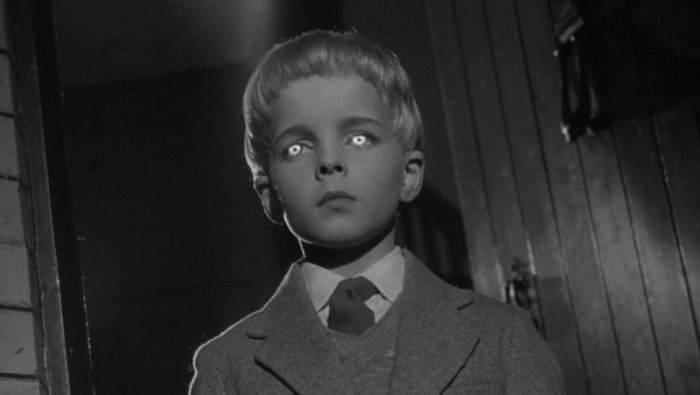
Unlikely help offered itself to me during the course of my studies. I was in my last year of college and the Chairman of the Philosophy Department, though I was an English major, had become my benefactor and opened doors for me in a highly conservative academic environment, allowing me to pursue interdisciplinary research projects into obscure, shadowy areas. But it was actually my mom who suggested that I read what a Carl Jung had to say about the ‘archetypes and the collective unconscious.’
And so I came to stand before the many elegant black volumes of the Princeton Bollingen edition of Jung’s collected works. But what could this Swiss psychologist, the son of a minister, who reached manhood in the nineteenth century, say of any use to a nineteen year old Jewish kid from the Bronx who found himself obsessed with sci-fi fantasies like The Midwich Cuckoos, in which a UFO-related incident somehow resulted in large-eyed, androgynous children with psychic powers and a group mind? I scanned the index volume for a minute or so and came across a late work, Flying Saucers, A Modern Myth of things Seen in the Sky. That was a bit of a shock, as UFOs were a major part of the fantasies and my esoteric research. I went right to volume ten, Civilization in Transition, where flying saucers were considered. This subject seemed to haunt Jung near the end of his life, and he couldn’t let go of it. At the end of the book there was an afterward, followed by an epilogue, followed by a supplement.
As I glanced through the supplement my jaw dropped open in amazement. Jung had devoted this lengthy supplement to analyzing mythological layers of meaning in John Wyndham’s The Midwich Cuckoos! It seemed as if this dead Swiss guy had stepped out of the bookcase and had holographically manifested himself to look over my shoulder at the same sci-fi story that obsessed me. Even more amazing, I saw that we had some parallel ideas about what it might mean. From the moment of that first encounter, Jung, like a wizard bearing a torch, became my guide as I followed numinous visions of evolutionary metamorphosis down the rabbit hole and discovered what I now call “the Singularity Archetype.” (see the 1978 paper that resulted from this encounter: Archetypes of a New Evolution) So I am glad to be a Jungian, and not Jung, because I get to be the benefactor of his many decades of heavy lifting. He had the earth-moving power to tunnel deeply into the cultural matrix and uncover the deep program, the core ruling images he called archetypes. If anyone has made a heroic contribution to pulling back the veils of Maya, it is Jung.
If you have not read Jung before, and would like to go beyond this quote collection, a perfect starting place is Man and His Symbols by Carl Jung. This book was written by Jung and many of his most brilliant colleagues, like Marie Louise Von Franz, as an introduction to his work. Jung’s part, entitled Approaching the Unconscious, was completed shortly before his death in 1961 and represents a mature summing up of his way of psychological exploration. An alternative starting point or follow up to Man and his Symbols is Jung’s autobiographical work, Memories, Dreams, Reflections. This book expresses Jung’s more personal voice and some of his inner experience so it as if he were talking to you across from the primeval campfire and is a much more intimate introduction. Volume 9 of the collected works, Archetypes of the Collective Unconscious, and volume 10, Civilization in Transition would be a great follow up to Man and His Symbols. Another inexpensive and easily available follow up would be The Portable Jung, edited by Joseph Campbell.
C.G. Jung Quotes:
People will do anything, no matter how absurd, in order to avoid facing their own souls. They will practice Indian yoga and all its exercises, observe a strict regimen of diet, learn the literature of the whole world—all because they cannot get on with themselves and have not the slightest faith that anything useful could ever come out of their own souls. Thus the soul had gradually been turned into a Navareth from which nothing good can come. Therefore let us fetch it from the four corners of the earth—the more far-fetched and bizarre it is the better! Whether this psychic structure and its elements, the archetypes, ever “originated” at all is a metaphysical question and therefore unanswerable. The structure is something given, the precondition that is found to be present in every case. And this is the mother, the matrix—the form into which all experience is poured.
The psyche consists essentially of images. It is a series of images in the truest sense, not an accidental juxtaposition or sequence, but a structure that is throughout full of meaning and purpose; it is a “picturing” of vital activities. And just as the material of the body that is ready for life has need of the psyche in order to be capable of life, so the psyche presupposes the living body in order that its images may live.
What we call fantasy is simply spontaneous psychic activity, and it wells up wherever the inhibitive action of the conscious mind abates or, as in sleep, ceases altogether.
Natural man is not a “self” —he is the mass and particle in the mass, collective to such a degree that he’s is not even sure of his own ego. That is why since time immemorial he has needed the transformation mysteries to turn him into something, and to rescue him from the animal collective psyche, which is nothing but an assortment, a “variety performance.”
Were it not for the leaping and twinkling of the soul, man would rot away in his greatest passion, idleness.
To have soul is the whole venture of life, for soul is a life-giving daemon who plays his elfin game above and below human existence, for which reason—in the realm of dogma—he is threatened and propitiated with superhuman punishments and blessings that go far beyond the possible deserts of human beings. Heaven and hell are the fates meted out to the soul and to civilized man, who in his nakedness and timidity would have no idea of what to do with himself in a heavenly Jerusalem.
The world comes into being when man discovers it. But he only discovers it when he sacrifices his containment in the primal mother, the original state of unconsciousness. …the primitive has not yet experienced that ascetic discipline of mind known to us as the critique of knowledge. To him the world is a more or less fluid phenomenon within the stream of his own fantasy, where subject and object are undifferentiated and in a state of mutual interpenetration.
The primitive cannot assert that he thinks; it is rather that “something thinks in him.” The spontaneity of the act of thinking does not lie, causally, in his conscious mind, but in his unconscious… His consciousness is menaced by an almighty unconscious.
Science, curiously enough, began with the discovery of astronomical laws, and hence with the withdrawal, so to speak, of the most distant projections. This was the first stage in the despirtualization of the world. One step followed another: already in antiquity the gods were withdrawn from mountains and rivers, from trees and animals. Modern science has subtilized its projections to an almost unrecognizable degree, but our ordinary life still swarms with them.
Whatever name we may put to the psychic background, the fact remains that our consciousness is influenced by it to the highest degree, and all the more so the less we are conscious of it. The layman can hardly conceive how much his inclinations, moods, and decisions are influenced by the dark forces of his psyche, and how dangerous or helpful they may be in shaping his destiny. Our cerebral consciousness is like an actor who has forgotten that he is playing a role. But when the play comes to an end, he must remember his own subjective reality, for he can no longer continue to live as Julius Caesar or as Othello, but only as himself, from whom he has become estranged by a momentary sleight of consciousness. He must know once again that he was merely a figure on the stage who was playing a piece by Shakespeare, and that there was a producer as well as a director in the background who, as always, will have something very important to say about his acting.
Rationalism and superstition are complementary. It is a psychological rule that the brighter the light, the blacker the shadow; in other words, the more rationalistic we are in our conscious minds, the more alive becomes the spectral world of the unconscious.
Nowhere and never has man controlled matter without closely observing its behavior and paying heed to its laws, and only to the extent that he did so could be control it. The same is true of that objective spirit which today we call the unconscious: it is refractory like matter, mysterious and elusive, and obeys laws which are so non-nonhuman or suprahuman that they seem to us like a crimen laesae majestatis humanae. If a man puts his hand to the opus, he repeats, as the alchemists say, God’s work of creation. The struggle with the unformed, with the chaos of Tiamat, is in truth a primordial experience.
The unconscious is the unwritten history of mankind from time unrecorded. The conscious mind allows itself to be trained like a parrot, but the unconscious does not—which is why St. Augustine thanked God for not making him responsible for his dreams. The unconscious is an autonomous psychic entity; any efforts to drill it are only apparently successful, and moreover harmful to consciousness. It is and remains beyond the reach of subjective arbitrary control, a realm where nature and her secrets can be neither improved upon nor perverted, where we can listen but may not meddle.
Any attempt to determine the nature of the unconscious state runs up against the same difficulties as atomic physics; the very act of observation alters the object observed. Consequently, there is at present no way of objectively determining the real nature of the unconscious.
Nobody can say where man ends. That is the beauty of it. The unconscious of man can reach God knows where. There we are going to make discoveries.
Before the bar of nature and fate, unconsciousness is never accepted as an excuse; on the contrary there are severe penalties for it.
Every advance in culture is, psychologically, an extension of consciousness, a coming to consciousness that can take place only through discrimination. Therefore an advance always beings with individuation, that is to say with the individual, conscious of his isolation, cutting a new path through hitherto untrodden territory. To do this he must first return to the fundamental facts of his own being, irrespective of all authority and tradition, and allow himself to become conscious of his distinctiveness. If he succeeds in giving collective validity to his widened consciousness, he creates a tension of opposites that provides the stimulation which culture needs for its further progress.
When we must deal with problems, we instinctively resist trying the way that leads through obscurity and darkness. We wish to hear only of unequivocal results, and completely forget that these results can only be brought about when we have ventured into and emerged again from the darkness. But to penetrate the darkness we must summon all the powers of enlightenment that consciousness can offer.
“Reflection” should be understood not simply as an act of thought, but rather as an attitude. It is a privilege born of human freedom in contradistinction to the compulsion of natural law. As the word itself testifies (“reflection” means literally “bending back”), reflection is a spiritual act that runs counter to the natural process; an act whereby we stop, call something to mind, form a picture, and take up a relation to and come to terms with what we have seen. It should, therefore, be understood as an act of becoming conscious.
Gleaming islands, indeed whole continents, can still add themselves to our modern consciousness.
There are many people who are only partially conscious. Even among absolutely civilized Europeans there is a disproportionately high number of abnormally unconscious individuals who spend a great part of their lives in an unconscious state. They know what happens to them, but they do not know what they do or say. They cannot judge of the consequences of their actions. These are people who are abnormally unconscious, that is, in a primitive state. What then finally makes them conscious? something really happens, and that makes them conscious. They meet with something fatal and then they suddenly realize what they are doing.
An inflated consciousness is always egocentric and conscious of nothing but its own existence. It is incapable of learning from the past, incapable of drawing right conclusions about the future. It is hypnotized by itself and therefore cannot be argued with. It inevitably dooms itself to calamities that must strike it dead.
The stirring up of conflict is a Luciferian virtue in the true sense of the word. Conflict engenders fire, the fire of affects and emotions, and like every other fire it has two aspects, that of combustion and of creating light. On the one hand, emotion is the alchemical fire whose warmth brings everything into existence and whose heat burns all superfluities to ashes…But on the other hand, emotion is the moment when steel meets flint and a spark is struck forth, for emotion is the chief source of consciousness. There is no change from darkness to light or from inertia to movement without emotion.
Nothing is so apt to challenge our self-awareness and alertness as being at war with oneself. One can hardly think of any other or more effective means of waking humanity out of the irresponsible and innocent half-sleep of the primitive mentality and bringing it to a state of conscious responsibility.
Without consciousness there would, practically speaking, be no world, for the world exists for us only in so far as it is consciously reflected by a psyche. Consciousness is a precondition of being. Thus the psyche is endowed with the dignity of a cosmic principle, which philosophically and in fact gives it a position co-equal with the principle of physical being. The carrier of this consciousness is the individual, who does not produce the psyche of his own volition but is, on the contrary, preformed by it and nourished by the gradual awakening of consciousness during childhood. If therefore the psyche is of overriding empirical importance, so also is the individual, who is the only immediate manifestation of the psyche.
…All Nature seeks this goal and finds it fulfilled in man, but only in the most highly developed and most fully conscious man.
Archetypes are like riverbeds which dry up when the water deserts them, but which it can find again at any time. An archetype is like an old watercourse along which the water of life has flowed for centuries, digging a deep channel for itself. The longer it has flowed in this channel the more likely it is that sooner or later the water will return to its old bed.
Our personal psychology is just a thin skin, a ripple on the ocean of collective psychology. The powerful factor, the factor which changes our whole life, which changes the surface of our known world, which makes history, is collective psychology, and collective psychology moves according to laws entirely different from those of our consciousness. The archetypes are the great decisive forces, they bring about the real events, and not our personal reasoning and practical intellect…The archetypal images decide the fate of man.
…They (the archetypes) may be compared to the invisible presence of the crystal lattice in a saturated solution. As a priori conditioning factors they represent a special, psychological instance of the biological “pattern of behavior,” which gives all living organisms their specific qualities.
Sooner or later nuclear physics and the psychology of the unconscious will draw closer together as both of them, independently of one another and from opposite directions, push forward into transcendental territory, the one with the concept of the atom, the other with that of the archetype.
I can only gaze with wonder and awe at the depths and heights of our psychic nature. Its non-spatial universe conceals an untold abundance of images which have accumulated over millions of years of living development and become fixed in the organism. My consciousness is like an eye that penetrates to the most distant spaces, yet it is the psychic non-ego that fills them with non-spatial images. And those images are not pale shadows, but tremendously powerful psychic factors. The most we may be able to do is misunderstand them, but we can never rob them of their power by denying them. Beside this picture I would like to place the spectacle of the starry heavens at night, for the only equivalent of the universe within is the universe without; and just as I reach this world through the medium of the body, so I reach that world though the medium of the psyche.
The organism confronts light with a new structure, the eye, and the psyche confronts the natural process with a symbolic image, which apprehends it in the same way as the eye catches the light. And just as the eye bears witness to the peculiar and spontaneous creative activity matter, the primordial image expresses the intrinsic and unconditioned creative power of the psyche. The primordial image is thus a condensation of the living process.
It is a great mistake in practice to treat an archetype as if it were a mere name, word or concept. It is far more than that: it is a piece of life, an image connected with the living individual by the bridge of emotion.
The so-called “forces of the unconscious” are not intellectual concepts that can be arbitrarily manipulated, but dangerous antagonists which can, among other things, work frightful devastation in the economy of the personality. They are everything one could wish for or fear in a psychic “Thou.” The layman naturally thinks he is the victim of some obscure organic disease; but the theologian, who suspects it is the devil’s work, is appreciably nearer to the psychological truth.
All the true things must change and only that which changes remains true.
Nobody doubts the importance of conscious experience; why then should we doubt the significance of unconscious happenings? They also are part of our life, and sometimes more truly a part of it for weal or woe than any happenings of the day.
In order to do anything like justice to dreams, we need an interpretive equipment that must be laboriously fitted together from all branches of the humane sciences.
As in our waking state, real people and things enter our field of vision, so the dream-images enter like another kind of reality into the field of consciousness of the dream-ego. We do not feel as if we were producing the dreams, it is rather as if the dreams came to us. They are not subject to our control but obey their own laws.
Anyone who wishes to interpret a dream must himself be on approximately the same level as the dream, for nowhere can he see anything more than what he is himself.
Dreams are as simple or as complicated as the dreamer is himself, only they are always a little bit ahead of the dreamer’s consciousness. I do not understand my own dreams any better than any of you, for they are always somewhat beyond my grasp and I have the same trouble with them as anyone who knows nothing about dream interpretation. Knowledge is no advantage when it is a matter of one’s own dreams.
The art of interpreting dreams cannot be learnt from books. Methods and rules are good only when we can get along without them.
Only the man who can do it anyway has real skill, only the man of understanding really understands.
So difficult is it to understand a dream that for a long time I have made it a rule, when someone tells me a dream and asks for my opinion, to say first of all to myself: “I have no idea what this dream means.” After that I can begin to examine the dream.
…The whole dream work is essentially subjective, and a dream is a theater in which the dreamer is himself the scene, the player, the prompter, the producer, the author, the public, and the critic.
Just as the body bears the traces of its phylogenetic development, so also does the human mind. Hence there is nothing surprising about the possibility that the figurative language of dreams is a survival from an archaic mode of thought.
Nature commits no errors.
Now supposing that these (dream) interpretations also go astray, the general inconclusiveness and futility of our procedure will make itself felt soon enough in the bleakness, sterility, and pointlessness of the undertaking, so that the doctor and patient alike will be suffocated either by boredom or by doubt. Just as the reward of a correct interpretation is an uprush of life, so an incorrect one dooms them to deadlock, resistance, doubt, and mutual desiccation.
Many people who know something, but not enough, about dreams and their meaning, and who are impressed by their subtle and apparently intentional compensation, are liable to succumb to the prejudice that the dream actually has a moral purpose, that it warns, rebukes, confronts, foretells the future, etc. If one believes that the unconscious always knows best, one can easily be betrayed into leaving the dreams to take the necessary decisions, and is then disappointed when the dreams become more and more trivial and meaningless.
Experience has shown that a slight knowledge of dream psychology is apt to lead to an overrating of the unconscious which impairs the power of conscious decision. The unconscious functions satisfactorily only when the conscious mind fulfills its task to the very limit. A dream may perhaps supply what is then lacking, or it may help us forward when our best conscious efforts have failed.
To concern ourselves with dreams is a way of reflecting on ourselves—a way of self-reflection. It is not our ego-consciousness reflecting on itself; rather, it turns its attention to the objective actuality of the dream as a communication or message from the unconscious, unitary soul of humanity. It reflects not on the ergo but on the self; it recollects that strange self, alien to the ego, which was ours from the beginning, the trunk from which the ego grew. It is alien to us because we have estranged ourselves from it through the aberrations of the conscious mind.
Anyone who wants to know the human psyche will learn next to nothing from experimental psychology. He would be better advised to put away his scholar’s gown, bid farewell to his study, and wander with human heart through the world. There, in the horrors of prisons, lunatic asylums and hospitals, in drab suburban pubs, in brothels and gambling-hells, in the salons of the elegant, the Stock Exchanges, Socialist meetings, churches, revivalist gatherings and ecstatic sects, through love and hate, through the experience of passion in every form in hos own body, he would reap richer stores of knowledge than text-books a foot thick could give him, and he will know how to doctor the sick with real knowledge of the human soul.
An ancient adept has said: “If the wrong man uses the right means, the right means work in the wrong way.” This Chinese saying, unfortunately only too true, stands in sharp contrast to our belief in the “right” method irrespective of the man who applies it. In reality, everything depends on the man and little or nothing on the method.
True art is creation, and creation is beyond all theories. That is why I say to any beginner; Learn your theories as well as you can, but put them aside when you touch the miracle of the living soul. Not theories but your creative individuality alone must
decide.
If I wish to treat another individual psychologically at all, I must for better or worse give up all pretensions to superior knowledge, all authority and desire to influence.
We cannot change anything unless we accept it. Condemnation does not liberate, it oppresses.
When the ego has been made a “seat of anxiety,” someone is running away from himself and will not admit it.
Among neurotics, there are not a few who do not require any reminders of their social duties and obligations, but are born and destined rather to be bearers of new cultural ideals. They are neurotic as long as they bow down before authority and refuse the freedom to which they are destined. As long as we look at life only retrospectively, as is the case in the psychoanalytic writings of the Viennese school, we shall never do justice to these persons and never bring them for the longed-for deliverance. For in this way we train them only to be obedient children and thereby strengthen the very forces that made them ill—their conservative backwardness and submission to authority.
Where love reigns, there is no will to power; and where the will to power is paramount, love is lacking. The one is but the shadow of the other.
In spite of all indignant protestations to the contrary, the fact remains that love (using the word in the wider sense which belongs to it by right and embraces more than sexuality), its problems and its conflicts, is of fundamental importance in human life and, as careful inquiry consistently shows, is of far greater significance than the individual suspects.
The love problem is part of mankind’s heavy toll of suffering, and nobody should be ashamed of having to pay his tribute.
It is a favorite neurotic misunderstanding that the right attitude to the world is found by indulgence in sex.
So far as we know, consciousness is always ego-consciousness. In order to be conscious of myself, I must be able to distinguish myself from others. Relationship can only take place where this distinction exists.
For two personalities to meet is like mixing two chemical substances: if there is any combination at all, both are transformed.
It must be admitted that a fit of rage or a sulk has its secret attractions. Were that not so, most people would long since have acquired a little wisdom.
Sentimentality is the superstructure erected upon brutality.
Most men are erotically blinded—they commit the unpardonable mistake of confusing Eros with sex. A man things he possesses a woman if he has her sexually. He never possesses her less, for to a woman the Eros-relationship is the real and decisive one.
Our life is like the course of the sun. In the morning it gains continually in strength until it reaches the zenith-heat of high noon. Then comes the enatiodromia: the steady forward movement no longer denotes an increase, but a decrease, in strength. Thus our task in handling a young person is different from the task of handling an older person. In the former case, it is enough to clear away all the obstacles that hinder expansion and ascent; in the latter, we must nurture everything that assists the descent.
If there is anything that we wish to change in our children, we should first examine it and see whether it is not something that could better be changed in ourselves. Take our enthusiasm for pedagogics. It may be that the boot is on the other leg. It may be that we misplace the pedagogical need because it would be an uncomfortable reminder that we ourselves are still children in many respects and still need a vast amount of educating.
Our whole educational problem suffers from a one-sided approach to the child who is to be educated, and from an equally one-sided lack of emphasis on the uneducatedness of the educator.
Children are educated by what the grown-up is and not by what he says.




Sadly true and not correctable in this world:
“Our whole educational problem suffers from a one-sided approach to the child who is to be educated, and from an equally one-sided lack of emphasis on the uneducatedness of the educator.”
Raised Christian i remember hearing; “The Chosen are Few.”and “The truth shall set you Free!” I finally understand these teachings….We have the ability to choose….once you are able to be honest with yourself, you realize just how imprisoned you’ve been….in you thoughts, your beliefs your life…true freedom truly comes from Truth…whatever yours may be…!