 ZapOracle.com Zap Oracle

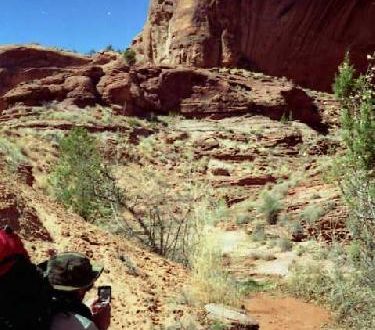
The photo relates to a practical way to navigate your pathway through a chaotic world. I have a poor natural sense of direction. Yet, ordinary map and compass skills allowed me to function as a wilderness guide. In the photo, I led a small group through a maze of canyons with no marked paths in Escalante, Utah.
Orienteering is a simple but effective method of wilderness navigation. You orient your map to the visible landscape as best you can, recognizing that the map is not the territory — some features may have changed, and others may have been mapped wrong, but most things will correspond. With the help of a compass, you locate a nearby landmark along your line of travel. You walk to that landmark, reorient briefly, and pick a new landmark. This is called “point-to-point navigation.”
Pathfinding through life can be like finding your way through a maze of canyons. First, you must know the overall direction you want to go. If you don’t already know your overall direction, you need to locate it with deep, global intuition. This is a crucial psychic function that works like your soul’s compass. The mind and the ego are indispensable psychic functions, but they will not cut it here. If you try to use them as your soul’s compass, you will likely find yourself in a mental ping-pong game — What about this? But what about that? But what if this happens? But what if that doesn’t happen?
You can’t think your way through to your overall direction in life because thinking doesn’t plumb the depths of your soul and purpose. One way to contact the necessary depth of recognition is to go to a quiet, solitary space and ask yourself: What will I remember well on my deathbed? Your honest answers to this core question will reveal your True Will and the life mission you need to accomplish. Once you’ve located your intended life direction, the mind/ego alliance can step in to handle the micro level of path orientation.
The start of the day is often ideal for path orientation. A natural unit of time lies before you, and you have a goal: to make the best use of your time, consistent with your overall direction, between awakening and bedtime. Locate navigational landmarks in space/time to orient yourself efficiently. For example, if you have a doctor’s appointment today, that’s a navigational beacon, a definite point in both time and space you need to hit because maintaining your health is consistent with your overall life direction. You also need to get to other points in space and time for work, creative sessions, exercise, practical chores, and quality relationship time. Orient your day map to navigate time and space efficiently. For example, if you need to get something from a store that’s near the doctor appointment, it would be efficient to go there right before or after.
It’s also efficient to bulk similar tasks together. For example, if there are a few small home repairs needed, you might as well do them together as once you’ve gotten yourself into mechanical repair mode, it’s easier to stay in that mode.
It’s most efficient to do things during the “peak time” to do them. For example, I’m at my peak cognitively about ninety minutes after I’ve gotten up and had my daily dose of caffeine. So that’s when I start my writing/creative session almost every day. In the afternoon, I have the most active physical energy that’s been pent up from sitting during the writing session. That’s peak time to take on physical chores like cleaning, but it’s also peak time for exercise, so I have a difficult choice between which to prioritize. I tend to prioritize chores and other practical tasks and exercise after, but that diminishes the intensity of the workout, so it’s a difficult trade-off.
Off-peak time is the peak time for off-peak tasks. For example, on an afternoon when I’m feeling physically under par and/or mood challenged and/or having an issue that is causing emotional/psychological instability, is the perfect time to do necessary but cognitively unchallenging tasks that produce concrete results like the laundry. I save such tasks for those under par zones when doing simple, physical work will be therapeutic.
It’s ideal to reserve peak time for work on a big dream that’s crucial to your life path. A good rule of thumb is that a big dream needs at least two hours a day. The work on your big dream is important but may not be urgent (in a superficial temporal sense), like hitting the doctor appointment at a specific time or answering a ringing phone. Without a good day map, most people default to the superficially urgent, small stuff and neglect the important, non-urgent work. In time management literature, this is called “majoring in the minors.”
When you draw up your day map, gauge time as realistically as possible. Like many people, I have an unhelpful tendency to estimate how long I think something should take as compared to how long it usually takes (about twice or three times as long as I think it should). Add buffer time between any scheduled tasks to avoid the stress of rushing or falling behind.
Since I’m self-employed, my schedule is more flexible than when I was in school or working rigidly scheduled jobs. The most scheduled part of my day is my highest-value activity — the writing/creative session. Getting it done at the start of the day before I do anything else reduces the chances that unexpected events will interfere. People close to me know not to disturb me during that time. I defend my peak time for my peak activity. When I’m finished, the sense of accomplishment raises morale for the rest of the day.
Most days, after my creative session, I have to tackle mundane, mechanically resistant tasks. I employ a few strategies and tactics for dealing with this part of everyday life. One is conceptual — instead of calling mundane tasks “to do” items, I call them “Quest Links.” This may seem silly, but it reminds me that necessary practical tasks are in service of my life mission — my quest.
The Fellowship of the Ring has a quest that will drastically affect Middle Earth’s fate. In the books and films, however, we observe the quest during its most dramatic moments. But if we watched the fellowship moment-by-moment, we’d find that most of the time, they were dealing with mundane activities like gathering firewood and wearily plodding along the path while being oppressed by weather and biting insects. And yet, even in those conditions, meaningfulness was still present because they were on their quest. Therefore, gathering firewood was a Quest Link.
If what you need to do is too much to allow for big dream time, relationship time, self-care, etc., then it’s time to triage your projects and activities — What can you afford to let go? What can you absolutely not let go? What might fall in some middle category? It is better to accomplish some important things really well, plus a modest amount of mechanical chores than to be in a frantic rush all day trying to accomplish everything you think you should be able to do (usually based on what a superhero could do after twelve cups of coffee). Mark out your day map with majors and a modest number of minors.
I often look forward to doing routine mechanical tasks because most of my reading is done via audiobooks. I also use routine task time to listen to podcasts and catch up on world events via quality news sources.
You can also make mechanical tasks a chance to get into a flow state https://en.wikipedia.org/wiki/Flow_(psychology) by treating them like a game or sport where you are trying to push the limits of performance and efficiency.
The mundane tasks I dread the most and am most likely to procrastinate on lack intrinsic interest yet require mental focus — E.G., taxes. My psyche cringes from the claustrophobically narrow reality tunnel required. Most of the pain, however, is in feeling the monkey on my back, the anxiety of knowing this has to get done, and I’m putting it off. Once I overcome the resistance and start doing these tasks, I get focused and efficient and build momentum. So once I finallly get myself into paperwork mode, I’m in peak time to burn through other paperwork tasks. Afterward, there is a high sense of accomplishment.
Your state of mind as you draw up your day map is essential. Don’t let the map-drawing exercise become a futile attempt to tightly prestructure the future. The map is not the territory, and the day’s landscape will likely have unseen and unpredictable features. Drawing your day map is a strategic activity you engage in the moment, but future developments may require you to to redraw it. For example, a few minutes ago I learned that the other four members of my household will be gone from the house for several hours. Since my two teenage godsons are off from school for the summer, this is a valuable opportunity for me to do things that require solo house time. I’ve just redrawn my day map to record card videos while the house is quiet. Then, I’m going to tackle all the unopened mail and financial paperwork because I can spread all of it out on the dining room table and focus on it without any noise or distractions.
When I was writing my sci-fi epic, Parallel Journeys, getting up predawn was ideal. Emerging from the dreamtime when the rest of the household was still in it created a liminal zone closer to the dreamtime and further from mundane consciousness. If I sleep late, I have to pass through a house bustling with morning routines as people get ready for school and work to get to my study. This is far more distracting and inauspicious for my imagination than waking up predawn to a quiet house. See: Predawn Window Zone.
Many successful people who have 9-5 jobs will choose to get up early to create some peak time before work. They may use that undisturbed peak time for high-level thinking or exercise. See the book, What the Most Successful People Do Before Breakfast
Don’t draw up a day map with the relentless efficiency of the commander of a Nazi Panzer division. Don’t make the day into a death march. Leave space for self-care, relationships and to unwind before sleep.
You will function better if you can stabilize your sleep schedule. I have a loose time marker for when I want to get to sleep. If I can get to sleep before 9:30 pm, I will often be able to get up by 4 am, but if I stay up past ll pm, I will probably need 7-8 hours of sleep. There are cycles with sleep and dreaming, and every hour of sleep before midnight may be worth two after. If I catch the right cycle, I can get in my REM sleep earlier and have a higher percentage of REM sleep. Since REM sleep tends to happen at the end of the sleep cycle, usually in the early morning hours, it is particularly exhausting to stay up late and then wake up to an early alarm that truncates REM sleep.
Often, we find ourselves faced with a classic problem — our body is a more conservative organism than our psyche. What is good for the body is like what is good for a cat or dog — a consistent, predictable routine. Eating and sleeping at the same time every day is great for the body, but it can be oppressive to the creative spirit. There needs to be a careful negotiation and choice. Sometimes, the spontaneous social or creative opportunity is worth staying up all night. More often, I have the greatest fulfillment if I can get to sleep early and start my creative session predawn. If I break that rhythm, it can sometimes take me a few days to get it back.
Once you have prepared your day map, taking all these things into consideration, you start moving toward your navigational points. It is most efficient to have your map and a list-making device (such as a smartphone) within hands reach throughout the day. If you need to unplug, put the phone in airplane mode while you continue to use it for this purpose. Quest links and future time markers should be listed or calendarized immediately so that you don’t fatigue and worry yourself by trying to retain them in memory. Nearly everyone these days has a smartphone in their pocket, so this has never been easier. Outsource mundane memory to your phone. Don’t exhaust working memory by trying to “keep stuff in mind” — that’s like walking down the path carrying a rock.
Finally, be path-oriented, not goal-oriented. Don’t demoralize yourself by continually checking for progress on your long-term goals. Focus on the part of the path you are on at this moment. Us point-to-point navigation. Traveling to the next point is where the rubber meets the road. If you feel off-kilter, stop and reorient yourself by asking yourself the question, What’s the best use of my time right now? The answer could be a nap, time off for contemplation, hammering away at minors, working on a neglected major, etc. If the answer or answers aren’t what you are currently doing, take a few moments to reconfigure your day map.
Card #574 – Catching What’s In Reach:
Often, we are so mesmerized by long-term goals, by what is presently unavailable, by the past, and by what is out of reach that we fail to notice or act on things within our reach right now.
Each day is like a stream flowing from awakening to bedtime. If we’re not fully awake and engaged, the stream can flow by before we even notice. This may be what’s happening to older people who say, “The years just fly by.” Every day stream has tiny windows of opportunity — the chance for a few seconds of pleasant conversation with a store clerk, that fifteen-minute chunk of time before you have to get to the next appointment, that listless half hour in the evening which you could fritter away channel or web surfing, or spend soulfully calling a friend you haven’t conversed with in a year, or writing in your journal. Coming down the day stream are the endless flotsam and jetsam of potential distractions, but amidst the debris are some things of great value if we can reach for them in time. Sometimes, we’re so caught up in what is lacking in our life that we fail to notice things within our reach during this day stream — to grasp them, we have to be alert, and our timing needs to be just right.
Most days, there are some key high-value things I’m trying to reach for — the morning writing session, ninety minutes for exercise, high-quality relationship time, time for high-quality reading, and/or watching movies or documentaries. On a day off, I can get all four of these in. But on working days, I might be able to get only three out of the four. On a busy day, I might get in only two out of four.
As you approach your day stream, know what your three or four high-value things are. You know the scheduled stuff like work has to happen. You know that opportunities for distraction will be flowing all around you, but if you time things just right, you could get in three of the four instead of two of the four.
Consider this an auspicious time to focus on your day stream with alert engagement and catch what’s in reach.
Some simple, grounded strategies to get more out of your day stream
Pathfinding means orienting yourself toward your big dreams, and making day maps that navigate carefully through majors and minors. Dealing with the chaos of life means journeying as best you can between awakening and bedtime.
For more on your relationship to time see:
Temporal Fencing and Life Fields
and Kill the Time Grid and Fire up your Life
Read Time Shifting, an article by Stephan Rechtschaffen and consider reading the book as well.
For more on setting the overall direction see:
The Path of the Numinous
For a philosophy of dealing with mechanically resistant minors see: Mechanical Resistance Matrix
For more on the Warrior path and philosophy, see:
The Way of the Warrior
Warrior Quotes
Taoist Quotes