 ZapOracle.com Zap Oracle

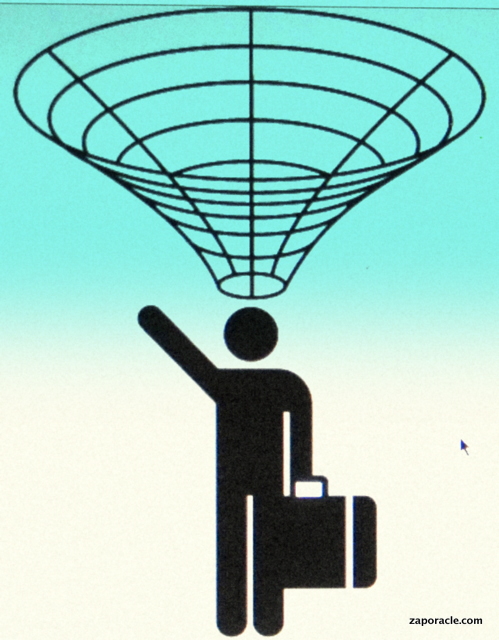
© 2003, 2008 Jonathan Zap top image, Interdimensional Passport (collage, copyright Jonathan Zap 1997)
Are you an Interdimensional Traveler?
This guide is written by an Interdimensional Traveler for fellow Interdimensional Travelers.
How can you tell if you’re an Interdimensional Traveler? Look at yourself in a mirror—if you are in some sort of human form and the looking glass returns any sort of reflection, then, for reasons that will soon be explained, you are an Interdimensional Traveler. If the mirror does not return your reflection, then you are definitely an Interdimensional Traveler and probably know it. You have always been an Interdimensional Traveler. Before you were born into this strange and still patriarchal realm you were in another realm, a womb, a metamorphic wet-world in which you floated and existed like an uncollapsed waveform of possibilities. And where were you before the womb realm? Well-documented case histories and evidence suggest that a human being is a multiple-incarnate entity. I say “suggest” because other paranormal explanations are possible besides reincarnation. But it is reasonable to take seriously what a large number of people in various periods and cultures have concluded: just as we usually pass through many phases within a single incarnation, most of us seem to pass through many incarnations, and each of these incarnations can be viewed as its own dimension.
If the idea of multiple incarnations seems too fantastical and unproven for you at this point, then you can reality test your status as an inter-dimensional traveler with a very simple experiment: (For safety reasons the following experiment should be performed from home and not while driving a car or operating any other heavy machinery.) This evening when you start to feel tired and your day is winding down, turn the lights off in your room and lie down on your bed. Once you have completed these steps, go to sleep. After you have drifted into sleep for a while you will most likely find yourself in another dimension called the dreamtime. This dimension has a different physics than that of the waking time—-gravity is not so relentless and you can fly if you wish; time drops its linearity, that dread ticking of the clock, and becomes far more flexible and bendable; objects and bodies are not so fixed as the waking time, but are revealed to be shape-shifters and changelings, and manifestation requires no heavy industry for it is only a thoughtform away. Remembered or not, the daily alternating rhythm of waking and dreaming is as fundamental to mammalian incarnation as the the systole and diastole of your heartbeat.
Interdimensional traveling is actually more fundamental to your existence than your heartbeat, because one day your heart will stop beating, but you’ll still be an Interdimensional Traveler. (Note: Even if you don’t believe in reincarnation, from the point of view of eternity once you have ever been an Interdimensional Traveler, then you always are—- in eternity every thing that has ever existed always exists. In other words, your lifetime doesn’t have to persist throughout eternity to be part of eternity. So just the fact that in this incarnation you alternated between waking and dreaming dimensions means that you are always an Interdimensional Traveler.) But maybe you’re the sort that doesn’t remember your dreams, and although you realize that REM sleep is a neurological necessity, the dreamtime does not seem particularly real to you. If that’s the case, try a different experiment. Have a conversation with someone to whom you are connected by inner ties. Look into that person’s eyes. Can you sense that this other person is like his or her own dimension, an ever-shifting nexus of strange elements with its own timeline and unique inner content generated by a multi-layered psyche? A deep relationship is an impingement and overlapping of dimensions. Behind the eyes of the other you can glimpse an individualized culture, an inner climate and weather system of shifting moods, evanescent feelings and glittering thoughtforms. It’s hard to get through even a single day and night without interdimensional travel. Interdimensional traveling is part of your birthright, and whether you’d like to or not you are going to travel interdimensionally.
Oh, and let’s not forget that even if we were born too soon to reach the event horizon envisioned by the Singularity Archetype, we are hurtling toward a guaranteed interdimensional portal popularly known as “death,” which shimmers before us in the night of time. We might not be sure what’s on the other side of that event horizon, but it is obviously still another dimension. And so the most concise and accurate description of our core identity is that we are Interdimensional Travelers. This is what we are, whether we want to be or not, whether we swallow red pills or blue, and our main choice is if we are to be savvy Interdimensional Travelers or foolish ones. But no matter how savvy an Interdimensional Traveler you may already be, the journey across dimensions can still be a rather perplexing process. This guide, which contains insights gleaned by a fellow Interdimensional Traveler, is offered in the hope that it can provide some assistance to you on your travels, whether the event horizon you cross is personal or a species-wide singularity.
Emerging from the Dreamtime
It is before dawn and I only just awoke from sleeping, dreaming a variety of absurd things. A pathetic robot, sort of like a rickety torso on a skateboard. I was sending it down a grassy hill, but I knew that it didn’t have the horsepower to make it back up the hill, and I gradually became aware that I was creating this pathetic situation. This was just a haphazard little reality my bored psyche was generating for its amusement, a boy with a box of crayons on a rainy afternoon. So I left the robot to coast, and withdrew into a darkened space unbound by gravity where I was rotating slowly, because it felt good to rotate slowly and feel the fields of charged energies around me. They were mostly invisible, but some seemed fringed with indigo light, and I sensed that I could go anywhere from this space and be in any form. My disenchanting bondage of one body/one psyche had been freed from the tragic magic of the lower densities, and I was not eager to return to any version of that annoying corporeal heaviness and the absurd limitations it imposed. There was so much more power and freedom being an unbound avatar rotating in fields of energy, a self-contained vortex of awareness able to travel anywhere. It didn’t seem at all appealing to be bound to a single aging body caught in an historical time track. And this particular time track seemed especially unappealing since it was an unstable primate-collective possible-endtimes sort of time track where depressed people took serotonin-specific-reuptake inhibitors, the global economy was ruled by psychopaths, and politics were ugly and riddled with parasitic elites. A world of allergens and toxicities of every sort and every sort of hassle and irritating inconvenience. And why was I supposed to accept that
absurd set of impositions again? Why was an entity like myself, rotating in fields of unbound potential and shimmering energy, supposed to shrink himself back into such a narrow and obnoxious time track? I saw then my bodily incarnation as an old vinyl record turning on a turntable with the tone arm removed. The record was somewhat scratched and dusty, but it reflected enough light to show that its surface was not so flat as it first seemed. There were a great number of concentric lines deeply etched with information, vibrational information, and I realized that upon waking I would be obliged for some absurd reason to shrink myself down to a tiny diamond needle and put myself back into almost the exact time track of the very same record, the very same waking situation where I had last left off, only maybe six hours downstream in time. Then it would be as if the dreamtime had never happened. Some insidious power would make the dreamtime vanish like a soap bubble, like the little man on the stair who wasn’t there. What power of enslavement took the dreamtime away and forced me to reenter the particular waking life, this flatland of rotating vinyl, this not-so-golden oldie, this mechanical medium, to turn with its monotonous revolutions until it plays itself out? Why is that such an inevitability? In the dreamtime I allowed the shrinking down to occur, allowed myself to be the diamond needle again, circling slowly in my time track on the dusty, scratchy landscape of etched vinyl. But when my diamond needle made contact with the dark vinyl I was surprised to find that it was no longer a flatland, it was more like an intricate maze of canyons. A vast and complex landscape surrounded me on all sides, and it was moving, changing, and I could barely keep up with the moving and changing. I only had time to observe the smallest part of its vast and metamorphizing complexity. Also, I sensed that there were other entities rotating with me, others that were living out parallel time tracks on the same spinning record. And some of these others were deeply connected to me by inner ties. We were like planets in strange elliptical orbits with each other, and there were obligations amongst us, promises to keep. It was like we were classmates incarnating together, and somehow our grades and permanent record cards had become strangely intermingled. We were networked together as if we were nodes in a single brain, and I realized it wouldn’t be fair to the other brain nodes for me to arbitrarily withdraw from the network. It would be a betrayal for me to choose my own graduation day and skip off on my own eternal summer vacation while my classmates labored on. We were brain nodes that had fired together, and wired together, and there was a certain soulful and loving sense to it all, a sense to my enrollment in the time track, this absurdly uncomfortable classroom where I sit slightly slumped, slightly restless in my seat, part of a modular desk bolted to the floor. And then I run my hands over the smooth imitation oak laminate surface of the desk. The desktop is sloped at an angle convenient for writing. The laminate surface is framed by a smooth, rounded border of aluminum and can be lifted up. There is space inside the desk, like a sink without a drain made of beige painted sheet metal, and in it are notebooks, my notebooks, and some are black and flecked with amoeboid shapes of white. But the notebook on the top of the pile is not black or flecked with amoeboid shapes of white. Its cover is a many-colored collage and it is thicker and held together by a long coil of wire like an unelastic spring. Words arise in my dreaming mind and I realize that this is what is called a “spiral notebook.” That name seems weird and uncanny somehow, so I pull this very thick and spirally notebook out of the belly of the desk and I see that the cardboard cover of the notebook has been etched with blue ballpoint, designs carved and shiny from the belabored passes of a steel ball bearing greasy ink. I open the notebook to a particular blank page that has been indented by a ballpoint pen pressed between the pages like a butterfly. Or maybe like a butterfly if a butterfly had a wingless torso of faceted transparent plastic with a single, central artery of greasy blue ink. As I take up the pen and press its steel ball to the paper, I see the vision again of the diamond needle scratching along on the concentric time tracks of the record, rotating slowly at a rate of thirty-three revolutions per minute. I see that the diamond needle is reading vibrational information etched into the record, but at the same time it is also etching new information onto the record. It is a read/write needle. Then I notice other diamond needles in contact with the same record and they are read/write needles as well. I see that myself and my fellow travelers are all reading and writing from and onto the same spinning medium, orbiting together in undulating, concentric bands. I realize that I need to fulfill my role, a particular read/write needle revolving in a particular time track. I pick up my pen and write a title at the top of the blank page: “A Guide to the Perplexed Interdimensional Traveler”
The Secret of Life
In the Sixties, aspiring young travelers set out to “look for the meaning of life.” Unfortunately, as someone once pointed out, they got the question backwards, because it is life that asks you in a challenging tone: “What is your meaning?” and you had better be able to supply the answer. Meaningfulness is what we need far more than survival; and anyway, as Don Juan put it, “There are no survivors on this earth.” Or, as a wise older man once told me, “Don’t do anything you won’t remember well on your death bed.” — a razor sharp way to cut out the trivia and superficialities to get at the meaningful marrow of life. Concentration camp survivor/existential psychologist Victor Frankel created a whole school of psychology (Logotherapy) based on the innate drive for meaningfulness. The ones who could psychologically/spiritually survive the camps, Frankel observed first hand, were the few who could find meaningfulness in their experience. A frequent theme reported by those who have had transcendent near-death experiences is a revelation of a deep and unexpected meaningfulness in even the mosaic of small, seemingly unconnected experiences of life. Also revealed during many NDEs and other mystical epiphanies is that this plane of existence is something like a school where we signed on for extremely challenging learning experiences. (See Life Lessons from the Living Dead) This brings me to what I believe are the two sides of the “Secret of Life” magic coin. The first side is self-development — to grow, develop, evolve, become more self-aware and conscious in every way possible. This innate will toward self-development was apparent in you even when you floated in the dimension of the womb-world. The other side of the magic coin is to help others, especially with their development. There it is, both sides of the secret of life. And notice that, unlike so many other things in life, this magic coin is always available. But don’t take my word for it, go to the East and seek out a guru (who will probably hit on you and want you to sweep up around the ashram for twenty years), do whatever you have to do, but this is the secret of life that works for me and feels solid. I would also like to point out that the life stance I am espousing here in this guide, is not my original fabrication (much though my narcissism might want to take credit for it), but is largely based on my thirty-year study and practical application of the I Ching, the five-to-six- thousand-year-old Book of Changes, on which Taoism (and much of Eastern philosophy, martial arts, medicine and culture) is based. And the I Ching doesn’t want you to have faith in it (uncritical belief) or doubt, but recommends an open, neutral stance. Take what resonates with your inner truth sense, what works for you, and leave the rest. Returning to the two sides of our secret of life coin, notice that self-development and helping others are two sides of a single, integrated whole. But the first side, self-development, is the foundation, and it is only by developing yourself that you have the option and capability to help others with their development. In fact, from the point of view of the I Ching, you have only one obligation in life, which is to get your relationship to yourself right. Fulfill that obligation and your relationships to others, to time, money, sex, power, food, mortality, career, politics, and the universe will all take care of themselves. But neglect or distort any part of your relationship to yourself and all these other relationships will accordingly be distorted and diminished.
Inner Independence
At the heart of healthful relationship to yourself is a stance known as “inner independence.” You (but not necessarily your ego) are the center of your own vortex, your own ever-changing equilibrium. Whenever you fall into dependence — grasping for Precious like a an obsessed Ring Wraith, your center collapses and you become an enslaved puppet of the Babylon Matrix. A classic example of this is grasping for the “hottie” — that all attractive person out there burning holes in your mind like Sauron’s one ring to bind them all. Quentin Crisp put it this way: “The consuming desire of most human beings is deliberately to plant their whole life in the hands of some other person. I would describe this method of searching for happiness as immature. Development of character consists solely in moving toward self-sufficiency.” Codependence or inner independence? The first step on the path of seeking another to complete you is a supreme betrayal (the betrayal of your own soul) so don’t be surprised if betrayal remains a central theme of that path.
The Inner Marriage of Yin and Yang
Getting your relationship to yourself right means working to evolve the inner marriage of yin and yang, feminine and masculine within yourself. Get that right and as a whole person you have the ability to have spiritually transforming, life-affirming relationships. Look to another person to complete you, however, and you become a wraith forever grasping for a Precious that forever eludes your grasp. And of course Precious doesn’t have to be a Hottie, it can be consumer goods, money, power, career, or whatever the Babylon Matrix can tempt you with that you believe you can’t live with out. But I particularly mention the Hottie because this ravenous craving, which most of us know so well, is a pillar of the Babylon Matrix. In Plato’s Symposium, Aristophanes states that before we were in our present, gender specific bodies we were spherical beings containing both genders. Jealous gods, wishing to punish and disempower us, fractured our spherical bodies so that we would lose touch with our androgynous inner wholeness. In this weakened state we were easily conditioned to follow gender stereotypes which reinforced the ravenous delusion that we needed sexual/romantic union with others to complete ourselves. Break the power of that ancient ruling ring (which in the darkness binds you) and you reclaim your own center of power, self-actualization and ability to love others as a whole person. For more on this theme see: Stop the Hottie!, Casting Precious into the Cracks of Doom—Androgyny, Alchemy, Evolution and the One Ring, Lessons for an Entity Incarnating as a Mammal, and No Tristans Allowed Beyond this Point—Debunking the Western Myth of Romantic Love.
Meeting Halfway — The Touchstone for Relationship
Relating well to others means approaching them cautiously, grounded in your inner independence. We follow the I Ching principle of meeting halfway (Hexagram 44). Meeting someone less than halfway would be, for example, any form of neglect, such as refusing to give them a fair hearing about an issue. More than halfway would be, for example, giving unasked-for advice, proselytizing, self-important intervening, lifeguarding others, etc. So if you go to a party and see someone you’re attracted to but are so shy that you hide in a corner and never approach them, you have met less than halfway. Hitting on them immediately would be meeting way more than halfway. Even during a conversation, one needs to apply this principle of meeting halfway by keeping attuned to the moment and aware of the subtle minutiae of openings and closings in the other person. With openings, we advance; with closings, we retreat and yield space.
When the other transgresses, invades boundaries, or comes at us with false personality, we should never go along with their misdeeds or do anything that compromises our inner dignity. We should withdraw energy from coming at us with their false self. Withdrawal can mean anything from breaking eye contact (a withdrawal of energy), ending the conversation, or, in some cases, going our own way for a lifetime. When we withdraw, we should do so lovingly, giving the other space to come to their senses on their own. We do not, in I Ching terms, “execute” the transgressing person in our minds, which would be to view him as hopeless and unable to improve. This would only help to keep them imprisoned by doubt. We also don’t indulge in excessive optimism that assumes they will become more conscious in this lifetime. We remain open to the possibility but do not extend trust to the untrustworthy. We step back to allow the creative to take its zigzag course. And for both our sake and the other’s, we try not to carry ongoing grudges against someone. From the I Ching point of view, we are responsible not only for what we say or do to someone with whom we are connected by inner ties, but also for our thoughts, because these are communicated on the inner plane.
Psychic Filters and Inner Voices
Speaking of our thoughts, we need to watch them constantly. We need to recognize that different voices, often generated by distinct subpersonalities, speak in our heads, and we need a central, witness personality that observes those voices/subpersonalities without becoming them. Hexagram 27 reminds us not to nourish ourselves on negative, unnourishing thoughts and fantasies. Yes, that’s easier said than done, but here are a couple of psychic filters to keep online that are guaranteed to catch all the psychic allergens (the negative thought forms) that all too easily pervade our inner world. We’ll call the first of these the “tone filter.” As you listen to the voices of your inner world (or the voices in your outer, interpersonal world) refuse to believe any voices that aren’t calm, compassionate and centered. Listen to them, understand where they are coming from, but don’t become them, don’t identify with them or believe them. If a voice is nagging, carping, bitter, mechanically repetitious, whining, angry, self-pitying, hypercritical, etc. then it is not to be believed! By tone, you can easily distinguish the voices of false subpersonalities and the still, deep voice of the Self.
Gerund Filter
A second filter involves a list of categories of thought indicative of the ego nervously trying to control the Tao. The position of Taoism (based on the I Ching) is that the universe is unfolding as it should. But the ego, like a nervous backseat driver clutching an imaginary steering wheel in its sweaty, white-knuckled grip, never trusts the nonlinear path of the creative so completely out of its control. Categories (presented as a list of gerunds) that indicate the ego resisting the Tao and/or trying to assert imaginary control over it include: WANTING, WISHING, WORRYING, HOPING, FEARING, DREADING, DESIRING, ENVYING, COMPARING, SUPERVISING, LIFE-GUARDING, JUDGING, COMPLAINING, SELF-PITYING, STRIVING, ANTICIPATING, EXPECTING, PRESTRUCTURING, CONTRIVING, FORCING PROGRESS, HEDGING, RATIONALIZING, CLINGING AND DOUBTING. Yes, this is an intimidating list! It is an embarrassing revelation of how often we default to the ego dominating our psyches. We’ll get into some of the nuts and bolts of changing patterns of thought and the afflictive emotions that ride into town with them, but first I’d like to say a few more words about the ego.
Ego Bashing
In New Age and Eastern circles, ego-bashing and intellect-bashing are the norm, and it is often claimed that the only path to enlightenment is to eliminate ego completely. Unfortunately, they’re never able to show you people walking around and functioning without egos. Their claims are like a diet book filled with endless horrifying “before” photos but without any believable “after” photos. To the extent that they have an “after” image, it comes into focus in the manner of an incompetent watercolor done in an impressionist style. And when they do claim to have an egoless guru to show you, it inevitably turns out to be a womanizer with fifty Rolls Royces and an immature, unruly ego so gigantic and off-Scale that the deluded disciples can’t see that the Emperor of No Ego is naked while their ego projections clothe him in Saruman’s wizard cloak of many colors.
The Self-Organizing Principle of the Organism
Ego is so basic to our existence that one transpersonal psychologist defines it as “the self-organizing principle of the organism.” With no ego there is no self-reference which you need to do almost anything. An amazingly good discussion of the nature of the ego is to be found in the “What is Ego?” edition of What is Enlightenment magazine. Everyone they interviewed had something fascinating and insightful to say about the nature of ego except for one famous female guru from India, who while claiming to be a divine being without ego, reveals the classic delusions of a sadistic, power-tripping, gigantically inflated ego.
A Flaw in Many Eastern and New Age Paths
Eastern gurus with acting out, unruly egos have become such a classic syndrome that they deserve special mention in our discussion of ego. Jung, who helped bring the I Ching and other Eastern teachings into the West, warned Westerners not to uncritically adapt wholesale Eastern practices of transformation that were designed in a different era for psyches quite different from those wefind today in the West (and increasingly in the modern East).
A classic flaw in many Eastern approaches to transformation (and also certain New Age and Christian permutations) is a one-sided emphasis on vertical spiritual transcendence and a gross neglect of the horizontal plane of human incarnation — the engagement, the descent into the worlds of relationship, activity in the world and the details of how our personalities work and interrelate.
Especially deficient in so many of these vertical transcendence sects is the integration of what Jung called “the shadow” — the inferior and repressed parts of the personality typically hidden by a cloud of self-loathing, denial, and unconsciousness. Hidden within the shadow are often unexpected talents and powers cast off with the rest of the unwanted aspects of personality.
Shadow Projection and Integration
When the shadow is unconscious and unintegrated, it must be displaced, projected onto some despised person or group. For example, the Nazis projected their shadow onto the Jews, who they said were trying to control the world (while they attempted to establish a thousand-year Reich). Typically, on the personal level, shadow projection is experienced as an intense dislike of some irritating person, usually of our gender and age range. Repulsion can be like attraction in reverse, where we are magnetically drawn, like a gruesome car accident we can’t look away from, by the spectacle of someone acting out the inferior traits we fear and deny in ourselves. Integration of the shadow begins by reclaiming these despised traits, following the projections back to their source (our psyches) and recognizing that the shadow is part of us. This takes a great deal of moral courage and will. In The Empire Strikes Back, this is what Luke must do when he is instructed by Yoda to go into the cave and face fear without his light saber. He ignores Yoda’s advice about the light saber and cuts off Darth Vader’s head only to discover that his own face lies behind the mask.
The Wayfarer’s Path
Most people are not willing to face their own shadow and unconsciously make the choice of the Wayfarer in the poem of the same name by Stephen Crane: The Wayfarer, Perceiving the pathway to truth, Was struck with astonishment. It was thickly grown with weeds. “Ha,” he said, “I see that none has passed here In a long time.” Later he saw that each weed Was a singular knife. “Well,” he mumbled at last, “Doubtless there are other roads.” People who have sought out paths of one-sided vertical transcendence usually have done nothing to integrate their shadow, but instead form cliques, sects or cults where they can join with others in reinforcing each other in the delusion that they’re on a path of transcending their egos. Actually they to tend to form communities of immature egos, with grossly unintegrated shadows, which run around acting out all the inferior qualities they believe they have transcended. Any charismatic leader of the cult or sect will typically have complete license to act out compulsive sexuality, to power trip, dominate, seduce and financially swindle followers. The followers will feel an electrifying desire to proselytize. The need to proselytize is almost always a classic sign of an imbalanced psyche — the hysterical need to spread the psychic contagion and gain partners in vice while believing that you are converting the infidels. At the very least they will reek of spiritual affectations and more-transcendent-than-thou attitudes. To be a whole person means integrating yin and yang, feminine and masculine, horizontal and vertical, shadow and spirit. This is not as easy as the vertical shortcut, the purchased stairway to heaven or satori, and that’s why Jung felt that crucifixion — being caught between the horizontal and vertical axes of life is a central metaphor for the human condition.
Mind and Ego in the Hierarchy of Psychic Functions
”The intuitive mind is a sacred gift, and the rational mind is a faithful servant. We have created a society that honors the servant and has forgotten the gift.”
—– Albert Einstein
Eliminating the ego to resolve our troubled relationship with it is no more sensible than decapitation would be as a remedy for recurrent headaches. Superstitious dread of the ego is almost always accompanied by a fanatical anti-intellectualism and disparagement of the mind. Mind and ego are not our enemies. It is where we place our mind and ego and how we work with these priceless resources that often make them our enemies. In most I Ching hexagrams, the fifth line is the ruler, and the fourth line is the minister. This structure contains the secret of how to work with the ego and mind so that they become powerful allies instead of adversaries. In the place of the ruler in our psyche should not be our ego or mind but our higher Self and global intuition. (I’ll discuss where the mind and ego should be in a little bit.)
True Will and Taoism
Taoism is often presented in a way that makes it seem that you are passively surrendering to an outside Tao. A way to pierce through this illusion is with a concept such as Aleister Crowley’s “True Will.” (Note: I’m not endorsing Crowley’s character, only certain of his concepts.)
Your True Will is the will of your higher Self, the will that arises out of the depths of your Self. Some object to his use of spatial metaphor to describe the Self, but it is the most concise way of cutting to the essence of this concept. True Will speaks through the still, centered voice of global intuition and is often confirmed by synchronicities, oracle consultations, etc. It is your inner refraction of the Tao and the guiding star you should follow. Following your True Will might require you to overcome all sorts of inner and outer obstructions. You are not necessarily passively led by outside trends. As George Bernard Shaw said,
“The reasonable man adapts himself to the world: the unreasonable one persists in trying to adapt the world to himself. Therefore, all progress depends on the unreasonable man.”
Many would interpret the reasonable man’s position as Taoist and the unreasonable man’s position as egoistic and anti-Taoist. This would be true if the unreasonable man expected the world to adapt to his ego. But if the unreasonable man is centered in his True Will, then his stance is Taoist as compared to a “reasonable” person whose reason and rationalized ego are oriented toward accommodating the default parameters of the Babylon Matrix. (See Dynamic Paradoxicalism—the Anti-Ism Ism for more on my version of Taoism).
The Ruler and the Minister of the Psyche
With your True Will and global intuition in your psyche’s ruling place, you can appoint your mind and ego as ministers that follow the ruler and work as helpful subordinates. In this place, ego and mind can, among other functions, act as skillful intermediaries between the aims of your True Will and the outside world. Only when the mind and ego are foolishly promoted above their capabilities into the ruling position do they work at cross-purposes and undermine everything we do. And yes, they can be foolishly ambitious in the way of the Peter Principle to rise to their level of incompetence. The unenlightened ego thinks it should be in charge. The goal is to develop a more conscious, evolved ego that knows its place. The mind can also be a brilliant amplifier and translator for global intuition and primal creativity, among other useful functions. Try fixing your computer with your feelings or transcendent spirit!
I’m still working on aligning these aspects of the psyche in myself. Consciousness is not something you arrive at, but that you must earn and work toward moment by moment. I’ll briefly use myself as an example to ground this in a particular real-life case. Because I am (according to Jung’s typology) a thinking-intuitive type, raised by thinking types, people often have an understandable (but somewhat mistaken) impression that I am up in my head thinking of the things they hear me say or write. More often, the way I experience my psyche working is that there is a cascade of intuitions. My active thinking function works with that cascade, analyzing, interpreting, and typically turning the intuitive input into complex sentences that may give the impression they were “thought up.” Of course, sometimes I call up memorized raps on various subjects and recite them. But originally, these raps were sourced from a melding of intuition and thought. After the fact, I can ask the thinking function to act as an information minister and recite the rap, which has been processed (and sometimes distorted) by thinking but not originally created by thinking. I experience my thinking function as hollow, dull, and incompetent when it works by itself (except when it’s troubleshooting the computer, learning instruction manuals, etc.)
I can only feel enthusiastic about using my psyche when intuition, thinking, and (often) feeling are all connected and working together. The difference is instantly discernable, like the difference between a stereo system where all the components work together to create a full, spatial sound compared to the tinny, irritating monophonic tone of an AM radio broadcasting a call-in radio show. Of course, sometimes the ego can play tricks, like putting a grandiose symphonic soundtrack behind its irritating, hollow monophonic voice. But if you pay attention, you can tell the difference.
The Power of Holding Back
Many people feel trapped by their mind and ego because they find themselves caught in an introspective hell of mental tape-loops that often focus on alternatively degrading and aggrandizing self-evaluations. They come to feel that the inner life itself, self-reflection, and meta-cognition (the ability to think about thinking — a great evolutionary advance) are what are holding them back from an effectual life. They may even come to believe that the way to escape this inner turmoil is to become a thoughtless extrovert, a “man of action.” I came to realize this when I was nineteen and wrote a paper on Dostoevsky entitled, “Doestoevsky and the Profound Egocentric.” Many Dostoevsky characters lament their internal consciousness as a liability, feel that reason makes them incapable of action and decisiveness and seek to become unthinking men of action. The narrator of Notes from Underground, for example, says, “The direct, the inevitable and the legitimate result of consciousness is to make all actions impossible, or — to put it differently — consciousness leads to thumb-twiddling…” The earliest literary example of this syndrome I can find is in Shakespeare’s Hamlet. Hamlet reproaches himself for being “John-a-dreams.” In one monologue he states, Thus conscience does make cowards of us all; And thus the native hue of resolution Is sicklied over with pale cast of thought, And enterprises of great pitch and moment, With this regard their currents turn awry, And lose the name of action. (Act III: SC I, lines 83-88) Hamlet eventually tries to rebel against his introverted state and become a man of action: “‘O, from this time forth / My thoughts be bloody or be nothing worth!'” (Act IV, SC IV, lines 95-96) T.S. Elliot’s J. Alfred Prufrock voices similar sentiments. Prufrock says, “Time yet for a hundred indecisions,” and, “There will be time/ To wonder, ‘Do I dare?’ and ‘Do I dare?’” Prufrock would prefer to be thoughtlessly instinctual rather than in a state of ineffectual self0-consciousness, “To have been a pair of ragged claws/ Scuttling across the floors of silent seas.” Like many contemporary persons, these literary characters falsely attribute their ineffectual indecisiveness to introspection, reason and self-awareness. What is imprisoning them is not self-awareness, reason or ego, but psychic entropy and the hierarchy of their psychic functions. They are living in an inner hell world where mind and ego are in charge of introspection. If intuition and the self were in charge of the process, and mind and ego in service of these higher functions, their experience would be altogether different in kind. When I was nineteen and wrote my paper on Dostoevsky I had a breakthrough in this regard. I discovered that light could break through the shadowy mental prison when intuition took the place of recursive thinking. The inner process that used to torment me when it was conducted by mind and ego I now find to be entertaining, enlightening and forever providing me with exciting new material. Instead of mind/ego alliance playing the same old anxious tapes, my inner process is led by the muse. The ego and mind are very much at work in that process, but as followers, not leaders. Some people who villanize the mind and ego as the problem, rather than the foolish placement of the mind and ego, even more foolishly believe they must get rid of mind and ego through a lifetime of meditation. Other people villanize introspection and believe that being a thoughtless man of action is the answer. For example, presidents 41 and 43, Bush the father, and Bush the son, frequently brag, “I don’t psychoanalyze myself.” W. has even said more than once, “I only look in the mirror when I’m shaving.” But Socrates said, “Know thyself.” This world is dying from lack of effective introspection. Spend that inner time guided by your intuition, if you spend it alone with mind and ego, then the inner temple will seem a prison and you will feel like the mind and ego’s prison bitch. This helpful alignment of higher self/ global intuition and True Will with mind and ego is often especially challenged when we are caught in some dilemma and feel pressed to make a decision. The ego can’t stand the ambiguous, ambivalent situations that are so typical of human incarnation. It would like to force progress, come to some kind of clarifying decision and get on with its linear goal-seeking. This can lead to some horrible choices. Alternatively, the ego and thinking function, sensing their incompetence as high-level decision makers, will take the ambiguous situation and keep gnawing at it like a dog with a chew toy. Another metaphor is an endless Ping-Pong match where different thoughts and possible scenarios get bounced back and forth forever. What is needed here, and mentioned throughout the I Ching, is the all important ability to hold back, to not go forward until we have been shown, till we have heard that still inner voice speak our True Will or until a light has been shown through the unfolding of events of where we have to go. As Goethe said, “A master first reveals himself in his ability to hold back.” The Zen archer who hits the mark does so because she holds the arrow back until just the right moment.
Solitude as Default Position
One aspect of life that is a classic illustration of this principle is the choice of whether or not to go forward into a romantic relationship. Some people have an ego identity that requires them to be in a romantic relationship. It’s as if something inside them says, “I have to be going out with someone, might as well be this person…” Anybody who finds they are weighing this kind of choice by examining lists of advantages or disadvantages of possible mates is playing this sort of game. This is the merchant mind trying to evaluate where it can get the best deal. My personal point of view is that for the conscious person the default position should be solitude, but with a willingness to enter into romantic relationship and give it all the infinite care it deserves if, and only if, that is the person’s True Will, and he is called from the depths of his being to have a relationship with a particular person (and not an idealized projection). Although I am fanatically opposed to one-size-fits-all formulations, especially about something as fantastically varied as human eros, this is what I believe can spare the conscious, evolving person from the suffering of messy karma. Hold back until you know.
Reticence
A woman I know has been practicing a wonderful inner discipline that accords with the I Ching principle of holding back. She calls the practice “inner yes.” Until a choice lights up in her whole body and being, an inner yes, then the answer is no and she waits. This takes patience, but saves her from many costly mistakes. Similarly, the I Ching puts a high value on reticence, holding back with spoken words and other actions, until you are sure you have the inner yes. When you are dealing with a captive audience, for example while riding in a vehicle, I believe that a moral person should have strong inhibitory filters before they speak. If I speak to a captive audience I am usually blocking any members of that audience from being able to effectively concentrate on their own thoughts. So before I encroach on the perceptual space of the other, I ought to be convinced that what I have to say is something they need to hear, or that it at least has sufficient entertainment value, as compared to me venting or indulging the narcissistic urge to capture attention.
Emotional Alchemy, Dealing with Afflictive Thoughts and Feelings
Earlier I promised that we would get more into the nuts and bolts of how to deal with negative thoughtforms and the afflictive emotions associated with them. The most comprehensive and effective approach I’ve found is in a marvelous book entitled Emotional Alchemy by Tara Bennett-Goleman. Tara, a Zen Buddhist psychotherapist, and her husband, Daniel Goleman, wrote the best-selling book entitled Emotional Intelligence. They’ve also collaborated with the Dali Lama on a book about overcoming afflictive emotions. If you like this approach, I would certainly suggest reading Emotional Alchemy, which is now available in paperback at almost any large bookstore. The book is rather repetitive, however, and in a few pages I can probably tell you 80% of what’s in it. The Golemans bring together Buddhist psychology, cognitive psychology and some recent findings from neuroscience into their groundbreaking work on afflictive emotions. “Afflictive emotions” is a Buddhist term that describes a general phenomenon that most of us are all too familiar with — the suffering, the affliction of negative emotions. There is nothing new about this problem, but it has also never been timelier with depression and anxiety disorders dramatically on the rise in the West, particularly in the U.S.
Through a synthesis of the three disciplines mentioned above (neuroscience, cognitive psychology and Buddhist psychology), we’ll examine how afflictive emotions work and how they gain hold and easily dominate our inner experience. Then we will discuss the alchemy part, how to transform our relationship with afflictive emotions through methods that can dramatically reduce suffering. (I can testify from my own personal experience to the effectiveness of this method.)
Neurological Materialism
Part of the reason that afflictive emotions are so virulent, and so hard to change, may have to do with our neural architecture. I say “may” because neurology is in its infancy and has never been able to successfully explain the association of consciousness and the brain. A terrible delusion which I’ve written about elsewhere, and which I wish the Golemans had acknowledged, is the philosophical and pseudoscientific position known as “neurological materialism.” A neurological materialist believes that consciousness (if they admit consciousness exists at all — many don’t) is an epiphenomenon (a secondary effect) of biochemical processes in the brain. Neurological materialism dominates the psychology departments of most colleges and universities in the U.S., and many ordinary citizens have picked up on this and taken it as a given, proven by “science.” But it has not been proven by science, quite the contrary. There is much scientific evidence pointing away from neurological materialism. Part of the problem is that in the “soft” sciences of biology and psychology, many have not been able to integrate the findings of quantum mechanics and are still pretending to do science while inhabiting an archaic Newtonian universe where everything is governed by causality. Physicists like Danah Zohar, Roger Penrose, Amit Goswami and Fred Alan Wolfe have proposed quantum mechanical models in which neurological process is a correlate, an analog, an acausal parallelism to a consciousness that is hyperspatial, nonlocal, not “in” the brain. Those who have had OBEs (out-of-body experiences—I’ve had numerous) and NDEs have experienced that consciousness can exist outside the body and is actually greatly enhanced by being out of the body. (For a highly detailed case history of an NDE that is inexplicable via neurological materialism see: Life Lessons form the Living Dead.)
Neural Architecture and The Emotional Body
You do not, however, have to buy into the fallacy of neurological materialism to recognize that neurological realities — such as neurotransmitter levels and neural architecture — are huge players in human experience. So after this long disclaimer about neurological materialism, let’s take a look at what neuroscience can tell us about afflictive emotions.
The Low Resolution Amygdala
Now that we have the technology to do real-time body imaging of live people, scientists are able to map out activity levels of different brain structures moment-by-moment. What’s been observed is that when people are exposed to an emotional trigger event, the amygdala, a brain structure somewhere behind the frontal lobes, goes “hot.” When strong emotional response is aroused, the amygdala lights up on the computer screen as its metabolism intensifies. Neuroscientists believe that the amygdala evolved as an environmental threat-detection monitor. They believe that it stores threat patterns (such as snakes, spiders, fire, predators) and when a trigger event occurs, when something is perceived in the environment that matches or seems to match these patterns, the amygdala turns on and triggers fight-or-flight readiness throughout the body. The amygdala, however, is no rocket scientist; its pattern recognition ability is primitive and low resolution. As a survival strategy it’s safer to get a lot of false positives rather than to miss a single actual hazard. Better for a scaredy-cat (a domestic cat with overly strong startle reflex) to jump away from imaginary hazards than to miss one car. (The big cats I used to work for at the Prairie Wind Wild Refuge didn’t have this type of startle reflex because no one sneaks up on a six hundred pound tiger…) So, for example, an animal or person could have a powerful startle response to, say, a piece of rope dangling from a branch at the edge of peripheral vision that the speedy but imprecise amygdala may read as a dangerous snake. Also, to put the amygdala in the context of neural architecture, it has strong neuronal connections to the neocortex in human beings. This may explain how the amygdala, which is fast but low-resolution in its discriminations, can easily dominate our higher thinking, which has higher resolution but much slower reaction time. Therefore we experience a second or two when we actually think we’ve seen a snake until our neocortex can reassert itself and reinterpret the sensory information with higher resolution discrimination. It is also believed by neuroscientists that in this phase of evolution, where most human beings are more threatened by emotional trauma in early childhood than by snakes or fire, patterns of emotional trauma are now what is primarily stored in the amygdala.
Schemas: Stereotyped Patterns of Emotional Reactivity
Following that glimpse at the amygdala from neuroscience, we switch to cognitive psychology, which holds that there are classic, stereotyped patterns of emotional reactivity known as “schemas.” These schemas (and here you would do well to go to Emotional Alchemy, where they are individually discussed) include very familiar afflictions such as: abandonment fear, low self-esteem, deprivation and entitlement. When trigger events occur, these engrained patterns of emotional reactivity take over and we typically have disproportionate, inaccurate, stereotyped responses, while the higher resolution discrimination and more reflective aspects of higher thinking are overridden by an intense emotional funk.
Trigger Events And Storylines
Let me ground this approach in a specific example. Our case involves a young woman, an office worker, who was raised by narcissistic, rather unloving parents. As a consequence of her early childhood experience, she is especially governed emotionally by the deprivation schema with generous helpings of the low self-esteem and abandonment schemas thrown in. One of her coworkers goes out on a coffee run for everyone and when he returns, as a random accident, her coffee was forgotten. This minor accident is a trigger event for her deprivation schema. Almost instantly, in less than a quarter of a second, her amygdala lights up and catalyzes a cascade of pronounced physiological changes — her face flushes as capillaries dilate, heart rate increases, body temperature elevates and breathing becomes fast and shallow. The amygdala sends strong signals to her neocortex causing her thinking to fall into line with disproportionate, inaccurate, stereotyped thoughtforms that coalesce into a storyline which helps to perpetuate the trauma and reinforce the schema: They forgot mine on purpose. I’m always left out. No one ever gives me my fair share. I knew they didn’t like me. He’s just like my father… This funk could continue for hours, or continue almost perpetually in the background, especially as internal perturbations — traumatic memories, negative thoughtforms and fantasies—are internally generated as trigger events that perpetuate the misery.
The Law of Dependent Causation
Buddhist psychology now comes into play with suggested methods of self-liberation from afflictive emotions. The Buddhists have a concept variously translated as the law of “dependent origination” or “dependent arising.” There is a chain of dependent, causally related events that creates the suffering of afflictive emotions. In the case of the schema attack described above, we have trigger event linked to neurological response linked to physiological response linked to cognitive response (the storyline). Break any part of this chain and you can break the whole cycle.
Breaking Inner Tape Loops with Numbers Exercises
An elegantly simple method to break the cognitive link involves occupying your mind with simple numbers exercises. This method is not in Emotional Alchemy, and these particular numbers exercises come from a book of psychological techniques and exercises designed to support a Gurdjieffian approach to consciousness. Use this method especially when you find that your mind is “looping” — playing the same negative storyline tapes again and again — “he said, she said” etc. When you focus your mind on the numbers exercises, you will stop the looping, stop the storylines stone cold dead in their well-worn tracks. True, numbers exercises may not be very entertaining, but I’ll take nonentertainment over looping storylines that create the suffering of afflictive emotion and thereby degrade bodily health as well. The first numbers exercise is to count up by 2s from 1, and down by 2s from 100 in an alternating sequence: 1, 3, 100, 98, 5, 7, 96, 94, 9, 11, 92, 90, 13, 15, 88, 86, Etc. This gets a little tricky when the two streams of numbers cross, but you’ll find that you get into a rhythm with it and it gets a lot easier with practice. Your mind will want to default back to storylines, daydreams or other distractions, and if it succeeds, it will break the numbers exercise at which point you just pick it up again, from the beginning if necessary. The second numbers exercise is much easier and can be done partly on autopilot which presents a great temptation for your attention to wander and for you to lose track of the numbers. It’s designed that way to train you to maintain focus, to have power over the default mechanism that wants to switch you back to storylines, daydreams, etc. It also trains you to divide attention, as you can easily do this exercise while doing laundry, driving, manual chores, etc. This time you count up by twos in an ascending/descending sequence that keeps growing like a ladder that you climb up and down while adding a new rung with each ascent. The top number is always repeated and is 2 higher than the last top number. It looks like this: 1 3 3 1 1 3 5 5 31 1 3 5 7 7 5 3 1 1 3 5 7 9 9 7 5 3 1 1 3 5 7 9 11 11 9 7 5 3 1 Etc. One more part of this easy sequence is that whenever you hit the number 11, coming up or down the ladder, you do some sort of bodily movement — snapping your fingers, blinking an eye, etc. You’re doing well with this exercise if you can make it into the 70s without losing the number stream by defaulting into tape loops or daydreams. Like push-ups and sit-ups, numbers exercises may not always be fun, but they are an effective and direct way to become stronger.
Heisenberg’s Uncertainty Principle And Self-Observation
Now we’ll return to the Emotional Alchemy approach that centers on the Buddhist practice of mindfulness. I’ve been practicing mindfulness techniques for years and have found them to be very effective in everything from dealing with bodily pain (mindfulness pain management), every day tasks and even getting more enjoyment out of eating food. We know from physics (Heisenberg Uncertainty Principle) that to observe a thing is to change a thing. The maximal case of this effect is when the human psyche is observing itself.
Mindfulness Pain Management
Mindfulness involves sustained investigative awareness, a persistent witness consciously observing what’s going on (inner and/or outer) with great moment by moment presence. To practice mindfulness pain management I focus in on the pain sensations. The pain I feel in my recently dislocated thumb seems to radiate outward in pulsing concentric waves from the center of the knuckle. I observe and map out its periodicity, its ebb and flow, when it is peaking and when it is subsiding. I don’t shrink from it, I welcome it into perception and carefully observe its modulations. When I do this it becomes an interesting energetic phenomenon happening in my perceptual universe. Emotional funks and negative thoughtforms can also be studied with this careful, impersonal observation.
Mindful Self-Observation
When I hear a voice speak in my head I can welcome it into my perceptual field, the inner theater of my mind, and ask it to step into the spotlight of attention and show me who it is and what it really wants. By mindfully observing the emotions and storylines, we cannot be identified with them. We become an outside witness to them, so they cannot think us, as they did to the young woman office worker in her schema attack. You can observe them with a cool, neutral, compassionate stance. Instead of shrinking from them, welcome them into attentional space. The metaphor I’ve used for myself is that I am a butterfly collector in the Amazon, where a rare, interesting butterfly has flown into my net. Aha, here’s a live one I can study. As you work with this practice you will find that your mindfulness will have less discontinuities and you will catch schema attacks sooner. At the early phase of the practice you might notice that you had a schema attack after it’s over. Why did I get into that silly argument? Oh, I see, it was my deprivation schema triggered when she said… Another time you might catch a schema attack while it’s happening, while the butterfly is in the net. If it is happening just internally (not an interpersonal argument) you can observe without direct interference and learn something about what type of schemas you have and what type of subpersonalities come forward to speak for them. See how long the schema attack lasts. When does it peak? When does it start to taper off? What was the trigger event? How is your body being affected — breathing, muscle contractions, etc?. After you have felt that you’ve sufficiently studied who the voices are and what they want, you can choose in a later stage of the practice to actively intervene. The numbers exercise is one way to do that. The frightening-looking deities seen outside of some Buddhist temples are supposed to be entities of “wrathful compassion.” At this phase of the practice you can be wrathfully compassionate and intervene with a ferocious act of will. I used to visualize a glowing magical sword hovering above an old reel-to-reel tape recorder I used to have, the moving reels of tape playing the annoying thoughtforms. When I summoned my will the sword would come slicing down into the tape, cutting it in two so that the reels would begin to spin quickly in opposite directions. Another visualization I’ve used comes from the first two Lord of the Rings movies where we see Gandalf facing down the Balrog on the Bridge of Kazadum. I see Gandalf activating his staff and luminescent sword, Glamdring, and saying with all his might, “You cannot pass. I am a servant of the secret fire… You cannot pass.” A simpler technique I recently came up with that seems quite effective is that when I notice my mind picking up a dumb tape loop I just say to myself in the tone of an irate, protective mother watching her two-year-old pick up a dog turd and begin to put it in his mouth, DROP IT!!! DROP IT!!!!! Get creative and use whatever works for you.
The Magic Quarter Second
Finally, if you really want to go for the Olympic level of this practice, you will try to derail a schema attack in what neuroscientists call “the magic quarter second.” If you were able to recognize that a trigger event is catalyzing your amygdala to launch a schema attack in the first quarter second, before it has gained a physiological hold on you, then you could knock it off its tracks, nip it in the bud before it can do any damage at all. Usually you don’t know if a trigger event is coming. But in some cases you do, let’s say you have to make a phone call to that difficult parent or problem person you know is likely to trigger you. I had a great opportunity to try the Olympic version when I was canvassing for a wildlife refuge. In certain yuppie neighborhoods I knew there was a high probability of getting a nasty response. As a former, recovering New Yorker, who was also a school teacher for fourteen years, six in the South Bronx, my whole being is conditioned for the high-speed come back. I might have needed that skill back then, but when canvassing, such a reaction can get you and your organization into trouble. So what I would do is ring the bell, take a couple of deep breaths, center myself in my body and wait like a tennis player for the ball to come across the net and a golden opportunity to catch the magic quarter second. But even though I knew the trigger event was coming I often couldn’t help but to react anyway. It should go without saying that what you especially don’t want is to allow a schema attack to control your actions, decisions or spoken words. There is a well-known Samurai story where the Samurai has a duty to assassinate the assassin who killed his master. Methodically he stalks the assassin and at the right moment approaches with drawn sword. The assassin spits on him. The Samurai sheaths his swords and walks away. The idea is that he became emotionally agitated when he was spit on and now if he used his sword it would no longer be a pure, impersonal act. Words are often swords. When we are emotionally agitated we should sheath our tongues and hold back from actions and decisions.
Shock
Shock is what often stirs up transformation, evolution, and metamorphosis, both personally and collectively.
But how do we deal with the shocks that appear outside as fate, the curve balls chucked at us by the Tao that sometimes seem to smash us right in the face? How can we work creatively with the slings and arrows of outrageous fortune? Since I’m undergoing a series of shocks in my own life right now (and shocks, like earthquakes and their aftershocks, tend to come in a series), this is no academic exercise but a challenge to see how well my philosophy of shock can hold up to the real thing.
The Necessity of Shock and the I Ching
First, to avoid taking shocks personally, we must acknowledge that they are inevitable and necessary. Shock is such a well-recognized principle in the I Ching that it is not only one of the 64 hexagrams (hexagram 51, Shock, Thunder, the Arousing), but it is also one of the 8 trigrams that pair up to create the 64 hexagrams. Shock is a crucial alchemical ingredient needed for personal and collective evolution.
Homeostasis and Punctuated Equilibrium
Why is shock so crucial? One reason is that all organisms are conservative. They dial in an equilibrium, what biologists call “homeostasis,” and they seek to maintain it. This is a crucial life function because organisms are generally complex, fragile processes that require relatively narrow parameters of environmental conditions such as oxygen levels, temperatures, and food sources. They will inevitably be subject to destabilizing, toxic forces (such as cosmic rays and viruses) that can cause death or even extinction. Organisms work indefatigably to try to dial in their niche, to maintain the homeostasis that keeps them going. You don’t want your liver enzymes, heart rate, or blood sugar to fluctuate wildly. That would threaten your survival. You want them dialed in, rolling along on an even keel.
The human psyche is an organism, the most complex we know of, and complexity often means fragility. Both Freud and Jung recognized that the human psyche is highly conservative.
Contra Naturum Development
Conservatism can be good for homeostasis but can also put a ceiling on development and evolution if it’s excessive. To evolve means to change, but most people resist change. Without mincing words, a reasonably conscious woman told me, “I don’t like change.” I told her I could sympathize because unpleasant shocks often precipitate change. But disliking change creates suffering because change is our only constant.
“It is said an Eastern monarch once charged his wise men to invent him a sentence to be ever in view and appropriate in all times and situations. They presented him with the words, ‘And this, too, shall pass away.’ How much it expresses! How chastening in the hour of pride! How consoling in the depths of affliction.”
— Abraham Lincoln, in an address to the Wisconsin State Agricultural Society in 1859.
The conservative tendency is so strong that many will resist change even if they are in a bad situation, and an opportunity for improving change presents itself. You may remember the Morgan Freeman character in The Shawshank Redemption, who cannot adjust to life as a free man (after decades in prison) and wants to get locked in at night. I once saw a news story about a young girl who had suffered horrible abuse from her mother, who had broken many of her bones. At a court hearing, we see a kindly-looking protective custody woman leading the little girl away. As she’s removed from the court hearing, the little girl screams that she wants her mother. Better the devil we know than a devil, or even an angel, that we don’t.
In most circumstances, however, the conservative, homeostatic tendency benefits organisms. Organisms love homeostasis. For example, your dog or cat would love for their bowl to always be in the same spot and for feeding to always happen on a fixed and predictable schedule. Your body does better with a consistent diet and bedtime.
However, if there is one organism we know of that has a deeply conflicted relationship with the conservative, homeostatic tendency, it is the human psyche. It’s not good enough for our psyches to stay the same. We need them to evolve. Bob Dylan, in a song lyric, summarized this essential situation: “He who’s not busy being born is busy dying.”
A person committed to consciousness is, by definition, a person busy being born. Consciousness is never a static, permanent attainment. More often, it’s a moment-to-moment struggle as you fend off tape loops, chaotic emotions and desires, and other forms of psychic entropy that would like to overwhelm your consciousness. On the positive side, the commitment to consciousness can keep you busy being born for an entire incarnation.
Some people are busy being born by the struggle to live a righteous life and the courageous attempt to bring a high degree of compassionately engaged impeccability to bear on every moment. They are busy being born through the continuous growth of their character, soulful relations with others, and a commitment to ethics.
But there are a great many people I call the “hollow folk” who are busy dying. Aside from obviously self-destructive types, such as people suffering from addiction, consider how many people are psychologically stagnant. Their neurotic symptoms and distorted belief systems only become more defined and rigid as they age. They are becoming more mechanical as conditioning increasingly controls their thoughts and actions.
For many people, being dominated by acquired conditioning is the default state and may encompass their entire incarnation. Consider how many people are born, live, and die within the thorny confines of a fundamentalist religion. That’s from my point of view, of course. From their POV, they may enjoy a fulfilling life that is given needed structure and mythical dimension through fundamentalist religion. The degree of structure and mythical dimension they inherit is stronger than anything they could have created for themselves. The need for people to be structured from the outside depends on their level of development. From my POV, it is a very particular blessing if a person is strong enough to find spiritual truth on an individualized path that allows them to live a life of moral and mythical dimensions without the help of fundamentalist religion. This oracle and the whole Zap Oracle site are designed for such people.
The average person tends to tread water, seeks to maintain the status quo and homeostasis, and will change inwardly only in response to drastic outside shock. When shocks occur, the average person takes no responsibility (especially if they are negative shocks), instead believing that he is the victim of “bad luck” or forces beyond his control.
Of course, sometimes circumstances are, as far as we can tell, independent of individual will. When there are earthquakes or volcanic eruptions, most of us assume that these are caused by geophysical forces and not because there were too many sinners in the land, or that God was upset because we failed to massacre the Hittites as instructed, or something like that.
(See<a href=”https://zaporacle.com/dynamic-paradoxicalism-the-anti-ism-ism/”> Dynamic Paradoxicalism — the Anti-ism Ism </a>for a discussion of the dynamic paradox: you create your own reality vs. outside reality creates you.)
Many shocks are self-created — for example, an illness brought on by willful neglect of health and the active abuse of one’s body. Especially with self-created shocks, you must get busy being born, or else you’ll be busy dying.
Our lives are highly complex processes. When a shock punctuates equilibrium, systems move toward a lower or higher state of organization. The conscious person seeks to use shocks to reorder themselves, their relationships, and sometimes the larger world in life-affirming ways.
Initiation and Shock
Initiation is a vast topic and I’m only going to touch on a couple of key points. I’ve had a couple of interesting conversations with Stanislav Grof on initiation and it felt like we saw it in very parallel ways. Although I haven’t read it myself, I believe he has written about initiation in one of his books and that would probably be great source for learning more about intiation. Initiations used to be structured in traditional cultures as a way to awaken people from the immaturity of youth into adulthood. Tribal initiations often involve life-threatening shocks and trials such as ordeal poisons. In modern culture we don’t offer much in the way of sufficiently strong initiations. Joining the military and going through boot camp is certainly an intense initiation. Of course, it is an initiation aimed at producing soldiers not highly individualized psyches. In our society, a person with a strong will toward individuation will attempt to spur development with self-initiations. These could take many forms such as travel, wilderness experience, experimenting with hallucinogens, etc. Initiations usually need to have a perilous intensity. You need to feel that sanity as well as life and limb are at stake. In Casting Precious into the Cracks of Doom…. I described it this way:
A few years ago a very enthusiastic young woman told me how she was involved in a new education program for kids which would involve “tribal initiations in the wilderness.” Although not wishing to deflate her enthusiasm, I felt forced to tell her that actually she was talking about arts-and-crafts in the woods, that tribal initiations were impossible for any legally constituted school in our society because you would have to be willing to have some initiates die or go insane.
Choosing Shock through Self-Initiation
Some people seek to generate their own shocks to stimulate development. Since we live in a culture that does not provide the developmental shocks that in traditional cultures are provided by initiation, we may seek to create our own initiations. Self-initiations, voluntary shocks, include things like fasting, heroic doses of hallucinogens, mountain climbing and extreme forms of travel, sports or adventure. These self-initiations can go amiss if they serve to build up false ego rather than collapse it. I might, for example, undertake these extreme practices so I can build up a prideful identity for myself as a master of asceticism, an hallucinogenic test pilot, a daring mountain climber, etc. If the means of initiation becomes an end in itself, then it is being abused and has depotentiated as a developmental shock. Traveling, for example, can be a great way to stir up change, to shock your complacent equilibrium, but as Emerson put it, “The problem with traveling is you take yourself with you.” Traveling can be a real secular pilgrimage, a transformational journey, but only if we are integrating it as inner change, not just as a changing glamorous backdrop for ego-identity and dramas. Some people try to push the self-initiation option too far, which amounts to the spiritual self-violence of forcing progress. Some people have a Germanic death wish and fall for the glamour of excessively risky behavior. One of Nietzsche’s moral superman notions was, “What doesn’t kill us makes us stronger.” But that notion can be pushed too far, and Nietzsche ended his life completely insane. So taking a hundred tabs of acid, for example, my neither kill you nor make you stronger. You want to learn from subtle shocks if you can, and don’t necessarily need to whack yourself on the head with a two-by-four. Self-initiations usually need to have a perilous edge, but hopefully stop short of self-destruction. If the self-initiate is fortunate, the danger proves lethal to ego structures but allows other healthy tissue to survive and reconfigure. But many self-initiations, just as those induced by the tribal collective, are shattering to the body and/or sanity of the initiate. There is always the danger that the self-initiate has presumed upon his inner strength, and like the young, naïve hero, he ends up devoured. Because young people are not being provided initiations for the most part, they will often seek out their own, but many of the initiations they find or create are of low quality and wantonly destructive. For example, the initiation of a street gang, which may ask you to murder someone to prove your street cred. Many sorts of adolescent risk-taking are unconsciously intended as self-initiations. Since most such initiations are unguided, there tend to be a lot of tragic outcomes.
Shock as Evolutionary Catalyst
Shocks can be “good” or “bad.” Winning the lottery or suddenly falling in love are shock just as much as a car accident or economic crash. Shock just means the equilibrium has experienced a perturbation or disturbance — a sudden disequilibrium. Don Juan said (I’m paraphrasing) that for the average man everything is either a blessing or a curse, but for the Warrior everything is a challenge and a learning experience. The psychic inertia that resists change is so strong that Jung described the path of individuation, or unique individual development, as “contra naturum” — contrary to or against nature. Gurdjieff, who so eloquently described man’s mechanical nature, called the change to unmechanicalness “against God.” Their point was that to generate your own internal change meant pushing against such vast inner and outer inertial force that it was as if you had a whole universe resisting you. Often it is us, our own neurotic homeostasis and passivity, our false ego, that provides the resistance. And as Jung said, “Man’s greatest passion isn’t sex, love, money or power — it’s laziness.” So shock can be like a divine gift, a catalyst for evolutionary change. After all, if it wasn’t for shock in the form of a giant asteroid hitting the earth sixty-six million years ago and flattening everything larger than a chicken, there might be a velociraptor strolling through tropical foliage instead of you sitting there reading this over the internet. Our incarnation begins with birth shock, is punctuated with shocks, and often ends with one.
Thought Experiment In Subcreation
Try this thought experiment. You are the author (the equivalent of God) of a novel about a young person who in the course of your story is going to develop greatly as a person — psychologically and spiritually. Would you as God/author provide him with the perfect, peaceful relationship, the perfect career and a tranquil, happy “successful” life? Not unless you wanted to create a boring story and a boring character. What you will probably find is that as God/author you are going to have to create “evil,” you are probably going to have to hurl some gigantic shock at that young person, right at the limits of what he can handle, to get him out of the door and on his quest. If you are writing a screenplay you better do this in the first ten pages (the equivalent of the first ten minutes of screen time). This is called the “inciting incident,” and if you don’t have it, unless you are an absolute master with a cult following, you will probably lose much of your audience. There are classic, archetypal elements to story structure because story structure parallels life structure. Tolkien called fantasy writing “subcreation” because the author is acting as a subset of God in creating his own world. What would The Lord of the Rings be if Tolkien hadn’t sub-created evil in the form of Sauron, Saruman, Ring Wraiths, orcs, etc? Hobbits going on dates with other hobbits? Boring. Nobody wants to watch Frodo eating second and third breakfasts every day while getting fat and complacent in Hobbiton. No, we want to see him at the Cracks of Doom tormented by evil temptation. We want development in our stories, not stagnation; we want shock, change and lots of it. But when it comes to us, no way, we want predictability, we want a world where we get what we want when we want it — and what we want is to get dealt the royal flush with no jokers or wild cards. The message of hexagram 51 is that shock can be developmental. What counts is our stance in relation to the shock. We need to accept shock, even welcome it as a learning challenge. Many shocks we experience involve relationships. Our voluntary relationships (such as romantic relationships), by an almost invincible psychological principle, reflect where we are inwardly. So instead of going into he said/she said mode and creating a schema-driven storyline bound up with the particulars of that episode of the soap opera, you can instead ask yourself this question: When have I been here before? When have I felt, in different circumstances, what I am feeling now? If you are honest with yourself, you’ll probably recognize that this isn’t the first time. So pull your gaze off the present overly-charged situation and look at these parallel points on your inner map, especially if they are points involving other relationships. Take a step back and see if you can find a pattern. Is there a mistake here you’ve made before? Are certain schemas activated? Remember the principle that those who don’t learn from history are doomed to repeat it, especially if it is relationship history!
Subtle and Gross Shocks
The way things often work is that we are first given a chance to learn from a subtler shock, but if we don’t learn from it, don’t answer its demand for change, we get more powerful shocks. Our bodies teach us through shock, and so do our psyches as well as the force vectors of seemingly outside fate. For example, a man poisons himself with too much alcohol and his body sends him a self-protective shock. He finds his head in the toilet in a violent spasm of vomiting and he wakes up with a horrible hangover. That’s actually a subtle shock, way too subtle for some people. The man works through that subtle shock and a few more like it while he develops his “acquired taste” for self-inflicted punishment and he even comes to take pride in his tolerance for poison, “I can really hold my liquor. I may be fat and impotent, but I can drink these young punks under the table.” When subtle shock doesn’t work, then you get big shock. Instead of nasty symptoms, your body presents you with a major disease like cirrhosis of the liver. Still, some will disown responsibility for the shock: “I ought to sue those liquor companies.” Feeling a victim is indicative of refusing to rise to the learning challenge of shock. If you are a victim of your personal history, then you are bound to remain one as history repeats itself, because a victim is the opposite of a learner/Warrior.
Catching Things Before they Exit the Gate of Change
The conscious person prefers to learn from the subtle shocks rather than get hit over the head with a two-by-four. Instead of waiting till we have a major diseas,e we can pay attention to our bodies, notice the subtle shocks that tell us we’re doing something harmful, and make corrective adjustments. in I Ching terms, the idea is to “catch things before they exit the gate of change.” If you can notice the subtle pre-signal shocks, you can sometimes avoid the need for full-scale shocks. For example, if your observation of body language tells you that your approach toward a certain person is creating resistance in him, you can back off and avoid the shock of argument and conflict.
Attuning to Subtle Shocks
Some ways to become attuned to subtle shocks include paying attention to intuition, considering synchronicities as possible signs or portents, remembering and interpreting dreams and consulting with the I Ching or other oracles. In his potentially life-saving book, The Gift of Fear, security consultant Gavin de Becker provides numerous case histories that demonstrate that most victims of violent crime rationalistically overrode distinct intuitions warning them of impending danger. Our intuition is much more acute (and so much faster) than our conscious thinking, especially in rapidly unfolding life-or-death situations. Many of Gavin de Becker’s clients, often celebrities, are being stalked or harassed by anonymous threats. Gavin discovered an intriguing and effortless way to find the identity of an anonymous harasser. I don’t have the book in front of me, but it goes something like this: Gavin: Who do you think it could be? Client: I have no idea. Gavin: OK, just as a game I want you to pick the name of anybody you know, anybody, right off the top of your head. Client: OK — Bob. Gavin: Any reason to think it might be Bob? Client: Oh, no way, it couldn’t possibly be Bob; he’s such a nice guy, so polite. He sent me a dozen red roses last week. Almost inevitably the person they pick off the top of their head will turn out to be the harasser. Dreams, especially nightmares, can be subtle shocks seeking to awaken us to inner (and much more rarely, outer) problems, giving us a chance to learn and make adjustments so that we don’t have to get whacked over the head by fate or develop full-blown diseases, “mental illnesses,” etc. Oracles, especially the I Ching, The Book of Changes, can give us a heads up about a problem that if neglected may become shock. Sometimes it can give us an early warning radar blip that shock is coming. If the shock has already arrived it can advise us on how to weather the storm.
Avoid Presumptions about the Shocks of Others
Also, we should adopt a learner/Warrior relation to shock for ourselves, an inwardly independent stance, but not necessarily apply it across the board to the shocks and misfortunes of everyone else. In twelve-step programs they’re fond of saying, “God only gives you the burdens you need to bear.” Fine, I accept that for myself, but I wouldn’t want to tell that to a baby dying of AIDS. I don’t want to smugly look at a continent of people dying of famine and presume they are getting the burdens or learning experiences they need, or that their karma is punishing them. It’s not so clear (without having to resort to reincarnation and multiple lifetime karma) if the shock as learning challenge applies to those who, for example, don’t seem to have enough neurological/cognitive function to learn from what’s happening to them. I accept this stance for myself because I know that I have (and probably anyone able to read this has) the inner resources to learn from the shocks I am experiencing. If I don’t choose victimhood for myself, that doesn’t mean that I assume there are no victims anywhere. What about mistreated animals and abused children? Is God giving them the burdens they need to bear? I’d love to have a pat formula to explain these horrors away, but I feel like it would be a self-serving disrespect of the authentic suffering of the world.
Are Shocks Good News or Bad News?
One lesson of shock is that we’re not in control of the Tao, and there are lots of unknown, unknowable variables in play that make life the unpredictable experience we all know it to be. From our limited vantage, it’s also hard for us to know if the unpredictable shocks are “good news” or “bad news.” You’ve probably heard the old Chinese story about the farmer whose neighbor asks him, “What’s new?” “One of my horses ran away.” “That’s bad news,” says the neighbor, “I’m sorry to hear that.” “Well, actually, the mare that ran away came back with a stallion so we ended up with another horse.” “Great news,” responds the neighbor. “Well, actually, when my son went to train the stallion he broke his leg.” “Oh, that’s terrible news.” “Well, actually, the army came through to conscript young men into the draft, but because my son had a broken leg they didn’t take him.” And it keeps going like that… Every event is connected to a vast unknown web of antecedent and consequent events and therefore we are unable to judge the overall effect. On the other hand, we should also resist the New Age fuzzy-headedness that insists that we be nonjudgmental about everything. The warnings about being judgmental are about using bad judgment, especially to stereotype people based on religion, race, orientation, etc. We have to be judgmental. To say that it’s bad to be judgmental is a judgment! Shocks demand that we make good judgments. So although we don’t know where everything is going, and don’t presume that negative shocks may not be developmental, we also don’t surrender our judgment by adopting glib sayings like, “It’s all good,” or, “God only gives you…” It’s not all good, and there are things our True Will may demand we make judgments about and work to change.
When in the Belly of the Beast
Finally, it’s one thing to have a philosophy of shock, it’s quite another thing to be in the belly of the beast. When I look back at my own efforts to walk the talk during my last fortnight of shock (these events which precipitated the writing of the guide are narrated in The Path of the Numinous — Living and Working with the Creative Muse) I see cases where these principles helped me handle things well, and other times when I was on the ropes. The shocks triggered huge schema attacks, and it was a titanic struggle to regain my inner independence. When you’re feeling overwhelmed it can be good to third-person yourself for a minute, consider your situation from an outside vantage and ask yourself, “What would I advise this person given this set of circumstances?” There is an advanced martial arts technique where if you are being attacked by multiple assailants you create a remote POV, like an eyeball on the ceiling, mapping the action out from above. Writing this guide has been an exercise in remote POV for me. Sometimes, under the acute stress of shock, it’s easier to be a Warrior than in ordinary circumstances. Don Juan said, “It is much easier for Warriors to fare well under conditions of maximum stress than to be impeccable under normal circumstances.” Use the shock as an opportunity, rise to the occasion. The Chinese ideogram that means crisis also means opportunity. Although I may not have walked the talk perfectly (who ever does?), I did use this occasion of shock as an opportunity to examine and write out my “Weltanschauung” or philosophy of life. Shock can be an opportunity for you to do the same. If for no one else this is a guide for me, this perplexed Interdimensional Traveler, as I try to find my way through the labyrinth of the Babylon Matrix into greener worlds than these…
Never Surrender
At all costs, the Interdimensional Traveler must never surrender multi-incarnate identity and essence to the Babylon Matrix, or any other such matrix. Since so many readers are most familiar with the hideous strength of the Babylon Matrix, we will give it particular emphasis. From a thousand-thousand angles, the dark magnetisms of the Babylon Matrix would love to pull travelers into the wrong ends of telescopes. Essentially, the Babylon Matrix has a tunneling effect that can easily shrink your incarnation until it is like a twisty wormhole burrowing into the festering tissues of a rotten apple. When you choose the BM wormhole over the rabbit hole of the self-aware Interimensional Traveler, your incarnation shrivels and descends like the slow intestinal twisting of an endless, monotonous colonoscopy, winding its way down the wrong end of a telescope. The Babylon Matrix seeks to remake you in its own image. It would like to play you out as a tragicomic retread, the six billionth remake of Honey, I Shrunk the Interdimensional Traveler. The Babylon Matrix churns out remakes by shrink-wrapping hominids into stock characters. It would love for you to be a frat boy, a homeboy, a drama queen, a geek, a couch potato, a yuppie, a workaholic, a celebrity, a celebrity stalker and so forth. Surrender to its shrinking rays and you might find yourself living out your incarnation as one of these diminutive caricatures, a skin job with a limited shelf -life. In the Eighties, in the early hours of a smoggy and overcast Monday morning on the Cross Bronx Expressway, I first saw what would become a ubiquitous bumper sticker. It read, “I owe, I owe, so off to work I go.” It was as if the veil had pulled back right there on the Cross Bronx Expressway, and something I wasn’t supposed to see, one of the underlying black magical spells, actual source code of the Babylon Matrix, suddenly became visible in the manifest realm. What potency such spells of darkling magic have! A spellbound victim, the owner of the bumper sticker, laboring under the power of malign enchantment, discovers the spell, the actual contract the devil made him sign in blood, and yet cannot break from it. There it is, the devil’s contract, turning slowly in the spinner rack of a convenience store, rendered word for word onto self-adhesive vinyl. The victim purchases this perfect copy of the spell that rules him and attaches it to the bumper of his car where he sees it every day, and yet he never awakens from its power. An Interdimensional Traveler must never surrender to such spells! These spells are swirling around us like sheets of self-adhesive shrink-wrap spun by a tornado. We live within a tornado of memes, a dark and smoky twister spinning fragments of culture. Spinning within the twister are newspaper headlines, faces, fragments of video, sound bytes of neurotic conversations, glossy magazine torsos—a swirling shrapnel of sticky cultural fragments. Lose your footing and the twister rips you out of Oz, out of agrarian Kansas, out of all the infinite places you could be, and shrinks you into an anxious meat puppet, stuck in traffic, worried about being late for the florescent-lit cubicle, unpaid bills and debts stinging like pale scorpions at your shrunken kernel-like mind animated by coffee with non-dairy creamer, kept afloat by serotonin-specific-reuptake-inhibitors and propelled by spell-induced fears. Is there an engine driving the twister that eludes us, adding invisibly to its torque and stickiness? The Interdimensional Traveler will at least keep that an open question. He knows that there are other worlds than these, and who can account for all the forces that interpenetrate the Babylon Matrix? Certainly there is no ambiguity about the existence of the agents of the twister, the enforcers and minor black magicians of the Babylon Matrix. They are all around us, uttering their obvious and yet potent and insidious spells from school yards, televisions, street corners, classrooms, boardrooms and bedrooms, from the thousand-thousand blind alleys of the Babylon Matrix. The Interdimensional Traveler must not step through the wrong ends of telescopes! The Interdimensional Traveler must not let anxious voices, inner or outer, hurry them down narrowing corridors. The Interdimensional Traveler must not step onto the conveyor belts of degrading and dreary timelines! Some foolish Interdimensional Travelers will perceive these injunctions through the exciting, intoxicating and scintillating distortion fields of the archetype of the eternal youth. These archetype-possessed travelers will see the injunctions of what not to do as an infinite license to indulge, and though they emulate Peter Pan on steroids, they end up as flabby Peter Pans with kidney damage, divorcing the Babylon Matrix only to marry flaccid Never Never Lands where obese lost boys play video games in their mothers’ basements. The path of the Interdimensional Traveler is not a license to indulge, it is a space that opens when the imagination of the eternal youth and the impeccability of the Warrior meld. It is a path that demands prodigious will and discipline. If you try to follow the path of the Interdimensional Traveler without will and discipline, you will end up as a pathetic lost boy of some sort, sucking weakly at the soured edges of the Babylon Matrix, caught in a grey limbo where embittered contempt for the realm of shrink-wrapped, spell-driven drones melds with a parasitic dependence on the fruits of drone labor. Portals open for the traveler on a mission of compassion who is aligned with his or her True Will. Different portals open for a dark traveler possessed of and by a dark will. Still another set of portals open for the young fool traveler who may, for example, step through the wrong end of a kaleidoscope. Certain intentions beckon certain matrices, for better and for worse. An Interdimensional Traveler must be a Warrior, must have a moral purpose, and must be aware of all the shrinking rays that press upon us. The price of freedom for the Interdimensional Traveler is eternal vigilance about the sticky enchantments that would like to bind us to the Babylon Matrix and turn individualized travelers into hordes of automatons and hungry ghosts. To step across the event horizon you need to molt the many layers of malign enchantment encasing your soul. Go then, there are other worlds than these…





I like the term you use “babylon matrix” – sort of a system focused around attaining pleasure and stability without being encumbered by the natural laws and instincts. It highlights that if one still honours their natural instincts, developing thier natural “soul” – they see a world that is obviously artificial, lifeless, and frustrating. However, within the matrix, such natural individuals seem primitive, alien, inferior. The feeling of inferiority creates a need for revenge, a faith in the natural laws to bring about some type of eventual collapse of the “system”.
I think that what is contained within nature, and what is expressible in nature, is a part of nature. So indeed, we are just looking at a higher part of civilisation, a hidden federation or “dominance system” and we are the free agents, the initiators of change, the representatives of naturality in an unnatural world.
I read every word. Thank you. Just what I needed to read at this moment.
Aw, this was an extremely good post. Taking the time and actual effort to create a good article… but what can I say… I procrastinate
a whole lot and don’t manage to get nearly anything done.
I’m thankful to have come across your many articles on the existence of man and his pursuit of becoming more conscious. I found out about you through your article on Alex Grey and was interested to see your take on Terence Mckenna.