 ZapOracle.com Zap Oracle

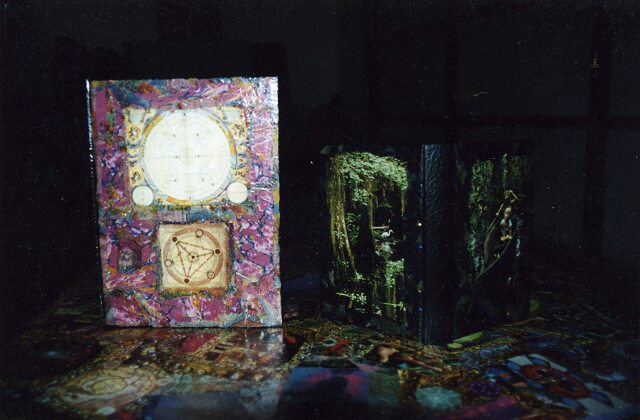
Journal books I decoupaged on a table I decoupaged Image and Glossary copyright Jonathan Zap, 20111
Alchemical Tautness — A state of metamorphic tension. “The eminent anthropologist A.L. Kroeber said that the ideal condition for any person or society is ‘the highest state of tension that the organism can bear creatively.’” —Duane Elgin, in Awakening Earth
” . .. .he had a high degree of “Alchemical Tautness,” a quality arising from an ongoing struggle between opposing forces in a psyche, a potently creative tension for a personality strong enough to make use of it.
—Parallel Journeys
Androgyny, Androgynous, Androgyne Androgyny refers to the integration of archetypal Masculine and Feminine qualities within a single individual. It is the sacred inner marriage or union of opposites, of yin and yang also known as the hieros gamos. Androgyny is an intrapsychic orientation and not necessarily related to physical appearance, gender preference and other attributes with which it is often confused. An androgynous person could look distinctly male or female, while an androgynous-looking person may not be androgynous. Similarly, bisexuality, an interpersonal orientation, is not necessarily a sign of androgyny. The androgyne represents a conscious fusion of archetypal masculine and feminine qualities, while the “hermaphrodite,” as Singer adapts the term, is a person where masculine and feminine are merely confused. Many people who are costumed in an androgynous way are actually hermaphrodites. In The Gnostic Gospel According to Thomas, Jesus defines androgynous wholeness: .”Jesus said to them: When you make the two one, and when you make the inner as the outer and the outer as the inner and the above as the below, and when you make the male and the female into as single one, so that the male will not be male and the female (not) be female…then shall you enter (the Kingdom).” See: Casting Precious into the Cracks of Doom—Androgyny, Alchemy, Evolution and the One Ring for much more on androgyny.
Archetype (from Crossing the Event Horizon—Human Metamorphosis and the Singularity Archetype): Jung and his colleagues have provided us with definitive evidence of a collective unconscious. From this collective layer of the unconscious emerge the great, primordial images Jung referred to as the “archetypes.” Archetypes are “innate universal psychic dispositions that form the substrate from which the basic themes of human life emerge.” Across cultures and periods we find endless variations of these archetypes, such as the Self, Persona, Shadow, Hero, Great Mother, Trickster, Devil, etc. The archetypes may manifest in anyone but often show up most vividly in the fertile psyches of artists, poets, mystics, writers, shamans and prophets. Through such individuals the archetypes become myths and diffuse throughout a culture.
Edward Edinger, a Jungian analyst who wrote eloquently about the nature of archetypes, points out that although we can study archetypes as patterns, they are also living, dynamic agencies. Similarly, we could take a smear of human blood, dry it out on a glass slide, stain it, and illuminate it on the stage of a powerful binocular microscope where we could observe the structure of the erythrocytes and leukocytes. But while we’re looking at all the intriguing structures frozen in time on the glass slide, we need to also have a stereoscopic vision in which we see not only the slide but the inner reality of our bodies where blood exists as trillions of living cells pulsing through our veins and arteries. Archetypes are not merely things that we observe, they are living agencies as active, pulsing and alive within our psyches as the blood that is, pulsing and alive, coursing within our bodies. Edinger reminds us that the archetype, “is a living organism, a psychic organism that inhabits the collective psyche. And the fact that an archetype is both a pattern and an agency means that any encounter with an archetype will have these two aspects. “As a pattern, we can encounter an archetypal reality and speak about it as an object—an object of our knowledge and understanding. But as a dynamic living agency it appears to us as subject, as an entity like ourselves with intentionality and some semblance of consciousness.” Jung, in Answer to Job, describes the archetype as follows: “They are spontaneous phenomena which are not subject to our will, and we are therefore justified in ascribing to them a certain autonomy. They are regarded not only as objects but as subjects with laws of their own. [. . .] If that is considered, we are compelled to treat them as subjects; in other words, we have to admit that they possess spontaneity and purposiveness, or a kind of consciousness and free will.”
Babylon Matrix is used to refer to the default reality, the waking time of human incarnation especially as seen in its darker aspect as the timeline of history and toxic patriarchy. When James Joyce as Stephen Dedalus says, “History is the nightmare from which I am trying to awaken.” he is referring to the same skull-shadowed zone I call the Babylon Matrix.
Divine Anxiety From Parallel Journeys:
…he radiated what I call “Divine Anxiety.” It’s the kind of look you see in the eyes of Elijah Wood as Frodo when he’s struggling with being a ringbearer. It was not merely the anxiety of personal neurosis, but the haunted quality of someone struggling with an uncanny fate.
It is anxiety that is the result of a will to consciousness as it struggles with a difficult social matrix, mechanical resistance, and an inner tension of opposites. Divine anxiety is a byproduct of “Alchemical Tautness.”
Dynamic Paradoxicalism —- a meta-philosophy created by Jonathan Zap that recognizes that most important areas of truth exist as a paradox, where seemingly contradictory elements have a dynamic level of validity based on context specific circumstances. Although a greater conception that synthesizes the disparate elements of a paradox into a grand unit is an awesome addition to the conceptual toolbox, it is not always the most useful tool in the box. Dynamic paradoxicalism recommends an ability to slide between the poles of a paradox, in some circumstances favoring the point of view of one side of the paradox, in other cases the other pole, and in still other cases favoring the unified view. see http://www.zaporacle.com/dynamic-paradoxicalism-the-anti-ism-ism/
Enantiadromia (en-ANT-ee-a-DROH-mee-a). Jung used the term frequently, but it originates with Heracleitus (b. 540 BC) who seems to be one of the earliest dynamic paradoxicalists. According to Encyclopaedia Britannica, A significant manifestation of the logos, Heracleitus claimed, is the underlying connection between opposites. For example, health and disease define each other. Good and evil, hot and cold, and other opposites are similarly related. In addition, he noted that a single substance may be perceived in varied ways—seawater is both harmful (for men) and beneficial (for fishes). His understanding of the relation of opposites to each other enabled him to overcome the chaotic and divergent nature of the world, and he asserted that the world exists as a coherent system in which a change in one direction is ultimately balanced by a corresponding change in another. Between all things there is a hidden connection, so that those that are apparently “tending apart” are actually “being brought together.” “Heracleitus.” from Encyclopædia Britannica 2007 Deluxe Edition.
Homo gestalt
In Theodore Sturgeon’s 1953 science-fiction novel, More Than Human, a group of mutants, who each have distinctly different strengths and weaknesses, form a collective consciousness while retaining some individuality and become, in many ways, a single entity where each mutant serves in a specialized role, as if they were organs of a single body. Sturgeon coined the term “Homo gestalt” to describe this new entity. Similarly, more recent abduction testimony has emphasized the “Greys” as having a hive-like collectivity, and this is experienced as another threatening aspect of their alien otherness.
There are a number of possible reasons for this collective consciousness motif appearing in so many permutations of this archetype. One is that it may be a fairly literal indicator of evolutionary change. If the ego ceases to dominate the human psyche, then perhaps the boundaries that it creates around the individual will dissipate and we will become more collectively aware. The shells of the oysters dissolve and the pearls lie together.
The Homo gestalt aspect of the Singularity Archetype reflects an evolutionary possibility. Encapsulated psyches become telepathically connected, but without a loss of individuality. For example, in the world of Dune, there is a sisterhood of highly conscious warriors known as the “Bene Gesserit.” To become a Bene Gesserit Reverend Mother, one must survive a perilous rite called “The Water of Life.” In this initiatory rite one imbibes a potent psychotropic, mutagenic poison. If the initiate survives and becomes a Reverend Mother, she will retain her individuality, but will also be aware of the memories and all the psyches of all other Reverend Mothers, living or dead, who have similarly survived this rite. The Reverend Mothers don’t need cables or funny tails to be part of this network.
Interdimensional Traveler As explained in A Guide to the Perplexed Interdimensional Traveler, all human beings are interdimensional travelers:
How can you tell if you’re an Interdimensional Traveler? Look at yourself in a mirror—if you are in some sort of human form and the looking glass returns any sort of reflection, then, for reasons that will soon be explained, you are an Interdimensional Traveler. If the mirror does not return your reflection, then you are definitely an Interdimensional Traveler and probably know it. You have always been an Interdimensional Traveler. Before you were born into this strange and still patriarchal realm you were in another realm, a womb, a metamorphic wet-world in which you floated and existed like an uncollapsed waveform of possibilities. And where were you before the womb realm? Well-documented case histories and evidence suggest that a human being is a multiple-incarnate entity. I say “suggest” because other paranormal explanations are possible besides reincarnation. But it is reasonable to take seriously what a large number of people in various periods and cultures have concluded: just as we usually pass through many phases within a single incarnation, most of us seem to pass through many incarnations, and each of these incarnations can be viewed as its own dimension.
If the idea of multiple incarnations seems too fantastical and unproven for you at this point, then you can reality test your status as an inter-dimensional traveler with a very simple experiment: (For safety reasons the following experiment should be performed from home and not while driving a car or operating any other heavy machinery.) This evening when you start to feel tired and your day is winding down, turn the lights off in your room and lie down on your bed. Once you have completed these steps, go to sleep. After you have drifted into sleep for a while you will most likely find yourself in another dimension called the dreamtime. This dimension has a different physics than that of the waking time—-gravity is not so relentless and you can fly if you wish; time drops its linearity, that dread ticking of the clock, and becomes far more flexible and bendable; objects and bodies are not so fixed as the waking time, but are revealed to be shape-shifters and changelings, and manifestation requires no heavy industry for it is only a thoughtform away. Remembered or not, the daily alternating rhythm of waking and dreaming is as fundamental to mammalian incarnation as the the systole and diastole of your heartbeat.
Interdimensional traveling is actually more fundamental to your existence than your heartbeat, because one day your heart will stop beating, but you’ll still be an Interdimensional Traveler. (Note: Even if you don’t believe in reincarnation, from the point of view of eternity once you have ever been an Interdimensional Traveler, then you always are—- in eternity every thing that has ever existed always exists. In other words, your lifetime doesn’t have to persist throughout eternity to be part of eternity. So just the fact that in this incarnation you alternated between waking and dreaming dimensions means that you are always an Interdimensional Traveler.) But maybe you’re the sort that doesn’t remember your dreams, and although you realize that REM sleep is a neurological necessity, the dreamtime does not seem particularly real to you. If that’s the case, try a different experiment. Have a conversation with someone to whom you are connected by inner ties. Look into that person’s eyes. Can you sense that this other person is like his or her own dimension, an ever-shifting nexus of strange elements with its own timeline and unique inner content generated by a multi-layered psyche? A deep relationship is an impingement and overlapping of dimensions. Behind the eyes of the other you can glimpse an individualized culture, an inner climate and weather system of shifting moods, evanescent feelings and glittering thoughtforms. It’s hard to get through even a single day and night without interdimensional travel. Interdimensional traveling is part of your birthright, and whether you’d like to or not you are going to travel interdimensionally.
Oh, and let’s not forget that even if we were born too soon to reach the event horizon envisioned by the Singularity Archetype, we are hurtling toward a guaranteed interdimensional portal popularly known as “death,” which shimmers before us in the night of time. We might not be sure what’s on the other side of that event horizon, but it is obviously still another dimension. And so the most concise and accurate description of our core identity is that we are Interdimensional Travelers. This is what we are, whether we want to be or not, whether we swallow red pills or blue, and our main choice is if we are to be savvy Interdimensional Travelers or foolish ones. But no matter how savvy an Interdimensional Traveler you may already be, the journey across dimensions can still be a rather perplexing process.
Logos Beheld I adapted this phrase from comments Terence Mckenna made in his book, The Archaic Revival, about Philo Judaeus, an Alexandrian Jewish philosopher who was a contemporary of Christ:
“I always think of Philo Judaeus writing on the Logos. He posed to himself the question: ‘What would be a more perfect logos?’ and then he answered, saying it would be a Logos that is not heard but beheld. And he imagined a communication where the ears would not be the primary receptors but the eyes would be. A language where meaning was not constructed through a dictionary of spoken words, but where three-dimensional objects were actually generated with a kind of hyperlanguage so that there was perfect understanding between people. This may sound bizarre in ordinary reality, but these forms of synesthesia and synesthesic glossolalia are commonplace in psychedelic states” (162). Listen to a free audio presentation Logos Beheld or see the Logos Beheld section of my book Crossing the Event Horizon—Human Metamorphosis and the Singularity Archetype when available.
Metaphysical. This is not an annoying word I don’t use, but I would like to give a better definition than the ones that can be found in dictionaries. Metaphysical–a fancy-sounding, meaningless word New Age people can put in front of what they’re doing to create a false impression of profundity.
Mislocation of the Godhead I am using the term “Godhead,” which has various dictionary definitions, to mean: that which is divine and the source of divine emanation. Like all definitions this is imprecise and circular, but hopefully the meaning will emerge. The healthy, androgynous way to locate the Godhead is to see it located everywhere. This accords with the Sanskrit definition of God as, “A circle whose center is everywhere and circumference is nowhere.” In a modern version of the Eastern salutation “Namaste,” one is acknowledging the divinity of the other person. But it is not just in them, but in oneself and in everyone and everything. In other words, everything that we experience is part of the “mind of God.” Mislocation of the Godhead is when you have a Precious that glows brighter than anything else in the phenomenal world. For example, a Christian who believes God is shining up in the heavens while humanity is just a bunch of unworthy,wretched sinners. Similarly an infatuated person mislocates the Godhead disproportionately in the beloved and puts them on a pedestal and idealizes them.
Mutant A Mutant is not a genetic anomaly but a person who is undergoing evolutionary metamorphosis. Mutants are empowered by a core of self-actualization (what Jung called “individuation.”) A Mutant is a self-aware interdimensional traveler who is taking charge of his or her own interdimensional journey into the unknown. A Mutant is someone who has a deep commitment to consciousness, which means a willingness to peel back the many layers of acquired conditioning and to help along the project of consciousness in general. This means that the deep commitment extends to others who are also committed to consciousness. A Mutant with a capital “M” is one who serves transpersonal aims, and is not merely looking to enhance his own status. It is this sort of Mutant that Jung is referring to when he says, “Every advance in culture is, psychologically, an extension of consciousness, a coming to consciousness that can take place only through discrimination. Therefore an advance always begins with individuation, that is to say with the individual, conscious of his isolation, cutting a new path through hitherto untrodden territory. To do this he must first return to the fundamental facts of his own being, irrespective of all authority and tradition, and allow himself to become conscious of his distinctiveness. If he succeeds in giving collective validity to his widened consciousness, he creates a tension of opposites that provides the stimulation which culture needs for its further progress.” Mutants are the intended users of zaporacle.com.
Psychopath, Psychopathy, Situational Psychopathy and Sociopath: A psychopath is a person without conscience, empathy or even an ability to experience the range of human emotions. Their ability to feel is confined to a narrow range of primitive proto-emotions such as anger, frustration and rage. Psychopaths will tend to be pathological liars and expert manipulators victimizing family, friends and strangers. Often they are charming, charismatic, popular and admired, if not loved, by members of both genders. They are not mentally ill, not delusional, and may often be more coldly rational and intelligent than non-psychopaths. They are likely to be promiscuous and to abandon partners without remorse. They are prone to entitlement, grandiosity and find nothing wrong with themselves. They typically blame others for the consequences of their actions and engage in moral reasoning that is glib and superficial if not absurd. They usually have little fear of consequences and enjoy risk as they need novelty, stimulation and living on the edge to compensate for their emotional vacuity. Non-psychopaths who act like psychopaths are frequently called sociopaths. Sociopath is a term that many researchers dislike since it is often incorrectly used as a synonym for psychopath. A sociopath is someone who acts in an anti-social way, who commits transgressions without taking moral responsibility. Most psychopaths are sociopaths, but many sociopaths are not psychopaths. If that’s not confusing enough, the DSM created a third unilluminating term, antisocial personality disorder or ASPD, which they define as ” . . . a pervasive pattern of disregard for, and violation of, the rights of others that begins in childhood or early adolescence and continues into adulthood.” Some say that ASPD is just psychobabble for “criminal.” I have created the terms “situational psychopathy” and “situational psychopath” because I believe these clarify the key difference. Some people, who are not psychopaths, will act like psychopaths in some situations and there are some situations that seem to bring out psychopathic behaviors in non-psychopaths. The stress of combat is the classic situation of situational pscyhopathy. See: Foxes and Reptiles—Psychopathy and the Financial Meltdown
Pushing the Envelope Boundary expansion into a zone of novelty previously unexplored by the species or an individual.
Singularity Archetype
The Singularity Archetype is a primordial image of human evolutionary metamorphosis which emerges from the collective unconscious. The Singularity Archetype builds on archetypes of death and rebirth and adds information about the evolutionary potential of both species and individual. A Composite Picture of how the Archetype Presents A rupture of plane event occurs, usually threatening the survival of the individual and/or species. The event is a shock that disrupts the equilibrium of body/physical world and also individual/collective psyche. It is an ontological shock that will be viewed as the worst thing possible by individual/ collective ego. There is another rupture of plane which may actually be the same rupture as above but seen from a cosmic rather than a personal view. The shock is revealed to be a transcendent evolutionary event. The revelation of the transcendent aspect will often involve spiral motifs and unusual eyes and lights. Consciousness and communication metamorphose and with them core aspects—ego, individuality, connection to linear time, corporeality, gender identification, social order, etc.—- fundamentally transform. There is a vision or actualization of release from some or all limits of corporeal incarnation and the emergence of “glorified bodies”(often androgynous and shape-shifting) which have enhanced powers and various degrees of etherialization. More visual and telepathic modes of consciousness and communication emerge and this is part of a transformation of individuality into “Homo gestalt”—a new species where individual psyches are networked telepathically. The SA my occur as a dream, vision or fantasy about eschaton—an end point of the species. The SA may also be experienced and even actualized to various degrees by an individual through transcendent and/or anomalous experiences such as NDEs, UFO/abduction/close encounter experiences, kundalini and psychotropic episodes. As with encounters with all archetypes, individuals and groups will attach idiosyncratic material to it such as particular end dates and scenarios. But the SA cannot be located in linear time and is not reducible to a premonition of particular outcomes or predetermined futures. It could, however, be viewed as a “strange attractor,” a not fully formed pattern associated with the future that is affecting individual and species in past and present. Another way of defining the SA (in its collective form) is as a resonance, flowing backward through time, of an approaching Singularity at the end of human history. Some with a scientific background my object to this use of “singularity.” For them, singularity has a specific mathematical meaning: “In mathematics, and in particular singularity theory an Ak, where k ≥ 0 is an integer, describes a level of degeneracy of a function. The notation was introduced by V. I. Arnold.” But other definitions include:the quality of being one of a kind; “that singularity distinguished him from all his companions”
- strangeness by virtue of being remarkable or unusual
- wordnetweb.princeton.edu/perl/webwn
- Technological singularity refers to the hypothesis that technological progress will become extremely fast, and so make the future unpredictable and qualitatively different from today.
- en.wikipedia.org/wiki/The_singularit For example, here is the blurb from the webpage for the movie version of Ray Kurzweil’s book The Singularity is Near: The Singularity is Near – The Movie Home “The Onset of the 21st Century will be an era in which the very nature of what it means to be human will be both enriched and challenged as our species breaks the shackles of its genetic legacy and achieves inconceivable heights of intelligence, material progress, and longevity. While the social and philosophical ramifications of these changes will be profound, and the threats they pose considerable, celebrated futurist Ray Kurzweil presents a view of the coming age that is both a dramatic culmination of centuries of technological ingenuity and a genuinely inspiring vision of our ultimate destiny.”
- Kurzweil, however brilliant, is a materialist and his view of the singularity is flattened and distorted by that perspective.
- Similarly “event horizon” which was coined specifically in relation to black hole physics is commonly used metaphorically as in a recent article on education:
“Is this what is happening to education today? Did the current mandates create an event horizon? Is every dollar that is earmarked for education disappearing into the “is it on the test?” event horizon?”
Tragic Magic I frequently use this phrase which was invented by my friend Rob Brezsny. Tragic Magic are the forces, internal or external, that cause people to fall through the wrong end of the telescope into paths of diminishment. Examples of tragic magic forces are acquired conditioning such as that generated by advertising and peer pressure, lethargy, base addictions, repeated patterns of relationship pathology, and poor nourishment of both the physical, cultural, intrapsychic and interpersonal varieties.




These concepts are so relevant! It’s like intersectional metaphysics, in a way!